Also Available On






BreastFeeding Month with Sabrina
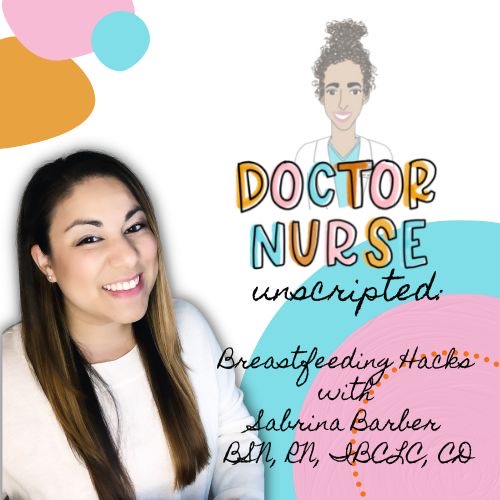
Sandra Pagenta: [00:00:00] Hi, Dr. Nurse podcast, unscripted guys. Thanks for tuning in today. Today we have Sabrina. She is on the podcast to talk to us today about breastfeeding motherhood and nursing. Cuz I believe that so many things intersect with our nursing careers and that somebody needs to create discussion around them. So one of the things that I reached out to Sabrina about was because.
I found that breastfeeding was challenging in the beginning, becoming a new mom and learning how to breastfeed, cuz it is a skill that used to be passed down in the huts. When we would all sit around the fire and we would go like teach each other how to breastfeed. But now that we don’t have huts and nobody sits around the fire doing that kind of stuff, moms are very isolated.
So I was like, oh Sabrina, would you come on and help me? Talk educatedly about breastfeeding hacks for new moms that are headed back to work nursing moms, moms that are gonna be busy on the floor or busy in their practice. And so [00:01:00] welcome Sabrina. Thank you for coming on.
Sabrina Barber: Thank you so much for having me.
Thank you. It’s such an honor to be here and amongst our peers, amongst the community and sharing what we do as mom life.
Sandra Pagenta: Totally. And I love that our stories are the same, cuz we both, we both breastfed babies for, I want in one month short of three years and you’re still breastfeeding. You’re is it almost three year old?
Sabrina Barber: Yes, she turns three next month. Yep.
Sandra Pagenta: So, yes, we’re like mama breastfeed and mamas. So would you, yeah, just maybe run through some of the benefits of breastfeeding, just as a refresher for our nurse and nurse practitioner moms.
Sabrina Barber: Absolutely. So the benefits of breastfeeding stem far beyond that initial.
Newborn stage. So we know that initially colostrum is incredible and it has so many antibodies called the main one is S IGA and it lines the [00:02:00] intestinal tract of the baby to prevent infections. And it’s almost like. People compare it to like their first vaccine. So as soon as baby latches to the breast or the parent is able to express any colostrum initially that, that those immune properties just kind of seal baby’s gut and prepare them for success.
Sandra Pagenta: Which is really, really cool. I didn’t know that, that’s so cool.
Sabrina Barber: Can you provide nothing else? Get that first feed in and and you’ll be golden, but as, as baby grows parents milk changes to meet babies’ needs. So the immune properties change the, the calorie content, the proteins, the carbohydrates meet baby, where they are for as long as the parent chooses to provide that breast.
So it could be all the way up until toddlerhood, which is why we’re still doing it. I will say we all had the Ronna in our household [00:03:00] this year and my daughter was the only one that did not get it.
Sandra Pagenta: Wow. Wow. Here’s my eyes. Cause that was again, I breastfed during coronavirus as well. And that was my hope that, I would be able to prevent and protect him from the, you know, C.
And we actually had the same thing, but I was kind of in the, in phases. Cause he was only breastfeeding in the morning and then the afternoon. So he didn’t get a ton of breast milk, but he was over COVID within 24 hours. And so yes, he tested positive. He. Lots of snuggles, lots of little Leche lose was what we call it.
And then he was fine and he was okay. So I, I did get that in cuz that was what I was holding out for, like, for us to be able to battle that as a family. And so I totally see you, like, I love that story, so, and it’s
Sabrina Barber: incredible because as, as we become. Sick. It’s, it’s important to continue either nursing or pumping and providing your milk [00:04:00] because your body builds the antibodies for your baby, so that your baby is starting to get those antibodies and that protection before they even start to show symptoms, which is why babies tend to get.
Faster a lot better, a lot faster than their parents.
Sandra Pagenta: interesting. I mean, he was fine. The next day he was ripping a roar and I was like, kid, I’m still, I’m still fighting Theona man. And he was like, I’m done. Like, I’m good. I was like, oh my God. So this is the only problem is that you gotta find the energy to keep up with that.
Sabrina Barber: Exactly. Everything’s exhaust. Yes. Oh my gosh. And then on the flip side, it’s not really a one way relationship. It’s not a one, a one sided gets everything, baby. Doesn’t get it all. Benefits to the parent too, as far as like hormone regulation and studies show that the longer you either breastfeed or pump.
So as long as you’re moving that milk, it correlates with decreased chances [00:05:00] of ovarian cancer, breast cancer decreased chances of developing diabetes, heart disease. So it’s definitely a mutually. Beneficial relationship if things are going well, you know, we gotta take into account parents’ mental health, for sure.
Sandra Pagenta: Yes. Yes. All well said. And again, . That’s why I feel moms need so much support because it is such a vital process to us being healthy as people. And it’s such a big, like when you look at the cost and the time that it takes to breastfeed, cuz we know that I’ve found it very meditative now to breastfeed, but if you don’t have that time, the work to keep your milk up the work to sit and breastfeed and to do that, connecting with your.
Takes time. And for moms that are busy and overwhelmed and, and working a lot, it’s hard to keep that up. And so could you kind of expound upon what are the current recommendations? What are like, you know, [00:06:00] again, I know some things have recently changed, but what are some of the current recommendations that they have for breastfeeding moms?
That’s kind of like a minimum and then where’s the maximum kind of, what should we be kind of shooting.
Sabrina Barber: So finally the American academy of pediatrics has gotten on the same boat as the world health organization. Yes. And so their recommendations is to breastfeed, exclusively provide exclusive breast milk for six months.
Until you add in solids and then to two years or beyond, as long as it’s mutually beneficial for the parent and the baby. And this is something that we as lactation consultants have known forever. The science backs it up. But what I think is so challenging for families is that our system as a country does not support that.
So, you know, it’s hard enough to get parents to breastfeed past two weeks if they’re going back to work because they don’t have paid parental leave, [00:07:00] you know, the daycare systems, my goodness. There’s just so many barriers. And so we already have a system here that’s set up to not. Breastfeeding chest feeding families.
And then we’re like, oh, by the way, now we’re telling you to do it for longer. So now it’s super impossible. and so when gosh, when those recommendations changed, we as lactation consultants were kinda had mixed feelings about it. You thought we would like throw this whole parade. Yay, bro. This fast, but really we.
The struggles that these families face, if they don’t have that support system from their like immediate little village, right? The people inside their home, their caregivers, those who are gonna be taking care of. Baby. When they go back to work, then we can’t even expect the system to do what it needs to do to support these families.
So we got work to do. We got work to do, ah,
Sandra Pagenta: Sabrina. I love what you just said. And last night, when I was looking up to get prepared for this, I wanted to [00:08:00] see the percentage of moms that breastfeed at. Over a year, the data’s not even available for that. They don’t know how many moms are breastfeeding over two years, that one and a half year mark, they don’t even have research to show that most, it said something about moms that were breastfeeding.
And again, I just read it on some websites. This is very loose knowledge. And if I’m wrong, please correct me. Cuz I, again, like I said, you’re the expert. So like half of moms are breastfeeding still at six months. And then I think it was like, it drops to like less than 30. By a year mm-hmm so like, it’s just, am I right?
Those, those numbers. Right? Cause I just saw that and I was like, that is not good. Like, those are not good numbers. I mean, most moms have stopped by half, six months and then the majority of mothers have stopped by the year mark. And so again, here are, here are these big governing bodies that are saying, Hey, you need to get two years in.
And you’re right. These barriers are just preventing moms from, from breastfeeding. And I actually had a friend of mine tell me that it would cost her more. Per [00:09:00] hour to miss seeing a patient than it would to buy formula. And so she was a provider at a healthcare facility, and so she did the math and she was like, it’s actually cheaper for me to just buy formula than to pump for the baby.
And so she just made the switch cause she’s like, I need the money. And so it was just one of those, like, and again, I just remember that, that conversation just bothering me, like, why is this our system? Like, I don’t understand this. This should not be like, that’s an invaluable thing right there. Like that substance has.
It’s what, what do we call it? Liquid gold, right? Because of liquid gold. Mm-hmm so she’s like liquid gold, a couple I’m like it’s liquid gold.
Sabrina Barber: It’s tough. And especially like, if we, if we’re segueing over to talking about employment and meeting those breastfeeding pumping goals, when you’re at work. It’s it’s important to have the conversation with employers and say, Hey, if you provide this space for your [00:10:00] employee to pump and provide milk studies, show that it’s gonna make it one so that your employee is more loyal to you because wow, this person is supporting my feeding choices.
They care about me and my family. And two studies show that the longer you breastfeed less chances of illness for the parent and less chances of illness for the baby, less MIS work, higher productivity, come on, it’s a win-win situation. But again, it’s changing that, that, that system as a whole, and the idea of surrounding. Feeding your baby.
Sandra Pagenta: They just don’t get it. I, I love that. And I wanna know what you think are some of the things, again, you’ve segue perfectly into where I would like to move the conversation is here at the doctor nurse podcast. I’m all about increasing someone’s self-efficacy I don’t wanna make victims.
I don’t want people to think that the system is broken and they can’t accomplish their goals. So how can we today talk about some things that working moms can do? If they want to breastfeed [00:11:00] for longer than that six month period, how do we capture more moms at that six month year? And now two year mark of breastfeeding?
What are some ideas that you have?
Sabrina Barber: Yeah. So this is, this is my specialty because as a, as a pumping mama, myself and being a nurse on the floor, being a nurse that owns their own business I was in the hospital system for a while, so I knew the importa. Of kind of taking this taking this during pregnancy starting there when you become pregnant, that’s when you decide how I’m gonna feed my baby.
I mean, all of your prenatal visits, are you gonna do bottle? Which I can’t stand that question. But that, that conversation begins when you’re pregnant. And so when you do choose to speak to your employer and you start talking about maternity leave, Go ahead and talk to ’em about, this is how I plan to feed my baby.
This is what I am allowed to have by law, because there are federal laws governing [00:12:00] the, the fair labor act about break time for breastfeeding for mothers, or I should say parents and. The space that needs to be provided the amount of time that needs to be provided. So there’s law, you can slap that law right there
Sandra Pagenta: on, on your boss’s desk
Sabrina Barber: Mm-hmm mm-hmm so ha saying, okay, this is what I need. Now, a lot of times your company or your health insurance will provide you with breast pumps. So getting what you need and your materials gathered ahead of time before baby comes is gonna be really helpful. So things like breast pumps, storage bags coolers, things like that.
So that way you’re preparing before baby arrives. And just getting your, your support system ready, knowing, okay. If this is the daycare that I’m choosing, are they supportive of breastfeeding parents? Will they allow me to come and nurse my baby on, on my lunch break? Or how do they feel [00:13:00] abouting breast milk or things like that because some, some facilities are more equipped to.
Handle those sort of things than others. So kind of being choosy about that, I would recommend that as well and talking to your family as well. So getting all those conversations started and then meeting with a lactation consultant. That can help you get that plan going ahead of time, because if you’re going to work, pumping is usually going to be a part of your regimen.
So figuring out how you can kind of get that ball rolling and, and ease into it is gonna be huge.
Sandra Pagenta: Ah, so many nuggets, so many good things in there. I love all the stuff you’re saying. I had two thoughts, I wanted to know why you didn’t like the question breast versus bottle fed. Why don’t you like that question? I was just intrigued by like your response to that.
Sabrina Barber: Well, because I feel like it puts a It puts feeding families in a box because someone’s breastfeeding journey can look many [00:14:00] different ways.
So they don’t say, are you planning on providing breast milk or formula because you could pump and bottle feed, breast milk. It makes families feel like it has to be an all or nothing thing. And makes families think that if they have to combo feed, like supplement with formula. It’s failing it’s con or that they’re failing.
Yes. Yeah. So I feel like just giving them those two categories, doesn’t open up the conversation enough for how families choose to feed their families.
Sandra Pagenta: Oh, that I love that. I wanted to give a couple things that I found, were critical for For my success and being able to go as long as I did.
So I had a, an unwavering boldness. That was one thing that I discovered as I was thinking about breastfeeding was my, why was really, really big. And so everyone’s gotta do their why for themselves. And so if you’re doing a why, because you think it’s a, you need to do, or you have to do, or you are feel expected to do.
I think it puts a different spin on it [00:15:00] more so than if you see again, going over. Benefits that you talked about earlier in the podcast episode where you, you know what you’re giving your child, it’s something that you, it’s the best thing that you could physically give if your body can produce it. And if you’re able to extract it, there’s so many factors along the way that if you’re able to do this, if you’re why is really big, then you can keep it going.
Right. And so that’s the one thing that. Kept focusing in on when I was like, oh my God, I’m so tired. It’s two in the one, you know, I just kept focused in on that. Why, you know, like the why is what I just, I just, you just fixated my, my mind on the other part that I would like to give a shout out is to my husband because that man.
He was a beast. I did. All I did was pump. Okay. That’s it. I mean, which again is not a small thing, but that’s all I did. I had a little tiny container. And so when I would come from, from work, I would dump [00:16:00] my pieces from my pump in that container.
That was a sign of my husband that they were dirty. I could not have done this without him, period. It would’ve burned me out to the max, but I, this is our system. It was just a little Ziploc bags inside the Ziploc bags, with the pieces in the pop parts that I had gotten dirty. I bought extra and I packed individual pump pieces. Yeah. For each pumping session. I would just pump and then I would put them back in the bag, dirty. I would store the milk and then I would put them back in the bag, dirty. I would close the bag off and then I would have my next bag for the next session. So then my next section, I would have a whole nother set of clean. Supply. So I didn’t have to run to the thing and clean them at work and all this stuff I knew I would drop stuff. When I got home, I took my two little sets for my two pumping sessions at work. And then I put them in that little bin, he would get off work and he would come home and clean my pump parts. He would dip them in the hot water and then he would sterilize them. He would then wait till the sterilization was done [00:17:00] and then he would pack them in brand new zip lock bags, clean
and ready with all the parts inside. So the next day I would get my lunch box and everything would be there. . He’s the pump fairy. He’s the pop fair. He loved, I think he had an affair with that sterilizer because he loved it so much.
That system, right? Yeah. Getting those systems in place was so tantamount to us being successful for as long as we were, because I could count on him to do his part. And then I got to do my part and then our child got to benefit from our mutual. Collaboration. Does that make sense?
Sabrina Barber: Absolutely. Feeding is a family affair, no matter, no matter what that looks like, whether it’s directly at the breast, whether it’s pumping.
I actually have a course called pumping back to work and it is. Everything that we’re talking about here, about the tips and the tricks, what to have, what to pack in your pumping bag, how much milk you should leave for your baby, how to build a milk stash, how much [00:18:00] is actually normal milk stash versus social media, milk STEs.
All of those things are in my online course, pumping back to work on my website for families that are. Ready to make that transition. And I even do pumping schedules for 12 hour shifts, eight hour shifts, PRN night shifts, educators, truckers, like all the things they’re all there. So that way families have what they need and they can prepare to go
Sandra Pagenta: back to work.
A couple things, one, I will link your stuff in the show notes so people can find you and they can find your courses because again, a schedule and having those systems in place is gonna keep you so much more. More productive and able to keep going because you guys just get into this routine.
And then you’ve got the, I know what I’m doing. I know when I’ve got enough and by, and by collecting when I was on maternity leave extra, I was able. To not have to feel stressed out when I was at work, because I knew I had that stash that [00:19:00] we could dip into while I was working. And so that, that kept us successful as well.
So I love that you’ve got a course out there that MAs can use because I didn’t have a course. I just POed up and did it all by myself and learned all this stuff. And I was. Hearing all my friends that were struggling are just not keeping up and they couldn’t, it was too much. And so, yeah, I think it’s great that you have something out there for moms to, to have help.
Cause it’s a tough, it’s a
Sabrina Barber: tough thing. Think of how much less stressful would’ve been going into it, knowing what you were supposed to do. Rather than like figuring out what your, what your little thing is. I mean, of course it is. You always have to find your own groove and every family is different, all the dynamics, but just kind of relieving that stress, knowing that somebody’s gonna tell me what to do is why I, it, cause I had to figure it out.
To and being a lactation consultant did not give me any type of edge in this game
Sandra Pagenta: whatsoever. Interesting. yeah, no, that makes a lot of sense. And again, I didn’t even know milk links out of both sides. [00:20:00] I thought like, it was like a, a, well, like coordinated and thing was like only one boob at the time there I got milk coming out everywhere.
So it’s like, and that’s what somebody told me to capture that milk. I was like, what? They’re like put a ha. On one side and you breastfeed on the other. And I was able to collect a bunch of milk that would’ve been wasted in the shirt or wasted in the bra. So there’s so many hacks and if you’ve got ’em on your course, it’s gonna save every mom a lot of time and keep you going to that two year mark now that they have put on moms with no additional help.
So for the last part, I wanted to talk about two more things before we finish up and I wanted to know combating unsupported people. People that are side eyeing, you and practitioners that are , you’re doing what, isn’t it time for you to stop?
Like the dentist and like different people that say things to you that you’re like, You’re questioning my resolve on this and my family members that made make comments and things like that. What are some tips for moms to just kind of like give ’em a little fire under their [00:21:00] belly to shoot back. I mean, some women are good and they’ll just pull their boob out and like, you can deal with it.
But then some women are kind of like, I was getting a lot of slack, so I just kind of stopped. Cause I thought maybe I was weird. What do you say to moms like that?
Sabrina Barber: I would say going back to your, why going back to why you’re doing what you’re doing and knowing that there is no wrong way to feed your baby, unless you’re feeding them like arsenic all right.
So you are not, if, if you are like, my biggest thing is how you’re feeding your baby. Own it, if that means you’re exclusively breastfeeding own it. If that means you’re combo feeding, breastfeeding under you’re supplementing with a bottle because of whatever, because you have low supply because you have hormonal issues because you know anything, you had to have IVF, whatever, if you’re combo feeding.
It, and you don’t owe anyone an explanation of how you’re feeding your baby. So there are so [00:22:00] many moms that are, when, when we’re in a consult, they’re like, Ugh, I feel like I have to justify myself if I’m exclusively pumping, because of course, everybody wants to know how you and baby are doing after, after you deliver their first question is, are you breastfeeding or bottle feeding?
And some, some families are like, oh, well, how do I explain. I’m pumping, but I’m not breastfeeding. I, I just say we’re doing what works for us and it’s working. Great. Thanks for asking.
Sandra Pagenta: very good. That’s very good advice. Yeah.
Sabrina Barber: And so if that means you’re in the middle of the park and your baby’s hungry, if you’re comfortable enough.
Whip it out, I will say after certain age covers don’t work. So at some point you’re gonna figure it out five and six months old is not tolerate being covered
Sandra Pagenta: to just like we
Sabrina Barber: wouldn’t.
Sandra Pagenta: Yes. I saw this hilarious meme that somebody had gone up to this mom that was breastfeeding.
And they [00:23:00] said cover up when you’re feeding. And she put the, the cover over her head and left her tit out with the baby.
So she put the cover over head I thought that was so hilarious.
Sabrina Barber: The only way we’re gonna be able to meet this, you know, two year goal is if we, and it’s, it’s so cliche to say, but if we like normalize breastfeeding, if we normalize seeing a boob out in public, if we normalize, you know, breastfeeding. Your baby on the bus on the way to daycare, you know, black and brown mamas.
That is the hardest thing. So much stigma around that. Pop, pop it out, baby. Do what you gotta do on, on your way, on your way
Sandra Pagenta: to work. Yes, that is totally like, eh, there’s going to be so fired up as you say, just pop it out, just do it. And again, People are gonna judge you no matter what you do, but you have to live with yourself.
And if [00:24:00] you think that this is the best thing for your child, for whatever reason, inside your mama, heart, mama, gut, trust it and do the best that you can. And we wanna get you there. And then my last question is when do you know when it’s time to wean? Because I think for some moms it’s kind of hard. Like they just don’t know like, okay, do I stop now?
Like I’m at the year mark? Or like, okay, I’m gonna do two. So how do you know, like when it’s time?
Sabrina Barber: So there’s a lot of factors to consider. One, if things are.
Going well between you and your little one, and you are getting that mutual bonding. If you are feeling that mutual, positive relationship, then you can take it as far as you want to. Honestly. And usually in toddlerhood they will self wean when they understand what’s going on or they have better things to do.
that’s a nurse, my daughter right now. She’s like, she’s sometimes she’s just too busy. She just can’t be bothered.
Sandra Pagenta: So. That’s [00:25:00] substitute right,
Sabrina Barber: exactly. I’ll say though, that there are circumstances where if breastfeeding isn’t going, how you planned and you are trying, and it has impacted your mental health and seeking support.
Isn’t working, you have every right to wean as early as you want,
Sandra Pagenta: because it should amen. Ultimately
Sabrina Barber: breastfeeding shouldn’t affect. Bonding. There are some situations where there might be postpartum depression. There might be postpartum psychosis and issues that we don’t see that families feel like they have to wean abruptly.
So my advice to that would be get in contact with a lactation consultant so we can do it in a way that helps you find closure. In, you know, in your relationship and feel comfortable with your decision to wean earlier than that two years, that three months, whatever it is, and that we can do it in a safe way that supports your body and your baby, for sure.
Sandra Pagenta: [00:26:00] Oh, beautifully said Sabrina. That was , so therapeutic and the way that you just like close that up. You’re just like, we just want you to end it so well, so you it’s like, yes, that’s what I want. I wanna, yeah, that’s perfect. So it’s true.
Sabrina Barber: I, I will be in the grocery store right in the middle of Publix and someone will, I don’t know how it happens.
Someone always finds out I’m a lactation consultant. 40 50 year old women are like, oh man, I had such a hard time and I wish I could have done it longer, like caring this guilt for decades. And I’m like, man, if you only had somebody, oh,
Sandra Pagenta: it makes my wanna cry.
Sabrina Barber: Yeah. If you only had somebody just. Help you like type your little experience with like a little bow and like move on and, you know, make it so that you know, that it is not your fault.
It is not your fault. There’s a system that needs to support you better. And that’s what we’re here
Sandra Pagenta: for. Oh, my gosh. Well, Sabrina, I think that you would be an excellent resource for any new mom. That’s wanting to get [00:27:00] back or to start the game and to move and transition seamlessly into work. I think it would be just so incredible to have you on their team.
And thank you. Do you do like telehealth or you just, you just see patients in your clinic? Do
Sabrina Barber: entrepreneur? I do. I do telehealth worldwide through motherly love lactation. I’m on Instagram
Sandra Pagenta: at motherly love. I love you on Instagram lactation. I love you on Instagram. That’s what I found you. I was like, she’s cool.
Sabrina Barber: And then I also do in person visit and there’s. No situation. That’s too complicated for me to handle through telehealth. So if you need any assistance, I’m here for
Sandra Pagenta: you. Well, thank you so much for your time. Sabrina guys. Thank you for listening to today’s doctor nurse podcast, unscripted episode, breastfeeding moms at work and how to stay successful as long as you can.
And thanks for listening. Thanks for coming on. Thanks for having me. Alrighty. So that’s it. We hit stop and.
Podcast Description
This week on the Doctor Nurse Unscripted Episode I wanted to share content on breastfeeding hacks for the working mom. Since August is National Breastfeeding Month, I couldn’t think of a better time to sit down and chat with a breastfeeding expert. I know that when I went back to work I was overwhelmed with not only becoming a new mom, but also learning how to feed my kid while I was working. I would have loved some guidance specifically tailored to a working nurse mom to help me stay successful in my journey. Remember, I do not just want to help you figure out your careers-but how to be successful in all the areas of life nurse moms juggle.
So I got to sit down and chat with Sabrina Barber. She is a registered Nurse and International Board Certified Lactation Consultant and Childbirth Doula serving families in the prenatal, postpartum, and pediatric realm for the last 10 years. She is the owner of Motherly Love Lactation Services, co-founder of Baby BLISS Feeding Collaborative of Central Florida, LLC. She is a mama of 2 with feeding difficulties, tongue ties, and severe food allergies. She opened her private practice to serve families in the way she needed support! She offer in-person consultations in Orlando, FL, breastfeeding/pumping online workshops for families, and virtual visits worldwide!
Sabrina’s Links: https://linktr.ee/MotherlyLoveLactation
Here a the link to special information about the month: https://www.usbreastfeeding.org/national-breastfeeding-month.html
Doctor Nurse Podcast Links:
Doctor Nurse Links: https://linktr.ee/DoctorNursePodcast
Wanna start a side hustle? Subscribe to the Doctor Nurse Podcast and I will show you how to start: https://view.flodesk.com/pages/625318...
Latest Episodes
Doctor Nurse podcast brings you weekly shows to help INSPIRE, EDUCATE AND EMPOWER nurses with true stories of initiative and impact.
Doctor Nurse podcast brings you weekly shows to help INSPIRE, EDUCATE AND EMPOWER nurses with true stories of initiative and impact.
Latest Episodes
Doctor Nurse podcast brings you weekly shows to help INSPIRE, EDUCATE AND EMPOWER nurses with true stories of initiative and impact.