Also Available On






Sandra Pagenta: Welcome Molly to the Doctor Nurse podcast. I’m so happy to have you on today.
Mollie: Oh, I’m so happy to be here. I know we got to chat a little bit before we hit record and I feel like we are hind spirits and have a lot of, a lot in common, a lot of alignments here that I’m really excited to discuss on this podcast.
Sandra Pagenta: This episode of the Doctor Nurse Podcast, we are gonna be focusing on sleep. And as I’ve been doing kind of a deep dive into health and wellness, it’s this thing that just keeps coming up to the surface as super important. And so I wanted to have an educated conversation with a sleep expert about why sleep is so important.
Two nurses, where does sleep intersect with nurses? Cuz again, I was telling Molly before the podcast, a lot of the nurses that we see in practice that are working and out there just stressed out to the max, burned out obesity, fighting autoimmune diseases. And we also work night shift and we also work shifts that again, take away from our health and our wellness.
And so I [00:01:00] want to just bring conversation around that and to really bring awareness to how important sleep is. For our careers. Molly, I’ll let you take it away. Kind of describe a little bit about your story and then kind of go through why sleep is so essential for your health, your mood, your waistline why sleep is just paramount to having a, a well, a life of wellness.
Mollie: Absolutely. Well, number one, I think one of the things that we were vibing on is the fact that my family. Littered with nurses and , my grandmother’s a nurse, my multiple aunts are nurses, my cousin. I mean, just lots of alignment with nurses. I’ve seen what that looks like and those different types of shifts that they might be carry and the struggles that can come about from that.
And. I really, really emphasize. And so I really wanna stand as a as an an opportunity to speak to this topic of sleep and how this can play. So crucially into what nurses are needing to deal with and the struggle that’s there. So [00:02:00] I really am grateful to be here. And as far as the backstory.
It is I think interesting and hopefully relevant because my story is one of struggle really. And the creation of this company’s sleep is a skill had come from really aiming to solve my own problem with my sleep. So, and I share that because. For whoever is listening and wherever they might be at with their relationship to their sleep, no matter what is kind of what they’re struggling with, I really am a stand that there are so many things that we can do to make a difference.
So stay tuned. We’re gonna dive into it, even if you’re just kind of sleep curious and wanna look at just a little bit of, , upleveling things that you could do. We’ll, we’ll speak to that, but also if you really are struggling, there’s certainly a lot to dive into. But the why I got here, what it looked like for me, my relationship in my sleep was one of, a lot of labels and narratives.
So for most of my life, it was that I’m a short sleeper, I’m a night owl. It’s in my jeans. You’ll sleep when you’re dead, , all of [00:03:00] these sort of isms or even just judgments on my, myself of come on. Let’s let’s rally let’s , mind over matter, lots of different ways of navigating this as a, as a child, as a teenager in my early twenties, all of it looked a lot like that.
And it looked like a fixed conversation as how is it relating to it is that’s how it is for me. This is kind of my lot and nothing to really look at. , it’s just more about surviving that particular part of my life and it wasn’t until I went through my own period of insomnia while traveling internationally.
And this came on the heels of being a serial entrepreneur in Manhattan, really burning the candle, both ends getting sick progressively more and more often getting the beginnings and ulcer, having shingles in my twenties more and more anxiety and really just not drawing the parallels of. My LA my management or my lack of management of my sleep was playing a role there mm-hmm
And so, , I have a tendency of being kind of asleep at the wheel until even with all [00:04:00] these knocking signs from the body that something’s not well , kind of continuing on and doing the things that don’t work. And it wasn’t until I went through that period of insomnia, and this was traveling internationally, my fiance and.
We’re had this idea of becoming kind of digital nomads, but much before far before our businesses were ready for that. And so the stress that we had in New York, we kind of just took on the road with even more variability that comes with travel and all the things and What that ended up looking like was just night after night of not being able to sleep.
And at first I thought I was okay, this is jet lag. I’ve never really traveled much. I came from not a lot of money, so this was like a newer thing for me. And, and then it kept going and kept going and my amount of stress was mounting. And so I started having a lot of fear because I had I’m really I come from a family.
Individuals who had a lot of prescription medications, sleeping medications, all of that. So when this started happening for me, a lot of alarm bells [00:05:00] went off of, oh no, is this the moment for me that I’m gonna kind of go in this path? So I went to the doctors in Croatia with Google translate and said help.
I can’t sleep. And they just sort of were looked at me and said, okay, well, here’s, , prescription. And it was their version of Ambien. And in that moment, it was really a kind of wake up call for me, no pun intended that I needed to address this needed to get at the root of this. And it really sent me down this rabbit hole of exploring, not even exploring like really feverishly finding.
The solution is what I was looking for. And in the process of that became really fascinated with so many elements that particularly Corbi. So the science of time and how this affects your biology, and it became a shake up of how I’d been managing my life. So as I started to Institute these things and meeting with tons of experts and just exploring all kinds of modalities, some working, some not working slowly began to [00:06:00] bring back and restore my sleep and this took time.
But then once it restored to that baseline, which as I shared, wasn’t that great. Then it became this conversation of optimization and this was a whole new world for. And as my life started to shift in alignment with this changes of my sleep and an entire, what came with that in order to change this, because I was such an extreme night owl, I had to really turn upside down my habits and patterns, and really my life looked very different on the other side of that.
So yeah, it totally changed things in such a phenomenal way that I could not stop talking about it. So organically, this sort of just grew into small groups and then. One on ones and courses. And now we have almost four years of weekly sleep optimization newsletters. We have weekly sleep podcasts with some of the top sleep experts in the world.
We’re in hotels, we are in Casa, Chipi in Manhattan, others. We work with particularly poker players, which oddly kind of align with with nursing, if you’ll believe it or not, they have a lot of variability in their schedule and [00:07:00] kind of akin to shift work. Lots of stress, lots of variability. But I say all that truly because that some of these lowest moments of our life, and if it looks like for anyone listening around their sleep, that it.
Such a blessing and it can be the body really communicating that something is not working. And this is an opportunity to discover lots of different ways that we can transform the experience of our life and our sleep. So we’re gonna definitely get into that today. Yeah.
Sandra Pagenta: I love that. through your deep diving, why is sleep so important? Especially in regards to women and how, , at different points in our life, how sleep affects us. We have some of the worst shifts. We have to cover seven to seven, these super long shifts, then driving home after we’ve been exhausted and then the blackout curtains to keep it all dark and getting up and doing it night and night after night.
And it was one of those things that my mom is Puerto Rican and she was like, Don’t do the nice shift. I’m like, mom, there’s more money. She’s like, [00:08:00] no, no, no, no. It’s about your health. And so she said this to me and I always listened to her because I knew there was wisdom in what she was saying. Yeah. It’s hard not to look at the paycheck and realize like, oh my God, the shift if is so much nicer, but again just why is it important that.
We get sleep. What does sleep do for the body? Because that’s kind of where I wanna start. And then I wanna transition us into, , how we can biohack later down on the conversation,
Mollie: Well, one, I’m glad you listened to your mom where possible end. I also wanna be responsible for the fact that our society is run on and is dependent upon shift workers and it’s so, so crucial. So what do they do and what do all of us that might have some of that variability in our schedule too?
Mm-hmm so one. I think it’s really great to start with the why, because many of us might not be aware of just what it, how much of an impact it, it can make on our health. And I’m really standing as making the argument. That on kind of even imagine a pyramid of health that I really firmly believe that sleep is the foundational rung of that [00:09:00] pyramid.
And for so long, it’s been , exercise, it’s been nutrition, but I’m really stand that we speak to that’s. Sleep is the beginning because it impacts even our results with those other two areas. And then of course, all the other things that go into wellness and mindset and others. So just from that visual, what are some of the specifics that get impacted?
Well, we struggle to find a single area of life that is not negatively impacted when our sleep is deficient. So what I mean by that? Categorically is Harvard. Medicine had reported a while back that people who regularly get fewer than six hours of sleep a night are at a higher risk for a number of things, diabetes they’re at a higher risk for heart disease, stroke, cognitive decline, and my favorite death from any cause, which basically is all cause mortality.
So those are just a couple buckets that show up and beyond that as we get more layer to get more nuanced. Certain elements as far as hormonal imbalances, just at [00:10:00] the bare minimum cortisol is one that can really get augmented as we are having some of this disruption in our sleep and certainly melatonin levels can go all outta whack and occurring at the wrong times which is a master antioxidant, super important for health and wellbeing beyond just the, what we think of for sleep, but then also for our waistlines, as you were speaking to as well we see changes.
Glucose exist on a circadian rhythm, which is fascinating. And I shared how fascinated I was in this topic of chronology the science of time and how time affects our biology. And it’s clear that circadian medicine is per purported to be this upcoming trend and already a trend in in this, in the medicine space, but also what could be coming in the future and how this could have wild implications in many areas of how we’re thinking about health.
There are many clocks in our body and virtually every cell in organ in our body is kind of, you can think of it as equipped with these clocks and they’re looking to stay [00:11:00] on time. As regulated by our master clock in our brain, our super charismatic nucleus, which is kind of the conductor of all these clocks.
And when we start having all that variability in our schedule and we choose, or, or we do have those variabilities in our night shifts or rotating shifts or all of these things that can come up that can throw off those. A lot of things seem to be impacted and one is glucose and leptin.
And so that kind of or leptin and gorilla and how that affects glucose and insulin. So when we think about those things then, well, one immediate impact and I, I have a lot of. Clients cause we’re really based on technology, accountability and behavioral change and how that affects your sleep and how we can help make a difference with your sleep from that vantage point.
But because we’re so technologically focused, we have a lot of people wearing different wearables and one of them is continuous glucose monitors, and they’re fascinated. Okay, fantastic. Right. So fascinating. I’m sure you can speak to that. And anyone not watching this, standard’s got hers [00:12:00] on, so, and I’ve got mine on.
You can start to really discover a lot of things for yourself. And one of the things that many people discover is how even just one or two or more nights of poor sleep, how you might be setting yourself up for more of that rollercoaster of a day. Yes. And. And how much of a bidirectional relationship is there, because then if you are choosing those kind of poor foods or available foods, and maybe sometimes on our night shifts or what have you, we might not have lots of options and we’re choosing some of these foods that then are further amplifying that roller coaster.
And then that roller coaster affects our ability to get great sleep. So there’s a lot there. Yes. But, and that’s not even speaking to some of the emotional implications, so emotional regulation kind of depression, anxiety, a number of things can also come up when we are getting insufficient sleep.
So those are just a few.
Sandra Pagenta: Yeah, no, that’s excellent. I love how you just bundled it up. So you could really make it clear that this is something that again, affects every area of your [00:13:00] life. It is the pyramid. It is the base of the pyramid because everything else builds on top of it. It ends up. Driving how you behave.
It ends up driving, how you’re able to handle a difficult situation with a patient. It drives how you end up eating the next day and what you end up craving and how you end up getting into these cycles of then eating foods that aren’t good for you. And so it ends up driving almost every area of your life.
And then depending on where you are in your age group, and kind of, if you’re an older female or a younger female, where you are in your cycle also affects your ability to, , Exa to, to heal and, and to be ready for the next thing that’s coming and infertility and all these different things that I’ve seen nurses struggling with that it’s like, whoa, these are these, these things are all based on this one area.
And how well are we doing here? And that’s really what, again, I wanna bring focus in on because here, like, What I talk about all the time is about your career. But if your career, your career is built on top of this element of sleep, right. And how successful you are at your job and doing the things that give you [00:14:00] passion and lights you up inside again, if you’re getting good sleep and you’re really making sure you’re focusing in on yourself, then you can go out and do the things that you love and be present and be aware.
And it just trickles into everything. And that’s pretty much what you’re saying. It trickles down. All the way down to how your, how your hormones react and you don’t even know, these are things that are happening inside of you. One of the things you also say.
Is, there are things that we can do, , and I know you’ve, you’ve linked, , sleep to a num a number of neurodegenerative diseases. It’s linked to other cancers, diabetes. I mean, this, this is just it’s, it’s leaking into everything. And so for my nurses that do work shift work for my nurse practitioners, students that are like, listen, I don’t sleep.
I can’t sleep. I have a kid I’m trying to get my master’s degree to become a nurse practitioner. What do I do? What can I do to help kind of bridge some of those areas that I know I’m deficient in and kind of what I like to call bio hacking and do your best to kind of [00:15:00] understand, like, okay, I love one of the quotes that you said about.
What you don’t measure you can’t you said what you don’t measure you can’t yes. Manage. That’s what she said. Yes. And I love that because yeah. I mean, again, that’s where I wear the glucose monitor. I really want an aura ring just to like, get that data, like, see what I’m I’m building. When am I doing here?
Because you can’t see it. But for my nurse, it’s like, listen, I don’t have time to manage it. I don’t have time to measure it. Tell me what I could be doing. I just want some, maybe some simple hacks and then also kind of where your business comes into play. Like if somebody wanted to reach out to you, I saw that you had an assessment on there. It was super informational with just things that you can do just right now, immediate yeah.
That don’t even cost a lot of money to help sleep help you get to sleep better.
Mollie: First while it’s top of mind just wanna make two quick book recommendations if anyone’s listening.
So if they wanna go deeper, because clearly we call this company, sleep is a skill for a reason, cuz we’re really a stand that this could be an entire, this is an entire area of study. It’s something we do a third of our life and there is just so much to explore. So my hope is that [00:16:00] even if we’re sparking an interest in this that you might wanna go deeper.
So two that I think might apply in this conversation. One is the book, why we sleep by Dr. Matthew Walker and , most people, if you’re even remotely interested in sleep, you may have already read this. But I do mention that just because of his focus on the medical field as well, and really sounding the alarms of the importance of kind of changing how that is conducted, especially during residency and other areas of time, when , the medical fields might have some , problems of, of the relation of sleep management and how that, how that looks currently.
Sandra Pagenta: Those effects also get compounded, right? Because it’s not just you miss one night of sleep. It’s like, no, you’re missing multiple nights of multiple amount, like small amounts. And so he talks about the compounding effect of that. I see. Especially for physicians and here they are operating on people, sleep deprived.
It’s like, what are we doing? Alarming. This is so scary.
Mollie: Yeah. Alarming, crawl parallels between other countries and how they’re managing their medical fields and, and haven’t necessarily, and don’t look at sleep in the same way as kind of expendable [00:17:00] as how we certainly seem to be managing it. Right. So it’s an interesting book that very eye-opening and, , been a bestseller for a long time for a reason.
So that one could be an, a thing to explore. And then the other one I recommend is a little newer and it’s called the sleep fix. And that one, I mentioned that because that’s specifically meant to also help support shift workers, which there aren’t a lot of books out there just directed at shift workers.
So I think that could be helpful. So and the what’s interesting about that one is it’s written by. A ABC correspondent who was on the night shift. And so she had her own experience and really kind of from a journalist lens, went down the rabbit hole on this topic. So hopefully those can provide more tips, but in, so for the time we have today, Yes, then what I can share a couple things.
One, I wanna just this might seem like how is this related, but I think it helps kind of provide a kind of container of what we’re speaking to and part of the problem that we’re in for many of us with our sleep and this applies to nurses and doctors, et cetera. So. [00:18:00] One study that I often point to occurred in 2001.
And it’s the EPA EPA did a study and they found that the average American spending 93% of their life indoors, and it splits down to 87% of their life inside buildings. Another 6% in automobile. And I’m saying that because that’s, , basically leaving us that the average person is spending only about 7% of their entire life spent outside.
So why, what the heck am I talking about this with sleep? Because you said, okay, let’s do some quick tips. Well, I think it is super important for us to get grounded. One of the problems of why are we having such an astronomical struggle for many of us with our sleep and it just by the recent decades has just absolutely escalated to a real tipping point of, of a problematic situation that we have here.
And. Part of the theory around this is that our circadian rhythm, this rhythm that is basically occurring on a 24 hour rhythm is guided by the behaviors that we [00:19:00] engage in and our environment that we’re exposing our bodies to. And so if we are now living as kind of indoor zoo animals, and certainly any nurse can attest that like, oh my God, I can’t see these walls anymore.
I’ve been inside these, this place for too long. Yes. The, the problems that really amount from this are that the divorcing from these rhythms of nature, that, , the basic elements of sunrise, sunset, but also the temperature changes that happen when we’re outside the kind of air quality, a number of things that come about these inform these rhythms of what to be doing when and all those clocks that I mentioned before.
Yes. So. What this really is a stand for, is that in order to help heal some of these problems with our, with our clocks or in our clocks, it really requires an element of rewilding or how to basically. Create these rhythms of nature, even if we are living far outside of that, like many of shift workers are.
So what would that look like? So [00:20:00] one, we wanna actually create a blueprint based around what we would see in nature, but even if we’re living inside our own smart homes and , all the things that we’ve got going on. How can we mimic that? So that’s what we’re gonna aim to do for today. And so if we are someone that might have variability in our shifts or long shifts or rotating shifts or all those things couple of things that we wanna do, we wanna create as much of a lifestyle as possible with our shifts that we humanly can because.
Sleep loves consistency. And with that example that I shared, what’s one of the most consistent things that happens if you truly are living in nature, like our ancestors did for, , thousands and thousands of years, you would be rising with the sun to an element. , you’d be sleeping outside in , on the ground, pretty much close to the ground, which is cool.
And as cold as it can be in, in the environment. And then as the sun is rising, then what also happens, the presence of light is there. And then the temperature goes up. So those two cues actually help to serve as [00:21:00] this anchoring system to wake us up. So we wanna mimic this in whatever schedule you got going on, but the goal is seven days a week that you’re creating this.
So we have our clients create something called our circadian crafted. So we educate around all these things that affect your circadian rhythm and your INFR rhythm, which is what you mentioned pointed to for women and their cycles. So that’s , our, our rhythms that happen in about a month and for us, we need to also consider that cause that impacts our sleep too.
Yes. But. So with our circadian crafted day, we are seeing, how can we consistently have this consistent wake up time? So that’s one thing that please, if you’re listening that you wanna really see, how can you create this in your own life that you have your consistent wake up time? No matter what really happens with the night before for the, , Creating this mindfully.
And so you’re finding how can you create a consistent wake up time, ideally seven days a week with, , plus, or minus 30 minutes or so. And so that becomes like your anchor by which you then can bring all these other hacks [00:22:00] or what have you into, so now if you’ve got your consistent wake up time, and so for some people that can be a struggle because if you are on the night shift, that may mean that you, that becomes your reality.
Going forward for the time that you are a shift worker. And, but that’s really our, that is our recommendation for night shift workers is how can that become just that’s what life looks like for you and how can we embrace that and make that something where you really look forward to that and you get sleepy at the same time.
You wake up at the same time. Rove dating shift work is a whole other animal. So that is something that gets a little more nuance. That is one of the reasons why I recommend that book as well, to go a little bit deeper. Cause that takes a lot more kind of strategy or what have you. But assuming that right now, we’re just speaking about generalized shift work or , for nurses in general, then you’re creating that consistent wake up time and what I want you to make sure you’re doing.
In the morning after you wake up that you are getting yourself exposed to light as quickly [00:23:00] as possible. Our goal is for it to be natural light because that is, has a number of signals that are present in it because it’s full spectrum light. But this is not like a, , a woo woo thing. This is biologically hardwired that in it’s known as sunlight anchoring.
I believe that was coined by Dan party out of Stanford. And speaking to the sunlight anchoring is where you wanna get that brightest shot of light at the first half of your day. Because that sets that master clock that we spoke to and then really has a cause and effect of when you’re gonna get tired.
Later on in the evening. So if you strategically, if you wanna stay up later with some, my poker players do want that, cuz they have to be alert for a tournament or whatever. We can delay the time that they get their bright sunlight on purpose and that’s gonna make them sleepy later. So know that you have a real cause and effect of what happens and when you’re exposed to this But if you are a shift worker, you might be missing that time of the sunrise period or the [00:24:00] earlier part of the sun.
So you might need to artificially create this for yourself so you can certainly get different light boxes. And and so they, you, you might already be aware of some of this, but I hope that we bring in a bit more of a sense of urgency, that this is something that you do every single morning. You’re exposed to that for an extended period of time and knowing.
If you aren’t getting as much sunlight exposure, this can affect your vitamin D production. And vitamin D is a precursor to serotonin, which is a precursor melatonin. So you absolutely need to attend to that. There are there’s one light box, no affiliation on the market that is FDA cleared to generate vitamin D from a box, which is the spurty lamp.
S P E R T I believe. And some of that can be covered by insurance. If you have like skin issues that are coming out as a result of, , kind of problems there as far as one of them being vitamin D. So some people can get this covered, but you really wanna holistically look at how can I create and mimic what would be happening in nature for me.[00:25:00]
While I’m inside and probably spending a lot of time in the hospital. So if we are in the hospital, that’s another element that I wanna put in is. How can you get outside as much as humanly possible? For years past there might have been smokers that would get their smoke breaks. We wanna get our sun breaks.
I know this sounds crazy, but yeah, getting outside and getting that sunlight exposure, because that is really gonna help you stay on time and, and of course you do wanna apply this at a schedule that makes sense for your shift. So if this would be out of alignment with when we wanna get you the brightest shot of light, Then, , proceed accordingly.
But for most of us, we wanna be getting outside as much as we can to get that naturally occurring sunlight. And then the, one of the other resources that I would just drop is time shifter. It’s an app that originally was created for jet lag. And so for management of jet lag, so you would put in like your flight, so you’re ever traveling, gonna hop a bunch of time zones, you would put in your flight and then it would guide you on.
When you need to be sleeping, when you need light [00:26:00] exposure, when, if you use caffeine or melatonin, when you dose those. Right. But what I’m really excited about about that company is that now they’re releasing this same kind of protocol for shift workers and it’s beautifully designed. , so I’m really, really excited about that.
And they’re actually pulling the same algorithm that NASA uses for their Astron. To stay on time while they’re shuttling through space, because sun is rising and setting every 90 minutes or so when they’re in space. So it’s really crucial for them to stay aligned. So they are really, they don’t mess around with that piece.
So they’re pulling that for us to utilize on a day to day basis. So some of those resources should be helpful, but I know out of what I just mentioned, it’s the consistent wake up time and really designing. To be a lifestyle for whatever your schedule is. Then you are applying that bright shot of light on the first of married as quickly as possible to when you first wake up.
And then on the flip side of light, and these are all known as Zeit guiders out of Corbi. So that means [00:27:00] time givers. And so these time givers are things in our environment or behavior that basically set or in train that master clock and that circadian rhythm. So what are those things? The top highest impact or time giver Ciad rhythm in train.
Element is light. So that’s why we mentioned that one first, but you can’t have a light without darkness. So on the flip side of that, you wanna figure out in your day where you’re gonna be getting where darkness makes sense to kind of go dim to dark mm-hmm. So where would the. Sunset be occurring.
Even if you’re a shift worker, then kind of mimicking that in whatever way possible. And then you can move over to blue blockers. Don’t do clear though, in the evening time you want them to be orange or red? Cause those clear ones are insufficient. For the night anyway. And so make sure you’re getting those, you’re mimicking the sunset.
If you can get red light in your environment, Amber lighting, all those things that can make a huge difference in your melatonin production. Cause that will be one of the last things I’ll say on this point [00:28:00] is that melatonin is known as the hormone of darkness. It’s also been called the vampire hormone and it’s called all of that because in order to sufficiently create melatonin, The body requires the presence of darkness.
Mm-hmm . So if, if we are not properly really bathing ourselves in darkness at night, then we’re not boosting and building enough of that internal melatonin. And that’s a big, big problem also for immune function, health and wellbeing because melatonin is that master antioxidant. We’ve seen it have efficacy as far as cancer studies and its importance there and other areas.
COVID it got a lot of press. Yep. Whatever you can do to make sure that you have that balance of light dark. And then my last quick thing, I know I’ve been talking a long time. You’re good. Temperature is the other piece. Yeah, I was gonna, you wanna say chill, chill, chill, chill. Temperature chill. So, and getting it because our temperature is not static as , throughout the course of the day.
It, it oscillates and it moves. So we wanna help cultivate a higher temperature throughout the course of the day. And then a real, pretty dramatic [00:29:00] drop as far as temperature is concerned. Cause it does, the body does so much to keep us , in a similar temperature. And then it does drop in the evening and that drop helps signal that it’s time for bed.
And if we’re not having that proper drop, then that can be problematic. Lots of things can affect temperature glucose. So if you’re eating too late that can kind of uptick the bodily temperature and that can make it harder, fall asleep and certainly stay asleep. Those wake up happen exercise, timing, and.
Thought timing even. So if you’re having stressful thoughts at the wrong times that can actually there’s, there are certain studies showing that that can heat up the prefrontal cortex when your brain is sort of an overdrive and kind of a hyper aroused brain activity state. So giving you some reverence for what types of thoughts you’re engaging in, does it make sense to go and, , go on social media or whatever at the times when you might not wanna be cultivating that.
And so some of those things. Elements that can be impacting that bodily temperature. And then I guess I would say the last one that really can also do that is known as chrono, [00:30:00] pharmacology or drug timing. And so, and when you say drug timing, that can mean our most basic drugs, like our caffeine, our alcohol, our THC, but then also prescription drugs or supplements things that we might be having that could be setting the wrong signals at the wrong times.
Sandra Pagenta: Yeah. I feel like what you just said in all of that was that this. An art and a science to understanding really where it is that you need personally, to adjust your life. And that having someone that really understands in an incredible level of depth is really impressive. Molly, how you understand sleep and what it does to the body.
And you gave. Resources, because again, I read, I read the book, why we, why, why we sleep? And it just completely changed my whole thought process, cuz I was kind of like what you were saying before. Like I’ll sleep when I die. And then I realized, , that that’s exactly what I am going to do. I’m going to die if I don’t sleep.
And so when I became a new mom and I wasn’t. Sleeping. And I was working full time and I was, , I was getting [00:31:00] up at 6:00 AM and not getting to bed until 11, 12 o’clock and just repeating this cycle again, I looked at my husband and I said, something needs to change. I can’t do my career and be a mom and get adequate sleep.
I’m gonna die. Like this is gonna kill me. And eventually something is going to break. And so that’s why I stepped away. I said, I can, I can only do this. Part-time I can’t work. Full-time this is too much. I need. Rest and I need sleep and you’ve got to prioritize that in your life. And I love everything that you just said the quick biohacks that we can do to again, get those clocks back onto the right time, or at least a time that can work with your lifestyle and what you’re doing and getting out in nature and grounding and.
Kinda resetting the energy and the, and the, because we’re energy. Like when you think about like, what happens when you’re coding, what do they say? Like, well, 20 jewels or 30 jewels, do they spit out like an energy molecule. Right. And then you don’t think that it matters that you connect to the sun in the earth and you, we were sleeping on the ground, , it’s [00:32:00] cave people.
Yes. And so you just start to realize we’ve so far removed ourselves from. Those things out of a matter of convenience, right? So we do live in our smart homes and we do have all these nice things. But what we’ve done is we’ve actually, I think, through moving to a level of convenience, we’re moving away from what’s naturally something that we should be doing.
I’m not saying you gotta sleep outside, like a weirdo in your neighborhood, but totally yes. Those little things that you can do to mimic that and to realign your body with the earth and. With really with what you needing. Molly,
where can they find you? Like, what do you do as like, as far as consulting, group, , visits, , what is it that maybe you could offer a nurse that’s like, I wanna figure this out.
Mollie: Absolutely. So one we, you can find us@sleepatskill.com and it really acts as kind of a bucket for a lot of different steps that you can take depending on where you’re at in your sleep.
So one, if you wanna just kinda learn more, you’re kind of sleep curious, then you can take our sleep [00:33:00] assessment get some resources back based on what you’re dealing with with your sleep. That’s tailored to. And then that also can sign you up for our weekly newsletter, which I shared. We’re almost at four years of doing that every Monday.
And we really recommend people, , respond back to that. And cuz we really try to put in some of the information from people, , that are reading that and sharing any stats that they have or experiments that they’re doing or whatever. , feel free to respond back to that. That’s every Monday.
And then we also have the weekly podcast. The sleep is a skilled podcast, which we’re so grateful. We just hit number two for sleep podcasts as far. I mean, granted, there’s not a lot of sleep podcasts, but.
, we feel really excited because, , it’s just part of the, our real dying mission to make sure that we’re getting out this conversation around sleep and really transforming this conversation on the planet. So to have that is really a real honor. So we wanna help support getting out quality information on sleep to the masses.
So if you wanna just, , learn more, those are steps you can take. And if [00:34:00] you are then really struggl. What I love what you said, if someone’s like, oh my God, these are so many things. Where do I even begin? One of the things that we require, everyone we work with is to wear an aura ring. And I have no affiliation with aura.
I mean, I, I, , like them and they’re great. Yeah. And, but I don’t get anything from people signing up or getting aura ring. But we do have everyone wearing that as of right now. And that could change you. There’s so many exciting sleep wearables on the market. But we do have people wearing that.
So that could be a place that you could start and then. What we do is we have a couple offerings. So with people, with your ordering, you can share your data to our dashboard. So we can go over all this information’s breadth of information, as far as for however long you’ve been tracking, or even if you’ve only been tracking for a few days, we can still get some information outta that.
So we have a couple different things. We have something called the sleep 360, which is a 90 minute call that we do have you do a lot of work before even getting on that call. So you do our first two weeks of our online course that [00:35:00] has a lot of assessments. You also send over your sleep environment, pictures you take , you do a different that’s awesome.
Something called. So they call the sleep sabotages. We have you do, which is looking at all these areas of life and how some of those stressful pieces under any stress load might be impacting some of your sleep results. And then also looking at physiology and how from a physiological standpoint, are there certain things at play that we might wanna hone in on?
So we take lots of assessments. You also create your circadian crafted day and you do this all before you get on our call. So then we can go over all this along with your sleep stats on the call. So we really aim for that to be super valuable. And that’s one offering, that’s the kind of the lowest interactivity.
Then the next one is a 10 week sleep program, which is something that we really are excited about. Cause we continue to improve upon that and having different groups. So basically it’s, it’s a group experience where everyone is wearing the aura ring and then you have you’re going through 10 week module.
And you’re really transforming your life and your sleep as a result. And each [00:36:00] call you get on each week is this live call you’re answering. We’re going over questions and looking at your specific sleep stats. So we’re sharing screen and looking at your stats live. So that’s been really exciting and we have office hours with that and all kinds of things.
And then for one on one, so people are really struggling. They’ve got more layered things at play. Then that’s the one on one option and that’s a 90 day kind of experience. And then sometimes we go longer if there’s more to really work on. So those are some of the things that steps that you could take.
But all of those, like I said, for the actual ones, where we go deeper with you, they do involve that ordering. So that could be something that you could even start with now. And then. , kind of set up something that makes sense for you. That is so
Sandra Pagenta: cool. And again, I saw that you had the order ring on.
I was like, oh, I’m so jelly. I love that thing so much. And seeing that people have, , they get such great data for it. I do get a little overwhelmed because it does seem like a lot, like when I see my dad, my dad has one, and I was like, oh, let me see what the data is. So I was looking at his app and I. There’s a lot of stuff on here. It would be nice to have someone [00:37:00] kind of walk you through, like, this is significant because like, this is what this means and I definitely think that’s something I would be like willing to check out. Thanks for coming on Molly. Thanks for sharing everything that , , with my nursing listening audience.
And yeah. Thanks for your.
Mollie: Oh, well, thank you. And thank you for the work that you’re doing and creating a forum for you. Certainly for me to be able to talk about my favorite topic, but certainly for all of these things that you’re doing for people in the area of health and wellness, and then sharing vulnerably, your experience, it’s just so important to have those people to point to that went through that tough time and then came out on the other side of it.
I know when I was struggling with my sleep, I wanted, , success stories I wanted to see, okay, is this my lot in life forever? , you can get that catastrophic thinking when you’re not sleeping. And certainly to be able to point to people that have made a difference there in whatever you’re struggling with is so, so huge.
So you’re making such a difference. So thank you for doing this and thank you for having me and yeah, just really appreciate it.
Podcast Description
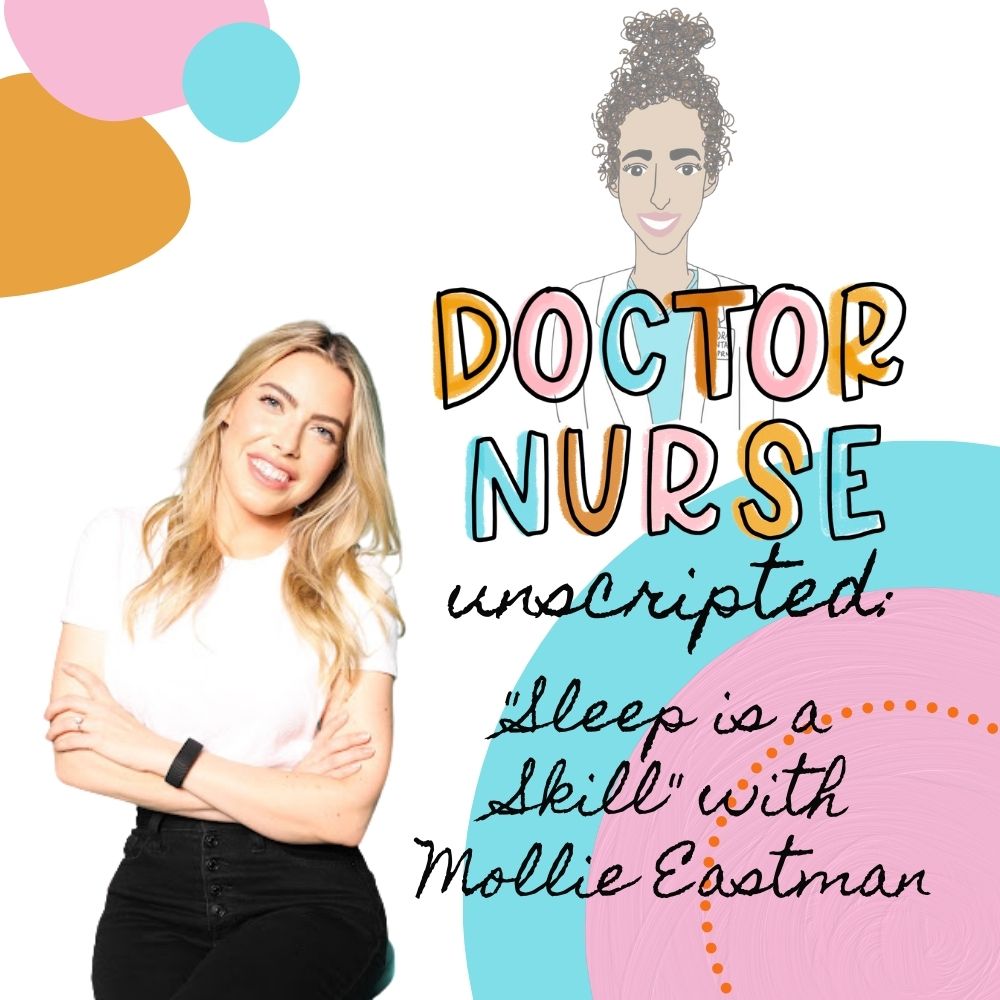
Mollie Eastman is the creator of Sleep Is A Skill, and the host of The Sleep Is A Skill Podcast. Sleep Is A Skill is a company that optimizes people’s sleep through a unique blend of technology, accountability, and behavioral change. After navigating insomnia while traveling internationally, she created what she couldn’t find – a place to go to learn the skill set of sleep. With a background in behavioral change from The Nonverbal Group, she became fascinated with chronobiology and its practical application to sleep and our overall experience of life. Knowing the difference between a life with sleep and without, she’s now dedicated her life to sharing the forgotten skill set of sleep. In the spirit of that goal, she has created the #2 sleep podcast, written a popular weekly sleep newsletter for over four years, partnered with luxury hotels & lifestyle brands, and has appeared on over 150 podcasts.
Training:
Creator of The Sleep Is A Skill curriculum & sleep optimization process
Led Focus Group with Levels Health Examining Continuous Glucose Monitors & Oura Ring Sleep Overlaid Data
Behavioral Change Expert at The Nonverbal Group, NY, NY
Behavioral Change Expert at Beyond Tells, NY, NY
Bachelor’s Degree in Psychology from Syracuse University
Mollie’s Links: Website: https://www.sleepisaskill.com/
Weekly Sleep Obsessions Newsletter: https://www.sleepisaskill.com/newsletter
10-Week Wearable Group “Optimize Your Sleep” Program: https://www.sleepisaskill.com/optimize
Sleep Is A Skill Podcast: https://www.sleepisaskill.com/podcasts
LinkedIn: https://www.linkedin.com/in/mollie-mcglocklin-sleep-is-a-skill-82531825/
Instagram: https://www.instagram.com/mollie.eastman
Facebook: https://www.facebook.com/sleepisaskill/
Twitter: https://twitter.com/SleepIsASkill
Latest Episodes
Doctor Nurse podcast brings you weekly shows to help INSPIRE, EDUCATE AND EMPOWER nurses with true stories of initiative and impact.
Doctor Nurse podcast brings you weekly shows to help INSPIRE, EDUCATE AND EMPOWER nurses with true stories of initiative and impact.
Latest Episodes
Doctor Nurse podcast brings you weekly shows to help INSPIRE, EDUCATE AND EMPOWER nurses with true stories of initiative and impact.