Also Available On






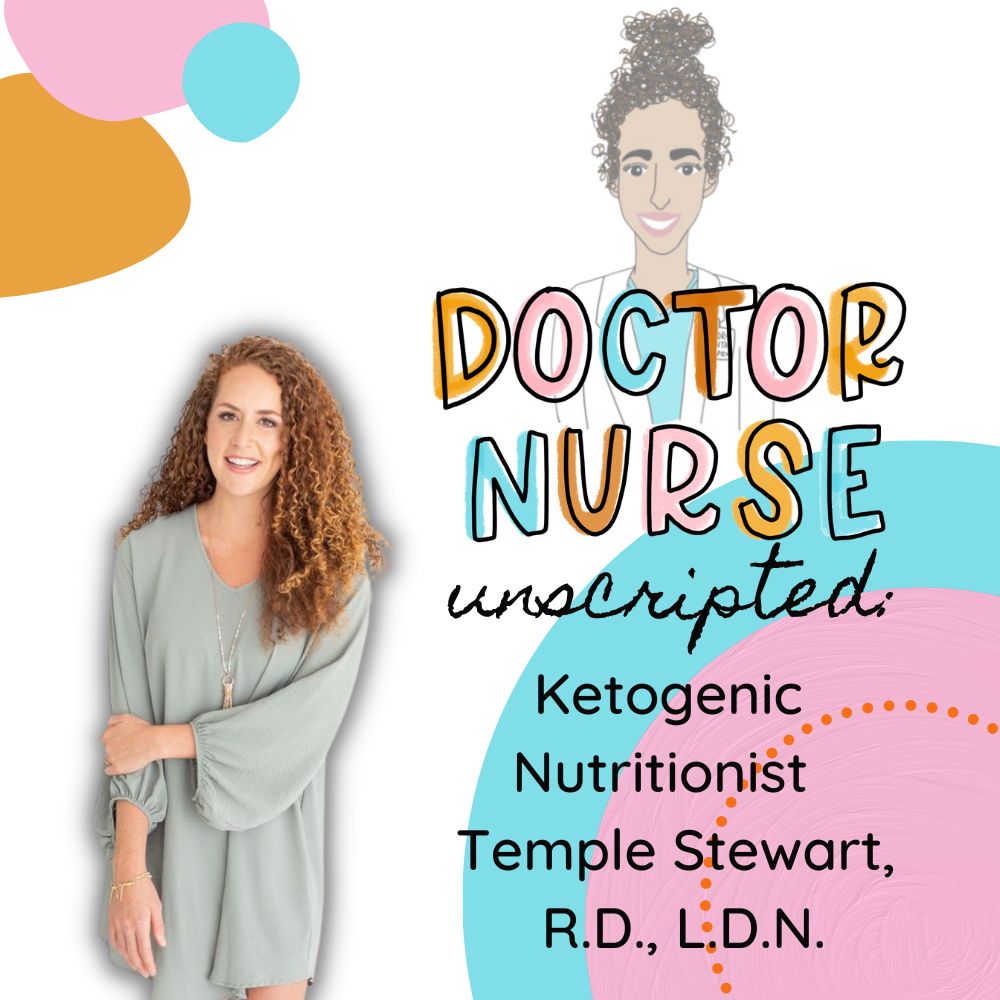
Dr. Sandra Pagenta: Hi, Dr. Nurse Podcast. Welcome to another episode of the Dr. Nurse Podcast unscripted. I have on today’s podcast episode Temple Stewart. She is here as a registered dietician, living in Arizona, Phoenix, Arizona. And she has her own private practice where she works with individuals to help them focus on a ketogenic.
And lifestyle for diabetes management, blood pressure management, and so much more. So she’s gonna come on and have an educated conversation with me about the ketogenic diet cuz it is something that again, I have adopted into my lifestyle and I’ve noticed through, you know, heavy research. It’s a super big benefit.
So thank you. Temp a temp for coming on today.
Temple Stewart: Yeah, I’m happy to be here. Thanks for inviting me.
Dr. Sandra Pagenta: Yeah. Let’s get, let’s dive right into this, right? So can you explain to my listeners kind of what a ketogenic versus like low carb diet kind of looks like?
Temple Stewart: Yeah, so this is a really great question. A lot of times these two get connected and they’re really different in a lot of ways.
So low carb is more focused on higher protein, so you don’t get necessarily always get into ketosis with a high protein or low carb diet. Whereas keto, the focus is getting into ketosis and having the effects of being in ketosis. Now again, a lot of times we use the two hand in hand, depending on the individual situation.
And when you’re follow a ketogenic diet, I’m not saying that you’re, you know, never gonna dip into that, the low carb, higher protein style and vice versa. But the two are separate, especially if you’re talking about the therapeutic uses of a ketogenic diet. So it kind of depends on your individual situation, which way we take that.
But if you’re talking, technically, low carb is more of a high protein style, moderate fat, whereas ketogenic diet is a higher fat, more moderate protein style eating pattern. .
Dr. Sandra Pagenta: Got you. Cause I’ve seen it written where it almost comes down to a number, like ketogenic is less than X amount of carbs a day, whereas like a low carb is kind of more of like a range.
It’s like 30 to 50. Whereas if you’re doing ketogenic, you’re like less than 25 carbs a day kind of deal. Exactly,
Temple Stewart: And it’s all about the macronutrient ratio. So you’re not gonna get into ketosis if you’re eating. Most average it’s over 40 total. Carbohydrates, depending on the insulin sensitivity of the individual, but mm-hmm.
it, it does, It comes down to numbers and hormones, essentially.
Dr. Sandra Pagenta: Yeah. So the reason why I wanted to talk about this is because, nurses are one of the largest healthcare occupational groups, and the prevalence of obesity ranges somewhere between 30 to 55% depending on race, location, work settings. And so when I read that, I just realized, wait a minute, like we are.
The face of healthcare in a lot of ways. Yet we are not the face of wellness. We are not the face of being, you know, healthy. And we have these long shifts. We, we have shift work, We work at night and we have very stressful, demanding jobs. And so one of the things that I wanted to do was to create a conversation about nurses, for nurses, about how they can live and eat healthier.
So that their careers are benefited. Right. Because when you’re healthy, then you work differently. And so what have you seen in your clients that you work with that adopt a ketogenic or low carb? You know, whichever one you’re working on. If you’re kind of focusing more on the keto part, what have you seen like when they adopt that lifestyle?
Temple Stewart: Yeah, well I work with a lot of nurses, and you’re absolutely correct. I feel like there’s a lot of factors that go into it. The shift work, the, the constant busyness. There’s a lot of demands on nurses to take care of a lot of patients. We all know there’s a nursing shortage. We could go on and on. A lot of nurses are, you know, not only have this demanding work schedule, but they’re also moms.
They’re also, you know, providing for families and it’s, there’s a lot going on in, in these women’s lives and men’s lives too. So yes, I think it’s demanding. There’s not a lot of time to, to eat during work itself, but I’ve seen a lot of women and men that adopt a ketogenic lifestyle. In nursing one, it’s very nice because keynote can be done anywhere, anytime, and it helps you with hunger cravings.
So I feel like one of the problems with the night shifts and even just at work shifts is there’s. Snacks and always food and always junk and vending machines, you know, it’s very easy access to a lot of trash really quickly in terms of food. And so keto really helps stabilize blood sugar and it helps stabilize your leptin and grin levels.
And so all my clients will always tell me they’re like Temple. I just feel like I have so much more control at work. I don’t feel like I need to reach for the donut. Every time there’s one in the break room, I don’t feel, you know, the blood sugar roller coaster when I’m taking care of my patients and even my night shift nurses tell me that, you know, they do better because they don’t feel like they need to eat all night to keep themselves awake.
They have more stable energy. And so overall, because of the hormonal effects of being in keto, there’s just a general sense of wellbeing. That’s a, it’s a bit hard to describe on a podcast, but it comes along with being in ketosis that I think. Nurses feel a little bit more in control in and around food while they work.
And so again, it’s very satiating. You’re eating a lot of high quality foods when you’re in ketosis and when you’re following keto, you’re eating a lot of proteins that come with a lot of healthy fats. You’re eating a lot of. You know, nutrient dense, high fiber vegetables that are gonna keep you full as well.
And so again, it comes back down to that reduced cravings that remaining full for longer periods of time that stabilize blood sugar, which of course, stabilizes mood helps with, you know, anything that you may be dealing with. And. You know, patient control, all of that stuff. So it’s just makes life a little bit easier.
And ketos very easy to do on the go too. So let’s say you do have a 15 minute break and you are feeling a little hungry. You can run down to the cafeteria or whatever and get a couple boiled eggs, or maybe go through the line and get, you know, a protein on top of a salad. The beautiful thing about keto is it can be done anywhere and it’s easy to bring snacks for, and it’s not this complicated number counting thing that a lot of people make it.
So I feel like it fits pretty naturally in the nursing workplace as well. .
Dr. Sandra Pagenta: Yeah. One of the things I like about ketosis, or at least diving into that world, kind of understanding what your blood sugars are doing, is wearing a continuous glucose monitor, and that has been something that’s been a complete game changer for me, just personally because once I slap that glucose monitor on and I’m watching what the food is doing to my blood sugar, I am astounded to see that things that I thought were innocuous, things that I thought were just not a problem ended up being.
Huge spikes of glucose for me and made and made me realize like, Whoa, like I am spiking my blood sugar 10, 15 times a day with these little tiny snacks that I’m doing. And so, yeah, when I do eat meals that are filling and full of protein and full of fat, I tend to not go. Like starving, panicked, looking for food.
It almost like it gives you control over more of your life and more of your processing through like, when is the next meal coming? You’re not panicked. Right? And so again, I think ancestrally, I think that we ate a, a diet very similar to this that wasn’t a lot of sugar and lots of carbs. And I think that’s why our ancestors were able to go long periods of time before finding the next meal because they had these stable blood sugars.
And I think again, it, I think keto is so cool because it ties so nicely in with pairing it up with a, like continuous glucose monitor and seeing what’s happening. And, and, and ketosis isn’t necessarily something you have to stay in all day long. It’s something that even. And again, correct me if I’m wrong, temple, but even if you dip into ketosis at night, they’re saying that there’s some benefit from just kind of this intermittent fasting principle of stopping eating at a certain point and letting your body as it runs through, you know, the glucose in your system, then turning on an alternate system of, of energy.
And that’s been found to be just as effective as those brief period, not, maybe not just as effective. You correct me if I’m wrong, but that little ketosis timeframe while you. In sleep has actually been found to be very beneficial as well. Is that correct?
Temple Stewart: Oh, yeah. And I think that that’s important for people to realize.
Cause I think sometimes it’s easy to think, Oh, I’ve gotta do, you know, this crazy fasting regimen that’s too difficult for me to manage and it’s just uncomfortable. And it’s like, No, no, no. Stop your eating at this time, a reasonable time during the evening, you know, whether that’s, you know, 5, 5 30, and just don’t eat until the next morning.
You know, And it’s like, it’s as simple as that. It’s as simple as just not snacking all night. And so, you’re absolutely correct. And and going back to the ancestral way of eating, Yes, our, our ancestors didn’t have a convenient store on every corner. They weren’t constantly snacking all day, which allowed them to get into TUDAs, which also allowed them to tap into their fat.
Which is something that we just don’t do often when we’re constantly, you know, eating and constantly snacking. Why would we need to burn through these stored energies that we’ve, that we’ve stored when we, when we’re constantly putting stuff in our mouths. So I think that that’s an important fat loss principle that you just touched on as well.
Dr. Sandra Pagenta: Yeah. Yeah. And again, like once you start noticing by implementing these principles in your life and you’re watching the fat come off your body, you’re just like, I’m really not even doing that much. I’m not even having to watch every single piece of food I put in my mouth. I don’t have to monitor calories, and that stuff gets to be exhausting.
It’s not, it’s not sustainable. And I have found just this kind of compressed window where. High quality food, grass fed beef grass fed grass finish beef good eggs from a good source that they’re free range, that are not like in cages and the in the egg yo just look bright and happy, like the sun. And you’re just like, Okay, so something’s going on here.
And I am very much not been, you know, I I, before when I was in eating that way, I’m realizing now. I was just on a sugar roller coaster constantly, and I know that I’m not, I was not the only one. Especially looking around at my cohort, you know, my coate, my cohorts, but looking at my cohort of, of nurses that are, you know, also struggling with weight and autoimmune diseases and that keto has been found to help send some of these things into remission and living a diet where you living, a lifestyle where you are.
Just paying attention to how much intake you have of carbs is changing people’s lives. So I think it’s, it’s really, really cool. Alright, so the next thing I wanna talk a little bit about is kind of what are some things that you’ve noticed are barriers for, for nurses to starting a ketogenic diet?
What are things that, you know, if a nurse is like, Oh, this sounds really good, but I can’t because. Ah, what are some of the barriers, and then how do you help over your clients overcome those?
Temple Stewart: Yeah so one, I will start with it. There’s just a, a massive amount of misinformation around keto. Like there’s so much stuff you can get into online where people are just doing horrendous things following the keto genetic diet.
They’re eating loads of processed ketogenic. Processed trash foods that have tons of seed oils and really aren’t that ketogenic and that, you know, they’re following these the, the ketogenic diet, but they’re eating basically the same types of foods that they were eating before. And that’s not very helpful.
They don’t see results. You know, some may even gain weight cuz a lot of those foods are really high calorie and loaded with that and, and even still affect the blood sugar. That’s one problem. I think there is a little bit of fear around just, Oh, I’m eating high fat. Especially in the nursing community that has been around a lot of the medical, You should fear fat.
Cholesterol is bad, like you’re gonna have a heart attack. This isn’t good for you. I think there’s still a little bit of that fear there. Especially if they’ve, you know, worked in some of the cardiology settings and been around doctors who are pushing a lot of this. And so that is definitely a barrier that you have to explain about dietary cholesterol.
And you have to talk about insulin resistance and inflammation being the drivers of. Heart attack and stroke. And so I think that medical misinformation is a huge barrier that we have to overcome as well. Obviously, you touched on schedules. It schedules are crazy. It’s hard when nurses are at work, they’re at work and they’re busy and they’re walking around.
They don’t have time to sit and eat and not be distracted. A lot of times they’re, you know, either skipping meals. They have lives, lives at home where they haven’t been able to really plan a lunch and they’re constantly eating on the go or ordering Uber Eats or doing things that require, you know, them to eat quickly, eat fast, and then be back on shift and they don’t have much of a time to rest.
I hope you’re enjoying the episode. I wanted to take a second and tell you what I’ve got cooking at the doctors podcast. my business partner and I, Jackie king, created an Etsy shop called success and P the goal of our Etsy shop is for NPS at NP moms to work smart, cherish the moments of life and live beautifully. We created adorable digital downloads for new moms, moms that need to get organized. And we also just launched a brand new digital planner. It’s Nurse practitioner themed planner with stickers to help you customize and keep your life organized. It has inspirational quotes for different nurse specialties, as well as facts related to, our job as nurse practitioners.
So for my listeners, if you go check out my Etsy shop, which I have linked in the show notes if you use the code doctor, nurse for the next two weeks, you will be able to get 20% off the planters and be able to download them to an iPad Using the good notes app and you can immediately start organizing and planning your life so that you can start a side hustle so yes check it out thanks for listening to the episode and thanks for supporting our etsy shop if you do stop by and let’s get back to the episode
Temple Stewart: And so I just see those, those are kind of the biggest barriers that we overcome. And again, it goes back to a little bit of planning, a little bit of education and talking through some of this, a little bit of just talking about what it looks to fall, what it looks like to follow a well formulated ketogenic diet.
I explain to all my nurses, Look, if you look at keto, like a modified Mediterranean diet, . Then it’s like, Oh, okay, this is totally healthy. That’s all I have to do with my nurses. And they’re like, Oh yeah, yeah, Mediterranean, that’s totally healthy. Like this’ll be good for me. I can totally do this. And it.
that is the way I explain it to my nurses cuz they get that and they know what Mediterranean is and it truly, it’s, it’s great for you. And so those are kind of how we overcome the barriers to anyone really working in the medical field. And thankfully I think a lot of doctors and a lot of specialty physicians and nurses are catching on and realizing like we have a massive gap in nutrition and that.
Truly our biggest problem, like people are literally dying from lifestyle, nutrition related disease. That’s our biggest issue. And so what we’ve been doing is just not working. And so they’re more and more opening up to the idea that we need to change. It’s not just calories in versus calories out. It’s the quality of these calories and the macronutrient makeup of them.
So yeah. Yeah, that’s kind of, that’s kind of how I approach it.
Dr. Sandra Pagenta: Yeah. You know what is so funny is you were talking about that it made me think about when I was a baby nurse and we used to treat pain and I remember we would just give people opioids like crazy and we would, we made addicts out of an entire population, right.
We would just dole out pain medicine. I remember. I would go into a room and I would feel guilty as I was like pushing pain meds on a patient who was like half asleep, but just demanding for more pain meds. I’m like, You haven’t been up all day, like you haven’t been walking. You know, I knew it was counterintuitive to everything that my Puerto Rican mother would be telling me to do if I wasn’t feeling well, you know?
But I would just, I was told like, the patient always is right, and so. I’m feeling that same way about food and nutrition and as we treat patients for diseases and we prescribe medication and we quote unquote like, you know, advise them and counsel them. I’m having a hard time as I practice clinically looking at then.
The obesity rates of patients, the obesity rates of, you know, the healthcare workers, looking at what we eat and then thinking, how does this thing that I do 3, 4, 5, 6 times a day not impact more than the med, the medication that I’m giving this patient one time a day? Like, how is this not? And so I’m getting that.
Same. You know, that same voice of like my mother just being like standard. I stop eating as late as . Like what are you doing? And these natural things that we just know to be true. Yeah, we’re just ignoring and we’re just like, No, it’s fine. It’s fine. I’m too busy. I’m this and that, and it’s just like, wow.
Like we just need to kind of go back to like, Hey, listen, we need to really, It’s just crazy to me that we have more knowledge, but we’re not necessarily. More wise. And so that’s the part that I’m starting to see doctors waking up to. I’m waking up to, and patients are so much more receptive to, because I’m telling you, I’ve recommended to so many patients.
The book called Glucose Revolution by Jesse, I can’t ever pronounce her last name. It’s like French or something. Fancy Glucose Goddess, right? Yeah. The Glucose Goddess. Oh my gosh. I, I write that, that title to the. About four times a day to my patients and they’re like, I’m gonna go get the book. I’m like, It’ll change your life.
Like, yeah. And just these little simple things that you can do to affect how your glucose and your blood sugar is responding inside your body will slow down those curves that I’ve watched it, when I wear my cgm, I’m like, I know, like, you know, I’ll eat. And that’s crazy cuz even though I may eat something like for example, potatoes.
even after I, if I’ve had the vegetables and I’ve had the protein in the fat, and I’ll have some potatoes afterwards. It spikes my blood sugar more than like a little tiny bowl of oatmeal with some fruit. And so I’m like, I probably am not like whatever it is inside of me metabolically, it’s just not doing a good job, like pulling down the glucose from the potatoes.
So that just means that like I have less of them or I don’t really have them in my diet. So it helps kind of dry the decisions that I make. Where I don’t feel so constricted. And that’s what’s wrong with diets. It’s like, this doesn’t work because you crave the thing that you’re like, you know, like we have a toddler inside of us.
Like when you tell your toddler, you know, you have babies. So you know, like, don’t do that. It’s like, Oh, I’m gonna go do it.
So, So yeah, it’s just like you can’t tell yourself no, but how can you do it in a way that, you know, again, is keeping your sugars under control. You’re not getting on that rollercoaster with that then affects your emotions and you’re snapping at your patients and you’re snapping at your children. Yeah.
It just literally permeates into every area. So that’s why I wanted to talk about this stuff because I said I focus so much on the career aspect on my podcast, but I’m realizing that like this affects your career, like your sleep. Your diet, like all this stuff begins to affect it, so not a hundred percent.
Yeah. So what would be one thing that you would recommend to a nurse today that she can do today to start getting healthy? What is your like number one go-to? Sing Temple. So
Temple Stewart: I would say read the book that you just suggested and also read the book by Dr. By Dr. Benjamin Bickman. Why We Get Sick.
That was another one that changed miles in my career. Oh, you would love it if you like. The glucose revolution. You’ll love this one too. And then I would just say take some time to really focus on your health now. I far too often get clients, nurses in particular that have have known there has been an issue and have put themselves on the back burner for 15 years.
And have, have constantly known and have constantly you know, taken care of others so well, including their patients, including their kids, including their, their spouses, and significant others. And have been primary caregivers to everyone else except themselves. And now they’ve come to me in their, you know, 250 pounds overweight, they’re type two diabetics, and.
A host of problems. And now not only is it, is it greatly affecting their health, but now they’re really having a hard time caregiving for, for those that they love. And so my encouragement would be is to, to catch these problems and start looking for these red flags sooner. And don’t wait for the moment where it’s, I’m not saying it’s too late, cuz I don’t believe it’s ever too late, but don’t wait.
so it becomes a bigger problem than it should be. And don’t wait till it becomes something that is way harder to overcome. And that’s gonna take much more drastic measures before you start taking action. Because it’s much easier to start controlling, you know, diabetes when it’s prediabetes, or it’s much easier to lose 15 pounds versus 150 pounds.
And so I just would encourage anyone that’s listening or. You know, whoever, that, it’s really important to try to, to notice red flags and to, to notice yourself putting yourself on the back burner. I think this is especially true for, for the nursing profession, cuz I, I don’t think anyone who’s selfish gets into the nursing profession because it’s just a constant caregiving.
You know, you know, giving away and being selfless and, and staying up all night and doing all the things. And so I would just encourage you. To notice that before it becomes a problem and take care of it soon, so that you are able to do the things you love and to take care of your kids and live a long, happy life and care for your patients as long as you can.
Dr. Sandra Pagenta: Yeah, well said Temple. And it’s so true because again, this is kind of my journey as well of just starting. I was so busy with school and work and doing all those things and working, you know, to take care of people that I wasn’t paying attention to myself. Yeah. And realizing that I was showing signs of insulin resistance.
And what’s crazy is that I will look back at even my wedding photos. Yeah. And my face and my jaw like is so heavy and I. What was going on. And again, with the birth of my son, I had, you know, gestational diabetes and that really set me off into a, I’m quote unquote skinny in a size six. Like, how am I gestational diabetic?
Yep. And I somehow lost 20 pounds before my pre-pregnancy weight after my son. And so I realized, Sandra, you were carrying 20 pounds of extra weight that. Affecting you metabolically. And yeah, again, there’s just so many things that I think, again, it’s a slow build. It’s been, I was only in, I was only like 29, 31, 32.
I was not 50, 60 years old. And so if young nurses can hear this and get started and start paying attention and prioritizing themselves earlier, you will be able to avoid. What I’ve, you know, gone through with P C O S and endometriosis and gestational diabetes and these things that keep reverberating the same message.
You have some type of metabolic dysfunction. Yep. You have some type, you know, like that was saying, but I was too busy to listen until one day I was forced to stare at it and just go, Whoa. My kid’s in the nicu. Like, how did I get here? Exactly. Again, it can happen to anyone. So I don’t blame myself, but there is an element of like, No, but what am I responsible for?
Like, yes, I’m maybe not responsible for all of this, but I am responsible for all for some of it, and I’ve gotta own my part in it. And I want nurses to hear that. Like, you’ve gotta own your part. You can’t take care and pour on people all your life. And then at the end of your. Be stuck with who you are cuz you will be stuck with whatever decisions, whatever you know, back burning you did to yourself, okay?
And you will be alone in that. They won’t be there with you. So prioritize yourself in these moments as you care for people. And so I wanna be the person that reminds them to do that work because if not, Who cares what you did with your career. You’re not well and health is everything. So, yeah. Thank you for coming on and, and explaining all that.
Is there anything else you’d like to share with my audience that Yeah, they can find you, how you help them? I mean, Sure. Yeah, yeah, yeah, yeah.
Temple Stewart: You can find me on just about every platform I, the dot keto. Do nutritionist, TikTok, Instagram, Spotify, all the fun things. You guys can find me there. If you ever have any questions, please don’t hesitate to DM me.
Reach out, go follow me, and I’m honored. Thanks for having me on. This was a lot of fun and I look forward to our continued friendship.
Dr. Sandra Pagenta: A hundred percent. Thank you so much, Temple. Have a wonderful day. You too.
Podcast Description
Temple Stewart is a Registered Dietitian. She specializes in helping women lose weight and realize the benefits of a ketogenic lifestyle. She received her degree in Dietetics at the University of Tennessee Martin. She completed her internship at the VA Medical Center in Bay Pines, FL. She currently works and lives in Phoenix, AZ with her husband and her daughters. She played sports growing up and was always fascinated with the way properly fueling her body impacted her performance on the field. Throughout the process, she learned how to eat for health and how to develop a healthy relationship with food. She was later diagnosed with Hashimoto’s Thyroiditis and PCOS (polycystic ovarian syndrome), furthermore increasing her interest in treating the body with nutrition She is passionate about helping other women lose weight and improve their health through nutrition and the ketogenic diet. Links: https://www.templetheketonutritionist.com/aboutme Doctor Nurse Podcast Links and where to hear other episodes: https://linktr.ee/DoctorNursePodcast Success NP- Etsy Shop:https://www.etsy.com/shop/SuccessNP?ref=seller-platform-mcnav Picmonic covers thousands of hard-to-learn facts and topics, to help you master the material that healthcare students often struggle to learn. This study system helps boosts nursing and nurse practitioner student’s confidence and grades. Picmonic learning system students increase retention and test scores. Why does Picmonic work? Years ago, psychologists and education researchers found mnemonics to be an effective tool in increasing retention and memory recall. Today, lots of different strategies for learning and memorization using mnemonics exist including keyword, phrase, music and image mnemonics. Using the idea of image mnemonics and applying clever pictures and humorous characters tied together with story and audio — and put it online to create the ultimate studying system for retention and memory recall. Use code DOCTORNURSE for 20% off your subscription. https://www.picmonic.com/ Become a NP Preceptor and make up to 8,000 bucks a year: https://nphub.com/preceptor/beforelogin
Latest Episodes
Doctor Nurse podcast brings you weekly shows to help INSPIRE, EDUCATE AND EMPOWER nurses with true stories of initiative and impact.
Doctor Nurse podcast brings you weekly shows to help INSPIRE, EDUCATE AND EMPOWER nurses with true stories of initiative and impact.
Latest Episodes
Doctor Nurse podcast brings you weekly shows to help INSPIRE, EDUCATE AND EMPOWER nurses with true stories of initiative and impact.