Also Available On






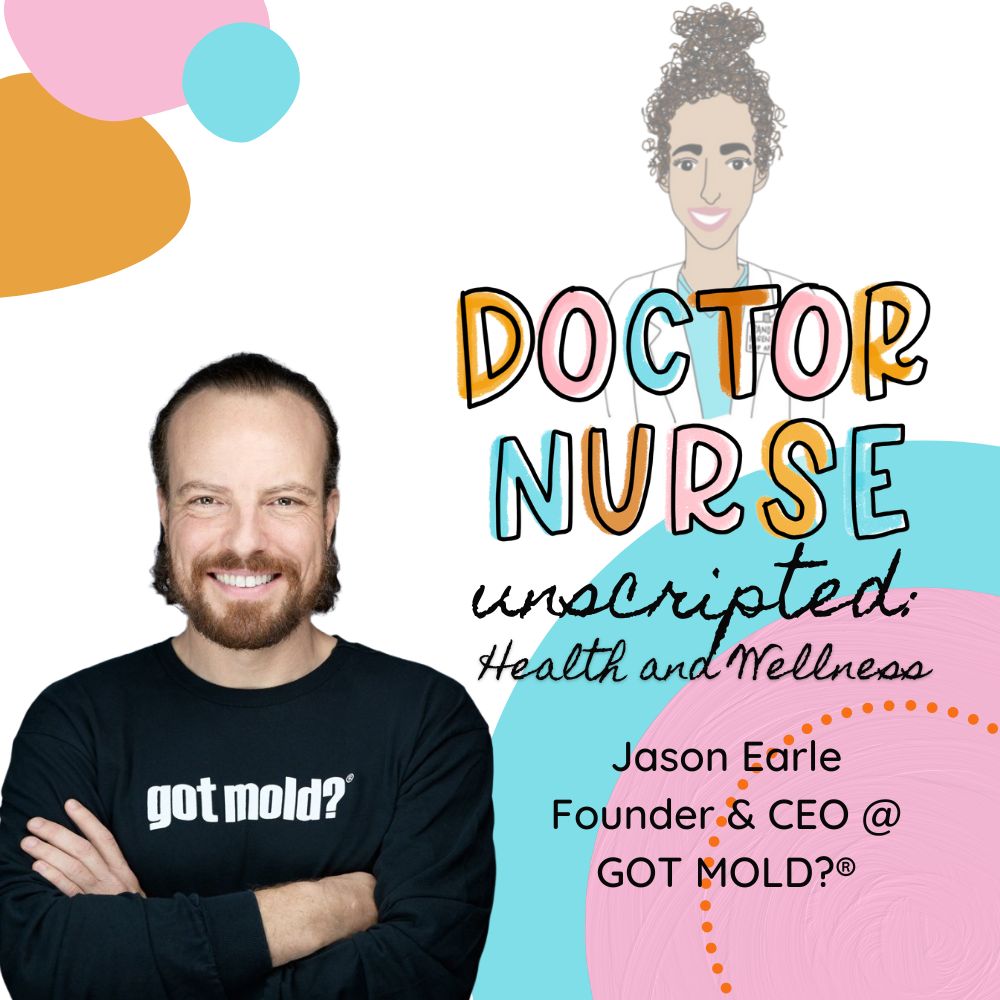
Dr. Sandra Pagenta: Welcome, Jason to the Doctor Nurse Podcast unscripted episode. I am so happy to talk to you about health and wellness, and one of the things I’m into is biohacking, understanding the world around us. Welcome to the podcast.
Jason Earle: So good to be here, Sandra. Thanks for having me.
Dr. Sandra Pagenta: Yeah, so I gave a brief introduction to who you are prior to the podcast, so my guests know you, but again, explain to my guests that are just tuning in.
All right. What is it that you do? I mean, you do everything. What is it that you’re not doing? Might be a shorter list to start with, but tell us what you’re doing so that they can kind of get an understanding of where, where you’re coming from.
Jason Earle: Thank you again for having me on the show, Sandra. I’m I’m kind of an accidental expert in, when it comes to mold and, and indoor equality. I’ve been doing it for 20 years, so by now I should have an experience, enough experience, to own that role or own that, own that description.
As with almost every business I’ve been in, I have no business being in it until I was in it. And so you know, I don’t know if it’s, it’s a combination of ignorance or arrogance, but that’s what I tend to do, jump in and, you know, sink or swim. So when it comes to mold and inner air quality I am the founder and c e o of got mold.
And so been in the industry for 20 years. I originally started on the inspection side of things and I can go into the story of how, how that all came about, which is maybe for a longer podcast. But I, I got into the inspection side of things. After a career on Wall Street I had an, awareness that.
That came about after I decided to go do something meaningful of my life. And I was reading a story about a guy who got sick from the hotel where he was an employee. He blamed the mold in the building and he had developed a, a, a number of symptoms, that that were echoed for me. He had developed adult onset asthma at 40 years old, as well as all these allergies and sensitivities to foods that he had never had a problem with.
And, . And as I was reading this story, I, had like a deja vu moment and I was brought back to my childhood. When I was around four years old, I suddenly lost a lot of weight in a three week period. And par parents took me to the pediatrician who told them to take me to the children’s hospital because they thought it was very serious.
And based upon my symptoms and my family history, the initial diagnosis was cystic fibrosis. And so my parents spent six weeks crying while they waited for the second opinion, which thankfully was not did not confirm that diagnosis. Actually what they found that I had was asthma, compounded by pneumonia which led to my first big dose of antibiotics, which is a, another rabbit hole we can go down, but sure.
and I was allergic to every single thing they tested me for. So it was grass, wheat, corn, eggs, dogs, cats, even cotton. And I grew up on a little non-working hobby farm surrounded by grass, wheat, corn, eggs, dogs, cats, cotton and all that stuff. And so I basically lived in a wash and allergens itchy my whole childhood.
And quite frankly, a lot of that’s blurry because I think I kind of blocked it out. It was, you know, a lot of inhalers and all that kind of stuff. But and I, and I intuitively spent a lot of time outside and, and, and, you know, looking back in retrospect, you know kids I think be, are better at intuition.
They haven’t gotten all the layers of judgment and fear on top. Yeah. So I intuitively knew that outside was better than inside, and so I spent most of my. In nature, despite the environmental allergens, it seemed to be better than inside. And then when I was about 12, my folks split. Which was good for everybody involved.
And we moved outta that, that house. And all my symptoms went away. And I never thought about it again because it was all chalked up to what they call spontaneous adolescent remission. And my grandfather had grown out of his asthma and so they just thought it was the same with me. And so so.
My, my mom died about a year later suddenly. And then I got Lyme disease a year after that. And so I had another big dose of antibiotics and then through a series of sort of crazy happy accidents, I met a guy at the gas station where I was pumping gas after dropping outta high school who recruited me to come work from on Wall Street.
And so that’s how that happened. That was a total fairy tale. You know, definitely I, I was, I failed Algebra one, so I certainly didn’t, I was not innately talented when it came to these things. mostly cuz I slept through it. , but, so you’re
Dr. Sandra Pagenta: a Guinness World Record awardee,
Jason Earle: correct? Yeah, yeah. No, I, it was, again, it was totally an accidental thing.
I was 16 years old, pumping gas and a guy came in, I fixed his tire, fixed his tire, and he, and he, he and I start, started a conversation and, and he gave me a huge. And I and, and anyway, it, it, it went on to a couple of conversations and he basically recruited me to come work for him. And I unknowingly year later I got my stockbroker’s license under his tutelage.
And I unknowingly at the time became the youngest licensed stockbroker in US History. So. It was crazy. And I, I didn’t even know it really at the time. I didn’t know until years later, everyone around me was like, oh my God, this is so cool. You’re, you know, you have no idea how, how much of a headstart you have.
And my, my, all my friends were still in, you know, sitting there working on, well, algebra two you know, so we’re more like trigonometry at that point, but at least. So anyway, but that, that, that, that for nine years and throughout the entire nine years, I always had a problem with the fact that my, my mother had impressed upon me the need to To focus on, on improving the quality of other, other people’s lives.
My mom was a nurse. She gave. She gave all of herself to, to a fault. But she really in, in indoctrinated me into, into the philosophy of service. And oh, that was so neat. So Wall Street wasn’t, wasn’t that for me, right? It was nine years of me basically, you know, making as much as I could. And, you know, the only people that benefited from my success were.
You know, the people who I hung out with and the people who own stores where I shopped, you know? And so, so when I, when I decided to go backpacking, and that’s where I read that story about the gentleman with the, with the adult onset asthma. It just, it, the light bulb went on and it was immediate to me.
I, I, I became immediately fascinated with the fact, oh, first of all, I called my father from a payphone. As soon as I heard this, as soon as I read this article and I said, Hey, dad, do you think we had a mold problem at Trenton? Which was the house, the address where we grew up. Yes. And he just laughed at me.
He’s like, of course we had mold, we had mushrooms in the basement. Why do you ask? You know, and oh my goodness. I just sat there, kind of, kind of amazed at how flippant he was about it, because for some reason intuitively I knew also that like mold and asthma don’t mix, but I said, do you think that was part of why I got sick?
And he, he said, well, certainly couldn’t helped. And meanwhile, you know, they smoked indoors, right? They with an asthmatic kid. That was the seventies and eighties. That was not for lack of love, it was just that lack of awareness, you know? Exactly. I took a, I actually became fascinated and I, I took a job working for a mold remediation contractor doing it sales so that I could learn what was going on.
And quickly saw there were a bunch of thugs and using chemicals instead of cleaning properly. And this was before there were any standards or guidelines or regulations or anything. So it was really the wild, wild west. And I decided that the best place for me to actually learn and serve was actually, to, to develop an inspection company that was based.
No conflict of interest that was completely service oriented to help the consumer navigate these waters and to protect them from the contractors because the contractors were the most dangerous element in the whole equation.
Dr. Sandra Pagenta: And so the contractors were people that were hired to clean your house of mold, but there was no way to regulate if they were actually doing it or
Jason Earle: not.
That’s right. And so my job was, to do an inspection, identify the area. To reduce the size of the remediation to the smallest possible scope because remediation contractors wanna do what the opposite, they want the biggest possible, right? And so they have a conflict of interest, even walking in the door, a contractor giving, doing an inspection for you, that’s not a free inspection.
That’s likely gonna be very expensive. And so, you know, what we, what we decided to do, what I decided to do was, was figure out how to create a buffer between the consumer, the concerned consumer, and the the contractor who may or may not. Ethical boundaries. And so and so I began doing inspections at night for people who were concerned.
Cause I didn’t have a business model. So I just started saying, Hey, I’ll help you if you need anything and I’ll come in. And I was learning how to collect air samples and all this stuff. And eventually people started saying, wow, this is really useful. You know, I should pay you for this. Well, how much, you know?
So I had, it was really customer driven and then people started paying me and then the business developed out of that. And it was right around that time that I developed. Curiosity in different technologies to find hidden mold. And I stumbled across mold sniffing dogs, which was just crazy enough to be brilliant.
And it’s a real thing, right? They’re good. It’s a real thing they’re good at. Right? So I, I found, I, I ended up getting one of the first in the world and one of the. The first, certainly in the United States, her, her name was Oreo. And she and I started in 2003. We ended up with a bunch of news organizations descending upon us in the first couple of weeks.
And then, and they were trying to debunk us and instead they, they, they hid mold in the house. One particular episode, it was a channel six action news. And instead of debunking us that we found the mold in like three minutes and said they endorsed us. And we hadn’t even, like, I hadn’t even set up an LLC or anything.
So my phone, my personal phone is ringing like crazy. Doctors are sending patients to me and I’m like, I guess I’m in business. And so, and I never had to advertise again. And that a couple of stories of, of healing were so dramatic that we landed on Good Morning America. And we got invited to do Extreme Makeover Home Edition a couple of times.
And then I’ve got like, Boxes and boxes of like big rubber made, like those giant totes that you store ski stuff in. Yeah. Filled with magazines and newspaper articles and books on working dogs and college biology textbook. We’re in like all this stuff. And it all just came from a, a, a molt sniffing dog and, you know, a, a recovering Wall Street guy.
What was your company called at that? Well, we called it that old, no, I called it lab results because we were using a Labrador retriever and laboratory. That’s . Yeah, that’s great. So it was called Lab Results. And then, and then, and then we went to go expand the business to, to increase our reach because it was just, it was, it was, it was so much fun, but I couldn’t do everything.
And I certainly couldn’t. And our phone was ringing off the hook and I couldn’t serve. I was getting third year, four calls a day. Wow. And again, with no advertising. and running myself ragged. Mm-hmm. . And so ended up tra getting control of the phone. Number one, 800 got mold. That’s a long story for another podcast I got it from the Catholic Church, believe it or not. And seriously. And when they say it’s a $64,000 question, I actually paid $64,000 for it. It was a re and the phone number’s a question. So I actually have the 64,000. Isn’t that funny? ? Isn’t that funny? So anyway, so that, that, that, that was, that was a great business for a long time and, and, and would still be if it weren’t for the fact that it just simp the, the ability for us to, our impact was limited by how fast we could expand with vans and dogs.
And that, by the way, doesn’t scale that well. Yeah. So so. It always frustrated me that our inspections were kind of out of reach of the average consumer. And so I began developing a few years ago, a do-it-yourself test kit that would allow concerned consumers the ability to test their error without the conflicts of interest, the concerns about finding and hiring someone they can trust.
And then also You know, just in an affordable way. And so so that’s what, that’s, that’s what the got mal test kit is, is really all about. It’s being able to give people the tools and knowledge they need to make better decisions about their, they breathe on an affordable basis.
Dr. Sandra Pagenta: Yeah. So what one of the things that I wanted to know was, I guess we, we’ll dive into the, the actual way that your mold kit works is, I’ve used it in my house and I’ve gotten results and it’s, it was so easy and it was so reassuring. To know, okay, I don’t have mold. We’re good. Like it was just a good feeling. But we’ll go into that a little bit later. But I wanted to know why does it matter to check for mold? Like why is this a big deal? Why is this something that somebody shouldn’t just like scroll through this podcast and just ignore everything and say like, well, I don’t think I have a problem with it.
I don’t have any symptoms. Like, why is it something that you should check even if you don’t have symptoms?
Jason Earle: yeah, no, that’s a good question. And by the way, I would hope anybody listening to this would already be kind of pre-filter. To care about mold. Right. Because most people would probably not even like click on it if they Sure.
Right? Yeah. So, so I, I’m hoping that anyone listening to this already recognizes that mold growth indoors is a potential health hazard. Yeah. And like, that’s like the baseline understanding that I hope. I, I, I have with most people that I talk to, cuz it wasn’t always like this 20 years ago when I started doing this, people would say, mul mold is a business.
Like what, what, how, what does that, what do you mean? And, and WIS would, would, would spend 45 minutes on the phone with us to schedule an appointment. The husbands would call to cancel. About 10 years ago, the husband started calling and no one cancels. So there was a big shift and serious a title. Yeah. And it, I think it was largely driven by Katrina and things like that.
But, and I bring all. For a reason, because, you know, mold forever was just an aesthetic nuisance. It’s, you know, it just smells bad. Whatever, you know, maybe it makes your, maybe, maybe a sneeze. You know, people didn’t take it seriously. And recent medical research, and when I say recent in the last.
10 to 20 years and it’s gotten, it’s accelerated quite a bit, has linked mold to some of the most prevalent long-term illnesses in America. Both on a, on in terms of either aggravating. Existing conditions or causing actual illness. And so, like, for example, some of the big numbers that are interesting according to the Mayo Clinic in the 1999 study, they, concluded that of the 37 million Americans with chronic sinusitis, approximately 97% of those cases are mold related.
which is massive, that’s 11% of our population that probably is not aware of that, right? And so my job is to bridge the gap and to connect the dots. The other one big number is 24.6 million asthmatics in the United States, of which about 10 million are kids. And the EPA and Berkeley Labs.
Did a study and they concluded that about 25% of those cases are mold and dampness related. And so it’s a big, big number. Yeah, they went so far as, to identify, you know, sort of like the public health costs associated with that too. So those are like upper respiratory things, but more interesting in a sort of more nebulous way fashion it.
When you start looking at some studies that have come out recently from, for example, brown University, they. Actually, we’re trying to debunk another study from Oxford University that had found a correlation between mold and depression. And they thought, Hmm, well let’s take a closer look. And they, they had 6,000 per participants in this study, which is huge.
And they had these people fill out a quality of life survey as well as self-report, whether or not they knew of a molder moisture problem in their building. And they found a very strong correlation between mold and mold and dampness and depression. This is fascinating on a lot of levels because.
I would argue that most people who are living in a moldy house are depressed because, for various reasons, probably because they’re disempowered. Yeah. But also as it turns out, the chemistry and by the way, Bryan University didn’t say whether mold caused it or not. They just found a relationship.
Yeah. Was, was this statistically significant a relationship? Very. Very. Okay. Very. Yeah. But so a recent, my, one of my friends, Dr. Joan Bennett, Rutgers University had. Had her own experience. She’s a mycotoxin expert and she’s a mold expert, and she, she actually went down into her home that was flooded in hurricane during Hurricane Katrina.
Yeah. She got a face full of the musty smell while wearing a respirator. So in other words, she wasn’t breathing spores, she wasn’t breathing the myco. She was, she was just, the musty odor had gone through and she, she fell ill and she became fascinated and started studying the musty odor. And she started doing experiments with fruit flies, especially.
Des engineered fruit flies that fluoresce when they produce dopamine. Check that out. So that’s cool. And so she exposes these fruit flies to the musty smell and the first thing she notices, they stop producing dopamine. They also stop reproducing. They also fly down and set it to the light, which is their natural inclination, and they also develop a locomotive disorder.
Their arms and legs start acting differently. And then, then they, she also noticed that they developed what she characterizes Parkinsonian like symptoms. So neurotoxicity. essentially. And subsequent studies that have done, been done by her team and, and, and other, other reputable labs have found mitochondrial damage caused by the musty odor.
And by the way, this is just one compound within the many compounds that make the musty odor. So it was an isolate, but still the point is that that she found in animal studies that exposure to the musty smell makes you. I mean that’s, it’s not producing,
Dr. Sandra Pagenta: don’t mean. Yeah. It’s affecting the gut microbiome, I’m sure.
And like you end up in inhaling it, it goes into your bloodstream. It goes into your GI tract. I mean, they’re finding that there’s more serotonin in your gut than in your brain. Right? And so I’m wondering how this is all just playing and then you lost all that weight when you were exposed to mold. And so like how is it affecting like all these different aspects of our body?
That’s incredible.
Jason Earle: That’s incredible. Yeah, no doubt. And the microbiome thing is a big deal. So mycotoxin. Are the, are the poison that molds produce to kill other molds. We happen to be more genetically related to, to molds, believe it or not, and fungi than we are to bacteria. So microtoxins are used, they’re, it’s chemical weapons on a microscopic level.
And, and so mostly they’re, it’s used to kill competitive organisms. In fact, everyone knows penici. Penicillium is what makes penicillin. And in the Petri dish that Dr. Alexander Fleming noticed the ring around the colony, the famous discovery of the, of antibiotics, what he really discovered was mycotoxins.
And because that’s the same thing to say, want mycotoxins kill things? We don’t want antibiotics, kill things. We do want same chemical. It’s a semantic thing. And and so he actually called it mold. Very scientific. Wow. Mold juice. That’s what he called penicillin. That’s what he called penicillin when he first noticed that there was a moat around the colony that the streptococcus or strep that causes strep throat.
Everyone here who’s listening, Dr. Nurse, I should know my audience here, . But it was killing the strep. Yeah. And so so fascinating. But what’s happened now is people think that because a lot of people get mycotoxin tests for their bloodstream for their for, for their, or they for urine or blood, There’s two different kinds of tests you can take.
And if they find mycotoxins, they immediately think, I must have it in my house. And sometimes they do, sometimes you don’t. Believe it or not, most of the mycotoxin exposure you get is from food, from moldy grains, from things like applesauce, tomato sauce, wine nuts, dried fruits, spices especially imported stuff because it’s not handled properly in long on the long distance.
And so so that kind of microtoxin exposure is particularly harmful for your micro. Because now you’re talking about mycotoxins, the kill bacteria in a dish. Right? Mycotoxins get into your gut. And we are microbial. We are 37 trillion. Microbes on average and about and about 38 trillion human cells.
So we’re about 50 50. There used to be fu that was like a 10, 10 to one, or not a 99 to one I’ve heard, but it’s actually more like 50 50 in terms of number of cells. And so we need that, Cooper, we need a very robust, diverse microbiome in us, on us, and in our buildings. And so, you know, the, the, the respect for these.
these microbes and how they interact with us is of the utmost importance. Mm-hmm.
Dr. Sandra Pagenta: so interesting. Like listening to you talk, I’m just like, tell me more, tell me more. It’s so good because again, you don’t realize, nurses in particular don’t realize that we’re in balance with our environment. We’re in balance or, or out of balance with our food and the area and things around us and.
One of the things I want to, to kind of portray is, hey, listen, you’re not just a worker bee, that you don’t have to pay attention to these other aspects of your life and your career, just your career, but you have to also look and see how you’re functioning in your space. And so that’s why I love having these conversations, and you’re just absolutely blowing my mind with understanding kind of how this can affect you.
So what can you do to prevent, so, so for example, how do you test for mold? So some say, say someone’s like, okay. I wanna know what’s going on. I, I think maybe I have some of these things going on. What do they do to test for mold? How do they do it?
Jason Earle: There’s a lot of different kinds of tests you can take.
And first of all, you, the sort of, the spectrum is you, you’ve got like on the low end, you can buy these $10 Petri dishes at the checkout, at the hardware store. They are essentially consumer fraud in my opinion. Cuz they always grow ’em mold and they don’t really ha help you. They actually cause a lot of fear.
, I don’t recommend those in fact, you know, there’s a push to actually have those taken off the market. The, the, on the other side of the spectrum, you’ve got professional assessments through companies like my molded spectrum company, right? And and, and they can be a thousand to. , $5,000, you know, depending on how square footage and the number of tests you take.
And that’s not covered by insurance. And you know, that’s a cash pay. So it’s cost prohibitive for most people. In the middle, there really isn’t much. And, and that’s why we endeavored to create the got mal test kit because we were asked by so many people over the years if there was something we could recommend and we looked and we couldn’t find anything that we could behind.
So we decided to. One that would fit, fill, fill the gaps. But in essence, you’ve got three kinds of tests to oversimplify it. You’ve got air samples, you’ve got surface samples and then you’ve also got dust samples, which you could argue are also surface samples. Air samples look for various different things.
You can look for spores which is what the got mal test Kitt looks for. You can look for gases, which is the musty smell. There’s another product out there. Made by a company called Home Air Check and, and that looks for the musty smell. Those are, those, those are the most reputable st methods for collecting air samples.
Surface samples are where people get into trouble, tape lifts swabs. Mm-hmm. And then of course, if you want a bunch in dust samples, , they get, they get to be complicated because people think that if you find mold on a surface, that means you’re being exposed to it. The stuff is not radioactive.
Just because it’s on a surface doesn’t mean mean you’re breathing it. Yeah. And, and if you find mold and dust, that’s normal by the way, because mold spores are a normal part of your environment. And that’s a really important point. See, mold is a normal part of a healthy environment. In fact, there’s a direct correlation between high biodiversity.
In the indoor environment. In other words, lots of different kinds of microbes and low incidence of asthma, allergies, and autoimmune disease. Interesting. The opposite is also true. The low biodiversity actually is directly correlated with high incidence of asthma allergies, and. And autoimmune disease. So that, what does that mean?
Now, in our modern day post covid where everybody’s used a lavish amount of antimicrobials, every Clorox stock was, has never done so well, and it’s, and it, and this is because everybody, and by the way, the nurses and doctors who are listening to this stop using. Wide spectrum antimicrobials all the time.
You need to have a diverse microbiome microbiome on you, in you, and in your buildings. And the reason that we have these problems, these resistant organisms, whether it be Mesa or c diff, , all that stuff is because we use a flame thrower and we kill everything. And by the way, there are tens of millions of different bacteria, and only about a hundred are known to cause really serious human disease.
But yet when we talk about bacteria, it’s a bad word, and this is not This is factually incorrect. Bacteria and fungi are our friends, most of them. There are a few standouts that happen to get really serious headlines, but the reality is that’s usually caused by an imbalance in our environ. Not caused by presence of the microbe.
Hmm. Does that make sense?
Dr. Sandra Pagenta: Yes so you want a diverse, you want a diverse ecosystem of bacteria around you so that it keeps everything at check and in balance. That’s, it’s whenever that balance gets skewed, that then you can start to de-develop disease.
Jason Earle: That’s right. That makes sense. That’s right. Yeah.
So, and that balance, and when it comes to our buildings is moisture pri primarily it’s moisture when it comes to our body. It has to do with once you break that commensal layer, which is this, This, this amazing mesh that we have all around us of bacteria that are literally like locking arms to protect the, there’s a sheath all around us in our gut and or all around us that’s protective.
The moment we crack that sheath, we al allow the other bo the other bad guys to get in there. Mm-hmm. . And that’s why you have leaky gut and all that kind of stuff. Right. But when it comes to the, when it comes to your building, it’s not dissimilar. You have to look at the building as an extension of the immune system.
Our buildings are a lot. Exo skin, an exoskeleton we wouldn’t do well without them. A lot like a hermit crab, right? Like he doesn’t do well without a shell. Yeah. Yeah. We’re the same way. Mm-hmm. , and, and you could even argue the building as, as an organism, you know, it’s got you know, respiratory system and a circulatory system.
And a nervous system and, and, and it doesn’t really have an immune system unless you look more closely and realize that. We’re the immune system for the building. And when the building gets sick, we get sick, and then when the building heals, we heal. And so there’s a real symbiotic relationship if you’re willing to follow that.
Phil. Philosophical, yes. Meandering all the way down. Love. But it does love. It does. It goes all the way down. And so, you know, testing from mold is really about finding clues. Testing is not about. Proving that you got this mold or that mold finding out if you got the good mold or the bad mold. Cuz by the way, there’s no such thing as good mold growth in your house.
You want a lot of microbes, you just don’t want any of them growing in your house. See, you wanna have lots and lots of microbes. In fact, if you take a deep breath right now in a healthy home, you’ll breathe in thousands potentially of potentially thousands of species, more likely in the high hundreds.
But in an unhealthy house, you may breathe in under a. And so, so, and by the way, some of the most vir virulent ones, because the only ones that are there that are survived, all the antimicrobials are the nasties. Yeah. Right? Yeah. So you want that, and that’s why I always tell people, run your air purifiers all day long, but when the weather’s nice, open your windows.
You know we don’t want a sterile environment. It, it is counterproductive. We are, we are, we are part of nature, yet we’ve disconnected from it so, so, so significantly in the last few generations. Yeah.
Dr. Sandra Pagenta: So your test kit, how does it specifically test for mold and. I mean, I’ve, I’ve, I’ve done the test kit, so I, I know how it does it, but for those that don’t know, what does your got mold test kit do?
Kinda walk us through that and then Yeah. Where they can purchase it and buy it. So kind of walk us through how it works and then walk us through how to, how to, how to get it if, if you’re interested.
Jason Earle: Yeah. Yeah. So if you were to hire a professional and they were to come to your house, they would come in armed with a whole bunch of different tools and equipment.
And one of the things that you’d find in almost every one of their toolkits is an air sampling pump. And, and that air sampling pump is generally a, a calibrated device that’s delicate and expensive and and it, and it’s mounted on a tripod and it interfaces with a cassette. Like this called an aerosol cassette.
And these aerosol cassettes are the, the go-to for professionals worldwide. This captures all airborne particles within a certain size range. So it captures mold, spores, and pollen and, and other things that, that you may not think are airborne, like human skin cells. There’s a lots of stuff in dust that you’re breathing that you may not be aware of.
But we find all that. Part combustion particulate. So people who have who burn a lot of candles, we find that in these cassettes, people who have back drafting appliances because they’re ventilated because things aren’t, don’t, you know, their, their combustion appliances aren’t venting properly, that will show up.
So there’s, this is a, a Swiss army knife of, of, of, of, of tools. But we use it specifically to find. mold sports, right? But the problem is, is that you, historically speaking, needed to hire a professional to have them come over with the air sampling pump. And so there’s lots of expense and then there’s strings attached.
You’re gonna get a report and they might steer you in a direction. And so to take all that stuff out, what we decided to do was create an air sampling pump of our own. I’m glad it was right here. It’s usually crossing the room, . And so this is our air sampling pump. Yes. Looks a little bit like a minion.
And and the, the, the cassettes go right on like that. It’s very simple. And this pulls exactly the same airflow rate as a professional pump that would cost a thousand bucks. And again, the, it’s comes attached to a human, usually that that may or may not be in alignment with your needs and values and,
And so you run these cassette, you run the pump. It’s got a built-in five minute timer. It’s very easy to use, as you can attest. Mm-hmm. Runs for five minutes. You put the cassettes back into the same box that, that, that from which they came put it, put it in the mail. And within two business days at the lab, you get a professional report from the number one lab in the world.
And so text, text message to your phone,
Dr. Sandra Pagenta: that was incredible. I like got a text message and like it just clicked the link. I didn’t have to go down some rabbit hole to. Click the link. The report just pops right up on your phone. I was like, this is really nice. It was, and it breaks down like all the different microbes or I guess, yeah, the microbes of the different things that they tested for and that were, you were either positive or negative, which I thought was just an interesting test and it was so easy to use for those that are listening and out watching on YouTube.
That, like you said, it looks like a, like the, like the, like the head of am minion. And the little cassettes are just little round disc that go on top of the the air, I guess. What, what do you call it again? You had like the air, the air cassettes. Air cassettes.
Jason Earle: But the, the pump, the aero cell cassette.
Oh, the pump. Yeah, the air sampling pump.
Dr. Sandra Pagenta: Air sampling pump. And so you put that on there and then it samples the air from the different areas and you have to label. Where you’re pulling the air from so that you can go back and understand, okay, well this was from this area of the house and that was from this area.
And then he also has you test pri. First from the outside. So you kind of do like a, a control, and then you come inside and you test the areas on the inside, and then you send those cassettes back. And I’m serious, the results came back lickety split. It was pretty incredible. So I, I would, I would love to have a shameless plug for your company so that people can reach out to you and yeah, connect and, and get a, a mold kit.
Talk about the cost and
Jason Earle: Absolutely. Well, thank you very much for that, that glowing endorsement. I, I didn’t realize before we got on the call that you were actually ha were, were also a customer which is, which is always nice. I love to have people use the kit before, before we have a podcast so that they can really, it’s fabulous.
Ask be more well informed so that it was refreshing that you said that. Yeah. So we, we have three different configurations. Here’s the shameless plug. We have one, two, and three. Kits as well as one, two, and three room refills. So this is one of the nice features is that this pump, once you have it, it’s yours.
You can either let it, you can keep it and retest. And the refills are $50 less per room, per per configuration. So it’s a 1 99 for one room that includes the pump 2 49 for two room. And 2 99 for three rooms. And then once you’ve got the pump, you can buy refills to retest, and it’s $50 less. So it’s 1 49 for one room, 1 99 for two, and 2 49 for three.
Lot of people will give this to a friend. Will lend it to their friend who’s a teacher who can’t seem to get the mul, the, the, an inspector into their classroom or to, if they’re, if they’re a renter, they’ll give it to their neighbor because they all have the same crappy landlord that won’t respond to their water damage issues.
And so, you know, people are using this tool. It’s turning into a lever for change, which is kind of cool. And and so it’s it’s, it’s, yeah, it’s, it’s diminutive. In appearance, but powerful in its, in its potential. Yeah. That is so cool. Yeah. So so we, we, we created a little welcome page for your listeners which is@gotmold.com Doctor, nurse.
Podcast, all singular. Doctor, nurse Podcast. Okay. And and there you will find a couple of things. Number one we have a link to an ebook that we produced, which answers a lot of people’s initial questions about mold. So it’s about 45 pages. It’s got inspection checklists. It’ll be, if, if you’ve used it and follow and, and go through your house, you’ll learn more about your house than you probably ever.
Before much like our bodies, many people aren’t familiar with what’s going on until you stop and look. And a lot of people don’t know about the mole in the middle of their back or, you know, this thing that’s here that they’d never felt before until, you know, it’s a little bit bigger than they were hoping it would be.
You know? Yeah. Like get familiar with your body, get familiar with your building. It’s the same kind of thing, you know. And so the inspection checklists are, are very valuable. And then of course there’s there’s also a bunch of FAQs. And so for people who are just getting started on their mold awareness journey, that’s a really useful tool.
And that’s at the, that’s at got mold.com/nurse, doctor nurse podcast. There’s also a coupon code for anybody who wants to buy one of our test kits. And I’ll give it to you verbally here. It’s Doctor Nurse 10 in case you just wanna go to Gamal dot. And, and, and go from there. But that gives you a 10% discount.
As a way to say thank you for listening to the show and, and to thank you for, for having me.
Dr. Sandra Pagenta: Yes, no, thank you for coming on and sharing. And I wanted to know, cuz this is one of the things that popped up, I had two questions that popped up as I was talking to you and they’ll be really quick.
But the first being that if you do find out that you do have mold. , what should somebody do as next steps? Because I was thinking like, okay, so you do the test and it’s almost like anything, and you know, you check a PSA or you check something at a patient and now you go, now we gotta do something.
Right? Yeah. So once you check, do you have a way to kind of help? And I know that in your report you give recommendations at the end, right? So Indeed, do they have the, this would, would somebody be able to then work out the steps to, to mitigate mold if it is something they. in their, in their home.
Jason Earle: Yeah.
It’s a really good question because there’s, unfortunately, most people think mold test shows it positive immediately call the remediation contractor. And that, that would be a lot like getting a high cholesterol, getting a test back from from an at-home cholesterol test. Yeah. And scheduling heart surgery.
That makes There’s an interim step. Yeah. Which is go to the doctor and have a physical done. So to follow the building as a body metaphor that we talked about before. Yes. Loving that. You know, an inspection is a lot like a physical. Getting a mold inspection done is a lot like getting a physical. You do that periodically to make sure things are in order.
And, and then based upon that physical, then you may get additional testing done, and then you may have additional procedures done by specialists. And so that same logic should. Apply to how you manage issues with your building. So if you’ve got a concern, you can do an at-home test for your body.
You can do an at-home test for your building, and then if you’ve got a concern and, and you’re unable to identify, so the, the thing that you wanna do as soon as you think you have a mold problem, and by the way, here are the three things you need. If you see something, smell something, or feel something, do something, see it.
Any signs of. Moisture only. It only takes 24 to 48 hours for mold to develop after water damage. 24 to 48 hours, 72 hours after water damage. The industry standard says you have to treat it like it’s mold, whether it’s visible or not, so people have to move quickly. When you have a moisture issue, you have to move quickly, and most people don’t move fast enough.
So that’s why mold is such a a, a major issue. And then when you do find that you, that you’ve got a mold problem for whatever reason whether it be through an at-home test or through your observations the first step, the first step and the most important step is find the source of the moisture and stop it.
Because that’s the genesis. It’s the alpha and the omega. Yeah. Molds growth doesn’t occur absent. Extra excess moisture. And so you have to identify the source of the moisture. And this is where that second step, which is getting a, an inspector, getting a specialist, an unbiased. Inspector that doesn’t have relationships, financial relationships, that is with remediation contractors, someone who’s got specific special specialties a a specific specialized experience in this.
And by the way, we, we do provide links to those resources in our report. And by the way, also little secret. On the sample report on our website. So you don’t even have to use the kit if you don’t need to. If you don’t want to, you can actually find inspectors through the, the sample report on got mold.com.
So you can also find remediation contractors through that, through, through, through one of those links too. But getting a professional inspection is super important if you don’t know where the source of the moisture is and what the extent of the mold growth is, because the inspector will put a bu put it in a package and put a little bow on it for the remediation contractor to.
You know, that’s the goal. And so there, there’s a, there’s a sequence of events here and you don’t wanna skip over any of that. So it all comes down to moisture. A mold problem is a moisture problem. Mold is actually not the problem. Mold is actually the symptom. If you wanna go root. Cause people talk about root cause.
Mold is a root cause. Yeah. Nope. Root cause is dampness in the building. Mold is a symptom. And then the mold causes other, it’s a, it’s a cascade or a waterfall and, and so you need to go one layer deeper than most people do, which is where’s the moisture coming from, and then what’s the extent of the damage and contamination that’s been caused by that.
And that usually, unfortunately, requires the assistance of a professional inspector.
Dr. Sandra Pagenta: Yeah. What I love about this whole thing is that you’ve given people the power. to test for themselves and instead of feeling like you’re dependent on this contractor, that is gonna be disingenuous and possibly just trying to get more money out of you, you kind of give people the power to go, oh, this is a problem and I know it is.
And now I have the, with that knowledge, I can then move forward and. Mitigate and fix something that I can do on my own without needing to be dependent on someone else. So you’ve given people power and it’s, that is incredible that you’ve created a business and you’ve also are creating a service and yeah.
You do all this with something that you’re passionate about, which is the air quality and getting people their health and their wellness back. So, Thank you, thank you for, for creating such an amazing product. And again, coming on and, and sharing with my audience your expertise. It’s, it’s wonderful. Thank you so much, Jason.
Jason Earle: Thank you for having me. And thank you for all the kind words. It’s it’s a pleasure to serve. And, you know, listen, I, I think that you know, there are four basic human needs, air, water, food, and shelter, and , air, water, food, shelter, shelter. Everyone knows, you know, you can live without a building for a little while, but not too long food.
You can live with that for about three weeks before things get weird. Water, three days, air three minutes. And yet of the four things, of the four things I just listed, air is the thing you think about last. And so hopefully after people listen to this, I like to think that when people, there’s a quote, I forget who said it, but once, once someone’s mind expands ba from a new idea, it never regains its original shape.
And I like to think that awareness around environmental stuff is very similar to that. So I hope the people who are listening to this with c with curiosity, but maybe not knowledge or experience yet maybe their mind has, has, has changed, shaped. And now they’ll start to see air as as, as, as what it is, which is by the way, we breathe 20,000 times a day.
There’s nothing you do. There really isn’t except for your heartbeat. And yeah, it’s the thing that you think about the least. And so I, I hope after this, this podcast, people will think about it just a little bit more.
Dr. Sandra Pagenta: Yes, well said, well said. And yeah, guys, breathe easy. So check out gold, got mold, and use my link if you’re if you’re interested.
And thanks for listening to the podcast today, guys. Enjoy the journey.
Podcast Description
Jason Earle is a former Wall Street investor turned benevolent capitalist, nationally recognized mold detection expert, and GOT MOLD’s founder. We talk about the importance of indoor air quality and the health hazard mold can be on your health. This matters for nurses because we work in buildings, where we trust building owners to take care of. The hospital can be affected by mold and your symptoms could be related to where you work. Get educated today and do the testing for your home if you are concerned about the effects this could be having on your health!
In this episode, Jason talks about his unusual and fantastic career on Wall Street, how he got into the mold business, and the surprising effects that unwanted mold can have on your physical, mental, and even emotional health. Find the FREE Find Mold eBook HERE, and use the coupon code “doctornurse10” for 10% off when you purchase a test kit!
———————————————————
Follow up with the Doctor Nurse Podcast here! Success NP- Etsy Shop developed by my best friend and me who are both Nurse Practitioners and create beautiful designs for your life! Check us out.
Picmonic covers thousands of hard-to-learn facts and topics, to help you master the material that healthcare students often struggle to learn. This study system helps boosts nursing and nurse practitioner students’ confidence and grades. Picmonic learning system students increase retention and test scores. Why does Picmonic work? Years ago, psychologists and education researchers found mnemonics to be an effective tool in increasing retention and memory recall. Today, lots of different strategies for learning and memorization using mnemonics exist including keyword, phrase, music, and image mnemonics. Using the idea of image mnemonics and applying clever pictures and humorous characters tied together with story and audio — and put it online to create the ultimate studying system for retention and memory recall. Use code DOCTORNURSE for 20% off your subscription.
Latest Episodes
Doctor Nurse podcast brings you weekly shows to help INSPIRE, EDUCATE AND EMPOWER nurses with true stories of initiative and impact.
Doctor Nurse podcast brings you weekly shows to help INSPIRE, EDUCATE AND EMPOWER nurses with true stories of initiative and impact.
Latest Episodes
Doctor Nurse podcast brings you weekly shows to help INSPIRE, EDUCATE AND EMPOWER nurses with true stories of initiative and impact.