
Also Available On






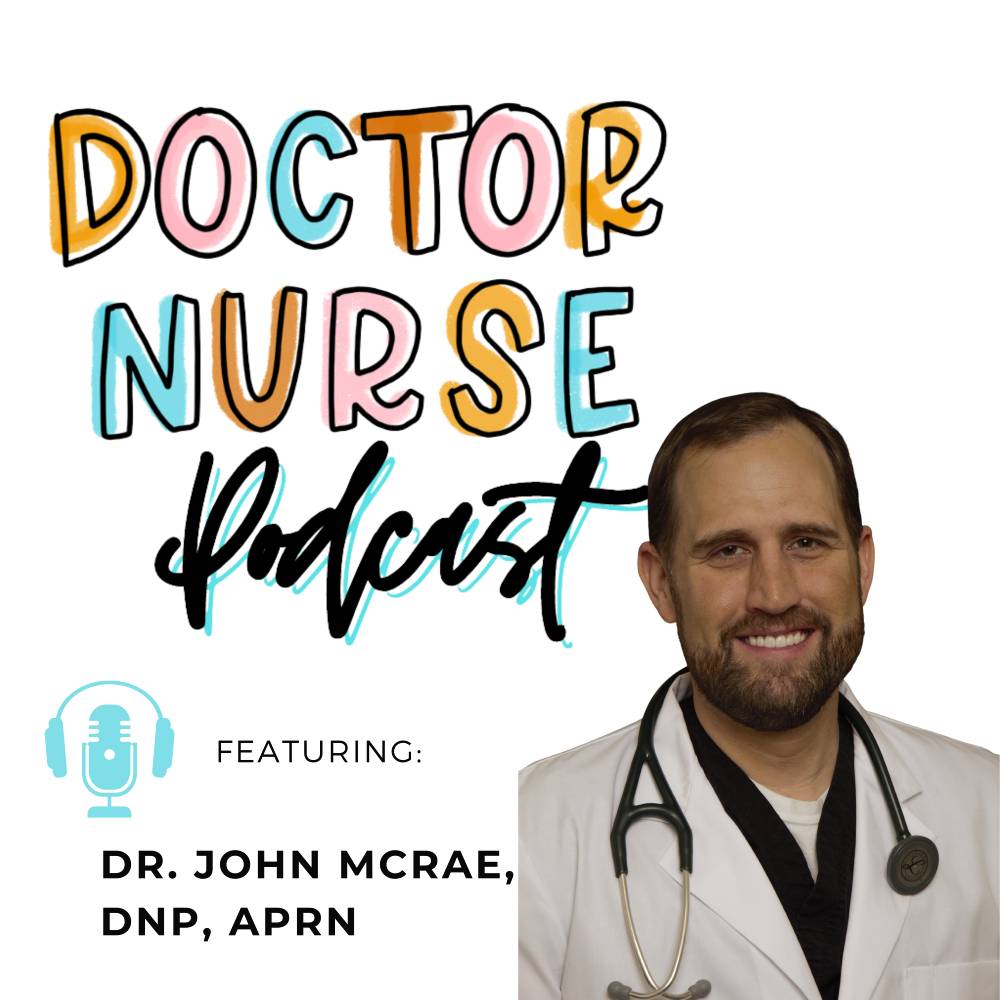
Sandra Pagenta: [00:00:00] Hi, doctor nurse podcast. Thanks for listening people. We’ve got the wonderful Dr. John McCray McCray. He is a doctorally prepared nurse practitioner. Your family, nurse practitioner. You also have your masters in public health. I like to hit on anything you’ve got, because it is important. You spend time investing your energy and your money and just your.
Okay, so you need credit for it. So let’s start kind of with your history. And I’d like to just kind of take it from the top and just let our listeners know where you’re from and then kind of your expertise. And then we can get into your journey, but you grew up in Idaho and after high school, you went to the university of Idaho with the thought of becoming a doctor.
After applying to dental school a couple of times, trying to kind of see if you can get in it just wasn’t happening. After trying one last time in 2007 to get into dental school, you went and got your bachelor’s in nursing, and then you fell in love with patient care. And then in 2011, [00:01:00] you finished your degree. You started as a bedside nurse after trying to climb the corporate ladder, realizing this is not going to be a way that I can create change.
You decided to become a nurse practitioner. Which then you realized you also can’t create a whole lot of change there working for the system. So. After that program was finished in 2016 you started your own business in January of 2017, that did not take you very long to figure it out. And you got started in aesthetics and you found a passion for that.
And then it looks like during the pandemic time, you started learning how to create courses, to teach other healthcare professionals, to do aesthetics and other procedures that you know, Very well because of your business, how to do. And so you’re married for almost 20 years. Wow. And you’ve got some babies and you have a cat and a dog and a hedgehog.
So
Dr. John McRae: yeah, life is good. Well I’m Hey, I’m, I’m pleased to [00:02:00] be here. Thanks for having me. It’s you know, you put that into a, a five minute nutshell. It was a long time. I have 13 years of education because not necessarily because, oh, I’m an overachiever it’s because I didn’t know what I was doing. You just kind of float with life and you kind of go from.
You know, here to there. But the dental school thing is kind of funny. I have a family member, he’s an uncle he’s, he’s a, he’s a dentist. And I saw he’s about 12 years older than me. And I saw how successful he was in his life because of, continuing education. And so I thought, Hmm, I’m going to get into that.
But getting into dental school is very difficult. The average program only has about 50 slots and they’ll have over 2000 people apply for those 50 slots. Wow. And so when. One of 2000, it’s really hard to rise to the top. I had my biology degree. I went back and got a master’s in public health.
And during that time I keep trying to get into dental school, you know, and it’s expensive. Like you’re looking at two, $3,000 an application process, plus the testing requirements, plus all this kind of stuff and [00:03:00] pre-recs and whatnot. But after I got my master’s degree and I got straight A’s in my master’s program, No.
I’m like, okay, I got a public health degree. My project in my master’s degree was water fluoridation, which is right up the dental alley. And I’m like, okay, they got to let me in. Now they’ve got to let me know. And they did it. And so you get to this point where you’re a little disenfranchised with the world.
You’re like, oh my gosh, what else could I do? But the problem is, is that there’s 2000 people and they all have the same story. Right. If I have a master’s degree, how many other people have master’s degree? Well, the answer is a lot, and so it was just really high, hard to rise at the time.
When I graduated from my master’s program, I, it was during the downturn economics, you know, the housing crash of 2008, 2007 that low between 2008, and 2011, where there is literally no jobs. I could not get a job, but I was noticing as I was looking for public health, There were a ton of public health nursing jobs.
I mean, just a ton of them. And I’m like, holy smoke, but they all required a nursing degree. [00:04:00] So my wife goes, my wife years ago, she goes, you should become a nurse. And then all of a sudden, she was like, I told you, you should’ve become a nurse. Your wife’s always right. Right. Somebody was, I went back to school, got my nursing, my baccalaureate and in nursing.
And I loved it. I love patient care. I love the science behind it. I’m like screw dental school, I’m going to become a nurse. So I got hired by a hospital in right out of school in 2011. And I said, Hmm, I’m going to climb this corporate ladder. They hired within I’d have tons of opportunities.
And I dove into that bureaucracy and I got very jaded very quickly because all it was was talk like you go to all these meetings and they just talk, talk, talk, talk, talk. And it was all about the money. How could they be more fiscally responsible? And what ended up happening from all these meetings is nurses took it.
You know, they took the, you know, you make a change. And it was usually for the detriment of the nurses, more patients, more were less [00:05:00] resources. It became distant. I was just disenfranchised from it. I’m like, I can’t do this for the rest of my. I went back to school again, working on degree number four and three years later, got my doctorate.
When I finished my doctoral degree my project that I did and my doctorate was an oral cancer screening and primary. And when I was doing that, I worked a lot with dentistry. Right. Cause that’s kind of my
Sandra Pagenta: love.
Dr. John McRae: You love it. Well, yeah. It’s kind of interesting , you say that, but yeah.
So I did this oral cancer screening project and I worked with dentists and I saw how dentistry worked versus how medicine works because you know, I was trained in the medical model. Dental model is completely different. It’s it’s just that well, in the medical model, what are we training? We go sit down with the patient, what’s your chief complaint.
And then we work them up by asking a bunch of questions, right? Yeah. And by the time we’re done asking questions, I mean, you know, this you’re, you’re an NP, but once you’re done with those [00:06:00] asking those questions, you pretty much know what’s going. Right. You do a quick physical exam just to confirm what your hunches and then you assess, and then you plant assess plan implement, or excuse me, then you diagnose and treat dentistry.
Doesn’t do that. Dentistry is a, I call it a doing model versus a thinking. So dentistry, what they do is somebody comes in, oh, you got a tooth toothache. Let me look. They go straight to the looking. They don’t ask questions. They don’t I mean, they’ll ask a question or two, but they go in and they go straight to the treatment mode.
Right. That’s how they’re doing. And they’re also trained on a very specific system of the body, which is, the oral cavity, and they’re all cavity, right. And they’re not really trained to look at labs or look at you know, other diagnostics other than, you know, x-raying that well, that’s what the mass part of the body.
And there’s a lot of things that go on with the mouse that have other health implications. They’re going to, do
Sandra Pagenta: you like, do you feel like that [00:07:00] is an incomplete model? Okay. So you are against that model. You feel like it’s not
Dr. John McRae: complete? I don’t know if I’m against it.
I mean, it works for what they do. It’s just lacking.
Sandra Pagenta: I was going to say it because I feel like when I’ve left the dentist personally, I always leave. And I think like, that’s. I mean, that’s kinda how I feel like when I leave the dentist sometimes. And I, I told my husband this, I said, I, it almost feels like it’s kind of voodoo medicine.
So I mean, like, I love dentists. They are amazing, but sometimes I kind of feel that way. Okay. Is that it? All right. I’ll go home and nurses to then get a root canal. And I guess that’s what we do. I don’t know. It feel like there’s there’s something lacking is what it feels like
Dr. John McRae: to me.
And under the converse of that in medicine. They don’t spend a whole lot of time on the mouth either. Why there’s a whole profession for that. And that’s a lacking key proponent of medicine as well. And so anyway, so I’m doing this project, I’m working with dental professionals and I’m learning how they do things.
And then I see how medicine does things and I’m, I’m [00:08:00] looking at this going, okay, there’s a niche. Like there’s a crossover, there’s a gap. So my last year of my NP program, I got this really awesome opportunity to work at the VA. They actually paid me as a student of the VA, some VA.
Centers of excellence and you can actually be a paid student at, as an and work as an NP while you’re in NP
Sandra Pagenta: school. I think it’s called like the valor program for for nursing. The
Dr. John McRae: nurses it’s called the valor program. I don’t know exactly what it’s called for NPS. The valor program actually pays. Then the NP one, I made like 12 bucks an hour or something like that, but it doesn’t matter because I would have been willing to do it for free.
Right. It’s like an internship. But so for that last year of my doctoral program I had my own patients. I mean, I was, I was, I was working as an NP, which was really cool. But anyways Where was I going with that? Oh yeah. So I got, I got kinda jaded with the weight and peas are treated in medicine. I mean, the VA is very good with, to their [00:09:00] NPS, but in all my other rotations, you know, and PS got slammed with patients.
I mean, you’re seeing 20, 30 patients a day sometimes in these primary care practices. It just, I could just see the burnout, like you’re going to get burned out in this model. I’m like, I’m not going to do that. I don’t want to, I’ve already been burned out once as a bedside nurse. I am not going to be burned out again as a nurse practitioner.
And so that’s why I started my own business. But anyways, when I saw I graduated in. And I started looking at jobs and I realized, okay, if I work for somebody, they are going to work me off. I mean, they were just going to work me until I’m dead and then I’m going to, I’m going to quit. I’m going to go someplace else.
And then they’re going to work me till I’m dead and it’s not going to be very fulfilling. That’s not why I got in that spotlight got in. So after looking at around a few jobs, doing some interviews, I’m like, okay, I’ve got to start my own thing. So back to the dentistry thing, my uncle who I told you, I, he was 12 years older than me.
He had a [00:10:00] successful dental practice. Well, he had just built this big, huge building. And he was only using about two thirds of it. And it was about a third that was just kind set vacant. And I go, Hey, let me set up shop in your dental practice. I’ll form my own business. Which is called mountain west medical services.
And we’re going to do a crossover, like I’m going to fill in the gaps at dentistry Smith. And that’s how I started the business. And so he goes, okay, well, what does that look like? So anyways, what did I end up doing? Is he did a lot of surgeries. Like he was more of an oral surgeon,
Sandra Pagenta: general surgeon.
Dr. John McRae: Yeah.
So he does a lot of like implants and bone work and bone grafting and things like that. So I started off just doing. His preoperative screenings. So
Sandra Pagenta: I wanted to add, at least we’re here in Florida. Nurse practitioners can step into the dental world from like my scope of practice when I’ve read it.
I didn’t know, we could work with dentists, but like, I believe at least here in Florida, We’ve got the capacity to go into [00:11:00] the dental world and work in that. You’re the first one I’ve ever talked to. That’s been kind of in that role.
Dr. John McRae: Yeah. So I’m in Idaho and Idaho is a very rural state and we probably have all the states have the most liberal roles to our practice. They want, they want you to do anything you can, you think. That you, that you can get trained to do. So I do a lot of stuff that in other states you’re not going to be able to do I work completely independent.
So yes, I’m in the dental world, but I’m completely independent product provider. I can prescribe any kind of medication. I can purse. Well, two with a few exceptions, but I’m fully, I have a full scope of practice authority here in Idaho. And the reason why Idaho does that is they want. To be in a rural setting and they want you to access to care, access to care.
Right? So that’s kind of how that’s kind of the philosophy behind it. Which is a great philosophy. So they have a very liberal scope of practice. If you look at our scope of practice laws, it’s written in a way that basically says they don’t give you a lot of limitations to just say, Hey, get the training.
And if you can get competent at something, [00:12:00] go for it. And so. That’s kind of how it is. So anyway, so I’m open up my dentist, uncle D the dentist, and I started doing these things that that he can’t quite do. So I’m doing lab work and stuff for his patients. And I started kind of like a little primary care practice, but I wanted to focus more on wellness versus treating sickness.
And so so I started kind of diving into wellness and why people feel crummy versus why are they sick? I started playing with like hormones and I started you know, doing weight management and stuff like that. And I wasn’t quite Getting to the bottom of the root cause. Like why do people feel fatigued all the time?
Why do people feel tired all the time? Why aren’t they what’s going on? You know? And, and so I kind of in 2019. This is a couple of years after you know, starting the practice. I I started treating people with neuromodulators, which is a fancy word for like medicines, like Botox to treat TMJ issues, a [00:13:00] dental problem.
Okay. So you could put some neuromodulators into the muscle. Clench and grind and you can help alleviate cranial facial pain which led me into kind of aesthetics as well, because you use Botox for aesthetic reasons too. But anyways, I found out I was like, okay, well, why do all these people have these TMJ problems?
Why are they clenching and grinding? And I found out I went to a conference that 96% of people that clench and cry. Have sleep disorder breathing such as sleep apnea. Right. And I’m like, holy smokes. I didn’t know this. So, and dental, the dental world, they they’re, they’re big on treating airway. Like they have a whole subset in their, in their, in, in dental, dental practice where they treat airway and they do that by jaw repositioning and, you know, treating TMJ and stuff like that.
And so I started going to dental conferences. And I started learning about airway from the dental side and come to find out it’s a freaking problem. Like there are tens of [00:14:00] thousands of people that have sleep disorder breathing. I see it all the time. I S I walked down the street and I could just see it on people.
Now. I know I’m serious. My uncle and I, we started this brief. Practice and we’ve started. We S we, we went to the, we got all the training in 2019, and then 2020, we started treating people for airway and I do all the workups for them. I do the sleep testing. I, I do laboratory testing.
And then if they have a dental, there’s a dental option to treat, sleep apnea. And if they have, if they meet those criteria, then he’ll, she’ll treat the sleep apnea. Well, anyways, we did it as a afterthought in both of our practice. We’ve treated. In fact, I just got the statistics a couple of weeks ago.
We treated in the first year, so 20, 20 minus then pandemic, we treated about 144 patients or 154 patients. Of which 20% of them ended up in some sort of oral appliance that, you know, he fitted them too, but was there like
Sandra Pagenta: a sleep machine, something
Dr. John McRae: to help them? [00:15:00] Well, that’s not like, see PEPs an option.
Like if they need a C-PAP I’ll, I’ll manage that, but there’s there’s oral appliances you could put in somebody’s mouth that advances the jaw and opens up the airway. We started looking at it and we were bringing in about almost $18,000 of revenue a month doing this as a happened thought.
Okay. Like as an afterthought and yeah. And so anyways, long story short, next year, we’re going to start another business. That’s focused solely on breathing and We’re going
Sandra Pagenta: to bring up. There is a big movement of breathing. The wind Hoff method. People are getting really into breath work. For sure.
It’s
Dr. John McRae: huge. Well, I’ll tell you to tell you my story on the breathing stuff, and we’re probably going off track here, but I don’t care. I’m very passionate about it. You know, that conference, I told you where I was learning about all this stuff they had. They had a vendor come and the vendor was a home sleep pack asleep.
Okay. And they said, [00:16:00] Hey, anybody in the audience want to do us a sleep study tonight? While we’re at this conference, I raised my hand, they gave me a sleep study. So I go back to my hotel room. I take the sleep study next day, I wake up, I go into the conference, they have all my numbers up on the, on the screen and I have sleep apnea.
And I’m like, what is going on? I mean, I had, I had sleep apnea and I hadn’t quite yet, like I know. Right. And so I’m like son of a gun. This is a huge deal. No wonder. I feel like crap. And then that was my aha moment. If I have sleep apnea and I’m a medical provider and I didn’t recognize that I have sleep apnea, I’m treating how many of my patients have it.
Wow. And so anyways, I went back and we fit in myself in this oral appliance that, that PA that expands the palette and, and moves the mouth and stuff like that. I’ve worked for two years and I cured by sleeping. Like I no longer has gotten there. I just did a sleep study a few months ago.
And I w I went from about 15 APNIC events an hour to four, which if, you know, [00:17:00] medicines you need at least five did have sleep apnea. And so it forced me to breathe through my nose. The nose is what supposed to filter out all that crap. My story, which is about two years old, and now I’m fixing patients.
I saw this woman a couple of weekends. She had a tongue problem. She had sleep disordered breathing, because she had a tongue tie, which we don’t get trained on school on how to evaluate
Sandra Pagenta: that in neonates, that like when they’re born,
Dr. John McRae: they don’t fix them as a neonate.
They have that tongue problem, their whole life. Right. We did a tongue tie release on her and did something called myofunctional therapy, which is like physical therapy for the tongue., I work her up. She gets treated.
I don’t see her for a year. She comes back into my office a year later and I walk into the exam room and I don’t recognize her. And I’m like, holy smokes, you look amazing. And she goes, yeah. And I go, what’s different. She goes, I breathe through my nose. And they go, what do you mean? She goes, well, ever since you fixed my tongue, I can breathe through my nose.
I don’t have sleeping issues anymore. I sleep, she had lost 18 pounds, not even trying. [00:18:00] She exuded health where, before she looks sick now she looked healthy and she goes, this has been the most amazing thing in my life. You know, we ran her labs. All her inflammatory markers had gone down. Her cholesterol had gone down.
Why? Because she’s sleeping and breathing through her nose. About 25% of my practice now is on airway and sleep. And I work up a lot and I’m going to be transitioning that over to a new, a new business. Next year, we’ve got an investor that’s going to be funding it. And it’s incredible. Yeah, it’s pretty cool.
Sandra Pagenta: Pretty cool aspect. You’ve got the Botox, which you also do teachings. When I was in. Kind of what you’re involved in you’ve described that you really wanted to give back to the nursing profession, you enjoyed mentorship. And so you said, how can I create, you know, something that I can continue to give my knowledge to those who want, who want it, who are, you know, starting
Dr. John McRae: off in their career at
about, I think two years ago Idaho state university, which is where I got my doctoral program through they [00:19:00] asked me to be a professor and an adjunct.
And so I taught a few courses and it was great. Unfortunately, They don’t really pay that. Well, like I was getting like a couple grand to teach a course type of a thing and it, but I did it because I was passionate about teaching and whatnot. then COVID hit and I shut my practice down for six weeks.
Like most of America shut down. And when you are self-employed and you require to be working to make money and you take six weeks off, it almost bankrupted. It was not, it was not a good situation. So I thought, this is going to happen again. What can I do to help the revenue stream?
And so I started the Dr. John courses in, in w over the summer of 2020, we filmed some, e-courses and then we developed our curriculum and whatnot, and I go, and I told my marketing team. Hey, let’s build this. And let’s focus on nurses. So we built a funnel on Instagram and we focused on nurses and we’ve done a lot of engagement with nurses , podcasts like these and whatnot.
And the reason [00:20:00] why I wanted to focus on nurses is COVID really has screwed up the nursing profession. There’ve always been burnout in nursing. When I was in school, I did a paper on burnout and all the literature on burnout, they use nurses as the example, the case study.
And these are like psychologists that, yeah, these are psychologists that are, are working on burnout and they used the nursing profession as the quintessential job that you’re going to get burned out. And so we had burnout before. And then COVID comes and the burnout now, it’s ridiculous. Like I had a patient come in last week who was a nurse on the unit I used to work at in the hospital and I go, oh, how’s everybody doing?
You know, blah, blah, blah. She goes, there’s only three people left and I go, what do you mean? There’s only three of your class. She goes, there’s only three people on our unit that are actually hired to work. Our unit. The rest are traveling. Now when I left, there was, there was 60 nurses on our unit that we, that we had hired ish.
They’re down to three. [00:21:00] They lost everybody. And the whole units now have traveled nurses.
Sandra Pagenta: What did she attribute the like the loss of attrition to, did she say, like it was vaccine mandates? Did she say it was just the workload? Did she say it was?
Dr. John McRae: I think it came down to the workload, like.
It’s not so much that they had more patients it’s that the ancillary staff used to help them are gone. Like the certified nursing assistants. You know, when I left the hospital, they had, I think on average eight patients to take care of. And when they left, there was one or two for the whole 35 bed unit.
So it went from eight patients that care four to like 16, and then, you know, the people, that’s what that is. That’s dangerous. And then the people like, even the people use to like stock the rooms, they got rid of those. And the nurses had to stock the rooms, you know, the, the give, right. And then the charge nurses instead of being.
You know, it didn’t have any patients that could help out, they had a full patient load. And so it’s just these little things to where you take [00:22:00] away more and more resources and you go to work and you hate it. And I didn’t realize what kind of stress I was. I was under at the hospital. I, you know, I left several years ago and my son had just had surgery this last spring.
And when I drove into the parking lot and I had to been there to the hospital, I drove into the parking lot, my heart started in, I started getting palpation palpitations, and I had this thought, yeah, I had this thought. I hope I have enough staff tonight. Now, when I left the hospital, I was a nursing administrator and I was responsible for making sure we had staff, you know, and everything.
And I realized I had PTSD, like, oh my gosh, I’m having a post-traumatic stress event right now because I pull into the parking lot. All those emotions came flooding back and I felt stressed out and you’re not even there. So I’m like I was under that stress every single day in the house. Yeah. So anyways, nurses, our nurses are getting burned out and There’s a lot of [00:23:00] nurse injectors out there, but they needed the training.
I created this journey, having done the journey myself in aesthetics and learning what was right and what was wrong. I started off with this little cheap intro course.
It says, Hey, these are the things you need to think about. If you’re a registered nurse. Before you jump into aesthetics and then once you meet all these criteria is, come talk to me. I do bi-monthly zoom trainings, you know, life with me. That is so cool. I’ve made those fairly inexpensive.
And then if they want hands on training, they can come and see me for hands-on training. I started that in January. And it, it got really busy. Like I had no idea how, how, how busy I was going to be. It took a lot and it took a lot of my time, but I was loving it because I’m helping nurses, which I’m really passionate about.
But I’ve had nurses that have changed their life. Like there’s this one nurse, I have a. Who I keep in contact with that I trained I sent her, she sent me a text in the spring and she’s like, Hey, I just wanted to thank you for the course. , I’m doing really well. And I’m like, oh, okay. She goes, yeah, well, I launched this month and I worked a total of 14 [00:24:00] hours and I made $6,000, like $6,800.
And she goes I had no idea. I can make this kind of money as a bet, as a. And I go good for you. She quit her job. She’s a mom. She literally works. Five to 10 hours a week and makes as much money as she would working full-time at a hospital.
Sandra Pagenta: What I I’ve found through having all these discussions with nurse practitioners or nurses that have stepped outside on their own, the fear is one of the.
All the nurses are dealing with, they’re grappling with how do I leave this thing that you’ve kind of found a lot of comfort in. You can expect the crazy, you kind of get used to your abuser, right? When you’re like, no, no, come be free. There’s like a thousand other people and options like don’t settle there.
What’s something that you would say to help a nurse that is struggling with that fear, what would be a tactic you would recommend?
Dr. John McRae: In my training, I actually we spent about 30 minutes talking about this and I have what I call the [00:25:00] obstacles or barriers, the barriers you have.
And one of the barriers is change nurses. Hate change. They hate it. Think about when your hospital or your organization comes up with a new policy and you’re like, why in the heck are we doing this? We’ve been doing it this way for X amount of. Yeah, they don’t want to change. How many nurses do you know that got a job out of school and ended up retiring from that same job?
Like I know of a handful, like at the top of my head, they just don’t leave the, the job, even though they hate it, they come to work and they’re like, oh, I hate this. They’ll work until the day they die. You know why? Because it changes uncomfortable and nurses don’t want to be uncomfortable.
Human beings don’t want to be. Now on the converse nurses hate change, but they actually adapt remarkably well to it. Like all those policies that you think of that your organization is. Changes to adapt very well to it. And so I left, I make sure that they recognize, Hey, change is [00:26:00] scary. Change is fearful, but without risk, there’s no reward and you have to risk on yourself and you can make that risk as risky as you want it to be starting a new business.
Starting starting business can be very expensive. When I started my business, I did it the most expensive way possible, which was called a brick and mortar. You get a physical location. And you start a business. Why is that the most expensive? Well, you got to location, you’ve got to rent.
You’ve got staff, you’ve got a lot of overhead, right? Water, sewer, trash, all that kind of stuff. You don’t have to do a business like that. You could do something very simple. Like one of my nurse, I just told you about how she made her money is her sister was oh, the salon and she went in and one day a week would do injectable.
At this at her sister’s is a long, she paid her sister like 300 bucks a month. Okay. Which is nothing to start a business. The sister has all the insurance paid for, that’s, that’s already taken care of. She had to get some malpractice insurance, which is like [00:27:00] 300 bucks a year for a nurse. And she started injecting.
It’s basically pure profit. The only thing that’s that she’s risking her time, right? Yeah. She had to buy some supplies and whatnot. There’s some risk with that, what ended up happening was, yeah, she risked a little bit of her time, but now she has nothing, but time she left the hospital, she could spend all the time in the world with her, with her.
Right. And that, that story is not unique. A lot of my trainees who hit, who put their, their shoulder to the wheel and really push they’ve become very successful. The ones that aren’t successful are the ones that, oh, they do training. And then they just think that if you build it, they will come. It doesn’t work that way.
You got to work it, you got to knock on doors, you got it. I always encourage nurses to invest in themselves. If you, I mean, think how hard you work for another organization. Now put that same amount of effort at yourself.
You’re going to be successful. Yes.
Sandra Pagenta: And I love that you will never fire yourself. That’s the thing [00:28:00] that I always tell myself whenever I was, I was down one day about the podcast and I was like, oh, I’m not going to have to get it out. And then I was like, so what you’re going to fire you.
Like you’re going to be all right. And I was like, you’re right, Sandra, you’re going to be just fine. You’re not going to find her. You keep muscling girl. There is a different feeling when you’re working for yourself about, you know, something that you’re building that is your passion. You do feel differently about going and working on that.
And then also the life that he creates outside of that, you’re just like, this is awesome. This
Dr. John McRae: is great. When you start your own business, it’s like having a baby and any, but any of the parents out there know. The first little bit kinda sucks. You got this baby. All they do is cry, poop, and spit up.
And that’s what a business is like when you first started. Eventually they start oohing and on at you and, oh, that’s so cute. And eventually they start sleeping through the night and you’re like, oh, this is cute. And then they turn into teenagers. You’re like, oh my gosh, you’ve got all these growing pains.
Right. That’s but my business, like, I got a lot of girls, but at some point your business, you let go. And it runs [00:29:00] itself. And then you’ve got all the freedom in the world and owning your own businesses. Freedom is it’s a lot of work, but it’s freedom. I mean, I work 31 hours a week. I work Monday through Thursday, I’m off two o’clock on Thursdays and I have Friday, Saturday, Sunday off every week.
It’s a wonderful thing. I want to take a week off. I take a week off. If I want to go to a conference, I go to a conference. I have nobody telling me what to do. And that kind of freedom is amazing. You don’t have to get pre approved for PTO. You don’t have to work mandatory overtime. And there’s none of that if you want to.
Great. If not, that’s okay, too.
Sandra Pagenta: Thank you for sharing all the pieces of your journey to where you are today. You’ve told us how, as you’ve told us lows, is there any specific examples of along along the way? Either something you had to overcome a challenge or a moment that you thought, oh, no, my business is going on.
Or kind of like when you, just, when you described like COVID and like just being like, I was going to be bankrupt. Any other moments that you feel like you want to [00:30:00] highlight on for our listeners that can kind of help them relate to the struggle?
Dr. John McRae: My first year of owning my own practice. I had the philosophy.
If I build it, they will come. It’s not how it works. I didn’t understand or appreciate the value of marketing and marketing is incredibly important because how are people going to hear that? Okay. And there’s lots of different ways of doing marketing. It took me two years to figure that out.
Like after the second year my first year I generated $9,000 of revenue in one year. Now I kept my job at the hospital. So I was working that to pay the bills, but I only had nine. I don’t know, 30 grand to get my business started. So $9,000 and you spent 30. The second year, the second year I did, I did a little bit better, so what I did to to get the word out is I got on social media and I really hit Instagram hard. It’s free. It got to the point where it was too much for me to to handle. I now pay somebody to run my social media. But it’s every dollar I spent, I probably get 30 back.
I have a very successful [00:31:00] practice I have on average about, I think I just looked at the numbers yesterday, 71 new patients a month into my practice, which is if you don’t. Yeah, that’s good growth. That’s good growth. And they all find me on Instagram or Google me. It took it. Google’s great, but it takes a while to build up your search engine optimization.
It took me about four years. Popping up on the first page. So you gotta, you gotta work on that too, but Instagram is a great way of just instantly. Yeah, you know, in front of people. When I started, I could look at the day when I started doing marketing and I started doing it well, and I literally started having financial growth.
And so when you start off have a marketing plan, and you’re not going to have a lot of money to do it, that’s fine. Learn, learn the ins and outs of Instagram, learning the ins and out of YouTube channels. One of the nurses I trained he’s a nurse. He already had a business running in in Georgia and he his business was, he would go do COVID testing and do immunizations and stuff like that.
That was his business. He [00:32:00] realized that that’s not going to last forever. And so he contacted me about learning how to inject. He does some training on the side for nurses to do to become entrepreneurs. And he did it through YouTube.
YouTube’s a great way of getting in front of people. There’s a lot of successful business owners. You mentioned that you’re going to potentially. These podcasts on YouTube. Great way of getting your name.
So did YouTube do Instagram? These are all free things you can, you have access to. And if you want to pay somebody to do marketing for you too, that’s great. I’ve played around with a bunch of stuff. Really cheap marketing that you could do is streaming ads like on Hulu and these, you know, every, every network has, they’re actually very inexpensive for a thousand bucks a month, which sounds like a lot.
When you’re starting a business, you can literally get your ad in front of about 30,000 people.
Sandra Pagenta: I mean, considering like how much ads cause for like Superbowl and like you see these big time ads and these are
Dr. John McRae: commercials that people have to watch for these, these training [00:33:00] things. So I played with that a little bit.
I run Google ads. I do stuff like that. I spend about $3,000 a month on marketing. Now, but you know, when I started off, I didn’t, when I started off, I did all the free stuff,
Sandra Pagenta: but you’ve seen that it pay.
Dr. John McRae: It’s such a big deal. Yeah. That’s awesome. and that’s probably how you found me is through Instagram correctly.
I did find it. Any
Sandra Pagenta: mentors along the way, anyone that you felt, or you’d like to give a shout out, that’s really helped develop you and your career and anybody that you do have mentoring you right now?
I mean, do you have any of those?
Dr. John McRae: My uncle, the dentists actually helped mentor me through business. He helped me a lot through that his name’s lawn. We work in the same building. So we see each other every day, which is awesome. I have a brother that’s a lawyer he’s really helped mentor me through like the business side of things.
Like, Hey, these are the legal aspects of your business and stuff. The other thing that’s really important is getting a good accountant when you’re starting your own business. So I have an accountant, Jack Trent. He helps you. Think through things to where you can be financially responsible and a good [00:34:00] steward of money.
I said, as far as like mentors that have trained me, I’ve had a lot. So it’s hard for me to like send out a shout out to like one or two, two different people. But I am a junkie for continuing education. I have spent more. After my doctoral program on continuing education I did on my doctoral program. Wow.
I go to tons of conferences and I’m always learning from people. I fly experts out to train me on certain things. I’ve done that a few times. I’ve flown to other providers practices and learn from them post-graduate education, which, could be expensive. But I’m a junkie for all that kind of stuff.
So like last weekend I was in. Schick or not last weekend, the weekend before I was in Chicago, learning how to do fat transfers, you know, take fat from one area of the body and put it in another area of the body
Sandra Pagenta: and do this in the clinic setting and under anesthesia type thing.
Dr. John McRae: Nope. Nope.
You give them a little, a little value, a little bit of drill, kind of help calm down. Then just take fat from one area and put it in the other [00:35:00] area. I was refining my skills on. Most of what I practice, I did not learn in school. The foundation, like how to treat a patient. Yeah. You learn that in school, like how to talk to patients and whatnot. But as far as the actual science that I’m doing. I didn’t learn that at school. I think that’s important for anybody that’s going to school. You’re not going to come out, knowing everything you’re going to come out, knowing enough to be safe. And then you got to go.
Sandra Pagenta: I think one important thing to make note of as well as, as nurses, nurse practitioners realize that hospitals and taking a job, thinking that, oh, they’re going to give me opportunities for growth.
I have found the opposite. I have not found that I’ve had a lot of opportunities for growth while working under a system. It’s where I’ve stepped out of the system and taught myself whatever it is. No one taught me how to do a podcast. Nobody taught me how to do other aspects. Procedures or whatever, but I’ve sought that out on my own.
And that’s really where that investing in yourself really does lead to growth because [00:36:00] waiting and thinking, oh, my job’s going to get me some Sammies. I actually get denied when I’ve been asked, when I’ve asked my job, Hey, I’d like to go and do this conference. Can I use that money? That’s allotted to me as an, a benefit.
They’re like, no, you have to ask for permission. Whereas. No. If I just invest in myself and I just go learn it. No one’s going to tell me no. I love that you’ve spent more time learning stuff that wasn’t taught in school. And that really is the call to action that I have for all nurses and nurse practitioners is, do not sleep on your degree because if you sleep on your degree and you think, oh, we can just work in the hospital.
You are missing growth. That is, I wake
Dr. John McRae: up at 65, retired from a job. You don’t like exactly.
Sandra Pagenta: Miserable and you’ve missed your life miserable. I don’t want
Dr. John McRae: that for you. This sounds very cliche. But it’s the absolute truth. I, I like going to work on my. I have we’ve we took like five days off and I’m kind of bored right now, which is why I scheduled this podcast.
Cause I knew it kind of energize me during this, with this [00:37:00] week off. I mean, time off is nice, but like I look forward to Monday, like I got tons of fun stuff I’m doing on Monday and I really enjoy going to work. And that sounds so cliche because nurses can’t wrap their minds around that because the job kind of sucks.
Right. And you work for somebody else it’s work when you work for yourself. It’s you’re growing something that’s yours and it is different. So if you ever had this inclination, I want to start a business or I want to work for myself, but go for it.
Sandra Pagenta: what is a piece of advice that you said you wish you would’ve known? If, you know, if you did start off in your career and if, if, for example a nurse that she’s just starting off and she’s like, what do I need to know? What do I, again, I think you just answered it. So you really could just reverberate what you said, but just the thought of like, what is something that you wish you would’ve known when you started off your career?
Dr. John McRae: That’s the one regret I have in life is I wish I would’ve known the joys of business ownership in my. Like that I would have done that so [00:38:00] much sooner because I’d be right now in a situation where instead of having a teenage kid as a business, I’d have this like full courses that’s running itself. Right. Because it takes you, it takes some time. You’ll never not value taking a risk in yourself.
Like when you risk in yourself, Yeah, you might sell. Let me look at me. Geez. I tried to get in a dental. Three different times and I failed, but that’s okay. Something else always pops up and then you’ll be successful at that.
Sandra Pagenta: Now you’re working with a dentist and you’re doing so awesome. I just think it’s so full circle.
I want nurses to find their passions outside of nursing and then find ways to merge them or even find ways to just go be happy, doing something else in life. Nursing fuel your other dreams.
Dr. John McRae: I just had this flashback of when I was a bedside nurse, I had this patient who was a pharmaceutical rep and I was walking him in the hallway and he was a head honcho in this pharmaceutical company. And he goes, yeah. I only hired [00:39:00] nurses to be. My reps and I go, oh yeah, why’s that he goes, because they know how to sell. And I said, Oh, not me. I hate selling. Like that’s not for me. And he goes, oh, that’s funny.
He goes, you’ve made me do 10 things today. I didn’t want to do.
Yeah, exactly. And that’s it. That’s exactly what he said. And I kind of stopped and that took pause. I’m like, holy smokes. I do sell, like I sell. People at their worst, like these people are sick and I’m making them do things they don’t want to do. Just think about what it’d be like if you’re helping somebody do something they want to do and how successful you feel.
So sells is huge and business. Like any kind of business you’re in, you’re going to be selling yourself or your product. It’s true. You know how to do it. If you’re a nurse, it’s truly any healthcare.
Sandra Pagenta: Yeah, I agree. Oh, John, this has been an awesome conversation. Last part of our interview is the rapid fire questions.
Questions, questions, questions. Let’s do it. [00:40:00] So yeah, let’s go. Your dad. So what’s your favorite Disney animal?
Dr. John McRae: My favorite Disney animal. You have to watch Disney. I love the lion king. So I’m going to say.
Sandra Pagenta: Okay. All right. So you send that
Dr. John McRae: pretty fun too. Yeah,
Sandra Pagenta: I agree. Doris tours. Hilarious. Okay. So tell me about one of your favorite solo artist.
Do you have a favorite solo artists? I do a Taylor swift fan.
Dr. John McRae: No, not that I’m a solo artist. Well, when you said artists, I went right to the violent femmes, which was the band I loved growing up. They’re not solo. I do appreciate Whitney Houston. She was talented.
Yeah,
Sandra Pagenta: no, she definitely brings it. And then for the final question, what is a city that you wish to live since you’ve only lived in Idaho?
Dr. John McRae: Good question. I have one of my favorite cities is Nashville. I’ve done a lot of conferences in there. I love that place. The food is amazing. The weather’s awesome that people are nice.
It is a cool town. if I didn’t live in where I live, Nashville would be. The top of [00:41:00] my list.
Sandra Pagenta: I agree. I think Asheville and Austin are two cities that I just think are just like weird and they’re just cool. And you just get a different vibe from those cities. You’re like, I can do this all day.
So thanks for your time today. Thank you for coming on the podcast and sharing your journey. I know that it’s going to help a lot of people and it’s going to inspire a lot of nurses to seek freedom. Can you tell us again just where we can find you if a nurse was looking. To seek you out. I know you’re on Instagram, share your spots where people can find you.
Dr. John McRae: I have two Instagram sites. One is for my business, which is mountain west medical. So at mountain west medical, you’ll find that. And the other Instagram is for nurses that want to be more self-sufficient and that’s at Dr. John McCain. So D R J O H N M C R a E. That’s more that’s more for nurse preneurs as, as I call them.
So your seeks out there, if you want to look at my website, mountain west medical.com. And if you want to get ahold of me, you can send me an email at info [00:42:00] at Dr. John courses, D R J O H N courses.com. You can send me an email that way we have to respond to.
Sandra Pagenta: And I will link all that in the show notes guys.
Thanks for listening today.
Dr. John McRae: And yeah, thanks for having me on. I appreciate it.
Podcast Description
Dr. John McRae, DNP, MPH, NP-C grew up in Idaho. After high school went to the University of Idaho with aspirations of becoming a dentist. Started a biology degree. Transferred to Boise State University and finished biology degree in 2003. At that point tried to get into dental school and was unsuccessful. Decided to get a Masters degree in Public Health. Went to A.T. Still University for degree. During that program tried a second time to get into Dental school…again failed. Finished Masters degree in 2007 and tried one final time to get into dental school and failed. Started looking for public health jobs and noticed the only ones available were for nurses. So in 2008 started BSN program. Fell in love with patient care. Finished degree in 2011. Started as a bedside nurse with aspirations of climbing the corporate ladder. Very quickly was jaded by bureaucracy in healthcare. Decided corporate was not for me. Went back to school for DNP as a nurse practitioner. Finished that program in 2016 (3 years). 6 months later in Jan of 2017 started my own business. Got into aesthetics and found a passion for that. In 2021 launched Dr. John training brand which has been successful. In 2022 planning on starting another business focused on breathing.
Married for almost 20 years. Have three children…boy, girl, boy ages 15, 13, 11. Have a dog, cat, and a hedgehog. Life is good!
Dr. John’s Links: msha.ke/drjohn/
Doctor Nurse Podcast Links: linktr.ee/DoctorNursePodcast
Latest Episodes
Doctor Nurse podcast brings you weekly shows to help INSPIRE, EDUCATE AND EMPOWER nurses with true stories of initiative and impact.
Doctor Nurse podcast brings you weekly shows to help INSPIRE, EDUCATE AND EMPOWER nurses with true stories of initiative and impact.
Latest Episodes
Doctor Nurse podcast brings you weekly shows to help INSPIRE, EDUCATE AND EMPOWER nurses with true stories of initiative and impact.