Also Available On






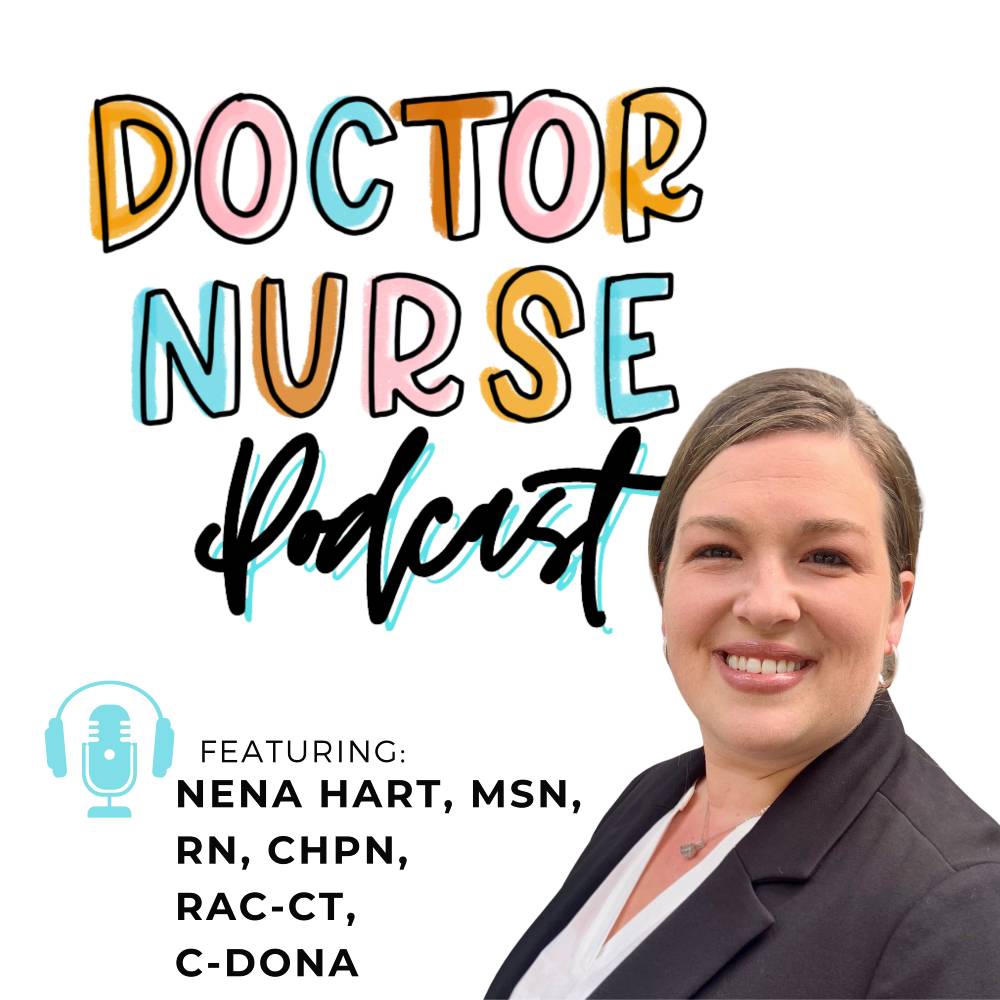
Sandra Pagenta: [00:00:00] Hi, Nina. Welcome onto the doctor nurse podcast. I am so happy to have you on, so happy to hear your story and share with all the nurses out there, what you’re involved in and how you made your career, what it is today.
So let’s dive in.
Nena Hart: Thank you. I’m so glad to be here.
Sandra Pagenta: Great. So the first question I ask everyone is kind of describe what you do for a living. Tell me what your current job title is and what you do on a day-to-day basis.
Nena Hart: Okay. Well, my current job title is I am the owner and executive consultant at my own company, heart health care solutions.
So on a day-to-day basis, I am working with hospice and long-term care organizations to Help fix problems and improve the overall stability of the organization, whether that be through survey and regulatory or staffing or culture. So it’s very exciting.
Sandra Pagenta: At what point do you start the breakdown process of these are the problems, and this is how I get you to solutions can walk [00:01:00] me through
Nena Hart: that process as soon as possible. A lot of times. Looking into your own organization, you see different problems, you’re comparing benchmarks of your goals and your organizational focuses and an outside person who’s learning your systems and interacting with your staff and your processes sees something totally different or issues that you.
Maybe don’t consider as urgent as someone else who is less emotionally committed and less ingrained in the day-to-day
Sandra Pagenta: that makes sense. It’s fresh eyes walking in, not, emotionally invested. You just want to have you’re about getting the results that you need to get this place or whatever the client’s business, fully operational, that’s pretty cool. How did you get to this? Career this job, walk me through the moment you decided to become a nurse and then those tiny micro decisions [00:02:00] or those jobs that you took or whatever those little moments are in your career that led you to this specific spot.
Nena Hart: I love that question and I love talking about this. I started as a CNA, a nurses aid, a certified nurses aid. At 18 and there was no motivation behind that. I just signed up for a local class. I think it took six weeks and I liked it. I liked helping people. I liked meeting new people and I had no idea what healthcare was like, especially long-term care and nursing homes.
I just. Had no clue what I was coming into. I was in school for early elementary education to become a kindergarten teacher, which took me one round of curriculum to figure out I’m not a kindergarten teacher. And I got married and I was working third shift as a CNA and I just saw these people.
Who needed so much from us and everything was so broken and [00:03:00] nothing made any sense. And there was no commitment and everything was so messed up. And I went home and I told my husband, I’m going to be the director of this place. And I’m going to make sure these people get taken care of because this is not right.
It shouldn’t be this way.
Sandra Pagenta: Were you seeing that made you think like, this is not right? What were you noticing?
Nena Hart: You didn’t care about their patients, people who treated their residents in long-term care, they’re called residents. Cause they live there. That’s their home who had no respect for the needs of the elderly and that they’re a person, they’d walk in and say, it’s time to go.
I cannot tell you how many times I’ve seen that happen. How many times that happened is so simple. And it seems, and if I said that to a CNA right now, they’d be like, okay, it is it’s time to get up. What do you want me to say? And it’s like, well, I want you to say it in the way that you’d like it said to you, Hey, are you ready to get up this morning?
And if they say no, turn around and leave. Yeah. Like, it’s not a task that you check off the [00:04:00] box. It’s a human being. It’s very easy to do, to become task oriented as a nurse, as an aid, as someone in healthcare. If I don’t have him up by breakfast, he won’t eat. Or if I don’t have them up by breakfast, I’ll get in trouble because my section isn’t ready.
Oh
Sandra Pagenta: yeah. Yeah. Right. So there’s
Nena Hart: a lot of. Determining factors as to why systems are broken and the culture in long-term care is the way it is. That was almost like an unconscious mission that just triggered at that time. At the same time I had my first daughter and she was born with gastroschisis. And so all her organs were on the outside of her body, below her liver. So it’s super rare. It’s not rare anymore. Yeah. So it was one in 15,000 when she was born in 2005. And I knew from 20 week ultrasound, that that was going to happen.
My doctor called me and said, here’s what we saw on your 20 week ultrasound. And I was an aide at this time at a nursing home work. And I said, do I need to stop working? Can I still work in my own bedrest? No, [00:05:00] everything is normal. We’re just gonna put you with a specialist and they’re just going to watch it.
There’s nothing we can do. So they originally had told me, like only a small loop of bowel fell out, so it’s fine. She’ll be born. We’ll stick it right back in and we’ll sew it up and she’ll go home. Yeah, and that was not what happened by 37 weeks. Everything had come out of that whole next to her umbilicus.
When she was born, she was at actually at Riley children’s hospital in Indianapolis and there, I met some of the most amazing nurses I’d ever met in my life. And I was still an aide at the time. And she almost died. She got an infection. She was on TPN. She was on vanc and morphine and intubated.
And, she’s much like her mother, so she’s very stubborn and they would, they would put the silo back on to try and by gravity, allow the organs to go back in and she’d pop it off and we’d start over. They suture should they sutured it into a bumper and she popped that off.
Oh my
Sandra Pagenta: gosh, this is crazy.
Nena Hart: I learned a lot. Yeah. I learned it and she’s [00:06:00] beautiful and healthy and 16 now. And just, you never know other than she doesn’t have a belly button, you might notice that. So. Okay. But that kind of gave me a brand new perspective to nursing kind of like you said, when you had your son.
It’s it just changes, everything, changes everything. Yeah. So I went back after she was in the NICU. She was in Riley for 13 weeks. So she came home with an NG and we worked through that and just learning, learning, all those things. I enrolled in LPN school to get my, my LPN license and.
Was able to complete that and worked as a charge nurse on the floor for a while. And then pretty much immediately went back to get my RN. So just as a general rule, a director of nursing has to be an RN in most states. So I went back to get my RN immediately after I finished. So when you went
Sandra Pagenta: back for your LPN, did you stay in that residential healthcare setting, or did you go to the house?
Nena Hart: Nope. I worked as an aide on the weekends. I did weekend doubles for awhile. And then I went down to [00:07:00] PRN at the end, I think, while you were in school. It’s hard to like work full time and do swell. My gosh. Yeah. Yeah. And my daughter by then was, you know, 18 months I think.
I got pregnant with my second child, my son during my RN, and ended up having him two weeks before graduation and could only miss six clinicals. I was like, no, where at the end we are doing this. Like I cried on the way to clinicals every day for, you know, three solid weeks. I don’t, I don’t remember.
Let’s see, I had it. February 4th and I graduated May 10th or something like that. So
Sandra Pagenta: that’s like not
Nena Hart: even eight weeks. I think I missed, I missed two weeks sick. I missed all six clinicals. I could miss. I couldn’t be absent all year. I couldn’t take any, I couldn’t miss any time because I was saving it. For when I had him.
So I had him over our spring break. I told my doctor look, we are on a tight schedule here. So, he induced me. So that I could finish school. I cried every day to clinicals. After I would drop him off. He wasn’t even old enough to go to daycare. He had to go to a [00:08:00] friend of mines because they won’t take him under, at daycare under six.
So I finished it. The moral of the story is I did it. I worked as an RN in a couple of different settings as a A nurse on acute rehab at the local hospital, which was more of the long-term rehab unit. And then I worked as a hospice field case manager during that time.
Absolutely loved that. One of my favorite jobs of all time, because
Sandra Pagenta: of being in the field as the case manager. But why did you like that so much? What about it? Did you like
Nena Hart: you’re playing their ball game now? This is not an institutional healthcare setting where you tell them the rules and they follow it.
You’re going into their house. It like opened my eyes to how people live and it always was so interesting. I was on call a lot of the time and, you’d have after hours, we had a lady after hours.
You know, through a mucus plug and what do I do at 2:00 AM with, I don’t have a nebulizer or a suction in the trunk of my car what are you going to do? you have very limited response. [00:09:00] So I’m calling the medical director saying. What do I do? And he said, check your pulse. You’re freaking out.
Sandra Pagenta: Yeah. Check your pulse, check your
Nena Hart: pulse. You’re freaking
Sandra Pagenta: out.
He was the best.
Nena Hart: So, you know, and he was there at 2:00 AM, walking me through it. Okay. Calm down and take a breath. Let’s think about what you can do, what you’ve got in the home, how you can prepare the family for what’s happening to her. This was half a mile from my house. You know, this, I, my husband knew these people from the fire station.
Like these are, these are people in your community that you’re interacting with.
Sandra Pagenta: I did a rotation, a couple rotations.
Where I went into people’s homes as well for home health. And there’s such a vulnerability. There’s such a connection. You get with someone when you go into their personal space and you care for them. It’s different. It’s unlike totally different. It’s just, you’re right. Like you said, it’s like, now we’re playing on your home turf, , you’re playing online and now I’m playing on yours.
The walls are down with patients too. I just feel like they’re just like, here’s [00:10:00] my place like coming inside. I get why nurses went to your house and cared for you in your home.
. It’s a different dynamic. I think it’s really good to experience that because you see people as people
Nena Hart: yeah. You see them home. You see what they came from, when they come to your setting, it’s, it’s like, okay, you have to be this this way here.
And we have to do this. Like I said, that task oriented mindset that we get into as clinicians sometimes, and at their home, it’s not that way.
Sandra Pagenta: Yeah, they’re a body. When you go into their house, you’re just like, oh, you’re a mom and your dad and your grandma and your pictures on the wall.
Nena Hart: And, and there’s a hole in your floor and there’s cockroaches here and there’s no power. And there’s a bottle of morphine next to the toaster. And, all these things that are not even on your radar. When you’re in a clean well lit institution where you have all the tools you need to take care of them.
Sandra Pagenta: Yeah. That’s crazy. So after doing the hospice home health ,
Nena Hart: where did you go [00:11:00] next? I saw an ad in the paper. And it was for a Don of a local facility, a director of nursing.
And I thought I’m going to apply for this, even though I have zero management experience. And in my mind I knew I was totally unqualified, but I knew I wanted to do it. And so I applied for the job and I got it. I got the job and I was my first director of nursing job. I was paid $27 an hour. So many nurses, I know started that as an RN now.
Sandra Pagenta: Yeah, I think I started at like 22 and that was 15 years ago almost.
Nena Hart: I started it at 22, 15 years ago. Yeah. So it was more about the opportunity for me. that was what I had been working towards. That was your dream. Yeah, that was my dream. Yeah. Yeah, it was a rude awakening. It was one of those dreams.
You’re like, Hm. I see why this was so hard now. And maybe I harshly judged these other people trying to do this. Yeah. It’s
Sandra Pagenta: humbling. Right? Real
Nena Hart: humbling. Plus what’s throw in [00:12:00] there that I was twenty-five and so the people working for me were any, twice your age, older than me.
Yeah. So I had to work twice as hard. As everybody else to get half the respect as anyone else.
Sandra Pagenta: How did you overcome that? Where did you put your mind in order to, just to get that respect? Like, what were some of the techniques you put in place that you could get the respect you needed at your job?
Nena Hart: I put in my mind that. Just because I’m the boss or the manager. I actually don’t know more than them. I don’t know more about this facility. I don’t know more about their residents. I don’t know more about the processes. I don’t have more experience. She’s like, I’ve been an aide for 30 years and I’m like, absolutely.
Show me what you do. Show me how you take care of this person, who we can’t figure out why they keep falling. That’s good. Or. How have you been managing this patient who’s combative when you’re trying to get them to the shower. And it showed me a lot of things. I found a myriad of things that were [00:13:00] very positive and very negative.
So I’ve found that there are amazing, brilliant. People who know how to get people to do what they need to do by leveraging their relationship and leveraging their personality and influencing others either with touch or with a joke or with a memory or however they did it. Or with bribery. Let’s we we’ll go get your vanilla ice cream.
Let’s go for a walk.
And sometimes it like that, especially with dementia patients, it feels like, okay. I can’t get them to do anything that they, I can’t get them to eat. I can’t get them to go to the bathroom. I can’t get them to change their clothes. I can’t get them to lay down. It’s a constant struggle when you want the best for that person.
And they’re making a different decision for whatever reason. Yeah. And I also found a lot of negative and sad things. Like I said earlier, even small things like it’s time to get up or you need to take a shower, you smell. You know, who wants to be talked to that way? No one, and [00:14:00] those were the minor things.
The things that didn’t have to be reported to the state or the police yeah, lot of state reportables in long-term care a state reportable would be something like an allegation of abuse of any kind, any kind of allegation, whether or not it’s substantiated. We would do an investigation and report it to them.
My first facility was trial by fire. Literally, I got a call at 11 o’clock that the facility was on fire. So we had to go and evacuate that whole wing the fan above the nurse’s station caught on fire and fell down into the nurses station on fire. Was anybody hurt? No, no one was hurt.
Everyone was evacuated. They did a great job, but it was still scary. And it’s like, what do we do? And I’m like, I don’t know. So a lot of it was learning as I went and asking for help. My assistant director of nursing there had been at the facility for like 20 years. So she was very headed and very entrenched in the facility. And there’s a lot of that that happens. And that’s both positive and negative, but she [00:15:00] helped me through dealing with a lot of the staffing issues and things that would come up with the residents that I am like, I don’t, I don’t know what to do.
Sandra Pagenta: So after you take that director position, did you hold onto that for a long time? Or did you end up going into other positions?
Nena Hart: I didn’t. There was a new kind of survey, a new kind of government survey came out called QIS. I think it’s quality indicator survey and it was based on.
Taking charts to the next level, when you found an issue, that’s goes to the next level. And so they decided that my facility was a great pick for the first QIS survey in Indiana. And so I had the feds and the state there for my first survey as a Don ever and actually ended up going okay. That was like the experience right there of like, wow.
I need to take this up a notch. So I learned a lot from that survey and I ended up taking a position in Tennessee and we ended up moving. That facility was kind of a game changer because they had had a really bad survey that had gotten an IGA and immediate jeopardy, [00:16:00] meaning someone was in the immediate jeopardy of being hired.
Because of the practices at the facility. And they had agency in there because they had so many open positions. And so they were trying to get cleared from that survey. The agency
Sandra Pagenta: might say had like just temporary nurses in, they didn’t have like their own staff. Yeah. Okay. Got it.
Nena Hart: Right. Okay. And so they had an interim director there and she was actually great.
She got things into a much better place by the time I got there. But that was my first fix it situation like, Hey we can do this. And so we rebounded from that bad survey, we got the staffing, got all the agency out and got the staffing stabilized and had a great team. We built a team that was very effective.
There were still lots of issues. We saw this improvement in the facility and the stability of that facility, that was very positive. And so that was my first like aha. Experience of this is what it looked like [00:17:00] before. And this is what it looks like now. And whatever part I played in that felt good.
And we had this , rockstar team, and we did it together. I am still friends with that team. Wow. Right now, I mean like, , those, those people have worked with me and for me and beside me and helped me everywhere. I’ve been sending that day. Wow. That’s
Sandra Pagenta: so cool. So then after, okay, so you go to this, this place in Tennessee and how long did you work at that facility?
Nena Hart: Year and a half before my regional said there’s a regional position in Kentucky and I’d like you to consider it. Whoa. And now you’re moving up again. And so what happened was, is I freaked out and I didn’t go through it that we went up to Louisville. We looked at houses and.
They ended up calling me and saying like, well, the territory has changed. And we originally had you in these buildings right here in Louisville where you wouldn’t have any overnight travel, but we had to restructure. What they did, they eliminated an entire level of leadership. And so that [00:18:00] increased the territory by about three times and they said so you’ll have to be at these buildings and you’ll probably be traveling Monday through Friday.
I still had a toddler at that time. So we talked about it and I was like, I don’t think I can do this. I don’t want to do this, this isn’t right. You know, what, what the original thought was. And so I did not take it. And that was something that I’ve wondered for a long time.
Like, was that the right decision? Should I have done that? Where would I be right now? And during different times in my career, I’ve wondered, how that would have, how that would have changed the, where I am today. Maybe, maybe good. Maybe bad. Yeah. Yeah.
Sandra Pagenta: So after you turned that position down, But you’ve moved.
Right? So you’re now in
Louisville.
Nena Hart: So what do we do now? So we went back to our house in Indiana where we lived and I opened helped open a new facility there. And then we realized like, wow, we really love Tennessee. And we’re just not happy here. So I finished that facility got them through their [00:19:00] survey and we went back to Tennessee.
And the facility I walked into, this is one of the biggest challenges probably of my career, but I immediately noticed that things were not the way they should be. And I tried to bring it up a few times and I wasn’t getting the response I expected. So you were the director of nursing. I was the staff development coordinator.
So I was like, what, what position can I take to get back to Tennessee? And there was this facility there. Yeah. And I’m like, I’ll get there and we’ll figure it out. So I get there and I realized like, wow, the staffing at this, facility’s kind of dangerously low. And I’m seeing like we’re missing PTI and ours and we’re missing labs and we’re missing.
Dialysis records and we’re missing all these things and yeah, we got some wounds going on here that are not improving and they’re escalating pretty quickly and we can’t get people up and we can’t get people to dinner. So I’m bringing this up and I’m bringing this up and it’s one of those [00:20:00] situations where.
I’m not in charge here, you know? Yeah. So after probably, and this is what was a hard decision because I was only there for a few months and I’m like, what do I do? Do I leave do I try and stay and just do the best I can. So I ended up calling their corporate hotline and just saying, Hey, I can’t stay here.
Here’s why. And I just, I feel like I have to let you know, like there are these scary things going on. So they sent their regional consultant to the facility for a mock survey, which is one of the things I say now as a. Long-term care, stability consultant that is not effective. It’s not an effective way to prevent a bad survey.
So she looked at three charts and went back and said, everything’s fine here. This is not substantiated. This is not true. Their systems are good. Their staffing could be better, but this is not an accurate report. You’re getting from the person at the building. So at that point, I thought, well, they don’t want to change it and I can’t [00:21:00] change it.
So I’m going to leave. Shortly after I left that facility had six immediate Jeopardy’s and two K level tags, which means actual harm did occur. The resident with the worsening wound, lost his leg and subsequently passed away. The facility was put on a 30 day, fast track to Medicare decertification. They had several lawsuits result from those negative outcomes and the company that I went to work for when I quit acquired that facility. Oh my gosh. That is full circle. We need somebody to go back and fix it. And I’m like, well, I’m going to need a raise. Okay.
And they said, okay. And they sent me back. They said, go back. Get the staffing where it needs to be build your own team from scratch. So I’m calling those people at that first facility that supported me that I’m like, Hey, can you come with me? Will you come here with me and help me fix this? And it was miserable.
Did they leave? It was absolutely. Oh yeah. They came, they all came and we worked 16 hour days from Halloween to Christmas.
Sandra Pagenta: [00:22:00] My goodness.
Nena Hart: And I had just had a baby. I had a six week old baby, my third
Sandra Pagenta: oh my gosh. Would it be. So you now are back in the director role. Finally, and you’re at the place that you reported and you’re fixing all the problems, which are more than you can count.
Nena Hart: And 164 page plan of correction,
Sandra Pagenta: 264 pages of it. Problems. This is nuts.
From there, how did you get to your own business?
Nena Hart: As I helped turn these facilities around that facility was a huge success. We ended up passing survey, they had like two or three deficiency free surveys after that, where there were no tags, the staffing maintained full for.
Years after that we brought on board a team and systems. And a lot of that was due to having a great company where I felt like I had enough autonomy to be successful, but was still able to have the support that I needed to say, I need this or that. You know, I.
[00:23:00] I need to add a position. I need to change the structure of your leadership team. I need to add another layer. I need to take away a position and move it over here. And they would say, okay, do it. And so for me, I figured out pretty quick, that’s how I’m successful. When you let me do what needs to be done and provide me the support that I need.
How did you
Sandra Pagenta: figure that out? Like what training did you get to figure that out? Nina? So you’re just have like a natural ability. Do you feel like to kind of see the forest through the trees at these facilities?
Nena Hart: I feel like maybe partially. And I do feel like I do everything the hardest way possible.
So repeated failures,
Sandra Pagenta: maybe it’s having babies. Maybe that’s what it is. You just have a baby and then you get enlightened. Does that mean?
Nena Hart: So I get my next degree and then I changed jobs and that was a vicious cycle in my career. I ended up. You know what? I ended up getting my bachelor’s and then I went back and got my master’s with my fourth son.
I had my fourth son during my master’s, so it’s like this, this fun thing I’m doing where I have a baby go back to school and change [00:24:00] jobs. And it’s like, you know, I always kind of felt like, what am I doing? why am I not happy at my job? Or why is this not, you know, I’m doing great things. Why am I not satisfied?
So it wasn’t all. Feelings of success. A lot of it was like, I love my team. I love helping people. I love changing things for the better for these residents and on the internal side, wondering why that’s not enough and why I’m not happy and why I, Moving from facility to facility, fixing things, and then leaving, you know, some of that’s really positive.
Like you’re a turnaround specialist. You come in, you change things for the better and you leave and you move on and you leave things in a great place. And some of that’s like, I put all of my energy and everything I had into this facility and now I’m shot and I have to go somewhere else. So. Wow.
Sandra Pagenta: Okay. At this last facility, that with your third baby, That you had and you turn it around and where did you go from there?
Nena Hart: I went to Hawaii.
Sandra Pagenta: I
Nena Hart: got a text [00:25:00] that said Don needed on the white sands of a wahoo. And I screenshotted that text and sent it to my husband and he said, let’s go on packing. And he wasn’t sure.
Sandra Pagenta: And you guys went there. How long did you stay at that job
Nena Hart: so my husband’s Hawaiian Japanese, so his family’s here. I’m in Hawaii currently. And I stayed at that job for only six months. It was so expensive here and our house in to Indiana ended up not being rented out. So we were paying for that house and the house here.
And the rent here, I would say at the time we were paying. Six times what we paid in Indiana for our rent. So the cost of living in Hawaii is really high, but I also felt like I was really micromanaged in that position. And I wasn’t doing anything to help that facility because I was doing work that didn’t matter.
And so Which was sad because I loved that company. Why didn’t you, you
Sandra Pagenta: feel like were you in a director of nursing position and you felt like the changes that you were trying to implement to make them function better or to manage. They were just kind of writing you off, [00:26:00] like somebody above you was saying like, yeah.
Okay, sorry. No, is that what you were experiencing?
Nena Hart: Yeah, I, there really wasn’t many changes to make and it was a great team and it wasn’t a facility in crisis. And so I guess I was a little lost in that end to like, okay, what can I change here? But the other thing was they had their role so clearly defined that if I wanted to, I couldn’t.
The director of nursing did all the admission management and bed management. And that was miserable for me. So I took in all the admissions, went over all the paperwork, put them all in the computer and got them to their room and assigned them to the nurse and went over all the med list and med reconciliation and prepared the admission for the floor nurse to do.
And that is not in my opinion, an efficient way to utilize your director. Got it. So it was more of an operational efficiency issue. It made me feel very micromanaged that that was what I had to spend my time doing. And it wasn’t an efficient use of my time and I wasn’t good at it and I didn’t enjoy it.
And it wasn’t purposeful. Why are you paying me this much money? You could [00:27:00] pay an admissions nurse to do this. And most places do. So this was a different structure that I had never seen. They didn’t have a. Marketer for the facility who would bring in the admissions. And so that was different. So we left and we have moved to Hawaii three times to make a long story short.
This is our third, third trip round with Hawaii. Yeah. So you moved back
Sandra Pagenta: to Indiana back to Hawaii,
Nena Hart: back and forth. Yeah. We went to Tennessee, we went back to Tennessee. Yeah. So when we went back to Tennessee from this position, I ended up going back to hospice and a director of operations position and really enjoyed that and moved up very quickly.
So I was promoted at a year after that to area administrator, we had 17 locations at the time. And in that time we opened like 10 more. And so in another year and a half, I was promoted to area vice president over the 27 locations in Tennessee. I was with that company for almost five years. It was a great fit.
It was very rewarding. It was very autonomous. We were doing great things. There were lots of fires. There were lots of things we could turn [00:28:00] around and fix fires though. Right? You didn’t mean that goodness this time. But you know, it was very fulfilling experience and I lived there for almost five years.
Before we moved back to Hawaii. Gotcha. So
Sandra Pagenta: fast forward to when you decided to go ahead and start your own business. Cause I mean, clearly from your story, you have ample amount of experience directing, fixing, putting out figurative and literal fires. What led you to just go, you know what, I think I’m supposed to go in, change it and leave.
Like when did that. When did you go ahead and just decide I’m pulling the plug I’m working for myself,
Nena Hart: decided for me, largely I had always wanted to have my own business and I had been working for probably a year on the backend on developing content for courses, for directors of nursing, like directors of nursing.
Don’t get trained. There is no training. So they’re like, Hey the Dom has gone. Can you do it? That’s the truth. You know, that’s largely the training. Only one [00:29:00] facility I was ever at gave me any training at all . So I’m like, I’m going to start putting all my knowledge into some courses for directors of nursing and help them be trained and not be so frustrated and overwhelmed, but it never nothing ever materialized from that.
No, no one bought those courses. I, it was very challenging to put all that into a. Materials, all that experience and time and, sit down and work through what the early looks like is actually a lot. And so I always wanted to have my own business, but I really didn’t know how to do it. And I kept hanging on to these jobs because they were my security and I’m the breadwinner.
So our third round in Hawaii, I was offered a CEO job at a hospice here. And I was like, this is it. This is everything. It checks all the boxes. It’s exactly what we need to get to Hawaii and stay in Hawaii. So apparently while we were moving, they decided to restructure without letting us know.
And they let me go four weeks after we got here. So, yeah. And how long ago. January of 2021. [00:30:00] Yeah. So 2021 has been my year. So my gosh, I thought that this job was everything I had been wanting and I had to have it taken away from me to, to prove that holding onto that was keeping me from what I wanted to do.
Because as soon as that job was gone, I was applying for other jobs. And one of the other hospices here was like, Hey, we want to get accredited with ACHC. Have you done anything with that before? And I’m like, yeah, we, I did that for my 27 hospice branches in Tennessee and survey’s kind of what I do.
And they’re like, well, what would you think about consulting? And I’m thinking in my mind, well, I’m thinking it’s all I’ve ever wanted to do. Ever since I didn’t take that regional job, I wanted to be a consultant and thought it was a mistake that I didn’t take it. And so that was my first experience working for myself and really being able to help an organization prepare for survey and get the systems that they needed in place.
And so I’m still working with that organization [00:31:00] now. Yeah. Yep. We’re waiting for survey any day. Yep. Their survey readiness state was 81. Yeah. This is awesome. What an incredible
Sandra Pagenta: journey like to where you are now? That is so cool. And like walking at me through like the different little micro decisions and then how this one just kind of stung
it’s not a lot. Yeah. Like
Nena Hart: I had never been fired or written up or, you know, I always thought that my job performance was something I had control of because I’ve always done well. And I’ve always been promoted and been recognized and been valued. And this position didn’t value me at all. They didn’t care.
They just let you
Sandra Pagenta: go. And that’s crazy. Cause you have four children. You’re the main breadwinner. You’ve literally moved across the country to take this job.
Nena Hart: They right after Christmas, they fire
Sandra Pagenta: you, you just let go, which is interesting. And why that would spur you to realize why am I working so hard for an organization when I can be doing that same work for myself, the value still lies [00:32:00] within me.
Yeah. Why don’t I just go and put the stock in my own company? Me
Nena Hart: and it was a slap in the face that I could have done. When I started, wanting to do it two years ago, had I let go of the job that I had, but I was too afraid. I was too afraid that it wouldn’t be consistent, that it wouldn’t make the money.
I thought I needed that. I wouldn’t be able to do it, all these things.
Sandra Pagenta: So what have you found since you’ve taken it on? I mean, do you, do you regret working for yourself?
Nena Hart: No, it’s the best I was killing myself for them. I was waking up at six and getting home at six, Monday through Friday.
And they were like not even appreciative of that, like you’re not doing enough, this isn’t a good fit. We called the other office and you weren’t there. And I’m like, yes, I was, I was there. Maybe I was in the bathroom. Maybe I went to lunch, like all these things that I was like, why is this not enough?
Why is this happening? Like this? I’ve never experienced this type of situation. I got fired [00:33:00] and started working this contract that I’m currently still working today and I’m working 24 hours a week and I’m making the same money that I made for them as CEO my own house with my four kids. And I’m meeting new people and I’m loving, helping people with fixing their problems and meeting their staff and learning their history.
The flexibility is unreal. I’m not micromanaged. I’m, I’m not undervalued. I’m learning how to control my time. I’m learning how to control my work and what I do, and what’s effective and what’s not effective. I’m learning so much about myself and like I’m my own boss.
And that guy runs a real loose ship. You know what I mean? And there’s no one left to blame. That’s what I’m learning. And, the revelations that I’m having about what I can do, this is illimitable, this is a kind of mind blowing.
Sandra Pagenta: Wow. Wow. I just. Do I have to find another word for awhile. I just, I love that word and it’s just so great.
And it just describes it so [00:34:00] perfectly because I think that what you’re describing about fear and letting that control you and not realizing that on the other side, if you just get over the fear, if you move through the fear that you’ll find that the thing that you’re afraid of might not even be true.
Right. Like your fear of like, I won’t be able to make enough. I won’t be able to support my family. It’s like, actually you will. And you’ll even have more time for your family. And you actually feel all the things you were hoping to feel working for somebody else by working for yourself. It’s crazy.
Nena Hart: I was so ashamed of being fired.
The shame that came with that because I had always been so successful and valued. I had never experienced that. The shame. So heavy, like during the process of being fired and not having a job and not knowing are we going to have to leave Hawaii again? After we got here four weeks ago, they offered me a severance package of one month for two years of not working for another hospice who would take that?
Who is that? What deal is we offered that so [00:35:00] that you would take that money and go back to where you came from. And it was almost like a challenge at that time. Oh, I’m not going anywhere now. Now you’re going to deal with me forever. So every day that I go down to the beach, I walk to the beach with my kids, or I go pick them up from school or I go meet a friend for lunch.
I think to myself, I am so happy. I don’t work for them. I’m so happy I was fired. It is the best thing that ever happened to me professionally to be let go from that job.
Sandra Pagenta: That is incredible. So I had a similar situation, happened to me as well, where my boss sat me down and told me,
we’re don’t have money for your position. Your job is ending in three months. And I was 30 years old and I was unmarried and I was finishing my doctorate. And I remember just like looking at myself in the mirror and just being like, you’re about to be an unemployed 30 something year old, single woman.
That has a doctor because a doctor of nursing and this is what your life is going to be. And I remember like these moments where like, nobody checks on you to see, [00:36:00] like, are you okay? You’re about to lose your job. Like, in fact, I will never forget one of the doctors thought it was funny to like count down like two more days, one more day.
What I do. I will never forget that. I don’t know if I’m allowed to say that on my podcast, whatever I said. And so I just remember like, being super hurt by that. And yeah, it was just one of those things that it was the greatest thing he ever did for me, because I would have stayed there forever, like eating them, like the crumbs of misery floor.
And yet when I left and I got a different job, it was like, Oh, this is, this is the best thing that’s ever happened to me. I, I ended up getting married and all these things ended up happening. That was like, I knew I needed to move you out of that situation. You needed to be moved out of that situation because you would not have left.
So I had to
Nena Hart: never have let that go. I would have been miserable at that job right now today.
Sandra Pagenta: Yes. Yeah. So it’s like, it was the biggest favor. And in the moment it doesn’t feel like that in the moment. It just feels like, why is this happening? Just hold on. You’re about [00:37:00] to find out why, and it just is so beautiful.
I just think it’s such a beautiful story and it’s so reductive and it’s just, it’s true of nurses for this story can be applicable to anyone because if you just, if you’re sitting in a situation, you’re looking at your job and you want to make a change or you want to do something like on the other side of that field.
Could be the very thing that you’re hoping for. Don’t be afraid. Just
Nena Hart: go do it. Yeah.
Sandra Pagenta: So I feel like you’ve, you’ve described a ton of successes and failures along your journey. Yes,
Nena Hart: absolutely.
Sandra Pagenta: Any particular mentors that you felt like somebody really did give you great advice. Somebody really did say something to you or come alongside of you and really help you along the way.
Nena Hart: I’ve had so many great people, I’ve had people in roles above me who are my supervisor and roles, people who I supervise to mentored me, you know who had enough guts to tell me what was real and what was going on or how I came off or how I sounded. And I value that as much as those people putting [00:38:00] into me because they saw potential I had a great VP of clinical services at that facility that had all those IJs and that was going to close.
Her name is Kim Cox, and I still talk to her today and she’s supported me in my own business. And she really took the time. To work through things with me and let me be authentic and say, I don’t understand this, or I don’t want to do this, or this is too hard or whatever, and she would work through it with me and say, here’s why we have to do this.
Here’s here’s what, this is the purpose of this. And she helped me write that 264 page plan of correction and implement it. And she was at that building every day. She was committed to my success and the success of that facility. She was a great encourager of me. Just that cheerleader that you need to keep going when things are really hard.
Sandra Pagenta: You need people in your life. You learned from people up underneath you, giving you feedback. Because it’s true. You think that like all advice comes from the top down.
But actually, if you look at the people that you might be managing, they could be giving you that feedback to make you more [00:39:00] emotionally intelligent. Like, Hey, listen, like you’re not doing this well and you can make changes because that’s truly, if you’re a leader, You have to kind of understand where the people that are underneath you, how they are responding to you.
Yeah, I think that’s really astute.
Nena Hart: That’s how I fix the problems is by listening to people, listening to the systems that are broken, listening to what they’re experiencing that is causing the breakdown that you’re seeing in the systems.
Making your staff turnover and making staffing critical and contributing to those problems at the facility or at the hospice.
Sandra Pagenta: Yeah, because if you think about it really at the core of what you’re doing is you’re protecting the elderly in our country, right? Like if, if no, one’s looking out for them, they’ve spent their whole lives contributing to their families and contributing to the country and then to have.
People just kind of treat them poorly in the last years of their lives is so terrible. And for you, it’s a mission. Like it is to like go and protect those people and get them what they [00:40:00] need, because they can’t advocate for themselves. It’s like advocating for, infants babies. It’s a different age, but it’s almost the same kind of care of their vulnerable and advocating for them.
Nena Hart: It’s a change in mindset that needs to happen.
Sandra Pagenta: So there’s a nurse, she just graduated and she’s looking at a long-term care facility.
She’s like, maybe that’d be cool. I don’t know. Might want to do that. Or, or she’s not even thinking about it at all. She’s like, no way I don’t want that job. What do you have for that? For a new nurse, just getting out of school. What advice do you have.
Nena Hart: I was listening to the podcast episode with Dr.
Jasmine and I was listening to how she said she went to a few different geographic locations and different hospital systems and how she learned that was not for her. And she learned what was for her and how she wanted to provide care. And I think that was impactful for me because. What we need to do as nurses is find what fits for us.
And so I think I was originally interested in NICU because my daughter was in the NICU and I realized [00:41:00] that wasn’t the right fit for me. And that I could make a bigger impact, going back to the facilities where I started. And so I think just trying. Different things and learning as you go, like, what feels good to me and what doesn’t.
And like you said, I’m not holding onto something because you took a job, like, well, I put all this effort into getting this job now. I can’t leave. Cause I don’t have experience in this area or like she said on the, on the last episode where she said she didn’t have experience and addiction medicine, and it’s like, Hey, you’re learning something new every day, no matter what, what specialty you’re in. So let it go and go try something else, you know? Just always learning and growing and being willing to let it go. I think
Sandra Pagenta: keeping kind of an open hand with your career and just letting what doesn’t fit, slide off. Like don’t grab anything like so hard that you’re just carrying a load of girl precious.
Like, no, like just keep an open hand and what is meant for you will stick. It will just naturally fit and [00:42:00] you won’t have to. Hold on to something so hard. And
Nena Hart: it’s not a failure. It wasn’t a failure that I got fired and that, that company wasn’t a good fit for me. That’s not a failure on my part. It was a huge success, you know?
So don’t treat it like a failure. If you, if you try something and it doesn’t work, it was a learning experience and it’s boosting you to success. So
Sandra Pagenta: good. Love that. All right. So. The last round of the interview is the rapid fire questions.
Nena Hart: Questions, questions,
Sandra Pagenta: these questions you could not prepare for. Okay, you’re ready.
All right, here we go. What’s your favorite board game? Clue. Clue. Oh, clue. I
Nena Hart: remember that one time I played with my kids.
Sandra Pagenta: And when are you most inspired?
Nena Hart: Probably when I met the ocean.
Sandra Pagenta: That’s deep. And if you could teach that, which one subject in school, what would it be?
Nena Hart: I guess English. Cause it’s really the only thing I’m good at.
Sandra Pagenta: Oh man. That I like the worst than English, we need all types. We need all that. So thank you for coming onto the podcast. Thank you for sharing your beautiful journey. Yeah, I think, I think you might be most [00:43:00] inspired when you’re having a baby.
I don’t know. That might be, that’s going to be my takeaway from all this. But thank you for sharing your story and coming on and sharing with everyone. Like just how you got to where you are and where can people find you if they are. Wanting to reach out to you and see what you’re about
Nena Hart: awesome. So you can see my leadership courses and my long-term care staffing stability and hospice accreditation programs on my website, which is www.hearthealthcaresolutions.com. Or you can email me personally just to talk or say hi, Nina at heart health, healthcare solutions.com. I’d love to hear from you and hear about your journey and your leadership opportunities and your facility.
I love to stories. That’s really cool.
Sandra Pagenta: Thank you so much. And again, guys, thanks for listening to this week’s episode of the Dr. Nurse podcast.
Podcast Description
Latest Episodes
Doctor Nurse podcast brings you weekly shows to help INSPIRE, EDUCATE AND EMPOWER nurses with true stories of initiative and impact.
Doctor Nurse podcast brings you weekly shows to help INSPIRE, EDUCATE AND EMPOWER nurses with true stories of initiative and impact.
Latest Episodes
Doctor Nurse podcast brings you weekly shows to help INSPIRE, EDUCATE AND EMPOWER nurses with true stories of initiative and impact.