Also Available On






Sandra Pagenta: [00:00:00] Hi Beth. Welcome to the doctor nurse podcast. So happy to have you on today,
Beth Hanes: Sandra. Thank you so much for having me. It’s such an honor. I so admire what you’re doing with this podcast. So thank you.
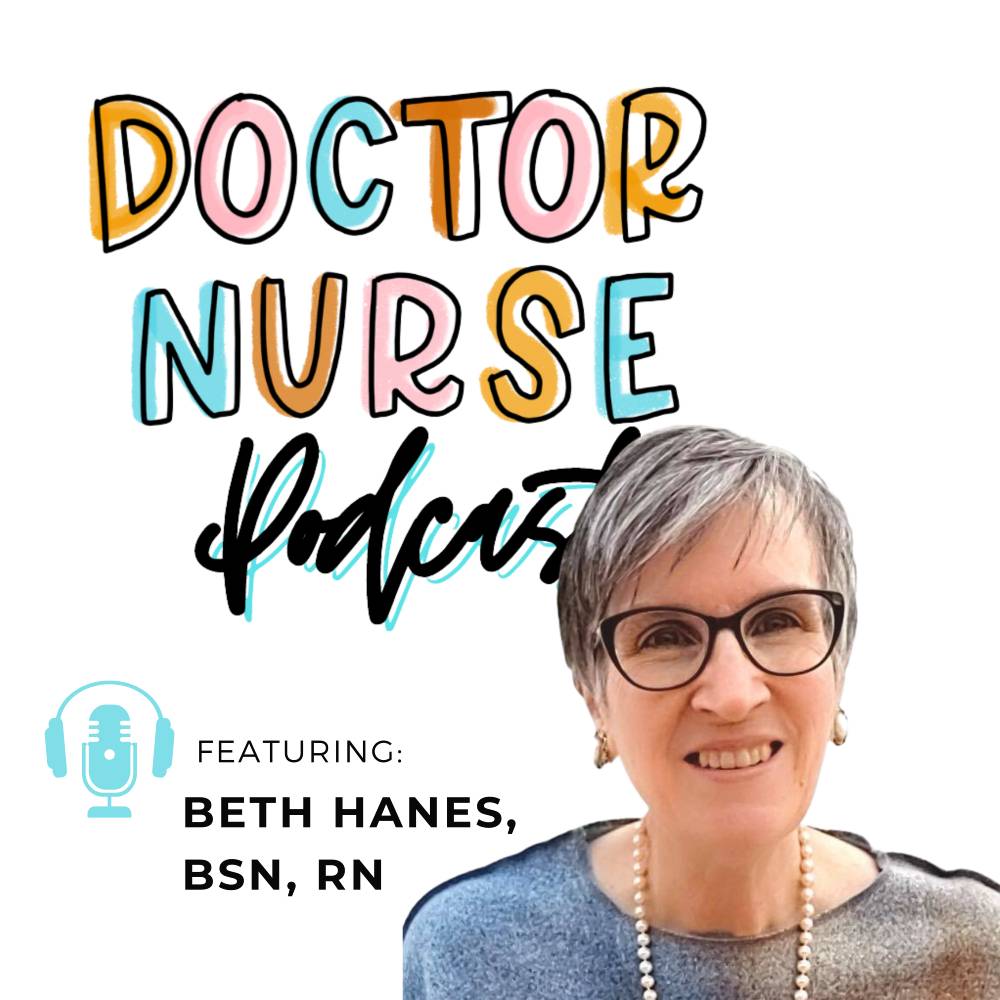
Sandra Pagenta: For our listeners, Elizabeth is a BSN RN. Built a six-figure writing business in her spare time.
And she became a nurse at midlife and you primarily worked in the peri-operative nursing setting for your whole career. And you’ve decided to go ahead and pivot again. And now you’re coaching nurses to become freelance writers, which has blown my mind. Also the host of the RN to writer show, which I have been just absolutely binge listening to.
It is so interesting for our listeners guys check her out. She is on the mission to have nurses take over the health writing space. So I really, really, really liked what she said there. And I’m so happy to interview you. Welcome.
Welcome, welcome. And, let’s dive right in.
Beth Hanes: Thank you so much. Let’s do it.
Sandra Pagenta: All right. So describe to our listeners, what [00:01:00] use your current role? What’s your job title? What do you do for living everyday, Beth?
Beth Hanes: So my job title is fluid. I call myself the CEO of this company, but there’s only two of us. And so what I do is I offer.
Courses and coaching to other nurses who want to learn how to become freelance writers. And every day I come into the office enthused and energized to do whatever it takes to help these nurses get started. And I’m happy to say that recently we’ve had a lot of success stories from nurses in the program, telling them about their first successes.
So that is very gratifying. That’s
Sandra Pagenta: awesome. So tell me what a nurse writer does. What is that, that job that you’re teaching other nurses
Beth Hanes: to do? Right. It’s a very unknown career option for nurses. But the truth is that. The journalism and content or marketing industries [00:02:00] have always relied on freelance writers to produce articles for magazines or write web pages, or, you know, all of us, you, you sign up for something and you get a sequence of emails to either explain what you bought or try to get you to buy more stuff.
Chances are freelance writers wrote that. And today. There’s a great demand for nurses to do a lot of that writing because when companies publish information on their website, under the byline of a nurse, an RN and LPN and NP, actually any clinician MDPA social worker, when they publish that content some search engines view that as more authoritative, so that boosts.
Pages rank in the search index. So there’s been a massive uptick in companies looking for nurses to do this kind of writing and. That’s how I made my career. And so that’s now what I teach [00:03:00] other nurses to do is to tap into that. Wow.
Sandra Pagenta: That’s awesome. What have you found in the industry that they’re looking, are they looking for RNs?
Do you have to have this incredible writing history or can you just be any kind of nurse? How do you, how do you think that you might be qualified to even start down there?
Beth Hanes: That’s an excellent question. I think one thing that shocks nurses coming into this is as my friend, Jennifer LW, Fink, who I had on my podcast recently said the barrier to entry in the writing industry is exceptionally low.
It does not require any particular degree. It does not require it. Experience as a professional writer at first. I mean, Y your career will unfold in different ways as you get experience, but to come into this, you absolutely do not need previous writing experience. You do not have to be an RN. You do not have to have.
20 years of experience as a nurse. The truth is [00:04:00] that the vast majority of health writers who produce these articles and content have no clinical background at all. And most of them don’t even have a journalism degree. They’re just people with average writing skill, and that’s what I tell nurses.
If you ever got a C on a nursing paper, your writing chops are good enough to think about pursuing a writing career because you’re not expected as a professional writer to be. And ultimate authority on grammar and punctuation and all of that, the clients and the editors are going to provide you with a style guide, for example, which is just a document that tells you how to punctuate and tells you what kind of sources to use.
They’re going to tell you all that and you’re going to also have an editor. So. The only thing clients are looking for is a good, solid draft. And so back to my point, if you ever wrote a paper that earned a C, then congratulations, you can be a freelance writer.
Sandra Pagenta: And that’s what it boils down to. [00:05:00] That’s really cool.
And that’s pretty simple. It seems pretty easy. So tell us about your journey from. Being a midlife nurse too, to just stepping into freelance writing, what was your journey there?
Beth Hanes: Sure. Well, I think it’s important to note and I’m always very transparent about this, that I was a writer before I was a nurse.
So way back in the dark ages of my career.
I started out in public relations and marketing, and I wrote tons of press releases and marketing materials. And then I went into a series of like middle management office type jobs. Then I had the opportunity to become a nurse, which was my dream as an adolescent, but like a lot of people and adolescents, I lacked the confidence to pursue that.
Hmm. So I went back to school and became a nurse and within a few years of nursing I realized it was not a good fit for me. I’m very introverted and it took a lot of my energy to do high quality nursing and work with people all the time. [00:06:00] And so I came home one day from my shift and I was honestly complaining to my husband about how.
I loved doing patient education, which is true for a lot of nurses. I know. And I was being squeezed into reducing the amount of patient education I got to do. And it made me wonder, I was wondering out loud to him. If I could really continue as a nurse. And he said to me, You need to really think now about going full-time freelance, because if you combine your nursing with your writing, you can impact literally millions of patients all at once.
You can educate thousands of people all at once instead of five, a day at the bedside. And I was like paying the light bulb, went off, you know, what an awesome husband. Yes. Yes. He, he always, he was he’s deceased now, but he was always my biggest champion, all three of those years when I was struggling to figure out freelancing and wasn’t quite making it, he was always like, just keep plugging.
And he was correct. Oh my gosh, how
Sandra Pagenta: sweet.
Beth Hanes: So that’s how that came to pass. [00:07:00] Gotcha.
Sandra Pagenta: Tell me throughout your journey, what was something that you kind of identified as a really big success in your career? Something that you look back and you say this was, this was the high, this was a true career high for
Beth Hanes: me as a writer. Yeah. You know, one of those happened right out of the gate.
When I, I had been freelancing part-time on the side while I was working full-time as a nurse and I was saving up the, the meager amount of money I was making at that time as a writer. And I invested that in going through. A conference, the association of healthcare journalists conference. And at that conference, there was an opportunity to meet with editors, to pitch an article to them.
And I made an appointment to meet with two editors from web MD and I met, right? Like that would be a home run run. Yeah. It’s like medical, Google, right, right, right. And I was, I was dreaming big there because I did not have the writing experience that they would normally look for, but I met with them and they were unimpressed [00:08:00] with my article idea, but they were fascinated by the fact I was a nurse.
Like this was kind of new to them too, that here’s a person who could write and could prove that she could write, but she was also a nurse and they started like brainstorming how they. Like right in front of you? Yeah. Like how could that work in any way? Within weeks of attending that conference? I, I came away with a contract, a 12 month contract to write for them.
Not articles though. They used to have like a core type thing that was for medicine called web MD answers. And I was their resident expert. So I would go on there and answer people’s questions about health, but that was what launched me that allowed me to quit my nursing job because then I had a foundation of money, you know, like I, I could replace my nursing.
And so. Yeah. So that was a big win right there. Wow.
Sandra Pagenta: From the jump and just having the, again, you just had the courage to just go for it and look like it ended up being the thing to get you out of a [00:09:00] job that you were like, this is terrible. I’m not happy here anymore. You know? And that’s something that I tell my listeners all the time is that you let fear hold you back from possibly, you know, the fear of change, right?
The fear of something unknown holds you back from possibly what could be your dream. So like just don’t be afraid and wherever fear is go into it, you know,
Beth Hanes: I think you hit the nail on the head, Sandra, like that is the key to, yeah. Fear holds us back. It keeps us locked in. And I think that it’s important for your audience to think about the fact that our decisions are not irrevocable.
Like you can, there are many alternative nursing careers, like writing that you can pursue on the side. And if they don’t work out, that’s fine, then go try something else. Like, it’s not like you have to think in terms of forever, how can I quit my job and give up all those money and benefits and blah, blah, blah.
And it’s such a risk it’s like, no, keep that. And then try out other stuff on the side too, until you find something that [00:10:00] suits you and then pursue it.
Sandra Pagenta: Absolutely. Absolutely. When you think about it too, even from a different angle, what was something that you had to overcome in your career that you look back and you think, I could have let that hold me back, but I didn’t like.
You know, what was something that you did have to overcome? What was the fear
Beth Hanes: maybe? Well, let me tell you, I spent 20 years trying freelancing on the side with very little success. So there were a lot of things to overcome. Partly I think one key fear that I had to overcome was imposter syndrome, like.
That feeling? What does that imposter syndrome is when you are certain you were going to be found out for not being. Who you are or being good enough at what you do? I think a lot of nurses, I know I had imposter syndrome terribly when I was a new graduate nurse, you know, it’s like I was certain at any moment, the charge was going to walk up to me and go, you’re known.
You may have the degree, but you’re not [00:11:00] really doing this. And that happens with writers too. You just lack confidence in your ability. You’re certain that every time you turn something in to a client that it’s going to come back. Horrible red ink. And they’re going to say, we’re never working with you again because clearly you suck and you should not be a writer.
And that, that is a huge fear for people, you know? So it has never happened to me. How have you overcome
Sandra Pagenta: imposter syndrome? How do you overcome it?
Beth Hanes: That’s an interesting question. And there are tomes, there are literal books on that, but to me, I think small successes. I think accumulating small successes sending your first piece out, it gets rejected, but it has lovely comments back from the editor, sending your next piece out.
It gets accepted and you’re like basking in the glow of that. And then eventually you pitch your dream publication, whatever that is, and you know, maybe it’s web MD and they accept your pitch. And then at a certain point, really that imposter syndrome gets less. Cause then you’re like, okay. [00:12:00] Yeah, I can do this.
You know, I am good at this. I’m getting validated, I guess that’s the key.
Sandra Pagenta: The validation sometimes it’s gotta be self validation, sometimes when I’ve posted a reel on Instagram, I go and look at it in my other private Instagram account. And I like it.
To like encourage myself.
Beth Hanes: Absolutely. I constantly tell nurses in my orange into writer programs, that self-validation is the important thing. I I’m kind of shocked at how many people. Dismiss their accomplishments. Like they’ll say, you know, we’ll convene in a group coaching session and I’ll ask, you know, who has successes to share.
And somebody will say something like, well, I didn’t really get anything accomplished this week. I only finished my website and wrote a letter of introduction and set three points. I’m like, that’s not nothing. You have to give yourself credit for that stuff. And validate, you are doing this, you’re moving.
Sandra Pagenta: That’s good, Beth. So tell me, was there anybody that mentored you along the way? [00:13:00] Did anybody introduce you to this? I mean, it sounds like your husband was super inspirational by just kind of putting the two pieces together, but did you find anybody along the way that’s been a big help to your career?
Beth Hanes: The short answer to that is no. And that is why I do what I do today is because I want to be that person for other nurses. I, like I say took almost 20 years trying to figure out freelance writing even before I was a nurse. And now after I went full time as a nurse writer, I did connect with two other nurse writers who were.
I think slightly before me and we spoke regularly as our own little support group and sort of figured things out together. But in terms of did I have a person or even a group to sort of guide me along? I can’t think of one that figured it out. It was all trial and error.
Sandra Pagenta: So it doesn’t sound like there was much of a community is what you’re describing.
Are there a lot of nurse writers, is this..
Beth Hanes: So [00:14:00] interesting question. I’m not positive because until, until our into writer, I, I’m not aware of any specific communities for nurses now, the medical writers association and yeah. There are a lot of nurses who do science, writing, pharma writing what I call high scientific writing, but I don’t do that myself.
That’s not my strength. And so I was never acquainted with any of them. So there have been nurse writers. I think that there are quite a few of us, but as a percentage of like the entire population of health writers, probably very, very small. Yeah.
Sandra Pagenta: And do you think that there will always be a need for nurse writers?
Beth Hanes: Oh, absolutely. What do you
Sandra Pagenta: think the market is expanding or, I mean, with just everything going digital right now, we all work from home. Everything is just home-based computer-based what do you think the market’s going to look like?
Beth Hanes: We are in the information age, and that is not going to end in my lifetime.
There are currently 400 million active [00:15:00] websites in the world. Right. And if only a small fraction of those are health websites, that’s still a massive amount of information that needs to be produced. And so I actually get this question a lot. People say, well, are you not saturating the market with nurse writers?
Or, you know, that’s a scarcity mindset. The, the world, yeah, the world of. Content production is not a pizza. That there’s a limited number of slices. The world of content production is there’s pizzas being made every single day. Love it. So if you think about a site like let’s, let’s pick the Cleveland clinic because they have a very robust in in-house content marketing team.
Cleveland clinic alone might put out this is hypothetical. I don’t have any insider information. They may put out 20 to 50 individual pieces of content a day, just them now think about all the other. And they’re just a provider. Now think about all the other providers who are publishing [00:16:00] and now think about all the healthcare manufacturers that are publishing and all the technology.
And so like this. The sheer volume of content that has to be produced every single day. And that’s not even counting the journalism side, all the reporting, it’s just going to keep growing exponentially. So there’s never going to not be a need for nurses who write. And that’s not only my opinion, by the way.
Experts in the industry have validated this as well. So yes,
Sandra Pagenta: yes. And that actually was what I listened. And I heard the reason why I asked the question was because I learned that on your podcast. That it is a growing business. you had someone from a a writing group that you used to work with.
You had her on your podcast and you were, had her describing kind of where she thinks the industry is going. And I think the way you said about the pizzas coming out of the year, We don’t need to ask for a slice, you got a whole pizza, there’s enough room and there’s going to be space. And so if you’re interested in this, check it out as a side hustle, like you said, if it doesn’t work, it doesn’t work, but at least you gave it a shot [00:17:00] and it might be something that fits your lifestyle.
It might be something that, like you said, you were working on the floor and you’re like, this isn’t for me like this, isn’t my personality. And thank goodness. We’re not all made the same way. And that we’re all meant for something different. So it’s really, really well.
Beth Hanes: Yeah, thank you. Yeah, it’s a wonderful way to use your nursing knowledge and really expand your impact as a nurse writing, That’s really great.
Sandra Pagenta: So a lot, our last question is, what advice do you have for a nurse who starting off in her career? Maybe she’s like, you she’s been on the floor and she’s like this blows and she’s like something new or she’s like, I have no idea. Like what Beth is even talking about. Like where can I, what can I even get started?
What advice do you have for a new nurse starting off?
Beth Hanes: Yes. First is be patient with yourself. Because when you start to explore freelance writing or any alternative career, you’re talking about needing to learn in an [00:18:00] entire industry like writing and content production in general. Our industries and you’re a nurse.
So it is going to, there is going to be a learning curve. Involved. Persistence is key. Be systematic as you start exploring this, I will say that our inter writer offers lots of free resources to people. We have I do a blog every week. We have a newsletter that has external links to tips, to help understand this industry and get started.
We have the, our inter writers show on YouTube and of course Spotify and apple podcasts. And yes, we also sell courses and coaching that. So I’ve had people who got started and found success only using our free resources. The purpose of doing courses and coaching is to. Shorten that learning curve to get quicker success.
It’s not about, you can only succeed if you buy my courses and coaching. I appreciate that. I believe you mentioned [00:19:00] the mission of our inter-rater earlier, which is, and we are mission driven. Like I had to start with courses and coaching because my goal is for. Possibly healthcare communications to even become a nursing specialty.
Like I want nurses to set the standard for content and journalism, content marketing, internal communications PR in healthcare. But I can’t do that. If there’s not nurse writers. So we had to start by teaching people how to be writers so that we can basically invade this and take it over. So that’s what I would say is learn about the industry, use our resources, if that’s helpful and be persistent because slow and steady is what will get you.
To your success. Yeah,
Sandra Pagenta: that’s really good. The consistency over time, everyone just, I hear that constantly in the book James clear atomic habits, he talks about the consistency, right? And he’s like, just do it every day repeatedly. Even if it’s a minute, even if it’s five pages, it’s like just be consistent.
And when you get into that [00:20:00] mindset, it really does begin to change the environment around you and things start to show up. Wow. I’m just being minimally consistent and this stuff’s kind of coming to me. It’s kind of crazy how the universe works this way. It’s like a secret hack for the universe. It’s just stay consistent.
So that’s really good advice. Yeah. Beth. Can you tell people how to find you? Where can I know you’re on, like you said, you’re on Spotify, you’re on YouTube. You are on apple podcast. Again, subscribe to her show. It’s just so great. And she’s just to the point their episodes are just jam packed of, of just knowledge and information and how can they find you on your way?
Beth Hanes: Thank you. So we’re at our inter-rater dot com. It’s a numeral two it’s RN to writer. I do want to emphasize that all clinicians are welcome. When I launched that website in 2014, it was a blog about me. I’m the RN going to writer. I just kept that name, but it confuses some people because they’re like, oh, it excludes me.
No. Now we don’t exclude anyone. If you’re a clinician, [00:21:00] by all means join us. I wanted to put in a little plug to, for the success society, which is the only online forum community for nurses and other clinicians who write I did not want to go on Facebook because of privacy concerns. So we have a private community on the website, but you can find us there are into writer and that links out to all our other resources.
Very
Sandra Pagenta: cool. So for the last part of the interview is the rapid fire questions. Are you ready? So our first question is what’s your favorite drink? Coffee or tea? Coffee, hot coffee. Yup. Yup. Who is your inspiration and
Beth Hanes: why? Gosh, my inspiration. That should be an easy one. Shouldn’t it? You know, the first thing that comes to my mind is my mother.
I take care of my mother. She has dementia now, but she has overcome a lot of obstacles in her life and that’s been very inspiring to me.
Sandra Pagenta: Wow. That’s incredible. And are you a summer? Winter fall spring. What’s your
Beth Hanes: favorite season? I [00:22:00] am a spring person. I read, I love the I love when everything is coming out.
It’s like filled with promise the spring. I just love that. It’s like we’re leading into summer and I love the summer and I love the fall. But spring is what inspires me.
Sandra Pagenta: I love that. I’m such an autumn person. Like, I guess maybe I’m like opposite. I’m like, everything’s going, it’s just got like this like different vibe of like new things are coming.
Maybe it’s like a reverse reverse of what you’re saying. Yeah. But I, I like the fall. It’s just something about pumpkin spice lattes that I love.
Anyway. Thank you for coming onto the podcast. Thank you for your time today. It was so great
Beth Hanes: chatting. Thank you so much for having me truly it’s an honor to be on. And I really appreciate all you’re doing for nurses. I appreciate you letting me get the message out to nurses about this fabulous career alternative.
And maybe we can chat again on my podcast. I would love that I’d be
Sandra Pagenta: honored to be on. Thank you. All right. Thanks guys for listening.
Podcast Description
Elizabeth Hanes BSN RN built a six-figure writing business in her spare time. She became a nurse at midlife and worked primarily as a perioperative nurse for her whole career. Today, she coaches other nurses to become freelance writers through her RN2writer program.
Latest Episodes
Doctor Nurse podcast brings you weekly shows to help INSPIRE, EDUCATE AND EMPOWER nurses with true stories of initiative and impact.
Doctor Nurse podcast brings you weekly shows to help INSPIRE, EDUCATE AND EMPOWER nurses with true stories of initiative and impact.
Latest Episodes
Doctor Nurse podcast brings you weekly shows to help INSPIRE, EDUCATE AND EMPOWER nurses with true stories of initiative and impact.