Also Available On






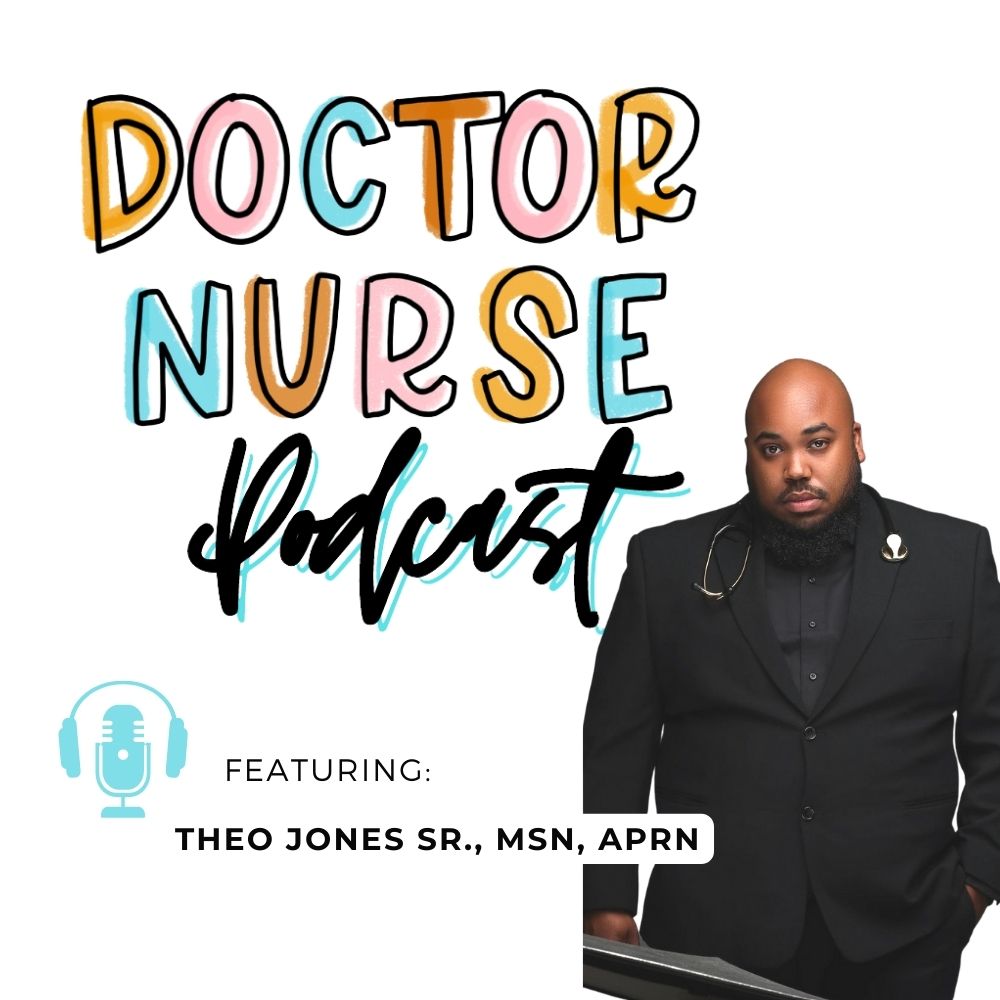
Sandra Pagenta: [00:00:00] Hi doctor nurse podcast. Welcome today. We have a special guest Theo Jones, senior received his bachelor’s degree from Cerner Douglas college in 2014, where he worked as an ICU nurse and then a trauma surgery. Oh, D. He then pursued his master’s of science in nursing at Chamberlain university in March of 2018.
He is currently launched in runs the weekend white coat concierge, LLC since 2018 and has worked in internal medicine as a nurse practitioner, hospitalist. I believe you have your master’s degree in family, nurse practitioner. He began his career with an acute pain fellowship at MedStar Georgetown hospital and later managing the acute care pain service at several sites in the north Baltimore area.
Welcome the a that is not all you’re doing. You’ve got a whole bunch of other stuff to side stuff. So we [00:01:00] will get into all your side hustles, all the things that you’re doing on top of your business. So let’s dive right in. You ready? Yes all. So I just explained kind of your backstory, but I really want to know what you do on a day to day basis.
What’s your days look like? How do you define yourself as far as your job title?
Theo Jones: Sure. On a day-to-day basis, I’m a lot of different things. I guess the best description is an entrepreneur. So on a day-to-day basis, I kind of get up the first thing I do in the morning, Meet with my assistant kind of outline what we need to get done for the day I review any patient walks that I have, and to see if there’s any patients that she needed, anything.
I, I go to a lot of different things. Mostly a good workout meditation. , I joined the 5:00 AM club recently, so I’m loving that. That’s a great book by the way, people should read that. After that, after I go [00:02:00] through patients I actually teach two, so I’ll check all of my classrooms.
And if there’s anything left kind of. Follow-up on a pharmacy, requires a close my day
Sandra Pagenta: out. Wow. So take me through all the different buckets you’re involved in. So let’s start with your concierge business the weekend white coat. Exactly. What is it that you’re doing there?
Are you providing primary care? Walk me through that.
Theo Jones: Sure. We can white holders, like completely my baby that wasn’t birthed. It’s so we can wait. Colt concierge is a subscription service for patients. So yes, I do primary care, but also do so much more. I do one-on-one health care planning. I do vitamin drips which is pretty much included in the service.
I connect patients to that. I’ve worked at a few hospitals for a long time. So I’ve met a lot of doctors, a lot of surgeons. Yeah, they’re the [00:03:00] best in the country. I’ve worked at some of the time institutions like top 50 hospitals. So I’ve met a lot of people. I connect to a lot of people. They get me as as part of the service 24 7, they get access to the weekend white coat application, which is a telemedicine.
That I have right now on the Google store and apple app store. I didn’t quite make the jump to Amazon absolute yet. It’s not enough business there, but on a daily basis it’s pretty much one of those things where it’s 24 7. If they need me, they get me. If they don’t need me, it’s fine. I’m still here.
Sandra Pagenta: When I was looking at your website, you’ve got different tiers that you’ve got that people can buy into. So that just ups the level of care that you get. Am I understanding that correctly?
Theo Jones: A hundred percent correct. So some people like the option of not having to subscribe to so much because everybody doesn’t need that much attention [00:04:00] and some others do so some want more than one household, if they don’t feel well, somewhat, , less, they just want to see me when they want to see.
And it works because bothering people too much, she kind of, it can kind of change the relationship. , everybody, everybody gets away from that annoying friend, but , I think that’s who I don’t want to be in this situation. I want to be that friend is there and when you need them. Yeah.
That’s
Sandra Pagenta: really cool. So in those packages and I heard you say you do IB hydration, you do house calls, you do labs, you manage their medications. With some of the other things that I, I mean, those are a couple of ones I can recall, but what are some of the other things that you are able to do with your concierge?
Company,
Theo Jones: I can pretty much get specialty medications. I have good relationships with compound pharmacies, sort of a need something made up for a patient. I can just kind of call the pharmacist and tell them exactly what I want and the. I mean, I can kind of, I can make a lot of stuff happen. It’s all [00:05:00] about who, , and what you can do versus what.
They want what they want done in the reality of it, if that makes sense. And when I say that, I mean somebody will have one idea and then they’ll come to me and they will just get something on a completely different level, ? And they’ll never expect it like, oh my God, this is way better than I expected.
The traditional nine to five office model has ruined us. ’cause we’ve moved into this society where Amazon can have a package to your door in two days, but pre prior to that, , it took weeks for the home shopping network to ship your stuff or HSN. But, , we can wait, call it.
We kind of changed the narrative because healthcare. Ken some straight to you, and it’s not just like, , any in your regular health care. It’s like I’m pulling up and doing EKG. We’re doing like a full workup in the home. I’ll I even started this thing called VIP days where a market is get it all done in one day kind of session.
, I get you, I get you a full, physical, get you [00:06:00] started on. Get all your labs stone. If you need any specialists referrals, I get it done that same day. And we kind of conclude, , on a transactional basis, if that’s what they want VIP days are pretty popular.
Sandra Pagenta: So do people need health insurance to see you?
Or are you private?
Theo Jones: Well, I’m proud of you don’t even need health insurance to see me, honestly, I’m using health insurance. The only thing that I use it for is for things that are ordered for the patient. Other than that, no, you don’t need to have health insurance
Sandra Pagenta: to see me hours a week. Are you working on the job?
Crushing it? How many days? How many hours a week are you? ’cause I mean, driving to see patients and taking care of people that can take a lot of time, ? Do you have a radius that you work in? That was another question I wanted to know. Like, do you say like, listen, if you’re 50 miles out, like we out, or if you’re like, no, no, no.
I treat everybody no matter where they are in the greater Baltimore area, I’ll go to you. Yeah, those are my [00:07:00] questions. Like how many hours are you spending? A week at work.
Theo Jones: I would say I’m on a weekend white coat physically, how many hours I would say I spend about maybe 15 hours a week physically.
As far as like digitally, I would say I, I maybe spend about 30 to 40 hours a week, so it’s not a ton of time in the grand scheme of things of what I was doing as a hospitalist. Some weeks as a hospitalist, I’d be like clocking 70, 80 hours a week. Versus, , me doing like 20 to 30 on my own business, it’s kind of a different vibe
Sandra Pagenta: for sure.
And the other different vibe is the cost. So as a hospitalist say, you make about a hundred grand a year. Are you pulling in comparable pay or more? Better better
Theo Jones: concierge medicine is pretty lucrative. So you don’t find the usual crowd. The crowd that I usually have, or like entrepreneurs a lot of them are high net worth individuals who have.[00:08:00]
Luxury of paying for cost saving services all the time saving services. So if you can have a cleaning lady come to you, Alison clean your home, you don’t have to do it. You can focus on doing other tasks in your business, right? If you can have a. A car cleaning service come to you to clean your car.
You don’t have to do it now, if you don’t have to go and wait inside of a doctor’s office for two, three hours after your appointment time, you don’t have to do it. Also occupied a few other spaces when COVID hit pretty bad, especially early this year I was doing mobile COVID testing. So it was, it was a pretty, it was a pretty good year.
So far. Last year was a really good year. You can make your money plus on if you can mark it right. And finds your right
Sandra Pagenta: clientele pocket. Wow. That’s incredible. That’s the weekend white coat, which I like that name. I think it’s really cool. It’s just got really good. Like just got an edge to it. You’re involved in some other things, as I was looking you [00:09:00] up, you’ve got an ebook that you’ve written, you’re really into finance. It looks like you’ve teamed up with another nursing influencer and you guys have created some content. Tell me a little bit about what your, what also you’re in as far as.
Theo Jones: Oh, yes. So two eBooks. My first ebook was so you want to be a nurse is kind of a two-part book in one. So the first part is, so you want to be a nurse in the second half of it. So you want to be a nurse practitioner and this kind of just walking you through the. They won to kind of end game.
And that was kind of the intro into our second book, a white coat, green bands, which is kind of life after bedside and trying to help people transition away from bedside. And it’s funny, me and Morgan was my business partner. We always talk about how they don’t teach too much. Financial literacy and nursing.
They don’t teach a lot of how to get away from this. They teach you how to be in it, but they don’t teach you how to get out of it. [00:10:00] Yes. I’m a financial freedom advocate from day one. My goal is to be completely free of like anything maybe about 40, , like I just want to have that much passive income stacked up by the time I turned, I guess 45 at this point, I’m already 33.
Well, I’ll be 33 this month. Well
Sandra Pagenta: happy early birthday. Thank you. I love that goal. I love that you’re dreaming big. I feel like you’re going to get there at 40. I don’t know what you got going on, but I just feel like you’re a go getter. So I, I see you at 40 just knocking it out of the park.
And so as far as , that stuff is going, is that, is that it? Is that all we got? No,
Theo Jones: I’ve got more so, so we’re actually, I’m actually going to be relaunching. So you want to be in this book, we’re going to break it down into two books now. So it’s going to be a lot more. Well, I guess you would call it an abridged version, but we’re going to add a ton more information.
What type of that white coat green bans, the [00:11:00] book, it has a course attached to what we did a part two which is still on sale. Then we did flight school, which is absolutely awesome. I think the flight school record, which is more like financial freedom, financial literacy kind of stuff, trying to help get you from.
So business inside of that, of course we did a lot of stuff. We had an Airbnb expert, we had a the rehydration team come in and kind of show the blueprint, the search on RV rehydration service. I even taught how to build a telemedicine practice in the course. And that was, that was pretty fun.
We talked about building the ebook and marketing itself a bit of a marketing guru on the side, from what I could see, we did pretty well. As far as marketing last year, a lot of Facebook, it’s a lot of like , a lot of collaboration with different teams just to kind of put everything together.
So we could a lot of that. And this year[00:12:00] we’re having we had an NFT project. Moving into the digital space. I love this whole crypto thing in this whole, like exclusive non fungible talking kind of business. So that’s coming soon. And more Tacoma is
Sandra Pagenta: I really liked how you’re starting to kind of get, how a tree has these roots that kind of just go out and they, , goes looking for water so that the trees never went.
, something coming in. I really love that analogy for what you’re doing. It’s kind of the same thing of like, just sending out your routes to go find sources of income from other areas. That’s just absolutely brilliant. And it’s the thing that. More nurses need to be doing. And I love having these conversations because I think it brings these awareness to other nurses that other people are doing it.
Why not? You?, these resources that you’re providing to people I think is very beneficial. Fantastic. How did you get here? Because you didn’t wake up one day and just have a weekend, white coat business, and an ebook and an app and [00:13:00] telemedicine and all this stuff. You went through a journey to get to this spot.
So kind of walk me through the day. You decided to become a nurse until you’re at this point. Now with you got buckets and buckets, how did this
Theo Jones: happen? Well, , it’s pretty funny. I wasn’t a healthcare provider initially. So I was, I used to be a therapist, actually like a mental health could be hilarious.
I was, I worked in psych for like five years prior to switching to nursing. So I think what really changed, I was a. I remember I was dating this girl at the time. This was before I was married. This was like way back. I was like at CCBC, which is a community college here and I was visiting a friend of mine.
He was taking up accounting courses. And I remember being in the hallway thinking to myself, like, man, I need to get out of this draining line of work. Absolutely. I’m pouring so much of myself into this job. And all I get is complaints not knowing at the time with healthcare was coughing. [00:14:00] So initially I started taking my prerequisites at a community college and I remember getting ready to apply for the nursing program.
The, the the counselor taught me, I will never get into the program with my grades, which I felt interesting because I mean, I didn’t exactly have failing grades. It was more so that I guess it was so much competition and she didn’t think I was good enough to make it, but I didn’t let that stop me. I have this saying if there’s no door that you went jumped through the window, don’t be denied.
So I jumped through a lot on windows. Plats. So like three, maybe three or four different nurses, schools, which feels impossible with the amount of paperwork you got to do, but I did it and that’s how I ended up actually going to see at Douglas college. So I started there in 2011 and while I was going through the program, my first job was as a nursing student at the [00:15:00] VA.
Which was terrible by the way it was, oh my God. I hate, I hate to say this out loud, but everything that you see on the news about the VA health system or my multiplied by five. So that was my first job. And after that I was I, I see you nurse extern for Merlin general, which doesn’t exist anymore.
I’m dating myself real in general. Doesn’t exist anymore, but I was an ICU nurse extern from there. I did some time doing that sort of the program that I was in at Syngenta Douglas college. They had an LPN exit option where you could take your LPN boards and still finish up your bachelor’s. So I did an exit option LPN.
I took the LPN, inkling someone lunch brigade and passed it and came back to school. When I, what I hope when I tell people this third 30 look at me crazy, but I went on my lunch [00:16:00] break. I passed it and I went back to school. Swear to God. You can ask some of my friends, they were there. And I worked as a corrections nurse for a year.
Yes. Some change until I finished my bachelor’s.
Sandra Pagenta: I feel like you’re the kind of, you’re the kind of guy who could work a corrections nurse job. Like I could never go work corrections, but like, you’re a big guy. So like you could go into those areas and like, totally get away with it. Like little old me, even though the money looks really great at those jobs, I’m like, I could not survive there.
I just cut it like.
Theo Jones: What I’m saying, Andrew, I think you’d be surprised. Those are some of the nicest criminals. Honestly, they were nice that I get in the hospital.
Sandra Pagenta: What though? What though? I have taken care of some inmates when I was a nurse and. Outside of being intrigued by like, why are you handcuffed to the bed?
, like outside of just wondering what they were doing, they really were nice. People. Like I’ve never had one that was like, , you see these terrible things on TV where like, these people are like, , clamoring in the bed and then you actually meet them. And [00:17:00] then. Yeah, I did some stuff and I’m here.
So thanks for taking care. It was
Theo Jones: a yes, sir. No, sir. Thank you. Thank you, sir. I mean, very grateful people. Honestly, I look back on that fondly and the only thing I hated was being locked in that wasn’t the worst, like being locked in hand to do closed behind you.
Sandra Pagenta: Yeah. Yeah. I could see that being a little unnerving and to know that that’s how they lived their lives.
It’s gotta be, it gives you a lot of compassion for
Theo Jones: them. Right. And how we’re all like attached to our phones. You can’t have a phone for like eight hours at a time. Wow. So if anybody needed to contact you, if it was an emergency, they would never be able to reach it was the craziest thing. So
Sandra Pagenta: you did that job for how long.
Theo Jones: And so I was there as LPN for about a year and after I finished boards and I’ll never forget this the day, the day I figured figured out that I passed my boards was December 4th, 2014. Okay. And I was in [00:18:00] the office as an LPN. And I remember like, everybody was like, happy that I passed. My boys are like, yay.
And then charging them. That was that they said good job. But today you still have. Get back to it. And following week I was the charge nurse.
I know, right? Oh, it’s a lot of those on my journey. So I I was there for about, I guess, about two years on and off. I still dissident PRN. I took my first job in the ICU in 2015. And I had been grooming myself to be ICU nurse for so long. I took the job and completely hated it. Oh my
Sandra Pagenta: goodness. What made you think that you wanted to be an ICU nurse and then what made you realize you can’t stand that?
Theo Jones: Well, , I really like the science of it. It’s it’s such a, it’s such a forward-thinking specialty in nursing and they’re always the creme de LA creme of the hospital. Yeah. , it’s nothing more pride feeling [00:19:00] than having an ICU. T-shirt a jacket, , everybody knows you nurse. So you wanted
Sandra Pagenta: it for like the status, like the status symbol, like in the science, you liked the science, but also just being like I’m at the top, the time
Theo Jones: the American express card in nursing.
Sandra Pagenta: That’s true. So what made you realize you had. The
Theo Jones: personalities. Oh my God. It is such a main girls club, maybe because of
Sandra Pagenta: that same mentality, , like we’re the bad ones we know we’re doing like, blah, blah, blah. And then they’re like also like awful spirit. And
Theo Jones: it’s so it’s so much gatekeeper in an ICU.
A lot of people don’t talk about this. It’s so much gate-keeping I mean, depending on if they like you, , depending on what you look like, It’s a lot of gatekeeping. They’ll they’ll if they don’t like you, they’ll try to get rid of you. And I remember my list day in ICU. This is before I decided I needed to leave.
My son was just born and I was trying to get [00:20:00] some kind of. But, , I was trying to take a little bit of time
Sandra Pagenta: off baby.
Theo Jones: Yes. Because my wife wasn’t, she was sick after birth and she wasn’t doing well. And then nurse manager, who’s a woman looked me in my eyes and said, well, I think you need to focus more on your career.
And I was like, oh, okay. I’m going to go ahead and go to their ship treatment and see if I can get reassigned to a different spot.
Sandra Pagenta: That’s the right. ,
Theo Jones: honestly. Yeah. So during that time I had the time off actually, I had a significant amount of time off, which was pretty good. And I ended up going to trauma or which is absolutely my love.
I love trauma or surgery. Kind of groomed me in a way. It helped my knowledge. It gave me skills that I was able to translate directly as a nurse practitioner, but. In the middle of that journey, , I that’s, when I realized I wanted to go back to school and become a nurse practitioner while I was in Ottawa and, , the scheduling and the [00:21:00] flexibility to immediate possible, this was the only unit that I worked, where I actually got two solid breaks.
I had a morning break and had a lunch break. And if I was lucky, I had a dinner break, depending on, what time the chefs will break down. And I was like, is this some kind of fantasy man? I thought I was in Narnia. I was like, oh, this is a whole different world. You don’t get breaks on the floor.
What is this? Yeah, it was beautiful. It didn’t come without its challenges, but , it served my purpose, which kinda wings into. Use the job before it uses you as a lesson that I usually, , say, , I got a little mantra that the first chapter of the weekend the white core green bands book is called F that Joe, and it’s a mantra, , it’s kind of, , use your imagination.
, use that job before it uses you, because it doesn’t care about you. W which it goes to say that in that situation, I was working [00:22:00] and throughout that process, it was kinda like. Come come during the snow come during his come door. And that, , you got class on understand become during that.
Come do that here, , but we just need somebody to cover these cases. No, nobody cared about the exhaustion and the burnout. So I did my, I did my two, two and a half years of studying so I can get this masters. I did my clinicals while I was working. We cannot. And, and 2018 a Grazer with Marsha doesn’t use.
Sandra Pagenta: Yeah. So then you, I saw that you took a hospitalist job as a nurse practitioner, which is tough hospitalists nurse practitioner jobs, bring it, bring the heat. So after you were in the Orr trauma, you loved it. It sounds like that was kind of the first job you really loved. Actually. You like the prison job to the correctional unit.
Tell me a little bit about this hospitalist job that you took as a nurse, because I’ve always been interested in hospital’s job. I feel like you’d be a really good on the [00:23:00] job training that cause you see everything walking in the door. And so yeah. Tell me a little bit about that and then how you ended up transitioning into your own.
Theo Jones: Well, okay, so hospitalist if you do not know your stuff, you’ll get your blood. My fellowship was, I did it when I did this fellowship in pain management. I was working on like post-surgical patients and it was, it was fun. It was interesting. And I didn’t like it after a while because all of my consults would ended up being those, like long-term drug users who came in off of like a three-day cocaine bender and they having pain.
And I was like, ah, I’m gonna lose my skills during this. So I switched to
Sandra Pagenta: hospitalist the fellowship, which is like, where they train you. You just like on the job training, right?
Theo Jones: Yeah, I was trained. I spent I spent maybe about four or five months of the Georgetown hospital working with a really brilliant anesthesiologists.
Actually two of them. And it was like a group of us. We all came with that and learns how you manage pain. [00:24:00] And
Sandra Pagenta: then you took that job and the chronic pain job. And you were like, this is awful.
Theo Jones: Yeah. So I switched to F it. After I finished that out, I switched to a hospitalist, which was very interesting because I started to really learn.
What it was like to do internal medicine. Like I trained in family practice, , but it was no real precursor to what being a hospitalist was like. Not only is the hours pretty grueling because seven days on seven days off is not for the week. No, , I really. During that time.
And I learned so much, it made me a better clinician in some ways, like I can treat. In fine conditions, a lot better than, , I would have done if I didn’t have the training, , , a traditional family medicine experience, , you get those like common colds, , sinus infections, , tonsilitis stuff like that becomes it off.
Yeah. But, , lo and behold, , when I decided to [00:25:00] switch to be a hospital, we had COVID hat. It was a condition and nobody knew what the hell was happening. Nobody knew how to treat it. We was just out here, blind is a bed. And here I am my first year as a hospitalist. And I’m like, oh shoot.
Sandra Pagenta: Yeah, you’re in it.
Wow. I was in the trenches. You did this for, I guess, up until the end of COVID. So when did you start your business?
Theo Jones: Oh I started a weekend white coat, like the minute I finished school, I was like, I’m not waiting for anybody. I want to have my own practice. And this is, I want to live my life. I was already laying the groundwork for weekend white coat.
My first logo was terrible. But I always had this hustle to try to do more than one thing at the same time to.
Sandra Pagenta: Oh, I love that. Let’s stop right there. Let’s stop right there. I liked that you started with that mindset right out of school. Like I need to be in multiple things because something is going to free me.
How did you get that mentality? What [00:26:00] made you think that? Because I don’t think that’s innate. I don’t think most people think that what, oh
Theo Jones: my God. So my mother has so much talent. She’s, she’s an artist, she’s a stylist, she’s a teacher. And she’s like always done so many different things.
She was a florist at one time and I seen her do all these different things. To make all these different things happen. And it was never all her eggs in one basket. So watching her and my dad, my dad, he was, he started his own business. While when he was still young, , in his thirties and forties and him as the entrepreneur, I seen how much freedom that allotted him while it took up a lot of his time.
, I don’t think he could scale at the time when he needed it, but, , seeing those two, they kind of really inspired. To get on it. We’ve of having my own cause it’s nothing like ownership that it changed your life. A lot of people go to the table and, , wanting to negotiate their contracts is nurse practitioners.
They really forget [00:27:00] that they’re providing a service that is irreplaceable. So the equity conversation shouldn’t be off the table when goals. we all supposed to be rich. I mean, I that’s my mindset. We supposed to be rich there’s there shouldn’t be any poverty in our blood. We, we worked this hard to get here.
We’re supposed to be rich that I don’t care what anybody says, being humble in that we supposed to be.
Sandra Pagenta: Interesting. I like that. I like that. That mentality of we are not supposed to be poor. We’re not supposed to be broke because I think a lot of people are working and they have done all this work and they are broke and they are struggling financially.
And I like that mentality shift. I’m not going to accept that. Like that is not acceptable. Like that is not okay. I think at another conversation I had with another entrepreneur, she is very much like if it doesn’t work, it doesn’t work. I let it go. And at first I was like, okay, she just lets, and then I started realizing no, once you [00:28:00] say I will not tolerate it.
It changes the atmosphere. It’s like a thermostat on, , on the wall. You go and adjust the temperature when you go like that temperature, no fly here. Like that, just the thermostat doesn’t go there. Then you just realize like your life adjust to that. And so I think that’s great. I think it’s a great mindset to have of just, I won’t accept that.
That’s just not. That’s not okay with me.
Theo Jones: It’s like, , simple questions. Do you tolerate disrespect? Yes or no? Right. And if you do not tolerate disrespect and being underpaid for your services is clearly disrespect. Nobody’s to tolerate distress. Yeah, I’ll tell you one thing.
One of the hardest situations I’ve been through in my life. So my dad died in 2018, right. I was going for interviews for like nurse practitioner interviews and maybe about two to three days after my after my dad passed, I had this interview with this physician. And he was opening his vascular surgery clinic.[00:29:00]
And I interview, I mean, I was like really like killing this interview. And at the end of the interview, does God offers me $77,000. , like I’m here three days after my dad died and you offered me $3,000, I’ve got to punch him in his face. That was the most disrespectful thing I’ve ever went through in my life.
It was funny, a little
Sandra Pagenta: disrespectful. Why did it feel disrespectful? Explain what was going on.
Theo Jones: Explain. I was being asked to do outpatient follow ups, inpatient followups showing up for surgeries, the first assessing procedures. I needed to cross cover. Another provider. Yeah.
After the day was over. And when it came time to say, Hey, , what kind of salary do you want for this? I said, Hey, 110 case. And it was fair. And this guy looks at me right in my eyes and say, oh, I was thinking more like 77,000, meanwhile, so much stuff that we had to go [00:30:00] through at my dad’s house paperwork, try to align.
Insurances is so much more that I could have been doing to. To help my family and that, that mental value of me being there. It just felt like the most disrespectful thing in the world.
Sandra Pagenta: I see that. So what you’re saying, like, I could’ve spent my time someplace else instead I’m here. And then you give me this low ball offer for this job, that’s going to be requiring a lot of time.
I shouldn’t have even come to this interview is kind of what you were thinking, right? Yeah.
Theo Jones: W w what call you say, y’all should be on about my lateness that I even showed up to this fake.
I was like, this is like the most tray. Like, I don’t, I don’t want to get out of bed for less than, , less than 58, ? Yeah, I hear what you’re saying. I feel like for value standpoint, at this point in my life, I would much rather have that time and freedom to be with my family than to.
Being scrubbed, being told to go see this patient or that [00:31:00] patient against my will versus doing it with my own way.
Sandra Pagenta: And that’s what spurred the weekend white coat. Right? So like
Theo Jones: that is exactly what spurred weekend white coat. I wanted to change the health care experience for me and the patient.
It’s easy to bring. It’s so easy to burn out and, being in and out of the hospital throughout a pandemic and, seeing patients on my own and seeing patients in the hospital, the vibe is definitely different. I actually liked my patients. Yeah, they’re good people. Not that I dislike the people that I see in the hospitals, I can’t pick and choose.
Sandra Pagenta: So exactly when it’s your business and someone is just, kind of emotionally, just not what your, your vibe or just he’s, this patient is just abusive or whatever nurses in the hospital have to take it. I mean, we’re, we’re not told to defend ourselves. We’re not told to, Hey, listen, like there’s a level.
You will not tolerate, we will not tolerate this behavior towards our nurses. And so they, so you hear [00:32:00] these stories of nurses being hit and kicked and cussed out and all these different things where it’s like, if you were to do that, you would do this to one of our nurses. We’re going to remove you from the hospital.
They don’t do that. They, they allow it, they tolerate it. And so, because of that, unless you say personally, this doesn’t fly in my space, I’m outta here. Right. Then you have to take it. Cause the job won’t support you. And what’s nice about having your job is you get to go. It’s my business. Like, I, I don’t want you here because you’re disrespectful or abusive or whichever.
And I now have the authority and the power to remove you, which is beautiful. I mean, again, there’s probably laws and contracts and you just can’t say, Hey, listen, time and you have to inform them and stuff like that, but still at least you have the option of saying, I don’t have to tolerate this.
And that’s also what entrepreneurship buys you. It buys you not just, you can tolerate what, , you have the ability to tolerate what it is that you do and do not want, but then it also frees you up from a time standpoint of just [00:33:00] being like, I get to do what I want to do. Like I get to go to work today.
I get to work on my baby which is different. You have a different love for your job.
Theo Jones: 100%. I mean, honestly, if I feel like I want to take a day off I’ll take a day off. I’ll just call my assistant and say, Hey, can you cover the phones? Let them know that I will not be doing anything outside of any membership work today.
That’s it. That’s beautiful. And, Sandra, I gotta say this here is very important. We protect our nurses, especially I’ll women nurses, 90% in the field. See, I can handle myself if a patient wants to fight. But it’s not fair for patients, who have obvious mismatch to these to these nurses that on the floors innocence, city it’s, I hate it.
, I can’t go to every hospital and protect, but, we need to protect our nurses and these hospitals are doing a very piss poor job at doing. Yeah, no, I can
Sandra Pagenta: see that. Yeah. I can see it’s making you upset and it makes me upset because it’s, again, I’ve been in those situations where you’re in a room with someone and you’re like, I’m uncomfortable [00:34:00] here.
And you have to still continue to provide care. So again, nurses are. Our warriors and it shouldn’t have to be that way. You shouldn’t have to go to work and fight. It’s kind of scary, but after all that and your journey weekend, white coat, I love it. I love how you got to where you are. And again, I think you kind of shared one of your biggest challenges, which was a day that your father had passed away and you had to go to work and you interviewed at this job.
Tell me about a time that was a real high in your career. I mean, have you had a moment along the path that you were like, this was amazing this day, this moment was a real high in what you’ve been doing and what you’ve been through.
Theo Jones: I had a lot of those. That’s hard to say. I mean, I would say, deciding to open the doors on weekend, white coat was one of my favorite days.
I remember it was just some like early day in 2018. I was like, I’m going to start seeing patients. That was a great day. Another great day was the first day I’ve realized that [00:35:00] some, ER, doctors do not do any medical work. It sounds mean, but I remember, I remember admitting this patient she came in with a complaint of chest pain and She was complaining of this pain.
That was more like Abby GRA gastric towards liver. And it was no real imaging done. They had this lady that worked at Phillips trust us and. I just happened to notice that her your analysis had a huge amount of Billy Rubin emit more than average. And I ended up just kind of opt in for a height versus a stress test only for my gamble to pay off and see this year.
Really I call societies versus this chest pain workup. She was able to have surgery, , in under 24 hours. , the state is versus a whole different diagnosis. I mean, this lady could add a, a whole different outcome for her hospital care. If we either worked up for chest pain and sent her home.
Yeah. So that was a, that was a big day for me being being able to solve your [00:36:00] own problems or just having a knowledge to kind of say, Hey, this is what I say. I stand by it. I guarantee it is blue magic. It’s the blue magic. We met standby.
Sandra Pagenta: I’ve never heard that before. Any other challenges that you had to overcome throughout your journey that you’d like to share with my listeners today?
Theo Jones: And crazy like nourishes bullying, kind of current culture and
Sandra Pagenta: nursing.
Theo Jones: I see you honestly, all throughout healthcare, healthcare is kind of nuts in a way.
I have a bit of a unique experience as a black man and nursing. I don’t think enough people talk about it.
Sandra Pagenta: What did you notice?
Theo Jones: So it’s a lot of gatekeeping, a lot of second guessing. You will be shocked. I mean, I recently had a patient I still kind of pick up in the hospital every once in a while I recently had a patient.[00:37:00]
She wouldn’t even talk to me. She told the nurse that she didn’t think I was a real provider because
Sandra Pagenta: of what reason? Being a man being black, it was black. Oh my goodness. Interesting. She was like, I don’t
Theo Jones: think he’s a real, like when I, when I spoke to the patient in this very apparent, when you meet those patients that are discriminating against you as a provider, they won’t make eye contact.
They won’t talk to you. They won’t look at you. They’ll just say things like, Hey, I want a real doctor. , and I find it, I always find it funny. I’m like, are you sure you want to talk to a person that has like lightly been listening to your, your family members care, but I’ve been here day to day, are you sure?
I was like, all right, sure. , I’ll go get this doctor and explain the whole situation skin so he can regurgitate everything that I told him.
Sandra Pagenta: So how do you overcome it? Because one of the things that I really find important for African-Americans is that. One of our things about our history that I think is beautiful is how we have overcome.
Right, right. Because we’ve had to, right. We’ve had to [00:38:00] overcome such great barriers and things that have held or have attempted to hold us back from success. And so what are some of the things or the techniques that you’ve learned throughout your time as being a black man as working in the healthcare field as a nurse practitioner, how have you overcome some of these.
What are some of the techniques that you’ve used to overcome these moments of blatant racism? Maybe not even blatant that you can’t even tell? Like what I mean, I guess, yeah. How have you ever.
Theo Jones: I needed the confidence of 10 men to overcome the micro-aggression microaggressions the confidence of 10 men to stand in the face of someone questioning what you do for a living.
I also needed. Have people to support me. It’s hard. It’s very, very hard to find mentors in this space. And I found, , one really good mentor. The doctor trained me Dr. Michelle Martin Jones. She was like the only doctor [00:39:00] that would take me under her wing outside of my pediatric rotation.
She’s like the only physician taking care of her ring on. The phone call because it was so hard to find my own preceptor. And , she’s been in so long that if I’m failing something, I’ll just call her and she’ll be like, Hey, I seen that before. And she she’s was such an amazing resource, she’s, she’s a little older, so she’s seen that generation where, she was doubted worse than I was.
And. Having somebody that’s been there to tell you what’s okay. , and that you’ll, you’ll continue to go through and see those good patients that’ll change your life. It kinda makes me feel good to, see that and have that. And it really helped me boost my confidence. But I think the problem is, some stuff will never go away.
That, that generation, it just, it just won’t go away. And the things that it’s inherent bias that people have is very And I mean, honestly, it just no, no room for it in the healthcare profession, but it’s still, it’s still [00:40:00] persistent because. Unconscious bias. Yeah.
Sandra Pagenta: I think it’s one of those things that we would like for it to be gone like cancer.
It’s like, why can’t we, why can’t we cure it? But I think it’s one of those things in life that it will always be with us. And so what we need is African-Americans as Puerto Rican’s as biracial, but as Asian-Americans, whatever it is, is to realize one, I think it’s beautiful that you said that she had it even worse than you had it.
And she was able to get. Staying in the game she needed to be there so that you could have someone to talk to, to keep going in the faith. And so if we quit, if we, say, oh, this isn’t for me, I don’t have what it takes. Then what we will end up doing is making it harder for the ones behind us, because they will be here and they will have no one to relate to.
But then also realizing that this is something that we are going to be dealing with. And so we need to create tools, tricks. Mantras, whatever it is, we [00:41:00] need to come up with things that we’re able to bolster ourselves against it, because it is not going away. It is called humankind. We are expecting humankind to move past itself and it will not.
I believe that it is something inside of us that comes from. In different ways for different people. And so again, I’ve been in a room and I don’t think I’ve ever shared this on the podcast, but I’ve been in a room where I’ve had a patient, not know that my father is African-American and say racist slurs when the African-American, the nurse assistant walks out of the room and I’m like, Dude, my dad’s black.
Like don’t, don’t think just because I’m alone, a couple of shades lighter that I am not any more African-American than that girl that just walked out of there, out of the room. And yet he said a racial slur in front of me and I couldn’t believe it now again, at that moment, I had a moment to either.
Realize that I’m not going to change this individual. This individual [00:42:00] is exactly who they are. And so I’m not going to waste time adding fuel to the fire, but it also let me see who they were and that, and that for me is just like, you gotta be careful around this individual. And so I think the point of all that story is that it’s around us even when it’s not blatant.
And even when you don’t see it, it’s still there. And so just creating, like you said, that mantra of. I am going to be confident despite what’s coming at me I think is absolutely pivotal to fighting this battle because it’s not ending and I don’t think it ever will.
Theo Jones: I agree. And, also nursing needs to make some changes.
The self to the, I think one big part of representation is to have a bevy of, administration management that look like us. When I still look around at some of these hospitals, nurse management, don’t look like. , like I say, an unconscious bias from a psychological standpoint, people will feel comfortable and relate to people that look like them [00:43:00] versus people that don’t.
So I remember, I always, like when I was applying for these jobs, they will always give you the survey and say, do you think you’ve worked well in an inclusive, diverse team? And I would always say yes and only to get into their environment. And it’s a big, no, it’s no inclusive diversity. , I check off two boxes.
I’m with like and, I had this joke with my friends. I’m like the walking diversity quota,
Sandra Pagenta: especially in nursing, for sure. Being black and being a man. You are, you are the not common when 90% of nurses are females. So yeah, for sure. And I guess I wonder, and this is just for my own edification, what you feel like include like a diverse Administration.
What do you think that that would bring to the table for African-Americans?
Theo Jones: I think that would bring more opportunities to African-Americans to grow in this space. Healthcare needs us. I think that [00:44:00] people just seem to bypass that whole idea. They need us because how do you treat a population that you can’t relate to?
, being black is such a unique experience. The thing is nobody can tell you how to be black, how to feel at being black. So how do you tell a patient. , that has no kind of no kind of relation to you about their experience. It’s a unique thing. I mean, from the communities we live in to the things that our families say is such a unique experience.
So how can you, how can you relate to a patient that , nothing about it mean, and let’s be honest, , some of these healthcare providers that first time seeing a black person is in clinicals is on their residents rotation. So. How do you, how can you relate to somebody that you have no experience working with?
That will be like me going to Mexico and working as a, working as a provider and then mistakenly giving every patient’s kid evil. What I mean?
Sandra Pagenta: But [00:45:00] you don’t even understand what you’re doing. Like please just stop. Yeah, exactly. No, that’s a really good perspective. I liked that. You said that.
Because there are times when I see African-American patients and my husband will say, I’ll take care of an African-American patient or I’ll come home and tell a story. And he’s like, you were able to relate to them. And I’m like, cause it’s just, yeah, I was raised with my black father.
So like I know certain contents that I understand certain things that are just inherent. Like, I’m just like, no, I get that. ? And so you’re right. You, I do relate at different times better than other, races, but I, I do want to make a point that I believe. Every color can have the desire within them to relate and to do the best that they could.
And so to ask questions, if you’re like, am I putting this in a way that makes sense? Asking those probing questions more so than just assuming that you understand things. I think that humility of, like, I might not get this, let me make sure that I’m presenting this in such a way or relating to this person.
I think that can be [00:46:00] done by everyone. I don’t believe that this is, an exclusive thing where African-Americans could only be taken care of by African-Americans. I don’t believe that.
Theo Jones: Yeah, I think, but I think the problem is healthcare as a whole needs to get rid of that arrogance that. Yes.
And to admit like, yeah.
Sandra Pagenta: Yeah, I agree. And I think to admit, I don’t know this, and so I want to bridge that gap that requires humility, and that is something that I don’t really see a lot in healthcare. So that’s very good. Very good point. Last question is, what advice do you have for a new nurse who’s starting off in her career?
That is a piece of advice you would say you want to keep and a piece of advice to toss.
Theo Jones: Okay. First the piece of advice I would tell us, you do not have to start off a miniseries. I think that is a common misconception. You do not have to start in the med surge. Med surge is a great deal. Yeah, every med [00:47:00] surg nurse that I’ve ever met, they talked to themselves at ETM, or they talked to themselves in the lunch line.
I’ve never seen a med surge nurse that wasn’t driven crazy. You do not have to slope. That is the piece. That is the advice. I want everybody to throw out the, that they’re going to win. I love that. That drives me crazy. Do not listen to these old archetypes, tell you what you have to do. You can do what you want
Sandra Pagenta: and toss this.
Theo Jones: One piece of advice. They keep in fact to keep your eggs in one basket. The idea is freedom. We want to get away from the bedside. Let’s be free. We can’t spend our whole lives. You don’t want to be that one nurse on a unit that has the jacked up back the drags one football. You want to be free, such as self up.
We’re in a profession where we make decent money. I mean, it’s even to the point where Congress wants to kept like traveling and respect, good, they make it, we can, we can leverage high net worth. Into [00:48:00] free ., we were in a very unique position. I mean, most nurses within a three year time period can make six figures.
It’s only like, I will say like maybe 10 to 12% of the people, making six figures. So let’s leverage this. I feel like you can start something so that hustle investments, whatever you can to have as much pay you. So buy your freedom out of working full time. You need your peace, your tie out.
This is my advice. Your time is worth more than you value it. So respect.
Sandra Pagenta: Yeah. But your time is valuable and you don’t realize it. What? It’s so funny when you’re young nurse too, you don’t realize that. At least I did it. I looked at things and material things as. , oh, I got to work a shift for that, or I got to go on this trip.
And so you would kind of look, I looked at it like, it was just a shift instead of that’s my time. And so once I had my son, I [00:49:00] began to realize, oh my gosh, my time is super valuable because I’m actually having to trade my time with my son for a job. And that’s when it became the commodity became very high.
Right? So before it was like, oh, a handbag, some shoes that trip, to Austin, whatever it was, it was fine to trade my time for that. But then when it became no, no, no. The time is with my son. And that’s now the commodity that gets traded. The price was too high. Something had to change. And so, yeah.
Right.
Theo Jones: It’s this book called your money or your life? I think the author’s name is Vicki. Robin. You have a read it.
Sandra Pagenta: Now that you’ve said it,
Theo Jones: you’ve got two bucks, your, your, your money or your life. That’s two books. I got a list. I I’m like this self-help development expert. So I mean, the thing with your money or your life she breaks down every product that you buy into.
So, I dunno. So you make $20 an hour, right? Yeah. And you want to buy a new pair of [00:50:00] Jordan tennis shoes for like $180. , how many hours of your life to those tennis shoes cost you? You
Sandra Pagenta: know, when you could have bought Nike stock about it that way, but if you buy some Nike stock, then it can appreciate.
Theo Jones: Exactly. Yeah. , like pre pandemic, Nike was like, I think Nike got as low as like $79 or something like that. As far as the stock standpoint, like one 17 at some point that’s crazy. People listen to it. If you have another show and you want to talk about financial freedom, I’ll come back. Cause I’ll, I’ll break it down.
I love it. I love that. That’s like my favorite thing, like, and I’m going to start breaking it down. I had a blog from like years ago that I never touched finance nurse.com. I’m going to, I’m going to start making that active again, because that was really, really fun time because people don’t, they gotta get it, gotta get it.
Sandra Pagenta: And tell me, we spend so much of our lives serving and caring for others. We need people looking out for us and making sure that. [00:51:00] Getting taken care of. Cause we take care of everybody. Exactly because
Theo Jones: I’ll tell you, I’ll leave you with this message, whether this is my last thing I say on here, jobs don’t care about you.
They will replace you with the next person up. They will replace you with the next perky one, the minute you fall.
Sandra Pagenta: That’s
Theo Jones: so true to yourself, more
Sandra Pagenta: than a job I’m with you, man. So for the last part of our interview is rapid fire questions, questions, questions, you ready? All right. If you gave someone a book to read, what would it be?
A
Theo Jones: four hour workweek by Tim Ferriss? One
Sandra Pagenta: of my favorite books. Name a song that makes you happy.
Theo Jones: Ooh. Assigning makes me happy. Kendrick Lamar humble,
Sandra Pagenta: humble Kendrick Lamar, but I don’t think I know that one.
Theo Jones: Sit down. Be humble. Hold up, sit down.
Sandra Pagenta: What’s your favorite restaurant?[00:52:00]
Theo Jones: Old procedurally bistro.
It’s a place here in Baltimore. It’s a French bistro.
The best they have the best eggplant, Napoleon and chill in the service. Me and my wife has been going there for like 11 years. We go for every industry and it’s the same Meda de there. He remembers us
Sandra Pagenta: every year.
Theo Jones: It’s a beautiful
Sandra Pagenta: place. I have questions. That’s it for time. Thank you so much for coming on today, Theo and sharing your journey and yeah. Encouraging nurses to go get free. That’s what we’re about here at the doctors podcast. So thank you.
Theo Jones: Oh, yeah, we supposed to be written. We supposed to be free. That’s how
Sandra Pagenta: I love it.
And where can people find you? Give us the shameless.
Theo Jones: Oh, yes. You can find me at weekend white coat on Instagram. You can find me@weekendwhitecoat.com. You can find me at finance nurse.com at college boy Jones, FNP. It’s my personal page. That one seems to be a lot more [00:53:00] popular. You could find me all over the place I’m out in this world.
Sandra Pagenta: And guys, thanks for listening today. And don’t forget to enjoy the journey.
Podcast Description
Theo Jones Sr. is a board-certified Family Nurse Practitioner. He began his career as a registered nurse at Johns Hopkins Hospital, serving in critical care units as well as trauma operating rooms.
After obtaining his master’s degree in nursing from the Chamberlain College of Nursing, he received training in pediatrics from Cross Keys Pediatrics, in addition to training in internal medicine and family practice from Mercy Medical Center.
In 2018, Theo founded Weekend Whitecoat Direct Primary Care with the goal to build a personal and trusted relationship between patient and provider.
Weekend Whitecoat was born out of my frustration with the current healthcare system. While working as a Family Nurse Practitioner, both in hospitals and in private practices, things would change rapidly while faces changed even faster.
https://www.weekendwhitecoat.com/about-maryland-concierge-medicine
Theo’s Links: https://linktr.ee/TheoJ
Doctor Nurse Podcast Links: https://linktr.ee/DoctorNursePodcast
Subscribe to my email list: https://view.flodesk.com/pages/621baf120753e8bf098b387a
Latest Episodes
Doctor Nurse podcast brings you weekly shows to help INSPIRE, EDUCATE AND EMPOWER nurses with true stories of initiative and impact.
Doctor Nurse podcast brings you weekly shows to help INSPIRE, EDUCATE AND EMPOWER nurses with true stories of initiative and impact.
Latest Episodes
Doctor Nurse podcast brings you weekly shows to help INSPIRE, EDUCATE AND EMPOWER nurses with true stories of initiative and impact.