Also Available On






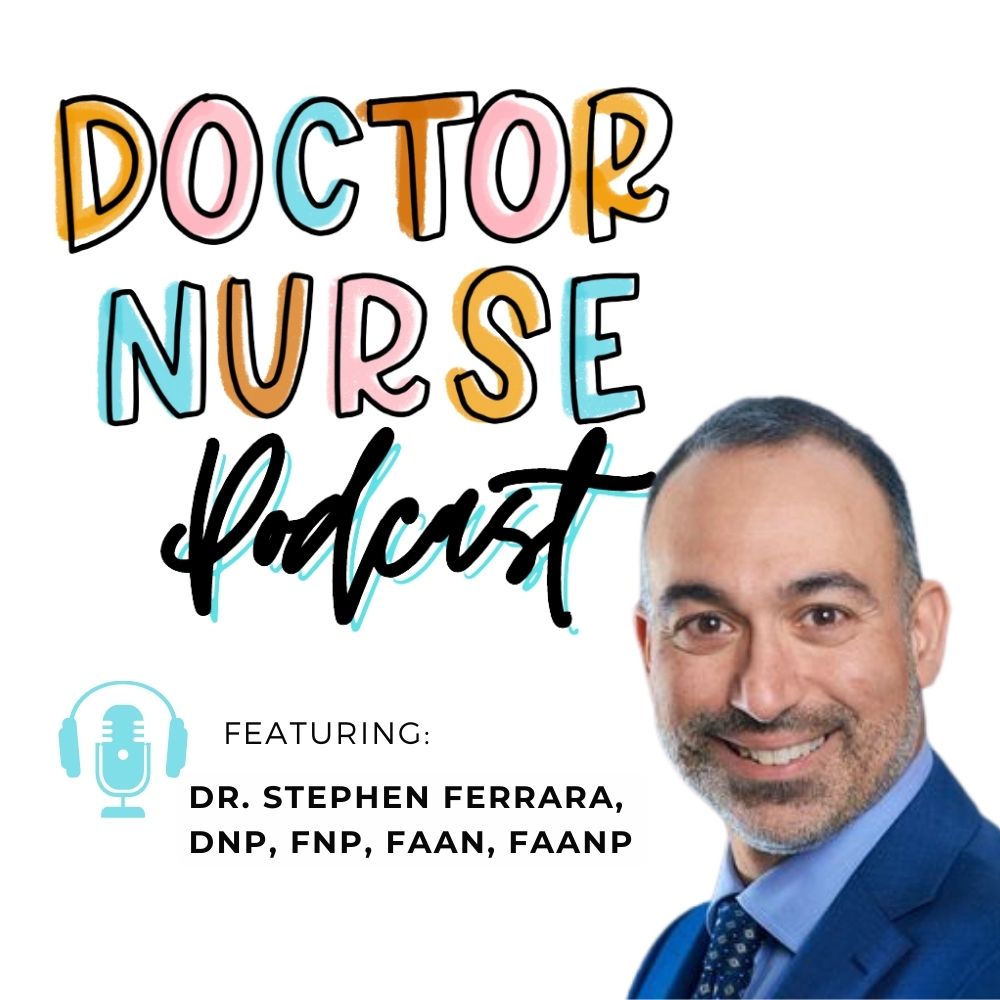
Dr. Sandra Pagenta: [00:00:00] Doctor nurse podcast. Thank you for coming on and taking the time to listen today. Today I have Dr. Steven Ferrara. He is an actively practicing family, nurse practitioner executive and faculty member. He combines years of clinical experience along with health policy developers.
Increase access to nurse practitioner partnered care in the state of New York City by serving as an executive director of the nurse practitioner association of New York state. He’s also. The associate dean of clinical affairs and associate professor at Columbia University, school of nursing, where he leads nurse practitioners as a primary care faculty and in their clinical simulation, he serves as the executive director of the Jonas nursing and veterans healthcare.
And he is the region two director on the board for a and P for the last six years. He’s received many awards for his health policy work with [00:01:00] his most recent being inducted as a fellow into the American Academy of nursing and 2020 guys, please welcome Dr. Ferrera to the podcast.
Thank you for coming on. And again, I will detail more in the show notes, all his degrees and all his accolades that you can check them out.
Dr. Stephen Ferrara: Thank you so much. It’s a pleasure to be here.
Dr. Sandra Pagenta: So excited to chat with you and guys we’ll start off from the very top. Explain to me what you see as your job title and your role and kind of what you do on a day to day basis.
Walk me
Dr. Stephen Ferrara: through your that’s a great question. I wear multiple hats, obviously from your great intro. And I do believe that all my worlds really do overlap one another. So my primary role is as a associate Dean of clinical affairs at Columbia university school of nursing. And there, I oversee our faculty practice.
Columbia University, I’m proud to be able to lead, this faculty practice, which was one of the first faculty practices for nurse [00:02:00] practitioners in, in the country. We offer primary care to the community, to the public. We’re not a free clinic, but we offer primary care services, we accept Medicare and Medicaid and all health insurances and that’s my primary role.
And then I’m also newly executive director of Jonas nursing and veterans healthcare. And this is an organization that is adjacent to Columbia, but. And we put together a scholarships for nurses who are trying to obtain or going to obtain their doctoral degree. So for DMPs and PhDs.
So there are S there are scholarships available through nursing programs. And that’s another part of my role. Right. That’s one side, and then the other side is as executive director. Of the nurse practitioner association, New York state. And this is the statewide association for nurse practitioners.
And you know, there’s a board of directors that are elected and I am the staff person to help operationalize. [00:03:00] The things that the board wants to put in place for the association. So for example, things like our legislative agenda membership communications. I do have a staff with that association and we all work to, make the best association possible for the risk practitioners in New York state.
Dr. Sandra Pagenta: Those are your kind of your two main hats. And is there any other hats you’re wearing outside of that or is that just kind of the main, the major two?
Dr. Stephen Ferrara: Well, I’m also, I’m on the board of AANP. I am the region two director. And you mentioned that as well, and this is a volunteer position, but nonetheless, it’s a responsibility and my region is New Jersey, New York, and Puerto Rico.
And there are state reps for each of those areas and I work with them and, we try to facilitate again communication and, and really look at nurse practitioners on, on the national stage, as opposed to the state level. And again, try. You know, create a community for nurse practitioners, for continuing education and conferences [00:04:00] and, all the things where associations are really important, I believe for, for us as our professionals sort of a hub that we should all belong to.
Well,
Dr. Sandra Pagenta: so what I love about your career is that you are, you’ve got your hand in mentorship. You have your hand in policy and changing the face of nursing. So that week. You know meet certain goals for our careers and be able to do certain things as nurse practitioners. And so I really feel like you’re at the forefront of creating change, which is incredible, but you didn’t wake up one day and all of a sudden have all this stuff, right.
You didn’t just somebody. There you go now go after it. There’s been a journey to this point, right? I really want to hear what made you decide to become a nurse and then walk me through to this point that you are right now, walking through
Dr. Stephen Ferrara: it. And I wish I’m going to say at the outset, I wish I could tell you.
It was all intentional. , but it wasn’t, and , I [00:05:00] found my way on this journey. So I’ll start way back, way back when, so I was a biology major student in college, and I thought I wanted to go into health profession. I didn’t know what I wanted to, where I wanted to be. I always credit my aunt who is a nurse, she’s a registered nurse.
And she has always been saying, go into nursing, check out nursing. And I said, ah, I’m not sure what I want to be, what I want to do. Well of course I graduated college with this biology degree chem minor and said, ah, I really need to figure out what I need to do now. Because I did not actively pursue.
Any of the other health professions , in school? I said, well, let me.
I still, I wasn’t a hundred percent sure that’s what I wanted to do. , so I said, let me graduate and let me get a job and see what, what happens then. So I found very quickly that For, I could not get a good job that was [00:06:00] outside of a lab as, as a biology prepared, , person. Yeah. And I’m not, I’m not saying that that that’s not, you know, a helpful degree it’s certainly, but for what I wanted, what at least what I thought I wanted to do this wasn’t going to get me at any, I was, I was interviewing for lamp positions and I was like, So that’s like, is there, are there any people there?
And they’re like, no, there’s no people. Right. Yeah. Right. So I said, okay, I definitely want to do something, with more people. So at that point I. Was able to get a job as a medical assistant. So I started at an ear nose and throat doctor’s office, and I was like
Dr. Sandra Pagenta: a CNA just like taking vitals or like
Dr. Stephen Ferrara: doing vitals, assisting with procedures.
I did a lot at your wax removal, a lot of Saruman removal. And. God God, you know, at least my feet wet as far as I was concerned. And then I also went to the certification for an EMT. So I did become an emergency medical technician, volunteered on an ambulance and really [00:07:00] got involved at that point.
This is more my speed. And as I did that, going to the ERs, speaking with the nurses that you know, as I was transferring patients, I said, this is what I want to do. So I thought I wanted to be an ER. Yeah. So I had this biology degree, I had a bachelor’s degree and I said, let me find a program that I could take advantage of my prior schooling.
So I did an accelerated program, right? So it was a accelerated bachelor’s degree. I did that in one. It was June to June, that’s intense and it was intense. It was intense. And was able to take my end clicks at that summer after I finished and became an RN I worked at a med on a med surge floor, med surge, ortho.
And I I’ve said this before that solidified my desire to never want to work in a hospital again. And not that there’s anything wrong with that. But I knew that that hospital environment wasn’t for me. , I only knew that by being in it. Right. So, so I said, okay, hospital, [00:08:00] you know, great.
You know, running around. On a, on a busy med-surge heavy orthopedic floor and said, okay I am going to do this NP thing and because that’s where I thought I wanted to be ultimately. So, yeah.
Dr. Sandra Pagenta: Yeah. So you’re working as a med surge ortho nurse. When did you get exposed to the nurse practitioner role?
Dr. Stephen Ferrara: The RN program I went to accelerated also had the NP component with it.
Right. So you could seamlessly go through, right. So I said, well, let me. So I was exposed to it early on. Right. So I knew this was out there and I said, well let me go one step at a time. So let me do the RN thing. So once I was working the, the med search stuff, I said, okay, it’s time to do the NP.
And I know there are many people out there who have issue with those people going straight through, if you will, from an RN to NP. And I truly believe that every person’s journey is their own I don’t think, making broad blanket statements. I did [00:09:00] have some experience in the healthcare field for a couple of years, you know, even prior to being an RN.
I think it’s very individual and I had colleagues who said. You know, their intention was to go straight through to become an NP. But they said, no, I’m going to work, three years before I become a, an NP. So, so that’s my educational journey. Right. And first roles I was actually.
Correctional facility as a NP, which was an interesting experience. I got to see a lot of things. I was very autonomous but quickly decided that that was also not going to be a long-term role for me. It sounds like I jumped around a lot, but I really don’t. I, I saved places. For a good amount of time when I knew that correctional health, which is its own specialty.
I mean, there are directional nurse practitioner associations. There are correctional health associations. Just not, not for me. When I went from there, I did college [00:10:00] health for a while. So I was in a busy student health center. And we had, students coming in, they were away from, from home traditional college-aged students.
And we were in charge of their care and did a lot of, episodic visits did sports physicals. And that was. But that was also something that I was there for about five or six years. And then, yeah, it was there for a while. I was the associate director of the student health center there and then said, okay, there’s really nowhere else to go from here.
So at that point I had gotten involved with minute clinic and minute clinic was. Just opening up that it was their massive expansion in the CVS locations, on, on the east coast, mostly, and was a manager of operations for them and, my responsibility was hiring nurse practitioners.
I mean, these clinics that were in five CBF, they were just being built. Like, I mean, I was touring CVS is and looking at spaces and doing punch lists, you know, from construction that needed to [00:11:00] be done because, we were setting up these brand new clinics and there was no like local office, like the headquarters at the time was in Minneapolis.
So we were flying to Minneapolis. So, so I was able to connect with other regions. People and we sort of, they were responsible for say like New Jersey and Connecticut people. So we sort of formed this like tight affiliations cause we were going through the same things. So I was there for a while.
And at about that time was when I got involved with the state association in New York. I had always paid my dues and never really was active though. I didn’t go to meetings per se, but what really got my interest was when legislation was being introduced to have nurse practitioners practice to the top of our licenses, right.
To not have a written agreement with a physician. And that just resonated with me, I never understood how Everything. I was able to bring to my patients that if I didn’t have this [00:12:00] written agreement,
Dr. Sandra Pagenta: your head yeah. And this like figurehead persons there, there wasn’t even a room. I
Dr. Stephen Ferrara: wasn’t even on site.
Like you, you don’t even have to be located on premises. Right. Like if this goes away, right? Like if the physician says, oh, we’ll look, Steven, we like you and all, but I can’t collaborate with you anymore. Then as of that moment, I can’t. It just didn’t make sense. So I got really interested in policy at that perspective.
So I joined, I became more active in the association. I became membership chair, and then I ran for treasurer and I became treasurer at that point. And then. I ran for president-elect. And around that time, our association the prior executive director departed, and we were looking for somebody to fill in that place.
So since I had the minute clinic experience where I was, familiar with operational. Aspects of, you know, just of, of, [00:13:00] of a business have a business. So I said, well, let me see if I can do this. I sort of applied as interim executive director was hired on a temporary basis and then ultimately said I am gonna see if I could do this permanently.
It is a part-time. Although I always laugh and say it’s part-time. But it’s, it takes a lot of my time, but I truly, I truly enjoy it. I love what I do. And to be able to have some aspects in health policy. Look, I, I don’t think I’m changing the world here, but if I can have a small part of change in changing in the changing practice for the better than, than I’m all in for that.
That pretty much gets me up until now. I had, I had been at Columbia now. So I went from minute clinic to Columbia university because again, to be able to lead a faculty practice was very similar to what I was doing with. I, I was ultimately responsible for 10 clinics in [00:14:00] New York.
For, for Columbia. I was there was one clinic and the idea was to expand it to at least another one. So we did expand our locations at Columbia and I also added a house calls practice to it. So right now at Columbia, we’re doing house calls, we’re doing primary care and it’s all, it’s all. Oh, my gosh,
Dr. Sandra Pagenta: you are absolutely incredible.
And the, what you’re doing is no, it is, it is impressive to say the least and what I find as you move to these different roles. When you stepped into the business world of CVS, what gave you the, the ability to move into that role from what you were doing before? Like how did you have the qualifications or, or did you just sell yourself?
Because, I mean, if you’ve got gumption, you’ve got the desire. I mean, what did you find? Cause that was a pretty big shift from realizing, in student healthcare, this is kind of where I max out. And knowing that you wanted more and [00:15:00] moving into that
Dr. Stephen Ferrara: role I would say. Both. Right. I would say I had a little bit of experience at, at the college health, because I was associate director of that center.
So I was not just a hundred percent clinical. I was involved with a lot of continuing education for the other nurse practitioners and, looking at more broader picture and not just day to day, although I was the only full-time. Nurse practitioner at that college. And, and we had a lot of per diem nurse practitioners that would work every day.
So there was every day there, there was at least another nurse practitioner working with me, but I was the person there to follow up on a lot of the labs that would come in and, and all things that. To be followed up on I did that, so I had a little bit of that experience and of leadership and the idea of minute clinic really also made a lot of sense to me. And I said, if the idea of putting nurse [00:16:00] practitioners in a busy pharmacy that is. Amazing for, for patients to have access to healthcare. It’s amazing for nurse practitioners because now we’re becoming sort of out there. Well, no, right?
Like I’m going to go to the minute clinic now I’m in the clinic. Didn’t you exclusively use nurse practitioners. It was nurse practitioners and physician assistants, but to put nurse practitioners out there, I mean, at the time and I haven’t followed so closely. CVS at the time. And I think it’s still up there.
It was like an $80 billion a year company. Right? This is what I thought was a huge initiative that was underway that was going to transform healthcare for better or worse in the United States. I haven’t shied away from controversy in my career.
And this was one of those controversial things because, you know I’d been on the inside and seeing convenient care and, the great thing is it’s access to health, right? It’s access to things that people may not have. [00:17:00] Pursued. But the downside was, it was a very finite model that was not utilizing a nurse practitioner to their full ability because, the idea was it was episodic care.
Right. And you’re going in because you have sore throat and ear infection, proctitis and. Nurse practitioners can and do much more than that. But I thought that this was a, a good spot for, for nurse practitioners and, and it was from that point, from the F college health that I was able to really transition fairly sleep seamlessly to the sort of corporate world, if you, if you will of, of CVS.
Dr. Sandra Pagenta: Very impressive. Take me through again, that was your entire journey. So listeners that are hearing you, you’ve just moved around and you’ve looked for opportunities and you say you’re not intentional, but what I do here is that at different points you were assessing, what are my options here? What can I do here?
[00:18:00] And now this isn’t really where I want, this has got a limit and I really want to, and you really wanted to keep breaking the ceiling. And so, and breaking past that feeling of, no, I can’t just do that. And now you’re moving into policy where you’re helping honors practitioners break through the ceiling of either legislation or whatever’s going on.
As far as the regulatory status and as one of the things I want to touch on, because I feel like you’ve probably had some ability being a man in this space. What have you noticed that has been different than, some of your female colleagues?
Dr. Stephen Ferrara: Yeah. That’s a great question. And you know, I think. To some degree I, white male privilege, right?
I recognize the fact that, because I am a male and I probably had experiences or not experiences, but I’ve probably had opportunities that by nature of that was, Might’ve opened some doors, but I will also say this, right. I think it’s
Dr. Sandra Pagenta: challenging. It is challenging.
Right?
Dr. Stephen Ferrara: I mean, look, [00:19:00] everybody has their own journey and that’s what I truly believe. I would be in nursing school and people would say, well, then you go to medical school after that. Right. Cause we’re assuming that I and guys become. You know, physicians and girls become nuisance.
And I said, no,
Dr. Sandra Pagenta: in the movie what is it? The one with Faulkner.
Dr. Stephen Ferrara: Yeah. It’s not parents meet the parents,
Dr. Sandra Pagenta: the parents that he’s like, what are you going to be a desk? It’s got this like that. I feel like you actually have to overcome this. This is actually a challenge, especially in this space. Right.
That’s mostly dominated by women. That’s kind of what I wanted to hear more about is just kind of some of the challenges that you face and you had to overcome through being kind of different in this space.
Dr. Stephen Ferrara: A hundred percent. I would work with female colleagues that were not, so accepting and I don’t think it was just female colleagues.
I mean, I think being a nurse is hard right there. We’ve heard the sayings before, [00:20:00] nurses eat their young and, and, it’s a hard profession to break through and, you know, I think whatever else you add on top of that just makes it that much more challenging. Right. So, yeah.
So th there was the perception that, oh, why are you just just being a nurse? I said, because this is what I want to do. This is how I want to connect with patients. And then, you know, My, my sexuality was, was, was questioned. You know, why do you want to be a nurse? Like, you know, so again, oh my God, it, it is what it is.
And I said, look, I’m not really being so concerned about what others think or do or saying. When I was RN on that med surge floor being the only male nurse and I’m using male nurse in airport. Because I do not like that term, but being the only male nurse it was Northern Pedic floor that were, , we do a lot of hips.
Whenever there needs to be a patient move, they’re like, Hey, Steven, I’m 5, 5, 9, right? I’m not this, this huge hulking of a, of a character. But you know, I [00:21:00] would, I would help. Right. And when it came time for me to ask for help and I didn’t like, is there anybody around you? Like we were just everybody. So, so those were, those are some of the things, again that also solidified.
Desires would never work in patient. But you know, never say never because you never know where you’ll end up by.
Dr. Sandra Pagenta: I never say never. Yeah. That’s
Dr. Stephen Ferrara: very interesting. Yeah. Yeah. So, so that was like that, that aspect of what I had to overcome per se. Yeah.
Dr. Sandra Pagenta: Yeah to be successful. But I’ll be honest with you. I really don’t feel like I want to focus in on how people are more advantage than others. I really want to focus in on how people overcome their challenges, because we all have challenges. We all have struggles, no matter what.
You are, or what you’re about. We’ve all had to overcome something either in our past our parents, it’s always something that you shared, in particular, the challenges with being a male in this field. I want to hear people say like, okay, well, I can’t do it because of I’m this.
And it’s like, no, he did [00:22:00] it despite these things. And despite the fact that we w we eat our young male and female, we just eat our
Dr. Stephen Ferrara: young, you know,
Dr. Sandra Pagenta: so that’s just beautifully said. Any moments in your career that you felt like was a real high that you, got to that day? I think I’ve arrived.
Dr. Stephen Ferrara: That’s a really good question. I left out that, I did go to school to get my DNP at, at some, somewhere along that journey. Right. Because I thought I needed that. I thought I needed this extra credit. Not credentialed, but this extra education to be able to get to where I thought I wanted to at least head in the right direction.
Right. I may never know the destination, but I, I do know the general direction I want to go. Graduating with the DNP and the school I went to, it was the first coat I was in the first cohort of, of the DNP. Like I was that first class. We often said we were the, you know, the crash test dummies.
And because they were still figuring things out, on the backend. But when I graduated. That felt [00:23:00] like a huge, like step right here. I am, I had this doctoral degree my parents didn’t go to college and I said, this is, this is pretty cool. My grandfather was so proud of me and it was, it was really, really, it was a, it was a huge step.
But I was just only getting started right at that point. A few things that, that do point a jump out is that, And we mentioned this a little bit earlier was I am fellow of AANP I’m a fellow of the American Academy of nursing, and these are honor type of, of, of designations.
You have to apply to it. You need a sponsor that you D to sponsors to, support your statement. And you know, it’s, it’s nice to be recognized. Doing the work that, that you do, that one does, and just sort of get this, you know honorary title to say you have attained this recognition of, of work of a body of work.
We recognize and appreciate [00:24:00] you. That’s really fit feels good. I don’t do it. Yeah. You know, to say, I am a fellow, but it is a it is an honor. And as far as you know, AANP goes there are less than a thousand fellows in a and P there are over 325,000 nurse practitioners in the United States.
So it is, it is nice. And in the American Academy of neuro. I believe there are 2,800 fellows worldwide and there’s 4 million nurses in the United States, so it is really nice. It’s really nice. It’s a really nice thing, but again , I don’t do my work so I can.
Dr. Sandra Pagenta: Sure, sure.
But I think one of the things to know is that it requires a level of expertise and a level of focused intention in your career to obtain something like that. One, I think there should be these awards for nurses out there to encourage hard work. I mean, let’s be real, right?
Like we work to get paid. [00:25:00] We work for a certain amount of. No, not applause, but maybe like I dunno what the right word is, but we’re working for something. We want to feel like we’re working towards a goal. That’s what I’m trying to say, working towards a goal. We need to create these goals because if not, then people don’t know what should I be shooting for?
And there’s nothing wrong with going, Hey, I shot for that. I got it. I think that’s something to celebrate. I think that’s something that more nurses need to be embracing. We have all stars in our mix. There is nothing wrong with, doctors do it all the
Dr. Stephen Ferrara: time. He’s got the golden
Dr. Sandra Pagenta: sister scope award and urology, and it’s like, he actually got assistant scope
Dr. Stephen Ferrara: and gold.
Like, are you kidding me? Like,
Dr. Sandra Pagenta: why not? Have and create the same awards for nurse practitioners and nurses that are doing incredible things with their careers and again, shooting for these goals. I love that. I think it’s great. I never feel shame about it. I’m going to promote it and say, yeah, I know that guy.
He did that. [00:26:00] That’s fantastic. any other challenges that you had to overcome in your career? As you’ve gone about that, you’d like to share it with my audience
Dr. Stephen Ferrara: no, I, I, there really wasn’t any, any like moments that, I found myself at a crossroads and I, it, it didn’t nothing like that.
It was, you know, it was just like I think is just being a business. Person having a family , I met my wife in nurse practitioner school. We have three kids, right? So, so that’s go haul all that. It is madness.
Dr. Sandra Pagenta: That’s incredible. Any mentors along the way, have you had anyone that’s kind of come alongside and just really helped you throughout your career?
Dr. Stephen Ferrara: Yes. I’ve had a few I can’t say I’ve had a lot and I do think that being a male has. Caused some people to not necessarily embrace me and say, oh, I’m going to mentor you. Right. Because I think there was the assumption that, oh, you, you probably have [00:27:00] it all figured out. You don’t need my help.
And I was like, ah, I think we all, all could use help, but what, one of, one of my mentors was in, in the nurse practitioner association in New York and. She basically grabbed, grabbed me and said, you’re coming with me and said you know, I want you to go to these meetings. I’ll help you. And she really, really is.
I blame her for a lot of what I believe her for her, some of the things, but, she definitely introduced me into the association world and. Broke down, like, yeah, you should totally be here because we need somebody like you and you need to like do your thing and mix things up. That was, a truly and, and we still are, are connected to one another and we speak all the time.
And you know, she was like by one in the field, like, you know, mentor. And then of course, once I was a little bit more established, I had other colleagues that, you know, it wasn’t [00:28:00] sort of a formal mentor relationship, but I definitely had a network of people that, that I could reach out to. And that’s been just.
Yeah. Priceless.
Dr. Sandra Pagenta: Yeah. I just see this, this picture of her just like taking her arm, like through your arm and just being like, come on, let’s go. You know, physically,
Dr. Stephen Ferrara: well, basically, so we have these town hall meetings again, this was when legislation was just being introduced and in New York state.
So this had to be probably a good. 1415 years ago. And I went to this town hall and this other person went to the, this other vet. Now he’s one of my, one of my good friends another nurse practitioner. And she grabbed both of us and said, you both need to be involved in this association. Right.
So, so he became president of the association. At one point I was president, I was executive director and like, this was not like a, you know, back room. Deal that we worked on it, we got involved in it. The more we got involved, more, we enjoy doing the work and [00:29:00] saw that we need to get the goal of, full practice authority for, for nurse practitioners in New York.
And we’re not there yet where we’ve we’ve improved, but we are inching. We are inching there. We’re in a, in a, in a good spot right now. So I have two
Dr. Sandra Pagenta: things to say about that one, being that guys, whoever you mentor. It’s your legacy. They go ahead of you and they do things in honor of you. So nurses have this released like sick and twisted perspective that everything is mine, where this oppressed group that we have to hold things close to ourselves.
But when you let things go and you bring people into your space, giving them opportunities to grow, what you will find is when they do go ahead of you or they do go out and do these things, they will do that. In honor of you, you will live on through them. And so it is through wisdom that you give to others first.
And then second off saying inching closer to autonomous practice. And I don’t know [00:30:00] how familiar you are with the state of Florida, but here we have this new bill that’s brand new. It’s probably about a couple of years old, where we actually are being able to get autonomous practice where you can work independently as a provider.
In certain fields it’s pretty restricted. You can’t do anything you want, but it’s. It’s moving along, inching along kind of like what you’re saying. I don’t know about in New York, but here in Florida, you have to do a certain amount of clinical hours or have a certain time in the field with underneath the position.
And then the other part is finishing the two classes, pharmacology, differential diagnoses make sure that you’ve got the right type of insurance to protect you in that applying for this license. Is that something similar in New York state? Do you have kind of a similar. Yeah. So after
Dr. Stephen Ferrara: 3,600 hours in New York state, which is just about two years of full-time practice no longer that requirement is, is mandatory for nurse practitioner.
So, but. Nurse practitioners need to maintain a collaborative relationship [00:31:00] with a physician in the hospital. So it’s not a formal agreement, so this is C and this is the challenge we have. Right. When we look at the broad scale of, of nurse practitioners across the United States, It makes no diff it makes no sense to me that in New York you have this 3,600 hours and then you have to you know, still maintain a collaborative relationship in Florida.
It doesn’t make sense to me that you have to do X number of hours, but it could be autonomous, but only, only in, in like these primary care areas or only in this. And then you could go to a state like. Right. And open up your practice and they want to be, day one, top of your license, top of your education.
And of course you collaborate of course you refer, of course you do things that any other a competent practitioner would do. , it’s state specific and this is the challenge we have and, the, my policy hat. [00:32:00] All these states that are not full practice authority have to have bills introduced and passed.
And it’s not like a broad scope, a broad brush perspective where you can sign one law and all nurse practitioners in every state are. The same requirements, right? So you have, you have this mishmash of, of of laws and regulations that just does it do not make sense. And that
Dr. Sandra Pagenta: needs to be, I agree. And I think it’s awesome that you’re on the front lines fighting that.
Please keep doing that right. Because again, it’s more of these states start to recognize this. It will make the other states that are, it’s like get on board. Like the rest of the country is here. What is wrong with you? And so I love that. I think it’s great. And the more we do it, and that’s also why I’m applying for autonomous practice, because I.
To show. No, no, no. There are nurse practitioners out here. There are going to do that. And the more of us that pursue those autonomous practice licenses, even if you don’t use it, I may not even use it. I just want the option. And so more of us need to [00:33:00] be doing this because it shows there is a need. People are receptive to it.
We are going out and getting them. I’m willing to do the work. It’s just a matter of work. So just go do it. It show that. Well, we can do I love that. So again, the last question of the interview is give me a piece of advice for a new nurse starting off in her career that you wish you would have known at the start of your career piece of advice to hold on to, and a piece of advice that you say don’t listen to that
Dr. Stephen Ferrara: garbage.
Okay, so that, that’s a good one. I would say piece of advice to hold on to is. Chart your course and stick with it. The amazing thing about nursing is that there are so many areas to get into that, if you don’t like bedside nursing, right. That’s okay. Because especially today with, with tele-health and think about broad scale and think about the fact that.
The job you want may not even have been created yet. And you could be, you could be the one to [00:34:00] create that job. Right. So, so, so that is an amazing aspect of, of what the profession that I chose. And that’s one of the reasons also, I said, nurses are everywhere and we could do a lot of things. Right. What I would say to, you know, kind of.
Get rid of that’s a good one. I don’t know if there’s anything. I mean,
Dr. Sandra Pagenta: I think
Dr. Stephen Ferrara: you have to med search, right? You have to do med surge, because you truly don’t. And I think here we are, you know, post pandemic, we’re still in a pandemic that, you know, we’re seeing that nurses have moved from areas out of necessity, right?
Like we had to go to ICU where. We really didn’t have ICU experience, but you did what you had to do. So, so I think that old adage of, you need to, pay your dues on med surge. That’s I don’t think that’s enough. Yeah.
Dr. Sandra Pagenta: Yeah. And even what you said earlier about nurse practitioners, not being able to go straight through or whatever, if you know what you want to do, I don’t see [00:35:00] why we make people do what they don’t want to do.
It’s like if you want to be a nurse practitioner and you want to go straight through. We want the people that are upset with you, like you do you like I’m going to go do me. And that looks like being a nurse practitioner earlier in my career than later, because this is a role that appeals to me. I do not believe in putting people in roles that they don’t want.
Again. You do you get what I’m
Dr. Stephen Ferrara: saying? Like I totally do. I have colleagues that will say, I will not precept a nurse practitioner student, if they don’t have X number of years as a man. That’s ridiculous. Why would you say like, well, you know, and, and look, I try and be diplomatic and try to see both sides.
Right. Because, okay. So the nurse practitioner role was built upon the RN, right? Like, required some experience. But I think if you. Sort of go into the mindset that I’m going to be an advanced practice nurse. It makes you think about things maybe a little bit differently, right. And you can have a [00:36:00] nurse and I’m not, I’m not saying that a nurse who has been a nurse for 30 years on a, on a med-surg floor, can’t make that transition to becoming a nurse practitioner because absolutely you can, but it may even be.
After being in the field for so long, kind of knowing what, being a med surge nurses. And again, nothing, no disrespect to my med surg nurses, but that 30 year person may have a harder transition becoming an NP versus the person who says I want to be. And go forth that way.
Dr. Sandra Pagenta: I agree. I agree.
I liked that. And I liked that you’re being diplomatic because it’s never black and white. And so I might look and immediately go like, oh, that’s ridiculous. But then it’s like, well, maybe there’s something there that I might not be understanding, which I can understand. Like, well, they haven’t been a nurse, but I also feel like in order.
To go be a nurse practitioner. She had to go do clinicals as an RN. She’s probably working as an RN through her degree, just because even PRN type work to make some money. So, I mean, she’s getting the experience that I went shortly after. I mean, I was in, I [00:37:00] was in a nurse for about a week. I was getting another loan a little bit longer, but like, again, I was in the same boat as you.
I was in, in a very short time. Hmm, this is not the long game like this can’t be. And so I immediately went back within a year. I spent, I mean, it took me a year of nursing work to realize this wasn’t for me. And I had that experience within a year. Like, I just feel like there’s, there’s a lot of gray and so yeah, I like that.
So for the last part of the interview, it’s
Dr. Stephen Ferrara: so rapid fire. Oh, geez. Okay. All right. All right. You ready? Where do you
Dr. Sandra Pagenta: go when you want to be alone? All your jobs and your kids and your house and the rent out where you go to just escape and get a little bit of.
Dr. Stephen Ferrara: Oh, that’s a good question. I go and wash my cars.
I like, I like washing my car, like not going to a carwash, but like washing it with a bucket and the soap and [00:38:00] my.
I really enjoy it. It’s therapeutic for me. I like clean things and you know, I know
Dr. Sandra Pagenta: do you have that you feel like makes you the most successful.
Dr. Stephen Ferrara: These are horses, persistence,
Dr. Sandra Pagenta: persistent. I liked that. And what’s the worst thing you’ve ever eaten at a restaurant that you were just like, I’m never going back there. That was awful.
Dr. Stephen Ferrara: Oh my gosh. I would say I would typically not even order something that I think would not be that good. Gosh I’m going to say I have nothing because you could obviously tell I’ve I’ve taken the safe. To feeding out in restaurants. I’m not
Dr. Sandra Pagenta: like I had beef tongue one time, or I would to an Ethiopian restaurant and had to
Dr. Stephen Ferrara: go with her.
I would not order beef tongue.[00:39:00]
I would order the chicken.
Dr. Sandra Pagenta: That was so funny. Oh my gosh. It was to be
Dr. Stephen Ferrara: so funny. All right.
Dr. Sandra Pagenta: Well doctor, thank you so much for your time today. Thank you for your candid answers and your responses and sharing your journey with my audience. I know people are going to get a lot out of it, so thank you so much.
Dr. Stephen Ferrara: Oh, I bet. And I thank you so much for having me on.
Thank you.
Dr. Sandra Pagenta: And guys, don’t forget to, I’m going to link all this stuff. I’m going to do all this social media hotspots, where you can find Dr. Ferrera and, and be able to reach out to him if that’s something that you’re wanting to do. And cause don’t forget to enjoy the journey.
Podcast Description
Dr. Stephen Ferrara, DNP, FNP, FAANP, FAAN is an actively practicing Family Nurse Practitioner, executive, and faculty member. He combines years of clinical experience along with health policy development to increase access to nurse practitioner-partnered care in New York State by serving as executive director of the Nurse Practitioner Association New York State. He is Associate Dean of Clinical Affairs and Associate Professor at Columbia University’s School of Nursing where he leads the nurse practitioner primary care faculty practice and clinical simulation. He also serves as the executive director of Jonas Nursing and Veterans Healthcare. Dr. Ferrara has received many awards for his health policy work with his most recent being inducted as a fellow into the American Academy of Nursing in 2020.
Dr. Stephen Ferrara Links:
https://www.nursing.columbia.edu/profile/stephen-ferrara-dnp
https://www.instagram.com/drstephenferraranp/
Doctor Nurse Links: https://linktr.ee/DoctorNursePodcast
Wanna start a side hustle? Subscribe to the Doctor Nurse Podcast and I will show you how to start: https://view.flodesk.com/pages/6253188857d9b15fd00f8329
Latest Episodes
Doctor Nurse podcast brings you weekly shows to help INSPIRE, EDUCATE AND EMPOWER nurses with true stories of initiative and impact.
Doctor Nurse podcast brings you weekly shows to help INSPIRE, EDUCATE AND EMPOWER nurses with true stories of initiative and impact.
Latest Episodes
Doctor Nurse podcast brings you weekly shows to help INSPIRE, EDUCATE AND EMPOWER nurses with true stories of initiative and impact.