Also Available On






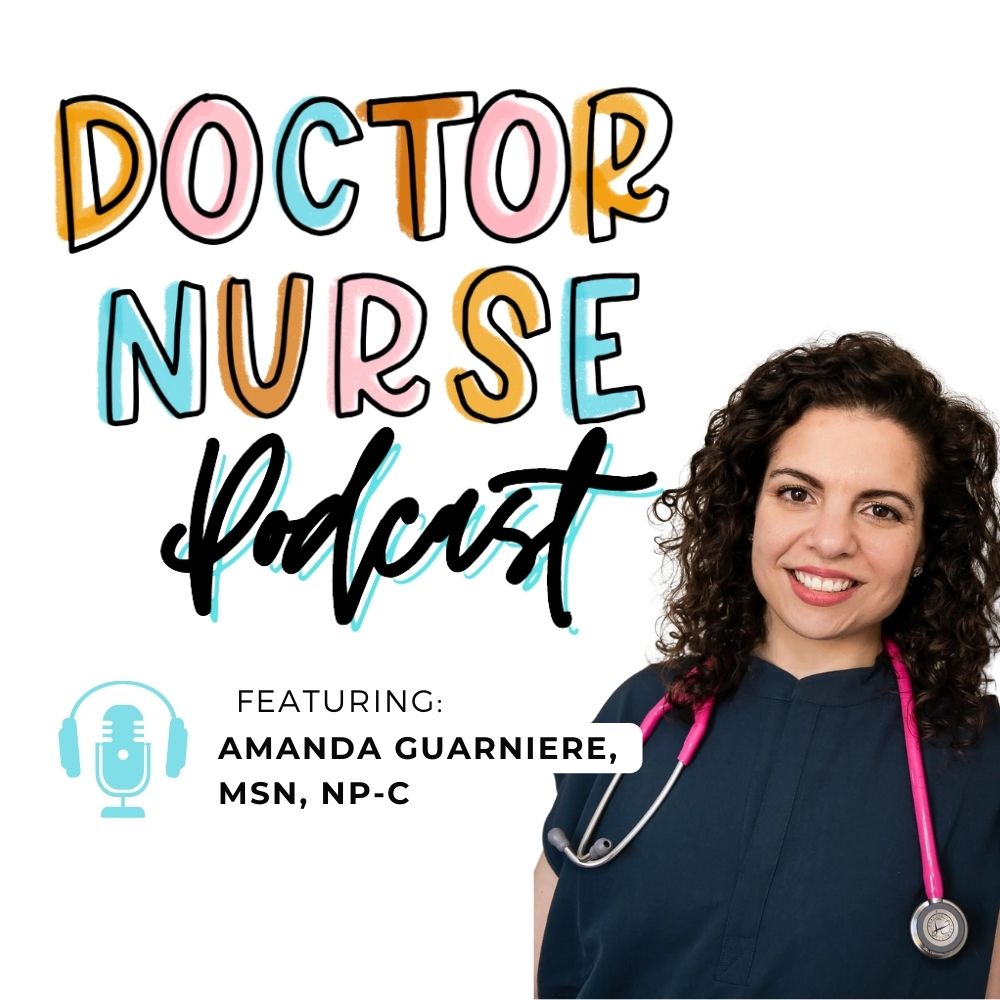
Sandra Pagenta: [00:00:00] Welcome to the doctor nurse podcast guys. Today, I have a really special guest. Amanda Guarniere is on the podcast today. She is a graduate of Yale nursing school in 2011. She is a dual certified nurse practitioner and a women’s health and adult, in 2018, she started her business called the resume.
And it is a business that offers career support for nurses and NPS, so that they can find land and love their dream jobs. She has a podcast titled nurse becoming, which is an inspirational podcast for me. It actually is what helps spur me on to create my own podcast. And she also had. The NP society, which has professional membership community that focuses in on helping NPS thrive in the clinical setting.
She is here today and she is so she’s happily married with three little girls and she’s here to kind of describe her journey and how she got to where she is today. So I am so happy to have you on Amanda. [00:01:00] Thank you for coming onto the podcast and chatting
Amanda Guarniere: with me today. Oh my pleasure.
I feel like this is a long time coming. You and I have been chatting behind the scenes on Instagram and it’s nice to finally be face-to-face.
Sandra Pagenta: Yeah, for sure. So let’s dive right in. So I wanted to start with, again, the classic question of how do you really see your role? What do you see your job day in and day out, kind of walk me through what a day in the life of Amanda looks like. Sure.
Amanda Guarniere: So right now I am currently a business owner and founder as my primary role. So yes, I am a nurse practitioner, but for the past few years, my primary focus has been on the resume RX. So right now on a daily basis, I.
I’m managing a team. I have an employee and some contractors who work for me, I’m creating free content for my podcast, for my social media platforms. And I’m supporting my students inside my paid offerings. So I have a few different digital [00:02:00] products and a membership for nurses and nurse practitioners where I help support them on this professional journey.
So my daily life now is a lot different than it was a few years ago when I was full-time practicing in the hospital. But yeah, I’m excited to talk about that a little.
Sandra Pagenta: Take me through kind of your steps to when you decided I’m going to go to Yale nursing school. Where did that love for nursing really start, and then take me to how you got to this spot right now, where you’re.
Amanda Guarniere: Sure. So I am a second degree nurse and nurse practitioner. So I was actually studying in a completely different field specifically. I was doing a violin degree and Italian language degree and undergrad.
Yeah. I don’t tell this story a lot, but, so that was my undergraduate focus. I was studying liberal arts. I wanted to be a music teacher and I had my first. Observation course in junior year. And I was like, this isn’t this education thing. Isn’t really, for me, I’m not sure that I can [00:03:00] handle these little kids and they’re screeching violins.
So I kind of went on this soul searching mission. And ultimately when I was studying abroad later that year in Italy, I had these little epiphany moments in these little nudges. That was basically telling me that, okay, this is your time. Your undergrad time is time for you to study your hobbies. But after this, you should go into a profession that is a, a service profession.
And so Kind of roundabout. I figured out that I wanted to go into nursing. My mom’s a nurse, so it was kind of staring me in the face, my whole life. And I knew that the end goal was for me to become an NP. I was really aligned with the role of NP. I had some really positive NPS and midwives. Figures in my life when I was a patient.
And I said, , this is what I want to do. So I looked for programs that would allow me to do that and come to find out there were all of these direct entry master’s [00:04:00] programs that were really designed for, for me, they were designed for people just like me, who had bachelor’s degrees in other fields and knew that they wanted to become NPS.
So I kind of drew a radius around where I was living. And said, okay. I will go within four hours of where I grew up and I will, I will move there for school. So I applied to five different programs and Yale was one of them along with a few other I guess, a well-known schools and ultimately decided when they visited Yale and interviewed there that it was going to be the best fit for me.
And so I jumped right in, I moved to new Haven. I. The accelerated program and after three and a half full-time years of very immersive schooling, I graduated. And so, , that was my schooling in a nutshell. And after that, I had a pretty traditional path entering the profession as an NP. I tried on a few different jobs and ultimately landed in the specialty [00:05:00] that I’ve spent most of my time in which has been emergency medicine.
So that was where I spent many years. I think I worked six years in emergency medicine and a few different jobs and locations and, and, and really the moment that everything changed for me was when I had my kids. So I got pregnant with twins and I was working full time in the ed. Went into labor at 31 weeks.
And we spent a month in the NICU. And so a month of my maternity leave, like I was going to have 12 weeks of maternity leave and five or six weeks of those were already spent in the hospital. And so I had a really rough transition back into work. And that was really when everything changed for me in terms of.
Relationship with work and figuring out like who this new Amanda was and what she needed. So that I’ll stop there for now. That’s kind of what, what [00:06:00] brought me to this new point?
Sandra Pagenta: At first, when you said you went into to delivery at work, I thought, oh, she’s one of those women that worked until she went into delivery, but no, you went into delivery because something was wrong at work and you super, super scary.
Honestly, As I was listening to your journey and what you’re describing it makes me think about kind of what I had my son. I had a similar, a rearranging of who I was. And, and to hear you describe, you go through this NICU process. I was in a similar situation. My son stayed in the NICU for a period of time as well.
And it is kind of like this crucible fire moment where you’re never the same after that. And so what really, what did you find when you attempted to go back to work after the birth of your twins and being in that NICU setting? And again, your babies are just teetering there. You’re, it’s scary.
It’s like, are they going to live? Or these are things that I remember experiencing when my son [00:07:00] was in the NICU and I couldn’t, I didn’t want to leave my, my nurse had to come find me because I was never in my room. Cause I was always on the NICU. And so they would come and bring me meds to the NICU because I was freshly postpartum and cut open and all those things.
And so I just remember going back to work and really struggling Did you have that experience at all? Is that something that you can relate to? Have you went back or did you not go back at all? Did you just say, listen, I can’t go back. I mean, I wish that I would’ve had the forethought to go like, okay, I can’t do that because I went back full time.
Which was not good for, for my, for my mental health or my physical wellbeing.
Amanda Guarniere: Yeah. I, I went back full time and. The reason, part of the reason was I was in a loan repayment contract and that loan repayment contract was, , I had delayed it for while I was on maternity leave. And when I went back, like, you didn’t get the payments if you weren’t working full time.
And there were all these things that would go wrong if you canceled it. So whatever, I went back full time and, the, the feeling was [00:08:00] it, it’s kind of hard to describe, but the feeling was like, I was leaving the people who needed me the most in the world for people who needed someone, but didn’t need me.
Right. And so it was this constant kind of push and pull between, okay. Who am I going to be? Who am I caregiving for? Right. So how can I sacrifice caregiving for these babies who are. My entire life to, take care of people who I didn’t know. And, and don’t get me wrong. Like it’s an honor to care for strangers in their worst moments, right?
Like it’s an honor to do what we do. But I ended up developing resentment towards my job for taking me away from the people who needed me the most. So it was like this constant, like attachment this pole. I was [00:09:00] always being drawn home and I couldn’t be 100% present in my work. And. , I started to fall out of love with the work that I was doing.
And, there were all these messy things wrapped up in it. Like I had to be there because of my loans. Right. It wasn’t, it didn’t feel like a choice. It felt like an obligation. And that was really, that was really difficult, but I, I stuck it out. I ha I, I had to, I, had six figures of student loan debt that were, half of it was going to be paid from this loaner payment contract.
So. I stuck it out and basically like the second contract was done. I dropped two, I dropped it 20 hours. So I dropped the 20 hours because I carried the health insurance and all these other things. But as soon as I did not, as soon as I was not obligated to work full-time anymore, I cut my hours, like the very next day.
Sandra Pagenta: Let’s pause there for a second, because one of the things that I, I [00:10:00] hear from your story again, and I identify with you so much is starting to feel resentful and starting to feel angry that you’re stuck and that you can’t be there with your family and that you’re having your subs. You’re substituting the care that you would love to go home and give to your babies.
You’re giving it to strangers, even though that your heart and your soul is telling you to go home. And I completely a hundred percent identify with that. How did you, how did you. Funnel or channel that into what you decided to build for yourself, right? Because one of the things that I love about your journey and what you’re describing to me is that you decided to make your own way into the life that you wanted.
And that nursing was this base camp for that mission. And that you were able to use your education to go, Hey, listen, like this is super painful and I’m going to take this painful thing and, and, and grow something beautiful out of it, because really what you’ve done, [00:11:00] Amanda with your career is incredible and what you’ve been able to build.
And we were talking before the podcast and we said this that, what you do is build resume. But what I really hear you describing is I really want to see, I really want to build the life that I want to look back on and with pride and I want to be excited and happy with the life and the career that I’ve created because they were mine.
I wasn’t forced, I wasn’t doing something because I was obligated. This is what I’m choosing to do. And, and I really want to hear what your, what your thoughts are on that.
Amanda Guarniere: Yeah. I mean, when I went part-time at work, the, the, I, I ended up having all this space in my brain, again, to think about things.
Right. And one of the things that I thought about was, well, what if I, is it possible that I never have to go back and work? Full-time again, if I don’t want to, right. What, what am I allowed to do? And I feel like,[00:12:00], my whole life. People pleaser, a rule follower, teacher’s pet, do everything that’s expected of me and, and do it 110% to, to a fault, right.
Overachiever to a fault is, is what you could call me. And, and so to have that space, to imagine what I want to do in my own way, like, oh, I’m all of a sudden an adult and. I can decide what I want my life to look like. So that was what I started thinking about when I dropped to part-time and, and I knew that I wanted to entertain the idea of having a third baby, and I didn’t necessarily want to feel obligated again.
To working full-time as I had for a long time. Right. So I wasn’t necessarily thinking, okay, what’s my exit strategy. I wasn’t thinking, how can I get away from working clinically as an NP? That was not even on my radar. But I started to think, okay, how can I have the best of both worlds? Right. I. [00:13:00] I envy the stay at home moms, but I also want to make money and support my family.
Where’s the middle ground here. And so that’s what I started to explore. And, I tried a few things on, I tried doing some freelance medical writing. I tried some blogging and kind of a different arena and it wasn’t until I realized that. I could help other nurses and other NPS navigate their careers through resumes, interviews, kind of this whole area that I talk about that I realized that I had like that light bulb moment of, okay, this is, this is not just a hobby, but this is a business idea.
And let’s see how far I can take this business.
Sandra Pagenta: That is really neat. And so guys for my listeners, I, again, here at the podcast, we are so into people building and crafting and carving the careers and, and, and the jobs that they want. Again, going part time, I think is a really pivotal thing for a lot [00:14:00] of people to grasp that it creates space for you to think.
And I felt the same way when I went part time, I actually was able to sit alone and be quiet and hear the little whispers of my soul and to know, oh my goodness, I could, I, what am I good at? Like what, what can I do that would be able to create again, this life? Again, I, I totally identify with you because I hear my, for my stay-at-home moms that there, they wish they could get out of the house.
And so it’s like, there’s that perspective, but then there’s also the, they don’t miss a moment. And so that’s super sweet. And so you just kind of struggle back and forth. I really like that you described very well. How you were trying to find that middle ground, because I think that so much in life.
Yes. As black and white, but there are shades of gray. Creating, creating the shades of gray and nursing is something that I I’m. So I think that more nurses and more men and women need to hear that there are shades of gray and in nursing can get you into. Into that space for whatever time you need it to be there. Tell me a little bit [00:15:00] about how you’re juggling mom life while owning your own business and still trying to stay present.
Amanda Guarniere: So that is the, that is the challenge. Does your, I think in terms of right now, I’ve created this, this life where I get to choose what I want to do, which I am so grateful and fortunate to be able to do.
And I’ve had to really examine what the different boundaries are, because it’s so easy to let all those lines get blurred. Right. So I could easily go. I could easily try to work all day with a child under my desk, which I did yesterday when they were home from school sick. Right now, for me, I’m really practicing Like pretending that I work outside the home.
So putting work hours on my calendar, sending the little one out of the house to daycare three days a week so that I can have, boundaries around my work time. That’s [00:16:00] been a really interesting exercise because my brain is always going and, and the, the, the blessing and the curse of, of having my own business is that.
I’m always thinking of ideas and strategies and new things to try. And it’s so hard to turn that part of my brain off. I don’t, I’m sure that exactly what I’m talking about. So, so yeah, so that’s something that I currently and working on being better at so that when I’m with my kids, I’m really present and Always thinking about my business, which is just so fun to do if I like, it’s always, my default of when I have free time is to think about work, but I know that that’s not the healthiest thing to do.
So I have to be really intentional about about how I spend that time.
Sandra Pagenta: One of the women that she told me, she’s a new nurse practitioner. She said she listens to my podcast while she’s breastfeeding. And that totally made my heart just saying, cause I breastfed my kid for two and a half years and I’m just like, yeah, just keeping doing it.
If I [00:17:00] there on the background as you’re breastfeeding, , whatever, you’re just thinking like. That’s really sweet, but I was thinking about her and I was like, what if she wanted to start something small? And she didn’t know how to scale? Like how. I know it’s like so broad and everything just kind of happened serendipitously.
And so it’s hard to really nail down how you’re able to scale and build. But what would you say for that nurse or nurse practitioner? That’s like, I don’t even know where to start Amanda. Like I am a new mom. I am exhausted. I’m tired. I’m pumping at three in the morning. Like how can I start something small?
Where do I even begin? What advice would you give to that nurse?
Amanda Guarniere: So I remember being there first of all. That’s a challenging place to be. If someone is feeling that pull to start their own business, then , it examining what you’re good at, what you love to do, how you would like to spend your time kind of envisioning your ideal life, but [00:18:00] also thinking really critically about.
What people will pay for. So I think that it’s so important to remember that if you want to have a business that generates income, that’s different than a hobby, right? So a hobby doesn’t necessarily make money in a business. Does. So if you want to have a business, then you need to find some way to validate your ideas, to figure out how.
Business is going to make money. And I think, another thing, another conversation that is maybe a conversation for a different day is that, this type of path of, of having a, a hybrid lifestyle where maybe you. Clinically part-time and non clinically, the rest of the time, it doesn’t always have to be you owning your own business either.
, you could, someone could work for someone like me, right? You could have some sort of non-traditional career that uses your skills, but you’re not necessarily the one building and starting something from scratch. So there are so many [00:19:00] kind of paths you can go on depending on what your goal is. If your goal is to start and grow your own business.
By all means, take that path. If your goal is to generate income from your family while you are at home and not in the hospital or the clinic, then that’s a different pathway to, and, and whatever is aligned with your goals is the right thing.
Sandra Pagenta: Yes. A hundred percent agree. Well said, Amanda, Hey, you put things so perfectly and just nice little bow right on top there.
Love it. The next question that I ask everyone, I would really like to hear a high or low in your career or a moment or a challenge you had to overcome. So just a moment that you were just like, this, is it the businesses going under, I don’t know, or just a real moment that you were like, this is it.
This is what it’s about. This is what I’ve been trying to create. I’m there, one of each, if you’ve
Amanda Guarniere: got one. So I would say that the biggest challenge that I’ve had to date is actually. The [00:20:00] decision to leave clinical practice and focus on the business full-time, which is a part of the story we didn’t quite get to.
And, and I’d like to say that it was a very confident choice in that one day, I said, all right, my business needs me, full-time and I’m going to take the leap. And it was all, rainbows and butterflies, but the reality was I had a clinical job lined up after. Having my third, who’s now two and a half.
And by the time that credentialing came through for that job it was April, 2020, and the job was in an ER in New York city. And if we all remember what was going on in March and April of 2020 it was a disaster in New York city with, , the first surge of COVID and, they called me in and said, can you start tomorrow?
And, and meanwhile my kid’s daycare had completely closed. The babysitter was not coming over. Like everything was just a disaster. And and I had such a hard [00:21:00] time making the decision to let that job. Right. I had gone through the credentialing. They were calling me saying, can you start tomorrow? And I knew deep down, this was not the best decision, right?
Because there was no PPE. We knew nothing about this virus. And. I was very, very close to saying, okay, I will risk my life, my family’s life for this one day a week job. Cause it was a per diem job and I really, really struggled with it. And meanwhile, my family and my husband, they’re all looking at me and they’re like, you mean like the answer is so obvious that you don’t need to go into this fire.
But I really, really struggled with that and I think. , with the chatter of, this is what we were meant to do. This is what we trained for. You’re, you’re abandoning your, your colleagues. If you don’t participate in this pandemic, I really, really struggled with that.
But
Sandra Pagenta: ultimately, how did you, how did you reconcile it? [00:22:00] How did you go ahead and settle to, to make the decision?
Amanda Guarniere: So I did a lot of journaling. I did a lot of crying. I listen to a lot of, a lot of like nineties music that helps me, like nineties Lilith, fair music, like Sarah McLaughlin. Fiona apple like that angry, angry girl music anyway.
But ultimately, like I knew deep down that the right thing to do was to let this job go and to be there for my family. I was in a position where I didn’t need the job, and that was hard for me to reconcile and admit, because I felt bad for others who probably would’ve made the same choice.
As me if they had the opportunity. Right. So so honestly it has taken probably this whole time for me to reconcile that. And even still, sometimes I’m afraid to admit it and I’m afraid to really own the choice that I made because I worry what other people think about me. Ultimately it just, I just had to keep reminding myself.
That it was the right thing to [00:23:00] do for me. And it was okay and safe for me to decide what the right thing was for me. Which is not really a PR permission. I had really given myself much in my life, so it was uncomfortable. But ultimately that was. You’re going to say, I was going to say that was just kind of the, the ultimate pinnacle.
Like it was, it was the worst moment and the best moment, because it was from there that what I knew all along happened was if I could focus on my business as my only thing, it would, it would grow in soar. And that’s what it did.
Sandra Pagenta: One of the things that we, we like to think about is how others are going to view us.
And we like to think, oh, well, somebody else wouldn’t do this. Or, or what are they going to think about me? And in the end, You will be sitting alone with Amanda in the end. They will be no one there. And you will never regret the time that you spent with your babies, with your family. Prioritizing those people that need you [00:24:00] over anything else.
I’m sorry. It just is what it is. And so I commend you for your bravery. I commend you for being in tuned and doing the thing that in your soul felt. And the moment it feels hard cause there’s so many external pressures. And I think every nurse can identify with this. There’s a lot of external pressures to provide, to feel like you’re showing up to not, oh my goodness, what is it?
What are people gonna think? And it’s like, actually, like, what do I think? And let me sit alone with that and doing the hard work, listening to the nineties, the nineties lady rock, and really getting to the core that. Beautiful self care. That is the stuff that more nurses need to be doing is just sitting alone with themselves and saying, what does my life need to look like for me?
Not for anybody else, but for me. And I think that’s hard work and a really great example of that. So again, another bow sit on that. I love how you shared that. So any mentors along the way, [00:25:00] did anybody help you Amanda, get to where you are today? Or has this been kind of a solo, a solo preneur? Type a
journey.
Amanda Guarniere: So I would say that for the most part, it’s been a solo preneur journey. However, I have invested in myself and in my business education. So I’ve worked with business coaches and business mentors along the way, which has really been a great investment of my time, energy and money, for sure. And then I do have.
, a few peers who are also in this space whose feedback and opinions and, and chatting has really been invaluable. So Liz roar from real-world NP, many of us know and love her. She and I have had similar business trajectories and we’ve kind of served as accountability buddies for. Over a year now.
So, she and I talk almost every day on boxer, whether we’re voice chatting or texting, and it’s [00:26:00] just so helpful to have someone to bounce ideas off of. Understands this weird world of online education and online business, which is really counterculture from what our industry is used to. So I would say it’s been, it’s been a combination of, of showing up for myself, investing in my own education and, and also having a few friends along the way.
Sandra Pagenta: Gotcha. My last question is what is a piece of advice that you would give to Amanda when she first was getting started, that you would say hold onto this and Chuck that to the wind, which give me a piece, one of each for a new nurse. Who’s like, all right, Amanda, what do you wish you would’ve known at the start of this whole.
Yeah,
Amanda Guarniere: I think, , we’ve touched upon it already, but I think I wish I would’ve known that it is okay and safe for me to make the decision that’s best for me and that it’s not, and that what other [00:27:00] people think doesn’t need to matter as much as I, as I think it will, and actually turns out I will be admired for those decisions that I was so hard on myself for.
Sandra Pagenta: Well said, beautifully said, I love that. And it’s so true because I do admire you for the boldness and the bravery to step out and go kind of counter-cultural. Because again, there is a struggle for women to really decide, okay, stay at home, mom. Okay. Want to have my own life? How do I balance it all?
And you don’t, you just end up having to. Sacrifice in certain areas and, make hard, hard decisions. This is not an easy oh yeah. Look at me. And just balancing. No, that’s not what’s happening. It’s it’s a real struggle behind, behind the decision. So thank you for sharing all that. All right.
The last part of the interview is the rapid fire questions question. So are you ready? Yeah,
Amanda Guarniere: I’m ready. I’m ready. Okay.[00:28:00]
Sandra Pagenta: A person who inspires you. Renee brown. Ooh, that was quick. What to you, what is the best age to be so far?
Amanda Guarniere: 35. That’s how old I am right now. It’s the best. So far.
Sandra Pagenta: All of that being present. All right. And from the resume RX, the girl, he tells you all about how to build your resume. What was your first job ever?
Amanda Guarniere: My first time ever was folding jeans at.
Sandra Pagenta: I was at the gap.
Awesome. Well, thank you for sharing. Thank you for your time today, Amanda. It was so nice to chat with you and hear your journey. And I know that a lot of people are going to get a lot out of what you shared. So thank you. Of course. My pleasure. And I was going to say, I know that on this podcast, you didn’t talk much about resumes and cover letters and you didn’t do much of that, but that’s, I really wanted to know Amanda and guys check out her stuff [00:29:00] because she tells you exactly what you need to know and do to build a bomb, totally killer resume.
And so where can people find you before you leave today? Sure.
Amanda Guarniere: Come find me on Instagram at the resume RX, or you can visit my website, the resume rx.com.
Sandra Pagenta: Great. Thank you so much, Amanda.
Amanda Guarniere: Of course. My pleasure.
Podcast Description
Amanda Guarniere, MSN, NP-C is an Ivy-league educated dual certified Adult & Women’s Health nurse practitioner and career mentor who helps nursing professionals find and land their dream jobs. She founded The Résumé Rx in 2018 and helps nursing professionals with career and résumé strategy so that they can land the opportunities that leave them personally and professionally fulfilled. She’s been featured in ScrubsMag, the NursePreneur Podcast, has written the résumés of several well-known nurse personalities, and is a 2020-2021 Doximity Op-Med writing fellow. She recently started the Nurse Becoming podcast and her increasingly popular Ask Amanda Anything IGTV series. Amanda is happily married with three young daughters.
Amanda’s links: https://www.theresumerx.com/
https://www.theresumerx.com/click-me/
My links to Amanda’s Template Bundle and Weekend Resume Makeover:
https://doctornurse–theresumerx.thrivecart.com/template-bundle/
https://doctornurse–theresumerx.thrivecart.com/wrm/
Doctor Nurse Links: https://linktr.ee/DoctorNursePodcast
Wanna start a side hustle? Subscribe to the Doctor Nurse Podcast and I will show you how to start: https://view.flodesk.com/pages/6253188857d9b15fd00f8329
Latest Episodes
Doctor Nurse podcast brings you weekly shows to help INSPIRE, EDUCATE AND EMPOWER nurses with true stories of initiative and impact.
Doctor Nurse podcast brings you weekly shows to help INSPIRE, EDUCATE AND EMPOWER nurses with true stories of initiative and impact.
Latest Episodes
Doctor Nurse podcast brings you weekly shows to help INSPIRE, EDUCATE AND EMPOWER nurses with true stories of initiative and impact.