Also Available On






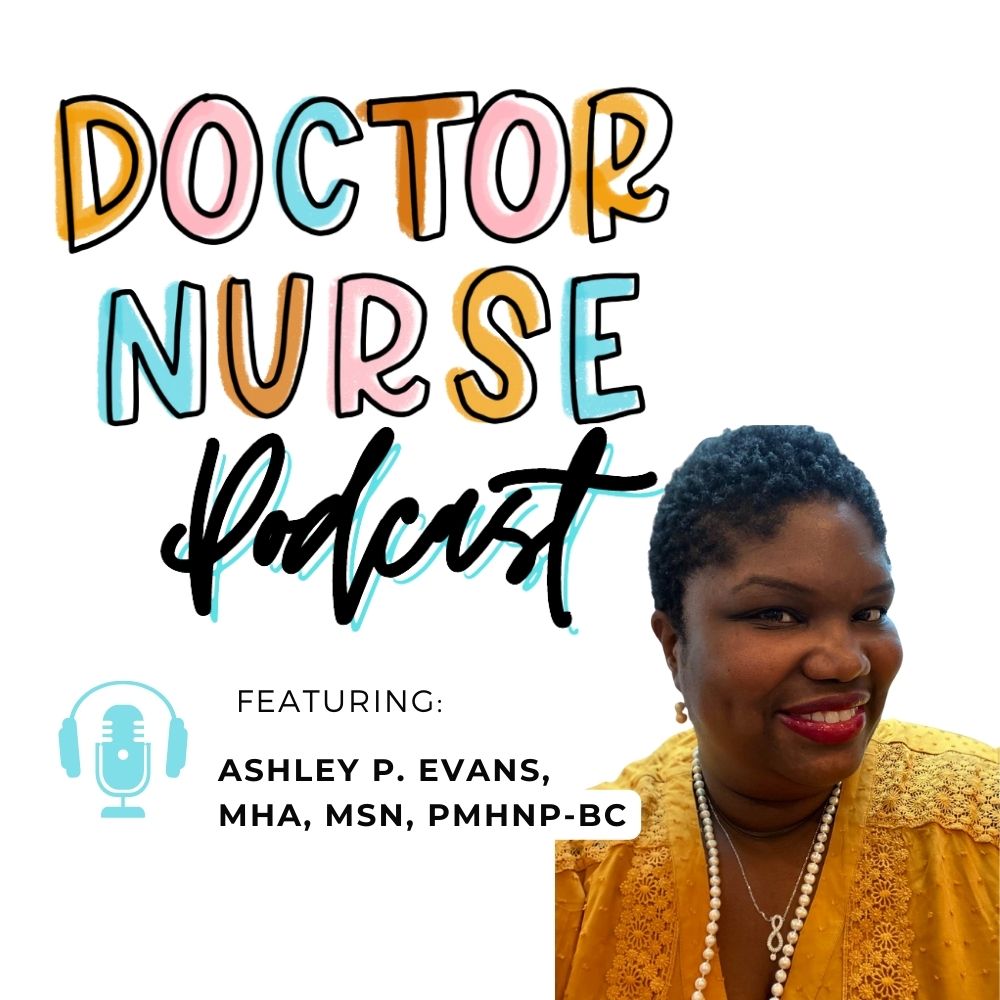
Sandra Pagenta: [00:00:00] Hi, welcome to the doctor nurse podcast today on the podcast, I have Ashley Evans. She is a nurse practitioner and the CEO and founder of psych life tea company. She has her masters in health administration and she has a master’s in nursing. And she is a board certified psychiatric mental health nurse practitioner.
She graduated in 2021 from the university of Alabama, at Birmingham with her master’s degree. She’s currently working at a psych mental health clinic at the veterans affair hospital. She created the psych life tea company out of her desire to create a positive experience for those who felt different by normalizing the conversation around mental health, her challenge to all mental health professionals is to empower others, to share their stories of mental health until the stigma is no more.
Oh, I love that. Just like fires you up. And honestly, I love driving out stigmas. I think there’s just a way that. [00:01:00] Limit ourselves so beautifully said and welcome to the podcast. Thank you
Ashley Evans: excited to be here with you today.
Sandra Pagenta: Well, I’m so happy to have you walk in it, to really dive into how you’ve carved your career and then also how you’ve made your business. Tell me about your current role and your job title, and then what you do for a living all the pots that you’re involved in.
Ashley Evans: Okay, wonderful. I am a psychiatric mental health nurse practitioner working for the VA here in simple Texas. In this clinic, we treat a myriad of mental illnesses, , from depression and anxiety to PTSD, schizophrenia, bipolar. We really see the gamut, , And, , we also treat lots of substance abuse as well. We also have programs that we refer veterans to.
Some of those programs are re are residential programs where they go in in order to detox and to seek help for coming off [00:02:00] of the substances. They will actually go into an inpatient unit to do that so that they can be closely supervised. And then, , once they have the time fully, they go into the residential program where they can learn how to cope with being without substances and learn what they can do instead. It really is a very comprehensive program. We’re very proud of it.
Sandra Pagenta: I actually did a rotation in psych mental health at the VA when I was a nursing student.
And it was an incredibly eye-opening experience watching and listening to these. Veterans that were experiencing, mental dysfunction and illness. And I’m never going to forget, one of the guys just seemed completely normal. He came into the room, he sat down and he was 25, 26 years old.
And I looked at my preceptor and I said, he seems completely normal. Why is he here? And she said, just listen. And so as he began to talk, he began to describe how he had two [00:03:00] PhDs and these, all of these different fallacies and delusions of grandeur. When I began to look around and go, oh my goodness, like.
This, this person is not well. And yet they seem, they, he seems so normal. And it’s just, again, kind of going back to that stigma that we all have. I feel like driving out the stigma of this mental health disease and people struggling with their mental health is critical because it can happen to any of us.
It is just something that it could affect anyone and it can be in your family.
Ashley Evans: You make a great point and I want to pause here. I don’t want us to proceed without really drawing out what you just said. The person looked normal, quote, unquote, that’s very important. And it’s important because of this.
What is normal, right? Especially as it relates to having. A mental illness or a physical illness, right? Like you can’t tell [00:04:00] that a person has hypertension by looking at them. Right. You can’t tell that a person has, anything you cannot tell, right. It is the same way for mental illnesses. I think there’s, there’s one thing that we have to understand.
And it’s the fact that mental illness is in the past, it was associated with beggars on the street, nomadic people who, , look like they’re quote unquote, crazy. I don’t use that word, but I’m trying to make a point. And the fact that that’s not how mental health actually looks is what is portrayed to us.
However, I have the face of mental health. Right. You have the face of mental health. And the reason I say I have that faith is because, , I personally have had a 16 year journey myself with having just battling depression and [00:05:00] anxiety. And I guarantee you, I told her unquote look normal, right.
But that’s what we have to get away from this notion that there’s a particular look, if you will. So it with having a mental illness. Yeah. Cause it’s right. It can be someone who has the most money in the world, money in the world is not going to keep you from being sad. It’s not going to keep you from being anxious. And it’s certainly not going to keep your genetics from developing whatever you develop, which we know genetics play a huge part from and to schizophrenia and bipolar.
It’s just going to do those things. Dr. Presented.
Sandra Pagenta: Tell me about how you developed your t-shirt company. So you’ve been working. How long have you been working
Ashley Evans: at the VA? I have been working at the VA for five years. And prior to [00:06:00] kind of go back and tell you a little bit of my history, because prior to working at the VA, I worked in a community hospital back in our hometown, Auburn, Alabama.
Sandra Pagenta: And
Ashley Evans: at that particular hospital is when I had my first experience in psych. You can imagine these adolescents had severe trauma. Trauma, you can’t even imagine the worst of the worst adverse childhood experiences these children had endured, from rape to, other sexual assaults to being beaten. I mean, the list just goes on. And it was very sad.
When I went into that unit, I stopped myself. Oh, my God, this is going to be a cakewalk, right. I’m just going to go and, keep some kids occupied. I didn’t understand just how [00:07:00] impactful the psychiatric realm of nursing truly was.
It’s far beyond sitting with, some patients it’s done that. I know a couple of years back there was the notion of all psychiatric nurses do is sit around and play cards. Have you heard that before?
Sandra Pagenta: I heard so many, some senators said something about all nurses do sit around and play cards
Ashley Evans: and then we just sit around and play cards.
Right. But if that’s all we did. Can you imagine how much talking we do while we’re playing those cards? I mean, it is a therapy session, 24 hours. When I started working in the adolescent unit, these kids, they taught me a lesson. And the fact that you cannot show up all bubbly and think that your bubbly ness is going to rub off on them on day one, it just does not work that way. When you have been exposed to the [00:08:00] types of trauma that these people have been exposed to and let down over and over and over again, it really changes them in a way that is very difficult to understand, but they don’t just perk up and, feel like you’re a Knight in shining armor coming in because you’re so nice and sweet
, it takes for you to show up time and time again, day in, day out, shit, that shit to really influence them the way that you really want. So influence them and start chiseling away at that hard core surface that they have built over, , the number of years that that trauma was happening to them.
So what I learned there was, , that they really experienced a great deal of embarrassment. They experienced a great deal of just feeling like people are, talking about them, looking at them. , they, they [00:09:00] feel like pariah is their own family. They, they feel like their families don’t love them.
And many of them, their families have abandoned them. So they have every reason to feel they’re not loved. And most of the time they feel like it’s because of their mental illness. We know that at the end of the day, that’s not the real reason why their family abandoned them. Their families had lots of trauma that were going on with them as well.
And, a mental illness, it is something that runs in families. Although the child is experiencing a mental illness, we can’t forget that the parent usually is to, especially when you have a child that young experiencing it. When I started working at the VA and I started working with adults, I noticed that the very same things that kids are plagued by in terms of, , just embarrassment and feeling so isolated and feeling so [00:10:00] different adults are plagued with the same thing.
Right. They feel their diagnosis has ruined their lives. And because of that, , they feel like they can’t be loved. They’re unworthy is what they think in their mind. They think that, , people are looking at them that they’re an embarrassment and they’re ashamed of themselves because of carrying this diagnosis.
And so I said, , how can I give back? , how can I show them that that’s not what we’re thinking? Especially, , people who were in healthcare giving them treatment. We’re not looking down on them. We want to build them up. And so I said, what?
When a person has on a shirt, right? And then the shirt is a Nike shirt and I’m from Auburn, Alabama, like I said earlier. Well, if you saw me with a Nike shirt that represented Auburn university, you would know two things. I love Nike and I love army university, right? So is it, , if I [00:11:00] created an apparel, mine that pulled together really beautiful, bright messages on, , bright teas and show support for the mental health community and show support for those who suffer with mental illnesses, I wonder how that would translate to them. I placed myself in their shoes quite literally, because though I’ve never been at patient on an inpatient unit, I can empathize. When you have empathy and you can place yourself in someone’s shoes, what they are experiencing, and you try to do something that prevents them from experiencing a bad onboarding into an inpatient unit or a bad exchange.
And so that’s why I came up with the theme line because the T line has beautiful saying [00:12:00] mental health matters, , reflective practice, , you are worthy just so many different things. I love that reinforces our advocacy from us to the patient. And it’s an awesome starter as well.
Sandra Pagenta: What have you noticed, do you wear it to work if you notice like any response from patients?
Ashley Evans: Oh yeah. It’s definitely a conversation starter, ? Oh, that’s so cool. Yeah,
Sandra Pagenta: because, and give me an example of like one of the conversations you’ve had with a patient.
Ashley Evans: Absolutely. So I went and got one patient from the lobby and I had all my mental health matter shirts.
And he came into my office, sat down and he also saw my mugs sitting in there on my desk as well, mental health matters. And he said, you really care, don’t you. And I looked at him and I was like, care about what, , I didn’t know what he was talking about. And you really care about mental health.
I said, [00:13:00] absolutely. I said, I am Ashley, all things, mental health Evans. And he was like, wow. He said, this isn’t just a job for you. I said, it’s my life.
Sandra Pagenta: That’s a really good segue into how you became a nurse and how you decided to be a psych mental health nurse, because your journey is really interesting.
Starting in the corporate world, kind of realizing that there was something missing. When did you decide to become a nurse and then walk me through your steps through nursing school and then to your master’s degree?
Ashley Evans: I’ll make it, , as concise as possible. But when I first went to college, I went, I obtained my undergraduate degree from Florida state university. Go NOLs.
Sandra Pagenta: We won’t hold that against you here, but go ahead.
Ashley Evans: I wanted to become a doctor. I want it to become I psychiatry. Okay. Interesting. so I was pre-med psychology. after the second psychology class, I’m like, this is for the birds. This is depressing. And [00:14:00] then I started delving into the math and science courses that I had to take, , for premium. I am, I am going to have to change my major because I cannot tell my dad that I’m going to fail a class because.
, it’s so difficult and I’ve always struggled in math and science. Well, let me just say math has always represented an opportunity for
Sandra Pagenta: improvement for me. I love how you worded that. That’s fabulous. They
Ashley Evans: struggle because it’s right. Love that. Absolutely. I changed my major to international affairs, something totally different. Aced all my classes, graduated to Birmingham, Alabama and started working for blue cross blue shield of Alabama. And when I started working there, I started out in claims, , and I told my husband said, what, I’m going to go back and I’m going to get a master’s in healthcare administration.
I decided I’m going to climb the corporate ladder. This is for me, I love administration. I [00:15:00] convinced myself that that was good enough. I went back to school, attain that masters and , eventually I went into another position there at blue cross, but I still had that nagging. , kept telling me, pulling on me, this isn’t what you want to do. I is more than, , why, because the money was good.
I mean, people say it’s the golden handcuffs. Right. And they say that yeah, the
Sandra Pagenta: The salary is the price you pay to let go of your dreams.
Ashley Evans: Like that money was good. Okay. I was getting my regular paycheck one Friday and the next Friday I was getting was known at that company as PVP performance based pay and honey, my bonuses.
I mean, they were awesome. I stayed there for a couple of years because the benefits were so amazing. Good. Yeah. Right. Yeah.
Sandra Pagenta: No, they can catch you on that.
Ashley Evans: It [00:16:00] was affecting my mental health. It was a very good job. people stay and jobs that are dead in and no psychological safety and jobs where there’s no support and encouragement inspiration, and they do it all in the name of a benefit.
Right. And to me, because it’s affecting your mental health.
Sandra Pagenta: Were you having mental health issues at this job or where, , okay. So it was just, you were still having that nagging, feeling that you were meant to do something
Ashley Evans: else. And I was like, what? I just, I really want to go back and do something else.
Before I really listened to myself, my husband and I, we had a baby. This is when I developed postpartum depression at that time after we had a baby and my mom had died when I was 15. And so I had, I had my first son When I was 23 and I tell people all the time when I speak about grief, that I did [00:17:00] not fully understand nor process my mother’s death until I had my first son in me to bring a child into the world.
So really process
of her and what that loss represented, , in, because maternally, you expect for your mother to be there with you during this incredible time in gorilla. And she was not. Then having all of the hormones in my body, just going through so much, that is when I developed postpartum depression.
And I ended up thinking psychiatry. He really changed my life. And I saw him at the urging of my husband who noticed that I wasn’t the same Ashley that he had known for so many years. And I’m so thankful that he noticed that, , in me now, this person who was crying all the time, didn’t want to hang out with the baby.
Didn’t want to, I mean, I was trying to live. It was just not [00:18:00] me. Right. And I’m thankful that he encouraged me, but the one thing I said when, cause I didn’t immediately say, okay, I’ll go see the doctor. , when he says you want to see a doctor, I was like, no,
Sandra Pagenta: I’m not, you need to go to production.
Ashley Evans: Actually. I think he had depression. And when he said depression, mental health, mental illness, I was like, have you lost your mind? Like black people do not go to see,
Sandra Pagenta: I was just thinking that yeah, with being African-American
Ashley Evans: We have to be honest about the black community. If we’re going to really move the needle, we have to do it in a very honest and transparent fashion. Okay. And so I was part of that group of people. I stand here before you, part of that group of people who thought to myself, mental health does not exist in black people because we are too strong. But
Sandra Pagenta: it is the exact opposite.
It’s the exact opposite. It’s the strong that asks for help. Like that’s vulnerability, that’s strength and vulnerability. [00:19:00] And
Ashley Evans: in my center did a weakness. I was like, yeah, , there’s no way I’m going to do that. I mean, it doesn’t exist or I’m too strong. Like I’ve done, , I’m the first person in my family who’s ever gone to college and graduated.
Like I started naming off all these things, but those things have nothing to do with your hormones and neurotransmitters in your body increasing and decreasing and making you feel sad. Right.
Sandra Pagenta: So how did you overcome that? How did you overcome that? The stigma, the culture, your own, , rap sheet of success.
How did you say all right, I’m going.
Ashley Evans: That’s a great question. , I, I listened to my husband and I said, what? I have a little one. It is best for me to go and see if I need to talk to someone about how I’m feeling, because I was crying all the time. And I knew that wasn’t normal. Right? And so when I went to the psychiatrist, he treated me with such respect.
He was a [00:20:00] Caucasian male. And I dunno, I was so blessed. I was so blessed to have someone who treated me ethically, who treated me with beneficent, who treated me with respect. Who didn’t rush me, but wanted me to fully process the grief that I had held for so long. He walked with me through those things and I decided at that point I have got to go back to school because I want to help people, like he’s helping people. And so that’s what made me end up, , talking to my husband about, Hey, I’ve got to get back, go back to school again. And he’s like, oh God, again, cause I had already finished my master’s and no busters. And I was like, yes, I have to.
I said, but don’t worry. I’m just going to go and get an associates. I just want to be a nurse. Okay. I just want to be a nurse. And so I went back and we moved back home over us so that we can have some help with our [00:21:00] little one. And I started going to school, , after work at the community college and it Auburn upline.
And I finished that degree in 2012, but , I settle for, I don’t settle. Okay. I keep going like the Energizer, but, and so I started working in a NICU then my husband and I would decide that we will be moving to Texas before then I said, what? I need to get back in school and get my BSN because that’s the only way that I’m going to be able to really make changes and, and get back into administration, , as a nurse.
And I said, this is it. I’m not going back to school after this. I go back to school and , we moved to Texas and I completed my BSN and that’s when I started working for the VA and, oh my God, it was such a wonderful experience. I loved working with that. And when you love doing something, when you’re [00:22:00] passionate about something and , you can be more impactful.
If you get additional schooling you’re just going to do. And I’m just going to go. I’m about to have this conversation with my husband and yet again, , but at
Sandra Pagenta: this point you’ve conditioned him. He’s ready for it
Ashley Evans: at this point. Okay. So you want
Sandra Pagenta: to go to school?
Ashley Evans: So I said, babe, , just one more time, I want to go back and get a nurse practitioner degree.
And so he knew how much I love psych. And he said, absolutely. , I, here I am. And I’m already having a conversation about. , should I do the PhD? Should I do the DMP? So
Sandra Pagenta: we’re not done. He’s now we love your hunger. For knowledge, I love for your hunger, for self-development and to continually improve your ability to impact patient’s lives.
And I share your love for the veterans. I also work with veterans and I absolutely love the population. It’s actually the population that I felt like I meant to work with just because they are [00:23:00] so real and raw and they tend to be in that age group that I love. I’m an adult nurse practitioner, a board certified.
And so that’s really what I like or just the older adults. And so it’s just a total, a complete hospital of older adults. I’m like, this is like my playground. I love this, this place, just three men that sort of more country that. So much for, for us to be free. It is so easy to just enjoy serving the veterans when you see that they gave up so much so that we could be free, the least I can do is just take care of them.
Well, so I completely aligned with you. And I, again, it does give you a different sense of purpose when you go to work. I only work two days a week, but when I do go in and they say, how’s your baby? And I’m like, oh good. And they’re like, I remember you were pregnant when you went out and I was worried about you, or they brought me gifts when I came back to work.
And so I just think there are some of the salt of the earth people and more [00:24:00] nurses need, if you are burned out or tired, go work at the VA because the population is incredible. You will be there with them. And I have a joined them. So I love that. You’re, you’re sharing that.
Ashley Evans: I will agree. Veterans. Some of the most transparent people on the earth.
I agree. They don’t have a filter and I love it was wrong. They’re going to tell you, and in the sight of you love that because you don’t want to have to go fishing and pulling out things that , or asking me questions about things that are not pertinent to them. for the most part, veterans tell you exactly what’s going on.
They tell you what they’re thinking, what they’re having a difficult time with, in, and in the population that I see in the clinic, these people deal with some nightmares. They deal with lots of hypervigilance and , the PTSD is very strong and they, they [00:25:00] also deal with. Lots of schizophrenia and bipolar as well.
But the, the population is amazing and I absolutely love it. And I love how, when they come in very raw meeting the treatment needing to get stabilized on meds, but being a little untrusting, like, I don’t know if I really want to take these medications and then you do your psycho-education with them, do psychotherapy, , give them medication, give them some group therapy.
And they come back in a few months and they’re transformed. Like it’s wonderful to see them in that way. You make them a believer.
Sandra Pagenta: Yeah, no, it’s funny that you say that. Cause I had a patient recently, I treated and he had said, I need to go see my psych doctor because, or my psych nurse practitioner. Cause he’s like, I don’t think these meds are working.
And I was like, okay, let me tag her real quick on a note. So I tagged the nurse practitioner, but it was just, it was just, he was wrong. He [00:26:00] came in and was like, I don’t think he’s meds are working. And my mom’s driving me nuts, ? And so it was just a raw moment of just, just like where he was that day.
And he was okay, nothing, , concerning was going on, but he was just raw. And I was like, man, I love this population so much. It’s totally my jam. And it’s what I’m meant to take care of because I really, really liked them. So actually tell me a little bit about a challenge that you had to overcome in your career.
A moment that you felt like this. Ashley’s out. She’s not going to make it, but then you overcame whatever that was. Do you have an experience like that?
Ashley Evans: There are many times that we make decisions that we later regret, and I remember I was in acute psych at the VA and I worked there for maybe eight or nine months and I saw a management position come up and I was like, I’ve got to apply for this.
, I’ve got to apply for this. And I applied and I got the job and I [00:27:00] remember finding out, cause the, the lady who I would be reporting to the nurse manager, she was hiring two assistant nurse managers. And I remember finding out who the second assistant nurse manager was going to be.
And. there’s always gonna be people whose aura and whose life does not align with yours. You hear the term. About them, but you don’t know a hundred percent, but you’re kind of like 30 certain that this person isn’t of the earth type of people, ? And so I remember finding out that this person was going to, , be your,
Sandra Pagenta: oh my God.
Ashley Evans: Yeah. And I prayed about it over the weekend. Like I got the job offer and I prayed about it. I told my husband, I said, you’re not going to believe this. We prayed about it. And we were just like, what, just go ahead and do it. Hopefully you’ll be in a separate office. And so I ended up calling [00:28:00] that Monday and I spoke to the nurse manager and I said, Hey, am I going to have a separate office?
And she said, yeah, of course you’ll have a separate office. Well, I never did sell her my concern. I just, , told her I wanted a separate. And I remember, , starting that job. From the time that I got in that job, this person was trying to sabotage me and to, , essentially just ruin my, my career ruined my credibility and who I am, everything that I stood for as a person, this person was trying to dismantle.
And I didn’t understand why. And I’m going to find out he was doing this because I’m a person that he was saying on the unit that we had worked for. I was friends with, and he didn’t like the fact that he, that she and I were friends. So he was trying to ruin my reputation because I was trying to instill worthiness [00:29:00] in her.
So tell her that she’s worth more than being with a person who treats her so poorly. Like he was treating her so poorly. This is, oh goodness. That
Sandra Pagenta: is, that is some psych drama,
Ashley Evans: the truth, honey. And so when he found out that I was saying those things to her, , building her up. He was living, but I didn’t know about that.
Cause she didn’t tell me he started, , saying all these ugly negative things, dismantling my like, oh my God. Oh my gosh ever. And what happened? I talked to my nurse manager and I said, Hey, I’m going back to acute site. And it was only after about seven months. At the end of the day, money doesn’t matter. My name matters who I am matters, what I stand for matters, that piece. I went back to acute psych and I should’ve never left, , because of the students I found out who was going to be my peer. I knew it didn’t feel right, [00:30:00] but sometimes you do things that don’t feel right. Went back to the unit and I gave the unit up a thousand percent. I may have been given 999% before I was given them a thousand percent now and went all in and was able to bring in ideas that I had. Brought changes for on the previous unit that I was working for those eight months, that CLC, which is the residential area for geriatric patients and was able to implement some of those ideas that I created there and brought them over to acute sites. So that’s cool, but it was an incredibly difficult experience that I was able to get through and able to give back up, , even more, once I got back to the place that I really loved
Sandra Pagenta: and see what I love about that. You think, ah, that was that wasn’t great, but you still walked away with so much knowledge, so much experience. And so [00:31:00] even though you tried it and it wasn’t for you, you still are better because of it. And I really want my nurses and nurse practitioners that are hearing this podcast today to let that sink in your soul.
Not every decision you’re gonna make, you’re gonna fit in and it’s going to be perfect, but it will make you stronger and you will come out of it a better NP if you allow it to, or a better nurse. And you’ll be more chiseled in a way that that experience caused you, , some type of learning or some type of gap closure or something that you go, all right, that wasn’t the best experience.
But I still learned something from there’s still a lot. I can, I can draw from that.
Ashley Evans: Discomfort for me represents an opportunity for me to learn, , and opportunity for me to get more comfortable with something that I would usually walk away from,
. Outside of nursing, , in my regular life, before I became a nurse, if something got difficult, I would walk away from it. When things go in a direction [00:32:00] you don’t want to go in nursing is such a robust feel.
You can literally like apply for a job today and have another job tomorrow. And that’s, what’s so wonderful about nursing. And that’s the reason why I was able to get through those eight months as the assistant nurse manager, because I knew that the options were limitless. I wasn’t bound, , to stay in that place.
It was just a matter of time before I put my mental health first and made the decision to not worry about the money. But to worry about my health first me first over the paycheck, the paycheck. Yeah. It, it will come, you
Sandra Pagenta: know? Yes. I love that. And that resiliency, I know is something that you put into your business and you put into your t-shirt business.
That fervor that you have for mental health and that, and that passion that you have is being [00:33:00] displayed in your t-shirts it’s in the messaging that you’re conveying to your patients.
And. I think the best thing we could do as nurse practitioners is to remind people that they are worthy of love worthy of attention worthy of time. And that messaging is just something that I think a lot of us don’t get a lot as children. And so you just become adults that still need those things just because you’re a different age.
Does that mean those things are not important. I love your journey. I love how. That time that you were, you were taking care of the adolescents, it helped you still see those same needs in the adult population. And then you’re looking to kind of fill in that gap with subliminal, but not so simple liminal messaging of you are worthy mental health matters.
And that’s your passion and that you have found it and you’re operating in your zone of strength and in your zone of passion, which is, which is perfect, which is just the perfect zone for your career.
Ashley Evans: So it really is. And one of the mentors, oh, go ahead. You were going to say [00:34:00] one other thing that I would like to say.
I think so many patients, so many people who have a mental illness, they believe they are the mental illness that they have. Does. That makes sense? That’s definitely true. They identified themselves as. , actually the depressed person, I am depressed. That’s who I am. I am depressed. , everything I do is depressed.
Like we have to get out of that mindset though. You are not the illness that you have. my name is Ashley Evans. I am a child of God. That’s who I am. I might have, , depression and anxiety, which I do. Thankfully, they are under control, , and I’m stable. But when I’m saying is that they don’t define me as a person.
They don’t, I love every day. My [00:35:00] job that I have for myself is to debunk the stigma that’s associated with those who have mental illnesses, because most people think they are poorly functioning people, and it’s just not true, can be a very highly functional person and suffer with mental illness.
So that’s one thing I want to draw out that you are not, , what you,
Sandra Pagenta: What your struggle with
Ashley Evans: not, yeah, you’re not the diagnosis that you carry. Yeah. Yeah, absolutely.
Sandra Pagenta: I get this word picture of like the body, right? And so you have like arms and you have legs and you have hair and you’ve got nose and years, all these different body parts, and you don’t walk around defining yourself by your nose or by your ear.
You’re a total picture, right? It’s everything. You’re the cumulation of all these different things in parts. And so it’s the same thing with, , past struggles or depression, anxiety, or. Diagnoses that you carry. I mean, people with cancer or all these different things, they had [00:36:00] that same mantra of like, I am not this, I am this.
And by focusing on what you are, you can elevate yourself up to that spot. If you focus in on the bad parts, the things that aren’t working. Well, things that are, , everyone has a little something it’s like, well, that doesn’t quite work the way it used to anymore. You can’t look at that. You have to look at all that you do have that’s working and functioning well
Ashley Evans: powerful.
The brain is powerful. A hundred percent. So focus on the negatives, Sandra, then that’s exactly what’s going to manifest in your life. See you two daily reframe the cognitive distortions that you struggle with. Please don’t think that I am perfect in my thought life. It’s just not true. No one in.
Sandra Pagenta: Come on.
Okay.
Ashley Evans: Where you’re thinking something negative, you have to daily reframe it Sandra, thankfully we can do that because the brain is [00:37:00] neuroplastic and that neuroplasticity allows rephrasing all of those things that you have weld on a ruminated on consistently in your life.
You can reverse it right now.
Sandra Pagenta: Yeah, I posted today that how amazing is the soul that both the devil and God are both after it. And it is so true because it’s this battle, right? This battle between, , submitting your thoughts either to positive things. Things that are true or so many of your thoughts that the things that are not true and you are not your depression, you are not your anxiety.
You are so much more than those things. And so leaning onto the truth, holding onto it. I, I look at it like just holding on for dear life off the side of a cliff, , just holding onto the truth and just saying this has got to work. Cause this is all I got is kind of the picture that I’m getting.
I don’t think you described any mentors along your way, but it sounds like your husband’s been your biggest [00:38:00] mentor coach, keep you going, but have you had any nurse mentors along the way?
Ashley Evans: , as a matter of fact, I did not have a mentor until about a year.
And some change ago and last position at the VA, I was the high-reliability organization lead. And I know you are familiar with reliability because you’re at the VA as well, but I was the lead for our organization here in central Texas. And so
Sandra Pagenta: for those who don’t know, could you explain what that is?
Ashley Evans: So high reliability is really awesome. It is a type of organization that understands that it has many high risk. And the organization, but though you have lots of high risk, like, , hospitals, do they have lots of high risk. You still want to have a very [00:39:00] low adverse event rate. And so reliability organizations pride themselves on giving their staff.
Or instilling in their staff, psychological safety, which empowers them to speak up when they see a safety concern, because it allows the organization to work proactively and not reactively split. And HRO is, and we have been on this journey as an enterprise in the VA since 2019, but slowly we’re tricking lane, , to each system to spread high-reliability reliability, which is going to take a while because it’s, , 160 facilities and over 1500 C box.
But anyway, I’m sorry.
Sandra Pagenta: I was actually thinking I’m pressing, she knows all this. I don’t even know all that.
Ashley Evans: It was the lead for over a year and it still pumps in my veins. I still get very excited and the whole incident with the nurse about a [00:40:00] week ago Rhonda, oh my God. I posted about that. I’ll have to share it with you, but that has everything to do with high reliability. No singing is really at a crossroads with that verdict.
Because nurses are on the front line day in and day out. If the system is not ensuring safety for patients and nurses, then it’s the system that is failing us. It’s not the nurses that are failing because of her son. The, there should have been systems in place to prevent, and this is all her liability.
There should have been systems in place to prevent where Donda from, from making some of the errors that she made in that incident. But because those systems weren’t in place such as her ability to give the, the medication without scanning it, because she’s in the pet scan room. I don’t care what room you in.
You need to stay in the
[00:41:00] area. Not.
Sandra Pagenta: That’s bad.
Ashley Evans: Failed. Done, duh. Yeah. Okay. Does she make errors? Absolutely. But guess what? Ashley has made an error. I guarantee you’ve made an error. We are humans. That’s why this system has to protect it’s human. But this goes in line with this because through high-reliability is when I met the most wonderful, most awesome nurse.
She was actually a Colonel in the army and her name was one of Jenkins. Shout out to Colonel Jenkins. I love her. Was. HR role executive coach. And she served me in that capacity. So I was able to calm her day or night with any problem that I had.
Sandra Pagenta: And
Ashley Evans: , very quickly when you meet people, Sandra, and I know, it too, even though it’s in a professional capacity, you very quickly learn, oh, I can be friends with her. What I’m saying? You [00:42:00] think to yourself? Ooh, she, I love her. Like her fervor was shot. It’s
Sandra Pagenta: energy,
Ashley Evans: energy that no, that’s a nest her ability to talk to everybody in the C-suite because it’s like, she created the C suite.
Sandra Pagenta: Yeah, no, I know what you’re talking about. Oh, I
Ashley Evans: love that. And she is. Thought of the earth, most wonderful person, very selfless, and will literally sit in the back while you do your thing. And she has totally helped to prepare you. And she’s sitting in the very back and doesn’t want the microscope on her.
She’s totally good with you being in the front. That makes her day.
Sandra Pagenta: You are pinpointing her ability to be a humble leader. She would rather create leaders around her and through that creation, she’s actually elevating herself, but she doesn’t think that that’s what she’s doing.
She’s just [00:43:00] she’s elevating others, but it’s through doing that, that other people didn’t go, this person is awesome, even though she’s doing is working on making everybody else. Awesome. ,
Ashley Evans: I remember a couple of months ago before I exited the position and went into mental health, she said, Ashley, I need you to Putting in to become a presenter at AmTrust.
AmTrust is a conference. And they do this conference two to three times a year and it’s for healthcare professionals, but you’re presenting to military healthcare professionals. Right. And I was like, I’ve never done a presentation before, like, like not that right, like where you have delegates who were coming and they are considering you as the expert of whatever you’re talking about, like present all the time, but not in that way, Ms.
Wanda, she was like, well, that’s what you’re about to do. So
Sandra Pagenta: I love that.
Ashley Evans: Yeah. So she said, what? I want you to put together something. And I [00:44:00] did, and it was chosen. And I presented at a conference for the very first time. So just things like that, that she inspires me. I never want to let her down. So when she asked me to do something, I’m going to.
Sandra Pagenta: Yeah, no. The main point I’m hearing in that is by taking your time and investing in others, you will grow yourself, even though you don’t even know you’re doing it.
And people, you will change people’s lives in a lasting way, it will be your legacy. And so I think that’s incredible and that’s what she’s doing either intentionally or not. But it sounds like she’s a pretty intentional person, so I’m sure she’s intentionally doing that. So for the last question of our podcast interview, it is about a piece of advice that you would give to a new nurse starting off that you wish you would have known, , go back to that.
Ashley, who’s just like, I want to help people that you wish you, would’ve known a piece of advice to toss and a piece of advice to keep toss and keep
Ashley Evans: one
Sandra Pagenta: of each.
Ashley Evans: [00:45:00] So I would love to give you this piece of advice. No matter what mistake you’ve made, speak up no matter what mistake you’ve witnessed, speak up.
And the reason why that’s important, Sandra is because if the error was made to Mr. Jones, we want to prevent that same error from happening to another Mr. Jones or whoever else. Don’t be afraid of how you , quote on quote, may look throw that out of the equation. And what I tell people all the time is to do the substitution test because of Mr.
Jones, where your dad, your brother, if he were any of those people and you were, , in the room. What do you want that nurse to speak up and let people know what happened with mistakes? I respect people much more who are [00:46:00] transparent, and don’t try to hide things over people who, , try to hide things and are very mischievous about it because you’re not admitting what we all know to be true.
We all make mistakes. So that’s one thing that I want to tell people, because in Knox at school, it is drilled into you that you have to be perfect. I don’t know about your nursing school sander, but that’s how mine was. You can’t make mistakes. You gotta be perfect, but young that’s false. It’s an illusion.
It’s not reality, ? So it makes nurses walk on eggshells.
Sandra Pagenta: The standard is unattainable being perfect is completely unattainable. And so what, what I also want to drive home that I think is good, that you’re saying is I know that would I’ve come forward with a mistake in any capacity that I’ve worked in.
Patients are way more receptive than if you did not tell them. And then you continue on as if you [00:47:00] were in that perfect state. I have received more grace and more covering when I’ve said we made a mistake here and I’ve owned up to it in the moment. I’ve let the family know the patient. Now in that same vein of what would I want done to my family member.
And I have always been received with thank you for telling us, and we trust you more now because you took that moment and you could have covered it for your ego. But you humbled yourself and you said, I’m not perfect. I made a mistake here. And there’s a humility that I believe that nurses need to have, should have probably mostly do have.
And I think that’s also why there were Donda case bothers me because she came in and said I made a mistake. And so I think that when we confess and we say, listen, I screwed up here. We need to be met with, and we typically are with, from a patient standpoint, we’re met with with grace. And so again, there is, I think a lot more to gain by being honest than being dishonest, trying to cover, to look like a certain
Ashley Evans: [00:48:00] way.
Absolutely. And , one thing that someone told me and it made so much sense. I don’t know if you are going to want to remove this from the podcast, if you do, that’s totally fine. No, if you
Sandra Pagenta: preface it like that, it stays
Ashley Evans: Ashley people, Sue .
Sandra Pagenta: It’s so true.
Ashley Evans: He said, when you are honest and you tell people, I am sorry, I made this mistake. I was overwhelmed. I don’t know what happened, but I made an error. He said those aren’t the people who gets them. Those aren’t the people whose families, , press charges.
It’s the
Ashley Evans: Yes. , to ask them about what they did, the people who, high, the thing. It’s very difficult to reconcile .
Sandra Pagenta: I agree. It’s been very disturbing for healthcare professionals because physicians have also been like, this is terrible. Nurses of course are up in arms. Like this is super scary and what it will do, it’ll drive us away from the [00:49:00] bedside. Like it will drive good nurses away from the bedside, which is not what we need right now. Don’t think you need to be perfect. Be honest. That is, that is the most beautiful thing you can do with your nursing career because you’ve got people in their hands, , an
Ashley Evans: honest nurse. One other thing I’ll say is to be authentic. When you can go home and know that you’ve made a difference, be the difference. Don’t worry about the naysayers that work that say Susie Q was always trying to, , Brownell somebody, girl, listen. Who cares about what these people say they are jealous because you have a fire in you.
Sandra Pagenta: I love that. That’s how we ended on love. That last part of the interview is the rapid fire questions.
These you can not prepare for, and they will come at you fast and you will have to just spit out whatever comes out. What’s for your holiday
Ashley Evans: Christmas.
Sandra Pagenta: What is your favorite beverage water? I’m so boring. Oh, that was so boring. It was not expecting that. I was thinking like, [00:50:00] like a margarita. You seem like you like have fun.
And what would you call a, what would be a spirit animal that you can look at an animal and go. I don’t think I’m that animal
Ashley Evans: you’re going to laugh. Which one had tiger. Tiger. ‘ cause baby. I am a go getter. Tigers, honey, they sit back. They have a vision. They create a plan and baby, they parents Sony
Sandra Pagenta: Thanks for listening podcast today. Thanks Ashley for sharing your journey and for just being so animated and fun. It’s been a great time and I’ll put in the show notes where to find your t-shirts. If we have any mental health nurse practitioners that are wanting some cool swag where they can find and pick up some of those items so that they can support their patients and just tell people that they’re worthy and that mental health matters and all of the wonderful messaging that you’re providing on your company. And yeah. Thank you so much for your time. Thank you. It was a pleasure. All right, guys. Continue to enjoy the journey.
Podcast Description
Ashley received her Bachelor’s degree from Florida State University with a degree in International Affairs with a minor in Religion. She began working in the insurance industry and obtained a Masters in Healthcare Administration to make herself more marketable for the company. Even with multiple degrees something deep inside her heart was yearning for something far greater than what her employer could offer her. She wanted to care for people. She obtained her a Associates’ degree in nursing in 2012 and started her nursing career in the NICU taking care of tiny babies! Still feeling like she was missing something in her nursing career the thought of being a psych nurse seemed thrilling. She was offered the job and from day one, she was finally “home” because that “feeling” was GONE! She was and is currently working at an acute psychiatric unit at the Veterans Hospital, As she cared for the veterans and listened to their stories, she walked away wondering – What contributions can I make to the world to prevent people from feeling this way?”
She returned to school in 2019 in pursuit of becoming a Psychiatric-Mental Health Nurse Practitioner (PMHNP) and graduated in August 2021 from the University of Alabama at Birmingham. She then released her apparel company PsychLife Tee Co. from her desire to create a positive experience for those who felt “different” by normalizing the conversation around mental health. Her challenge to all mental health professionals is to keep going and to start a movement UNTIL THE STIGMA IS NO MORE!
Doctor Nurse Links: https://linktr.ee/DoctorNursePodcast
Wanna start a side hustle? Subscribe to the Doctor Nurse Podcast and I will show you how to start: https://view.flodesk.com/pages/6253188857d9b15fd00f8329
Ashley Links: https://psychlifeteeco.com/pages/about-us
Latest Episodes
Doctor Nurse podcast brings you weekly shows to help INSPIRE, EDUCATE AND EMPOWER nurses with true stories of initiative and impact.
Doctor Nurse podcast brings you weekly shows to help INSPIRE, EDUCATE AND EMPOWER nurses with true stories of initiative and impact.
Latest Episodes
Doctor Nurse podcast brings you weekly shows to help INSPIRE, EDUCATE AND EMPOWER nurses with true stories of initiative and impact.