Also Available On






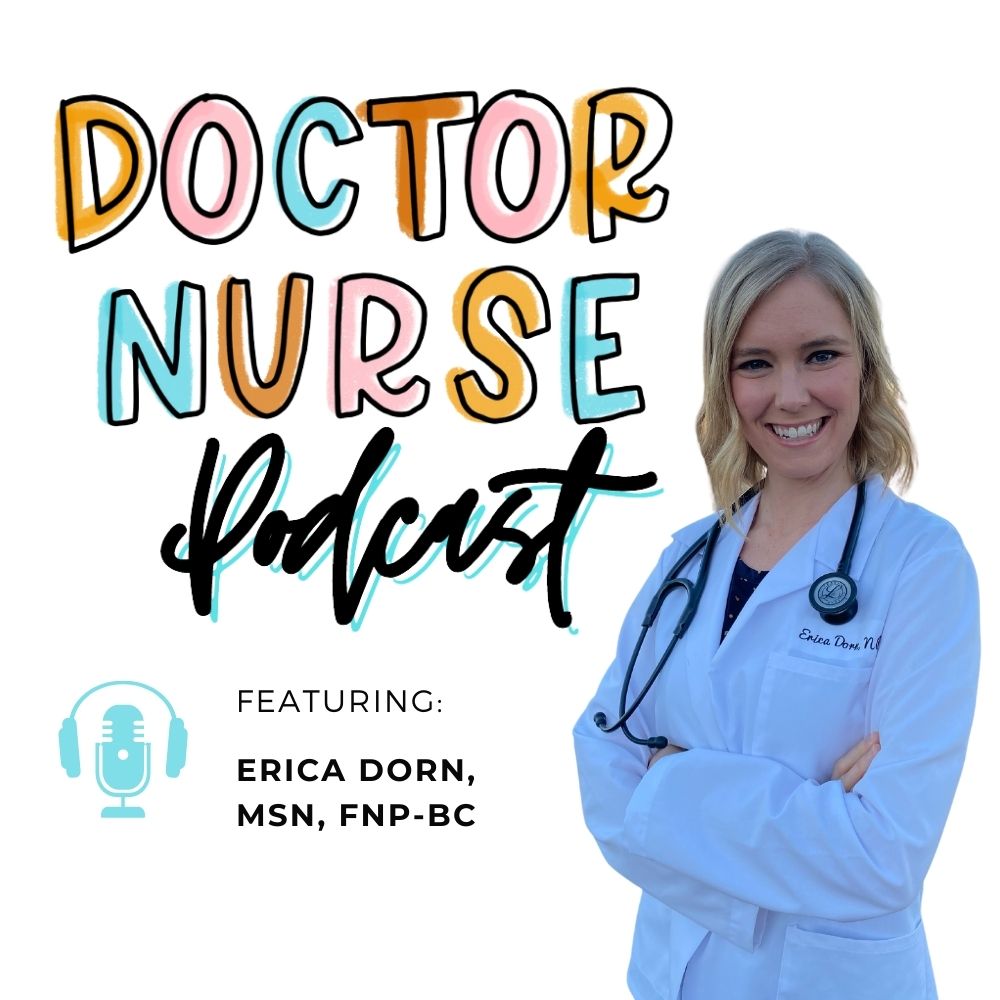
Sandra Pagenta: [00:00:00] Hi, welcome to the Doctor Nurse Podcast. Today I have on Erica D. She is a family nurse practitioner who graduated in 2020, and she’s the creator of the burned-out nurse practitioner, which she created about a year ago. And it’s a program to help nurses and nurse practitioners that are burned out, overcome their burn out and create work-life balance and advocate for themselves. Erica experienced burnout after she had been working as an RN on a busy acute care floor. And she now really wants to support nurse practitioners create that balance in their lives. She does this by offering online courses, coaching and support.
And she’s currently working in a rural area as a family nurse practitioner, also doing some acute care coverage. Welcome Erica I’m so happy to have you on today.
Erica Dorn: Thank you for having me.
Sandra Pagenta: Excellent. So let’s just go ahead and dive right in. Tell me about your current role and really how you see yourself in your current job.
What that looks like. [00:01:00] Day-to-day just walk me through what your.
Erica Dorn: Yeah. So currently I work in a critical access hospital as a family nurse practitioner. I do primary care and then cover emergency services and a little bit of background as to why I started the burnout nurse practitioner. I became burned out as an RN, working on a busy acute care floor.
I just became like mentally, physically, emotionally exhausted. I was not showing up for my patients or my family or myself. I just started to feel detached from my work in healthcare. Eventually I was able to overcome that burnout. And take control of my life and that’s what I do with the burnout nurse practitioner. Currently I help other in PS kind of create that work-life balance and conquer the burnout and really just advocate for themselves.
Sandra Pagenta: Take me back to the beginning of your journey [00:02:00] because you didn’t wake up one day and become a nurse practitioner and have this job and all the things that you’ve got going on with your business.
So kind of take me back to when you first decided to be a nurse, what made you go into the career and what made you think this is it? I figured out what I want to do with my life and then kind of. Unfortunate degradation of, oh, I can’t do this anymore. And to now where you feel like you’re starting to create space for the things that you might be more passionate about?
Erica Dorn: I declared nursing like in high school and it was really because I wanted to make a difference in people’s lives and just, , have that. Tremendous impact on patients and be there, when they were struggling and help them through that. And I learned pretty quick in my first RN job that you don’t have time to sit at the bedside and hold your patient’s hand, then you’re just overwhelmed
Sandra Pagenta: nursing school.
Yeah.
Erica Dorn: Yeah. And I mean, Anything in healthcare is just, there’s so many different demands and [00:03:00] different aspects and you’re just on the run all the time. I kind of felt this lack of like fulfillment and kind of lack of purpose through healthcare. I did decide to go get my family, nurse practitioner.
And so that did help. Because now. How did it help just cause I have more of that relationship and connection with my patients. They come back to see me, every month or so instead of working in a hospital and, I’d be with the patient for a 12 hour shift and then, they were discharged the next day.
So that did help. Through the burnout nurse practitioner, I have that. Fulfillment and that purpose and I’m helping nurse practitioners overcome the burnout, which like I said, is something that I have gone through. And so I just, I just feel like I’ve found my purpose through this.
Yeah.
Sandra Pagenta: So how do you help nurse practitioners? Because one of the things I really find that’s important is nurses and nurse practitioners are taken advantage of. And so I want to make sure that when people come on and [00:04:00] they’re offering coaching and they’re offering to change people’s lives, that they really explain how they change people’s lives.
Right. Cause if a nurse that’s listening is like, oh man, I understand Erica I’m there. Yes. Sign me up. What is she signing up for if she were to sign up with you?
Erica Dorn: Yeah, so I help nurse practitioners like identify, exactly what they are struggling with. And so it’s very personal to them. , we all have different roles.
Personal experiences and just so many factors I help that nurse practitioner kind of identify what they are struggling with and then we develop a plan to overcome that. Yeah, so it’s very focused on that nurse practice.
Sandra Pagenta: Yeah. And is this like a 12 week course? Is this three weeks? Are you, are you working with them as long as they need?
Are there courses involved?
Erica Dorn: I offer some coaching. So I have done, like a six week program. One-to-one coaching. I also offer just like one time kind of strategy [00:05:00] session. So for example I’ve coached nurse practitioners on if they should make a career change or, negotiating their contract and how they go about doing that.
And then I also offer some online courses. So I have one on burnout and controlling imposter syndrome, contract negotiation, and then The biggest one that I have is the nurse practitioner charting course because I identified had one of the major causes of burnout for NPS is work-life imbalance.
And the number one cause of work-life imbalance is charting because so many nurse practitioners are staying late at the office, bringing their charts home just, we have so many different roles, from. Medication refills prior authorizations, responding to all those patient messages.
Plus the charting. We just have so many tests that we do and it was very overwhelming and just causing that burnout in a lot of NPS, [00:06:00] for
Sandra Pagenta: sure. Would you share with my listeners, maybe one tactic that you would say if she’s like, okay, I am staying late. I am charting until. The wee hours of the morning.
Cause I’ve come home and I’m a mom. I don’t want to take away from my babies. So I’m, I just, I just finish up, get them all put into their little jammies, put them down, and then I go and back and chart. So if she’s like, okay, give me one tip Erica for me to just go ahead and turn this around.
What would you say is a tip that you would do.
Erica Dorn: Oh, I have so many, I would say one would be to make sure that the visit is problem focused. And more specifically the chart note, because as nurse practitioners, we tend to overcharge and, add in that extra information. And then we get afraid, about legal issues and trying to cover our butts.
And so we tend to add. , more than is needed in that chart. So I would say really focusing on that very short, sweet to the point, you
Sandra Pagenta: know, when I was first a nurse [00:07:00] practitioner, I kind of remember and identify what you’re saying. Cause I did write like patient said this, then he said this, I just want to make sure, that I’m taking care of everything. , I’m at that stage of my life now where I’m charting and I know exactly. , I’m, I’m just focusing on this. You can come back if you want to talk about that. But today this is all we got time for. Being able to create those boundaries, especially when you’re a new nurse and a new nurse practitioner is super tough, but you get there over time.
,I think it’s good that you’re giving kind of hacks to get there faster. Throughout your career and throughout building your business, tell me a little bit about maybe a challenge that you had to overcome that you thought this is. I’m not going to make it, this is it.
Or, something that you would describe as like, this was hard. And I had to overcome in order to be wearing them today.
Erica Dorn: I would say both like in my professional practice in business one of the hardest things has been imposter syndrome. So just that feeling that, I don’t know what I’m doing or someone’s gonna find me out.
And. Professionally, I was afraid that patients would think, I don’t know anything. And [00:08:00] I’m just that lack of confidence. And I was debilitated, by these negative thoughts in, and I’m second guessing every clinical decision and, , looking up information. And and so I’ve worked on that and overcome, those negative thoughts and had that mindset shift and really just becoming aware and replacing those limiting.
With positive ones.
Sandra Pagenta: Yeah. I find that whenever you’re trying to replace beliefs with things that you might trying to change your mind. And I don’t know if you experienced this and maybe you can give some insight on this, but I’ve always found that it’s a constant battle. It gets not something that you just do once people are like, okay, so how do I do this?
Do I just like, wake up and just say it once. And it’s like, no, you’ve got to get up every day and say it. It’s like, it’s like bathing. Right? You would think we do it more than once like you don’t just pay one time and then you’re good for life. It’s like, no, no, you get a very day and you babe.
It’s kind of that same mentality of, with your imposter syndrome and you’re struggling. And you’re like, I don’t know if I belong here. Honestly, one of the things [00:09:00] that I found in life is that unfortunately, none of us are enough. We are not enough. And so we’re all just trying to grow and change and adapt and.
Just giving yourself grace and just saying, Hey, listen, I’m here. I showed up. That’s like 85% of it is showing up. And as long as you keep doing that, you’ll belong more and more and more. And again, just capturing those thoughts and saying that I’m just not going to believe that.
Erica Dorn: What about you? Yeah, that was huge for me to realize that. I’m not the only one with these thoughts going around in my head. And I mean, I’ve talked to and coached new nurse practitioners, experienced nurse practitioners and, everyone struggles, it’s not only, starting out in your practice, but even those experienced, world renowned providers have had those limiting beliefs out sometimes.
So it’s completely normal. Yes.
Sandra Pagenta: Yes. You just can’t live in that. You can’t stay there, right? Yeah. Tell me about maybe one of the biggest successes in your career. Like a great story, or like something that [00:10:00] you were like, this lady she was on her way out, or this guy, he was going to quit.
And by working with them, I was able to change their lives. They’re still working, they haven’t given up. Do you have any great success stories that you’d like to share?
Erica Dorn: Yeah, I would think the biggest thing. That I’ve helped, like nurse practitioners realize is that small changes like can truly add up.
So I’ve had, NPS change one small thing to their charting, whether that’s having problem focused visits or, finishing the note right after the patient encounter those small changes. If you can save, , one minute per patient by changing something with your charges. And you’re seeing 30 patients a day, that’s 30 extra minutes.
And not to mention, the more energy you have and you’re just productive, more productive throughout the day. And being able to manage your time.
Sandra Pagenta: So good. Yeah. Have you read the book by James clear called atomic habits? Yeah. Yeah. So like you [00:11:00] totally made me think about that.
Like he always like talks about being 1% better. And so you’re just like, wait a minute, but that 1% begins to compound. Right. If you’re cutting out just a little bit of time, every day, weeks, months, years, then all of a sudden. You’ve got margin, you’ve got space and that begins to compound as you get faster and you get quicker and then you’re better at problem focused.
And you’re closing the note before you leave the room and you’re doing the different things and it really does begin to change everything when you’re, make those little small changes to your career. That’s great. That’s a great
Erica Dorn: perspective. It doesn’t have to be hard. I mean, just building that momentum and just taking action and.
Sandra Pagenta: Yeah, did you have any mentors, Erica, has anybody come alongside you and helped you in your career that you would like to give a shout out? Because I think that nurses don’t do a great job at creating. Links between themselves to say like, okay, we’re going to help one another.
We’re going to pull each other up. I don’t know if it’s women. I don’t know if it’s nurses. I don’t know if it’s the approach and there’s a lot of stuff going on, [00:12:00] but I don’t really want to focus so much on that. I really want to focus it on, Hey, there are people here helping if you’ve had some. And then if not, maybe for, giving some advice for someone that’s like, I don’t have anybody.
Helping me.
Erica Dorn: Yeah. I would say I’ve had several mentors and more like on the informal side. So they were not, directly teaching me in my clinical studies, but more of, I observed them and, saw what they were doing and. Loved, the way they interacted with patients or their knowledge about clinical practice.
And same thing, for the business side of things too, I’ve just looked up to a lot of different people. And I would say if you don’t have that, , If you’re struggling with kind of finding that community or, looking up to someone, I don’t remember who said it, but you are the five people that you spend the most time with.
And so if you’re kind of struggling with those types of people that have the negative mindset and, don’t really have that growth or not, [00:13:00] 11. In front of you. My suggestion would be to, reach out, listen to podcasts or listen to books, or, read articles or things that kind of help you to level up your mind.
Sandra Pagenta: Yeah. And then maybe like change out those people. Cause
I’ve gotten it up nice. And I’m like, you’re kind of negative. I don’t think we need to hang out. Thanks so much. So that could be part of it too, just putting it off. For the last question of the party what advice would you give to a new nurse who is starting off in her career?
And she’s like, I don’t even know where to start. Like nurse practitioner. She’s just like, I don’t want to be burned out. I’m so scared. Like I’m going to be burned out. Like there’s like now probably the fear of burnout. Right? So what was the piece of advice that you would give her to toss be like, this is garbage.
Don’t listen to it. Which pretty much has always the same, which is really funny. I should probably choose this question. Everybody says the same thing, but whatever, we’ll keep doing it. Anyway, and then the other one, is there a piece of advice to keep?
Erica Dorn: Yeah, I would say the thing to toss would be That you don’t have to be in that [00:14:00] social norm.
The social norm and healthcare, especially right now is you work your butt off. , you get extra money by picking up shifts or, by working extra hard. And then you. Overwhelmed burned out, pour it work-life balance. So throwing out that idea of this is how it is, , this is how it should be.
And just getting rid of that social norm. And then the other piece of advice to keep would be. To take control of your life. I mean, that’s something that when I was overcoming burnout, I realized that ultimately I’m in control of my own happiness and I choose how I react to someone and I choose, to be grateful or to be happy.
And so I think once I had that mindset shift that really helped me to ultimately be in control of my life.
Sandra Pagenta: I love that. I love that. And you did not give the same answer. So I’m so thankful because everyone said don’t do med surge
I
Erica Dorn: didn’t start out in [00:15:00] med surge though. And I learned, so so I think that was a good foundation.
Sandra Pagenta: For the last part of the interview, it’s the rapid fire questions, questions, questions. All right. So tell me about, what’s your favorite beverage? What are you drinking these days?
Erica Dorn: I drink a lot of water. I would say. My favorite adult beverage would be like a summer. Shandies like Leinenkugel’s and unknowns. You better have that, but as it’s starting to warm up, it’s like so refreshing on a really hot day.
Sandra Pagenta: That’s awesome. And if you can learn a language in a week, what language would you learn?
Erica Dorn: I would say Spanish. I mean, I did take it in high school, so I know some, but I just love like it’s very fluid and, yeah. Very romantic.
Sandra Pagenta: What is your favorite pizza topping
Erica Dorn: cheese.
Sandra Pagenta: Oh, my gosh, I love pepperoni. I could just eat that stuff. Oh, it’s terrible,
Erica. Thanks for coming on today. Thank you for your time. Where can people find you? Oh
Erica Dorn: yes, I am on Facebook. The burned out nurse practitioner either Facebook page or Facebook group. I’m [00:16:00] on Instagram at burned out in P and then my website is www dot burned out in P D.
Sandra Pagenta: Alrighty. Thank you for coming you for having
Erica Dorn: me.
Podcast Description
Erica D the NP is a family nurse practitioner and creator of The Burned-out Nurse Practitioner. Erica became burned-out from healthcare working as a RN on a busy acute care floor. Erica was able to overcome the burnout and take control of her life. The Burned-out NP was created to help overwhelmed nurse practitioners create work-life balance, conquer burnout, and advocate for themselves. Erica currently offers online courses, coaching, and support.
Erica’s Links: www.burnedoutnp.com
Doctor Nurse Links: https://linktr.ee/DoctorNursePodcast
Wanna start a side hustle? Subscribe to the Doctor Nurse Podcast and I will show you how to start: https://view.flodesk.com/pages/6253188857d9b15fd00f8329
Networth Nurse Wealth Building Links:
https://doctornurse–networthnurse.thrivecart.com/wealth-building-toolkit/
https://doctornurse–networthnurse.thrivecart.com/realestaterightnow/
https://doctornurse–networthnurse.thrivecart.com/realestateebook/
https://doctornurse–networthnurse.thrivecart.com/personalfinancerightnow/
Latest Episodes
Doctor Nurse podcast brings you weekly shows to help INSPIRE, EDUCATE AND EMPOWER nurses with true stories of initiative and impact.
Doctor Nurse podcast brings you weekly shows to help INSPIRE, EDUCATE AND EMPOWER nurses with true stories of initiative and impact.
Latest Episodes
Doctor Nurse podcast brings you weekly shows to help INSPIRE, EDUCATE AND EMPOWER nurses with true stories of initiative and impact.