Also Available On






Sandra Pagenta: Welcome Justin to the Dr. Nurse podcast.
Justin Allan: Hey Sandra, how are you?
Sandra Pagenta: Hey man. So happy to have you on today. I’ve explained to my listeners pretty much what you’re doing. How do you see your role? How do you define what you do for a living? And, yeah, just kind of walk us through what a day in the life of just now and looks like.
Justin Allan: I do a lot of stuff. I mean, I got like four or five businesses. So my main business right now is a lead NP, to be honest with you it’s just blew up in the last two or three years. And so I’ve, dedicated most of my time to it, but I still have my, my , my side practices too. So I got my men’s health clinic my medical cannabis clinic.
I still do. It just went recreational in my state. So, oh, about a year ago or so, so it’s kind of up and down. So it’s interesting to see what’s, , what’s evolving with that, but it still seems to be a profitable practice. And then I got some property management stuff, some rental real estate.
Sandra Pagenta: Nice. Very nice. So diversified.
Justin Allan: Yeah. Yep. Yeah, totally
Sandra Pagenta: loving what you’re doing. Yeah. And so you’re totally aligned with what I began to realize about nursing. And what, what really is the best thing that we should be doing from the moment we hit the ground as nurse practitioners, which is diversifying, identifying side hustles, things that we might be enjoying as a hobby that could eventually turn into something that can set us free.
Right. And so as my listeners know, , that wasn’t something that I developed. I really got heavy into the education portion. It really wasn’t. It’s almost like kinda like a horse eating grass, not really looking around. And so I love the content you’re putting out. Cuz you encourage horses to pick your head up and look around and make sure that you are putting yourself in the best position to really generate passive income for your life.
So you can live your life. Like we don’t have to be broke. Like you do not have to be broke as a nurse practitioner or burned out working 60 hours a week. Let me show you how to do.
Justin Allan: Yeah, no, it pisses me off. I mean, it just pisses me off. I see these nurse practitioners taking these jobs for 45, 50 bucks an hour.
I’m like, what are you doing? You’re worth way more than that. Let’s say you work at an urgent care family, practice, something you’re billing 500,000 to a million dollars a year. And , they’re being generous by giving you 45, 50 bucks an hour. I mean, come on. You’re worth more than that, ?
Yeah. So yeah, it’s the problem is, is that our market’s getting saturated. I talk about this all the time. And so the problem is that our schools just keep pumping ’em out and I want the best for people. I truly do, but there gets to a point where all the established NPS are getting screwed. And so, yeah.
I think it comes down to the RN level, pumping out RNs, and then the RNs get sick of bedside. They go to MP school and they’re pumping out MPS a lot of those RNs don’t even ever work bedside. They go straight into MP programs. What I mean? So they’re just pumping ’em out. So it’s just saturating the market.
It’s watering down everything and these people are desperate. So healthcare administrators. Docks, I mean, they all, they all know this. They can see that weakness. They can smell it in cheap labor mm-hmm [00:03:00] so it’s just a vicious cycle. What I mean? I mean, salaries are going down. Inflation’s going up.
Prices of everything else is going up, but salaries have gone down in the last 20 years. It makes absolutely no sense whatsoever. It’s one of the only professions that you can actually like see that, what I mean? That’s not happening. Accountants lawyers, doctors, some of that police officers, firefighters like yeah.
RNs, like what going on, ? Yeah. No, I
Sandra Pagenta: totally agree. And I love that you’re shining light on this because again, we, I think because this is a woman dominated field, I think because we tend to kind of have that same. Mentality from being RNs, taking orders from doctors, it just feels like the next right step to move into nurse practitioner roles that were underpaid and undervalued and continue to be kind of like subject to our master.
Right. And I love that you are encouraging nurses to go. You can be your own like master. You don’t need someone to tell you what to do, how to practice, how to make money. You can set your [00:04:00] own limits. And I think that’s something again that we need. Someone advocating from a really strong perspective with experience that knows exactly how to work out the steps.
So speaking of steps take you, didn’t just wake up one day. Okay. Justin, and have all this stuff. You were just like, oh, somebody just handed you. Real estate investments and handed you all multiple businesses. Like you went through a journey to get to this spot. Could you walk me through that moment that you decided, , you had a, B, I think you have a BS in biology, and then you decided to move forward and get the BSN in nursing.
What made you decide to go be a nurse and then walk me through how you kind of had this aha moment of wake up nurses. We have value we can bring, we can bring.
Justin Allan: Sure walk me through it. Well, first and foremost, I wanted, I ever wanna know that I didn’t, I didn’t have anything held like handed to me. I had no silver spoon.
I grew up in a trailer. I mean, I came from nothing. Okay. So everything I have, I’ve built myself. So no one’s really taught me a lot of this stuff. It was just a lot of reading, [00:05:00] educating myself, listening to podcast, reading books. Finding some mentors and stuff along the way, what I mean? But but anyways though, so yeah, I got my first, I got my bachelor’s in biology and chemistry and also got a minor in business too.
Wasn’t too sure what I wanted to do. I just liked science, like business, dental, school, medical school, pharmacy school, PA like I had really had no clue. What I mean? You’re 20, 21 years old. You’re still a kid. How do you make life decisions at 21 years old? .
Yeah. So graduated took like a year off, , bartending, waiting, just, , jobs like that and realized that I’m just wasting my potential here. I had a buddy of mine. He was like, dude, I’m gonna go do a BSN, basically accelerated BSN program. So you already have a bachelor’s degree. You become an RA like a year and a half.
I’m like, okay. Wow. This is pretty, I mean, that’s, that’s pretty cool. So I looked into it and I mean, I’ve always kinda wanted to help people and get into medicine. I just didn’t wanna go to medical school route. Didn’t wanna go to dental school route. Like I just didn’t wanna take on $200,000 in debt and yes, I didn’t wanna do it.
What I mean? [00:06:00] Whatever I applied to the accelerated BSN and got in and I mean, Did it and was like, okay, cool. I was like, I don’t wanna be an RN forever. So I wanna be a nurse practitioner after shadowing, some of ’em and whatnot. So, yeah. So I worked as an RN.
Did ER home health, chest pain center stuff, kind of just floated around a little bit. And yeah, I went D P school part-time while working full-time as an RN mm-hmm , , pay for school, pay for myself. I mean, I didn’t have anything. I shot to make a living. What I. So I did the same. part-time MSN took me three years and then got out, working at an urgent care, just happened chance.
I just applied to it and got the job in a saturated market. So I took the job. And I think when I finally realized I was getting screwed, I mean, come on making $120,000 a year as a 27, 28 year old kid. Right. I’m like, that’s good money. Right. It was good money, 28, 29. Something like that anyways. Yeah, yeah, yeah, yeah.
It was good money. So I’m like, this is, this is fantastic. I’m killing it. [00:07:00] And so I had a bonus structure and it was VU based. And so for every patient I saw, , everything I billed, I would earn VU each VU. I was being paid a certain amount of money. Right. Yeah. And so you reach the VU up to your base salary.
Anything else is a bonus afterwards? There’s a, there’s an article on the lead in P website. I wrote about that. And anyways though, so they kept my salary at $140,000. And so I would hit the bonus after the second quarter. So January, February, half the year,
Sandra Pagenta: do what? So, so you still have half the year to
Justin Allan: work, right?
I’m working for free I was like, no. Sorry. No, so like, I mean, I had to do it. I mean, what else, what other choice did I have? What I mean? Yeah. And so I’m sitting here working for free and I see that the, the director of, outpatient clinics at this moderate size health system.
Got a Christmas bonus of $250,000 or whatever. I’m like, what what’s this guy do? What’s this fat dude. He does nothing. He sits there. Or what’s this guy doing, tell me [00:08:00] what this man does because, and seeing all the people, yeah. They’re sick of it, right? I’m like, I’m getting walked all over. I’m not fan of that.
So I’m forget this. So. I moved down to Florida, got a job at an ER down there. Maybe I’ll work, ER, for a while as a, as a nurse practitioner, same thing I’m looking around. I see all the doctors. I see all the PAs. I see all the nurse practitioners. It’s a dead end it’s ceiling and there’s no breaking through it.
Like, that’s it. That’s what you’re gonna do for the rest of your life, the rest of your career. You’re not gonna do anything else. That’s it. You’re gonna get little bit of raises here and there. Like I’m like, , this would drive me in scene. I can’t do this for the rest of my life. And so anyways, I I got a job in an independent state.
Moved 3000 miles away rolled some dice, whatever took the job, got out there. And within a month of being out there, I’m like, whoa, I am 100% independent out here. This is amazing. I’ve never practiced an independent state. Yeah. And I was like, within a [00:09:00] month, I was like, I’m open up my own business. I’m gonna, my own practice.
I’ve always wanted to. So I knew a doc. He had a Suboxone practice. He told me how great it was and whatnot. So I was like, ah, I’ll open up a Suboxone practice. Yeah. Took the course online, , and yeah. Did it, one business turned into multiple businesses after I saw the power of how much money you can make and how, how free you can be doing it.
I made more, and one day in half a day seeing my own patients, then I did an entire week working for someone else. I’m like, why. Why would I do anything different? It doesn’t make any sense.
Sandra Pagenta: Yeah. So one of the things that you were describing in your journey to where you are right now is you do you kind of found niches and that’s one of the things that I really wanted you to come on today and talk about is how to find a niche, like, okay.
So you decided to start a Suboxone clinic. Like, did you just go like, well, I have experience, I’ll just try it. Like, or like, how have you been able to find niches? What I like to call like holes and then [00:10:00] fill them by you providing the service.
Justin Allan: Well, I first discovered it I mean, yeah, sir, Suboxone’s a niche.
I basically just, I knew some doctor friends, they did it. And so I was like, okay, well, I mean, they said it’s pretty simple. It’s pretty easy, whatever. It’s decent money. So I was like, okay. So I just did that. I accepted insurance like a fool and then I learned that game real quick. Yeah. And I realized some things weren’t covered and some things were, and so I started exploring things that weren’t covered by insurance and to die.
I discovered all these cash based niches. And so the trick is that you provide things that insurance doesn’t cover. And so that’s where the inherent value is for people. Interesting. Yeah. And so if it’s not covered by insurance, it’s, it’s, it’s a niche cash service. So men’s health testosterone replacement therapy.
For example, insurance, doesn’t gonna pay for that insurance. Isn’t gonna pay for biodentical hormone replacement therapy, pellet. It’s not gonna pay for that. It’s not a medical necessity, right. Even though it improves the patient’s [00:11:00] life significantly, they still won’t pay for it. I guess it was just kinda one of those things that enlightening thing, insurance doesn’t pay for it.
It’s in demand. It’s a valuable service it’s been done elsewhere. So let me just deliver it here, where I’m living, because there’s, it doesn’t exist. So let me just deliver the need, deliver the demand. What I mean? Like you don’t have to reinvent the wheel here. You don’t have to discover something that no one’s ever done before.
You don’t need to do that. I think there are a lot of MP things. They need to discover some magical thing, but they don’t like, yeah. These things have been established. Provide the demand there there’s gonna be a need for this stuff and just deliver it. What I mean? So like, I guess it’s kind of one of those things that for your particular area you have to do is just some basic market research and see what is available and what isn’t available.
So So, yeah, I mean, does that answer question or do you want me to get a
Sandra Pagenta: little more? Yeah, no, no, no, that’s great. I, I think that one of the things, when I’ve talked to people and I’ve spoken to other nurse practitioners, they kind of don’t know where to go. They don’t know where to start. And so I think what you’re describing is, [00:12:00] again, you have to do a little bit of work, these things aren’t just gonna show up.
To you, but be again, pay attention to what’s going on around you and see, Hey, listen, is this something that maybe if we go out and I start something on my own. You also describe not just how to find niches, but you have courses on these cash services that you can start on your own, but you also describe the process of starting small, which has been something I’ve been talking about and realizing that once I went part-time at my job.
I was like, oh, dang, like when the baby’s sleeping, like I’ve got two to three hours start building. I think you’ve got courses on this and you’ve also got articles that I’ve been reading. About starting small and letting your practice grow and then you move into the automation aspect. And so I heard you just describing automating your services so that you can almost kinda walk away from stuff and it kind of works for you. Which doctors do all the time. And I don’t know why nurse practitioners feel like [00:13:00] we’re like cheating the system. If we somehow figure out what they’ve all been doing and getting rich off of why do we have to stay in the poor house while we have licenses and certifications and education that allows us to do exactly.
What they do. We’re not doing surgery, we’re not moving outside of our scope, but these things are within our scope yet. We don’t realize that it’s all around us. There’s an abundance all around us and we live in scarcity, so, right. Yeah. What other courses do you offer through the elite NP? Just for the nurse.
That’s like, okay, wait a minute. Justin sounds amazing. I wanna learn something. I gotta figure this out. What other things do you.
Justin Allan: Oh, I mean, God, we have 25 courses, 24 courses. Geez. Something like that. Last time I counted we’re releasing the thyroid course next week. So we have like a various line of courses.
Like we have like total practice creation courses. So it teaches you like the clinical niche skill. Opioid addiction, medical cannabis, men’s health, aesthetics, IV [00:14:00] infusion, whatever it is, it teaches you the clinical components. And then it breaks it down into the business components afterwards. So you learn, it’s like it’s a clinic in a package almost essentially.
Then there’s like other little courses, like accessory courses, like practice management courses, how to bill, how to market , telemedicine, considerations, things like that. And then some wealth building courses. The financial independence and investment course, and they had to lower your taxes courses.
So like, you get to a point like, exactly, like you said, you start small. While you continue to work. You want, it’s the principle of financial redundancy you wanna be as redundant. You wanna be as diversified as possible. Yeah. If you quit your job and go all in on your business, that’s foolish fools do that unless you’re completely just 100% confident that it’s gonna work and you have some.
And you have some savings, what I mean? Yeah. To, to float you through. Yeah. And so anyways though yeah, that’s how you start it. And then once the, like you say, once the practice begins generating significant profits, you can quit your job and focus on that predominantly. And so once you get to a point where you’re making enough money, , these other accessory [00:15:00] courses, like how to lower your taxes.
And how do we invest appropriate, , invest appropriately. Correct. It’s just, it’s a step wise thing. Exactly. ? Yeah. Especially the taxes component of it. Like what people don’t realize is, is that you can’t lower your taxes in any meaningful way as a w two employee. It’s impossible. You just can’t, you have a certain set of deductions and you tick ’em off.
Maybe you have a couple kids and like, that’s, it there’s really no other way to lower your taxes. Significantly. The working class, the middle class, the upper middle class. Get screwed. They just do you can’t lower your taxes. You’re getting hit like 25, 30, 40% tax brackets. When you have a business, though, you can lower your taxes significantly.
I think it might, I pay like 15% or something like that when it’s all set done. Cause of my business is right. So I, so I teach nurse practitioner how to do everything. What I mean? The system
free get outta the system. Yeah. For being a. Get outta the rat race, ?
Sandra Pagenta: Yeah. No, a hundred percent. And this stuff isn’t taught in school, this stuff isn’t even encouraged in school. I’m just gonna say it.[00:16:00] , people are like, oh, it’s not taught in school. Oh, I mean, they’re teaching you to be a nurse practitioner fine, but like at least plant some seeds, right?
Like they’re very clear on planting seeds on come back to us. We need you for the nursing degree, come back to us for the doctorate. And so you end up going back and spending so much money and. You look and you’re like, wait a minute. Oh, my gosh, I, I don’t wanna go to work every single day. And I’ve got nothing that I have been able to build.
And I love that you are getting people out of that mindset. You are breaking the shackles and you are getting people free. And so I just think that’s. Incredible incredible. And listening to your podcast. So many nurses come on and they sound, they sound, sometimes they come on a little scared and then they sound more empowered as they talk to you.
Some of them come on and you’re like the one with making like $250,000 a year. I was like, what? Like, that’s crazy. [00:17:00] Like, I don’t even understand that. You were having to push her outside of the scarcity mindset on your podcast. And I was like, this is, this is, this is where it’s at. Like, you are straight up totally empowering nurses to yeah. Create the life that they want, which is. Awesome.
Justin Allan: we really have started a small movement. I mean, we really have, I get emails all the time from people like, thank you so much. You changed my life, my family’s life. Yeah. , the elite MP, Facebook group, everyone in there helping each other.
Like, I mean, we’re, it, it’s truly changing. A lot of nurse practitioners’ lives. The thing is though, you want to change? What I mean? Like you have to have that desire to change. A lot of people are content making the 55, 60 bucks an hour, which is fine. Yeah. But a lot of us aren’t,
Sandra Pagenta: what I mean?
So, yeah. Yeah. And because you’re not free, like you just realize that, like, I, I met the mercy of. Whatever this institution dictates I have to do. , once you get that mindset shift and you’re just like enough, like you can’t go back, like there’s no [00:18:00] going back. No, cause you’re just like, hell no, this is garbage. there is so much better out there for me. And I really wanted. More nurses to see it and to hear it and to just go, wait a minute, this, this, this job doesn’t work for me anymore. I wanna pivot. And to be able to have the tools to do it and be successful. Throughout your career journey, , there’s been ups, there’s been downs.
There’s been times that you’ve probably been like. That’s it, Justin, we’re not gonna make it. This isn’t happening. This, this is it a throw in the towel or maybe there’s been real highs, but could you describe maybe a time that you had to really overcome something that you thought that was gonna, that was gonna maybe do you in that you’re like, I don’t know if I’m gonna be able to do it after this.
Justin Allan: The first year is difficult. It’s difficult. Most it’s the hardest part. I mean, it just is for any business owner really, but especially for the nurse practitioner, especially when you’re doing something that you’re not comfortable doing, what I mean? Like Suboxone or men’s health or whatever, , like you have the skills to do it, but you’re doing something kind of new or the whole [00:19:00] business components of it.
Like it’s kind of scary. I couldn’t tell you how many countless. , sleepless nights I’ve had, I mean, Laying there in bed by myself, staring at the ceiling and just wondering like, what am I doing? I’m gonna get sued. I’m gonna get be, , I’m, I’m gonna lose my license. I’m gonna go bankrupt.
I mean, just all of these negative emotions, completely trick your mind into it. You wake up the next day and you’re just like, I think I’m just gonna close your down. I don’t know if I can do this anymore. Like, I’m not, I haven’t made any money in the last three or four months working my ass. Like I could just pick up some extra in the ER, make 90 bucks an hour, walk away with the cash and not worry about it.
if I were to listen to my mind and those caveman instincts, what I mean? Fear is a, , it’s an ancient emotion. Like there’s nothing to fear anymore, really. I mean, what I mean? You’re not, you’re not gonna walk out the door and some savor or two, Tiger’s gonna take you down.
It doesn’t happen anymore. Right? Yeah. So a lot of this fear is just it’s nonsense. It’s your mind playing tricks on you. So you have to. [00:20:00] Overcome that. So if I would’ve succumb to it, there’s no way I’d be here talking to you right now. There’s no way I would’ve started the elite nurse practitioner.
There’s no way I’d vote. My men’s health point. There’s no way, like I had to overcome those fears. And so the first year I was going through a divorce, I was in a state where I, , barely knew anybody. I started a business and I started another business after that. I was working PRN shifts in the ER at a methadone clinic, just so I could pay the bills.
Mm-hmm I had absolutely no life for multiple months cause I was working so hard. Yeah. And there was, I mean, there was countless times I wanted to just like throw the towel in, what I mean? It’s difficult. But once you break past that though, it’s totally worth it. Yeah. I, I don’t regret a single.
Not, not one, I might have aged a couple years, but whatever it was worth, it but aged.
Sandra Pagenta: So in those moments in those times, cuz we all have been in them. I mean, even just recently with my podcast, I’ve been just like, I need a break. [00:21:00] This is just, this is killing me. Yeah. To a certain extent. How do you get back on the horse the next day?
And just say, all right. I’m doing it again. I gotta keep going. How do you, , you read the book like three feet from gold, right? You’ve heard the story about the guy that was digging in his yard and he was looking for gold or he had gold, steady gold.
And then all of a sudden, like he gave up on looking for it and he sold the land and the next guy came and he hired a geologist and the guy was. Yeah, the line, the, the, the gold line just moved over here. Like it, it just, you need to just dig. He was digging in the wrong spot, , like he gave up. And so how do you, how do you stay motivated?
How do you keep going? When, things might be a little difficult.
Justin Allan: Couple ways you read stories of other people who’ve done it, right? Yeah. You listen to their stories about it. I mean, they were there’s no, there’s no single successful entrepreneur out there. Who’s been on easy street. There’s just, it doesn’t exist.
Like you, you have to sacrifice to succeed. Nothing easy in this life comes free when you have, you have to sacrifice. And so you read other people’s stories. [00:22:00] You get a mentor to something you can bounce ideas off, get motivated from, and that sort of thing. And honestly, you just have to kind of just shut your mind off, get up out of bed and.
Do it, what I mean? Like I continue to work out the entire time I was doing this. I still ran my dogs. I still went to the gym. I still did all this stuff. Do you think I wanted to do that? And I, I really did not want to like, yeah, I just did it. Like, you just have to push yourself through that. You have to just know that there’s life at the end of the tunnel, , there’s goal at the end of the rainbow kind of a thing, what I mean?
Like, that like other people have done this and the biggest thing is really consistency. If you continue to do it. Eventually, I mean, you’re gonna succeed at some point you are, you’re gonna have lots of failures along the way, but eventually it, it it’s going to come together. And I think too many people, especially nowadays, they just give up, they want things handed to ’em.
They’re entitled. They want easy street. It’s just, it doesn’t work that way. If this was easy, everyone would be doing it.
Sandra Pagenta: Know what I mean? [00:23:00] Exactly. That’s really good. Yeah. I
Justin Allan: think some of it, I think you’re born a little bit with it too, ? Do you think so, some people have in your DNA.
Hey guys. Thanks for listening to the podcast. I hope you’re enjoying the conversation. I want to take a second to remind you guys to join the doctrinaires podcast email list. Weekly. I send out emails about podcasts episodes. Blogs on creating with information about nursing motherhood, finance. Health and wellness.
How to build side hustles. It’s all there. I want to provide nurses with information that I’m gleaning as I grow my business and my podcast. And now I have to tell you guys about today’s sponsor. The Dr. News podcast is sponsored by the network nurse. You guys know that I love Savannah a Royal and her whole team at the net worth nurse. I’ve actually had her on my podcast. So check out her episode. If you’re wanting to know more about her and what she does, her net worth nurse team is on a mission to empower nurses, to take control [00:24:00] of their net worth. The net worth nurse is an educational site where nurses come together to learn about wealth building strategies. Their website has blogs, instructional downloads. Video courses on real estate and investing. Personalized coaching and an interactive and growing community of like-minded individuals. The net worth nurse has everything you need to grow wealth be sure to check them out in the links in my show notes and let’s get back to the conversation
Sandra Pagenta: So I think sometimes there, it’s almost like the Phoenix rising out of like the crucible , it like awakens something. So for me, it was awaken when I saw my son and I had to give him away, I was just like, the mama bear was like, rise up, are you always gonna be here?
Like this? Can’t be like, you didn’t get a, you don’t have a frigging doctoral degree. And yet you gotta do. The the institution saying like, did you really do this? And so it’s interesting that, , I brought that up cause I really wanna hear your take on the DNP and kind of [00:25:00] what you think about it, because you’ve kind of got a different, a different mindset that I’m really interested to hear.
Cause I think a sign of a well-balanced person is for someone to hear another’s opinion and to not be offended, right. Like to just be. All right. That’s a thought, I didn’t think that because that’s what institutions are supposed to teach us when we are learning things is to learn how to learn, to learn, how to see different viewpoints and argue them.
So I wanna hear how you feel about the DMP and a nurse practitioner. That’s maybe thinking about getting the DMP.
Justin Allan: Can I get a drink first? I’m just joking. You gotta for this yeah. Little whiskey real quick anyways. Yeah, I think it’s this is gonna go against a lot of people’s thoughts, but this is my opinion on it.
Seeing it from a different perspective. I think it’s a waste of money and I think it’s a waste of time. I think it’s worthwhile. If you want to teach outside of that. I don’t think that there’s much use for it. I mean, if you wanna be like a high level administrator at a hospital or something like that, Sure.
What I mean? Yeah. [00:26:00] You want to teach sure. Outside of that, I think for the clinical nurse practitioner who wants to stay in the clinical side of it or one who wants to start their business or something, I think it’s a waste of time and waste of money. And so I break it down that article that I wrote it’s most successful.
It’s seriously like put it from here to here. Like overnight. It was crazy. I woke up one day. I was like a hundred comments where, what happened? What.
Sandra Pagenta: That’s why, what drew me to it?
Justin Allan: Yeah. Yeah. People either totally agreed or they did not, there were very little in between, what I mean?
Sandra Pagenta: but it’s good when you put out polarizing stuff, because it gets people’s juices, like fired up and they’re like, what’s this guy talking about?
, like if you’re mediocre trying to keep everybody happy. You ain’t keeping anybody happy. Like you just aren’t like, come on, pissing people off, ? and so,
Justin Allan: yeah, like it’s either, okay. You can spend two years, one to two years or whatever it is. Some, I know some DMP programs like three
Sandra Pagenta: years or whatever I started every year.
Justin Allan: Yeah. Yeah. It’s garbage 20 to $40,000. Yes. , so you’re spending 20 to $40,000. [00:27:00] You are delaying your life by anywhere between one to three years. Let’s just say two year average. It’s two years. Yep. You only. 80 years on this planet, guys, that’s it maybe a hundred, if you’re lucky, what I mean?
You only, you only get so much. And so you just gave up two years of your life and 20 to $40,000 on something that, in my opinion, I read the curriculum and I talk to other DMPs. I see no utility. Yeah. I see no benefit to it. That’s just my opinion though. And so, yeah, and, or you can spend that time instead working on yourself and doing something.
So like, I could have went back and got my DMP and I would still be making the exact same amount of money that I was making before working at the urgent care and the ER, and stuff. Sure. I might have got a $5 an hour raise or something like that. Some people get some raise.
Sandra Pagenta: They don’t even do that. Yeah.
They don’t don’t get any raises. No, they don’t. And not only that, I have two other things to add to that. That’s also why I believe these nurse practitioners deserve to be called doctor that’s for one, because it is extra time. It is extra [00:28:00] input. And I think we should be calling them doctor like doctorally prepared nurse practitioners.
Right? Sure. And so it bothers me that like, we have to fight with the docs over if we’re doctors in our, in our clinical field or not, that bothers me. And then the other part that I said, because I’ve always wanted to be a doctor. So since I was a little girl, I always said I wanted to be a doctor. And one of the other things that I thought about when I read your article, I thought like, okay, wait a minute.
But it gave me the opportunity to achieve that doctoral status without. 250 to $300,000 in debt. And that is one of the reasons why I also liked that option. And I think it’s something completely reasonable for somebody wanting that status, wanting that spot and still wanting to practice as the nurse practitioner.
And I also completely agree with what you’re saying. If this is what you want with your career and your life, then this does nothing for you. Do not spend the time in the energy pursuing it, [00:29:00] because unless you are moving into an academic or higher moving up the chain of command. in an institution, which is exactly what you’re like.
This is a joke. Don’t try to, there’s a cap right. In these, in these spots. Don’t do it then. I, I don’t see the use in it. And that’s somebody that has one. I have one, I spent the time, like I poured the time into it and I could totally see what you’re saying. And I can look at it from a balanced view and say, Hey, it does provide some, some different thought processes as my teacher.
Sure. So my teacher told me. No education is wasted after they cut like half the curriculum when I was in the middle of it. And I couldn’t believe it. I said, how are you cutting? I should be done now. Like, why are you now? She’s like, no, you need to finish the other half. I was like, oh my God, you kidding?
Yay. So I just, again, I feel like. You bring a really good perspective. And I think people should look at that. Like I’m not gonna sit here and sit on my D and P and go like, no, no, no, it’s totally a good use of time. It’s like, no, like maybe [00:30:00] it’s not, maybe it’s not. Can we look at it both sides and see personally, I don’t think it’d be worth it to go.
If you’re chasing after that doctoral status, I don’t think it’s worth it to go be a physician, unless you’re gonna be a surgeon. Don’t sure. Like why I agree. Why be a primary care doctor? Why do endocrinology? Why do these other little things, unless you’re gonna be doing stuff in the operating room, cutting stuff out.
I don’t think it’s worth it. I would go be a nurse practitioner. And if you want the doctoral status, get the DNP straight through from BSN to DNP and you got the doctoral status and you can go do. All the stuff, cuz, the guidelines just go do it. Right. Like, so I think that’s just another perspective.
Yeah. I loved your thoughts on, your website. I just think it’s just, it’s just really great. And again, it was polarizing and I loved it. So the last part, go ahead. What were you gonna say?
Justin Allan: I was gonna say I, I respect DMPs. I do, right? Yeah. I respect them. I respect you for getting your DNP. I respect people who want to go through the fur education.
Sure. But. That’s your goal, be doctoral prepared, learn maybe a [00:31:00] different perspective on things from, how they teach you some certain things. Yeah. Work in administration or teach whatever, go for it. Good for you. If your goal is independence, freedom, financial independence, totally those sorts of things.
And you wanna start a business. Do not go to the DMP. It’s not gonna benefit you very much. You benefit reading a couple business books
Sandra Pagenta: for free. I agree.
Justin Allan: I agree. Okay. Don’t get your MBA. You don’t. I need that. No, you don’t need that.
Sandra Pagenta: Right? Agree. So anyways, no, I agree. And it’s so funny because I actually had that thought when, before I got pregnant, like literally three months, I had signed up to go get my MBA and then I found out I was pregnant and I was like, there’s no way I can work and have a kid and get an MBA.
And then when the whole thing set up, I realized I was. Why don’t I just put the money in the time that I would’ve put into an MBA into me starting something on my own. Yeah. And I just think it’s so much of a better use of. Your time, like, and your money. And I agree with you a hundred percent. You’re on it.
I, [00:32:00] you and I just like this. So last question. What advice would you give a new nurse starting off on her career that she’s like, I don’t even know where to start Justin. Like I just graduated. What is one piece of advice you wish you would’ve been able to go back and tell Justin, right when you started becoming an RN right now?
Justin Allan: So RN or NP
Sandra Pagenta: either one. I mean, you can choose either one. I
mean,
Justin Allan: this is kind of a, yeah. Okay. I’m gonna go with NP cause RNs kinda one of those things that it’s like, you’re kind of, it’s a job, what I mean? Like you’re kind of locked into it, like, yeah. So that’s what you would tell, do something it’s a interested in.
Yeah. I mean, it’s a job. I mean, do something that you’re interested in, what I mean? Something like, yeah. But as far as an NP goes I would say get into a. Clinic or a position where you can learn a tremendous amount of knowledge. The first one to two years. And I think some of the best settings for that in my opinion, is the emergency department.
You get in the ER, as a nurse practitioner and you can pay your dues and be in there for [00:33:00] two years. You will seen practically everything you could possibly see. You will learn a tremendous amount of knowledge. You will be around lots of very, very, very smart people. And I think if you could do that for one to two years, You will come out of that being so confident and so prepared and so confident, you can pretty much do anything else that you want.
And so that’s good. Yeah. I think that that’s a very, very important thing. And also don’t be scared of starting your own little business. Like I seriously wish I would’ve started something within six months of being a nurse practitioner. Yeah. I could have easily started. A little niche practice, these things, aren’t hard.
IV infusion, hormonal placement therapy, weight loss, like this stuff is not difficult to learn. It’s low liability. Yeah. Has a low barrier to entry. Like I wish I would’ve started something sooner. And I also wish that I wouldn’t have let roadblocks. Prevent me from moving forward. So that’s another piece of advice is do not let little [00:34:00] speed bumps and roadblocks prevent you from pursuing your dream.
My roadblock was getting a collaborating doc cause I was in a restricted state. I thought, without this collaborating doc, I cannot start my own practice. I will never be able to start my own business cause I have to have one of these and I can’t get one. It was a mental roadblock.
Yeah. Instead I had to move across the country. Yeah, I could have stayed there, honestly, if I would’ve just got a collaborator, what I mean?
Sandra Pagenta: Only other thing I, I wanted to ask you and I meant, I meant to ask you earlier, you said something about a mentor who’s mentored you throughout this whole process?
Justin Allan: A couple mentors, no one. So one was a doc. He owned. Got you like six practices, something like that. , he kinda showed you the rope. This guy go fly fishing with him. We’ve, , we floated down the river and fly fish and I’m. Dude. I was like, every time I text her call, you you’re always down.
I was like, do you actually work? You actually do anything. Cause you, it seems like you’re always down. Like you’re always down to play golf. You’re always down to fish. Like, yeah. He’s like, man, my business is just run themselves. He’s like, I work maybe [00:35:00] 10 hours a week. I’m like, ah, I wanna be where you are at basically.
What I mean? Dang. And so he mentored me. And then at a surprisingly one mentor of mine, I just met. I needed some landscaping work done at my house and the guy comes giving me a quote and like, he’s kind of dressed up. Like you could tell he is kind of intelligent and stuff. He didn’t look like just a landscaper who’s dirty and sweaty and whatever,?
Yeah. And so I start talking to him, he’s like, yeah, I own this business or whatnot. And I just start chatting with him. He’s like, yeah, we’re at $2 million in revenue a year. I’m like for a landscaping business. What, how did you do that? And then Larissa’s history. I kind of just started texting each other and he helped me out, gave me like, he, he gave me $5,000 out of nowhere.
When I opened up my men’s health clinic, he was like, here you go. Just to help you out. Didn’t ask for a dime back. Absolutely nothing. I mean that $5,000, I didn’t need it, but like, it, it, it was great. What I mean? Like it was such a nice, just, it was such a nice gesture. Didn’t even [00:36:00] ask for a dime back.
He’s like, wow, should. What I mean? Wow. Like, and so I kind of wanna, I wanna push forward. You get it
Sandra Pagenta: forward? Whenever you meet these kind of people, it really is true. They, they have this abundance mindset of like, just give, like, because it’s all gonna come back to you and here you are like shouting ’em out on a, on a, , on a podcast about, , this guy that owned a landscaping company that yeah.
Totally helped you out. And you’ll never, you’ll never forget it. $5,000. I’ll never forget it. And you’ll never. It’s so sweet. Not at all. Yeah. So for the last part of our interview, it’s a rapid fire questions, questions, questions, questions. Oh, but what we typically do is I typically ask you questions about your, your personal life.
But I have some listeners, I had a couple questions for you that aren’t gonna be rapid fire, but I’m just gonna shoot them at you and you just kind fly by city parents answer ’em like on your podcast. So any advice for someone who start wanting to start a coaching business?
Justin Allan: Yeah. Are they a nurse practitioner, nurse practitioner?
Nurse practitioner. Yep. The biggest thing is that you wanna make sure that you there’s a, there’s [00:37:00] a very, very fine line to walk as a nurse practitioner doing online health coaching, for example, I don’t know what kind of coaching she wants to do.
Sandra Pagenta: I think she’s coaching other NPS, like on their life, like NP.
Justin Allan: Okay. So, okay then. Yeah. Then I think that that’s fine. Health coaching, you walk a fine line. You cannot practice unless you have a license in that state. What I mean? There’s a very fine line to walk with a health coach, but in terms of coaching other nurse practitioners, I think the big thing is, is that she needs to find a specific problem that they’re having and that she needs to be kind of the expert.
At solving that problem. It’s the whole, what’s my, who’s my target market. And what niche service am I gonna deliver to that target market to fulfill a certain need in their life to fix a certain problem? Right. So I think that if she wants to coach other nurse practitioners about a certain problem, then she really needs to figure out what is that problem?
And how am I going to fix it? Because the more specific you can get the better you’re going to be. Yeah. You have to be very, very specific in the online world.
Sandra Pagenta: Do you [00:38:00] think that she needs certification in order to, to coach? Or can you just be an NP and coaching and just coach? Okay,
Justin Allan: cool. Like regulation, love it.
Regulation behind coaches and certificates and stuff. The stuff is made up by companies to sell you a course. Yes. To be certified. They just make it up. There there’s no regulatory board for this stuff, guys. No, there’s really
Sandra Pagenta: not. No, you’re so right. I didn’t even think about that step, step my eye. I love it.
My next one is someone was asking about starting an LLC. It’s kind of state specific, right? Like,
Justin Allan: yeah. It’s extremely state specific. So there’s three options you can do. You can either form it yourself through the secretary of state’s website.
That’s what I do in my state. That’s what I do. I literally go to the secretary of state’s website, create an account and you can form an LLC for 50 bucks. Yeah. It literally 24 hours. It’s it’s, it’s not it’s it’s a piece of cake. It’s easy. You don’t have, or you pay a lawyer to do it for you. I mean, you’re wasting your money and what I mean, what are they gonna do?
They’re gonna give you an operating agreement, some generic form, [00:39:00] like they already add, like it’s, it’s unnecessary. Don’t, don’t waste your money on a lawyer for that. Or you can use an LLC creation service. So LLC creation service yeah. Are typically owned by a law firm and they streamline the process. So you just go to their website.
You type in your name, whatever they give you a generic operating agreement, which is just what you need. You throw it in a folder. You never look at it again. What I mean? Mm-hmm , , what my operating agreements are. I mean, they’re, , and so anyways, you just, yeah. And then, so you have your operating agreement, you have your LLC and they do it for you.
It costs like 300 bucks.
Sandra Pagenta: I think that’s what I did now that I’m thinking about it, because I did like incorporate fast, I think. And yeah, I, I went to their website. I paid 300 bucks and I let them do it. And like two days later they were like, here’s your business? Right? Like it was so easy.
Justin Allan: That’s honesty. The easiest. Yeah. That’s the easiest way to do it. Now I’m gonna throw this out there real quick. If you are operating an online business or a telemedicine practice form, your LLC and Wyoming or Nevada. Because there’s never been a corporate veil pierced in Wyoming or, or or Nevada. And [00:40:00] so the corporate protections are very, very very strong there.
And you are private as well. So you cannot look up the owner of a Wyoming, LLC. You just can’t, it would require a subpoena from a, basically a judge, which isn’t gonna happen. So you’re completely private. So someone looks up the Wyoming LLC. It’s just blank. There’s nothing there. So if you’re gonna do a telemedicine or an online business format in Wyoming Wyoming, LLC, attorney.com is who I use.
They’re great. It costs a couple hundred bucks and you have an LLC literally within 24 hours. And most of my businesses anymore are through a Wyoming LLC. So,
Sandra Pagenta: wow. That is good to know. Yeah. Yeah. That is good to know. And then our last one is information on an S Corp for a 10 99 worker, which I didn’t quite understand cuz maybe I just don’t know that you probably understand what this means, but yeah, that’s what she wrote and I didn’t know what it meant, but I thought
Justin Allan: I would ask if your employee is in a 10 99 position, they are going to pay you tax free, basically. Like here’s your money. You’re responsible for paying the taxes [00:41:00] basically. Ah, yeah, yeah, yeah. That’s right. Employment taxes, social security, federal income tax data.
Sandra Pagenta: That’s all your responsibility.
Justin Allan: Yeah. Yeah. They can either pay you as an individual or they can pay an LLC or a corporation. And so from a tax advantage perspective, you’re gonna wanna be paid through an LLC. Reason being is then you can start running expenses and whatnot through the business. Right.
So it lowers your taxable income. Yeah. And so if you elect that LLC as an S. So there’s a form that you file with the IRS. I don’t, don’t quote me on the name of that form. I have an article about how to do this. It’s called taxes as a nurse practitioner, entrepreneur, I think on the elite MP website, but there’s a form that you file with the IRS and you can elect to be taxed as an S Corp through your LLC.
So you’re operating under an LLC. But you can be taxed as an S Corp. The advantage of being taxed as an S Corp is that you do not pay self. You basically don’t pay employment taxes. So you don’t pay Medicare taxes and social security taxes. So it saves you [00:42:00] 15% taxes. the caveat here though, is, is that you have to pay yourself a reasonable salary.
That is taxed with the employment taxes, the 15% taxes that you have to pay. Yeah. Then everything’s left over. You take as an owner’s draw and you only pay federal income tax and you save the 15% taxes. Does that make sense? Yes, it does. It does. Yeah. So, so it saves you 15% taxes. The problem is though is at 10 99 being paid as an through an LLC.
You might have a hard time arguing with the IRS. If you were audited on, why were you paying yourself a reasonable salary left in the salary that they were paying you as a 10 99? It doesn’t. you might have that might be a losing battle if you were audited, but the chance of you being audited are once in 30 years.
So if you wanna take the chance, I think you probably be fine. Got
Sandra Pagenta: it. So just to make sure I’m, I’m understanding completely. So 10 99 employee, you would establish an LLC, the company would pay you through your LLC. Then you would establish an S [00:43:00] Corp after that is kind of the next step. So that would help save you from having to pay other taxes like Medicare.
And what did you.
Justin Allan: Medicare and social security, Medicare and social security. So when you look at your paycheck, you see the Medicare tax. Yes. The social security tax that comes out. Yeah. Yeah. You would avoid paying that. So.
Sandra Pagenta: Kind kinda structure. You’ve got the other part that you said you pay, you have to make sure you’re giving yourself a salary.
So if you’re not making you pay yourself
Justin Allan: yeah. A reasonable salary, an average salary for your profession. So for example, for a 10 99, let’s say that they were paying you. If I do 10 99 work, I, I demand at least a hundred dollars an hour. Okay. And so. They pay me a hundred bucks an hour and they pay my LLC.
Right? Well then you could pay yourself a reasonable salary for the average nurse practitioner salary in this country, which fortunately for you is going to be very low. So you can pay yourself 50 bucks an hour, the other $50 an hour. You, just builds up in your account [00:44:00] and you take that out as an owner’s draw and pay income tax and you skip the 15% tax.
So at the end of the year, it could say to. I mean multiple thousands of dollars. I mean, I do this, I mean most business owners. Do what I mean? Yeah. Smart. If you don’t, if you don’t have an S Corp, you better elect as an Corp. Seriously.
Sandra Pagenta: Yeah. That’s what I plan on doing immediately.
Justin Allan: When we get off this call, do it immediately do it immediately. Yes, absolutely. Like that’s what I do with my men’s health, medical cannabis lead MP. I file as an Corp, I pay myself a reasonable salary, everything else I take out as a draw and save myself 15% nice,
Sandra Pagenta: which is a lot of money. Yeah. Agreed. Yeah, and making a lot of money, what I mean?
And that’s incredible. Well, so Justin, I’ve had so much fun on the podcast today with you. You’ve been a wealth of knowledge, so many nuggets dropped along the way. Guys, I’m gonna put all this information in the show notes, so I’m not gonna waste anymore of his time explaining where he is, but I’ll put everything on the show notes.
If you have a shameless plug, you’d like to give Justin you’re more than welcome to, but I’m gonna put everything in the show notes, people, so people can find you.
Justin Allan: Perfect. Yeah. And Hey, if you ever wanna come on my show, let me know. Maybe I can help you out for now. If anyone, I would love it. I would love it.
Sandra Pagenta: Let me know. Okay. Sounds good guys. And thanks for coming on Justin. Alright. Thank you. It was a pleasure. Yeah. And guys, don’t forget to enjoy the journey.
Podcast Description
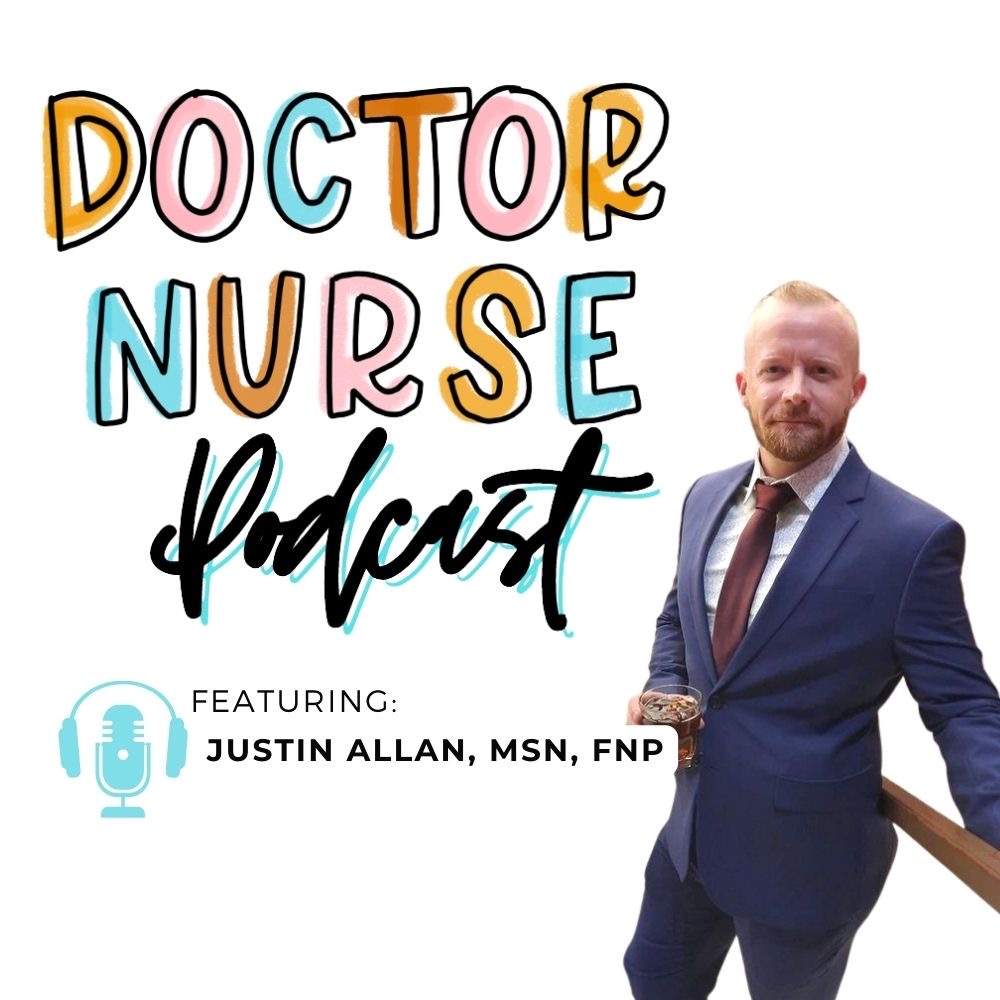
This week we meet Justin Allan, MSN, FNP who is making that much from his multiple businesses centered around his NP role. Justin holds a BS in biology, a BSN, and an MSN and FNP. He has worked in multiple practice settings including urgent care, emergency medicine, addiction medicine, family practice, and men’s health. He is the owner and author of The Elite Nurse Practitioner. Justin owns multiple successful practices and businesses as a nurse practitioner. And now, he helps nurse practitioners finally build the life they desire.
He states, “I have been practicing as an FNP for 8 years in multiple different settings all over the country. One thing I have learned is that nurse practitioners do not fully utilize their true power. Well, I am here to change that!”
He is dedicated to helping nurse practitioners break free from the shackles of modern healthcare. His mission is to help create a group of nurse practitioners that are wealthy, powerful, and professionally fulfilled. He has learned through trial and error and shares his knowledge with the nurse practitioner community through the Elite Nurse Practitioner Course Creation and content
Justin Allan’s Links:
https://podcast.elitenp.com/#episodes
Doctor Nurse Links: https://linktr.ee/DoctorNursePodcast
Wanna start a side hustle? Subscribe to the Doctor Nurse Podcast and I will show you how to start: https://view.flodesk.com/pages/6253188857d9b15fd00f8329
Latest Episodes
Doctor Nurse podcast brings you weekly shows to help INSPIRE, EDUCATE AND EMPOWER nurses with true stories of initiative and impact.
Doctor Nurse podcast brings you weekly shows to help INSPIRE, EDUCATE AND EMPOWER nurses with true stories of initiative and impact.
Latest Episodes
Doctor Nurse podcast brings you weekly shows to help INSPIRE, EDUCATE AND EMPOWER nurses with true stories of initiative and impact.