Also Available On






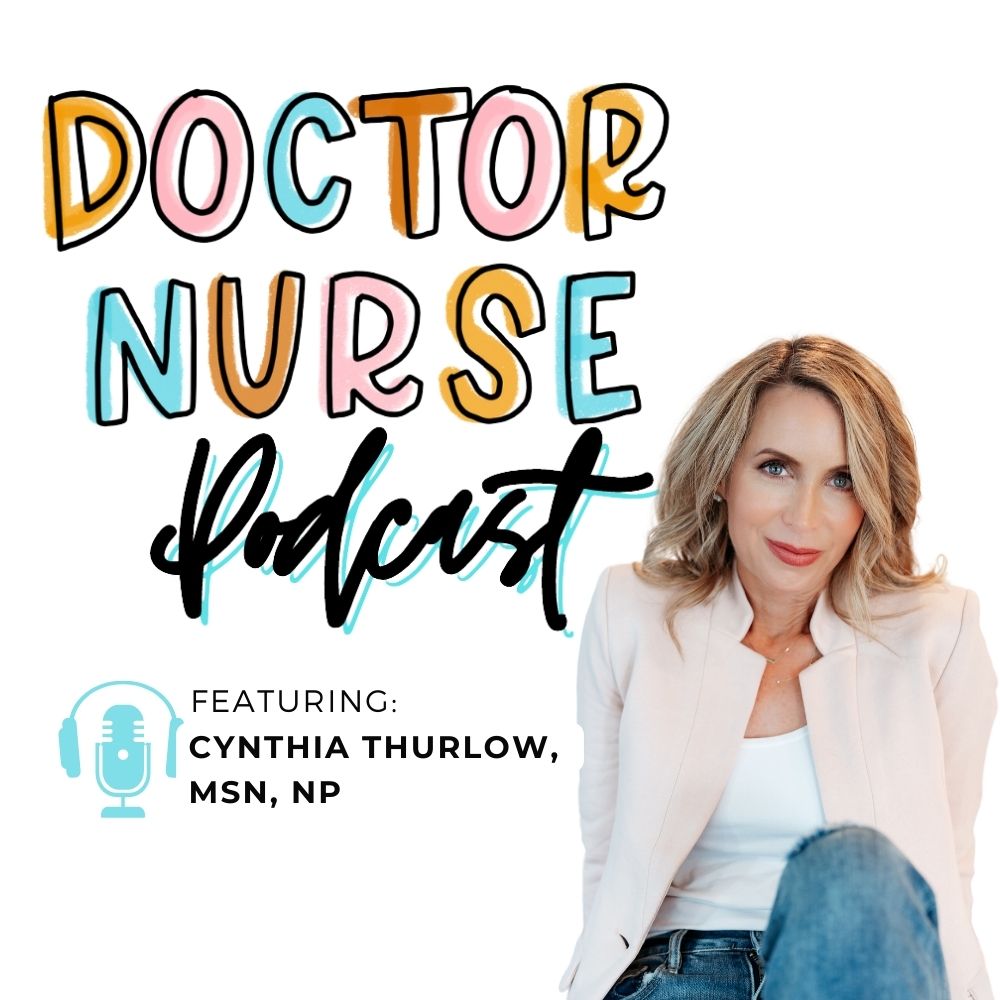
Sandra Pagenta: I am so happy to have you on today, Cynthia. I just cannot wait. This is total goals.
Cynthia Thurlow: Oh, well, thank you. No, it’s really an honor to connect with your community. And I was telling my PR group that. if there’s interest from fellow nurses to interview me for their podcasts or their platforms, how important I think it is for those of us that are, farther ahead in this game, if you will, to be able to speak to people at.
You know, the beginning of their nursing careers or their advanced practice nursing careers, I probably get DMS almost every day across social media people saying, I wanna do what you’re doing. How did you get to where you are? so it’s always an honor to connect with my fellow nurses and obviously support their podcasts.
And, and he’ll inspire, you know, this generation of nurses to do things differently. And I think in a lot of ways, what I chose to do was to take the path less traveled on a lot of different levels because I didn’t start as a nurse. I started as a PolySci major and got into law [00:01:00] school and then was inspired to take premed classes, which is a long story.
But ultimately got me into nursing and a nurse practitioner program. I did a dual degree program many years ago. And I’m so grateful I did because I would never have been happy being an attorney. And so I, I really ended up exactly where I was meant to be.
Sandra Pagenta: Yeah, which is so great. I love how you said looking back and helping those that are coming along the journey, because we are along a, a huge continuum of different spaces and different spots in our, in our lives.
And if we go back and we help others, that’s exactly what you said to me when I messaged you. And this is because I had a nursing student reach out to me who said, find a functional practicing nurse practitioner. And I reached out to you, which is again, like home run shot in the darkness, just see. And then you responded.
And I was like, oh my gosh. And this is for, I wrote his name down Joshua. Stacy’s who I’m doing this for? And that’s because again, he asked me to find someone so that I can have him on the podcast. So here I am reaching back to him and you’re reaching back to me.
It’s just [00:02:00] awesome. It’s just incredible. So I’m so happy to dive right in. And as you were saying, kinda, what’s your job role, what’s your job title? And I know you answered the question all the time. Like, how did you get here? And that’s really the, the heart of the podcast is really for people to go. So this is how she got here.
Mm-hmm this answers that question, right? Yeah. And so let’s start first with kind of what you do, what your day to day life looks like, how you see yourself and the roles that you
Cynthia Thurlow: occupy right now. Well, if you wanna hear something funny, my husband knows that if we are out socially, I mean, it’s really feels like it’s just been fairly, fairly recent.
We’ve been more social, but if I’m out socially and I want to talk about what I do, I say I’m an entrepreneur. However, if I don’t wanna talk about what I do, depending on where I am, I say I’m a nurse and a nurse practitioner, because then people they understand what that is. Whereas if you say entrepreneur people, I dunno what that means.
So the way that I would describe myself now, I’m still a mom. I’m still a wife. I’m still an NP. I I’m very proud of that. And in fact when people introduce me on other podcasts and they don’t mention that I’m a nurse, [00:03:00] I always correct them because I think that’s really important. I would say like, do not diminish what I am because I am no longer in the traditional role of what people envision NPS do or nurses.
I would describe myself as a podcast host. I’m really proud to be the host of everyday wellness. I’m also now the cohost of intermittent fasting podcasts in Melanie Avalon. I’m a speaker. I always say like, that’s probably one of my favorite things I do along with podcasting. And then the entrepreneurial space means that I’m a creator.
So I am constantly creating solutions for what my given clients now it’s client versus patient. My clients are struggling with. So I’ve created multiple programs. I’ve created very successful one-on-one programs as well as group programs. And so I always say, like being an entrepreneur is really wearing many hats all at once and trying to navigate the ups and downs of the unpredictability of being an entrepreneur.
But I can honestly tell you after six years, I can’t imagine doing anything else because it is so aligned with who I am. And, you know, I, I think [00:04:00] I was always one of those people that well, and I bucked against authority. I was always, you know, I was always a people pleaser. That was part of, part of my personality.
I’m always saying I’m, I’m now reformed people pleaser. But I think I was always thinking of different ways to tackle problems, whether it was when I was an ER nurse, whether it was when I worked in cardiology as an MP for 16 years, I kept seeing patterns and I kept, you know, identifying to my, my, mostly my physician peers.
We’re not making people better. We’re bandaid the problem. And this is what I was struggling with. I just said, ethically, we have to do better. And unfortunately, the kind of traditional alopathic model is I’m, I’m sure everyone that’s listening understands constrains healthcare providers to really focus on, on lifestyle based medicine.
So to answer your question, the way I would describe myself is I have many titles. There’s always the, the ones that are most important come first, you know, mom and wife, but I’m a nurse practitioner entrepreneur. That’s usually how I explain it.
Sandra Pagenta: I love when entrepreneurs [00:05:00] also really focusing on the two most important roles that are given to you from.
For me, it’s from the Lord. Like it’s completely bestowed upon you as mom and wife, because those are the most important things. And then the other things follow after that, I love that structure because when you keep first things, first, everything else falls in line. Absolutely. And so I just think that’s such great wisdom and a great way to define yourself.
And there’s so much that you’re involved in, in that there’s so much in that bucket, in that entrepreneurial bucket, that is just incredible, but you didn’t wake up one day and just have all this stuff, right. Mm-hmm like, you’ve been grinding for years. This has been a journey to this spot. And so one of the things that we focus in on at the doctor’s podcast is the journey mm-hmm and kind of that moment that you decided.
Going back to what you were kind of describing about when you were thinking about going to law school and you’re like, wait a minute, no nursing, like, what was that decision? What was that moment? That pivot, and then walk me through kind of how you got to this space
Cynthia Thurlow: that you are in right now.
Yeah. Well, it’s funny. I got a dog when I [00:06:00] graduated college, so I’d already decided I wasn’t really sure I was going to law school, like I had gotten in. And then I started looking at the financial investment and my parents were very clear. We will pay for undergrad graduate schools on your dime, which is completely appropriate.
Yeah. And you start thinking, you’re gonna spend a hundred thousand dollars. It’s like, am I gonna, is that a good decision for me to be making? And so I got a dog I’d always wanted a dog. I got this amazing little be Sean freeze. And she changed my whole world. I tell everyone I’m like, I had the most miserable two year experience working for a fortune 500 company.
But it was the best experience because that fueled my desire to get the heck out. And while I was working for this company, I was taking pre-med classes. Initially. I thought I wanted to be a physician. I have a lot of physicians in my family. A lot of nurses in my family and a lot of teachers. So I’m a, I come from a very service oriented background and I was sitting in, I think, a pharmacology class and this professor LA that to me, and he said, what are you doing in here?
And I was maybe a year or two older than the undergrads. It wasn’t like I was significantly older, but he said, it’s evident to me, you’re [00:07:00] coming back to do something very specific. And I said, oh, I’m gonna go to med school. And he said, no, I don’t think you wanna do that. He’s like, I think you wanna be a nurse practitioner.
And I was like, no, no, no, I don’t wanna be a nurse. To me, it’s like I heard years of my family members, sharing, funny stories and sharing sad stories. And he actually encouraged me to talk to his sister who was a nurse practitioner. And back in the 1990s, there were not a lot of nurse practitioners.
We were really not in the, the volume that we, that we see NPS. And now, so I had a conversation with her and then that got me thinking I can have a better quality of life. and that was huge for me, cuz I have a mom that retired a couple years ago, but had a hugely successful trajectory of her career to the point where she wasn’t really around a whole lot.
And so I was like, I don’t want that for my kids. And all my physician, my female physician, family members were like, the balance is a challenge. Like you have to be honest. So then I went another direction. And around that time I became really interested. This is back, you know, 1990s was still when HIV and [00:08:00] aids there was no real treatment.
It was all, you know, all focused on symptom management. And I got very interested in HIV and aids, which led me to two options for doing a at that time there were no, there were no DNP programs. It was you, you had a bachelor’s to a master’s program. And so I applied to some of the big ones, but Hopkins was my first choice because they were preeminent and HIV and aids management and I was accepted.
And I remember just being so completely. At peace with that decision. And my parents of course, completely freaked out, you know, inner city, Baltimore in 1990s was not all that safe, but I loved it. And so I went from, getting my, my second bachelor’s to working as an ER nurse, which I loved. I’m an adrenaline junkie.
I like sick people. I like the challenge of not knowing what’s coming through the door literally. And so I did that while I was doing my. My dual programs and for people that are out there, there were a lot of nurses back then that were very unsupportive of younger nurses going straight into advanced degrees.
And I always [00:09:00] used to think to myself like you, we all have the same choices. Like you could also go do an advanced degree. You’re choosing not to. And I can respect that, but don’t, try to. This is where nurses sometimes can be frustrating. They were trying to discourage me, like you’re not worthy enough.
And I kept saying, I’ll show you. And so I was an ER nurse for four years, and then I became, I went into cardiology again, another adrenaline junkie, fueled environment. And I loved it. I loved cardiology, like everything about the heart, but then I got married and then I had children and my boys are, are only two years apart.
And it’s, it’s amazing how life brings you. A lot of levity. You start to see, like, I don’t wanna be working full time and just exhausted and depleted when I come home. And so I, when I, I had the, the option to be able to work part-time. So from the time I became a mom as an MP, I worked part-time. And thankfully by that point, I had enough experience as an MP that I could do that comfortably.
And, you know, I kind of existed in this haze of. Exhaustion [00:10:00] having two little people at home. My husband did a lot of international travel. I was working part-time, but I was otherwise a full-time mom and a part-time MP. And then, you know, my, my older now older son developed terrible eczema and I kept taking the pediatrician and I kept asking, is it something I’m feeding him?
And it was like, no, no, no, just use these high potency, topical corticosteroids, and it’ll be fine. And I kept questioning, maybe he has food allergies. Maybe we should get that tested. So we finally took him and I expected something benign. I mean, honestly the allergist words to me were carry an EpiPen and pray, and that was not acceptable to me.
And I felt so alone as a healthcare provider because it, all of a sudden you realize, like you don’t wanna take your kid to a restaurant. You don’t wanna take your scary kid to someone’s house because you’re fearful that there could be cross contamination. He has peanuts and tree nuts allergies. And so I’m sure most of your listeners know only 30% of children will a allergies.
He’s not part of that 30%. He at 16 years old still has life threatening food allergies. And [00:11:00] that really got me thinking. And then there was a book I read called the unhealthy truth of a big proponent of reading. And I probably at any one, given point in time, probably have five books that I’m reading at one time, but I read Robin O’Brien’s book, the unhealthy feature.
Then it made me mad, like so angry. When you start to understand the interrelationship with how food is harvested, what’s sprayed on it, how that impacts our health and that that book is what started it all. And so I really started to second guess everything I was doing, I started to, I was making my kid all my kids’ food, which is tedious, but at that time I had the, the time to be able to do that, but really thinking, do I wanna go back into an academic center?
Hopkins was always trying to recruit me to come and do my, my PhD. And I just was like, I don’t know how to make that work with two little people at home. They need my, they need my focus. And so I took, you know, from a class in a university in Washington DC area, I went there and took one class and hated it.
Which is not, which is not gonna denigrate anyone that has gone that route. I respected enormously. It just wasn’t the right fit for [00:12:00] me. Then I did a wellness coaching program and that was, eh, and then I’ve read another book called Ethiopias and that changed everything. I reached out to the author. I was like, where did you get your training?
This is exactly what lights me up. And so I went down the rabbit hole of a functional attrition certification, which then led to all this functional diagnostic interpretation and testing, which again lit me up. And then around 2016, I said to my husband, I got outta bed. I’ll never forget it got outta bed one morning without a business plan.
So I don’t recommend this . I said, I can’t do this anymore. And he’s like, what are you talking about? I said, I cannot write another prescription. So in cardiology you write a lot of scripts a lot, whether it’s in clinic or the hospital. Yeah. I said, I feel so disconnected from what I’m doing and it’s, I, I towed the party line.
When I was at work. I did the evidence based medicine, you know, the statin for this, the, that I did all of it. And I started kind of getting in trouble at work, cuz I would start tinkering with statin doses because I was like, well, we don’t want their total cholesterol to be a [00:13:00] hundred. Like that’s a predictor of morbidity and mortality.
Like this is a problem. But I walked into work that morning and I said this is not about you. This is about me. I’m no longer growing intellectually. And this practice had been really good to me. So I always wanna be clear about that. They, when I tell you they did everything they could to keep me.
And then some, they were really very generous, but I just said, this isn’t right. So on April 1st, 2016, I left clinical medicine within, without a business plan. Without any idea of how I was going to recreate the income. I was no longer, I no longer would have. And the blessing of my husband, which is pretty incredible.
And within a year I was profitable and I made way more than I did as an NP. For anyone that’s listening, thinking, you know, you can’t replace that income. I don’t even, I think so differently about where I was before and where I am now. And my relationship with money is very different.
And you know, I, I value and respect people’s time enormously, but you know, the, the kind of current model, at least where I [00:14:00] was when I was having, as an example, when I, every year we’d have a review, I’m sure like most MPS, you have a review, you sit down, everyone loves you. They love everything about your work.
You’re an exceptional an exceptional MPP. And then you look at like what your hourly per hour is. And I’m like, this is not acceptable. this is, I was like, wait a minute. I know when I was an agency nurse in the ER, I made more money than this, and I have more responsibility now. So, you know, for me, it was really the right decision.
It may not be the right decision for everyone else, but I can tell you that becoming an entrepreneur allowed me to grow in really powerful and profound ways that I would not have been able to do. I’m an introvert. And it’s very easy in medicine to hide as an introvert you control. When you walk in the patient’s room, you control.
When you walk into the patient exam room, you control, you know, how you interact with your patients all based on, your introvert itself. And then all of a sudden, as someone who is not, I would not describe as an extrovert. You have to completely grow some new skills because you can’t get your business out there and think [00:15:00] that you’re gonna be able to do that behind closed doors.
You really do have to change the trajectory of what you’re doing, but that’s like basically where it started from. But I can tell you because a lot of the questions get, you know, so 2016, you left clinical medicine, 2017, you were growing your business. You started attracting a very specific type of woman.
It was woman just like me, who felt really lost in the medical system. You’re done having babies. You’re not really dealing with contraception. My husband’s out of vasectomy. We’re done having kids. I’m not menopausal, but there’s this gray nebulous area. And there’s no focus on medicine on women that are north of 35.
There really isn’t, the options are as follows. You have heavy periods because you’re estrogen dominant. So we’re going to give you synthetic hormones. We’re gonna give you an ID. We’re gonna bla your uterus, or we’ll just take it entirely. And I was like, time out. it’s not, these are not options. But so as I was kind of navigating things in 2016, into 20 17, 20 18, I decided I’m an introvert.
I should do something that will challenge me in a safe way. So I was like, I’m gonna do a Ted talk. And my husband was like, what?[00:16:00] I was like, yes, I’m gonna do a Ted talk. And
Sandra Pagenta: so that blows my mind that you did a Ted talk in your introvert. Oh, totally. I was terrified. And you, and you did a great job, like you just seemed so comfortable at
Cynthia Thurlow: there.
People look great. Well, I mean, the irony is I, I tend to, I now have fixed this, you know, I I’ve now work with speaking coaches who were like, you’re great. You just have to stop moving. But for me, like the nervous energy. So my first talk was on premenopause as embarrassing as that is. And then my second was on a subject I knew a lot about but during the actual first Ted talk.
I remember looking out in the crowd and saying, this is exactly what I wanna do. Cause I was connecting with so many more people. That was the big thing for me was that I have the ability to impact more people doing this than I ever did with, you know, my 15, 16 patients in cardiology, which that many on a clinic schedules a lot because cardiology patients are, you don’t generally get the, I need to check your blood pressure person.
I would get like complicated. I’ve been in the hospital for six weeks, Spath, that was like my norm. Yeah. Was my bread and butter, but now I get to impact people on a different level and I actually [00:17:00] genuinely love teaching. And so what do nurses do better than anybody we teach educators?
Yeah. And so it was really empowering to be up there and in between they, oh my God, I can’t believe I’m doing this because I’m an introvert. It was like, this is kind of cool. And so that’s, that’s initially where that kind of, that was the direction things went in. And then obviously in 2019 things changed.
It’s like, you know, it’s like, so what happened in 2019? Well, before I did my second Ted talk I went on a vacation with my husband, came back, got home one night and I was like, God, I thought I picked up a stomach bug. You know, I was like, I gastro your underwriter. Oh no. By the next afternoon I was like something seriously wrong.
I had really, really significant, substantial, worse than labor abdominal pain. And so I called my primary care provider and she was like, you realize you need to go to the ER. And I was like, no, No, no, I don’t wanna go to the ER, I’m a nurse practitioner. Exactly. I’m like, I don’t wanna go. I don’t, this is gonna pass.
She’s like, no, it’s not. You’ve been, you know, you’ve been in, you’ve had pain for over 12 hours. So when I got to the ER, I could not sit still. And so, oh my gosh. For all of us as clinicians, when a patient has this impending sense of [00:18:00] doom, you take it seriously. And I looked at the nurse who was not taking me seriously, cuz my vitals weren’t all that bad.
I just couldn’t. I was so uncomfortable. I couldn’t sit, I couldn’t stand. I was walking the halls. I didn’t look all that bad. And so I said to her, if you don’t figure out what’s wrong with me, I’m gonna die. And then all of a sudden, you know, they drew labs and then my white count was almost 20,000 and then it was like an emergency cat scan and then it was an emergency surgical consult.
And so it turned out that I had a ruptured appendix and I had pancolitis. The whole length of my colon was inflamed. And the surgeon looked at me and I remember this very clear it’s like 11:00 PM. So it had taken like forever. I mean it seemed like it took forever. She said, if I take you to surgery tonight, I have to take your colon.
I said, time out, you’re not taking my colon. She was like, you don’t need your colon. I was like, oh no, I, I need my colon. I need my colon. So I begged them to let me ride it out, to be able to get to a point where I could be in a better position surgically, but then it was like a cascade of complications.
And for anyone listening, there is nothing worse than being a healthcare provider, knowing [00:19:00] you’re as sick as you are. And then you have one complication and have other than a hypothyroidism, I don’t have any health issues. Then I developed a small bowel obstruction. So being a tiny person, I went from being a tiny person to looking six months pregnant.
And then it was like I had para retroperitoneal abscesses, and then I had official, I mean, it was like every side effect were, untoward, ex expectation related to this ruptured appendix. And even my surgeon, like I had five specialists seeing me. I was sick as stink. And I remember the whole first week, all I did was vomit.
Which eroded all the enamel on my teeth which is a whole separate yeah, like a whole separate thing. But I remember when they were putting the NG tube down, I was like, I don’t even care. I am so sick. I do not even care. But there was a point of which, and I say this to, to people that my patients would tell me that sometimes they felt a degree of spiritual awareness, something changed, something shifted for them.
And I do feel around day five when I was depressed, because I was like, I knew I was really sick. And my surgeon was seeing me three times a day, which says a lot. I was like, [00:20:00] something has to give, and I really felt like this spiritual, you know, whether you believe in God or you don’t, I was given a choice and I was like, I have two young boys.
I am not willing. This is not it for me, but if I’m going to choose to live, I’m gonna live big. And so I left the hospital. After 13 days, I went home with a ruptured appendix, a drain, a central line, and I prepared for that second Ted talk. I went home for the first week. I did nothing but sleep. And I had lost 15 pounds.
I looked disgusting. Like I tell people all the time, the camera really does add 15 pounds. Cause when I look at that second Ted talk, I’m like, I look fairly normal, but I was so skinny. And so 27 days after I left the hospital, I did that second Ted talk and honest to God when I stepped off the stage, I said to my coach, cuz they had a coach that was assigned to us.
I said, that’s the worst talk I’ve ever done? because they, they were very specific about keeping us to our time, not allowing us to go over. And so I skipped over a whole chunk of stuff I was gonna talk about, but it’s amazing to me that my brain, despite having been so sick had not processed the [00:21:00] trauma of being in the hospital and allowed me to remember and commit to memory that entire talk, get up there and execute it.
And I went home and said, this is great. I did this talk, check the box. I told my kids, we’re gonna have this great summer. I’m gonna disconnect. And what happened was exactly one year, three years ago, yesterday, The talk went viral and then it changed everything. And then there was no like laid back summer for my kids.
It changed everything. I mean, it changed absolutely. Wow. Positively everything. So when we talk about journeys and we talk about people, see, it’s almost like the iceberg, meme. If you see that. Yeah. People see just the, the bright, shiny objects to talk. They don’t see all the hard work behind the scenes.
And so I, I always tell people, like, I’ve worked very hard to get where I am, but people just see the bright, shiny. And I always say there’s so much more to it, but I do think through great adversity comes great opportunity. And this is something really worth emphasizing to your listeners that we all have stuff that happens.
Like every single one of us has stuff, but what do you do when it [00:22:00] gets hard? Like for me, I am stubborn. Like I am still gonna do that talk. I am still gonna, , mud through that. And I’m so glad I did because I really think. Had I not done that. I wouldn’t be where I am. So it’s like all this dots kind of align now, and now it all makes sense to me.
And then it was like, I made a series of very calculated decisions throughout 2019 into 2020. Then we have a pandemic. There’s a lot of things that shifted in my business and I’m so grateful that I was all online already because I, I can, I have my, like the last two years have been phenomenal. I tell everyone that, sometimes the universe kind of guides you in a certain direction.
Mm-hmm . But I, I think for a lot of us, like, I’m a very much an intuitive person, like whatever makes me feel energetically, very aligned and makes me feel good. I generally will kind of lean in that direction and has definitely served me well.
Sandra Pagenta: So much to unpack right there. But the, the bottom line, and I think the takeaway is that you decided at one point you had this moment where you were just like, I am going to go big or go home.
Mm-hmm and it’s just this, I [00:23:00] think this is so huge. And I want more nurses to, to see this and to feel this and to embrace this, whatever it is, that’s bringing you joy, whatever it is that you think this is what I’m supposed to be doing. Go do it now. Don’t wait. Don’t delay because you don’t know, like you were healthy.
Mm-hmm you were thin you had like, why did this happen? Well, how did this happen? You’re living this lifestyle. You’re in, involved in what you’re eating and yet it can still happen to you. You can still be on the brink of this. Is it like, oh my gosh, like, how was I here in Hawaii? and now I’m fighting for my life.
Yeah. And it’s a scary place. I have a couple questions, one of which they didn’t take your appendix, so did they eventually take it? Did you eventually have surgery or
Cynthia Thurlow: no? Yeah, no, no, no. So I had my appendix, I did my second Ted talk with a ruptured appendix. So I always say like, I probably am the only person that’s ever done a Ted talk with a ruptured appendix.
The irony is four days before they finally pulled my drain out. Like I had to think about what was I going to do if I had to go do this, talk with a drain in like, [00:24:00] was I gonna tape it to the inside of my leg? So people couldn’t see it. I mean, it was like, we’d all these crazy thoughts, but like, by some miracle, the official had fixed itself.
I think on a lot of levels that, , for me, it was like, reassuring was like, okay, I did the Ted talk. And then 10 days later had my Pennix out. And, and my surgeon who was amazing. Said to me, my body had totally walled it all off. Like it had protected me and not right. And she had said, it’s not a question of if, but when it would have created, like she was concerned, I was gonna have a even greater problem.
But she and I had, like, I sat in her office postoperatively cuz. And the other thing was that I guess she had seen a lot of appendix cancers. And so my appendix, obviously my remnants of my appendix were sent off for biopsy. So I was thrilled to know that there was no evidence of any cancers, but she said, had you not been as healthy as you were?
I’m not sure you would’ve had the same outcome, which to this day gives me chills because I kept saying I’m just so grateful. Like she was such a good surgeon. She never gave up and she tried. To honor. Cause I said, please do not. I don’t wanna, I don’t wanna collect me. I don’t wanna colostomy [00:25:00] back. Can you imagine?
Yeah, I mean, if that would’ve been the case, I would’ve accepted it, but with that being said, I was so grateful that I had such good care and that I had such a talented team. I mean, it was like the irony was when they had to call interventional radiology in, in the middle of the night. like, it just so happened.
The one guy who knew how to put this particular type of drain in just happened to be who was on call. And I was like, there’s no coincidences. Yeah, no, there are. So I think for people beautifully said that are listening. Our health is wealth. Had I not been as healthy. And sometimes nurses do such a, we do ourselves such a disservice of not taking, we take care of everyone else, and then we don’t take care of ourselves.
And so this is really like health is wealth. It is a currency. It is so important, especially metabolic health and, and I’m sure that we’ll probably touch on this, but it distresses me. When I look at statistics over what’s changed since 1997, when I started in healthcare versus now, I mean, it’s a whole new world.
It is very different. And so much to your point. Yes. Yes, the appendix came [00:26:00] out and I very happily showed all of my all of my photos on Instagram, but the one thing that was interesting for me. was, you know, when, when patients and patients would tell me this over the years, but now I understand it.
The trauma of being in a hospital, like the, you do get some degree of PTSD. When they told me when I needed to have surgery, I had to go back me back to the main or not the, the outpatient center. I just saw my, my poorer surgeon was like, what’s wrong? That’s what we want you to be. I’m like, no, no, no. She was like, well, they wanted to anticipate if there is a problem, we can just then admit you.
And I was like, no, no, there will be no problems. I’m gonna go, I’m going home. I’m going home. I’m not staying another night in the hospital. But it, it provides a lot of empathy for things that patients shared with me over the years when people would wake up and they’re like, what happened to me the last two weeks?
What, you know, and just the degree of gratitude I have for, I had a lot of good nursing care and I had some not so good nursing care. But the really good nursing care I had, they were in my lifeline. Yeah, how incredibly grateful I was. And I’m still in touch [00:27:00] with almost all of them. Like we all stayed connected, which was really, really,
Sandra Pagenta: really cool.
That’s so special. Mm-hmm so one of the things that I wanted to talk to you about, and again, this is kind of intersecting in between our some of the other questions I typically ask my guests. You talked about right then and there just, just a couple seconds ago about the metabolic syndrome that’s been affecting nurses.
And, and for me, I know a lot of my listeners are African American, Hispanic. And I know that there’s not a lot of options. I feel like I’m watching my fellow, African American and Puerto Rican, Hispanic women just getting larger and larger every year. And it breaks my heart. As I see this, and they’re walking around with all this extra weight and you wrote this book about intermittent fasting, I’ve read it.
It’s fantastic. Between walking my baby, I’m like listening to it, you know? And, and all the literature, because I had a pretty, pretty serious complication with the birth of my son. I had gestational diabetes and then he was born. Macrosomic just large. And I was, I’ve never been a big girl.
I’ve always been quote [00:28:00] unquote skinny in a size four to six. You know, I was always fine, but when he was born and he was in the ICU for four days dropping his blood sugar hypoglycemia. They’re talking about me going home and leaving him in the hospital cuz he can’t regulate his blood sugars. I began, I had this aha moment.
I had this the same moment that you have as I’m laying their cut open and they’ve pulled him out because I, I couldn’t get him out. I had the same moment of I’m sick. Like even though I know I’m well, it actually makes me emotional when I think about it. But I just remember laying in the hospital and just being like, I’m sick.
Like even though I’m not fat, there’s something inside of my cells inside my body. That’s not well. And I began to dive into a similar, you know, story that you’re sharing or read a book that talked about diet and exercise. And I was, and it was by a guy named Mike Adams. It’s kind of woo, like woo, woo. And people are like, oh, whatever.
But I was like, I had no idea that these were thoughts that people felt about food and nutrition, and I just went deep. And so I love your book [00:29:00] cuz it touches on every single thing that I’ve spent the last three years of his life, trying to get a handle on I’ve lost 20 pounds pre-pregnancy so I was I’m skinnier than I’ve ever been.
And it’s because I’ve been implementing the things you’ve been talking about in your book. And so I wanna touch on a little bit about what intermittent fasting is and really what the benefits are for anyone, black, white, Asian, whatever your race background is. This can change your life. And so if you would kind of touch on that a little bit for my
Cynthia Thurlow: listeners, I would be happy to, but I also wanna acknowledge what you have been through.
I think our children can be our most powerful motivator to, you know, really reflect on. Are we doing the best for us? You know, that’s, that’s always the thing. So I, and I can see, you know, the emotion in your face as you’re sharing that story. And I’m so, so grateful that you are in a position now where you can help educate others about taking better care of themselves.
So when I’m thinking about [00:30:00] intermittent fasting and especially for women, and this is really the first book that is written specifically for our unique needs, I would say we are not many men. We should not apologize for our physiology. And I do agree with you that there is not enough being done to talk about metabolic health.
But when we’re speaking about what intermittent fasting is, it’s just as easy as eating less often. And it’s really strategically aligned with our menstrual cycles. There are times in our cycle. We should fast. There are times when we should not. I think that for every woman that’s listening, that is curious about intermittent fasting.
It’s sometimes easiest to incorporate it in the follicular phase of our menstrual cycle. So from the day we start bleeding up until ovulation. And for those of you that don’t have regular cycles if it makes it easier to align with a lunar calendar, but I do encourage women. And I’m just this gonna be my caveat.
I know more about the menstrual cycle now. As a 50 year old woman than I ever did when I was younger, when I had cycles regularly, et cetera. So I think it’s important [00:31:00] for all of us to understand like what’s happening with our bodies during our menstrual cycles and to understand for a lot of people that have a regular cycles, it’s oftentimes related to an imbalance between the two big players, estrogen and progesterone.
And if you have polycystic ovarian syndrome or P C O S mm-hmm and 25% of those women are thin. So it is not just an issue with women that are overweight or obese. It’s really important to understand what you can do to support your body. And I wanna make sure I also talk about the fact, like we really look at the statistics.
We know that there is a. Neglect in terms of our focus as healthcare providers on or underserved population. So I’m thinking about, you know, people that might be in the inner city or they could be in rural areas, but irrespective, we look at the data. If we’re looking at different like racial breakdowns of obese of those that are becoming increasingly overweight and obese, it is disproportionately impacted by Hispanic and African American women.
And we can’t have a conversation without speaking to this fact that we need to be doing [00:32:00] better for all of our female patients. We need to be having conversations earlier. Meaning, you know, we don’t wait till someone’s diabetic way before then we look at a fasting insulin. Now this is something I probably 10 times a day tell people I don’t care if your A1C is okay.
And your fasting glucose isn’t too bad. What’s your fasting insulin. What’s your fasting leptin because more often the first biomarker that disregulates is insulin. Okay. So intermittent, fasting, amazing strategy for women that are still getting their menstrual cycle 35 and under you really do have to be careful because your body is primed for procreation.
Even if you’re choosing not to have children right now or ever north of 35, up to 50 per menopause, this is a time of it’s like reverse puberty. There’s no other way to describe it. They have to fast differently. Because they have, you know, their, their adrenals are helping to buffer the progesterone that is not being secreted by the ovaries.
And so I remind women at this time, sleep counts type of exercise counts, anti-inflammatory nutrition, [00:33:00] et cetera. And then menopausal women, 12 months of the menstrual cycle. You they’re a little bit more like men in that they don’t have as much flux day to day, week to week. However, the lifestyle piece is still critically important, but in terms of benefits.
So obviously people come to interment fasting, cuz they’re curious about changing body composition, weight loss, et cetera, but there’s so many amazing benefits. So first and foremost, the thing that stood out to me first, the end of one was I had so much more energy because when insulin levels are low in the body, guess what happens?
You free up stored fat that helps fuel your brain. And our brain loves fat. And there’s a, a particular one called beta hydroxybutyrate that Dr. That kind of diffuses across the blood brain barrier, which we all know about. So energy is number one, mental clarity, what woman doesn’t want more mental cl or man for that matter.
More mental clarity or, you know, more energy. I think about something called aji. You know, we’re at the crux of two years of a pandemic. AGY is this process where we’re in an unfed state where a body goes in and recycles and gets [00:34:00] rid of disordered organelles, mitochondria, et cetera. It is like taking out the trash, but this doesn’t happen when you’re eating all.
And what have we been telling our patients for years? Snacks, mini meals stoke your metabolism. Exactly. We’re just making our patients fat. So that’s completely, yeah, that’s completely an error. So atopy, I think about reducing our risk to certain types of neurocognitive disorders. Alzheimer’s Parkinson’s et cetera.
Now I wanna just speak about Alzheimer’s there’s a lot of good research coming out. That’s talking about specifically to women in middle age. That it’s the loss of estradiol signaling in the brain, along with some progesterone and testosterone that can fuel the degree of insulin resistance, that drives type three diabetes, which is Alzheimer’s.
So you wanna take this varied seriously. It also reduces your risk of developing certain types of cancers. We know that it improves your biophysical markers. We know that hypertension is a direct relationship with insulin resistance. It is not just too much salt in your diet. You know, you really look at the research.
That’s not what it shows. So high [00:35:00] blood pressure high triglycerides, low HGL. You know, when we look at LDL looking at particle size just looking at those biomarkers, they can all fast and glucose can all be improved upon. By eating less frequently. I think about reduction in inflammation. Now, people, you know, this has unfortunately become a catchall phrase, inflammation, oxidative stress, but a lot of it’s the byproduct of our lifestyles.
And so again, eating less often removing inflammatory foods, which I know can be very triggering. So I would try to skate by that issue. But those are like the big ones that I think about. But for a lot of women in particular, the focus is on the weight loss and the changes in body composition. Yeah. But I’ve had many women who all of a sudden struggle with infertility that when they lose weight, they aren’t struggling with O ovulatory disorders.
People that have P C O S that have, you know, cured themselves from P C O S because they have, you know, this ovulatory disorder or Lal phase defect is, is, is better supported in the body. So I think there’s a lot of benefits, but I would say women have to do it differently. Postmenopausal women and men [00:36:00] can generally do most days.
Otherwise women, if they’re still cycling, have to really focus in on, you know, the vicular phase and really backing off a bit on the Lial phase.
Sandra Pagenta: Yeah. So one of the things that I love about your book and the reason why it’s something that I really wanna start pushing more to, I’m gonna just give it to my mom.
I’m giving it to everybody because I really feel like women aren’t incur, like there’s all this literature out there. And a lot of people like talking. Intermittent fasting with women and how we shouldn’t. We need a certain level of fat in our body because you know, we’ve got all these hormones and I love how you touch on these things.
You actually kind of tailor make , where people are on their journey of life. And you’re like, this is the kind of intermittent fasting you should be doing. This is when you should, this is when you shouldn’t and it’s so helpful. And you give a, you have a PDF that’s like so big and so large with full of like recipes and meal plans.
And it’s, you can just follow it for 45 days. It’s it’s incredible. I walked away from your book feeling like this is so doable. This is something that would help. Every single person, every single woman and [00:37:00] man who is looking for how to do intermittent fasting safely, and to really be able to clear out some of the junk in their pantry, get in there and figure out what to eat.
What’s the right foods. What should I be choosing? What should I, all the questions that people ask around it? I feel like you just, you touch on every single subject. Like I wish I would’ve read this 15 years ago. Yeah. Like I really do because it would’ve, where would I be now? I would be in such a different place.
And since I’m, I’ve implemented a lot of the things that you talk about in the book, I don’t have joint pain. I have endometriosis and that I wasn’t supposed to get pregnant. And so I’m able to change things. My periods are regular now and they weren’t before. Like, these are things that I struggle with. I was taking birth control and ended up getting a rare, super rare side effect from birth control.
And so nobody once did the work that you’re doing, which is what are you eating? I mean, Mac and cheese and hot dogs and all the other things that were just easy. Every kid ate them. I poured milk over my cereal that then I poured sugar on like, that’s what I [00:38:00] did growing up because that’s what we all did.
And I know, again, we weren’t very wealthy, but I also feel like that was just when I talked to my husband and they’re kind of the same economics, you know, status of family life. We were. Yeah, I did that too. And I’m like, yeah, poured Kool-Aid and poured three cups of sugar in the Koolaid. Like it was just what we did.
And it’s, it’s a changing of your mindset. And again, once you see the information you stare at it, you can’t look at the world the same way. No, it changes you. And I,
Cynthia Thurlow: and I think I agree with you so wholeheartedly and thank you for all the wonderful accolades. And this is the book I wish I had before I went into menopause.
In fact, I tell people so time because I’ve, you know, the book is now being translated into Chinese and German and Spanish, and that there’s a check. There’s a check dialect that’s being translated into, which is really cool, but it also speaks to the fact that we are missing opportunities with our patients.
And if you were teaching the same dogma to your patients that you learned 20 years ago, it is time to wake up because most of what I was taught and I went to [00:39:00] arguably a top five, if not top one or two in the country program where, you know, they do some cutting edge stuff. And I tell people all the time, like I had to unlearn.
You know, that fat was bad. And then if you go down the rabbit hole of looking at the seven, you know, the seven countries study and you look at Amsel keys and how, the, the focus was ma was chosen to focus on vilifying fats over vilifying sugar. They knew back in the 1950s, that sugar was the culprit.
And so we have a nation that has unfortunately gotten addicted to highly processed, hyper palatable foods. We have serious issues with metabolic health. I think the last big study that I looked at from 2018, which is pre pandemic you know, this is from UNC chapel hill. Yeah. It’s probably worse. Now that was 80, 42% of Americans are metabolically.
Inflexible. And so for every person that’s listen listening, you have a responsibility to you and your patients to get yourself healthy, because we wanna serve as an example. Like that is one thing that Twitter is really the manosphere, [00:40:00] but it’s a really kind of great place to get a pulse, pulse sense of what’s going on in the world.
And it’s amazing how a lot of these guys, because again, it’s the, it’s the mare. They’ll talk by the fact that, you know, they’ll go in to see their healthcare provider and they’re like my healthcare provider isn’t healthy. And how can they give me advice about, lifestyle changes when they themselves aren’t listening to what they’re doing.
And so I, I, I may take some heat for that, but we really do have a responsibility to be talking to not only ourselves and getting real about like, what are we not doing in our diets? Or what are we doing in our lifestyle at no longer services? That’s why I prioritize sleep. I eat. I would say carnivore ish, I eat plenty of non-starchy vegetables.
I eat a lot of animal based protein. It is. So the antithesis of what I used to teach my patients, snacks, mini meals, heart, healthy grains. You know, dairy is benign. No, no dairy is okay if you tolerate it, but it should be full fat. It should be raw. If you tolerate raw cheese you know, get rid of this garbage of like heart healthy grains, you need more animal based [00:41:00] protein.
You need to , don’t buy into what bill gates is trying to push in his agenda. I’m trying not to get off on that. Oh, fake meat. I know. Fake meat that’s all the time. Like he should be an example of why you don’t wanna eat fake meat because he has man boobs. He has some gyne Kamat yeah. I was like, he has gyne Kamat people, which is man boobs.
I have moves, moves. And so I think that it’s really important. Like, like, let’s be honest, like the things that I teach my patients and clients to do or things I do myself. Is it sexy to go to bed earlier? No. Is it sexy that I meal prep? Is it sexy that
Sandra Pagenta: it’s sexy, that I look at the back of everything for seed oil, like sunflower oil, this has soybean oil.
And like, people are like, can you just eat it? I’m like, no, this is in it. I’m not eating this. Yeah. Like that’s, that is not, it’s not fun. No, I’m gonna be honest with you. I’m now the person in my family, people are like, okay, we’re gonna go get organic meat cuz Sandra won’t eat. I’m like, I won’t like, I just won’t anymore.
Yeah. Because once you see it, like you’re describing, you just are like, I can’t, I can’t do this anymore. And I will be that person. That’s like, I’ll just eat before and come.
Cynthia Thurlow: Yeah. How about that? Well, you know, and, and here’s something [00:42:00] like super easy if people are listening and they’re like, this is blowing my minds.
If you do nothing else, read food labels and don’t consume seed or vegetable oils. It’ll that is it’ll get rid of most. If not all what’s in the grocery store, we know the number one fat consumed to the United States right now is soybean oil.
Sandra Pagenta: Isn’t that sad. Yep. Yeah. No. When you see what it does, like the omega, you talk about this in your book, the omega three omega six ratio and how it has dramatically changed throughout history from like a one to one ratio.
I think you said to like six to one, or you had some it’s to 20 it’s unbelievable. One 20. That’s what you said. One to 20. I was like, Whoa, like we are so out of balance. And so we can’t blame just one thing, but what’s the one thing that we do every day. Hopefully if you, if you’re the following a fasting diet two times a day, but if you’re not fasting, you’re eating it three to six times a day, we’re doing it six times a day.
What are we doing? We’re eating. And one of the questions I wanted to ask, and this is just for me personally, mm-hmm I wear a glucose monitor because of what happened with my son. And I know that I’m, I’m at risk for type two [00:43:00] diabetes on top of the fact that I have a family history of type two diabetes.
And I know a lot of African Americans they’re in this same boat. Mm-hmm I know I’m not the only African American female who has a grandmother and a grandfather with diabetes. I have a father with diabetes and now I just had gestational diabetes. Mm-hmm despite thinking I was okay with, from a weight stand.
Now the trajectory of my life, I’m looking and I’m thinking type two diabetes is coming for me. And so I wear glucose monitor and I, I pay for it outta pocket. Like I literally told my husband, I’m like, we’re budgeting this glucose monitor because I need to know what’s going on every single second of the day.
And when I’m finding and I wanted to ask you, I will find spikes mm-hmm after eating, what I think is a pretty low carb meal, I’ll have vegetables and you know, chicken and I’ll have that. And I’ll spike my blood sugar will spike, especially if it’s from a restaurant, which has been very interesting. Cause I think it’s cooked
Cynthia Thurlow: in seed oil.
It’s exactly what it is. So first and foremost, I applaud you for wanting to I’m tri girl down that rabbit hole. I always say, once you see, you can unsee. So glucometers, continuous glucose monitors. If you were [00:44:00] insulin resistant or diabetic, you should demand them. Like without question. And, and generally they are covered.
Yep. For the rest of us, we may pay out of pocket. But I tell everyone, if you don’t go out to dinner, At a restaurant for a month or two that will more than pay for your CGM. And I bet you that information will be far more valuable. Yes. So, yes. I do trend information. Like when I go out to restaurants, I’m always curious to see something that seems fairly benign.
Like I had a piece of fish and some vegetables and if my CGM goes up, I’m like, Hmm. So I always ask, like, when I go to restaurants now, what do you cook your food in? What is the dressing made with? I mean, I am that person that occasionally will bring premade dressing with me or I ask my kids, they just, you know, they’re teenagers.
So I’m, I’m totally, yeah, I’m totally embarrassing. However I will be the first person to say that this is one of many reasons why we try to really be careful about where we eat out. , there’s no judgment if people want to. I’ll be the first person to say when I became an entrepreneur, my husband took over meal prep because I just don’t have the same time.
And he does. So it works out beautifully. But I think [00:45:00] when we’re talking about metabolic health, we’re talking about, you know, knowing what those numbers, like, when I was saying earlier, everyone should know their fasting insulin, everyone should know their fasting glucose, everyone that is listening can gravitate measure and, and measure their waste circumference.
You can find out what your blood pressure is, your triglycerides, your HDL all of which are real. And, you know, all of which are really important. We talk about big metabolic health markers. I’d probably add in like things like uric acid. I don’t know if you’ve read David Pearl letter’s book drop acid.
Oh, so good. So he was such an amazing, he’s such an amazing interview. Like just blows my mind. He’s brilliant. But for people to start, you know, Demanding of your healthcare provider. Like we are in a partnership. And I understand that this information is really important for me to know, like, why are we waiting for people to develop diabetes?
Yeah. People develop diabetes, it’s a lifestyle mediated process. And if we aren’t talking to our patients about sleep and stress management and exercise and nutrition, then we shouldn’t be putting them on more medications because we are failing them. Like that is such an important [00:46:00] caveat.
And for people that, you have family members that have had diabetes or you yourself have had gestational diabetes. Does that mean that there’s some epigenetic pieces at play possibly. Does that mean that’s your destiny? Absolutely not. No. I refuse to believe that. Yeah. I refuse, refuse much to the same point.
Like I’m a middle aged woman and there’s this kind of conventional mindset of, oh, you’re gonna gain 5, 10, 20, 30 pounds in middle age. And I always say BS. You know, we know that as we are., transitioning from perimenopause and a menopause, we become less insulin sensitive that loss of estrogen, estrogen drives insulin sensitivity amongst other things.
And so I remind people that’s even more why you need to have that CGM or have that in commoner. So you understand it could be that you have a load carb lifestyle. Like I do, but things like plantains my body. Doesn’t like, I can eat tropical fruits till the cows come home, but I eat a plantain, my blood sugar swipes.
So it’s that bottom individuality, which is another thing we don’t teach our nurses or advanced practice nurses about like the whole concept of you could have 10 patients and line them [00:47:00] all up and they might all need different macros. They might need different, you know distributions of protein, fat carbs.
So, you know, dig deep and demand more of your healthcare team. Like I, I, I mean, I fired the GYN who said to me when I was early forties and I was in the throes of per menopause. Well, Five pounds. Isn’t a big deal. I said, five pounds is a big deal. If you’re five foot three , you know, because then five pounds becomes 10 pounds becomes 20 pounds becomes 30 pounds.
And so that dove me down this, this big rabbit hole so that people could benefit from not making the mistakes that I was making in my early
Sandra Pagenta: forties. I will say this, what I could talk to you all day about this stuff, because I’ve dove so far down, I’m like in it.
Right. And so it’s something that I’m so passionate about, but what you’re describing is it takes a really small rudder to move a really big ship. Those little five pounds, even though it might seem really small, it’s taking you in a direction that if you’re not paying attention, and I think a lot of women are feel the same way.
They’re just not paying attention. You’re a busy mom. Mm-hmm, , you’re struggling to get calories. And you’re just glad that you had something in your mouth because you’re [00:48:00] just, you’ve been moving all day. And so I think. Bringing awareness to that, bringing awareness to wait a minute, hold on a second. Like, I am heavier than I have been.
Like I had noticed at the time when I had my son clothes were a little tighter, I did notice these little things, but I was so busy getting my doctoral degree and doing all the other things that I didn’t have time to really focus and check in with myself. And I think that’s what you’re encouraging people is to like check in and the glucose monitor does that.
It makes you check in with yourself and see how you’re doing. And the only other, the one question that we had from a listener was she’s been doing intermittent fasting, skipping breakfast, and she still feels like she’s gaining weight. So could you maybe touch on that real quick before we finish up the episode?
Cynthia Thurlow: Oh, this is, this is definitely a, a rabbit hole. There can be a lot of reasons why we’re weight loss resistant. I remind women, like, what are you consuming during your fasted state? You know, I’m not a fan of dirty fasting. So I tell people. If you wanna get the best results, you have to be honest.
Like if you’re having creamer, which is insulin anemic if you are adding protein to your coffee, like collagen peptides, I mean, these are the questions [00:49:00] I get every day, copious amounts of, you know, butter and MCT it. Well, guess what? You might be doing something as innocuous, as dirty fasting, and that could be driving it, but I think it also speaks to what’s your sleep quality.
How do you manage your stress? And especially if you were north of 35, I hate to harp on this. There’s nothing that prepares you for how differently you have to live your life in middle age. And it’s not bad. Like, I don’t, I’m not complaining about it. I’m just saying like, what I got away with the 20 and 30 is very different than what I do now.
So when someone is complaining weight loss resistance, the first things I think about are are you clean, fasting fair? Probably likely not. Number two, how’s your sleep cuz your sleep is terrible and you wake up three times at night and you’re having hot flashes or you’re just not sleeping. Well, that’s a problem, stress management because we know we have 40 time, 40 times more cortisol receptors in our abdomen.
So if you’re stressed out, that could be doing it. I think about like where are you age wise? You know, are you on synthetic hormones? Are you, you know, low estrogen, low progesterone. And so there’s hormonal dysregulation. Remember I talked about labs, get your lab checks. What’s your gut [00:50:00] health like tox into your expos.
So there’s a lot to unpack with them, but I would start with the clean fasting piece for that young woman or. Woman. Yes. It was a young woman. Yeah. I would start there and then also like, how do you structure your macros during your feeding window? If you’re eating like a carb dense diet, guess what?
You, you need protein. We need protein for multiple things. We are a, a nation of chronic under eaters of animal based protein. So pushing those protein macros that helps as itty helps them muscle protein synthesis really critically important that we maintain muscle mass, especially as we’re getting older.
So protein first fats that they aren’t part of that, of that protein and then non-starchy cards. And I hate to say this for a lot of women. A lot of who gets them into trouble is alcohol.
Sandra Pagenta: It’s not good for you. And it’s one of those things that I was recently listening to. And reading about how they’re literally saying no alcohol is the best way to consume alcohol and that they’re finding even one drink can increase your risk of breast cancerization,
Cynthia Thurlow: especially for women, especially for women, especially for women.
I got, I got hammered on Instagram over the [00:51:00] weekend., my team decided to release a reels that we had talked about and the amount of hate and people who were triggered by me saying, this is what work doesn’t work for me. And most middle aged women. We have changes in Liberty detoxification. We have changes in hormonal dis you know, regulation besides inflammatory.
And I mean, the hate came out. Some of them were from healthcare professionals, which I will add no nurses. They didn’t identify themselves as a nurse, but there were a couple others. And I was just like, wow, this is very triggering for people. I don’t drink. I don’t pass judgment on those who do, but for me, it’s the only thing that gave me flashes and disrupted my sleep.
And that tells you, like in my world, sleep is. Absolutely critical importance. Yeah. Yeah. And so that’s a non-negotiable but yeah, alcohol is one of those things. We, we live in a toxic, like diet culture and a toxic mommy culture where yes. You know, women are sloppy drunk. Yeah, exactly. They’re sloppy drunk.
And I’m like, you know, there’s no, there’s no judgment. I’m just saying observationally, you can see the culture habits. Yeah. But it’s like, is it serving you well and really examining your [00:52:00] relationship with inflammatory foods? Yeah. Like alcohol is definitely one of them. Yeah.
Sandra Pagenta: And if it’s triggering you, it’s probably because there’s something deeper inside your soul that you need to look at.
And so for the last question that I have on the podcast, I ask all my interviewers. If you could go back and tell Cynthia something at the start of her career for a new nurse, that’s starting off in her career journey that she’s like, where do I start? Where do I get going? What would you go back
Cynthia Thurlow: and tell yourself.
Oh, gosh. You know, I, I feel like being a people pleaser that I was, I stressed myself out so much wanting to like always be like the best nurse, the best NP and realizing we, we have training as nurses and NPS, but you do a lot of that training as a new NP and a new nurse. And so I thought honest to God, I didn’t sleep well.
The first six months I was a new nurse or a new MP, cuz I was so worried I was gonna make a mistake. Mm-hmm and so I would tell myself to relax because I was in, you know, in each instance I was surrounded by people who wanted me to succeed and wanted to train me and all those [00:53:00] things, but the, the feeling stupid the imposter syndrome that we all experience, that’s very normal.
That will go away with time. I probably would’ve told myself to stress a little less because I was so conscientious, which is not a bad thing. We should all be conscientious. Right. I was always, that person was like, you know, I couldn’t stay out late if I was working the next day. Cause I wanna make sure I got a good night’s sleep, but I would probably say the other thing is fine resources because I’m sure this probably hasn’t changed.
I know nurses can be hard on one another, but find resources. Like I always had a, a friendly face when I was working in the ER, as a new nurse. Like I was always made sure that I had a couple resources, people that I could go to, whether it was a physician or another nurse, same thing as an MP, stay connected to your, your classmates.
I can honestly tell you that. My favorite, some of my favorite people in the world are women. That I did my nursing program with, and then the women that I did my MP program with. I mean, these are women. Like I talk to, we text almost every day still to this day and I just think the world of them, so stay connected to your peers and then don’t feel bottleneck.
Like some of us choose [00:54:00] an area of medicine that we don’t enjoy. Come on. We don’t have to stay. I mean, do something else, like, that’s the one thing about nursing that doctors can’t do, doctors can’t just pick up and go to another specialty if you’re in the ICU and you hate it, try something else. Don’t feel like you have to stay in something that you don’t like.
I mean, obviously I’m certainly an example of that, but depending on where you are in life stages, you may want more excitement. You may want less and that’s totally okay.
Sandra Pagenta: Yeah, no, I think that’s great advice, guys. Thank you so much for, for tuning into the podcast today, Cynthia, thank you for your time.
You’re welcome. You’re welcome. Yeah, this was awesome. I hope that everyone got something out of it and guys check out her book, intermittent, fasting, and transformation. It is fantastic. I have read it. I’m telling you from someone who has spent the time, everything she’s saying I have done, and it has caused my joint pain to go away and it’s caused, my blood sugars to be normal.
I look, wake up in a fasting blood sugar in the eighties. And that’s, that’s perfect. That’s where I need to be. But you can’t, you can’t make changes if you don’t see where you [00:55:00] are and you don’t look at the reality, cuz I’ve actually had people message me and say you’re wearing a glucose monitor.
I’m so scared. I don’t wanna know. And it’s like, don’t be afraid. No, I can’t be afraid more afraid of what you don’t know. Yeah. Than what, what you see. Cause then you can change
Cynthia Thurlow: it. Well, and it’s all about reframing it’s you know, what do you find that’s going to empower you to make better decisions.
Sandra Pagenta: Yeah, it does.
It changes you right. When you go to eat that cupcake, you’re like, I don’t wanna see that spike. Yeah.
Thank you Cynthia.
Cynthia Thurlow: You’re welcome. You’re welcome.
Sandra Pagenta: Wonderful rest of your day.
Cynthia Thurlow: Thanks you too.
Podcast Description
Latest Episodes
Doctor Nurse podcast brings you weekly shows to help INSPIRE, EDUCATE AND EMPOWER nurses with true stories of initiative and impact.
Doctor Nurse podcast brings you weekly shows to help INSPIRE, EDUCATE AND EMPOWER nurses with true stories of initiative and impact.
Latest Episodes
Doctor Nurse podcast brings you weekly shows to help INSPIRE, EDUCATE AND EMPOWER nurses with true stories of initiative and impact.