Also Available On






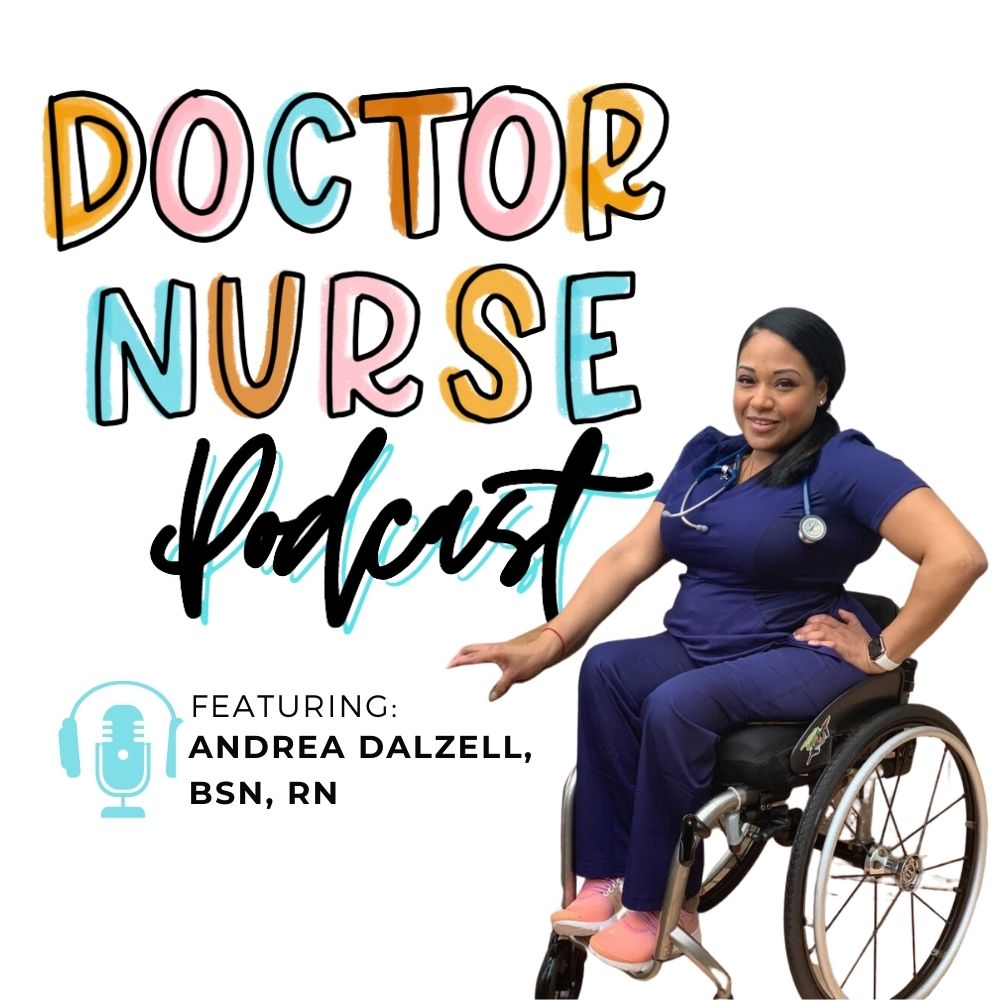
Sandra Pagenta: Dr. Nurse podcast guys. I am so excited about today’s episode. I have Andrea Dalzell. She is a registered nurse, healthcare advocate, disabilities rights, influencer speaker, and most importantly, a survivor guys. I, I just, I am. So pumped for you guys to hear her journey, how she is doing what she’s doing today.
Guys, she’s an inspiration to us all and yeah, Andrea welcome.
Andrea Dalzell: Oh, that is like one of the best welcomes ever. So thank you. I am excited to be here. Hello, All of the listeners
Sandra Pagenta: Well, I am just so excited to just share what you’ve gone through, where you’ve been and more importantly. Where you’re going.
Cause you just got such an incredible trajectory on your life. It’s just inspiring. So explain to my listeners for those again, you guys have listened to my introduction on her. You kind of know where she’s coming from, but where, how do you [00:01:00] see yourself? What are kind of your hats that you’re wearing in your current?
You know, occupational job status.
Andrea Dalzell: So the amount of hats that I’m wearing is absolutely unbelievable at this point in time. Well, let’s start at the top. So main bread and butter is I am a assistant nurse manager at a family care practice in Bronx, New York. I worked out Monday through Friday. Long hours.
Yes. If you follow me on Instagram shameless plug the seated nurse, you will know that I am constantly complaining about these hours. So yeah. That’s number one. The second hat is I am a school nurse consultant for a private school for neuro divergent students who Attend a different setting for school for school reasons.
90% of their kids take about medications throughout the day, and they have different levels of abilities. So therefore we have full nursing staff available to them all day long. And I consult with the LPNs just in case they are unsure and they can’t do as assessments. So I’m their backup. [00:02:00] Or I’ll go into the school and, and, and do IEP meetings and so on and so forth.
The other hat is I am the CEO of my nonprofit, the seated position. I am the founder, the CEO, and we are a nonprofit based out in New York. And we coincide with another nonprofit called the access project where we help people with disabilities get active and physical in space. And the seated position helps them to bridge their educational gaps, whether that’s from high school to college, college, to the workforce maybe the workforce into another type of We helped do all of their educational settings accommodations and making sure that they have advocacy on their side.
Sandra Pagenta: Wow. I don’t even know how you have time for that and to sleep and to someone have a social life and family and everything else. One of the things here at the doctor nurse podcast we like to talk about the journey, right? We like to talk about how nurses get to where they are. I know that the journey for everyone is different and success, isn’t the straight line. It’s this curvy line of ups and [00:03:00] downs. And then you finally get to this spot where you’re like, Hey, listen, look what I was able to do with my career. And this is the journey and the trials to that spot.
So I would really like to kind of hear. Taking us back to what originally put you in the wheelchair as a little girl, and then take us to how you ended up working as a nurse and starting this, you know, the seated position nonprofit and all the things that you’re involved in. I really wanna hear about like, kind of that journey.
Yeah, take me there. Take, take me with you.
Andrea Dalzell: Yeah. So. For everyone. I never wanted to be a nurse that was not my intention. My intention was to become a lawyer. So I Sue my doctors for all the pain that they put me through while I was a kid. You guys hurt, I have transferred to myelitis. It is a neurological issue that happens because of a virus.
I got a virus, it left me with inflammation of the spinal cord. And then I ended up having paralysis Incomplete paralysis from the waist down. So I use a [00:04:00] wheelchair to get around. I’ve been using a wheelchair. Since I was 12 years old and I’ve had 33 surgeries, it’s actually 37, but my number in the head is always 33.
So, I see I’ve had 37 surgeries and during the first set of surgeries, my doctor had to like write me out of the ICU to go to my graduation. And he came with his school. From high school. He came with me with his NP, to my graduation and in my memory book, they both wrote please anything but a lawyer.
Well, if you can’t beat them, you join them. And I was like, I am going to find the cure for pain because of all this pain nonsense, like I’m, I don’t like opioids. I don’t like the way they made me feel. I was constantly prescribed that because I have chronic pain. So I had to figure out how to navigate my world without pain pills.
Because if not, I’m just in bed all day. But then if I don’t have ’em I can’t function. So I was like, I need to be a doctor so I can figure out all of the pain receptors, like [00:05:00] understand, like understand it. Right. So I audited medical school classes in my final year of my biology and neuroscience degree in college.
And in that class, I realized doctors, particularly medical. Not nursing track, medical track, particularly everything is the disease process. So whether you come in as a patient, it doesn’t matter. You are patient a, but your diagnosis is B. You’re always gonna be seen as B. And how B is reacting to your body.
You’re no longer a yeah. So having all of this previous knowledge of being a patient, there was no way I was ever going to roll into a room and say to someone, you will never be able to do this. Because I already know that me putting that pretense onto someone means that they already know that they can’t do it.
And especially coming from a medical professional where this is like, healthcare is trusted. No way I’m gonna tell someone that they [00:06:00] can’t do something. No, there’s just no way. So trying to figure out nursing school. Actually didn’t happen until someone said, well, why not be a nurse?
Like, you’ll be able to be the holistic side of medicine that you want, where you’re more integrated and I’ve never saw someone, any of my nurses have a disability, not one. So I think subconsciously I never thought that I could be a nurse. I did my pre entrance exam. I scored extremely high com extremely competitive for my school.
And it took me a year to actually apply to the program. Why? I then again, subconsciously, I think I’ve never seen a nurse with a disability let alone in a wheelchair. It’s not something that I watched on TV. It’s not. So my, my favorite shows were like, how Grey’s anatomy, you know, like, ER, like I grew up on these shows, so I’m like, I’ve never seen a nurse with any type of disability.
Hello, Shonda Rhimes. If you’re listening, change this . [00:07:00] But let’s think about that. Right. If you never see something, how do you see yourself in that position? So, yeah, you know, I applied, I got in based on my grades, merit based nursing programs are the best. And I got into the program and then. The first day of orientation, the professors are like, we don’t think you could be a nurse.
We don’t think you can. Our, our hospital affiliates will allow you to be there. And, and this is everyday thinking. So don’t, don’t even like, this is not like something shocking, anyone listening, like what do you mean? They, they don’t think you could be a nurse. Well, again, representation matters. So if you’re only used to someone standing.
And now someone’s rolling into the room to get this nursing education. You’re thinking, how could they be a nurse? This is not, you know, it’s not abstract thinking. We’re so used to seeing people who are just standing up, who dealing with very obsolete illnesses in the healthcare field. As if healthcare workers can never get sick.
Sandra Pagenta: So well said [00:08:00] well said,
Andrea Dalzell: right? Yeah. Now let’s fast forward a little bit. I finish school graduate. I get, that I pass the NCL. In the 75 for all of those that wanna know that number. Yes. it doesn’t matter. OK. But I did it in that 75 cause I
Sandra Pagenta: had something to prove cover it.
Andrea Dalzell: I had something to prove the proof was that I had the knowledge, just give me the chance.
Right. So yes, here you go. I fast forward. Now I’m asking them, like, I’m having so much trouble to find a job, 76 interviews to find a clinical position in nursing to know.
Sandra Pagenta: I, I was thinking this when I’ve heard your story before I wanted to know how those interviews went, like
Andrea Dalzell: going to
Sandra Pagenta: do you really? I
Andrea Dalzell: do for all those facilities listening.
Yikes. Yes. I recorded your hiring managers because in New York state. Wow. You only have to have one person know that you’re recording. So, because I thought that I was doing such a terrible job [00:09:00]
Sandra Pagenta: going, cause you had 75 interviews, right? I must be
Andrea Dalzell: the worst. I’m the worst, right? At 15 I’m like, oh my goodness.
Let’s I don’t know if we mentioned this, but I was miss Wilshire New York, which is an advocacy pageant platform. My, I had a, I had a interview coach who taught me how to interview, like who taught me how to speak because I had so much media and press. Yeah. And how to take a pause and think before you speak.
So, you know, I was just always flabbergasted to get to this point of having a conversation in an interview and then never get a call. Something’s wrong. Like, I, I internalized me being the person that was wrong until I realized that it was the disability and them not being able to fathom past a wheelchair, doing something more than they think that they know.
Yeah.
Sandra Pagenta: So how did you get someone to take a chance on you? I guess, like, I, I call it a chance. Like how did you figure that out? What was that interview like compared to all
Andrea Dalzell: [00:10:00] the others COVID hit . Thank you. COVID for the one thing that came out of C. Was one, everybody was remote and two, everybody was scrambling for nurses.
It didn’t matter anymore. Right? Every single nurse was needed across the nation. We needed nurses outta retirement. We needed nurses who could just get on the phone. We needed nurses who could do triage in the hospitals. We needed nurses in the ICUs desperately in the ERs desperately. So here I am with all of this knowledge.
And a hospital system puts up their HR number, begging for nurses. And I reply. And I remember talking to my preceptor saying to her, I’m going to go into this place. They, they are already pushing me through the hiring process. They’re gonna see my chair and they’re going to say no. And she reminded me that on the bottom of every business statement, no matter what mission statement, anywhere, every business has to abide by one thing.
And that’s the E E O C statement. So it means that they’re an equal opportunity [00:11:00] employment, right? They’re not going to discriminate. So if they, the moment they say, you’re not welcome, or they’re going to renew your contract, bring it up. Keep recording, have a backbone fight for yourself. And it was the same, just the encouragement that I had needed to actually do what I’ve already been doing for other people, just for myself in a situation that has never been done before.
So I didn’t even need all of that because I got the job. The nurse educator didn’t say anything to me. I get to the floor. I’m on a clean unit during COVID the first half of it. And I get stuck with a patient that’s on event and the I’m on an ortho floor, which is considered a clean unit at the moment.
And none of the ortho nurses knew how to control the vent that the vent was going off. And they’re calling for respiratory therapy, but again, Mrs. COVID so respiratory therapy is spread thin. Yeah. Your co teams are spread thin, your rapid responses spread thin. So usually you don’t have more than three teams of, of this group [00:12:00] anyway.
So. I go into the room and I was like, I can do it. I have friends who are quads that are on permanent vents. Like I can, I can figure this out. And I go in there and I have vent knowledge because it’s the same vent a friend of mine has. I know what high peak means. I know I needed to get some suction in there.
I know I needed to, you know, loosen her up, pour some saline. Let’s go. And afterward they’re all praising me to the nurse manager. Andrea has vent mal and Andrea knows what she’s doing. They ship me straight to the ICU.
Sandra Pagenta: This thing that you’ve always wanted to do, which they, you, you had been told you can’t do, you were not being allowed to do now.
You’re standing in the room doing it. And you’re like doing I’m here.
Andrea Dalzell: You’re doing, I’m not really standing, I’m sitting, but yeah. I mean the perception though, right? So the perception is, yes, I am sitting in the room doing this you know what I need, I need you to just get.
I want your [00:13:00] listeners to realize, like, there is no real difference between sitting and standing, sitting for 12 hours versus standing. The difference is that I’m not going to hurt at the end of my shift.
Sandra Pagenta: Your dogs don’t bark. Like
Andrea Dalzell: my day, they don’t, they don’t. My body is used to sitting on an air cushion for 12 plus hours a day on a regular basis.
My arms are used to pushing my chair the way I need to go for miles. I did a New York city marathon, 26.6 miles of straight rolling around. I wanna know what nurses doing this and saying that they’re okay at the end of their shift, they. And I get to say, I don’t have to worry about that.
Sandra Pagenta: yes, you are. So right.
Oh my goodness. What perspective you have? After you work in the ICU, you’ve got this contract. You are again sitting in the room, like I’ve, I’ve, I’ve finally arrived. What ends up happening at the indepen of the pandemic.
Andrea Dalzell: So contracts are cut and I’m talking, I’ve [00:14:00] already made friends with the nurse managers on different units.
And I didn’t realize, and maybe I’ll, I’ll edit this part a little bit, but I didn’t realize that the. The nurse manager that I had met on the first night of my contract, she had asked me if I had ever worked a unit before. And the answer of course was through clinicals. Yeah. Yeah. You know, I I’ve been a, a health director for a camp already.
Like I know how to triage. I know what to do. And again, 33 surgeries, 37 to be exact, but. You know, I already know how to run every single pump, an Alais with a polar, whatever you wanna put in front of me. I know how to run them. You wanna do a Hein drip? I probably had three of those already wanna do blood hanging.
I get regular blood transfusions, like, so I have the patient perspective and I know all of that, but now I have the nursing knowledge and you’re asking me if I’ve ever worked a unit. Okay, cool. I literally said to her. HR got me this far. If you have any issues, please go back to HR. [00:15:00] But at the end of the contract, as I’m asking these managers to take into consideration, hiring me, it has to go through this one manager who already has this preconceived notion about my disability on units, post pandemic, and pre pandemic.
So pandemic is pandemic you it’s all hands. But as soon as that’s done, we’re kind of like, oh, thanks for your service. Bye. And I’m like, yeah, now I’m recreating myself again. So I go back to the school. I am school nursing. I get a job as the assistant nurse manager at a family care practice. And I’m like, yes, I can do this.
I can. Run circles around this now. and I did that and then I started my own nonprofit.
Sandra Pagenta: Yes. And so I wanna hear about how you started your nonprofit, how did this all play out? Like what happened?
Andrea Dalzell: On September 10th, 2020, this was right after my contract had finished Craig H Nielsen and [00:16:00] good morning.
America surprised me with a grant for $1 million. I won the visionary prize award for my perseverance and my ability to not give up and prove that even through the worst of times, there’s some type of What is the resilience?
Sandra Pagenta: Yes. Yes. You are incredibly resilient. You’re incredible. You are absolutely incredible.
One of the things that I remember hearing about in your other interview, I was listening to your other podcast episodes. And I remember a line that you said that just completely just hit me right in the middle. In the chest to the heart. And you said why, what I am doing for people that are disabled with my nonprofit and advocating for people that have disabilities and bridging those gaps between job interviews and job options, and allowing them to really get what they need from a system that says that they’re supportive.
Says that they don’t [00:17:00] discriminate, but then discriminates cuz that’s exactly what’s happening, right? Like you’re, you’re saying that like 76 interviews, 75 interviews. Like I wasn’t given a chance even after I was there doing the job, proving that I could do it. I wasn’t given the opportunity and I was discriminated against. You said all it takes is one moment for you to be able to being disabled. Mm-hmm it can happen in a blink of an eye. It can happen with just one single mistake, one single accident, one single, anything, anything, and you could be where I am or, or worse or in different situations.
Mm-hmm . And so. I at that very moment realized that this is important. This is everybody’s fight. It’s easy to separate yourself from it and just be like, well, those, those are her problems. oh, let it happen to you. Let it be that you are in the position. Mm-hmm and. Now you have a very different appreciation for what you have been fighting for.
[00:18:00] And so the award is well earned. You definitely deserved it. And again, I am just. And all and inspired by what you’ve been able to do and now how you’re able to help others and why we all have a dog in this fight. All do like what you’re fighting for is for everyone, you are fighting for humanity, you are fighting for.
Personhood, you are fighting for people to be seen as equal regardless of the disability. I just, Ugh. Thank you to be your hype woman all day. Yeah. I’m
Andrea Dalzell: here. Call me. I’ll take it. but just, just to piggyback off of that, right. Let’s let’s bring it back down into the realm of just healthcare in nurses and I, and I love to.
To talk about this part now is the fact that we chose nursing to be the healing hand, for whatever reason you got into it. Okay. Even if you went into it for money, no, one’s in this for money. So there had to be at some point that healing hand that I need to make a difference [00:19:00] part of you, whether you’re doing it because of a family member, whether you’re doing it because of you, whatever the case is, we join this profession because we care and we give so much of that care to our patients.
No matter what. How is it that we don’t in turn, receive that cure back when they come to our door, asking for a job or asking to be an intern or be in the program or to get into nursing school, because now we’ve already seen their deficit. Now we see it, whether it’s present invisible or invisible, and they’re letting us know about it.
We’re closing the door on the hard work that we put in. We, we heal these people. We literally give our souls to heal these. Every day, post pandemic, even more so now the way we are running around short staffed and, and, and overworked and underpaid and not valued and devalued. And yet there’s a [00:20:00] whole section of, of nurses who have disabilities and chronic illnesses, post pandemic, who cannot figure out how to even get back into their positions because other nurses are now gatekeepers saying, wait a minute, you should take some time off.
Wait a minute. We don’t know if this is gonna work for you, mate. Maybe we should try something D. Instead of allowing them to come back and seeing how that job’s gonna work for them instead of allowing them into a program and working with them to ensure that they can learn how to be a nurse effectively.
And if they can’t physically do it themselves, can they walk someone through it verbally? Because that’s what 9 1, 1 operators do. That’s what police officers do. That’s what fire services do. But yet we’re holding nurses and doctors to a whole different standards. You have doctors on the phone with doctors without borders, across the sea, walking them through procedures on the phone.
They have web cameras, web asking people to get through procedures, but with nursing because of the fact that we’re so physical and we’re so bedside focus. Mm, we [00:21:00] forget that every single one of us belong in this profession, if we choose to be there. Yeah.
Sandra Pagenta: Yeah. Cuz what you’re describing is like this scarcity mindset.
We talked a little bit about this before the podcast and I’m obsessed with this mindset because I believe that I’ve been a victim to thinking of, there’s just a lack of mm-hmm you, we’re all playing a game of spoon. So we all have to grab a spoon and let’s hope you’re not the one without a spoon. You know, you played that game.
Yeah. And there’s always one less spoon. So someone’s gonna be without, and I have started to enforce myself to embrace an abundance mindset of, there are a ton of options. , everyone’s got a seat at the table. Everyone has the ability to do something. And whenever you do not value people’s personhood and they value their contribution to society in whichever way that looks like everyone has a role to play.
Mm-hmm . Everyone has something that they can bring to the table, every single soul on this planet. And if you don’t [00:22:00] open up your hearts and your mind to. Everyone’s got purpose. So let’s find her purpose. Let’s help her. Let’s get her into those opportunities where she can shine. Because again, your nonprofit is how you’re shining.
Someone gave you that opportunity to go now, go shine. Mm-hmm and you’re like running with it. And I just think it’s so beautiful that even though people that were trying to hold you down and stop you from doing the thing that you knew you were meant. To do on this planet. Like you were meant to do this Andrea on this planet and you are moving in your purpose.
And I think that’s, what’s so inspiring to me is that you are moving in your purpose and you’re letting no one, not your, your disability, not your in fact, I feel like, I feel like your disability has become this now. Beautiful badge of honor that you get to wear and say, I am qualified because of this.
And it is again, just something that as I’ve heard you listen, and I’ve heard of a listen to your podcast episodes, and I’ve heard you talk today. Just keeps [00:23:00] reverberating in my mind that you are meant for something that’s specific for you that only you can fulfill. And every nurse is in that spot, regardless of disability, regardless of your past, because we all have a disability.
Mm-hmm we, I deal with things that you don’t deal. Exactly that are specific to me that are problems that every month I have to, I have to get, I have to get imaging every year. That again, I don’t really talk about my own personal health issues, but I have health issues that I actually have to get looked at every year.
I have to have evaluated. You don’t have to deal with necessarily what I’m dealing with. No, yet I can’t let that hold me back from my purpose. Like you just can’t. And so. I love that. I love that so much. And I want that to just reverberate so much in this podcast episode and for every nurse listening that you have something that you’re supposed to do, that’s specific for you.
Andrea Dalzell: we were talking a little bit before all of this, like, you know, just with people with disabilities in general, when you think about their rock bottom, their rock bottom is giving up their complete [00:24:00] vulnerability to someone else and hoping that their, that the trust that you’re giving them in your most vulnerable state will be respected and, and, and given a chance to, to grow and heal and, and figure out what life looks like.
and at my most vulnerable there’s multitude. We, we, we go through our vulnerabilities very differently, but my vulnerability is very visible. I can’t hide, rolling into a room. I, I can’t hide my disability. And when you can hide your disability, it it’s another pressure to be able to say it to someone and hope that they believe that what you’re asking for is actually needed.
Oh, I don’t really see you that sick. Oh, you’re not really that way. Oh, I don’t really, what is this coming about now? Like we question people’s health in, he. We question people’s ability in healthcare forgetting that technology has gotten us to this place. And to this point in time, that opportunities are literally endless to the point because technology is just moving in advancement farther [00:25:00] than we could have ever imagined.
And when you think about like, oh, you got discriminated against, you should have filed a. No one blatantly told me they’re not going to hire me because I’m sitting in a wheelchair. No, one’s going to do that. That’s not how it works. You don’t just get to file a complaint because you don’t get the job.
Yeah. You know, I have to be vulnerable. You have to allow for someone to think outside the box and I can’t force you to think that way. All I can do is give you the information and, and hope that you look at it from my side of you, where you’ve given me the opportunity to live. 37 surgeries is not a small feat, 37 surgeries means that there’s 37 different or staffs that have been in, in my care.
There are 30 different PACU staff that has been in my care. There’s 37 ICU staff that has been in my care. And, and that’s just pods, right? 37 pods because it’s 37 surgeries. And out of all those teens I’m living today. Successfully in my own role because whatever [00:26:00] success means to me may not be what success is for you.
Yeah. And I’ve come back to give back to a profession that has given me something and to constantly have to face a barrier is not fair to someone who’s coming up behind me, who has seen me get to this successful point in life, who, who sees what I’ve accomplished as, successful, and now trying to go that route and getting the same blockade that I.
How, why are we there? What happens to you guys when, when your backs are hurting from lifting that 300 pound patient, right? And, and you you’re now you slipped the disc, you, something has happened. Yep. And now you can’t get accommodations to get off whenever you need to. Because again, we associate healthcare with being synonymously healthy, and we equate disability to being synonymously, unhealthy.
And those two things don’t actually happen.
Sandra Pagenta: Yeah. You never think that they intersect, no. You never think that healthcare workers, and again, you almost have to do that when you’re [00:27:00] practicing as a nurse, you have to kind of disassociate like, well, that’s, you know, and the problem is we are so much more vulnerable than we think we are.
And I, and I never thought about what you just said that. That you are where you are because of the system. And yet the system is now saying, well, yeah, sorry. We’re not gonna give you any chances. It’s like, wait, wait, but I’m of you
Andrea Dalzell: believe in your skill to get.
Sandra Pagenta: Like, you’re just again, blowing my mind cuz it’s so true.
The hypocrisy of just that whole system it’s like, this is so hypocritical. Like you helped me get here with 37 surgeries. 30 said 37, right? Wait 30. Yeah. 37. You only count 30. Yeah.
Andrea Dalzell: I only count 33 but 37 in actuality.
Sandra Pagenta: And yet now you’re like, you can’t do this. This is what you can’t do. And again, not only have you done it, you are now reaching back and helping others.
And so. I feel like your whole journey has just been this uphill [00:28:00] climb that you’ve just conquered thing after thing after thing. And I like to ask people what was one of maybe the biggest challenges that you had to overcome in your journey? And if it can be like one specific moment that you remember just being like, oh, this is it.
Like, have you ever had a moment that, or, or maybe you never have that you’re just so incredibly resilient that maybe you haven’t, but maybe there was a moment in your, in your career as a nurse that you were just like, this is it like. I meant you or no? No, like I’m not gonna make it. Oh, and yeah. You then fought through like you pushed through.
Oh yeah.
Andrea Dalzell: I was going to fail my last semester of nursing school. I had already failed one class of pharmacology. You guys who messed up with pharmacology? Pharmacology is not our jam. Okay. I messed up in pharmacology, my, my, my first year in nursing. And I had to repeat the class and you’re only allowed one fail or you, you know, it’s one fail, one drop and that’s it.
Yeah. So I already used my fail [00:29:00] and I am in my last half of nursing school getting through maternity and I’m failing. Everyone is getting nineties in the class. I don’t understand what I’m lapsing. I’m doing really well in clinical. I am. Yeah, I, I, I don’t know what to do. Second test comes. I fail that test.
The third test comes, I am below what I need, so I would’ve needed. There’s 150 question final. They told me to drop. Everyone told me to drop. The professor, told me to drop the clinical professor, told me to drop. She actually begged on my behalf to figure out some type of like extra credit, because I was so great as a clinical.
Peer that she was like, no, there’s no way. The, the Dean of the program called me into our office, pulled me outta class, called me into her office and told me that she would give me two days past the deadline to drop the class. That’s how badly they wanted me to be like, do not go through with it.
They really thought I was gonna fail. And I was like, in some ways it [00:30:00] was the encouragement to drop and not fail out because they wanted me to pass. And in some ways it was more yeah. Which is kind. Yeah. Yeah. Which is great. And then in other ways, it’s like, You know, your tests are really bad. So can you stop because everyone is passing because they have test banks.
So sorry for my class. I’m out in all of you guys. And here I am trying to like, actually understand what it is that I am learning because I can’t afford to mess up. Yeah. The pressure that I had on myself was I should probably drop, I should, I should give it up. And I was literally on my way up to the Dean’s office on the second day, before five o’clock and upperclassmen saw me and said, what are you doing here?
You’re not supposed to be here. And I said, I gotta go drop a class. And they were like, aren’t you graduating this year? And I said, yes. And they were like, come to the nurse’s lounge. They said, what do you need? What do you have? They wrote out, I still have the picture. It actually gives me shows. They wrote.
All of my tests. They did my average. They told me what I needed to get. I needed to have 80 questions right on the final in order to pass the class with a [00:31:00] B minus. Oh, so they were like, what are you gonna do with that information now? Like, don’t listen to what the Dean says. Like, we know you’re gonna go drop your class, but you only need 80 questions out of 150.
You can do this. And I took the lead because the upperclassmen believed in me so much when I didn’t believe in myself anymore. I was like, everyone around me is telling me to drop. I need to drop. Right. Don’t, don’t give up this opportunity. And. If it weren’t for those upperclassmen, they didn’t know me. I wasn’t in their class.
I wasn’t in their cohort. I didn’t go to clinicals with them. They’ve never seen me operate before, but had it not been from them, I would’ve dropped because I would’ve listened to everyone. Else’s no, for me. Yeah. And I’m so adamant now on listening to my own. Yes. That those upperclassmen really gave me back my, yes.
To say you can do this, just put in the work two weeks. You have two weeks until the final. I called another one of my friends who was already a nurse. And she went through over a thousand maternity questions with me in two weeks. We did [00:32:00] almost 150 questions a night, almost dependent. Yeah. And went through all the, everything.
I watched all the videos. I was on YouTube nonstop. I maybe got four hours of sleep during that timeframe. And I, I passed. I passed. And that was just believing in me enough to say, I can get through it when even at a point in time, everyone else was saying no, and I was falling into that trap of no, like give it up.
You can have another chance and, and I’m not gonna negate having another chance. I could have taken that drop and I could have excelled through that. And if I had failed, it would’ve been terrible, but I took the chance on me. So you have to kind of always bet on yourself and not allow someone else to dictate your move.
And if you need to take that break because of whatever’s happening, then take the break. So for nurses that are hearing the story and, and thinking, oh my goodness, like, I don’t know if I would’ve been able to go through that test and take the drop. [00:33:00] You have it. If you have to extend your time so that you understand the material, then do.
I just knew what I was capable of in that moment and the resources that I had and the fact that those upper classmen really just motivated me enough to give it my all, instead of just. Allowing for the backtrack and saying, I’m just gonna extend my time. I would’ve probably just taken the drop and I don’t know where I would’ve been.
I would’ve probably failed two, three exams again, and I would’ve been suffering at the end, so yeah, who knows, but I knew to bed on myself. So I did. Oh,
Sandra Pagenta: I love that line. I knew to bet on myself. So I did. I mean, that is, that’s what life is about. It’s just about giving yourself a shot to go after your dreams.
And not again, like you said, if you needed that drop fine, but there’s likelihood it there’s. I think there’s a high sense of when someone gives you hope mm-hmm and you have that sense of like, I’m holding on to this, because this is the [00:34:00] last string I got mm-hmm and it better not break. I’m gonna bolster this string and tar on my way across it.
You just do it. And I just see that word picture when you’re describing that of like, this was the last string and I just went for it and I just think that’s so great. And Andrea, one of the things I like to talk about, because I notice that nurses in particular, I’m sure nurses with disabil. They even have less resources for mentorship, people that, again, like you said, talk about, you talked about, you have talked about representation, right?
Seeing someone doing it. And again, that’s the heart of the podcast is that self efficacy. Is that idea that you can do it yourself, right? Mm-hmm and you believe that you could do it because you’ve seen others do it. Right. Mm-hmm there terms that we’ve understand is so to be true.
Have you had anyone mentor you and I know that you do mentor you’ve mentored other nurses that have been in similar situations that, you know, you, you found yourself in kind of describe to me if anyone’s mentored you and then if not, [00:35:00] yeah. Like how you’re mentoring, cuz I really think we need to do more of that as nurses.
AndreaDalzell: Yeah. So a mentor without mentors is. Not a mentor. That’s one. Let’s put that out there right now. If you’re a mentor out there claiming that you’re a mentor and you don’t have multiple different mentors, you’re not a mentor because you can’t just have one mentor. You need to have a collective of mentors, guiding your thought processes and allowing for you yourself to figure out the path and how you then can, can transition for someone else.
Right. So let’s put that up there. And then also coaching coaching is different than mentoring. You pay for a coach to get you to the next spot. A mentor can just give you advice, right? Or you can pay for your mentor too, and they can be your life coach. Hey, whatever works. Yes. I was blessed to have. A multitude of mentors come through for me at different points in different aspects.
One of them, me George Gallego, who is a partner of mine right now for the nonprofits. He started the nonprofits will [00:36:00] wheels a progress, which partnered with access project. And now I’m here with the seated position and access project. So we and he partnered me from the very beginning when I was. In biology class in nursing, you know, before nursing school, being this wheelchair, New York how to be poised, how to, how to like really give you those hard hitting questions and get the answers that you need.
And he kind of navigated my world in disability. Then I have like Tiffany Gibson, who’s a part of new nurse academy, shameless plug for her. She’s amazing. She was the one that told me about that. E E O C statement. She was the one that told me how to be a leader in nursing. She was the one that taught me about emotional intelligence and disconnecting my feelings about my disability and what someone is saying and trying to take what they’re saying and feed them back the education that they know.
Yeah, right. You know, all of this, you know how to treat people, you know, how to care for people. How are you caring for someone with a disability? And then is that person coming back and asking for a job in three years because of your care, how do you, how do you navigate that space? [00:37:00] So TIFF Gibson did that for me.
And then now, like, Katie duke is another one. When I was so adamant about the hospital setting and going through the interview process, Katie was the one that was like F the hospital. You don’t need that. You can go anywhere. Like you can do anything. Like we know that nurses are saying that you have to be in med surg.
She was like, you don’t need to do that. You can do anything. We can figure it out. And, you know, so, and, and a multitude of other mentors that I am not mentioning, but. Have definitely come into. Oh no, there’s one that I have to mention. Dr. Gloria Ramsey. She is a wheelchair user who is a nurse who probably graduated in the, I think she graduated in 1980s or late 1970s.
I speak very highly of her because of the fact that she may act, I may have found the first. African American woman with a disability. She to go through nursing school and to become a nurse and now a JD.
Sandra Pagenta: So he’s a lawyer.
Andrea Dalzell: Yeah. Wow. She works at John’s Hopkins in Maryland. And I believe she just retired or she, she just finished, but I met her like three years ago and she has been.
The epitome of mentors. Oh, simply, simply because I never saw another African American female nurse that uses a wheelchair that went through the clinical process that has made a name for themselves. And here I was thinking I’m clearing a path and I don’t know how to navigate this. This path, no one else knows how to navigate this path for me.
And I found someone that’s already navigated to the point where she now knows the laws behind it.
Sandra Pagenta: So what did she teach you? I wanna know, like what was been a nugget that you’ve been holding on from conversations in time with her? So she’s
Andrea Dalzell: in education and I just finished my master’s in, in nursing education.
So
Sandra Pagenta: both, both done congrats.
Andrea Dalzell: Right. Thank you. And, and you know what she’s always told me. [00:39:00] She’s like, and, and it’s something that I’ve already said is like, if you can’t beat them, you join them. I can’t beat all of these nurses who are gate keeping and thinking that disability is the end all be. right. I can’t, I can’t beat them.
They already have this mindset they’re in they’re CNOs. They’re they’re the they’re corporates. They’re they’re everywhere. Yeah. What I can do though, is create the path for someone else to pick up and keep speaking on it. She’s been dealing with this since the early 1980s. I’m dealing with this now in, in 2022, that’s a big problem for it to be over 40 years of the same issues happening.
But her words to me were to keep continuing educat. Because education is what changes the way things are. And I never, so are you done? I never, are you done with your
Sandra Pagenta: master? Are you done
Andrea Dalzell: after the master or where you going? No, I’m going for that. Okay. So right now I am actually considering my NP instead of doing my DNP, just because I have to fast track some things I would like to do with [00:40:00] my nonprofit.
It’s a huge issue for people with disabilities that have primary. And I feel like NPS can fill that gap and really do focus based assessments for these individuals that can actually get them the resources and the care that they need. So the only, the only way for me to do that is to get into NP. I already finished my master, so it’s a year extra to do my clinical side.
And Gloria wants me to create a completely different focused assessment, particularly those who have spinal cord injury and illness.
Sandra Pagenta: That is incredible. Yep. Very cool. So you are gonna do what she told you, keep getting education and listen,
Andrea Dalzell: if it’s, if that’s what it’s gonna take to change, maybe when I’m her age and I’ve created this focus assessment, and now people are coming in the ER with spinal cord injury and illness, or they’re in the ICU, there’s a different type of assessment that then gets passed on to their primary care.
That knows what their baseline was in the ICU that will then follow them throughout their life, and then figure out what [00:41:00] aging with a disability looks like. So we can stop the stereotypical narrative that everyone with a disability is equal to a death sentence.
Sandra Pagenta: You have a unique.
Purpose that, you know, and I feel like you keep discovering what your purpose is. Like you find one and I’m like, she’s done. That’s it. She did her. You’re like NA nah, no,
Andrea Dalzell: there is.
Sandra Pagenta: It’s just, you’re like, you’re just like this evolving thing of just all right. Okay. I’m here now. I’m over here. Okay, I’m doing this and it’s so good for the soul. what you’re doing is good for the soul, because it allows you to be hungry for life. Yeah. It gives you a zest for what’s next
Andrea Dalzell: and oh, but I’m tired. Guys, I’m tired.
Sandra Pagenta: I need any help.
Andrea Dalzell: I need all the allies I could get. I know,
Sandra Pagenta: working full time if you could go back and talk to Andrea on that first day of nursing school, she’s rolling up first day and you could tell her something [00:42:00] that you would’ve liked to have known from the beginning and something that you would tell her toss. don’t listen to this. This is garbage.
Okay. Yeah. What would you go back and tell her if you could given everything that you’ve gone
Andrea Dalzell: through? Well, I didn’t know it at the time and you guys just heard me say it and it’s something that I’ve I live by now. It’s listen to your own. Yes, there’s a million nos, but your yes is the most important. So if you believe it for yourself, let no, no deter.
You. Wow.
Sandra Pagenta: So that would be one thing to hold on. What about a thing to toss or I guess you’re kind of toss the nose and keep
Andrea Dalzell: the, and keep the yes. Keep the, my, yes, my it’s always gonna be my, yes. Right? So like’s so long as you believe in own ability. You have to believe in yourself. And people’s, it’s very cliche to say, but you really have to believe in your own ability.
So for someone like me, who has a spinal cord injury, who [00:43:00] uses a wheelchair every day, I’m navigating my space and I have to think 30 steps ahead. There’s a step to the bathroom. If I slip, is there something next to me that I’d be able to get back on my chair? Okay. Is the handle down? Is my chair seat there?
If I’m getting in my car, do I have all of everything that I need because I can’t just roll back in or run back into the house, right? Like there’s always. A process and there’s always going to be a process. So yes, those are my daily processes. Now, when I’m facing the world, there’s always gonna be obstacles, whether there’s crossing the street and there’s no curb cut, whether I’m going to interview and it’s not wheelchair accessible, whether I am trying to.
Teach a class and, and no one is understanding directly what I’m talking about because disability doesn’t relate to them. Right? The most that they’ve had disability relations to is to a grandparent. So there’s always something to navigate, but as long as I am okay with saying, I can do it and [00:44:00] navigate the inaccessibility, navigate the, the bias, navigate the, the pathway that I want, then yes, I’m gonna do it.
And if I don’t want. Then it’s my no. And I can say no
Sandra Pagenta: well said, Andrea, this has been so much fun. And the last part of the interview, I go through rapid fire. Right. So I just hit ’em hard, super fast. Are you ready? Let’s go. name. I feel like you’ve told me this. Okay. We I’m gonna go here.
What age is the best age to be to you?
Andrea Dalzell: Oh, 30.
Sandra Pagenta: 30 interesting, 30, 30, 30.
Andrea Dalzell: Cause you, cause you’ve partied you’ve you understand party life. Now you understand adulthood. And this is the shift where you literally get to make or break the rest of your life. You get to decide, okay, I’m gonna have kids. I’m gonna settle down.
I’m gonna work until I’m 55. You get to now make this plan of action. Twenties. You’ve already discarded. You went to school. Yeah. You gave some time up. You’ve parted your life away. 30. You get. Literally change your entire trajectory. You can change it whenever you want, [00:45:00] but 30 you’re not partying until three o’clock in the morning anymore.
You can’t wait hundred percent. Your handovers are way worse now
Sandra Pagenta: so tell me, what’s your favorite holiday? Christmas? Ah, everybody tells me Christmas. I am so into July 4th. So like, I feel like I’m waiting for someone to be like July 4th. I OK. You know what?
Andrea Dalzell: All right. All alright. Chinese new year in China.
Sandra Pagenta: Oh, you went to China. I’ve never been to China, but I watched their Chinese new year on like YouTube. It’s lit. It’s lit like their fireworks are nothing like our July 4th fireworks.
Andrea Dazzel: I say, I dunno. I think I wanna go Asia for the fireworks. So funny. I love Christmas cuz I love to give gifts. I am a giver.
It is the way I show my love language to someone like oh, so yeah, Christmas is my, I need to see everybody’s face light up. I don’t even care about my gifts. Like.
Sandra Pagenta: Okay. So I feel like this question I’m very interested to hear. What are [00:46:00] you most grateful for
Andrea Dalzell: in the whole wide world? My mom. Hmm. I know that.
Oh my God. Little heart brain. No. Yeah. Okay. So both are my parents, but my mom, particularly because my mom is from Venezuela. She came up here from Venezuela. My dad requested for her to come up and they got married and. When they got married a year later, they had me. And then five years later, I have a diagnosis that they’ve never heard of.
They’ve never dealt with. No one in my family has any type of physical disability. And here, my mom is trying, she was the breadwinner of the household at the time. And here she is struggling to maintain that working mom status in an interior design firm while her child is going through major. Surgeries and rehabs and, and, and sicknesses and hospitalizations and all of the above.
And she juggled it all with two other three. There’s three of us total, and she juggled it all my entire [00:47:00] life. I have watched her fight tooth and nail for the thing with my insurance to get me things that I’ve needed. I’ve watched her cry when she thought I didn’t see her going, crying over things that I have been through and just.
Yeah, no, she’s a, she’s the faith. That’s it. That’s mom give it to her’s she’s the OG. That’s it? That’s it. Oh my goodness. There’s no me without her. This personality is all mom. This, this tenacity is all mom. I was gonna together her say
Sandra Pagenta: I think this is, yes, this is from mama. This is from the Latino mama.
And that’s it. so I have a Latino mama. She will tell me on any day I can do so I can’t do it. She’s like, what do you mean you can’t do
Andrea Dalzell: it? What does that mean? Don’t I never, I never raised you. What is never raged you with that word? What does that mean? Did you try?
Sandra Pagenta: Oh my God, we have the same mom. Yes and in the time she drives you nuts.
And then you realize when you walk away, She’s right. Yeah. She’s she’s gotta go do it. You gotta,
Andrea Dalzell: you just gotta suck it up. You gotta, you [00:48:00] gotta, you gotta face the fear conquer, like, you know, for all the fear, it’s not really fear. Right. It’s just the absence of courage. And we just have to find that part and my parents being immigrants in a country for the first time and having a child with, with a disability and having them navigate a system that they’re not even really clear about, you know?
Yeah. That that powerhouse is to them. I give them all the kudos it’s to my parents. And I thank them daily for making me the rebel that I am today. I had to fight them tooth the nail to be the person that I am too. Cuz they were so protective of me. Right? Like think about your parents. Your parents are no gonna be super protective.
They don’t want you to get hurt. They don’t want people to hurt you. And, but you gotta kind of find that voice. And I used to tell my mom all the time, but you can do it. Why can’t I .
Sandra Pagenta: Yeah. And she’s like, oh God, I raised that. That’s what I did. I mean, I’m a mom now, right? Yeah. So like when my son does something, I.
I can’t be mad cuz I would’ve done the same thing. Right, right. I can’t be mad. Andrea. I just think you’re [00:49:00] great. I really do have a huge fan. And thank you for coming on to the podcast today and sharing your journey with me. And I feel like we’re kindred spirit. We are partly because we’re both Latina and your curly hair and I just love your whole energy and your vibe.
So thank you for coming on and, and talking with my audience.
Andrea Dalzell: Yes. Thank you. So, so much for having me guys. Thank you for having me listening.
Sandra Pagenta: yes. And I’m gonna link all your stuff in the show notes so they can find you. If they’re interested your website, Instagram, I’ll put you everywhere and yeah. So that they can check you out, cuz you are definitely worth checking out.
Ooh. And yes. All right. Thanks for coming on guys. And, don’t forget to enjoy the journey.
Podcast Description
This week on the podcast, we hear from Andrea Dalzell who is a registered nurse, healthcare advocate, disability rights influencer, speaker and most importantly, a survivor. At the age of five, Andrea was diagnosed with transverse myelitis, an inflammation of the spinal cord that causes pain, muscle weakness and paralysis, and she was using a wheelchair full-time by twelve years old.
Inspired by her experiences with nurses, she received her nursing degree from the City University of New York, College of Staten Island. Andrea became the first registered nurse in a wheelchair in the state of New York, and she devotes her career to helping others with disabilities live healthier lives whether seated or able-bodied. Andrea was crowned Ms. Wheelchair New York 2015, and utilized her title and platform: “Life, Liberty, and the Pursuit of Access,” to promote her message and belief that people with disabilities can live a fulfilling life. As an advocate and activist, she has won national recognition over the years, including being named New Mobility’s Person of the Year (2021) and the inaugural Craig H. Neilsen Visionary Prize Winner 2020. She has also been featured in Unite Spinal, HomeCare Magazine, Apple’s iWatch campaign, Yahoo, and Forbes.
And since I have you here… I wanted to tell you about one of my affiliates. As you know running and operating a podcast requires time, money, and energy. By creating relationships with other companies I hope to provide you with good resources to help your career, studies and life. I am newly affiliated with Picmonic!
Andrea’s Links:
https://www.theseatednurse.com/
https://www.instagram.com/theseatednurse/?hl=en
Doctor Nurse Podcast Links:
Picmonic covers thousands of hard-to-learn facts and topics, to help you master the material that healthcare students often struggle to learn. This study system helps boosts nursing and nurse practitioner student’s confidence and grades. Picmonic learning system students increase retention and test scores. Why does Picmonic work? Years ago, psychologists and education researchers found mnemonics to be an effective tool in increasing retention and memory recall. Today, lots of different strategies for learning and memorization using mnemonics exist including keyword, phrase, music and image mnemonics. Using the idea of image mnemonics and applying clever pictures and humorous characters tied together with story and audio — and put it online to create the ultimate studying system for retention and memory recall.
Use code DOCTORNURSE for 20% off your subscription.
Thanks for hanging out with me! Enjoy the episode this week linked below!
Latest Episodes
Doctor Nurse podcast brings you weekly shows to help INSPIRE, EDUCATE AND EMPOWER nurses with true stories of initiative and impact.
Doctor Nurse podcast brings you weekly shows to help INSPIRE, EDUCATE AND EMPOWER nurses with true stories of initiative and impact.
Latest Episodes
Doctor Nurse podcast brings you weekly shows to help INSPIRE, EDUCATE AND EMPOWER nurses with true stories of initiative and impact.