Also Available On






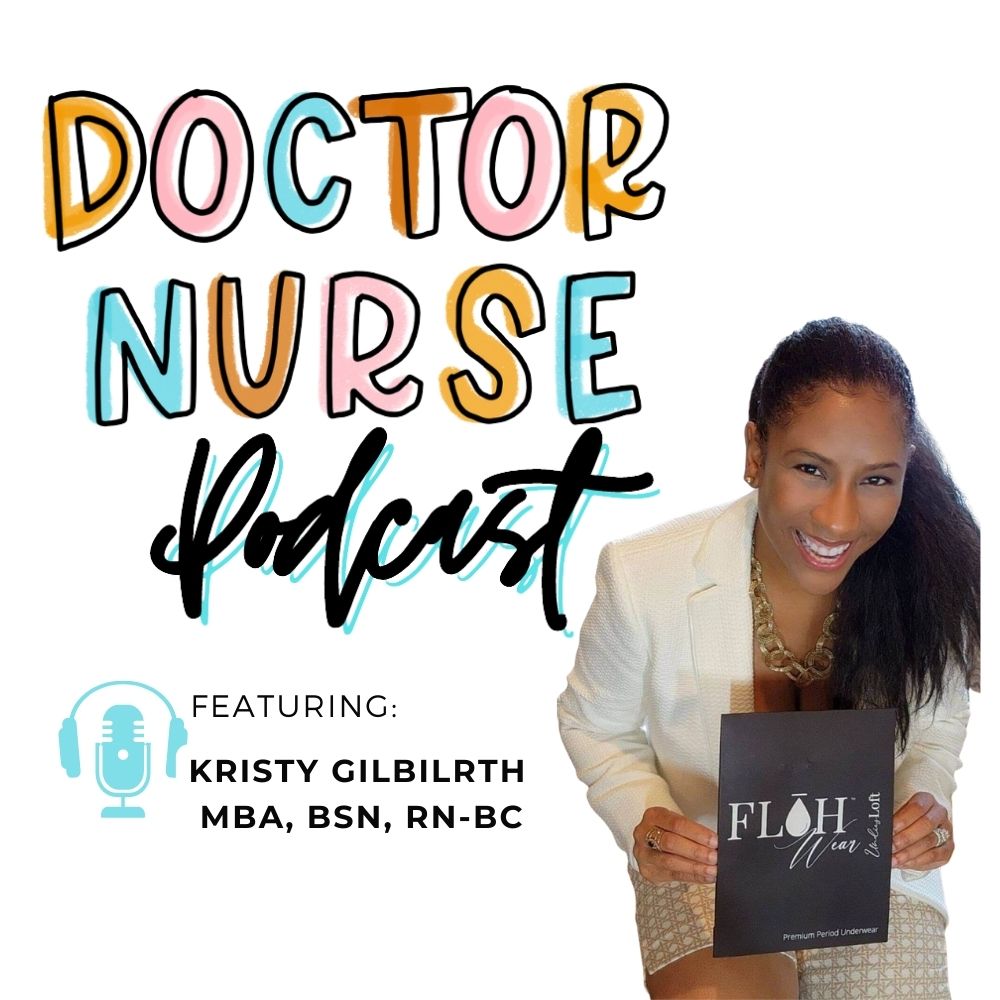
Dr. Sandra Pagenta: Welcome to the Doctor Nurse podcast with Kristy Gilbilrth. Also known as the menstrual maven, and she is a military veteran and a licensed registered nurse who is passionate about women’s health below the belt health awareness and health disparities.
So she started her career working in the military in the US Navy, and she has a background as a foreign nurse. And she decided after earning her MBA that she wanted to take your clinical skillset and marry them with leadership training for the military. She went into the corporate world and then has now moved into her latest role, which is nurse entrepreneur.
Which she launched Flow Wear by Undies Loft, which is her company that makes underwear that absorbs periods postpartum and mild bladder leaks. So I am so happy to have you on Christy. Thank you for coming on.
Kristy Gilbilrth: Thank you so much, Sandra. It’s a pleasure to be here. I I appreciate being here. But yes, all of those things that you shared about [00:01:00] me are true. . I didn’t pay Sandra
but but yes, absolutely. I, I think the, one of the best things about being a nurse is the, the wide options that we all have to be able to go into different things. And for me, nurse per was definitely A path that I saw for myself, just based on my, my desire to have always been an entrepreneur, but also marrying that with, supporting people, educating people in a way that.
Is game changing, life changing when it comes to navigating the healthcare system.
Dr. Sandra Pagenta: Yeah. That’s really great. And again, I’ve described kind of what you do, but how do you see your career, your job title? Like what, what would you say? Like when you introduce yourself to people, you’re like, Hi, I’m I’m Christie and I am.
I am the what? Like how do you introduce yourself? I am.
Kristy Gilbilrth: Yeah, absolutely. That’s such a great question. I, I’m still working on getting used to saying I am the founder and CEO of Lower Loft. , [00:02:00] I, I am and in I find that as nurses it’s so easy to lead with. And I’m a nurse, , and or I, I, I work at the hospital or , whatever it is.
But no, I, I am the founder and CEO of Flow Wear, and I’ve put in a lot of blood, sweat, and tears to be able to call myself. That as it relates to getting this business off the ground. And, and making a, a brand name that people recognize.
Dr. Sandra Pagenta: Yeah. That’s fabulous. So tell me a little bit about how you got to this specific spot.
I know you’re a military veteran right out of, sounds like you had told me earlier before the podcast. Mm-hmm. . , right outta school. You kind of worked that career and then moved into nursing and then Yeah. Worked into your MBA and then the business. So again, just kind of briefly walk me through that journey that you went through to get to this spot that you are today.
Kristy Gilbilrth: Yeah, so, I did, I went to the military right out of school. And I served five years active duty and at the only military installation of its kind in [00:03:00] the world for the United States Navy. Go Navy, Beat Army.
Dr. Sandra Pagenta: I was waiting for that.
Kristy Gilbilrth: And I, I earned my MBA at the time, so Oh, wow. It, it was, it was during my time in earning my MBA that I realized for sure that, , I definitely want to go into business for myself. I grew up in a family where entrepreneurship was, was not unheard of. And having that as a, a role model to be able to see my, my grandfather, who was the first person of color own his, his own, I’m gonna say brand name, but brand name billing station in town.
Unheard of, for me that, that was huge because, , my grandfather was orp. And then my grandfather at, at that time, the unheard of was orphan, went to college, graduated college, started a business, was a successful business man. And so having a legacy like [00:04:00] that to tap into and, and do things with him as it related to watching him build this business and, and, and The administrative part of it.
I always thought, man, that’s, That’s so cool.
Dr. Sandra Pagenta: So you got your bachelor’s in nursing and then your MBA all while you were in the military?
Kristy Gilbilrth: Yeah, yeah. So I got, while I was in the military, I got my under, I got an undergrad in healthcare management as well. So I’ve got healthcare management bs and then I’ve got BSN in the MBA.
Gotcha. And so, yeah. Yeah, so it was after. I got out of the military, I was told I would be more competitive for program that I really wanted to get in military wise if I had an mba. So I got out and pursued my mba. Sure. And then , as, as things kind of kept going, I realized, , It’s not bad being out here in the civilian sector.
Yeah, this is, this is not such a bad thing. , I, I did my five years and it was good, but I think I [00:05:00] can hang out here in the civilian sector a little, a little while longer. And so that’s exactly what I did. And I’ve not looked back, but, , along that path in doing that, I also recognize there are things that innately.
I could never do in the civilian sector. One of them is being a, working for someone else and being able to build a business that makes a difference for other people. And so as it relates to flow wear by Andy’s lot, , that really came out. As a realization for me, as an epiphany, if you will, as a result of my own personal experiences with my own below the belt health.
And I, I share on my website my story about uterine fibroids and detailing how one particular instance led to me saying, okay. This is crazy. This is absolutely crazy. I cannot, go into a client’s office and literally [00:06:00] walk in okay. And then stand up and have left literally a CSI situation on their brand new white leather chair.
And then have somebody pass me paper scrub. Over a public bathroom stall so that I can walk out in high heel shoes, to my vehicle in pouring rain, which is exactly what happened. And I just, I remember feeling devastated and humiliated and embarrassed and how can I ever show my face, to these people ever in life again?
And as I drove home, Which was about an hour and 15 minutes and pouring rain in between, tears in the rain, pouring rain as well from your eyes.
Dr. Sandra Pagenta: Yes, absolutely.
Kristy Gilbilrth: I was, absolutely, I was. And praying that I wasn’t soaking through the, the provisions that were provided to me by one of the office staff, who recognized that I had an accident.
And thinking to myself, I, I [00:07:00] cannot, This is, this is not something mentally I can handle on a regular basis. And, and no one should have to experience what I experienced ever. And so as a result, that was the, the impetus of, of flow whereby on’s lock, And you said, you said something very poignant to me, which was, That’s very traumatic and and it’s, I always thought of it as, , gosh, that was a hellacious experience, but it, it was, it was traumatic.
And out of that trauma as, as we had discussed out of that trauma was born. , an opportunity for me to serve other people and provide a platform to, to educate other people to still use those nursing skills, to talk about below the Belt health, to support people in advocating for their healthcare and hoping, hoping to narrow the gap.
In, in the little bit of in, in the smallest amount that I can do via my platform, narrow the gap as it relates to [00:08:00] disparities as well. Women, people born as female, people with uterus, as , oftentimes we, we talk about our concerns below the belt and they don’t get heard. I, I recall the start of having heavy menstrual periods, gosh years prior to this incident.
And what I was told by my clinician provider at that time was, Oh, it happens as you get older. It’s no worry. Oh, it’s no worry, huh. And I knew better. As a licensed registered nurse, as a clinician, yeah. In my mind I knew better. But there was also a part of me that just didn’t wanna realize what other possibilities there could be in one of those being uterine fibroids.
And I fit the perfect framework of an individual who would be diagnosed with uterine fibroids. And sure enough, I was, and , I [00:09:00] did not have the. The great experience of having a laparoscopic procedure. , I was, , full, laid, open, like c-section without a baby, type surgery, major surgery, and woke up and was told, Hey, we didn’t get everything.
And oh, by the way, , if you wanted to have a baby, it’s, it’s possible, but you may not be able to carry a term. Wow. And, and. Oh yeah, you’re gonna need a hysterectomy at some point. So just so .
Dr. Sandra Pagenta: Devastating to hear those things. How old were you when you experienced this?
Kristy Gilbilrth: Oh gosh. 37. 37. And this is, , we have been trying, my husband and I have been trying to have a baby, for years.
And , so you get to this point of where you’re dealing with your below the belt health and you’re, you’ve got knowledge on your own, right? Just, just by, happenstance of being. A clinician yourself, but there’s a part [00:10:00] of you that I think that’s just very human that we can all relate to that you hold out.
Because you, you hold out hope for your own patients, right? And why wouldn’t you hold out hope for yourself as it relates to something that you want, like so much. And but the reality’s set in that, okay, we, we have to make moves, , we got, we gotta make some decisions. And so for me, IVF was one of those decisions.
And IVF did. Help my issue with uterine fibroids or heavy menstrual periods. It just kind of added on another layer of complexity for, for me and, and, and for my husband. But at the end of the day, that, that route didn’t work for us. The IVF route did not work for us, but I, I’m a firm believer that, , everything is ordered.
Anyway, everything is ordered anyway, so things are happening or happened the way that they were supposed to happen, and but it’s brought me to the point now where I can [00:11:00] ensure that other people like myself have the information to advocate, know how to advocate, know how to have conversations, that are not adversarial with.
With their providers. And then for those who have biophysiological challenges below the belt, like heavy periods, postpartum bleeds and, and mild bladder leaks, to be able to provide a product that that supports, that as well as it’s just, it’s a blessing. To be able to have a platform to do all of that through this brand.
Dr. Sandra Pagenta: Yeah. You mentioned a lot of things that I wanted to touch on and I was actually kind of typing it in as you were talking because I was thinking about, I know a lot of women that listen to this podcast are African American and they are nurses that are African American. I have them, they. They always write to me like, Hey Sandra, what about this?
What about that? And I love it. And hearing you talk about the uterine fibroids made me think like this is a population that needs someone advocating for them, teaching them. [00:12:00] Because a lot of women that have fibroids, especially African Americans, don’t even know like, Why is this happening? ? I was looking at just.
, they’re saying it’s, it’s some evidence of diet, history, of abuse vitamin D deficiency a genetic component. So, and then they were saying, and again, this is one of the things that, , I, I don’t talk about very often, but I find it very interesting that we tend to be the number one consumer of hair products, hair care products.
Yeah. And yet we are the number. People to end up having our uterus have all these issues. And so again, I’m not saying I’m a conspiracy theorist and that I believe all conspiracies, but I have put the stuff on my hair to help moisturize grow if it needs it right now, but , to help moisturize it and do all that stuff and.
I started going through my own personal health journey through my own health issues. I have endometriosis and so again, we’re talking below the belt. You and I, we’re just gonna talk about that here today. So if you’re a guy and you’re uncomfortable, please excuse us. But yeah, I have endometriosis. I have all these other, , autoimmune type things or looking at an endometriosis like it’s an autoimmune [00:13:00] disease possibly.
And. What I find is that we put all these products on our skin and on our hair and our scalp, and they get absorbs. And where do those things go? And we don’t know. And black women have not been educated on these things. And yet when you look up the ingredients that are in these products that we put on our hair, and again, Vitamin D plays a role.
Your genetics play a role. I’m not gonna not look at only one thing, but we need to wake up to what is it that we’re putting on our body? If we are the number one consumers of these things, how is this affecting our health? And I’m gonna be nappy for some days if that’s what it looks like. If I need to put, I have to put this stuff on my hair to make you comfortable with my hair I, I don’t, I’m not gonna do it.
We just need to be paying attention. If you are gonna put stuff in your. You need to run it through the, the ingredients. Make sure this stuff doesn’t cause cancer. Because what I found was stuff that I was putting on my hair in, in Europe, they link it to genetic defects in your children.
They link it to all these other things, and I’m like, I had no idea. I’ve been putting this stuff on my hair for 15 years. I had no. Clue it could cause these types of [00:14:00] health issues. And so yeah, I’ve had to come up with natural regimens for my hair. I go, I spend more money to invest in companies that create products for your hair that do not cause cancer.
And, , yes, because we don’t know. And a lot of. Black women just want their hair to look a certain way. They want, , to kind of fit in with society, societal’s norms. But lemme tell you something, we are hurting ourselves, I believe, by doing this to fit a, a, a, a shoe that is not meant for us.
And so, again, that’s where I wear my hair. Natural. I hope I do a good job on social media just to show that because I’ve bought into the lives to a certain extent and feeling like my hair needed to look a certain way in order to be seen as valuable as to be seen as, Oh, your. And I remember I put in braids one time I wanted to wear braids.
I put them in because I wanted to give myself a break from having to do my hair all the time. And I put braids in and I’m gonna tell you something you get looked at differently. All my life I was looked at one way and then once I put the braids in and I came [00:15:00] to work, Everyone was like, What is wrong with you?
And I’m like, What? What is wrong with me? I’m African American. Like I have braids in my hair. Like I don’t understand. And I actually kind of had to build a fortitude up. And again, this is between you and me just talking. I had to build a fortitude up to just be like, My worth is not to find by what’s on top of what’s coming out of the follicles on top of my scalp.
Yeah. , and more African American women need to embrace this concept because us putting all this product, straightening it, heating it, pouring it into our, our systems, I believe that it is contributing to cancer, especially non cancerous growth. And the fi, , uterine fibroids, I mean, I can’t see how it doesn’t, I don’t know how you feel about that, but that’s kind of my own soapbox.
No, was that I, I was natural before.
Kristy Gilbilrth: I mean, my, my hair is actually flat ironed. I got flat ironed this weekend cuz I needed to have it trim. Yeah. But I was natural before natural was a thing. Yeah. Good. Been natural for over 25 years. Fantastic. And remember being, out somewhere [00:16:00] visiting, visiting a client and I had a curly afro.
Yeah. And I had a physician actually say this to me. He came out and he says,
I hope you’re enjoying the episode. I wanted to take a second and tell you what I’ve got cooking at the doctors podcast. my business partner and I, Jackie king, created an Etsy shop called success and P the goal of our Etsy shop is for NPS at NP moms to work smart, cherish the moments of life and live beautifully. We created adorable digital downloads for new moms, moms that need to get organized. And we also just launched a brand new digital planner. It’s Nurse practitioner themed planner with stickers to help you customize and keep your life organized. It has inspirational quotes for different nurse specialties, as well as facts related to, our job as nurse practitioners.
So for my listeners, if you go check out my Etsy shop, which I have linked in the show notes if you use the code doctor, nurse for the [00:17:00] next two weeks, you will be able to get 20% off the planters and be able to download them to an iPad Using the good notes app and you can immediately start organizing and planning your life so that you can start a side hustle so yes check it out thanks for listening to the episode and thanks for supporting our etsy shop if you do stop by and let’s get back to the episode
Kristy Gilbilrth: Oh my gosh, what happened to you? You look like you put your finger in an electric sock. Mm-hmm. . I’ve heard that. Yeah. And I just remember the, my self worth and value based on his words alone. Just went down. Right. It just flatlined.
And thank goodness for the Crown Act, but I, I, I am an ingredient reader as well. Poly Gly? Glyco. Mm-hmm. , , sulfates Sulfates. Mm-hmm. , all of that. DPA Dsma the whole bit. I, I am a firm, firm believer [00:18:00] that those things do contribute to, increased negative health outcomes. Yes. , there’s, there’s a part of you, genetic wise, genetic biomarker wise, if you will.
Will there is that you’re already predisposed for something, right? There is a saying out there, if you live long enough, you’ll probably have cancer because of the biomarkers, but it’s the other things that you do to help stave that off. Just because you are predisposed or have genetics doesn’t necessarily mean that you are going to beat this.
There are things that all of us can actively do to help minimize those risks. So yeah, hair care is, is big. The food that we eat, , I, I’m a big, big proponent of shop around the perimeter of the grocery store as soon as you go down the aisles. Well, I mean, and I get it. I PMs too.
[00:19:00] Exactly. But for the most part, if you’re good to yourself, Your, your body will return and like form. It will be good to you for you. And so, it’s, it’s one of those things. A lot of the times you don’t know what you don’t know, but as soon as you do know, it’s time to do better.
Dr. Sandra Pagenta: Yes. Well said. And that was again, leading me to the second thing I was thinking as you were telling that part of your story and your journey, is that how your grandfather broke free.
From generational poverty, and by setting the example for you, he sets his family in a trajectory of success. And so, again as I was saying earlier, , my, my grandfather and, and my, and my father, clearly African American on my dad’s side, and, , they began that process as well of just kind of breaking free from the chains of poverty.
And by doing that, setting his, the rest of the general. Up for success later down the road. And so it can start with you. It doesn’t [00:20:00] have to be, Oh, my children will be the one to break me free. Like let it start with you and then you can set the rest of your family off in a trajectory of success. It just needs to start with one person breaking free.
From the chains and then you now inspire future generations to go. So my grandfather was one of the first African Americans to own a business and there is no excuse. There is no reason why I should not, cannot, will not be just as successful. And so that’s right. You gotta break the chains. Right. And I love that.
I love that you are bringing awareness to women of color and women, women without color, cuz women without color also. Issues in health and endo and P C O S and all these different health issues and bleeding problems. , below the belt health that they need to have addressed. Women of color have things that we need to have addressed that are like, Hey, listen, our genetics load this gun so easy, but if you can work to not fire the gun, you might be able to save a level of this off to save your fertility.[00:21:00]
And then also just, , Again, going back to your journey and hearing so beautifully said, like we can start breaking cycles of poverty and, and lack of education with us that then affects the rest. And so just start with you. You can’t change your parents. You can’t. Change your children. You can only start with yourself.
So start here and then watch it trickle down cuz it will, it has no choice. It has to go somewhere. So you’ve got to do the work. And so one of the other questions I had, , . I like to hear this because nursing translates so well into entrepreneurship and a lot of people don’t understand that, that our nursing skills really help us to build businesses.
What has been one of the things that you found in your background as a nurse that’s helped you navigate business a little bit easier? And then what’s something that you think, This has been hard because I didn’t come from necessarily a business background per se.
Kristy Gilbilrth: For sure the research component. I, I remember being in nursing [00:22:00] school and, and I’m certain anyone who advanced practice can certainly relate to the, the, the times where you, you had to do research and , it’s not just reading somebody’s blog, right?
It’s like peer reviewed research and you need to know where to go to get this information. And so for me, Starting, starting my business and, and it not being, no, like my product is not novel. There are other. Brands out there that do what I do, but it, it would’ve been very much shortsighted for me to just say, Oh, well, I’m gonna start manufacturing these underwear because I have uterine fibroids and bleed all over the place, as opposed to.
Stop. Let’s, let’s do some research. Who are the key market players here in the US in, in Canada? Because those are the two places where I want to focus on for my business. , what are they bringing in annually? What is their per a, revenue, where are they getting [00:23:00] their. Their, their, their products from where are they manufacturing, How are they manufacturing?
What products, what fabrics are they actually using? What are their customers saying? So it’s all of this, this research on top of the fact of detail. Being detail oriented. The one of the things I, I still remember to this day is soon as you go into a patient’s room and you see the, you see tubes and all of that, the first thing you should be doing is tracing the line back to the patient.
Yes. So how can I trace what is the success that these companies are having? How do I trace that line to see at the most finite? Point or perspective of what they’ve done and how can I elevate that? Yes. So, , that has played a, a huge role for me as it relates to transferring those skill sets of a, of a nurse into business.
I, I would say that my, [00:24:00] my position in terms of needing more. Knowledge, about polishing, if you will, is really understanding the international market. That’s not something that comes by easily. Even if you did go to business school, even if you were around others who have businesses or we’re entrepreneurs.
Understanding international business. The guidelines of doing business outside of your, your country is a completely different beast. Whether we’re talking about importation and exploitation whether we’re talking about sourcing products or, or component of a product to make a. , widget, whatever it is that you’re making, that is something that is a deficit can be a deficit for those for sure.
And, and it was a, it was a pretty big deficit for me. Starting out, but [00:25:00] thankfully there’s the good old Googler out there , and then there’s sba, Small Business Administration. Mm-hmm. , which is huge. It’s, it’s a vault of resources that. For the most part, primarily of no cost. So I would encourage anybody nurse or otherwise considering a business, to look into the small business administration as the launching pad for getting up to speed with some of the things that you may not be aware of.
Yeah.
Dr. Sandra Pagenta: The gaps. The gaps in knowledge. Absolutely. Yeah, I love that. And you’re like the third person to recommend the small business administration. For nurses because it’s just, they’re like, it’s free. I mean, it’s kind of like the invention of the library. I mean, like my, my son goes and they’re like, There’s a place we can go to print books for free.
I’m like, Free baby. He’s like crazy
everywhere and wisdom and pick it up and run with it. And so yeah, there’s so, again, there’s so many options. And I, I think, I love how you said that [00:26:00] you’re. As you were talking, I was hearing like the assessment and implementation phases in nursing. I mean, that’s what we do, right? We’re trained to just assess, ask questions, figure out, trace it back, look at the full picture, look at the forest through the trees and to really go back and try to.
Piece all those parts together. It’s what we do every day with our patients when they’re like, I haven’t been taking my meds. And you’re like, Why? Why haven’t you been taking all the way back to the very well, ? And then you find out like their pharmacy is just the one that they’re sending it to is just too far.
Or like that me is just too. Expensive. And so we need to switch it up and like, we just find that that’s what we do every day in our jobs. And that same process translates so well into business. And we just need to embrace that. Like this is, this is just what we’re able to do. Hey, listen, you are not limited to just jobs in the hospital.
You can come up with ideas, you can change people’s lives. You can not only marriage. Knowledge and your understanding of health with a product, and [00:27:00] then you can pinpoint it at a group of people that probably feel like they’re not being. They’re not being marketed to, like this stuff is not marketed to us.
And so we don’t really think it’s a big deal. But now I see an African American woman who is broken free from the chains of feeling like I have to be a certain way or I have to, , do anything else besides just be myself. And I believe that this is what I’ve been called to do because of what traumatic events that ever led me up to them planting this seed and growing this tree out of my manure.
Outta my really bad experience, I was able to build something, this beautiful tree out of this by planting those seeds. I just think it’s such an incredibly inspiring story and I think that when you see what African Americans can do, people of color can do, it’s inspiring. We are some of the most resilient, incredible people and we just need to step in that we need to move in that And that is for everyone.
People of color, people not of color. I want everyone to see themselves, [00:28:00] every nurse, to see themselves as, I have so much capability, I have so much potential in this brain and in these hands that I just need to go after it. It’s just
Kristy Gilbilrth: absolutely, absolutely. I, I will say, if, if I could add one additional thing, Please.
, for, for anyone who is especially. For clinicians, for nurses, for anyone looking to get into business or, or anything at all, whatever it is, business or, or otherwise, start with the end in mind it, because that, that’s another thing you learn in in nursing as soon as that patient is admitted. What are you doing?
You, you, It’s oh gosh. The, the term has literally escaped me, but discharge starts at admission. Success starts at the beginning. And you have to start visualizing the success that you’re looking to have with your business or whatever your, your new career. [00:29:00] You have to envision that if you start from the front and work or start at the end and work yourself backwards, you can always almost, Figure out what your pitholes are going to be, what your gaps are going to be.
, you get that patient, they come into the ed. They’ve, they’ve coded several times while in the ed. Now they’re stable, they’re bringing them up to the floor, and you are tasked to get the room ready. I, I worked in a 12 bed acute care hospital, so was not lot of care , I mean, so it’s kinda like you did a little bit of everything, but you get that room together.
But because that that patient has already coded several times, that there are certain things you need to have ready to. Yeah, in order to support that patient, it’s the same thing when it comes to business. If you are starting from the end, you’re starting at discharge, and what does discharge look like, what does success look like?
And work yourself back to the start. You can say, Okay. I’m missing, [00:30:00] I’m missing the knowhow for X, Y, Z. Okay. I know I need to have this in place because at some point I’m going to come across this and there is no forgiveness in getting ready. You don’t get ready. You need to just be ready. There’s no time.
No, and and so it’s the same thing. We don’t get ready to save a patient. We need to just be. For your business, you have to have that same level of, of, of mental fortitude knowing that I need to do everything that I need in terms of learning. And and that can be overwhelming for people. But the best way to eat an elephant is one bite at a time.
So you learn one element a day, you create a. A calendar for yourself, and you say, All right, I’m gonna learn everything that there is to know about my specific product that I am importing. I’m going to now, two days later, I’m going to learn everything that there is to know about having a seamless return [00:31:00] process.
When someone says that they want to return a product, and, and, and you work it that way, it’s business. I think can be overwhelming sometimes as a clinician because we want everything to go right. It’s, I don’t, I think innately we don’t want to see anything go wrong. We want the best, and that, that bleeds into our, our personal lives.
And, and , as it speaks for business, it bleeds into that as well. We want it to go right, but you have to realize at some point it’s gonna go wrong, but it’s not the wrong, that’s the issue. It’s the not being prepared. So, yeah. Discharge starts at admission, success starts with the end in mind.
Dr. Sandra Pagenta: With the ease, like, yeah, because it allows you to work back a plan.
I’ve, I’ve been in the operating room with surgeons, and let me tell you something. When I’m with a physician that is laser focused doing his procedure, there is one thing they have all told me repeatedly. I need the room ready. I need to [00:32:00] have my tools ready. I need to have my stitches ready. I need to have my, everything has to be prepared.
He’s like 90% of this game. Sandra is getting this part ready. Then the 10% is where I go and do the thing that I’m going to do because I have gotten prepared. I have that, that one staple gun, I have that one thing that I need that allows me to operate the orchestra seamlessly. Right? Yeah. And so if you don’t do that part, which you’re describing, getting prepared, doing the hard work on the upfront, thinking about where, where am I shooting?
Because where is my goal? Where is my trajectory? What am I aiming for? because if you don’t know where you’re aiming, you’re gonna, if you’re not gonna hit anything. But if you, if you’ve got a goal, you’ve got something that you’re hit, you’re trying to hit, even if you’re off by a little bit, you’re still closer than you would be than if you had no plan at all and no idea what you were doing.
So yeah, wonderfully said. I think that is fantastic advice that the work that you do, The the [00:33:00] quiet work. It’s the deep work. It’s the stuff that’s not glamorized. It’s me missing, It’s me missing going to the beach this past weekend because I needed to do the little work of the podcast. It’s, it’s, this is the hard stuff nobody wants to talk about, Nobody wants to do.
We all just wanna go and have fun and, and, and make, and make this stuff look glamorized on, , Instagram and all this stuff. Yeah. But really the stuff that builds and, and grows and. I believe it’s for a reason that it’s like in the quiet, in the dark in spaces. Nobody sees that this stuff grows. People look and go, Oh, how’d you get here?
Oh, you got lucky. Oh, it was handed to you? It’s like, No.
Yeah, up at two when everybody else was sleeping. Like that’s why this grew. Because I was reading about how this one material is breathable more so than this material is. It’s more absorbent, but it doesn’t do as good of a job and it doesn’t, so, , so as well, it. That’s what I was doing. That’s the work I was doing.
The quiet assessing that we do as nurses every day in [00:34:00] day out that make people, , look at a patient, you go, he can’t get a bed sore because we gotta get him to discharge and he won’t be discharged. He’s got a bed sore. So not only do I know that he’s not. , able to get up and move, but now I gotta make sure I’m turning em every two hours and I gotta be putting pillows under the spots.
And so you’re thinking ahead, you’re prepared, You’re, you’re, It’s what we do on a daily basis and it is perfect for, , that same implementation phase. Assessment implementation interventions. It’s what we do. Day out at our jobs. That’s, it’s, it translates perfectly. And you, you talked a little bit about the small business and , administration.
You got some help. Has anybody mentored you along the way? Or has it just been, just, you’ve been a, a, a wolf pack of one. Which I find never to be.
Kristy Gilbilrth: I started out as pack of one for a very long time. So interestingly enough, this is not my first business. This is not my first foray into business.
Probably 12, 13 years ago, I started in business and I had my own brand again, Aroma, Chef, Bath [00:35:00] and Body, all natural, handmade, handcrafted body care that was personalized, which is, as we were talking earlier about ingredients, really got me to the point of, of realizing what’s healthy and what’s not. But I had a lot of that background that I was lone wolf in as well, that I had tapped into to pull this, , this business flow where by Indy’s lock forward.
However, as a veteran, I also have resources available to me and it until, This past spring, I wanna say March, April timeframe, that Ipar took in a women’s veteran business event that was a three day, immersion, if you will, into business that literally opened my eyes, to what is available not only through the Veterans Division.
for supporting people and getting started with business, but also through the sba. [00:36:00] And as a result of that, I did link up with a mentor. So I would say start with your local SBA chapter. It is, it’s free. It is free. And I had a, a mentor that I was connected with and she and I had standing appointments every Friday.
She would look at my books. She would look at she, she would look at everyth. She would tell me, Okay, this is where you Google to find this organization who assists people in learning usable skills like sewing. And so we can look at trying to get your manufacturing done and we can employ some people, who didn’t necessarily have options before.
And when you do that, there’s actual money. To that the government provides because you’re, you’re supporting the sector of people. Who didn’t necessarily have a skillset, and so they learned the skillset and now you’ve employed them. And this is an opportunity, This is another avenue [00:37:00] to get money. I, working with her, I learned that when you have your business operation in a particular place, based on the SBA map, if it’s I forget the word that they use to code it, but if your place of business.
Fits within that map. There’s money for that. There’s subsidies for that. So, You wouldn’t know any of this. I wouldn’t know any of this had, , had it not been for the sba. So I highly, highly recommend that if someone is even considering starting a business to look into the sba. , the government is the largest purchaser.
Of goods and they have contracts available for everything, Literally everything. Write down underwear for prisons, everything right, So you can get yourself a government contract. Whether you are teaching how to [00:38:00] breastfeed to women in lower socioeconomic areas, , as a licensed registered nurse, or, whether you’re going into schools and teaching health, because we all know that the school I come from, my, my parents are educators, so , I, I know all too well that the schools don’t have money.
They certainly didn’t have money when I was growing up that the teachers were operating very lean and they’re still operating very lean and it’s terrible. So they’re getting rid of a lot of programs. At the school level, but as a clinician, as an advanced practice or a licensed registered nurse, there’s no reason why you, you people watching can’t take your knowledge and your knowhow.
Go to Camba. Okay? I’m dropping gyms at this point. Go to com, get you an account. It’s free. Put in the search on Canva workbook. It’ll pull up a template and you start building your workbook [00:39:00] to teach whether it is six to 10 year olds, the basics of eating well, or whether it is 11 to 14 year olds. The basics of health and whether it’s 15 to 18 year olds at the high school level below the belt health.
Create workbooks, get you some business cards made. Go to go to I, I use a company. It’s called GR Print, but Vista Print is another one. G Print. You actually have to have a business, so G or, but vista print.com. Go there, get you some business cards, and then make a list of schools. And you start going to these schools, and this is coming straight from my, my parents, both of whom were administrators in the education.
You don’t call, you need to show. You asked to speak with the principal or the vice principal, and you have your 62nd spiel down. Hello. I’m a licensed registered [00:40:00] nurse. I’m wanting to give back to the community. I am aware that there is title, I think it’s Title one or. Don’t quote me on the title , Google it, Say it’s title one.
I understand that there is Title One Money to in order to for enrichment programs, I’d like to provide an enrichment program. For your school to support your kids in understanding their health. Get you a little 15 page workbook, have a contract ready to go, and what that looks like. And now you are serving the community because now you are informing and educating the next generation on how to be healthy.
How to understand their body, how to advocate when within the health system, all these things that most people do not get. Clinicians, nurses, advanced practice providers. Most people don’t understand that and you get paid for it. You’re a contract, guys.
Dr. Sandra Pagenta: Thank you very much. You hear it? Did you hear that guys?
[00:41:00] That’s literally a business she distributed right there on the spot. Go do it tomorrow if you’re like, I don’t have anything to do, I wanna do this or that. Just again, dark work in the dark. Figure out what needs to get done. You’ve gotta build that campa. Booklet, Right? You’ve gotta do that work, do that work, and then let it work for you Again, it doesn’t have to necessarily be this drudgery work of, I don’t wanna go to the hospital, or I’ve got this in addition to my work at the hospital.
I’m doing both for a period of time. And then whenever educational booklet that you’ve worked on is getting a little bit more traction, you’ve improved it, you’ve worked a couple more hours late into the night, a couple nights out of the week to make the booklet. You figured out what the people need, you’re actually able to now make something that can work for you.
And again, it may not necessarily bring in millions, but even if it brings in a little bit over time, that money starts to add up and so it can allow you to do other things. I just think that is such a great tip. [00:42:00] And again, you just mentored everybody that was listening so. No excuses, play like a champion.
And then for the last question of the podcast, I’d like to ask if you could go back and give Christy one piece of advice. She is just finishing up her military to, , to, time serving. She’s just becoming a nurse. She’s starting to go about, , she’s just became a nurse, she’s getting her mba.
What would she go back and tell her that you wish you would’ve known sooner? Based on what today?
Kristy Gilbilrth: I would, I would’ve told my then self, it’s okay to shine. Ooh, it’s okay to shine. Yes. , being in the military, which is such a male dominated field. As is medicine. I mean, I think nurses are, , it’s a little carve out, right?
But generally speaking, medicine is still a very male dominated field. Yeah. And I was so fortunate in my military career to have strong mentors who were actually women. My, my, my chief was female, my commander was [00:43:00] female, and there were times when I would say, I don’t want to do this. and there would be a conversation with both of them, , in front of me.
Well, we didn’t ask you what you wanted. You will be doing this. And thank God, thank God. But I felt so much pressure from my peers at that time because I was doing so much more than they were. I was being. Slot it to do things that were not necessarily, congruent with my rank. , I was probably, I was doing something that was a couple of ranks higher than what I.
What than what I was at the time. And so I, I felt, I felt some kind of way about it. Cause I wanted friends and I lost friends and for sure I would look back and say, it’s okay to shine it. It was okay to shine in the military. It’s okay to lose friends because if you’re losing people based upon you being great, guess what doll?
They weren’t your friends anyway. And it’s the [00:44:00] same thing. . Even in a nursing career, you’re gonna have people who are going to give you a hard time, who are gonna wonder, well, , why are you ? Why aren’t you satisfied with just being on the floor? , you’re always talking about business and nobody wants to hear your ideas, this, that and the other.
It’s okay to shine. Like if you wanna stay. In your corner. That’s cool. But I’m gonna go ahead and be a beacon of light and just kind of open my light up for, for everything that I’m due. And I, I think more of us, as, as women, Need to recognize that it’s okay for you to take up space.
Dr. Sandra Pagenta: Yes. I love that.
I knew that’s what you meant when you first said it. It’s okay to shine because it’s true. There’s this idea that you just wanna blend in. You just wanna fit in. You don’t want to be this awkward. Thing, you just wanna kind of fit in. I’m here just like everybody else, but that is [00:45:00] not how you move into positions of leadership or move into positions of entrepreneurship by trying to be like everybody else.
Everybody else is broke, miserable, and burned out. Everybody else is broke, miserable and burned out. Please shine. Please shine. Please stand out. Please be different because it sucks being normal. Normal sucks. And. We need more people saying, Hey, listen, I’m not gonna be like the rest of y’all because this is not fun.
Yeah. And that’s okay if you, I mean, that’s what we need. And I talk about that all the time on my podcast. There is no other Christie. There’s no other Sandra. Like there’s not, like, we’re never replicated off lit. What is it like off, often duplicated? Never replicated. Never replicated. Yeah. Yeah. It’s something like that.
I don’t know the saying, don’t quote me on the saying, but yeah, it’s just kinda like one of the things, like you’re an individual and. We need to do what is individually for you. And if all of us were shining, it doesn’t take away from my shine. When you shine, it doesn’t take away from my shine. And so you’ve gotta do you, and let me [00:46:00] do me, and we all can just do our, , I guess that sounds kind of strange, but let’s all just be ourselves and, and that’s really kind of what I was gonna say.
We all need to do ourselves, but I just, I knew where you were going, That’s where I wanted that to go. So lemme try. I did not cause that might be weird. But yes, and I, I think it’s beautifully said. And again, I hope that more and more people hear that. And I love what you’ve created and I think it is fantastic that you are marrying all these different things in parts of your career together.
So, for the last part of the interview, I do a rapid fire question. Are you ready for your rapid fire questions?
Kristy Gilbilrth: Okay. Okay. I, I think so. This is, I love Family Feud . So it’s gonna be like
Dr. Sandra Pagenta: So it’s gonna be fast. Ok. Steve Harvey, start the timer. What is your favorite food? Mexican. Mexican. What time of day are you most inspired? 10:00 PM 10:00 PM And what was your first job ever?
Kristy Gilbilrth: Taco Bell. Drive thru.
Dr. Sandra Pagenta: Taco Bell Drive thru. You come up from there. I came up from Cracker Barrel.
I love it. I love it. [00:47:00] Well, again, give a shameless plug for your company. If you had to give us. 32nd pitch so that people will buy your undies and what you offer. Shoot it. Shoot it to my audience. Now I wanna hear it. Okay.
Shoot my shot.
Kristy Gilbilrth: Absolutely. My undies locked. You can find us@undieslock.com. Our underwear are breathable made of bamboo.
They absorb menstrual periods postpartum, mild bladder leaks, definitely made for comfort, but you look fantastic wearing them. And you can find me. Locked and app flow where on Instagram if you have any questions. And I think that was less than 30 seconds, but that’s the crux of it. And it has been a true pleasure being on here with you, Sandra.
Kristy Gilbilrth: We, I could do this all day as well.
Dr. Sandra Pagenta: Me as well. We’re kindred spirits for sure. So thank you for coming on and sharing your wisdom and your knowledge and your experience and just being super vulnerable with all your struggles in life. And again, trauma and taking the trauma and creating something beautiful from it.
That is, I think the, the, [00:48:00] the sign of, of a life truly well lived is by taking the things that happen to us that are hard and, and using those things to create things that are beautiful. So thank. Thank you. I appreciate it. All right guys, and don’t forget to enjoy the journey. Thanks for listening to this week’s episode.
Podcast Description
Known as the Menstrual Maven, Kristy W. Gilbraith is a military veteran and licensed registered nurse passionate about women’s below-the-belt health awareness and health disparities. She started her career as a clinician while serving in the US Navy and has a nursing background as a floor nurse.
Upon earning an MBA, Kristy took her clinical skillset and leadership training from the military to the corporate world, where she held various positions, including training, patient services, patient access, marketing, and leadership roles, prior to becoming a nursepreneur in which she launched FLOH Wear by UndiesLoft, undies that absorb periods, postpartum, and mild bladder leaks.
Floh Wear By Undies Loft:
www.canva.com/design/DAFGzjnJIH0/UNLAyaZ2HM5WmBxgtPBILA/view?website#2:check-us-out-follow-us
CODE FOR MY LISTENERS: Sandrapagenta15- 15% off FlohWear by Undies Loft until November 19th!!!
Doctor Nurse Podcast Links:
linktr.ee/DoctorNursePodcast
Success NP- Etsy Shop:https://www.etsy.com/shop/SuccessNP?ref=seller-platform-mcnav
Picmonic covers thousands of hard-to-learn facts and topics, to help you master the material that healthcare students often struggle to learn. This study system helps boosts nursing and nurse practitioner student’s confidence and grades. Picmonic learning system students increase retention and test scores. Why does Picmonic work? Years ago, psychologists and education researchers found mnemonics to be an effective tool in increasing retention and memory recall. Today, lots of different strategies for learning and memorization using mnemonics exist including keyword, phrase, music and image mnemonics. Using the idea of image mnemonics and applying clever pictures and humorous characters tied together with story and audio — and put it online to create the ultimate studying system for retention and memory recall. Use code DOCTORNURSE for 20% off your subscription.
www.picmonic.com/
Become a NP Preceptor and make up to 8,000 bucks a year: nphub.com/preceptor/beforelogin
Latest Episodes
Doctor Nurse podcast brings you weekly shows to help INSPIRE, EDUCATE AND EMPOWER nurses with true stories of initiative and impact.
Doctor Nurse podcast brings you weekly shows to help INSPIRE, EDUCATE AND EMPOWER nurses with true stories of initiative and impact.
Latest Episodes
Doctor Nurse podcast brings you weekly shows to help INSPIRE, EDUCATE AND EMPOWER nurses with true stories of initiative and impact.