
Also Available On






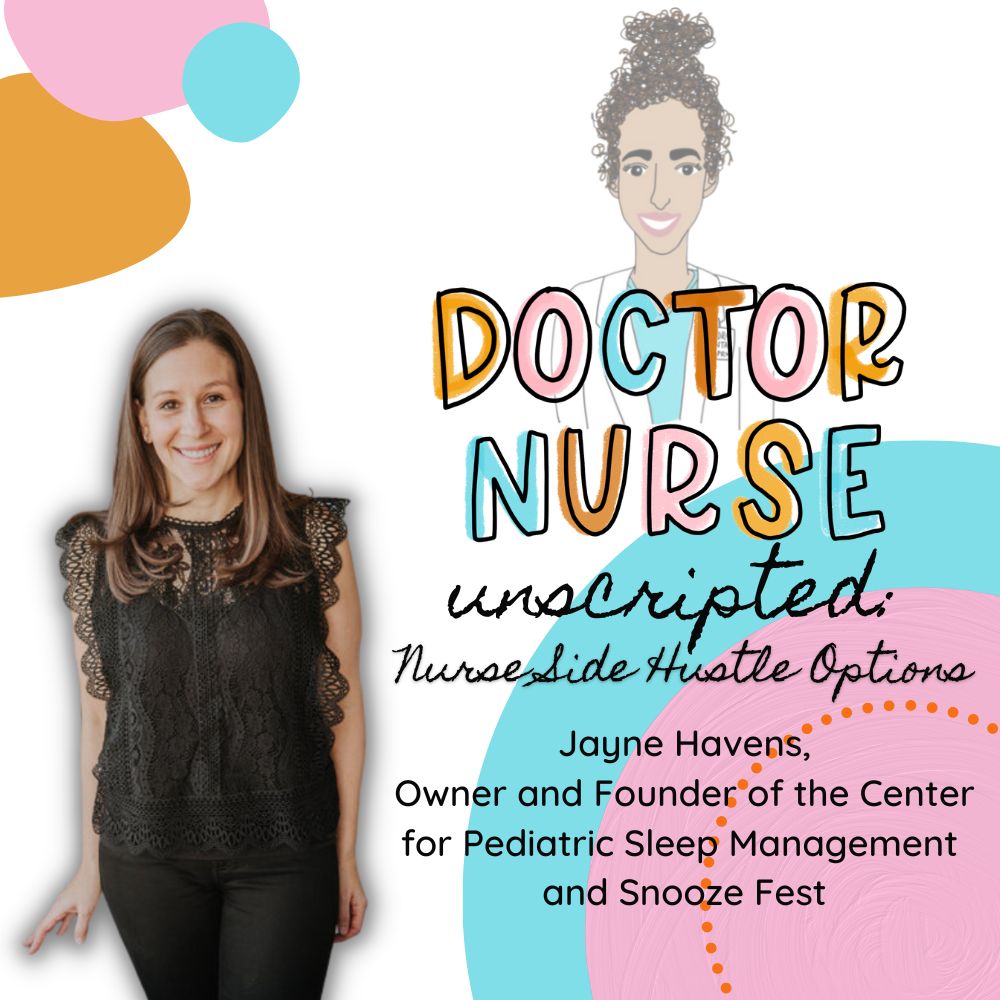
Dr. Sandra Pagenta: Dr. Nurse podcast unscripted. Today we are talking about side hustles. Guys, you know that I’m all about side hustles. I’m trying to get to give you guys opportunities and insight into potential side hustles for your nursing career.
I ran across. Jayne Havens is business and I was like, I gotta get her on the podcast. And I have to share this with nurses because I think this is a great way that nurses can make some extra side cash. Welcome, Jane. So happy to have you on.
Jayne Havens: Thank you so much for having me. I’m excited to be chatting with you today.
Dr. Sandra Pagenta: Me too. I can’t wait to dive into what you’ve built and then Yeah. How nurses can totally learn from, your whole organization and their system that you created. So let’s dive.
Jayne Havens: Sure. So I’ll tell you a little bit about me and what I do and how I help people, like nurses. So my name is Jane Havens.
I am a certified sleep consultant. I specialize in both infant and toddler sleep. Actually, I work with children up to about age six or seven. I say infant and toddler sleep, but it’s really Preschoolers and the kids are medium sized kids too. We sleep consultants. We support parents through the process of establishing healthy and independent sleep hygiene for their children.
I do all of my work remotely. I don’t go into families homes. I’m not there at bedtime. I live in Baltimore, Maryland. I’m supporting families all over the country and even abroad. I’ve supported families in. The UK in Israel, in Canada. This work really positions you to expand your reach beyond your own city and town that you live in.
I got started in this work myself when my kids were little I was a stay at home mom. I was sort of bored. And over being at home and singing Old McDonald all day long. I didn’t wanna go back to the office because I’d worked before having kids. I had gotten so used to just spending all of my time with them and I really didn’t wanna give that up.
I decided to look into side hustles and I didn’t want to sell a multi-level marketing product. I didn’t wanna do any of that. I wanted to do something that was helping people and that made me feel fulfilled. Sleep consulting came to mind because I was always really good at getting my own kids to sleep.
I taught them how to sleep independently when they were three, four months old. I was always helping friends and friends of friends. So I decided to get certified and what was intended to be a side hustle turned into. A six figure business within two years for me. So that was never my intention.
Not too long after that, I decided to create my own sleep consultant certification program. The reason I decided to do this is because I noticed that something was missing from all of the other programs on the market. The main two things that were missing. Community. There was really no community and support inside of the program that I took and I saw that women were craving that as they were working to build their businesses.
I think entrepreneurship can be really, really lonely and if you don’t have people around you building you up and cheering you on, it can be really easy to just give up and say, forget about it. So I think community is really important. And then the other piece was the business building and that entrepreneurship
when you take a Sleep Consultant certification course, nobody was teaching you how to grow a business. Nobody was teaching you sales, marketing, business growth strategy, mindset work. And to me these were the most important pieces of the puzzle. I created a program that not only teaches ladies how to.
Coach families through establishing healthy and independent sleep hygiene, but also how to launch, grow, and one day even scale a successful sleep consulting business. And I just love it.
Dr. Sandra Pagenta: I absolutely love what I do. That is so incredible and I love what it was built out of. It was built out of, again, putting first your priorities, which are your children, and then moving out of the margins of time that you had.
More so than what I find that a lot of women have been just, we now fit our children into the margins of our lives, and then, Wonder why women feel burned out. They feel stressed out. There’s mom guilt to the max. There’s all these other psychosocial things that women deal with that I feel like what you touched on is exactly what I know.
A lot of nurses Especially nurse moms have been feeling, especially with the pandemic. We talked a little bit before the podcast that a lot of women realize that role of mothering and primary caregiver really does fall on you when everyone’s going home and people are remote and there’s your husband’s, no longer really able to do the helping that he was doing
and it’s all on you cuz your kids can’t go to school anymore. So I think women are starting to wake up to this idea of what can I do as I’m mother and I prioritize my family first, and then I work out of those margins that I have. What can I build? And I love that you’ve got such a great insight on, it’s not just learning the skills of sleep.
You’ve gotta learn how to keep in community with people. And you also have to learn how to grow the business aspect, which is really, really challenging. So how could a nurse looking for a side hustle get started making money with you? So I’d like to hear a little bit about what’s the expected range of money that you could possibly make from a side hustle, working as a sleep consultant, and then how does she get started?
What does she need to kind of do to kind of. Maybe try this on.
Jayne Havens: Sure. So my program is called Center for Pediatric Sleep Management. It’s all completely online. It’s a self-paced program, so you don’t need to be anywhere at any particular time. You don’t have to be on Zoom at 8:00 PM I know with nursing, a lot of people have really hectic and.
Reliable schedules or just funky schedules so you don’t need to be anywhere at any particular time. You go through the training on a timeline that works for. My students have lifetime access to the course curriculum and our online community for students and grads. And you go through the program, it’s a combination of reading and video content.
It sort of toggles back and forth. We teach the science of sleep, which I would. Bet that most of you have some sort of experience with or knowledge, on that topic. We teach the science of sleep. We teach safe sleep as it relates to we, follow AAP guidelines with regard to safe sleep. We teach sleep as it relates to developmental ages and stages, all the sleep training techniques how to effectively communicate with your clients.
It’s all sorts of good stuff. You learn all of that inside of the course. Once you complete the course you’ll, you’ll be certified. There are a few assignments, assessments throughout the program. And, once you’re finished, you’re free to get your business up and running, however you see fit.
That’s really the beautiful thing about sleep consulting, is that you can do it in a way that works for you. I have women in my program that work full time and have no interest in a. Building an empire out of this, they’re happy to take two or three clients a month that makes them really happy, feel fulfilled, and earn an extra, you know, thousand, $2,000 a month.
Or I have others who are doing this full time and they make anywhere from five to $15,000 a month or even more. You can do this with one-on-one consulting coaching families individually. You can do group coaching programs, you can create your own online course. Really the sky’s the limit. Nobody’s, telling you that you can or can’t do anything that you want to do.
For better or for worse, the field is not regulated. So there’s no governing body that oversees this field. Online sleep consultant certification programs are not accredited. There’s nobody that’s saying, There’s, it’s a little bit the wild, wild West, if I’m being completely honest. And I think that that’s good and bad.
I do wish that there would be a little bit more oversight, at least with regard to safe sleep, because there are courses out there that are teaching all sorts of stuff that doesn’t really align with the way the American Academy of Pediatrics is saying that infants and toddlers should be sleeping.
But I also think at the end of the day, we sleep consultants. We’re essentially just parenting coaches. We’re coaching parents through something that feels overwhelming and stressful. And in that regard, I don’t think that there needs to be a ton of oversight. We’re. Moms supporting other moms. And I don’t know that that needs to be so highly regulated, but anyway, that’s sort of what it looks like.
You go through the course you’ll have all the tools that you need to get your business up and running, and then you’re free to take on clients and support them however you wish. We give a ton of guidance on both how to find clients and then best practices for supporting them. But really it’s up to you to do this in a way that works.
Dr. Sandra Pagenta: That’s really cool. And do you have nurses that are current sleep trainers? Right.
Jayne Havens: Yeah, I do. We actually consultants a fair amount. We have a fair amount of medical professionals inside of the program. We have pediatricians, we have nurses, we have PAs we have ib, CLCs. Actually, a lot of ladies in the medical field specifically are looking for.
Other ways to support their, I think people get into medicine because they want to help people, right? Yes. And what I’m hearing, and you tell me if you’re hearing this on yourself.
Dr. Sandra Pagenta: I think you’re gonna nail it.
Jayne Havens: Medicine is not what it used to be. And care for patients is not what it used to be.
And people get into nursing because they wanna help people and, then people get disgruntled. in nursing when they don’t feel like they’re helping people so These same people are coming to me and they’re like, I got into my field because I wanted to help people, and now I feel I get 10 minutes with somebody.
I don’t get to talk to them. I don’t get to hold their hand, I don’t get to support them. I don’t feel like I’m helping and I don’t feel like I’m providing the care that I signed up to provide. And so that’s why people get into this line of work because they’re looking for other ways to show that empathy that’s deep in their soul that they.
They want to give that off and they’re, they’re not feeling they have the opportunity to do so in their current line of.
Dr. Sandra Pagenta: A hundred percent agree with you and there’s a lack of flexibility in healthcare work as well. What I’ve experienced as a part-time nurse practitioner is what you find is that you’re not as valuable because you’re part-time cuz you’re not full-time.
So here I am trying to flex and be kind of like in these both worlds and then you find as you work, oh goodness, they see me more as a problem than I am a. And yet I’m trying my best to stay working to stay in involved, but then also raise my son and make sure he knows mama’s present, mama’s here, she’s involved in the things that are going on with him.
Because for me, it’s important to look back on my life and not determine, Oh, I spent all this time in my career and, and my son doesn’t feel like. I’m involved and I’m there and I’m a present mom. So I think a lot of women are starting to experience and starting to see I’m not valued at work, and the one place that I am valued, truly valued, and no one can ever replace me.
I don’t have the flexibility to work and take care of that. So I think that’s why, again, that’s just driving in particular women. And maybe even healthcare workers into finding that flexibility that we can’t seem to get from where we’re working because they don’t seem to value.
A mom that’s working part-time, but she’s, she’s coming in, she’s doing what she needs to do. But she’s also very much present at home. And so, again, when you realize that your options are limited, then you go find the things that you can build for yourself. So I absolutely love that. So I wanted to ask you, and this is really funny.
I was thinking about as we were talking so I wanna see what she knows and what she thinks about something. And so I was gonna pass a scenario by you and just see how you ma how you. So my toddler, he’s three, he’s been getting up out of his bed. We had to take one of the walls down, so we took the walls down to his bed cuz he climbed out was, of course it was scary.
I’m in the kitchen and he’s standing there. I’m like, How are you standing here where we have all fours of your crib up? So yeah. So the wall came down and now he doesn’t like to sleep in his. So, I don’t know, maybe another mama, there’s like, Yes, that’s what’s going on. What would you recommend, what would be something as in your sleep consulting world, would you go, right, this is what I would do for that mom just to kinda get a taste of the kind of work that you would be doing.
Jayne Havens: So I practice what I call a client led approach, which means I support families through methods that align with their parenting style and that feel safe and comfortable for them. There’s no one way to skin the cat that you just described. Okay. That being said, There isn’t. There are a lot there.
There are a lot of ways to skin that cat. What I will say is that when kids are afraid to sleep in their own room, here’s where parents go wrong, and no matter how you approach it, you need to have this in mind. Parents make the mistake of saying one thing with their voice and their words, and then doing another thing with their actions.
So what they’ll say is, You’re safe in your room. There’s nothing scary in your room, you’re totally okay here. But then the second their kid wakes up in the middle of the night, they’re darting in to sit with them while they fall asleep. And so their actions are suggesting a monster under the bed or there’s alligators in your sheets because that’s how the kid feels if you’re right there protecting them
so if I had to guess, you’re probably sitting with your kid while he falls asleep because he won’t stay in his bed unless you sit there and what you’re doing is you’re saying to him Your room is not safe and that’s why I’m sitting here with you. So you need to be consistent with both your words and your actions, and that can be a gradual process.
It doesn’t mean you need to close the door and lock it and say, See you in the morning. You can slowly pull your way out of that room, but you need to communicate effectively, both again with your verbal language and your body language, and he needs to know that he’s a hundred percent safe.
And then when he’s scared, you need to send him back to his room because he’s not in any sort of danger. And you wouldn’t send him into a burning building, yes. But you would send him into his room because that’s a safe, wonderful space for him. And when he sees that you believe that. Then he will start to believe that too.
But he’s taking his cues from you. So I guess the way that I answered it is more on a mindset. You need to change your mindset around it. And once you change your mindset around it, then there’s lots of ways logistically to manage the change.
Dr. Sandra Pagenta: That’s really good. It’s interesting too because it’s the falling asleep and it’s the staying in his bed. So he’s getting up in the middle of the night Yeah. And coming into the room, and so I’m good about leaving him. I’m like, It’s okay. Good nights out. We walk out. But then in the middle of the night he’s hopping up and so I’m so exhausted.
I’m just like, Wait, what’s going on? I’m disoriented and he’s busting the door open and all the things, and so I think that’s the work that we have to do. Send him back to his room. You’re safe in there. Because you’re right. I think I have been Wait, did he get up and was he concerned about something?
Is he looking for us? He can’t find us. You know, I’m creating all these narratives in my head thinking that must be what’s going on because I’m what do you call like when you transfer your own thoughts into their brains and you’re just like, This must be what’s going on. And you wake up and there’s nobody there.
So I think you nailed it. It’s probably just, Hey, you gotta go back to your bed. And keeping that consistency.
Jayne Havens: And it’s, it’s largely a combination of having a really solid plan and then also providing a whole ton of accountability and support. I equate the work that we do as sleep consultants to The work of a nutritionist or a trainer at the gym if you wanna lose weight, you can ask a friend to hold you accountable.
You can buy a book on a diet you can sign up for the Weight Watchers app. You can hire a nutritionist or a trainer at the gym. A sleep consultant is, The nutritionist or a trainer at the gym when it comes to sleep struggles, you can ask a friend for help. You can buy some little ebook or a real book.
You can buy a course or you can hire someone to actually walk you through every single step and hold you accountable. And that’s essentially what
Dr. Sandra Pagenta: Yeah that’s really good. So for the last question of today’s podcast episode, I really would like to hear how and in the life of an entrepreneur what is one thing that you wish you would’ve known at the start and one of your biggest hacks that you’re just like I keep coming back to this hack cuz it’s just so good.
So a hack and then something that you wish you would’ve known at the start.
Jayne Havens: I guess the one thing that I wish I would’ve known from the start is that There’s always more room to grow it is a never ending journey. And even if I compare where I was in my entrepreneurial journey when I was three months into my business or three years into my business, it’s never the end.
We’re only. Just getting started, and actually I think it worked my advantage that I didn’t realize that at the time because I just had these little teeny, tiny goals. I wasn’t thinking big. And now as I’ve grown and as my business has grown, the sky is the limit.
And then you can go older than that. And that doesn’t even necessarily mean income. It just means personal growth, professional growth being willing to try new things all the good stuff and then my hack. Is that outsourcing is a really wonderful, amazing thing. Okay.
Now that I train others to get into this line of work, I see how some of them get so tripped up on things that they really should just be Paying somebody to do it for them. And every single time you pay somebody to do something for you, you’re maximizing your own time, you’re maximizing your own strengths, and then you’re outsourcing the rest, and you always get a really good return on investment when you hire someone that has expertise that’s above your own.
You’re always gonna get a good return on investment. There are obvious situations where that’s the case and then they’re less obvious. So creating a website, I could have fumbled and finagled and tried to figure out how to make a website. , but I did that for an hour and a half and then I was This is stupid.
I’m not doing that. It’s, yeah, like I’m not gonna do this. So I paid somebody to make me a really beautiful website, and when I tell you I think I get clients in a higher price point because my website looks expensive. Yes. That return on investment was a no brainer and then there are little things I use a little scheduling tool called Acuity where I don’t have to say to a prospective client What time can you talk?
Or, Do you have time today? What time can you speak today? I literally send them a calendar. And, and it links and all my availability’s there and they just pick a time and they fill in the little questions and I consider that outsourcing, because I pay for that. But the amount of time that I spend going back and forth with people trying to coordinate a meeting is just silly
so I’m huge on investing in myself and, and just spending money where I am. The expert and that has always led to huge growth and a lot of people are scared to do that.
Dr. Sandra Pagenta: That’s really good advice. I think we talked about that in the email too with Calend Alley. I’ve had it on automatic for so many of my guests that when I’ve been doing these new doctor nurse podcast episodes, I didn’t have my workflow and last night I was working on it and I was like, I got my workflow.
Cuz this takes so much time for me to be able to process through. And I now have an email reminder that goes out to me that’s Hey Sandra, email your guest. And I’m like, Oh, thank you. Cause it’s just so much to be able to, again, work the podcast, work a part-time job, and be a mom. You just need to outsource some of those, some of that work to almost like a virtual assistant.
And the systems are so good now that you can just plug stuff in and it will help you stay on task. So, that’s, really great advice. And Jane, thank you so much for your time today in coming on and letting nurse nurses know. And nurse practitioners too know about potential way to make some income that’s in line with what we’re doing and aligned with the APA guidelines on safe Sleep for Children.
And it’s one of the rabbit holes I went into. When I was a new mom. And it was very helpful to see in that community setting what people were doing. And some of them are a little crazy, some of the Facebook groups, I was like, these people are kind of nuts, but, but some of them still were providing very good, safe content
One last question for you, Jane. How much time do you spend a week on your sleep consulting business? You’re the entrepreneur, ceo, woman in charge, but typically, I guess I’d like to hear what you’re spending on your business, but then also with the typical sleep consultant spends on their business per week.
Jayne Havens: It’s really hard to answer that question. For a few reasons. One, because like the flexibility that we have in our work makes it really hard to measure how much time we’re spending. For example, I was sitting in carpool line this morning and one of my clients texted me about her night last night and I quickly just sent her a voice note.
To respond to her text message. So was that time spent? I don’t know, kind of I was in carpool lines talking to my kids, also responding to my clients. So a lot of our work is multitasked with other work that we’re doing. So it’s really hard to measure. What I will say is that with anything else, you get out what you put in.
You cannot expect to have. Six figure side hustle, unlike five to 10 hours a week. That’s just not the way it works so your income is gonna directly correlate with the time that you spend now as you get busier and as you get systems in place and as you get referrals. Then it starts to come in a little bit easier.
I used to hustle hard to find sleep consulting clients. I used to hang out in Facebook groups. I used to connect with other professionals in the parenting space, whether it’s pediatricians or family photographers or preschool directors, All of these different professionals to get referrals.
But now that my name is out there, and now that I have a reputation and I’ve supported so many families, I don’t spend any time hustling my business every single day. Somebody texts me, emails me, calls me, and says they got my name from So and so, who’s either a referral source or it’s somebody who’s worked with me in the past and had a great experience so, Now I don’t spend any time hustling my business.
And you know, as far as how much time does it take to support a client it’s writing a written sleep plan, which takes me, I’ve written so many, it takes me 20 or 30 minutes at this point. It used to take me longer. It’s a onboarding phone call, which is about 30 minutes. It’s text message support for two weeks and then a wrap up call at the end.
So it, it’s actually not a ton of time to support your clients. It’s more business develop. Is, what takes more time. That’s where people really need to be patient and be willing to get to work a little bit. This is not a make money quick get rich scheme.
That’s not what this is. This is starting a legitimate business from the ground up. When you lay the foundation and you put in the hard work on the front end, then you reap the rewards down the road. Perfect answer.
Dr. Sandra Pagenta: I think it’s incredible what you’re doing and I hope nurses check you out I’ll link everything in the show notes where they can find you and they can reach out. Hopefully you’ll get some nurses to sign up and create some side income, so it’s great. Great. Thank you. All righty.
Thank you so much.
Podcast Description
As a new parent and overwhelmed by exhaustion, Jayne left behind her job in corporate sales, ready to fully embrace her new role as a mom. She loved her son, of course, but grew increasingly frustrated by his frequent night wakings. She found herself reading everything she could find in order to get him to sleep through the night.
Years later, when her daughter was born, Jayne applied what she learned once again, implementing healthy and independent sleep habits very early on, and before long, her entire family was able to get the sleep they needed. It was life-changing!
Friends quickly took notice of the fact that Jayne’s children were both fabulous sleepers, and they began coming to her for help with their own sleep challenges.
Through word-of-mouth referrals, Jayne began helping friends of friends through the sleep training process. In doing so, Jayne realized her passion and skill for helping families to achieve quality sleep for their children, and Snooze Fest by Jayne Havens was born. Jayne quickly established herself as a leader in the industry, building a strong reputation for taking good care of her clients, providing top-notch service along with expertise, and successfully leading families from desperate and exhausted to grateful and well-rested.
A few years later, Jayne’s passion for sleep consulting, her background in sales, and her experience as an entrepreneur collided in a new way. After years of research and educating herself on the science of children’s sleep, child development, and sleep training techniques, and after obtaining her sleep consultant certification, Jayne launched the Center for Pediatric Sleep Management (CPSM)—a sleep consultant certification program with a uniquely self-paced course, integrated learning approach, and full-bodied curriculum.
Through CPSM, Jayne leveraged her proprietary CPSM Success Method to train, mentor, and certify others to do this incredibly rewarding work and set them up for success as both sleep consultants and small business owners. CPSM has trained hundreds of sleep consultants to carry this work forward and continues to grow.
Jayne’s Links:
https://thesnoozefest.com/about
https://www.instagram.com/snoozefestbyjaynehavens/
Follow up with the Doctor Nurse Podcast here!
Success NP- Etsy Shop developed by my best friend and me who are both Nurse Practitioners and create beautiful designs for your life! Check us out.
Picmonic covers thousands of hard-to-learn facts and topics, to help you master the material that healthcare students often struggle to learn. This study system helps boosts nursing and nurse practitioner students’ confidence and grades. Picmonic learning system students increase retention and test scores. Why does Picmonic work? Years ago, psychologists and education researchers found mnemonics to be an effective tool in increasing retention and memory recall. Today, lots of different strategies for learning and memorization using mnemonics exist including keyword, phrase, music, and image mnemonics. Using the idea of image mnemonics and applying clever pictures and humorous characters tied together with story and audio — and put it online to create the ultimate studying system for retention and memory recall. Use code DOCTORNURSE for 20% off your subscription.
Become an NP Preceptor and make up to 8,000 bucks a year!
CODES FOR MY LISTENERS: Sandrapagenta15- 15% off FlohWear by Undies Loft until November 19th!!!
Latest Episodes
Doctor Nurse podcast brings you weekly shows to help INSPIRE, EDUCATE AND EMPOWER nurses with true stories of initiative and impact.
Doctor Nurse podcast brings you weekly shows to help INSPIRE, EDUCATE AND EMPOWER nurses with true stories of initiative and impact.
Latest Episodes
Doctor Nurse podcast brings you weekly shows to help INSPIRE, EDUCATE AND EMPOWER nurses with true stories of initiative and impact.