
Also Available On






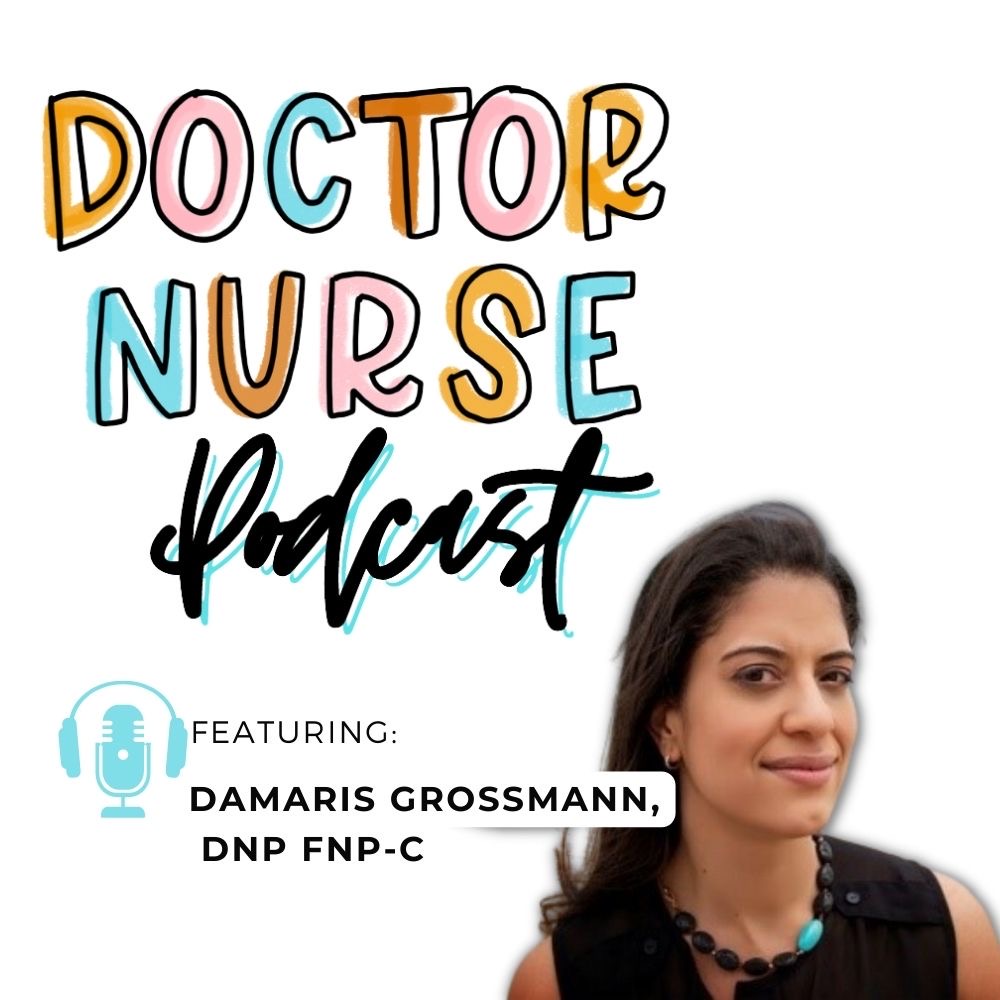
Dr. Sandra Pagenta: Hi, Dr. Nurse podcast fam. Welcome to the podcast. Today I have on Damaris Grossman, Dr. Damaris Grossman. She is a family nurse practitioner and she has focused a lot of her doctoral work in integrative health, functional medicine, mindfulness and stress reduction for her patients. And she has got a litany.
Of side hustle deals, things that she’s been working on on her own career, as well as her own business, working PRN as a locums tenant nurse practitioner. And again, like I said, she’s involved in speaking, she’s been involved in real estate deals. She’s got a pretty rich history of different things that she’s been involved in for her career.
And she’s gonna come on and talk to us about how sh her latest, her latest thing is to become upward certified functional medicine nurse practitioner. And I just can’t wait to hear all her journey and everything that she’s involved in. Welcome to Maris to the podcast. Thanks so much. Also you’re a mom. So you’re a mom of a toddler, so you’re a special class right now.
Damaris Gottman: Oh yeah, yeah, yeah. It’s like a whole other special space for us. Cause we have like, we’re the no sleeps and we’re trying to like, keep
Dr. Sandra Pagenta: still k, keep our business. Yes, exactly. And then keep the kid like balanced and a good human.
So it’s just a constant job, .
Damaris Gottman: It totally is. I mean, you gotta, you know, you gotta make it work.
Dr. Sandra Pagenta: Well, let’s dive in. What does your day-to-day look like? And I get in that, in entrepreneurial space, but then also in that side hustle realm that you kind of come in and out of.
Damaris Gottman: Sure. So my day-to-day is I work, telehealth work, web-based work, and I’m out of an office that is actually an acupuncture and wellness center. It’s Jennifer Lane’s acupuncture wellness group. And I rent a space from her. Well, I’ve been working out of her office actually before I was a nurse practitioner as an holistic nurse and integrated nurse.
And then I transitioned as a nurse, And then I do web-based telehealth work for patients in two different areas, like prescription wise, like those that I’m licensed in, and then those that I’m not licensed in. More of like a functional, not even just functional medicine, but a a health advisor or advocate.
Dr. Sandra Pagenta: Gotcha. , and that’s kind of your, like your day, like your bread and butter.
Damaris Gottman: That’s my day to day, yes. To get extra, obviously if my patient load is not as high or I’m, depending upon that stream of income, and I’ll tell you about being in a business way. , when you think about multiple streams of income, when one of the streams is kind of trickling and it’s not as flowing, you have to find your other way.
So I’ve had other areas to build that. So either a locum tems or an online work with another company or real estate.
Dr. Sandra Pagenta: Haha. So doing kind of those other things if you need, if you need extra income.
Damaris Gottman: Yeah. So when one stream is trickled or not, as, you always have something to build up upon and as the best as you can at getting as much passive.
and then thinking of work differently because it’s about trying to build up your time. Mm-hmm. then build up your time for freedom, then it is just about making money. So you’re gonna make money when you have the best intention forward. So I found when I was more positive and more giving and more open about the money and I didn’t think of it about making money, and I think about it as this is going to give me more freedom.
Then the work is work. But then, you know, so then you wanna figure out what it, what can you do that all. Make you happy, but also you enjoy doing. Oh, and then what’s these other parts? So part of business, I wasn’t great at it first. My husband was really good at it and he definitely taught me some things and I had to learn a lot of things. I failed a ton of times.
Dr. Sandra Pagenta: Yeah. Well, you know, again, we all go through, like I said, one of the things in my podcast, I say that success is not a linear. It’s just a linear line that it’s definitely this like ekg. When I had Tiffany Gibson on the podcast, she talked about, you know, it’s an ekg, right? You have highs, you have lows, you need to have those, or you don’t have a heartbeat, right?
And so that’s kind of, yeah, like how business is and how the nature of running a business, running side hustles, figuring out how to make more income while getting back more of your time, right? Because time is your currency. And I started to think absolutely that. My currency was what?
I got paid an hour. Oh, my currency is I’m $22 as a new nurse. That’s my currency. My currency is actually my time. That’s, that’s what I’m giving away. Just like that too. I wish I would’ve had that mindset from the beginning of my career that I’m giving away my time.
To be at this place. Therefore, I wanna make sure it’s the most lucrative, it’s the most in tune to what my heart enjoys, all those different things. And then you throw a kid in the mix and now going to this place is now taking away from time with my family. One of the things that I like to ask is through owning your own business, what has been one of the hardest parts and the hardest aspects of owning your own business? From when you were in that employee mindset, from when you decided, okay, now it’s time I’m gonna go ahead and start owning my own business.
When was that switch for.
Damaris Gottman: So I feel like it took a while. You know, I was always trying to figure out different things because my starting a business was out of necessity. Mm-hmm. Because I, you know, I was a veteran and my story came because I learned integrative health and holistic medicine.
because I had a, a severe back injury and head injury, you know, a mild injury that caused me so much pain and suffering that I, the conventional medicine wasn’t. , I wanna make conventional medicine, but one thing wasn’t fixing it. So when I started to understand my healing process, I then realized that there was other ways to be better.
So then when I was trying to do this side hustle, I realized like my work as a, just as a nurse at that time and now as a nurse practitioner, wasn’t good enough. Mm-hmm. . And I was like, there has to be another way. So it was like me trying to solve this problem for. Suffering pain stress. I was like, I gotta figure this out.
So through just determination of figuring out my own health journey, I became obsessed with it that they became these little business parts. So it was like, all right, I gotta learn holistic nursing because I can’t be a crapper. Not that that’s the word, but I wanna be the best nurse that I can be for my patients.
I wanna be calmer for them. I wanna be more centered. I know that my. Had to learn it. So I learned to learn different modalities because one pill isn’t gonna fix them, one drip isn’t gonna fix them. One, you know, one, you know, they need to be hugged and touched and talked to, and listened to on what happened to that.
So it’s like, that part for me had to be learned. And then I got so obsessed with it that, you know, I ended up getting an integrative, you know did my D M P and integrative work for anxiety and stress reduction because I was stressed and depressed and trying to figure out stuff. So it was like, if I have to figure this out, I want other people to know that there’s other ways.
And then for, as I was talking to you about getting the functional medicine part for me, that. , it’s like a, like a whole health circle for me. It’s like the, the icing on the cake. It’s not the full, it’s not the full answer, but it’s part of the equation. And so when I transition now to this business owner, I don’t always think I’m a business owner, cuz I think sometimes I’m, sometimes I’m glad to be on it.
Sometimes I’m a fan, but I look at it like it’s a stream of income and I. Make a difference. So if money comes through it, that’s great. I wanna, you know, so I do have a little bit different, I don’t, you know, have a primary practice per se. I have like a direct primary with, with an integrative approach.
Dr. Sandra Pagenta: Yeah. Yeah. And I think that, that, again, like I said, Owning your own business. And, and why that’s so tough is just that, because again, you have to kind of break out of that mindset of I need my freedom. I need a level of flexibility here that the healthcare system doesn’t really wanna seem to give nurses.
It seems to only want you full-time. It seems to only want you there all the time. And then you’re working weekends and you’re on call. And so again, whenever you, you own your own business and, and you. Separate yourself from that and you kind of pull, yes. There’s the harder part of, now you’ve got to be the business.
Right. So you’re on 24 7. Yeah. I was like more so than just when you work your shifts.
Damaris Gottman: It’s some of my health issues. Yeah. Yeah. What happened was is my health issues were unfortunately not giving me as, I wasn’t able to do as much of the full-time all the time, or I was overworked and then I couldn’t, and then I would be able, like, I just kept like faulting, so it’s like these side things kind of helped me hold off, you know?
Yeah. Chugging a lot. Yeah. But yeah, I mean, it, it ended up being okay.
Dr. Sandra Pagenta: Yeah. And so what are some of the aspects that you’ve, you’ve been learning throughout your career that you’ve been finding have been the most challenging? So I think a lot of nurses and nurse practitioners have started businesses or are starting side hustles are like, how do I get involved in marketing, advertising, financial planning, all these different things.
What are some of the things that you have.
Damaris Gottman: Oh, marketing was marketing. Still to this day, I find it to be like the bane of my existence. Yeah. I am, I’m am not an amazing marketer. Finances. So when I initially, when I talk about money now, I sucked. I mean, I was really bad at. Money. I never was taught personal finance.
I was never taught how to save a dollar. I kind of just, you know, like it was like shopping was therapy. Like you spend your money and, and it was different. I was grateful to have a partner that’s very good with finances and he did teach me a lot before I started a business. But in general, throughout time when I started to realize that money was that value and it, and it.
Compound interest and it can make you more and, and things could do more. I was like, oh my God, I, you know, it’s, so, I live a lot. Be below my means. Mm-hmm. meaning I don’t, I don’t have a big car, fancy car. . I live without a mortgage. So like in the sense of, so what this means is, is that I have a two family.
I have a smaller apartment, you know, I don’t, I have a big house, you know, that’s like a eight bedroom, but I live in one unit, and so my husband and I, we have the yard, but we have no mortgage. So wait
Dr. Sandra Pagenta: a minute. So going back, stop right there. So you’re telling me that you own a multiplex or some type of like,
Damaris Gottman: Oh my goodness.
I got a few and then I have, I have, I have real estate bills.
Dr. Sandra Pagenta: Yeah. That’s fantastic. So wait a minute. So you purchased this, you have to look at different, and you, you have everybody. It’s full of
Damaris Gottman: I’m a veteran, so Yeah, go back. I’m a veteran, so I was able to get a veteran loan.
Dr. Sandra Pagenta: Okay, got it. And so you got the veteran loan, you bought this?
That’s my initial realty. Okay. Mm-hmm. . Wow, that’s fantastic. That was
Damaris Gottman: my initial. , that was my first, the real estate. So it’s called house hacking and you’ll hear that through people. It’s called house hacking. And so it’s a different mindset. I didn’t think of like money like that cuz business is money, right?
And I think when you start to think of things differently and you go, all right, I will live a little bit uncomfortable, but it’s not even uncomfortable. I have a three bedroom. One bath, I have a big yard and you know and then I rent out my spaces. So, and then that pays my mortgage.
Dr. Sandra Pagenta: Fantastic. Fantastic.
So now you’ve got that freedom. No, you know that you’ve been that freedom right?
Damaris Gottman: So then there, I’m not worrying about it. Now I’m not worrying about my mortgage. Okay, so then you got that part that’s done. That’s out of the way. So now you’re like, okay, what do I have to pay? , what do I have to work, pay, live my life.
Dr. Sandra Pagenta: Huge.
Damaris Gottman: That’s a huge chunk of our, your bill. Huge chunk. Yeah. Think about that. But it’s a total different way of thinking. Instead of me buying the big house that I might’ve wanted 10 years ago, cause we bought about 10 years ago if I bought the big house, then I bought the nice pool and the, you know, the big rooms.
And my son still has this nice room, you know, he still has a place to live. And we, we live in a great neighborhood. Yes. But you, you have to think of it differently. So you live a little bit below your meat. I’m not saying I’m without, I mean, I buy my Whole Foods food and I get my things. So that’s part of the business part that was new for me.
Interesting. So it’s thinking of money differently so that when I went to go wanna make a difference and do my integrative work I’m not as stressed. . It’s a different way, it’s a different mindset. So the streams of income, this was a learning process for me cuz I wasn’t, like I said, I wasn’t graded it.
My husband was excellent and he was teaching me along the way. Yeah. And then I started reading, you know, and started like finding mentors and people that were. Better at it than me. .
Dr. Sandra Pagenta: I mean, even if your husband’s great at it, you still had to get on board, right? Because the two of you were joined. Totally.
So if he was, if he was on board and you were like, ah, whatever, I want a big house, get it for me. He would’ve had to work against you, which wouldn’t have been good for your marriage. So it’s good that the two of you came together and were like, Hey, listen, like what do we both want? And my husband and I have those conversations all the time where it’s just like, I’m kind of like you.
I live in a, a small house because I, I didn’t, I wanted to work part-time and I knew that that was something that I was probably gonna end up doing. And so that’s so important. I got my doctor because of it. Yeah, I mean, you you give yourself margins by not extending yourself to impress people that don’t care about you.
You impress yourself and so you’re just like, I make these calls. I make these decisions with my life so that I can live my life. And so I think that that is one of the best lessons that you can learn as you start a business is just going, I gotta live below my means because I’m actually living above what most people are living, which is the rat race.
Tired, exhausted, don’t see their families work until they’re 65 and then they die and they’re like, wait, what did I just do with my life? Yeah. And so to look like the Jones is, is to look. being broke and exhausted and tired and not really Yeah. Living the life that you want. At least for me, everyone does something different.
If it works for you, works for you. But this is what works for me. And so I’m like, I’m not, I, I just, I, I want, I’m not gonna chase that thing. I’m gonna chase the freedom, which is what you’re describing beautifully.
Damaris Gottman: Yeah, I mean it’s, it’s a freedom that like when we made our first million, it was like, that took like so many years.
That took about like 15 years total, you know? And it was like when you get to that level, then you’re like, oh, but money isn’t really money. It comes down to understanding where, what you want, like, and making a difference. So I can’t make a difference if I’m worrying about, and I know this is a business podcast, so maybe I’m going to tangent.
No, please go. I just think that people have to understand that it’s like, . It’s not a quick, you know, it’s not quick. Yeah. It’s gonna take time. Maybe some people already inherited it. It’s gonna take time. You know,
Dr. Sandra Pagenta: it took me about 15 years. Yeah. So how many real estate properties do you have total?
Damaris Gottman: So now I’m at a passive sector sponsor way.
So initially I had like two, three, but now I do passive and passively. Mostly I was like GP and, and active initially, but now we are because we pretty much. Some of my business to put into passive deals. So now we’re at a point where you’ll hear people say it’s more on like a, like syndication or assets.
So the. One bus. Yeah, one business, literally that does passive apartments and like, you know, it’ll be depending upon the sponsors. We have like a, a whole team. I don’t have a team, but we have a, we have people that will look at something and say, Hey, can you put money into, so now I just use and invest like maybe Angel Invest.
So I’ll Angel invest into a real estate, or Angel invests into a business so that it gives me debit.
Dr. Sandra Pagenta: Nice. Very good. Yeah, so I had Savannah Aroyo. She is the net worth nurse.
Damaris Gottman: Yes, she would. She knows what I mean. But I’m like, at an even different level. I do probably like now more. I wasn’t like that before.
Dr. Sandra Pagenta: Yeah.Yeah. No, but that’s what she does. She has people in her healthcare professionals pull their money together, buy deals together. She manages the property, so she does all the, the, the legwork. But then there are people that are passively making money off on the side. Yeah.
Damaris Gottman: So I’m, I’m on the passive side at this point.
I did operate and I did. manage like one or two and it’s just too much. Yeah. I have a Sweden didn’t, I’m, you know, I’m wanna be an integrated professor. Exactly. That was not my business goal. My husband really loves doing most of that stuff. But he has still a W2 job too. Yeah. So we don’t do that fully.
So most of it is our big investments. They, you know, we put in around 25 to a hundred thousand per deal and. depending upon the need or what we have available in our, but we don’t, like I said, we live below our means. So we do this because we choose my, so my income. Most of the time or extra, we’ll go into those because we look at it as we can retire early, we can become fire, or my son, I can have more time with him.
Yes. Or I can do more for him. And so it’s totally different way of thinking. Instead of everything controlling it. So even my business I don’t want it to control me.
Dr. Sandra Pagenta: I think it’s incredible and it’s, what I want more nurses to embrace is the, the mindset of freedom. Like, don’t, I used to look at like, oh, that’s just an extra. Instead of looking at it like, that’s 10 hours of my life, that’s 12 hours of my life I’m giving away. It’s not an extra shift. It’s not just a little extra pickup.
Again, unless you’re shooting for a goal, like, I’m doing this because I need to get to this spot debt free. Or, I’m doing this because I’m trying to get. Here, or we have this purchase coming up and I want to make that goal sooner. Again, keeping that in the forefront of your mind is working differently than, oh, I just want a pair of like, you know, X amount of depreciating asset that’s not gonna bring any money.
I live that way for years. I live that way. I was just like, oh, it’s fine. Just give them an a, four hours of your time where it’s like I could have. and learning how to do another side hustle. I could have all this other time that I gave to the hospital for their pennies and put my license at risk cuz I might have been more tired picked up, put my health at risk because I was just working extra.
All these different things are sacrifices that you lay down at that altar that I want more nurses to realize. Invest in yourself, let that job be the thing that allows you to put that money back into you, into whatever your priorities are, time, freedom, travel, whatever it is. Let that be what feels like.
Damaris Gottman: Yeah. I mean, and, and do it. You know, and I think it’s not that you can but now it’s like, I also try to make a difference too, so it’s like, yes, I have a little bit more, but then it’s like, well, what can I. Make sure that I’m, I’m not without of anything, but it is differently. I, I would like, you know, when I’m working in my business, I wanna, you know, I try to take it like this is super important cause I want people to have a better, you know, I want their health to be better so, of course if I make in, you know, more income in that.
But the different streams of income, like I said, are really the, that’s really the what, the lesson that I had to learn. Yeah. I think me as a business owner, I love it because I’m passionate about that part. I’m not really passionate about real estate. No. It’s just a, it, I’m not straight up.
Dr. Sandra Pagenta: yes, it’s a tool in your toolbox, which is fabulous.
Damaris Gottman: it’s a tool. . The other stuff is like my integrative stuff, my mindfulness, all of that stuff. I’m super passionate. That’s my, yeah, I love it. I will do that for free probably forever, but I do still like to make some income on that. And it’s only because, you know, If I spend hours of time.
Yeah. But the other times I, you’ll see plenty of free things from me that, yeah. That is so cool. So I, it was something,
Dr. Sandra Pagenta: yeah. So how have your nursing skills, I’m sorry, go ahead. Go ahead. You go ahead. I need to let you talk. Oh, no, how are I? No, no, no, no. I was gonna, I wanted you to finish that thought cause I didn’t catch it.
Finish your thought. .
Damaris Gottman: Oh no. I just wanna always be, you know, be as like in tune or give like the best, you know, for individuals, you know, that kinda thing. Yeah. Yeah.
Dr. Sandra Pagenta: So how have your nursing skills helped you with developing or in your business? Like, one of the things I always find very interesting is that we learn delegation, we learn how to implement interventions, we learn all these things.
In our nursing professions. And so how have those skills kind of helped you as you’ve been managing your business and kind of working on the, the functional medicine side of things?
Damaris Gottman: Oh, on the functional medicine for the holistic in the group components. Yeah. Yeah. So I would say I’ve had to, you know, build a team that was a newer mm-hmm.
I really didn’t have as much of a team before. That was, that was helpful. So I learned like kind of that delegating. I’m very big on like, do you know, really putting a whole approach to almost everything. So , I would say, like, you know, being caring and, you know, listening, listening is huge. I mean, listening above everything is like a big part.
And then organizing, like, you know, when you have to organize your day, like, and you have like that, you know, here’s your, your brain your brain, your brain goes a certain way. You gotta kind of have, I mean, I was an ICU nurse in er, so it’s like, I think you kind of have to have. Organized thought like when you’re super scattered, you better find a business that will help you bring that together.
So yeah, it helped me, you know, bring it that. And then a lot of my mindfulness training really helped when with my scatteredness and my anxiety stuff. So I utilize that a lot. Because, you know, we all have different flaws or different things that. Excellent at, or things that we’re really not good at and finding the people.
This is one new part that I learned in business is finding the people when things that I don’t wanna do. Ah, so, ah, this was huge for me and this has been more recent in the past year or two, is finding the people to do the things that I don’t really love doing the jazz. It’s for example, medical biller.
Hey guys. And thanks for listening to another episode that doctrinaires podcast unscripted. I would like to take this time to let you guys know about the doctor nurse podcast website. On this website. I have free resources for nurses that are looking to up their career. Maybe start a side hustle. I also have my Etsy shop where I’ve created really cute digital downloads for nurse practitioners. In regards to life. Pregnancy. Planning. As well as portraits guys check out my resources@thedoctorspodcast.com and let’s get back Episode.
Damaris Gottman: I have a medical biller now. Yeah. . Yeah. Someone to help me with my writing. I’m not a great writer, but And I have, so I have an editor yeah, I have an editor. I have people help me edit. I’m not an amazing writer. I also have a disability, so I had to learn with when I was getting my doctorate. I do voice texting, so I’m a voice recco, like I do a ton of voice recognition, so when I’m writing and you’ll see something, it’s usually voice transcribed.
Dr. Sandra Pagenta: Wow and then it’s edited. So what, what happened? What was your injury? Were you in the military, were you injured?
Damaris Gottman: I’m in military. Oh. So my military was a military trauma. I had a mild T b I and A back injury.
Dr. Sandra Pagenta: Did you really? Yeah,
Damaris Gottman: I was in during nine 11 and it was an an, you know, so that
Dr. Sandra Pagenta: Damaris, thank you for your service.
Damaris Gottman: Yeah, but I mean, I, I grew from that, you know, that’s why I was so obsessed with integrative health because it really had to, I had to, you know fix my health issues. Yeah. So, Training and stuff. I was like, the side hustle was just more because I, I couldn’t work as much, much as I was trying to work. So I was doing these little things to keep income coming in.
Some of them worked out really well. Like I did a lot of yoga, nursing in the beginning. This where I implemented cuz yoga was a big part of my life, mi mindfulness. So what it was is I was one of the founding members with the sealers and she’s been around for years. But basically it was implementing yoga and then yoga became my passion.
And then yoga therapy training, and then mindfulness training. And so taking those Yeah. Areas to help my back and help my anxiety and my injury. Yeah. Because I really didn’t have that. So then I started just using them with, with patients.
Dr. Sandra Pagenta: Yeah. You know? And so in your career, and kind of walk me through, so you were in the military?
No, no, no. You were in the military. And then did you become a nurse or were you a nurse in the.
Damaris Gottman: So I was not a nurse in the military. I was, I was military trained in the, in so military trauma trained. So I was in as an electronics technician and I taught people my job is really high stress intelligence in doing identifying friendly and foreign.
I saw that terrorism. Yeah. I didn’t, yeah. At that time. And then I was like doing nine 11. So when we were deployed, we were always trying to.
Dr. Sandra Pagenta: Different targets. That is so stressful.
Damaris Gottman: I learned a lot, you know, and it’s like all of those struggles, those failures, like, and when I was at rock bottom kind of things, when you learn that, then it’s like growing from it.
So I think. I still wanted to help people, so I wanted to nurse, you know, I had the military trauma train, so I became an LPN first. So as I saw, showed you my bio. Mm-hmm. , like I was an LPN because I had military trauma train. So when I was deployed, I did my job and then I did military trauma work. So that training helped me become an LPN right away.
So as soon as I got out, I was able to become an lpn. Was my health good? Not great. I needed to work. So I was an LP N first. Then I did, I did the, that route of lpn, bsn, you know. Then I went to rn, bsn, you know, rn, then bsn, then msn, then D. Yeah. I never stopped going to school. I’m super like, determined.
Like I, especially when people told me I couldn’t do something, I was the opposite. I was like, okay, we’re gonna do it.
Dr. Sandra Pagenta: No, you’re, you’re a total hustler is what you’re describing to my guests is that you just are always looking for ways to supplement what you need, get what you need, work for what you need. When you have freedom, you can spend time with your family, you can be a part of what’s going on around you, you can be present. You’ve had a T B I, but you’ve got a doctoral degree, like it doesn’t, these things are not holding you back. The things that.
Li limitations, quote unquote, where the world would look as like, oh, okay. You’re just like, Nope, I’m gonna go figure out how to side hustle because I’m not so good at these things and I, I don’t know how much I can carry, and I need to be able to find ways to dole out my money and make it work for me, because, you know, all these other things that I’ve got going on that make it more hard, that make it more difficult for me.
Damaris Gottman: but it wasn’t always perfect. Yeah. You know what I mean? Like there was a ton of failures, you know, there was a ton of times when it fell. So
Dr. Sandra Pagenta: tell me about one of those times, I wanna hear about one of those times that you struggled and you were like, that’s it to mess. Throw the towel in girl. Cause you ain’t gonna make it.
Damaris Gottman: Yeah I mean, so the part was kind of actually as I was getting my, my master’s in as a nurse practitioner, so I was really struggling with trying to see if I needed to go get my master’s right to become a nurse practitioner to. to make a difference. And I was like, oh, do I need to prescribe to make a difference for my patients?
And also like. Mentally study wise, I didn’t know if I could do it. I was not that I couldn’t cause I was high, high iq but struggled, you know? So like, so, and I had to learn a different way of practicing. So that was where, so when my writing, I have to write a lot all the time. And then I had to write for doctorate.
I struggled with thinking to, I remember teachers and professors were. Oh, you know, your rating is kind of eh, and, and you’re like, oh, but I know what I’m talking about. So until I learned a new way of learning and, and changed my behaviors, I wasn’t able to realize that I could help someone. The reason I went for the MSN and the D M P was it was part of the equation.
It was part of like what I wanted to do, but I knew that the prescribing wasn’t necessarily the solution, but it. It might give more credibility to, to the conversation of integrative health. So it was that for me, that was just what I felt. That was my ego, my thoughts. Yeah. Doesn’t mean everybody. Sure. . And so that, yeah, the struggle was like I was at home trying to go, I think I need this master’s.
But I didn’t know if I was gonna pass or I didn’t know if I was gonna be able to write the things and write this dissertation and, and and then having that struggle of like sitting on the computer and my neck was hurting, my back was hurting, and that not thinking I. Write well. And teachers saying, you were okay.
I was like, oh, but I know I’m not just okay. Mm-hmm. . And then when I learned and overcame that feeling when I was at rock bottom again, thinking, depressed, like, I’m not gonna get this master’s or this and this doctorate, I’m just, it’s not gonna happen. I. Sat there and I, you know, went back to my mindfulness, went back to my, my prayer and spirituals and said, there’s gotta be a way of doing so.
Then I went and researched how to learn yet how to learn different ways. So then that’s when I learned texting and thank God for technology. So then that’s when I learned like speech text. And then I learned that I could get an editor, and then I learned that I have, you know, I could read more. And so then I have things highlighted for me and I, and so it’s just a different, and so then I take.
and learning behaviors and style into my practice because you can’t teach someone that this is a, for example. So then that struggle was me learning. I struggled there. So then I ended up doing it even when someone said no. And it’s now, I tell that to my patients when they say you can’t do it, you can, but you have to take a different lens.
Then you also have to change your behavior. Then you have to learn, learn a new, learn like, so those things. So it’s like my past struggle. Have helped me become a better person. Oh, that’s so good.
Dr. Sandra Pagenta: I love that question because when people share what they are struggling with, it allows people to realize.
Wait a minute, she, I’m not alone in my own issues. I like, I think we like to think that everybody has it better than we do. And when you start to hear people’s journeys Yeah, and you start to realize like, no man, she was dealing with like pain every single day. I think it’s very inspiring when people share like, these are my struggles, because then you start to go, oh, we’re all struggling in some way. Nobody is exempt from. Excuse me. No one’s exempt from the struggle, so just get out there because we’re all doing this broken, we’re all doing this with our problems.
We’re all doing this with the things that we are told we can’t do it, and we’re doing it anyway. So just prove them wrong, you know? Yeah. Just prove them wrong.
Damaris Gottman: Yeah. Like really? So, and, and then if you need to pause, like, I’m not like a mile a minute All the time. If you need to pick a, a minute. Sure. And then learning that, you know, I’m like, that is so good.
Not always. I’ve not always got it all figured out, but sometimes . So I’m just steady. I’m just very steady. Yeah.
Dr. Sandra Pagenta: That’s so cool. So I wanted to ask just for people that are out there that are like possibly interested in what you’re doing and what your practice is like. Can you tell me a little bit about kind of how many patients you see?
What are some of the things that you treat and you diagnose in the telehealth space and in your.
Damaris Gottman: Sure. I, I’m not a big practice, so I take a lot, I take a lot smaller. I’m more on that, I’m not direct primary, but I’m more on the smaller end. So I don’t have like thousands of patients I’m under, under like 500, give or take, but not even, I would say most of the time my week is like, Six to 20 patients, depending upon the week on telehealth versus, and that could be anything from, you know, just needing to talk to them.
So my patients, I give them access to my text messaging and email. Email. And then they So it’s more time, it’s way more time on my end. And the first visits are because I take that functional medicine, integrative approach. My visits are longer. So when I was a primary provider, don’t get me wrong, I love primary.
I did like primary care, but it was missing and it was very there’s some very successful, I mean, you’ve had people on that are very successful in primary, but you have to have very high volume to be successful. I’m not that person and I think ethically I. Love it. I will do it for someone else, but I don’t love it for my business.
You have to have high volume to do primary on a regular cuz you’re with them 10 minutes. I like love being with a p I love to talk to them. So I mean, that’s when you find the real stuff. Like, so a half hour, at least an hour, the first visit on the functional medicine side, I learned because I, there’s even more of that needs to be added.
But when I learned on that, oh, there there’s gotta be another element. Like, so for example, Someone comes in even like a headache, a headache’s, never a headache. It’s just not, it’s never like, here’s yours, tripped in, and here is your whatever, your quick med, or here’s your head. No headache’s, never a headache.
It’s, you know, is it muscle tension? Did you sleep last night? Do you have enough magnesium? What, what’s going on in your stress in your life? How much water are you drinking? Are you exercising? Like those conversations are way longer. You pregnant, you’d not, you like, do you have, like, did you have an injury like, The headache’s.
Never a headache. So every illness or so in the functional side, they wanna just do root cause, which I absolutely do. I wanna get to the root cause. But that unfortunately is not the full equation because I can get to a root cause of a headache. So say you, you have a neck tension, but are you gonna fix that neck tension?
Hmm. , are you gonna go to acupuncture? Are you gonna go to physical therapy? Are you gonna go do the stretches that I need you to do? What can we do to make sure we get into that? So these conversations are longer. Gotcha. My initial assessment to get, I would love to do like, you know, so if I do lab work on a functional approach yeah, I’ll go look in micronutrients, we’ll do so initially for some patients.
So insurances will cover, I’ll do it out of network. I’ll do like a wellness exam, so we’ll try to see what we can get under. the basic umbrella, but I’ll do an expanded panel. So most people, like a lot of people I see are in metabolic health issues, stress issues, hormone and bowels. Okay. So, but I would say a good percentage of the population.
Dr. Sandra Pagenta: Yeah. And you see about 20 patients a week with these common issues. Yeah. That’s super. That’s, that’s pretty good. And again, because you don’t have mortgage, you don’t have these give or take.
Damaris Gottman: These other things. I mean, it’s not a lot. I mean, it’s, it could be more, it could be less, but
Dr. Sandra Pagenta: Yeah. No, I think that’s good.
And one of the things I was thinking is like whenever you’re seeing the patients and you’re working your weeks, you’re doing, you have these other income side streams that you’re doing, then you have the podcast, which you have another, you know, another. possible stream of income is from the podcast.
Damaris Gottman: Yeah. I haven’t fully streamed that. I mean, you’re probably better at sponsorship.
Dr. Sandra Pagenta: Yeah. . Yeah. No, but you just gotta dive in again with, depending on whatever your load is. Somebody told me this advice and I’ll, I’ll give it to you because it was so helpful for me. He got a sponsorship with 40 listeners and I was like, what you talking about 40 listeners?
And he’s like, that’s all that I have for this one podcast. And I got a sponsorship and I was. Okay. I have more than 40 listeners. Like, that is crazy. And so once he told me that, he was like, but you have to ask. And so again, I’m, I’m giving you this piece of advice cuz it was super good for me. But he was like, you need to ask people to sponsor your podcasts.
That’s how you get sponsorships. And I was like, Okay, I’m gonna ask. And so that’s what I did. I just started asking and just by amazing.
Damaris Gottman: Yeah. I haven’t asked, I haven’t even put that into my, I haven’t even put that before.
Dr. Sandra Pagenta: If you don’t ask Yeah. You won’t get it. And so, Damaris, my, my challenge to you today is to get out there and ask someone to sponsor your podcast because again, companies aren’t looking for people.
To talk about their products. So find something that you’re passionate about, that you like, that you think is very good, and sponsor it. Ask ’em, say, Hey, listen. This is something that I naturally use and I would love to have you sponsor my podcast. And so, boom, just like that. And what’s the worst thing gonna tell you?
No, when you’re in the exact same spot you’re in. So get your podcast sponsored. Yeah, girl. And Yeah, a little bit of money on the side from that thing. I mean, again, that’s, you’re doing the work, right? You’re doing the work.
Damaris Gottman: Yeah, yeah. And so, and writing. Yeah. Oh, and then I’m writing a book, right? So then I wanna let you know is I’m writing right?
So I never thought I could write. because I’m telling you, and that’s another business. So like whatever you’re gonna do to add in the streams of income, whether it’s a digital product, whether it’s a small book, they have a small ebook. I have a couple of coloring books I did from like whatever you gotta do to add those, things.
Dr. Sandra Pagenta: Yeah.
Damaris Gottman: You never know. I’m not amazing, but I keep trying. Yeah. But patient wise, I mean, I just wanna make a difference. So like I said to you before, I would probably give most of my patient care for free if I could most, I mean, I do a lot. , but it’s all about trying to make a difference for them. And I, I felt like I wasn’t doing enough.
10 minutes of my time for a patient is just not enough. Yeah. I mean, I have done it for like, I’ll do local times, like I was telling you for work too. Like if I can, but like for them, for other people I will. But for me, I like my heart. It’s like, no, yeah,
Dr. Sandra Pagenta: no, you’ve gotta do what your heart tells you is the right thing to do.
I, I totally agree with you. And if you could go back to Damaris, you know, just getting out of the military. Starting her L p N, if you could give her a piece of advice. Yeah. And you would tell her, hold onto this piece of advice throughout your career, write it. Just hold onto this like, it’s a lifeline and this piece of advice is garbage.
Don’t listen to it. It’s not true. What would be a piece of advice she would tell her to keep and a piece of advice she would tell her to toss? Hmm.
Damaris Gottman: that I used to. So a piece of I that would toss is I used to listen to everybody’s like negativity. Like, oh, you can’t do that. Oh, you can’t do that. And I would sometimes let that fester with me.
And then if I let a piece of advice that I would keep would, oh my gosh. Hmm. Be okay with not being okay. being okay with Like, what do you mean? Just if it’s not finished, it’s okay. If it’s not perfect, it’s, you know, and I remember being okay, like in the, like finishing as the L P N, I was like, oh, I’m just NLP n mm-hmm.
where like the just like, oh, I’m, I’m just this at this time. If that’s where you’re at, that’s it. Just because I got a doctor does not mean you’re not gonna make money. You can make money without having all these education. That’s one lesson is that you. You can now, the technology, you can make side hustles in anything.
Yes. I mean, you know, you’re telling everybody
Dr. Sandra Pagenta: every day. Yes. No, exactly. That’s exactly what I’m telling people all day. You don’t have
Damaris Gottman: to have all this education to make a difference. That’s the other big thing, don’t, I don’t need, you don’t need a lot of education to make a difference. And I think if you go forward with a, a positive heart and like with good intention, The intentions will come back like that, Carmen, that energy will come back.
But if your intentions are, are not true, it will come back.
Dr. Sandra Pagenta: Megan, one of my favorite books is Leader Without a Title. I love that book because it is a book about a. You can be a maid at a bed, you know, in a hospital or not in a hospital. A maid in like like a hotel and yeah. And be a leader. You could go outside of your way to show and, and, and care for whatever job you’re doing.
With a, with without a title, you don’t need title of c e o to now all of a sudden become this person that servant leads and make sure to think about others before themselves. Like if you’re just doing that as a nurse, as a bedside nurse, which is why I advocate so much because nurses do this work. We do just pour from our hearts on our patients and so.
That’s why I’m like, no nurse should be broke. No nurse should be, you know, financially destitute or tired or exhausted and just retire. Like, because we give so much that I’m like, somebody needs to be out there advocating for us to kind of have this mindset where we take care of ourselves. Because if not, we’re gonna burn ourselves out because we just naturally are people that go into the profession to give and to pour into others.
I mean, just hearing you talk about your passion for integrative health and functional medicine. What to provide your patients. You’re like, I would do this for free. I just love watching people come into this space of wellness and health and like, that’s what nurses do. I mean, I remember when I was a nurse, I had a patient who loved corn pops, which now from a, from a health standpoint, actually terrible that I bought him a box of corn.
Corn pops, but corn puffs. But like he loved that. I made him happy, but it made him happy. I went not shift one time and I went and bought this kid Corn Puffs and took them to work and I was just like, I’m not saying that to like toot my own horn, but it was just like I, that’s what we did. Like why wouldn’t I go?
That brought, brought him Joy. He did like, and so he’s sitting there eating corn puffs, getting, you know, his medicines and. That’s the joy of what we did as nurses and what we do as nurses and why I think it’s so important that, again, we have this mindset of like, Hey, nurse, you’re, you’re, you’re pouring at this hospital.
You’re pouring on your patients. Whatever it is, make sure to take care of yourself because at the end of your life, again, kind of like what we were saying, if you just burn yourself, You’re, you’re not gonna be happy with necessarily the outcomes. So just fix, change that mindset a little bit and put a little bit of care on yourself.
So I love that. And so for the last part of the interview, Damaris is the rapid fire questions where I just asked you questions you were not able to prepare for. Are you ready? Okay,
Damaris Gottman: sure. I think so. ?
Dr. Sandra Pagenta: Yes. What is your favorite?
Ooh. How did you play? Oh, monopoly. Of course. You like Monopoly, miss Real Estate. Yes, you do. And
Damaris Gottman: oh, and I ask, oh, candy Candy
Dr. Sandra Pagenta: Land with your son. That’s a good one. And I like this question, if you would ha, if you would give a book to someone to read, what would be the, what’s the title of the book if you could just.
Damaris Gottman: Oh well, okay. They’re two different areas, so Okay, so the who? Not the how. Who not the how. That one I just read cuz that one was Tanya. I can’t do everything. Yeah. Because I like to have control of things and I thought I have to do a lot. You need to learn how to delegate you. You do. Because you can’t do everything because then you’re gonna burn out.
So instead of burning out nursing, I’ll burn out as a business owner. Yeah. And you gotta learn your, your limits. That’s good. So that one was a big one. And then mindset was, I’m not like a cheesy woman, but for me, anything by Han, because I’m very much so about trying to really come back to center and your mindfulness.
So I’m really. realizing that you are enough. So the Len thing from Tick Han books, like peaceful in the step and there’s a lot of good things of that nature because you’re really coming back to it within.
Dr. Sandra Pagenta: Yeah, yeah. You know, it’s so funny. On my ET shop, I’m launching a mindfulness journal and it’s, the purpose of it is to keep nurses just to kind of like come home from a day and just like detox your.
And so, yeah, I love that. I love exactly what you’re describing there because again, the, the heart of mindfulness is an awareness that the world is going on around you, and you can take it in, but it doesn’t necessarily, the storm doesn’t necessarily affect you. The storm is around you, but it’s not affecting you.
And so, or if it is affecting you, you’re able to process the storm to where you don’t become.
Damaris Gottman: Yeah, yeah. What do, what do you gotta do? What do you gotta do
Dr. Sandra Pagenta: to like get through it? Yeah, exactly. I love that. And again, with all the jobs that you’ve been describing, all the things that you’re involved in, what was your very first job out the gate when you were like, I don’t know, however old, what was your very first job?
As nursing? Just general, general, general. It could be like Chick-fil-A. It could be like, you know, I worked at Ross.
Damaris Gottman: I think it was a, I worked, so I babysat babysat for years and then after that I did I worked at a grocery store.
Dr. Sandra Pagenta: You worked at a grocery store. Check out cashier. I yeah, you know what, it’d so funny.
As a kid, I remember loving to do that job as a child. Like just being like, click, click, click, click. You know, like the, the, the noise from the machine. Anyway, that’s probably tmi, but yes, I.
Damaris Gottman: and my son loves it when we go to like the self check act now
Dr. Sandra Pagenta: spice, he’ll cry if I don’t let him hit. Like do the barcode bleep.
And I’m like, okay. So we’re showing out in the store cause I won’t let my kid do the barcode. Okay, get up here, do the barcode. Yeah, we
Damaris Gottman: literally. We were at the grocery store and we were like holding up. Oh my. Sorry. Sorry. Yeah. Toddler.
Dr. Sandra Pagenta: Father. Totally hear you. Well do Mary, thank you so much for your time today.
Thank you for coming on the podcast and sharing all the stuff that you’re involved in and kind of how you’ve gotten started in business and dropping nuggets for nurses that are like, Hey, how do I do this? What do I. Do it anyway. Do it scared. Do it with your disability.
Damaris Gottman: Yeah. Do it anyway. Yeah. And my last go tell me advice, oh my gosh.
Is meet your patients where they are. Mm-hmm. , what do you mean? Be okay with them not always doing the prescription of what you want them to do or whatever they’re, you know, if you’re seeing patients be okay with it because you know what? They’re not ready. Oh, that’s so good.
Dr. Sandra Pagenta: But they may be eventually.
So be there when they’re ready. That’s good. . That’s good. Guys. Check out Damaris, check out her podcast, check out everything she’s involved in. Again, reach out to her if you are interested in what she’s doing. If you wanna hear more about her. She’s super open. I mean, she’s just, she’s all over the you know, she always, she puts her stuff out.
She’s like, Hey, come find me. I’m here. I’m, I’m wanting to, to chat and talk. So guys, check her out and guys, all right. All right.
Podcast Description
Damaris Maria Grossmann DNP FNP BSN, HNB-BC, CYN with over 18 years in the medical field with most of those years in nursing. She is very passionate about Mindful Life Investment and Integrative Health. Her Doctoral work focused on integrative health, functional medicine, and mindfulness techniques for anxiety and stress reduction for nurses, healthcare professionals, and the use of patient care. She has years of experience in the medical field in the military, trauma, rehabilitation, college health, community health, and acute pediatric care. A US Navy Veteran served in the Global War on Terrorism in the military for almost six years and received a Navy Achievement Medal. Additionally, she studies integrative health to incorporate and facilitate her practices of Holistic modalities, in Yoga Therapy, meditation, and breathing with patient care, as a Board Certified Holistic Nurse, and as a Family Nurse Practitioner. She is a compassionate and driven nurse leader! Here to help you find a Mindful way each and every day in your optimal wellness life. She continues her studies in Functional Medicine Certification Instagram & Tik Tok – @mindfullyintegrative Linktree https://linktr.ee/damarisDNP Linked In- https://www.linkedin.com/in/damarisdnp/ Website- https://mindfullyintegrative.com/ Website- https://damarismaria.com/ ———————————————————- Follow up with the Doctor Nurse Podcast here! Success NP- Etsy Shop developed by my best friend and me who are both Nurse Practitioners and create beautiful designs for your life! Check us out. Picmonic covers thousands of hard-to-learn facts and topics, to help you master the material that healthcare students often struggle to learn. This study system helps boosts nursing and nurse practitioner students’ confidence and grades. Picmonic learning system students increase retention and test scores. Why does Picmonic work? Years ago, psychologists and education researchers found mnemonics to be an effective tool in increasing retention and memory recall. Today, lots of different strategies for learning and memorization using mnemonics exist including keyword, phrase, music, and image mnemonics. Using the idea of image mnemonics and applying clever pictures and humorous characters tied together with story and audio — and put it online to create the ultimate studying system for retention and memory recall. Use code DOCTORNURSE for 20% off your subscription. Become an NP Preceptor and make up to 8,000 bucks a year!
Latest Episodes
Doctor Nurse podcast brings you weekly shows to help INSPIRE, EDUCATE AND EMPOWER nurses with true stories of initiative and impact.
Doctor Nurse podcast brings you weekly shows to help INSPIRE, EDUCATE AND EMPOWER nurses with true stories of initiative and impact.
Latest Episodes
Doctor Nurse podcast brings you weekly shows to help INSPIRE, EDUCATE AND EMPOWER nurses with true stories of initiative and impact.