Also Available On






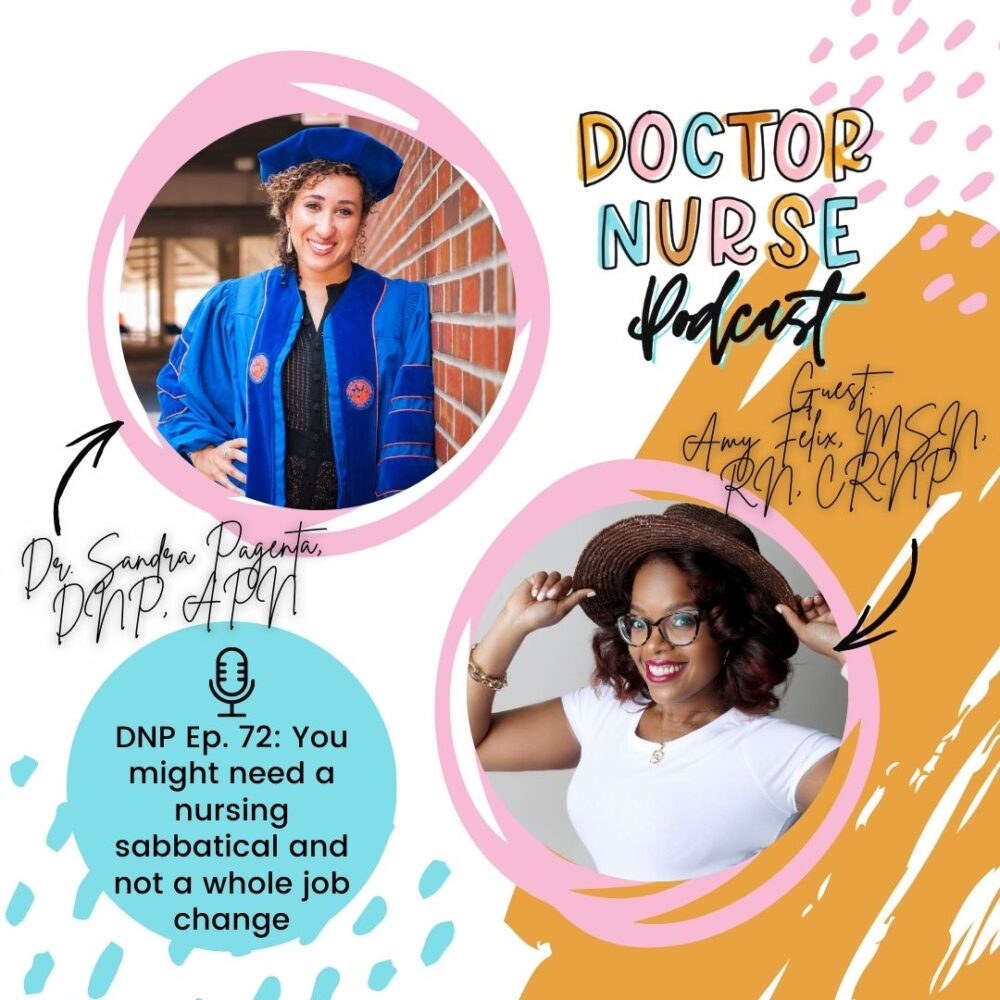
Dr. Sandra Pagenta: Dr. Nurse Podcast fam, welcome to another episode of the Doctor Nurse Podcast. Guys. Today we have on the show Amy Felix. She is a nurse with over 18 years of experience including critical care, outpatient, ambulatory and leadership. And she is going to come on and talk to us a little bit today about her journey, kind of what she’s been doing with her career and how she’s kind of metamorphosis her.
Career into now really advocating for nurses to take care of themselves. And I just think it’s such a neat thing. She’s also developed an app. We’re gonna get into all of that today on the podcast, guys. Welcome Amy to the podcast.
Amy Felix: Thank you so much for having me. I’m so excited to be here. Yeah.
Dr. Sandra Pagenta: Oh my gosh. And so for those of you that aren’t watching on YouTube, she’s like super gorgeous. So , we’re just so thank you. Like happy to have you on. I’m just really happy. I love your hair. Like I’m a little biased, but it’s fine.
Amy Felix: I mean, you know, from one curly to the next.
Dr. Sandra Pagenta: I completely get it. Exactly. I’m just loving it.
Alright, so again, I’ve kind of briefly introduced you. Tell my listeners kind of what it is that you’re doing right now. We’ll dive into kind of how you got to where you are mm-hmm. , but just tell me listeners, kind of how you see yourself.
Amy Felix: Sure. So, especially as we’re, you know, talking about 2023, I really truly see myself right now as an entrepreneur and sometimes I use the term as nurse entrepreneur because the work that I’m doing kind of encompasses so many different things.
And yeah, as a nurse entrepreneur slash innovator is how I see myself, right.
Dr. Sandra Pagenta: So tell me a little bit about what you have been working on some of the projects that you’re heading up and leading in your career. And these are just kind of the major ones, your two major buckets at least. So think you have at least two mm-hmm.
But if you have even more, just break into all the different areas that you’re sure that you’re in.
Amy Felix: So the things that I’m working on is, first I am the sole founder of the nurse sabbatical movement, which inspires nurses to take career breaks so that they can restore themselves and do their best work and find joy in the work they do.
Secondly, I am the co-founder and CEO of Track ce, which is a mobile application that supports nurses and doctors managing their renewals and for their licenses and certifications. And then lastly, I am doing some contract work on the side, working with a startup tech company called Burnout, Anticipation Technologies, which focuses on anticipating burnout in different units in hospitals.
Dr. Sandra Pagenta: That is so cool. So in that last role, are you working as kind of like a consultant, Correct. You guys, these are the signs, and if you’re seeing this, you’re about to lose a bunch of your staff.
Amy Felix: Exactly. So it’s an amazing company that’s just getting off the ground. We’re kicking off this year with using different hospitals to try out the model.
It uses technology app, which I love technology, and really looks at different areas to see where can we anticipate for now and not just prevent it. So this is a hotspot area. How do we start getting into these spaces and do almost like a rapid response to make sure that we prevent burnout from happening?
So it’s really from the spectrum of before we even happens. Let’s figure out how to deal with.
Dr. Sandra Pagenta: Oh my gosh. So I love that. Mm-hmm. and, because you remember, I don’t, I dunno if you remember this, but if, whenever I was in the hospital, we used to have this system where we would type in your vital signs. It was called like the Muse.
We would type in the vital signs and then it would tell us if a patient was like on the way down, like the patient was crashing, right? Mm-hmm. . And so you used to type it in and then every shift would get like a, a Muse score. So the muse score would be like 10 or five or whatever, and like correlated.
Okay. I think he’s getting really sick. So before the patient crops and then we’re trying to do CPR and cold blue and all this other stuff, there might be little tiny indicators that the patients aren’t doing well. So I think that’s what it sounds like. What you’re, what you’re describing to me is like an amuse amuse score for nurses that are on the way out.
They’re on, they’re on the burnout route.
Amy Felix: Exactly, and really trying to help see how we can help institutions use that information to help retain nurses. How do they make in the moment changes to support, not even just the nurses, but also the leaders who are leading the nurses. So I’m really excited about that project.
Dr. Sandra Pagenta: That’s so cool. So cool. Mm-hmm. . So Amy, tell me a little bit about how you got here in your career. I mean, take me through as you’ve been working as a nurse and you’ve 18 years of experience. You graduated with your bachelor’s in oh four, and then your master’s in, I have oh nine or oh eight. Oh eight.
Okay. Okay. Cuz I think whenever we typed it we typed 2009 eight and so I was like, I dunno which one, it’s okay. Which one? Yeah. So 2008. So you finished your master’s in 2008. Mm-hmm. . And you’ve been just kind of working, I remember when we talked before the podcast, you were like, I was just cranking. And you were mostly working in pediatrics I think.
Yes. And so, yeah. So kind of describe to my listeners kind of what led you to this point where you. . All right. I can’t do this anymore. Like I can’t keep climbing the corporate ladder. Mm-hmm. , like, take me through your story and your journey.
Amy Felix: Sure. So I think my story has been unique to me and I’m so glad for the journey and all the experiences that I’ve had.
I’ve always wanted to take care of kids. That’s always been my passion and I’ve always wanted to help people. And so in the work that I started doing, you know, my first role was a bedside nurse in the picu 55 beds, level one trauma center. The hardest of the hardest. And I loved it. I call it almost like it was bootcamp, like people talk about military, this was bootcamp cuz people were crashing.
They were dying. They were living like it was an amazing time. Within that space, I always knew I wanted to make more of a difference. And I think that’s what’s driven most of my decisions. And so when I decided to go back and become a nurse practitioner it was obvious that I wanted to have more of a say or a seat at the table in making decisions for parents, for patients and parents.
And so within that I did I did my NP and did outpatient gi. Which was like completely different right from critical care to, you know, working outpatient ambulatory with guts and poop and all that great stuff, right? Yeah. And people were like, are you crazy? Like, GI patients are crazy. And, but I knew I wanted a different experience.
I was feeling a little bit fatigued from taking care of the really sick patients and really just was. Open to the experience. And within that frame, like I got to learn so much stuff and really use my skillset as a nurse. As I was the nurse, the np, you know, the social worker, the care coordinator, and kept finding certain things that I loved to do and was passionate about.
It kind of thrive in that room. But lo and behold, after six years, GI just wasn’t the thing anymore. And I went to the emergency department, which kind of was like the Brennan butter of p. Again, an amazing time. Learned a lot, and leadership opportunities presented itself, right? So you think about the ladder, right?
People tell you, okay, as a nurse you can become anep or, you know, do research or you could go into admin and never in the more did I think I would do admin. Like I remember walking into the job the first year and meeting with my boss from one to. And I told her I could never do what you do. Like thank you for doing it.
But little did I know five years later I would be in her job. Right? So it goes to show that you never know what will happen. And I found myself in leadership after doing a lot of clinical work and saying, I wanna make a difference. I wanna have a seat at the table. I wanna advocate for my workforce.
The NP workforce, if you think about it in a unit, is so small compared to physicians and nurses. So how can I truly. Tell them what’s happening with our team. And so I did leadership for about five years and it was a great experience. You know, people find their passion and maybe cardiology in, you know, endocrine diabetes.
It never was a thing for me. It was always like, oh, this is kinda cool. I like learning about it. But when I got into leadership and leading people and helping people do great work, I found myself light up. You know, COVID happened. I became exhausted. The demands on the role was just do more, do more, do more with less time.
And I felt burned out, right? Like I was losing sleep. I had headaches, I had migraines. I was breaking out. I felt like I had no energy and time for the things that I loved. And even when I went on vacation, it still didn’t feel like. I would recover, I’d come back and I’m like, here we go again. And so I decided one day I was like, you know, I could look for another job, which is what typically people do.
But instead I think I wanna take a break and I’m gonna call it a sabbatical because you know, physicians get it and they were clinically priests get it. I mean, clergy get it. Different institutions are offering it and even McDonald’s. So like why can’t, why can’t we, as nurses, the most trusted profession in the United States, take breaks?
So I think my sabbatical has truly led me to all these various roles that I’m doing now, and really focusing on self-care, supporting nurses and inspiring them to do their best work while taking care of themselves and that it is compatible.
Dr. Sandra Pagenta: Yeah. So what did the sabbatical look like for you? Because I think that is so interesting.
Again, what you. Priest who pour into people, right? Mm-hmm. , like they come, they’re, they serve, they have a, a lifetime, excuse me, of service. Newsflash, nurses, all that’s all that we do is serve people. We actually serve them at the bedside. We’re like right alongside their hardest times and their hardest journeys.
Why don’t we get sabbaticals and sabbaticals From what I’ve known, and again, this might be a listener might be like, okay, what is this sabbatical? But it’s just this time where you just take a break and you just get a loan and you. Quiet and you just kind of listen to what your soul is saying. So what did a sabbatical look like for you?
And then what did you walk away from that sabbatical with?
Amy Felix: Exactly. So Sandra, you defined it correctly and while people might look at my story and say that it wasn’t necessarily sabbatical, cause I literally quit my job, but I’ll talk a little bit more about that afterwards. My sabbatical really was to take three months off to rest.
Like I knew I was burned out. I wanted. To just quiet my mind. I wanted to sleep in, maybe take a vacation on a beach and really just refocus on my healing. Mm-hmm. Let my life work out, meditate, and not be disturbed by the constant noises of a ding Microsoft teams meeting nonstop. Eat a real meal and not rush to do so in front of a computer while typing patient notes like the little things that we take for granted.
And so for the first three months, that’s what I did. Nothing people would say, you’re on your couch. And I was like, yes, it’s great to be on my couch and not having to focus on the next 50 things that I have to do. However, three months I was like, you know, by the second month I said, oh, I’ll start looking for a job.
But I wasn’t ready. I wasn’t healed yet. And so within four months, how did you know that?
Dr. Sandra Pagenta: How’d you know you weren’t ready?
Amy Felix: I was still retiring and every job that I looked at, I mean, I looked, I was looking at Ro Jo Jobs because I was saying to. You know, once I take this break, I’m ready to get back out there.
I’m ready to fight the cause, but nothing brought joy to me. Every job that I’ve ever taken in my life, I’ve been excited about every single one. There was nothing that was calling me to say the next step. Now I do believe in God. And I would say maybe there’s a spiritual portion to this where he was like, that’s not it.
But for me, in those moments, I, knowing that no job was appealing, I realized I needed more time. And so I took more time.
Dr. Sandra Pagenta: That’s incredible. I love that. So with your time that you took, Excuse me. What were the questions you asked yourself? What were the the little quiet moments and the whispers that you heard from your soul?
I hear that you said you were tired. What is something that you began to go, what does bring me joy? I mean, these are questions you had to ask yourself. Mm-hmm. , how did you explore? What, what was gonna be the thing that you would jump back into the workforce?
Amy Felix: Yeah, so I think it was multiple modalities. So I will say, and really do support nurses, or actually anybody really talking to a therapist or seeking counseling, because I think we see so much in our career that that also helped me transition to this space.
So I will, I will definitely say that was part of my journey. Part of it was thinking about what are the skill sets that I enjoy the most in the work that I do? Or what are the skill sets that I do effortlessly that bring me joy, which is me. Talking about wellbeing, supporting nurses, right? So anything in that framework.
And then how did I see myself wanting to work? So it’s not just the role, what did I want my day to day to look like? Do I want 10 hour days? Do I want 12 hour days? Did I wanna be on a, you know, device all of the time? And I realized those things didn’t. Resonate with me anymore. Being busy, the excitement of walking to the hospital did not resonate with me.
I realized I wanted flexibility. I wanted to do my best work, but be able to create and innovate without restrictions.
Dr. Sandra Pagenta: So what came to the surface? I mean, what was it that you walked away from this sabbatical, like Rip Roen ready to.
Amy Felix: Yeah, so I think two things really surfaced. In the midst of prior to me leaving my role, I had been working on this app because I really got frustrated with the process of renewing my three licenses and my two certifications, and I was like, this is ridiculous that I’m.
Copying pieces of paper, putting them in file folders. So my co-founder and I, Dr. Raja ier, had formed this company called Track, where we wanted to create an app to do so. But you know, when you’re kind of working on a passion project and it’s there and it’s like, oh, we’re slowly building it. And so in April of last year when I was ready to say, okay, I’m gonna find a job, the app was ready to go on the market and I was like, Like that wasn’t part of my plan, right?
But I was like, here’s this great opportunity. Let’s put it out there for free and see what happens. So we did and we started getting some traction, and then within a week or two, I entered my first pitch competition. Now I can tell you I may have watched a few episodes of Shark Tank . I come from a healthcare background.
I know how to do budgets, but pitching like what is. And so I entered my first pitch competition in the city of Philadelphia against nine other companies and got third place, and we won $10,000. And I think it was like ding, ding, ding. This is where you’re supposed to be. It’s gonna feel rocky. It’s completely different than you’ve ever done, but you’re still helping people using your nursing skills in a different way.
And I think those were the signs that told. You’re entering an entrepreneurship lane and you’re really gonna create this whole new thing that’s different.
Dr. Sandra Pagenta: And that’s okay. That is so inspiring. I mean, like, honestly, makes my hair stand up on, and it’s just so cool because again, like what you were saying about hearing and knowing from something higher.
Now for me again that’s, that’s God too like. , he does direct us if we quiet ourselves and we allow him to, and we get so busy in the hubub of everyday work and we just think about the paycheck and the stability, and we talk about faith, we talk about having faith, and yet when we are asked to step out in faith and do the scary thing, we’re like, no, that’s real scary.
That’s not secure. I can do that . And so you’re just like, I got faith, but like, you know, it’s just, you know, it’s like a shaky faith. It mean I’m there, but I’m not. Percent. And so like what you’re describing is just like stepping out in faith and just being like, okay, wait. Like what does this look like?
I’m taking a bet on me, mm-hmm. and what I’m, you know, able to, to accomplish and what I’m able to push myself to and the limits that I’m able to do or at least the limits I’m able to extend myself to. And so I think that is so. I think it’s just so neat that you were able to step into that directly out of that.
And even though you were looking for a job you were looking to do, that thing that we always do is to get back in the rat race and to get back in the boat and row the boat. Something told you No, wait, listen, wait, wait, wait. And we’re so busy rushing all the time that it is so good that you spent that time and you were able to hear yourself mm-hmm.
and you just seem like you’re just living in what is what you’re passionate about. So tell me a little bit about what you’ve done with the excuse me, with the sabbatical thing, because I know. That you were telling me, you’ve been encouraging other nurses, right? So you’ve got track CE that’s making, I guess I’m, I’m assuming it’s like a subscription service.
You sign up, you get the service right?
Amy Felix: Exactly. Yeah. So we’re the beginning phases of developing it, it’s running on, its like. Initial version, which we call the minimal viable product. And then we plan to hopefully launch this year as a paid subscription in collaboration with State Board. So hopefully that system or process can be more automated.
Dr. Sandra Pagenta: That’s so cool. And then the sabbatical. Yeah. The sabbatical experience and that whole thing has made you go. Hey, listen, I think more nurses need this. And that’s launched another side hustle thing that you’ve been a part of. Tell me a little bit about
Amy Felix: that. Exactly. So really and truly, it was more of me just blogging to say, Hey, this is my experience.
These are the things that I’ve been feeling. Is there anyone else feeling it? But as I started sitting with it more, I was. Like I wanna help other people. And people have reached out to me and say, Hey, like, are you still on sabbatical? Like, what did you do? I had, you know, other people who also left the similar role to me and took a month off.
It doesn’t have to be a long period of time. And they just felt rejuvenated. I had people who questioned like, I wanna leave my role, but I’m not sure. And I was like, well you can do all these things. Don’t worry about the money, but you can make a different lifestyle for yourself. Cause nursing is truly a great profession and you can.
Anything you want, we just have to be reminded to use those skills to do as such. So I’m really excited that this year I’m gonna be launching a course to support nurses with some group coaching on how to do their own sabbatical and use their skillset to rediscover their passion for nursing and find roles that really are, you know, suitable to the lifestyle they wanna lead.
Dr. Sandra Pagenta: So look out for more information and that comes this February. That is so cool. So what are some of the goals that you have for the sabbatical course that you’re gonna launch?
Amy Felix: So really and truly to hopefully inspire 50 nurses to take a career break, and re kind of refocus how they wanna work and how they wanna live.
And, you know, my big, big goal, which is not this year, is really to get a sabbatical program within an institution that is sponsored so that nurses, you know, so many times we’re denied vacation can take a month off and rest and come back refreshed to do the work that they. Yeah. Yeah. That’s like my big big goal.
Dr. Sandra Pagenta: Yeah. Then that would be really cool. And again, just even if that was something that we could do every year, I think that we would probably retain more nurses where we could have the coverage to step out, right? Because we’re in this nursing shorts, and I can imagine institutions being like, oh my gosh, how are we gonna let a nurse take a month off?
Yeah, we’re already short. Hey, you are already short because you don’t let nurses do this. So if you allow nurses. to have the break, to have the space, to have the time to go. I have the next month off. I get to just think and create and mm-hmm. . Cause I believe we’re creative people. Like I believe something inside of us.
When you think about biblically, we’re from a creator who created the world in seven days, right? Like that was his job. He spent seven days, he created the world, he spent the last day of rest. If the God of the universe needs a day of rest, you don’t think you. So one thing I love about it is that he shows I love creating.
And then I also need rest. Right? Exactly. And so those are two themes that we get from the Bible that are very clear on how we should live our life. Which again, I’m not saying we can’t work in institutions and systems that are already created for us. That’s not wrong, but I do believe that there is.
Something in all of us that desires or is something that’s been implanted in us for us to build, for us to make, because we all have a contribution to make in this world. One of the things I noticed as well, and, and I I, I was telling my husband this and my poor husband, he probably thinks I trips super hard on stuff, but.
I notice that in toddlers shows, which I know I’m a, you know, I let my kid watch tv. He, I’m sure people will be up in arms about that, but yeah, I, I let him watch tv. Mm-hmm. and I, I monitor what it is, but I notice they all talk about being a hero. All of them, you know, spider, he’s a hero. PJ Max’s the heroes.
And it’s always the heroes and the villains, right? Yeah. And I was thinking about it and I was like, why are all the shows for kids based on the same premise? And I think it’s because there’s something within us that wants to change the world, contribute.
To, to be this thing that’s like, I did that. Like Right. I made that. And so I think that that same childlike desire is on all of us. Mm-hmm. , but we suppress it with pills, with bills, with, you know, obligations. Mm-hmm. with all the things that we think are things we’re supposed to be doing. And yet that child still stays in there and is like, I wanna, like, what am I meant to do?
Like, am I meant to be Spider-Man? Am I meant to be gecko from PJ Max? Like, what is it that I’m supposed to do that’s supposed to bring, that’s supposed to, that’s my role as mm-hmm. , you know, the hero in my own journey and my own story. So I think it’s something that I’ve been looking at and I’ve been wondering like, what is that?
And then how do we apply that? Ourselves as adults, because I’m starting to realize that toddlers are just uninhibited adults and , it’s wonderful. It’s sometimes really tough, but it’s also super wonderful to watch, right? Cause you just realize like, I mean, they’re tired. I need to eat food or, you know mm-hmm.
like, there’s just certain things that really don’t change about the way that we are. But yeah, I think that that is something that. I think is very interesting. Anyway, this might be a huge aside, but let’s chat again, keep it on, on, on task here. What was one aspect of business that you have found challenging to overcome?
Mm-hmm. . And then one aspect that you felt like your nursing skills helped you in navigating.
Amy Felix: Hmm. I think just understanding business, like I said, I, I’m purely from a nursing background. I have no idea about marketing and different terms and technology, like we understand technology from our standpoint.
But it be, it could be very scary when, you know, you’re learning a business or even how to build it and the forms and everything you have to figure out and I was nervous. I was like, am I really doing this? Like am I doing the right thing? But then if you think about nursing, right? Like when we go to school, we get all the books that tell us, okay, these are the things you do and it somewhat prepares us for when you’re the patient’s in front of you.
Because things are always going awry. And you know, through my career I’ve transitioned to different specialties so many times that starting new afresh and learning something, Is not the first time and it’s not gonna be the last time. So going with that same mindset that it’s not gonna be perfect, but I’m gonna learn it as I go and get better.
Is really what’s helped me get this far. And especially in talking to people. I feel like as nurses, we talk to so many people all the time that even today my friends are like, everywhere you go, you meet people. And I was like, don’t you talk to people? Right. But I realize that’s that’s my special ad, that’s my, my gift.
Right. And I just share it with others, so I superpower help me. That’s my super. That’s your superpower. Yep. That’s how I’ve found people to help support me as I’ve moved into.
Dr. Sandra Pagenta: Yeah, that’s really good. And then what is something that you felt like was a natural, and again, that’s by what you’re saying. My natural ability is I was a nurse and so I’m able to just go into the room and talk to complete strangers and feel very comfortable.
And then the part is I don’t really know business and I don’t really understand these things. And so it’s something new every day. It’s something challenging, which is nice. Right? I mean, that’s that neuroplasticity, that nurses, I think have to have a lot. of, because we aren’t specialized. Whereas physicians, you know, they, they perfect in their little area.
Right? Urology or gi or, and they get really, really specific and they niche down really, really well. But nurse practitioners have the options of walking into a GI clinic and taking patients and walking into a urology clinic and we can just be really flexible. Which you know, again, is more challenging, but again, that neuroplasticity that we’ve gotta, yeah, then use, it can actually translate into, hey, you need to learn business.
And however you learn it, either through a course or through a mentor or through asking or whatever might take you a little bit longer, but you’ll get there. It’s just gonna take some time. So I think that’s really, really neat. And if you could talk to a, a, a nurse that’s burned out, she’s exhausted, she.
I want a sabbatical. That sounds great. Oh my gosh. Mm-hmm. . I think there was this John Christ. He’s a, he’s a comedian, but he did this, this act where he said He was in rehab cuz he had some issue. And so he went to rehab and he called his friends and he told his friends, I’m in rehab. Mm-hmm. and they have children.
So she was like, he’s like, yeah, he was complaining. He’s like, they make my food for me. And I just have to like, go and like, meditate and like, I just gotta like be. Quiet and I can’t like, you know, whatever, whatever. And I’m always outside and the, the wife was like, can I go to rehab? Like, that sounds wonderful.
Like, and so it was just really funny, like skip, but I was just thinking like, you know, what is, what if, what if there was a nurse that’s like, listen, I want a sabbatical. Like that sounds great. What would you, what would be one of the things that you would tell her to do or to start in order to maybe consider doing a sabb?
Amy Felix: I would say number one, first of all, believe that it’s possible. Like I never, and I think it might be the TA of me, the word no doesn’t really exist. If it’s no, this time, it’s find another way because anything is possible. And then secondly, I would say understand your why. Like I think I knew what I wanted from it, why I needed to do it, but I think once you underst.
That it’s possible and why you wanna do it, everything else can fall into line, right? Your why drives you, your why feels fulfills your purpose. And it, it helps you in the moments when you have doubt, fear that you can do this thing. Yeah. So those are the first two things that I would say that you.
Dr. Sandra Pagenta: Yeah because I would imagine, you know, again, if most Americans are living paycheck, paycheck, then mm-hmm.
how do you just break away from your job for, for two months or whatever, right. I’m sure you. Just were like your work hours, you just like put money away. You’re like, I know this is what I’m doing, so I’m gonna prepare. I’m gonna build the nest, I guess.
Amy Felix: Well, well, yeah, and I think it, I mean, there’s two different ways to do it.
I’ve met someone recently who just really told their boss that, and I think I would’ve had, I had this option that I’m really exhausted and I need time off. And they were able to get a month off from work, right? So it’s really, if you think about it right now, it is the nurse’s world. You can decide how you wanna do things.
People may look at you differently. They may talk about you like, how dare he or she do this? But really and truly you can design it how you want it to be done. So there are some people who have taken paid, there’s some people who have done vacation time in order to get. For me, like I said, I needed to break free completely.
And I was lucky enough that, you know, I came off the year of the pandemic where I was able to save a lot of money. Cause I wasn’t able to travel. I paid off my student debt and so I was debt free and I was like, I can afford to put money into me. Ooh, I can afford, I can afford to do this. Right? And reading books like the Psychology of Money, time is money, right?
And money buys You Freedom. And that’s what my savings. And having a strategic plan, like looking at, you know, you know your sick time, your paid vacation and all of that, and you just live differently. Like, and not to say that I have not been traveling and. You know, the way that I normally am accustomed to, but certain things I didn’t need anymore.
I didn’t have to buy lunch five days a week. Why? Cause I could make food and it was like, great, like at 12 o’clock I’m cooking lunch for myself. Instead of ordering from GrubHub, that would take an hour.
Dr. Sandra Pagenta: Those were the benefits for me. Yeah, that is so well said. And then if you could go back and tell yourself one thing at the beginning of your career that you would say, Amy, I want you to hold onto this piece of advice.
What would you tell that, tell that young Amy. And what is a piece of advice that you would tell her, this is garbage. Don’t listen to it. So a piece of advice that she needs to hold goes to her heart for the rest of her career. And then one piece of advice that you tell her, eh, this is
Amy Felix: Gab, it’s tass, it.
I think the one piece of advice I would tell her is that your path is gonna look different and it’s okay. I think, you know, coming up as a young nurse and starting with other people in the icu, you’re always watching your, your peers to see how far are they scaling. I remember the first time that one of my peers was charged nurse after two years, and I’m like, I’m just as good.
Why can’t I be charged nurse? And then advocated for that and always trying to be on that same level. Right? And there are probably many reasons for that as I like, push myself to be the best that I could be. But understanding that my path. Looking different than others, and that’s okay cuz it’s still gonna get me to where I wanna be.
So I would say that would be the one thing that I would tell my, my younger self. The second question was,
Dr. Sandra Pagenta: what is the piece of advice you would tell her? If somebody comes to you and says this to you, this is not true. Don’t believe it. This isn’t true. It
Amy Felix: isn’t true. You have to work this hard all the time.
Dr. Sandra Pagenta: Oh, that’s a good one. That’s a good one.
Amy Felix: You have to work. That’s one of my favorites. Have work this hard. Yeah, you have to work this hard all the time. I think, you know, I, I’m also kind of like this anti hustles culture. I’m over it and I’m not about it. I’m not about checking emails on four different devices every single hour to make sure I’m super aware.
I think that, it’s important for quiet time as we discussed before. I think it’s important for silence and you can still get the work done. But yeah, that would be my one piece of advice.
Dr. Sandra Pagenta: Yeah, because when you think about it, Again, going back to a similar concept we were discussing about, you know, the, how the Lord built the world
Like that’s not a small project. It’s not, he did that in seven days, right? And then he spent time for rest. And so I just find it. Ironic that he spent one seventh of the time of the week in rest and absolutely doing nothing. Which again, it doesn’t describe what he was doing, but he was resting, whatever that looks like to you.
And it wasn’t a legalistic thing. I think it’s just the way that nature needs it to be. Like you can’t just keep going. Mm-hmm. . And you do feel that way? You do. I mean, we run low on sleep. We don’t take our time to eat. There’s a lot of literature out there on taking your time when you’re eating to step away from the work and go sit outside and eat.
I find in my clinical space right now that I don’t even have time to go sit outside and eat. I have to be at the desk writing notes because if I’m not there, I’m gonna be there late. And so that little 30 minutes, what were you gonna say?
Amy Felix: No,
Dr. Sandra Pagenta: please don’t finish. No, no, no. That was it. That was all I was gonna say.
It was. Oh, so So It’s awful. It’s awful. No.
Amy Felix: Awful. So I think, you know, really how I got started in this wellbeing work is that I was the manager of almost 40 advanced practice providers in a busy emergency department with over 80 something beds. And the thing that drove me, the craziest the most when someone says, oh, I don’t have time to eat, I just have to keep going.
And I was like, what are you talking about? Cause I also get hangry, like the Snickers commercial if I don’t eat. So that’s really. It’s a toddler for me. Yeah, it’s a toddler, right? . It’s a toddler. But I know how to take care of a toddler, right? . But it’s this idea. As nurses, we have to keep going. We can’t take breaks.
We can’t take vacation the day that we have off. If they call us for overtime, I feel bad for my team, so I have to go in or that extra X amount of money is what I need to propel me. But what is it that when you do go in and you’re tired and you’re exhausted and you’re not giving your. Right. Again, the toddler comes out and I think it’s us realizing like, wait a minute, maybe I do need to take the 20 minutes just to even talk to someone.
Just change, just take a breath. Would really just change how the rest of my day flows. And also as an aside, as a nurse, it was super embarrassing to go out and eat socially because I’m so used to doing this that when you’re, when you’re out, people are like, we just got the course. How are you done already?
I was like, oh, you’re not sorry.
Dr. Sandra Pagenta: That is so funny.
Amy Felix: I know, I know. Other nurses must resonate cause it’s like Thai food coming down. We gotta call Paige.
Dr. Sandra Pagenta: Like, yes, that, oh my gosh, that is so funny. Oh, I can totally see that happening. Yes, for sure. And I think one of the things that I, I listened to Tony Robbins and like, it’s one of the things he said one time was he was like, you need to take five minutes for yourself to meditate.
And he goes, and if you don’t have five minutes, what kind of life are you living? It was like such a statement and I just remember stopping and just being. He’s a hundred percent correct. If I don’t even have five minutes. Five minutes in my life to sit down and deep breathe, what kind of life am I living?
And again, if I can’t take a month, 30 days to 30 days, spend. Out of my, out of my year, of just working to listen, to hear, to rest, to recoup again. What kind of life am I living? And I don’t think we ever stop and think about it. I don’t think we ever stop and think. I think I deserve rest. Like, and I actually believe that this rest will be restorative and bring me back to work even better.
So you want me gone? You don’t want me here. I want my toddler to nap. I, I miss him the moment he’s asleep. I’m like, oh man, I miss that kid. I want him to nap because he, it’s awful. So it’s that same thing. It’s so interesting that we accept these things in other areas of our. But for ourselves, we don’t give ourselves the option to go, but I’m feeling a little taller.
Like, I’m gonna go take a five 20 minute break during my day and if I don’t have 20 minutes during my day, for me, I gotta find another job. Like I gotta go find something else. Cause I can’t keep doing this. This is not, this is not acceptable. And when you set that in your mind that this is not acceptable anymore, it changes everything.
You begin to just go, this is the standard. You’re not meeting it. You need to go, like I, and you just, you operate differently. You attract things differently. Mm-hmm. . And now you’re able to help other nurses do exactly what it is that you needed to do, which is something unique to. I think that’s, That’s incredible.
So for the,
Amy Felix: I’m saying that
Dr. Sandra Pagenta: like, this is preach girl, I’m up on my cell box. Somebody take me down cause I’m up here . So, okay, so tell me, and this is for the last part of the interview, we’re gonna do rapid fire. Okay. And so rapid fire you can’t prepare for and just far by the seat of your pants, just give it to.
What you got, what comes to the surface and what’s your favorite holiday? We’re coming up a lot of holidays, so I just thought I would ask, oh, what’s my favorite holiday?
Amy Felix: I would say Christmas. Christmas, Christmas. I think. Yeah. I think it’s all the traditions, the family traditions. My family’s from the Caribbean.
There’s certain foods and things that we eat and it’s just like,
Dr. Sandra Pagenta: oh, it’s just homey. Love it. It’s so homey. And what’s your favorite color? Favorite color? Green. Green. Like what kind of green? Like an emerald green, like a Kelly Green, hunter green
Amy Felix: or like it’s on, it’s like a between a green and a blue.
So it’s like a turquoise kinda blue, like almost like a jade, which is kind of the color of like the narc sabbatical cuz it’s just so calming.
Dr. Sandra Pagenta: Oh, I love that. And if you had to give a gift to someone as a book, so you have to give somebody a gift, a book as a gift. Which book is it? Oh, my light just went out.
There it goes. It’s back. Which book would you give? Oh,
Amy Felix: I’ve read so many good books. Most recently, I would say this year, I would honestly say the psychology of money. I think that we are driven so much by money. Like we need money in order to pay bills and live, et cetera, that we sometimes don’t really understand its power.
And if we have a better understanding of it, then we’ll have a better way of using it to design the lifestyle that we love.
Dr. Sandra Pagenta: I love that because it’s true and there’s a lot of trauma around money. There’s a lot of generational Christ around money. Yeah. And so if you can break down what it is like your dysfunction is with money I think you would learn a lot about yourself.
I mean, even just in the time that I’ve been an adult, I’ve learned there’s certain things about money that are triggers and things that are just, they’re just tough. I think that’s cool. I’m gonna, I wrote it down, so I’m gonna check it out. Yeah, definitely. Amy, thank you so much for your time today.
Amy Felix: No problem. Thank you so much for having me. It was a pleasure.
Dr. Sandra Pagenta: Is there any like shameless plug you’d like to give so people can find you on all your social medias and all that jazz?
Amy Felix: Sure, definitely follow me on Instagram, on the nurse sabbatical or Facebook, the nurse sabbatical. Like I said, I am here to help inspire and support nurses take breaks so that they can do the work they love with ease and not stressed out.
And will be launching a group coaching program. So please come find me, send me a dm. You can also email me as well. All of my information is on my blog as well. WW dot, the nurse. Do.
Dr. Sandra Pagenta: Fantastic guys. Check her out. And as always, guys, enjoy the journey of your careers. Thanks for hanging out today.
Podcast Description
Amy Felix is a nurse with over 18 years of nursing experience including critical care, outpatient, ambulatory and leadership. Amy graduated from the University of Pennsylvania School of nursing with her Bachelor’s in 2004 and her Master’s in 2008.
Visionary Nurse Leader with demonstrated expertise in cultivating and managing exceptional teams to meet and exceed demanding targets and improving operations through effective employee motivational strategies. Recognized as part of the Young Voices Class of 2022 by the American Organization of Nurse Leaders as an upcoming exemplary leader within the nursing profession.
With 18+ years of nursing experience, skilled in providing exemplary care to pediatric patients in hospital acute and outpatient settings including intensive care units, outpatient subspecialties, and emergency medicine. Passionate about quality improvement in healthcare, nurse wellbeing, leadership development, and diversity in nursing.
Currently on a sabbatical to reinvigorate her passion for nursing through blogging and leading her tech startup company, TrackCE.
Linkedin – www.linkedin.com/in/amy-felixmsn
Instagram www.instagram.com/thenursesabbatical
Facebook – www.facebook.com/thenursesabbatical
———————————————————-
Follow up with the Doctor Nurse Podcast here! Success NP- Etsy Shop developed by my best friend and me who are both Nurse Practitioners and create beautiful designs for your life! Check us out.
Picmonic covers thousands of hard-to-learn facts and topics, to help you master the material that healthcare students often struggle to learn. This study system helps boosts nursing and nurse practitioner students’ confidence and grades. Picmonic learning system students increase retention and test scores. Why does Picmonic work? Years ago, psychologists and education researchers found mnemonics to be an effective tool in increasing retention and memory recall. Today, lots of different strategies for learning and memorization using mnemonics exist including keyword, phrase, music, and image mnemonics. Using the idea of image mnemonics and applying clever pictures and humorous characters tied together with story and audio — and put it online to create the ultimate studying system for retention and memory recall. Use code DOCTORNURSE for 20% off your subscription.
Latest Episodes
Doctor Nurse podcast brings you weekly shows to help INSPIRE, EDUCATE AND EMPOWER nurses with true stories of initiative and impact.
Doctor Nurse podcast brings you weekly shows to help INSPIRE, EDUCATE AND EMPOWER nurses with true stories of initiative and impact.
Latest Episodes
Doctor Nurse podcast brings you weekly shows to help INSPIRE, EDUCATE AND EMPOWER nurses with true stories of initiative and impact.