Also Available On






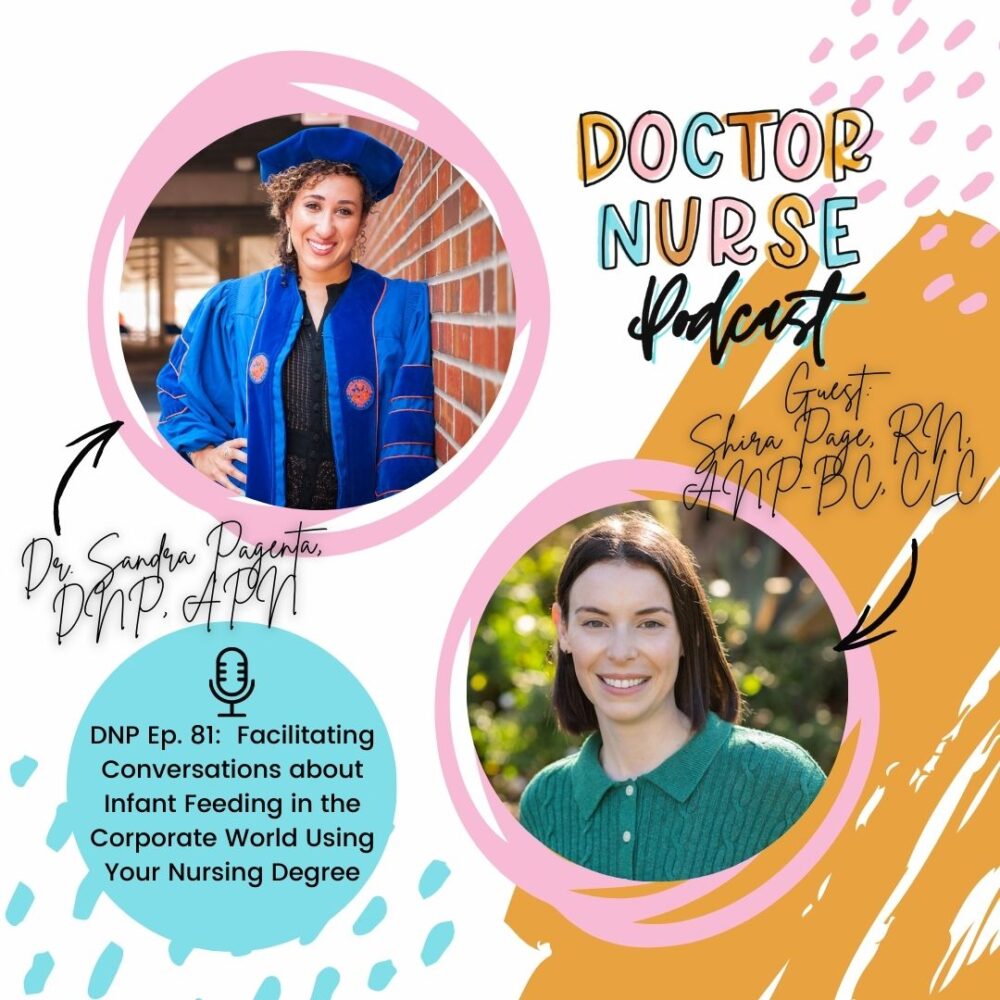
Dr. Sandra Pagenta: Dr. Nurse Podcast fam. Welcome to another episode of the Dr. Nurse Podcast. Today I have on Sheira page. She is a nurse practitioner and is the Bobby Medical Community Manager for the Bobby Formula Company. Her career has centered around improving clinical care. Of people in their most challenging moments.
She studied nutrition and dietetics and fall and followed by a master’s in nursing at the University of Massachusetts Medical School. Her expertise is in endocrinology, women’s health and weight medicine. She worked as a nurse practitioner in Mount Urban Hospital. Focusing on endocrine concerns during pregnancy postpartum.
After becoming a mom, she saw firsthand the challenges of infant feeding and became a certified lactation consult or L certified lactation counselor. Before joining Bobby, she serves as the medical director, as we said earlier at the community continuing medication medical education company. At a continuing Oh, you did that before you were at Bobby.
I think I read that in your history. Yeah. Yeah. You, you served as a medical director at a community at, at a con, I cannot say that word. Continuing education Ed company. And she was designing clinical education materials, I’m assuming to improve patient outcomes. And she lives in Boston with her husband and HER two Beez.
Welcome to the podcast. Thank you.
Shira Page: What a beautiful introduction. Yeah.
Dr. Sandra Pagenta: Yeah. So happy to have
Shira Page: you on I’m really excited to be here. I am a big fan. I just love nurse podcast. The talk about career, I think, you know, like. Five years ago, there weren’t that
many of them. And I, that was when I was really at a turning point in my career and I was trying to like soak up any information that was out there, find other people in the space who were looking to make career changes or look outside of clinical care.
And I felt totally alone and isolated. And now that industry is like booming and people like you are paving the way to elevate nurses and make them feel like. The world is their oyster and there’s just so many options out there and empower them in their careers and that that just makes me so sweet. So thank you for the work that you do, and thank you for doing this work as a new mom life deep in it.
I really appreciate it.
Dr. Sandra Pagenta: Heck yeah. Well, thank you for saying all that. That is so just kind. Very, very kind. Shira. So when you reached out to me, About the podcast. I was so excited to, to talk about the thing that we’re gonna talk about today, which is a little bit about your career, kind of how you got started, what you’re doing, and then also the conversation around breast milk formula, mom shame, and that whole like, That whole thing.
So what we’re gonna do is we’re gonna start off a little bit with you just telling us kind of what your job is. Most people don’t even know what a medical community manager is. I don’t know, you know, fully, I know a little bit now that I’ve met you, but outside of that, kind of explain to my listener who’s just like, wait, what does she do?
Kind of what you do for a living. And then yeah, we’ll dive into the other things. Totally.
Shira Page: So actually my title has changed a bit, or it’s Medical partnerships manager now. Because I think, you know, medical community manager and partnerships were very similar, but we started focusing a little bit more on.
The partnerships aspect of things. So I joined Bobby almost a year ago now. I was coming from, like you noted from the continuing medical education space, which is very much entrenched in pharma. And I was a medical director there creating clinical content and assisting with how we build out a strategy to get funding from pharmaceutical companies for education.
Great. And I was kind of looking for something that felt more mission driven and aligned with. Something that I was super passionate about. I really had wanted to be in the women’s health space for a very long time. Been obsessed with maternity and motherhood, infant feeding my whole life. Obviously, I pursued a certified accusing counselor certification.
Doing a lot of women’s health in my clinical career and technology, and so I got this role at Bobby, which was really working to engage clinicians around infant feeding. So got them to know that we have a new infant formula on the market, but also just help to improve infant feeding clinical care through provider education.
As you and I probably both know in competing some massive knowledge gap in clinical care. So you know, if you are a physician, even in a pediatric residency, you’re getting minimal education on breastfeeding and in competing in general, if you are under nurse practitioner, even in a family nurse practitioner track for maybe getting like an hour of didactic education on that topic unless you seek it out.
If you are a labor and delivery nurse, even if you are set up to pursue your I B C L C, within doing labor and delivery nurse care, you can have very limited mentorship and just have someone signing off on your hours. So there’s all these spaces for just massive gaps to be created in the endpoint, which is providers supporting parents in, in infant computing, and not having the knowledge or evidence-based practice to do so.
So that’s something I’m really passionate about fixing, and part of my role is creating education so that we can fill that gap. I also help healthcare providers just get content around infant feeding help to understand our product, both on the ground, in medical offices, at medical conferences through continuing education content resources.
And then very focused on creating a community of healthcare providers that are passionate about infant feeding. And they kind of see this. Dichotomy that exists in the infant feeding narrative, which is either that breastfeeding is the only way that parents should feed at all costs, regardless of what’s going on with them or their babies, or how challenging it is or their situation outside of the feeding experience.
Or on the flip side, providers that are kinda dismissive of breastfeeding and they’re just like, well, you know, this isn’t really working out like. Here’s formula. Just it’s not that big deal. Just go and do it. And they’re not acknowledging parents that maybe breastfeeding is really important to them. So trying to.
Get rid of that dichotomy and bring providers together to have more nuanced conversations about this topic so that we can actually support parents in reaching their goals, in feeling like this is an empowering experience from start to finish instead of something that has just become so wrought with shame and suffering and.
Just people dread, like people started to Dr. Have started kinda dread feeding their babies when they get pregnant and start to think about new motherhood because all they hear are horror stories or they don’t feel like they have the time and space or resources to feed their baby. They want to. The way they want to, or they know that they’re gonna feed their baby in a way that they’re not gonna feel supported in doing so, both breastfeeding and formula of feeding parents tend to feel this way.
Either they feel like they’re ashamed by their family or their healthcare provider, or they’re doing the wrong thing, or their friends are all doing something different. So healthcare providers are really at the center of this, and my job allows me to give them the tools and resources to make this a better experience and also bring in more evidence-based care to this clinical domain where it’s really lacking.
Yeah,
Dr. Sandra Pagenta: and that is a very interesting way to use your nursing degree and the abil and what you’ve learned through your experience as a nurse practitioner to actually be able to have a corporate job to work in corporate America and be able to bring that side, almost the humanistic side of. The people that you are creating the formula for, you’re actually bringing what I, what I kind of see is this humanistic side to, Hey, listen, how do we bridge those gaps between what the medical community is doing, between the patient, between what we’re providing as a formula company?
And I think that’s actually really, really cool. And I, you know, I, I. I wanna make sure that I’m staying true to what I believe. And, and again, I think this is just something for me personally here, the Dr. Nurse Podcast that I believe breastfed, breastfed babies and babies that are breastfed is the best thing for them as a healthcare professional, we know that milk comes, that comes from you as the mama is the best, and that they, children that are breastfed have lower rates of asthma, ear infections, diarrhea, vomiting helps reduce the rate of type two diabetes in mothers as well as certain cancers.
We know that it’s an active food, right? That it has enzymes that in live cells that tailor to your baby’s knee day in, day out, these are concepts that are just IR refuted in the literature and we know that that’s, these things are true. However, I also know, and that you’ve said very briefly that they are situations that make it hard for moms.
Right. We’ve talked a little bit about systemic issues such as lack of maternity leave, these things that moms don’t have access to, they don’t have support at home. There aren’t. Obvious and, and always easily accessible resources. like lactation consultants, things like that, that help bridge those gaps that you’re having if you are breastfeeding and kind of like what you’re saying, dreading every moment of breastfeeding.
However, what I think and what I really wanted to create a conversation around was, you know, as formula companies and as a company that’s creating formula, they have an obligation to provide a certain formula. Quality. And then as parents, we have to make those decisions. We also know that not all formulas are created equal, and that there are, like we said earlier, there are circumstances that prevent moms from doing that.
Again, you could have had a breast augmentation surgery that can cause you to not produce milk. There are real, real things that people are dealing with that make it hard. To breastfeed. I found it interesting last night when I was doing research that 84% of American babies are breastfed at birth, and then by three months that number has fallen to 50%, and then by six months, that number is down to 25%.
So 75% of babies are getting some type of formula by six months. Right? I mean, that’s, that’s the reality of the situation. So we can, we can, you know, walk around the nuance, but we can also realize that no, these things are things that we’re having to deal with as parents and so we’re hoping. That there is somebody bridging the gap between the medical community and the providers and us as the parents.
So I think that’s really, really interesting and good to talk about. And again, this is a global issue that we’ve got to chat. And again, Bobby is actually what I purchased. I purchased two cans. Prior to having my baby, I am eight weeks postpartum. And I purchased your formulas for my daughter just in case I wasn’t able to produce milk because I need to feed my baby.
And so I felt like your formula was the best that I did my research on. I’m always picking for myself, this is not coming from them. I did my own research and felt like this was the best thing, and so I actually supported your company. So I was glad again to chat with you about it today. Giving all of that and feeling that way.
So tell me a little bit about why you feel like this culture is there surrounding moms and the guilt that we feel about kind of feeling pushed to breastfeed versus, supplementing or yeah, kind of where this stems from and your experience kind of where you’ve been working, what have you been getting from people?
Shira Page: Yeah. Well thank you for everything you just shared as well. I think it’s interesting and might be be helpful to provide some context just to share a little bit about my own story. My. Mom is actually, or was a Lache League leader when I was growing up. And if you aren’t familiar with Lache League they’re breastfeeding advocacy organization, international.
They’ve done a lot of fantastic work in this space for getting breastfeeding education and support out there. On the flip side, they are incredibly dogmatic about breastfeeding and do not allow any sort of discussion of formula whatsoever. They’re very focused on attachment parenting, and. Parents being with their babies 24 7 to allow them to breastfeed.
Which you know, is fantastic and is ideal. That does not fit into many American parents lifestyles. It is not inclusive of parents who are not lactating parents or couples that do not have a lactating parent. And it doesn’t really align very well with parents who are working 40 hours, 40 hours plus having to go back to work at six weeks.
Mm-hmm. Mm-hmm. It also just doesn’t align with some people’s preferences. So, you know, I think it’s important to incorporate in this conversation. You brought up a lot of examples for why someone may not be able to breastfeed at all, or why they may be not able to breastfeed exclusively, why they may need supplementation.
Those are, there are so many situations like that, but I also just wanna call out to parents who maybe feel for whatever reason, that this isn’t the choice for them because those parents exist and. They don’t think they owe it to you or I or to their healthcare provider or to their friends or their mother-in-law to necessarily have a reason, right?
Like it’s their body, it’s their baby, and that’s. Their decision. And I just wanna be respectful of that because there are so many reasons, whether it is their mental health, whether it’s a history of trauma, whether it’s how they just envision their parenting journey or, you know, I have a, a very close friend who is planning to get pregnant.
In the next year who just has like severe anxiety around health and body and she has already made the decision that she’s gonna exclusively formula feed. And it’s just because she knows that it will destroy her parenting experience to try to have another thing involved that involves her body being self-sufficient. That’s definitely something to digest and like work on and. It’s not ideal that she feels that way, but she’s made that decision and I just wanna respect all those people that have decided that that is not the decision for them. Going back to the thing that you said before, it is true.
From CDC data, we know that about 75% of US parents will use formula in the first year, and there’s other research. That calls out that about two thirds of those parents will feel guilty about doing so. Two thirds of parents who use formula to feed their baby in some capacity will feel guilty about that.
Just this morning I was talking to an I B C C who works in the New York City area, and she was. Sharing with me that, you know, she sees parents who like have gone through traumatic births or have been septic post-birth and had to supplement because obviously they’re not creating a full milk supply after that.
And they’re like wrought with guilt about doing that. Mm-hmm.
Dr. Sandra Pagenta: I had to do that. Yeah. I had to do that when my son was born in the nicu. He was born with blood sugar issues and my milk hadn’t come in, and so we had to supplement with formula. While he was in the NICU for four days. And so yes, I a hundred percent agree with you.
I didn’t have, and again, can you imagine like, I feel awful, this birth experience has gone dramatically the wrong way. I don’t, I did not even, you know, again, C-section, all the things, and he’s in the I C U. I never got to hold him like until the first, like for the first four hours. I didn’t even know where he was.
I mean, it was very traumatic. And so then I go up there and see him and my milk’s not here. And he’s hungry. And he’s hungry because he has a blood sugar issue that’s causing him to need nutrition immediately. And so, We have to, we have to formulate, I had to supplement with formula right from the get right.
I didn’t have an option because my kid needed food. So, again, I totally agree with you. There are many situations that require you to use formula and, and, and you do feel awful cuz not only has this experience not gone the way that I wanted, the trauma of birth, but now the feeding part, the part that I’m supposed to be naturally equipped to do, I can’t do right now.
I’ve gotta. Feed him again, ar like the way that I don’t want further furthering the trauma of this is not what I want and, but I have to do it. So yes, I totally agree with you.
Shira Page: Yeah, that’s, and it’s so unfortunate, it like breaks my heart to think about because this is such a, this is such a magical time or has the potential to be such a magical time and.
Entering into parenthood and birth and feeding. Your baby also has the ability to be empowering, and there’s just so many touchpoints where it has become a disempowering experience that creates trauma, that sets people up to feel like they lost something or they should have had it differently. I think, you know, you mentioned C-sections or surgical births, and that is a great parallel in a lot of ways.
And we’re really starting to like shift the narrative on that. But parents who feel like the only way to have a quote unquote successful birth is to have like a non-medicated or for vaginal delivery.
Dr. Sandra Pagenta: You don’t get a shirt for that, by the way. You don’t, you don’t get a shirt at the end of it for doing it that way.
So bring on the up and down.
Shira Page: I mean, and then it’s just so like, it just colors their whole postpartum mixed. Experience to feel like they had that option taken away from them. And, you know, I don’t wanna sidetrack us getting into all the nuances of birth at the, the, the birth system and choice in birth. Like that’s a whole nother conversation.
But I do think it is a good parallel because. You would never have an OBGYN go to a parent and say, well, you know, if you don’t have a vaginal delivery like you’re doing second best, like, we need to keep pushing and risk your health and the health of your baby and. Put everything on the line to make sure that you have a vaginal delivery.
And in some ways, that’s kind of what’s happening in a lot of breastfeeding care. That it’s just this like one track mind, that there’s no room for a conversation. There’s no way of risk and benefits. And I think for me, and thinking about the healthcare provider and how they can improve it, There isn’t shared decision making.
So we know as healthcare providers that if you are gonna talk to a patient about an intervention, about a medication, any decision about their health, you should be using shared decision making. And that should be a decision that you’re making together where you. Help to understand the patient’s goals and preferences you share with them some medical information or facts.
You lay out the options for them with your clinical insight, and then you work together to find how those things intersect. I do not see providers empowered or educated to do that with infant feeding. I see that they have two sides of the coin and they’re either pushing one thing or dismissing it, but I don’t see that they know how to take the time to help patients navigate that complexity, and I think that that’s really something that we can all work on.
It’s something that I’m trying to work on in the education that we put out at. And the community that we’re building, because I think the more and more that providers who touch the patient journey in the first year of life are able to have those conversations, the more empowered, positive can feel about their feeding journey and feel like they’re walking into something as a decision that’s supporting their goals rather than as having their options stripped from them outta necessity.
Thanks for listening to the episode. I hope you’re enjoying the conversation. I wanted to take this time and remind you to check out the success. NP Etsy shop. It’s a shop that I design with my best girlfriend, cute nurse practitioner gear hats. Bags, anything you could think of as well as adorable digital products.
Mom life stuff. So resources for nurses to come. We’re just excited about our shop. It’s another way to support the podcast and to get really cool gear. Check it out and be sure to tell your friends about the podcast as well as the se shop if you’d like and what i’m building here, any promotion any sharing helps build my audience and i greatly appreciate it now let’s get back to the episode
Dr. Sandra Pagenta: Yeah, and I think what you’re describing there is the crutch, the crutch of it, right? Which is what are your goals? Everybody has different goals, and that’s why when things don’t go as you want, as you see planned, either in birth or with breastfeeding, then you do feel a level of. Guilt, shame, all these different concepts around it because you had these expectations that things were going to be a certain way, which is why when my birth went very differently than what I envisioned, it was the expectation of what I thought versus the reality of what it was.
And so again, for me, at that point, the goal shifted, right? So I was just like, I’m just gonna focus in on doing the best that I can to breastfeed my baby. At, at my pace. And so whenever we’re home, we’ll do the B, you know, like So that became the shift, right? That became the shift. But I never let the goal of what I wanted to, to be altered.
I was gonna do the best that I could. And I think that’s the part that we need to give each other a little more grace on, is doing the best that you can in the situation that you had. And I agree with you. If an OB GYN were to have said that to me in the moment, then I would’ve been like, Okay, well, do I keep trying?
Like it would’ve put me at risk, right? And so now when she leaned over the drape and said, Hey mama, you did the best thing right now for that baby that you, he needed to come out. That was comforting to my soul, right? And so, And I have it ingrained in my memory. And I, you know, unless something happens to my brain, I will always remember her leaning over the drape and telling me that we saved him and that was the right thing to do.
And in those moments, you know, when you’re just like laying there completely helpless and, and having this major abdominal surgery to pr, you know, have your baby out into the world you need to hear those things. You need to hear again, what I want moms to hear, which is you are doing the best you can in the situation that you are in.
And I think that’s the, the. The rhetoric that we need to hear. Now, there are some moms that are just not doing the best that they can. They don’t want to do the best that they can, and that’s a whole nother class of people, right? Like we can’t pretend like that stuff doesn’t exist. There are moms that are not doing the best that they can, but there are, I think the majority of mothers that are doing the best that they can in the situations that they’re in, and that’s.
That’s the stuff that need the mom’s guilt, and the mom’s shame has gotta stop around because we are all, for the most part, trying to do the best that we can in the situations that we’re in. And again, Protecting your mental health, protecting, you know, again, if your vision is for something else and your goals are for something else, then do those things cuz that’s what works for you.
And I think that that is kind of where the con, that’s where the, where the buck stops really is where you feel like, Hey listen, this is good for my life. And you have to live with whatever that will be. And we all have to make those decisions in our life towards different things at every moment of the day.
And so, yeah, I think having that conversation in providers kind of standing in the gap and letting people know if this is what’s best for you, and if this aligns with your goals. Then I’ll walk with you alongside of that and I’ll support you. I’m gonna present to you the truth. I’m gonna present to you the facts, but I’m also going to take into your situation specifically so that we can tailor a plan that works with your goals.
I, I believe that’s what we as pro care providers have a responsibility to do. And so, yeah. So how would you recommend, you know, those are, that’s kind of my feeling about it is again, reverberating, almost like mantra like status. This is what works for me. How do you think that women can combat, combat this mom guilt, especially circling around feeding, feeding their babies?
Shira Page: Yeah, I mean, I think that what you said is really aligned with a lot of the things that we’ve talked about at Bobby. We had a campaign in the fall about combination feeding and the, one of the mantras was that your best is best, right? Like, I think that that messaging is so important. And I think the expectations first reality concept that you brought up.
Is actually a perfect starting place. So that is kind of, those expectations are how you create a vision of what success looks like for you and what an empowered and positive experience looks like. And so I think there’s a lot of education that can happen there about shaping those expectations. And I think it’s a really sticky topic to be quite
Dr. Sandra Pagenta: honest.
Breast milk is sticky by way. Breast milk is sticky.
Shira Page: Milk is sticky. Formula. Sticky. Sticky. Yes, I think that. You know, we actually have a research study coming out that I’ll be excited to share on expectations versus what the actual experience is and how that impacts mental health. And there’s been other research in this space too, specifically around feeding.
But in the conventional kind of lactation education space, there’s this idea that you never want to kind of. Talk negatively about breastfeeding and how challenging it might be, or about how you might need formula outside of like very severe scenarios because you just, you don’t wanna like scare parents away from breastfeeding.
And so I think that’s kind of. It’s kind of pulled the wallet over the eyes of Paris in some ways. Like, you know, they hear things from their friends, but like it would be really nice if we were able to have really transparent conversations that were both educational and empowering to set people up for a feeding experience.
So helping them understand. All the different touchpoints where they may face challenges and to understand the statistics to understand their own scenario. Like, you know, if someone is going into a surgical birth or if they’re having a premature baby for really explaining and educating them what they’re feeding, feeding experience may be like, which is often left out of the conversation and.
Allowing that to be something that isn’t seen as this dark, like creeping thing that’s gonna sabotage their potential to be successful at breastfeeding, but as something that’s actually gonna help them have more realistic expectations and have a, a clearer vision of all the different ways that they could feed their baby.
So that they’re not completely blindsided and feel like the vision that they have is just smashed and now they’re doing this thing that they feel totally crappy about. So it is challenging because those resources, both from the clinical providers and just in general, are You know, they’re not as prominent as we would like them to be.
I know that the breastfeeding classes, both that I participated in, and honestly I’m ashamed to say some of the ones that I used to lead for prenatal parents were. We didn’t talk about formula at all except to help parents figure out how to navigate avoiding formula use when it’s recommended in the hospital in certain situations, because that is what you are taught in a lot of the lactation education, and I think that’s opportunity there to have providers and lactation educators.
They include a more holistic conversation so that people feel like they understand everything that is on the table for them and how they can use it as a tool. Just like we use medication as a tool or therapy as a tool to make a feeding journey that works for them. So, and Bobby, I built out a clinician network and also a network of, Partners in the medical space called Feeding Friendly, and those partners are committed to providing that sort of education.
So whether it’s a pediatric provider, Or a parenting education platform, maybe you can go there and know that the content that you’re getting is go, not going to like gate, keep information about infant feeding and is going to make sure that you understand the full spectrum of how you can navigate your own situation, what the options are.
So I think that getting, seeking out that type of education is really important on the patient’s side. And then I always just kind of add on the provider side that I honestly think the biggest thing is listening and really hearing what parents are telling you. You know, we, we all wanna think that we’re very good at this, but many providers are staffed with time and resources and, you know, especially I really feel for pediatric providers seeing babies, they get a lot of heat for not being good at, at navigating infant.
Feeding and not, you know, supporting breastfeeding, but like they have 15 minutes to do a full newborn and parent assessment and then have to navigate this very complex topic that should really have like an hour of counseling involved. So I think just really taking the time to listen to the parent and hear where they’re at that is just so essential.
Yeah. And helping to, you know, take the shame out of things. I think that, you know, the more that we can create team-based care to do that as well is really helpful. So if you feel like you don’t have the time in the office to address the situation, like bringing in a team of mental health professionals, lactation and feeding support providers who can do that, of getting on the phone with the OB and talking to them about what you’re seeing postpartum.
So that you can all collaborate together to make sure this parent is supported in the healthcare space.
Dr. Sandra Pagenta: Yeah. I think what you’re saying, and what I’m hearing most most from that, from that speech is that, Basically we’ve gotta support moms better. And that’s kind of what I would like this podcast episode to really say is that if you’re a mom, a nurse, mom, or a provider that is listening and you’re just like, wait a minute.
Like, I haven’t really thought about this again, I. Listening to what women are saying and hearing them and then referring them to the appropriate resources can keep someone who’s trying to breastfeed if those are her goals, breastfeed. And if there’s a woman that is, listen, I don’t wanna do this anymore.
I’m tired, exhausted, mentally fatigued. It’s affecting my. Mental health, whatever, whatever it is, I’m not making enough. My baby’s not gaining weight, the mirror out of things that can be going on. Then having those conversations and, and again, refocusing goals and saying, Hey, listen, if we’re gonna do this and these, this is the reality of what we’re doing and these are the resources that we have, and taking that time we’ll keep people successful or help people make the lives that they want with.
You know, with their feeding journey with their children and will make them a better parent. Because if you’re not, you know, feeling like you’re being heard and supported. We’ve heard recently in the news that there was a mother that, you know, hurt herself and her three children, and you look and you’re just like, people are, are really dealing with a lot of mental health issues.
And again, as healthcare providers, we have the unique opportunity of stepping into these people’s lives every so often and seeing how things are going and I think that we can have, like you said, those conversations and refer people. For those that are wondering what those resources are, you know, lactation consultants are always available and again, they’re not in every area, so you’ve got to seek them out if they’re not there.
That was one of the things that I remember the nurse as I was leaving the hospital the lactation consultant nurse, she came into the room and I’d been waiting for her all morning and cause she’s busy and so she. She was surprised to see me again cuz she had helped me with my breastfeeding, with my first.
And she said, oh my goodness, you had another baby? I said, yeah, I did. And we were talking and then she said you know, most people leave before I get here because they don’t wanna wait for me. And I told her, I said, I would not have left until you got here because I wanted to have this conversation with you.
And so reframing your mindset around that, like, oh, it’s okay. I’ll just go home and figure it out when I get home. It’s like, No, I’m not gonna leave until I have that conversation with the lactation consultant to, to get help because I was, when my daughter was latching. It was not going well. And I was getting a little frustrated cuz it was hurting and I mean, pain is a pretty good driver to get you to stop doing something.
And so when she came into the room and she helped me with breastfeeding, I looked up at her and I was like, You’re a miracle worker. And she was like, and she just laughed, you know? She was just like, what are you talking about? I was like, it doesn’t hurt. And so again, like can you imagine a mom that’s at home, like with chap nipples and she’s hurting and she’s miserable.
I mean, these are things that, again, you know, when you’re in the hospital in those moments, don’t leave until you see them and make sure you get a little bit of hands on the ground. Help. And yeah, as you go to postpartum appointments, like speak up if things are not going well, because sometimes doctors.
Don’t have the time to even ask you. So you’ve gotta speak up, you’ve gotta do that work. So I really wanna empower people to not be expecting systems to reach out to them because the systems are broken and they’re overwork over overworked. And so be quick to speak up for yourself. And I think that’s something I really feel passionate to say, so I’m gonna say it.
So Chira, tell me again to, to kind of finish up and, and, and, Wrap up the podcast here. Tell me what is it that, what is your vision again for providers and, you know, nurse practitioners and lactation consultants and parents to really know about formula, if you could give them one take home formula versus breastfeeding.
I know you can’t speak on the specifics of the formula that you make your company makes but could you kind of give us kind of a take home message that you’re really wanting to provide to my listeners?
Shira Page: Yeah, I think you know, you really teed it up right there by asking formula versus breastfeeding because what I would love for both providers and for patients, and as we shift the narrative about infant feeding moving forward and try to innovate in this space, is that we stop having to be breastfeeding versus formula, and we start talking about infant feeding holistically.
And that it doesn’t become this black or white thing. I think there is such a tendency to keep things black and white in the health space. You know, you’re a crunchy mama or you are like feeding your kids Doritos, or you’re sleep training, or you are attachment parenting. And you know, I think most of us who are seasoned healthcare providers and parents realize that that is not reality.
And I think that it sets people up for failure because you can’t really exist in those spaces. And for a lot of us, you know, a lot of Bobby parents, statistically many parents who are working or just parents who are formula feeding or also using breast milk in some capacity. And so creating this division where you have to live on one side of the aisle isn’t serving anyone.
I would argue that it’s actually. Hurting the progression of breastfeeding education because we’re saying you’re not allowed in this club unless you can do it exclusively. Mm-hmm. So I think that the more that we can see this as a spectrum of infant feeding, both in the way we care for patients and in the way we go into our own journeys, the better everyone will feel.
The more successful patients will feel, the less disempowered they’ll feel, the less shame they’ll feel, and the more healthcare providers will feel like they are. Able to support people because they don’t have to just squish them into a box. Mm-hmm. So that would really be the number one thing that, you know, I hope personally, that I’m passionate about, and also that I’m striving for in the way we engage healthcare audiences at Bobby and what we’re working for in creating a community of feeding friendly practitioners and healthcare clinics.
And there’s a lot of work to be done in that space. Like it’s gonna take a long time. Yeah. But we’ve seen such positive reception because I think so many people see this problem and they see that it’s not serving themselves in their practice or didn’t serve them when they were parents, and that it’s, it’s disempowering to parents in their feeding journey.
So excited to continue doing that work.
Dr. Sandra Pagenta: Yeah, no, I love it. And I think it’s so great that this company has hired a nurse to work in this space because we know that nurses, that’s what our thing is, right? Is we care about people and people matter. And again, what you’re saying over and over again is we are trying to put.
What the person wants at the center and move towards that goal, whichever that is. We wanna support however you want that feeding journey to look like. And I love The Economist Emily Oyster, Oster, I think it’s her name. Emily.
Shira Page: Yeah. Yeah,
Dr. Sandra Pagenta: no, she’s so smart and I’m reading her book crib sheet and I’ve read Expecting Better.
And I’m, I read I’m reading currently crib sheet, and so she talks a little bit about breastfeeding and she’s. You know, kind of combating really what does the data show, right? And, and those, again, I encourage you to read the book yourself. I’m, I’ve actually just started it. I think I’m on like chapter two or something like that.
I was reading it at my doctor’s appointments in the waiting room. And I just thought it was so interesting to see her perspective as she looks at the data to kind of, you know, again, Work. That exact line is pretty much where she comes back to, right? And so she comes back to, if it works for you, it works and so do it.
And yet, you know, but what does the data show? And so I, I’m having an an interesting time reading that and, and hearing the perspective of. It’s maybe not this thing that we touted as in, in, in the data. And so again, guys, read it on your own. If you make your own decisions and your own, you know, opinions on that, that you can take.
But I think it does kind of let up a little bit on moms for feeling like you’re failing because is the data even showing that if you do these things, that they will really make a change in the outcomes. Which I find very interesting. So yes, I think that there is so much more discussion that can be had and the more educated healthcare nurse driven perspectives we can have in the space, the better we will all be.
Cuz I think that is the sign of intelligence of a community is to be able to hold two separate ideas and in your brain and to battle them out for yourself. Right. And I think that for me, Kinda like what you’re saying, being that black and white, that’s fine, but hold them both and let them battle in the moment.
Right? You can have both thoughts in your brain like, oh, a breast is best. Oh, you know, formula is best. And but at the same time, hold those two thoughts and see if there’s some middle ground that we can live in, where we can protect people’s mental health. We can support people that don’t have systems that really support them.
Cause the most successful women at breastfeeding are those women that stay home. Well, not all of us get to stay home. So how do we, how do we ma you know, navigate those spaces? And then how do we not throw guilt on the moms that are doing their best? Cuz Best is what you can do. That’s all that you can guarantee.
And so yeah, thank you for saying all that. Thank you for having this conversation with me around it. I definitely think it’s something that we need to be doing more of. So thank you Shera, for coming on.
Shira Page: Yeah. Thank you for the opportunity. I feel like we could talk about this for hours and hours, but it’s been, it’s been really fantastic.
Dr. Sandra Pagenta: It’s been a great conversation. Yeah. So for the last part of the interview, Shira I do rapid fire, so I’m gonna give you some rapid fire. Are you ready?
Shira Page: Oh, no. Okay. Yeah, I don’t be afraid, so I have to, I feel like that’s a disclaimer, my brain. No, you’re good. Like 5%, but I’ll try.
Dr. Sandra Pagenta: No, you’re good. If you had to give a book to somebody, what would it be?
Shira Page: Oh gosh. It would be arrows.
Dr. Sandra Pagenta: The bittersweet. Ooh, I never heard of that. I’ll check it out. It’s what? Fringe.
Shira Page: It’s poetry.
Dr. Sandra Pagenta: It’s poetry. French poetry. Okay. I like that. And what are you watching on Netflix? What are you, Netflix and chilling these days.
Shira Page: Well it’s not in Netflix, but I’m watching succession and I just finished cheer, which I know is very 2020. But I highly recommend if you haven’t watched it, that you go back and watch it.
Dr. Sandra Pagenta: Very 20 and ooh, season. If you had to pick a season of the year that you feel like embodies you, that you would want to run all throughout the year, what season would it be?
Shira Page: Definitely Spring. Spring and New England is hard to eat.
Dr. Sandra Pagenta: Yeah. Spring, spring, spring. I was gonna say, I feel like you’re a fall person. I don’t know why I just got like fall vibes from you, but then I think it’s maybe your shirt. I dunno.
Shira Page: I was going back and forth between spring and fall, but spring, you know, there’s just a lot of opportunity.
Dr. Sandra Pagenta: Yeah. Yeah. Speaking of poetry and being deep Spring is like the hope of something new, so. Yes. Love it. Love it. Yeah. Well, thank you, Sherra, for your time. And guys, again, don’t forget to enjoy the journey of your careers. Thanks for hanging out.
Podcast Description
Shira Page is an NP and clinical lactation counselor working in clinician engagement and education at Bobbie, an infant formula startup. Her career has centered around improving the clinical care of people in their most challenging moments. She studied nutrition and dietetics, followed by a Master Degree in Nursing at the University of Massachusetts Medical School. Her clinical expertise includes endocrinology, women’s health, and weight medicine. She worked as a nurse practitioner at Mount Auburn Hospital, focusing on endocrine concerns during pregnancy and postpartum. After becoming a parent, she saw firsthand infant feeding challenges and became a certified lactation counselor (CLC). Before joining Bobbie, Shira was a Medical Director at a continuing medical education (CME) company, designing clinician education to improve patient outcomes. She lives outside of Boston with her husband and two daughters.
Linkedin for Shira: https://www.linkedin.com/in/shirapagenp/
Follow up with the Doctor Nurse Podcast here!
Success NP- Etsy Shop developed by my best friend and me who are both Nurse Practitioners and create beautiful designs for your life! Check us out.
Latest Episodes
Doctor Nurse podcast brings you weekly shows to help INSPIRE, EDUCATE AND EMPOWER nurses with true stories of initiative and impact.
Doctor Nurse podcast brings you weekly shows to help INSPIRE, EDUCATE AND EMPOWER nurses with true stories of initiative and impact.
Latest Episodes
Doctor Nurse podcast brings you weekly shows to help INSPIRE, EDUCATE AND EMPOWER nurses with true stories of initiative and impact.