Also Available On






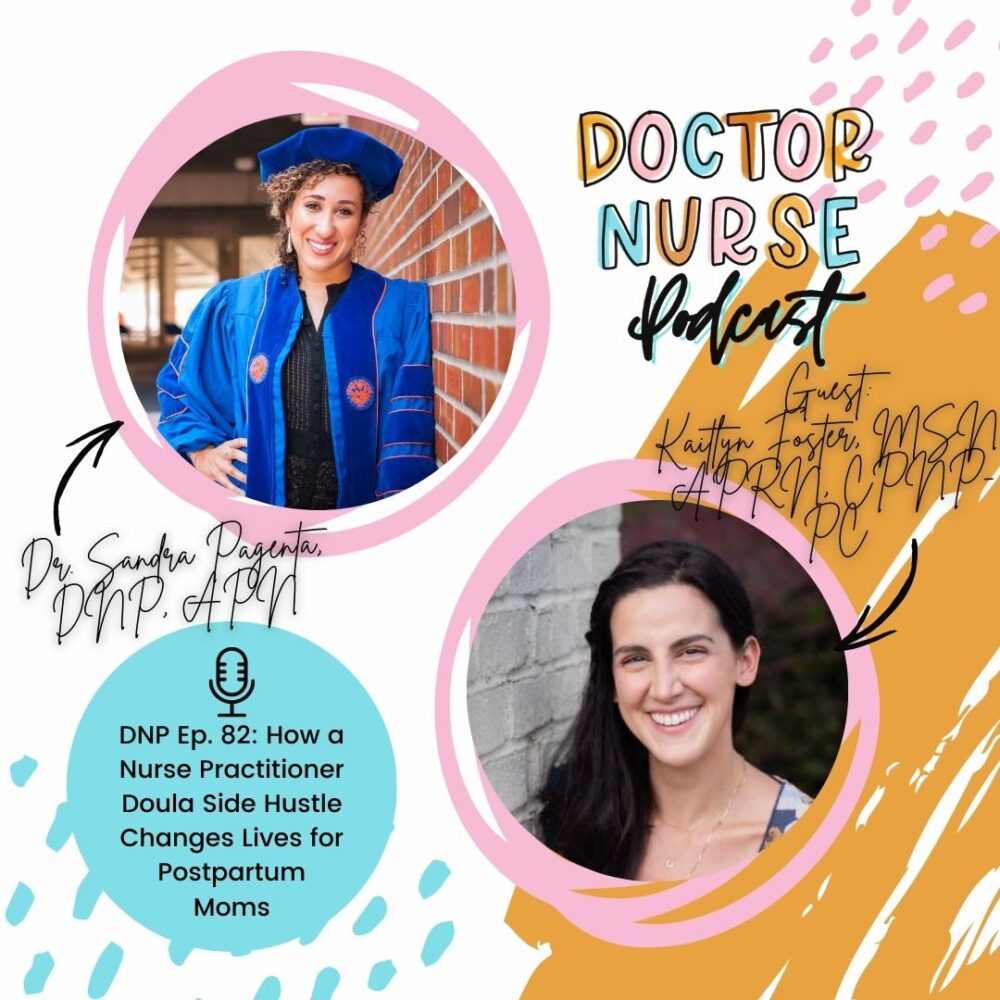
Dr. Sandra Pagenta: Dr. Nurse Podcast fam, welcome to another episode of the Dr. Nurse Podcast. I’m your host, Sandra, and today we have Kaitlyn. She is a B S N graduate from UVA. She worked in the NICU for seven years before pursuing her pediatric nurse practitioner degree at Vanderbilt University, and she now works time as a nurse practitioner.
I heard you say primary care when we were talking before the podcast. And she is a birth and postpartum doula who owns her own business in the greater Charlotte metro area. She was inspired to start her own business in 2022. It’s. Taken off and she’s been doing great work. And you guys know if you listen to my birth story, that I’m obsessed with doulas.
I think that they are so bomb. Welcome, Caitlin, to the podcast. I’m so happy to have you on.
Kaitlyn Foster: Thank you so much for having me. I did not hear your full story. I’m gonna listen to it like as soon as we hang up.
Dr. Sandra Pagenta: Oh my gosh. My doula is the reason why I had a Vback and I again, I love Emily Oster. She’s a author and she actually published something saying that doulas are responsible for decreasing the rate of C-sections by like 25%.
I believe in women. And. So that’s pretty substantial. You’re 25% less lucky to have a a c-section if you have a doula in your corner. So I am an advocate for doulas. I think they’re amazing. And to know that you’re just this hybrid nurse practitioner, doula just sets me on fire, like, whew. Guns and blazing.
I think it’s fantastic. So I’m so happy to chat with you. That’s awesome.
Kaitlyn Foster: Thank you for having me. Yeah, the combination has been amazing. And like I was saying before we started, I kind of thought after having my son, I would do it as a. Getting back into work, a side hustle, and then things really took off.
But I also didn’t wanna give up my nurse practitioner license because I love being a nurse practitioner, just the full time in the hospital and the stress was getting to me and I was having a little bit of burnout. So choosing to do both has gotten rid of all of my burnout, and now I’m really happy with both of the careers.
So it’s been really an amazing experience.
Dr. Sandra Pagenta: Yeah. So what I really wanna hear about is, Again, like kind of what your day-to-day looks like, kind of how you juggle it all. Because a lot of people that are listening to my podcast are interested in side hustle gigs, starting their own business. Really? What can my nursing degree help me do?
That is away from the bedside. We love. I love the hospital setting. It’s great for certain times in your life, but once you become a mom and life becomes a little more complicated and you need that flexibility, I’m finding that the hospital’s really not meeting people’s needs. It’s really just being super stringent and burning people out.
So, This is a note to hospitals that might be listening to my podcast. Hey, do a better job at creating some flexibility within your positions. But you know what, if you’re gonna lose women and especially moms in healthcare, then what can they do is kind of the heart of my podcast. So tell me a little bit about kind of what your day-to-day, how you split up your week in between your work and your different jobs and managing, being a mom.
Kaitlyn Foster: Yeah, so I think the key is find something that you really are passionate about, because if I was doing something else as a side hustle, it would feel like a dream. So I realized it wasn’t that I wasn’t doing, I was tired, but not because I was doing too much. I wasn’t doing enough of what I love. Which is working with women, networking with women, and just working with women in community.
So when I started focusing on that, everything else fell into place. And I had this idea that to have my own business and make it work as a mom, I had to have a schedule. I had to do things I didn’t like doing. Like I had to do the admin work, the website, the social media. And so I first started trying to do everything.
And it was awful. And then I got this advice that said, stop trying to do what you’re not good at. Do your genius. So I started doing only my genius, which is talking to women, working with women and power, like figuring out what they’re good at and helping them find that niche. And that’s when my business exploded effortlessly.
Before that, it was a struggle. I couldn’t figure out when to put the time in to write the social media posts, which I hated doing what I felt was necessary. But now I hired someone to do that. I, we eventually hired a nanny to help with childcare, so I did a few things to make sure that I could focus on the area.
That was my genius, and then my business really took off when I got clear about what I’m good at.
Dr. Sandra Pagenta: Does that make sense? Yes, a hundred percent. And I’ve heard that as well, that I’ve had somebody ask me, I was gonna drudgery do something, and they’re like, hire that out, if that makes you that miserable. Yeah, don’t do that.
I’ve had multiple entrepreneurs come up to the podcast and say that exact thing, like, get really good systems to help offload. You know, having to manually think about things. So again, for someone listening, like I use someone, I use a program to schedule people onto my podcast, like, I used to be doing all this extra work, and I’m like, I’m not doing that again.
Like, I need to f well, we’re gonna pay for that because it’s just too much. And the more that you offload into systems, the more that you offload into, I’m gonna pay someone to write that blog. I’m gonna pay, I just can’t do it all. My, my genius is sitting and having conversations with people like, that’s what I’m good at.
This is what I need to be focusing more, more of my time on. Cuz this is kind of my. My little thing, so I completely agree with you. So again, so how many days are you working as a nurse practitioner in primary care? How many days are you doing doula work? Which I know doula work, which we’ll get into. I want to hear like what your doula work looks like.
Cause I think you’re doing the more, the managing part more and then Yeah, listening. Yeah. And then describe kinda your How you kind of fit all of it into your busy schedule?
Kaitlyn Foster: Yeah, so what it actually looks like is Monday, Wednesday, Friday, I work in a pediatric nurse practitioner office and we have a nanny who comes to our house while I’m gone to watch my son.
And then on Tuesday, Thursday, I’m off with him and I do my doula work. In between. So I was doing a lot more before I went back to primary care. Right now I’m contracting the majority of it out. So I have doulas that work with me on my team when I do do the doula work, I’ll do overnight care or some on Tuesday, Thursday.
And then I was struggling with how am I gonna attend birth? And I felt like it was impossible with my schedule and I realized, okay, what are you good at again, working with other women? Women. So I have a woman who’s a doula and she. Has the same philosophy as me, so we work as a team and then if I can attend, great.
And if I can’t attend, she goes, or vice versa. That’s how I do the birth attendance, and usually at night is when I get done with like my admin things or when my son is napping, like my son’s napping right now and at night I’ll work on scheduling contact, meeting with clients, doing Zoom calls. And I really think it’s like, I just don’t watch TV at night.
I just think it’s like a dumb thing. But people are like, when you have time, I’m like, well, instead of binging Netflix, I just like binge my business.
Dr. Sandra Pagenta: Ooh. Oh, come on, come on. Caitlin. Do fantastic. I love that.
Kaitlyn Foster: Doesn’t mean I don’t watch TV and I don’t binge shows, but we, like, we don’t have a tv so at night I just, I sit on the couch and my husband helps me with the finances of my business, and that’s what we do together for an hour.
And you can get so much done. It’s just think of how much time at the end of your day as a mom, you sit down. Flipping mindlessly through the channels or cleaning up something from the kids or Instagram reels and exhausted. Yeah. Instagram reels. You literally can spend an hour. Yeah. But if you can stop and focus on what you are doing and do something you love, I feel more energy versus if I literally binge reels or scroll through Instagram or stare at a TV for an hour, I don’t feel good.
I feel good when I do my stuff, my business, and then I can go to sleep and have a good night’s sleep. Oh, Caitlin,
Dr. Sandra Pagenta: I needed to hear that today honestly, because I literally have on my, in, in my closet. Cause you know, I podcast in my closet. Yeah. For those who don’t know, that’s what I do. And, and I legitimately have on the wall in here.
Like my vision board, right? And so on my vision board above it, I literally wrote, replace Netflix with podcasts. So like replace sleeping in with early mornings. Replace, replace, replace, substitute, substitute, replace scrolling, like watching Netflix at night with working on your business because. What you’ll believe is that you don’t have enough time.
What you’ll find is that you waste a lot of time, and when you become a mom, you realize how much time, how little time you have. If you really wanna spend quality time with your children, how little time you have for yourself. And so you’ve gotta crem a line in. I’m like, give a mom 15 minutes and watch what she can do in 15 minutes because we, we could, we could change the world in 15 minutes if you give it to a mom because we just know, like, you gotta use your time wisely.
Right.
Kaitlyn Foster: 100 percent and you don’t have to have a kid who’s a perfect sleeper of a perfect napper. I had a kid who didn’t sleep for the first year, like no joke, like contact naps, co-sleeping. We did all the things so you don’t have to have set time. I think this is something that people get really hung up on.
Yes. You sometimes have to schedule a podcast interview and show up on time for that. But for me, taking responsibility of my time and trying to change my language around time instead of, I don’t have time for that. I started saying, I’m not prioritizing that right now. And it really was confronting because I had so many reasons, which I believe are excuses of why, like excuses, excuses, reasons, reasons why I couldn’t get it done and I didn’t have time.
But when I changed my language, Suddenly I had time for whatever I truly wanted to do. And if I wasn’t doing it, I had to ask myself, why are you not making time for this? Mm-hmm. And that was sometimes not fun to answer
Dr. Sandra Pagenta: Yeah, no. Cause you have to sit with yourself. You have to be real. Yeah.
Kaitlyn Foster: I was like, cause I’m afraid I’ll fail.
Like what if it doesn’t work? Like what if I try and it doesn’t work? Or what if it works? Like how am I gonna find time to grow this? What if I like it more than healthcare? So there were so many questions in the back of my mind that were. I was using the time excuse to really not work on myself and why I wasn’t showing up.
Dr. Sandra Pagenta: Wow. And then I have time and that is like real. That is so real. That’s raw. I love that. Right. I love that.
Kaitlyn Foster: I can’t tell, and I know that’s probably not necessarily the answer you want, but I can’t tell you as a mom how to. Make your side hustle or your business in terms of your schedule when you really want something to happen.
Like you said, give a mom 15 minutes. If she really wants to do it, she will. If there are things holding you back, you won’t. Mm-hmm. But that’s for you to figure out.
Dr. Sandra Pagenta: Yeah, You gotta ask those hard questions of yourself and sit alone and kind of process through. Yeah. If it works, I love that part. If it works, because it’s true.
Because you end up making these, I mean, I’ll be honest, I, I started podcasting in December of 2020. Mm-hmm. And I didn’t launch my podcast until May of 2021. Cuz it was that what if it’s, what if Who wants to listen to this? Who wants to, you know, what if it actually works? What if people, what if nobody, like, if you go through that, right?
And you just have to go take action, do it anyway. Do it scared. Do it. Just do it. And so I love that. Going back to my birth story and kind of chatting about what. So you do primary care, which nurse practitioners and nurses know what primary care is. But for the person that’s like, okay, so I’ve never heard of a doula.
Explain kinda what it is that your doula work looks like. You’ve explained how you incorporate it in your week, but for someone that’s like, okay, wait, go on to births. Like what is that? Like, what does a doula do? And so yeah, so that’s somebody that’s thinking about, whoa, I didn’t even know that’s something that I would wanna do.
Explain kind of what you do.
Kaitlyn Foster: Yeah, so a doula provides support to a woman. If you’re talking about a labor doula, they provide support during the labor process. Often they meet with them in prenatals prior to birth, and then they show up for labor whether wherever they plan their birth at home, in the hospital, in a birthing center.
And they A, they help them advocate for what they want, or they provide simple physical support, like rubbing their back, helping them with positions to cope with the physical sensations of labor. And I think the optimal doula helps you in the prenatal process, process your fears about birth and prepare emotionally and spiritually as well.
Because during birth, the maiden will die and the mother is born. So it’s no small thing. You’re gonna have to go through the emotional processing at some point. So ideally, the doula is there to help you, and then people say, why doesn’t my husband just do it? The role of men in labor is incredibly different than a woman who’s either been there or is just a woman and understands the perspective that you’re coming from.
And if you look back, men are just recently incorporated into birth, and we suddenly expect them as women to know exactly what to do and be our only support for birth. And men fix things. That’s what they like to do. They see it. How can I fix it? They try to fix the problem. There’s nothing to fix in birth.
You just need someone there with you to get you through it and say like, you’re doing it. You’re already doing it. You can do it. Not the fix it attitude because men were kicked out of the birthing room for years. Yeah. And just recently like. Maybe the past 20 years, they’re brought back in and they’re expected to take the full burden of helping their wife or partner through labor.
Just doesn’t, it just doesn’t work. So that’s what a labor doula does. And then postpartum doulas, this is something that I find people really don’t know what it is, and it’s the heart of my work because I do believe this is where a lot of the true work is. So after you have the baby, everyone’s there for a few hours, and then you’re alone with a new baby.
That you’re supposed to take care of. And the majority of women in our country unfortunately, according to the statistics, do not have a good birth experience and are very traumatized. So they’re in like a PTs d response with a new baby still recovering. So the doula does everything that like your loving grandma kind of would do.
She comes over, she takes care of you, helps you with breastfeeding, helps you with cooking, shows you how to take care of a new baby. And this is huge because in our culture we don’t see birth anymore unless it’s staged in a movie, which I do not believe is an accurate representation of what birth looks like.
And you don’t see postpartum. You don’t see postpartum, like how do you breastfeed? What do you do? You need a wise woman at your side to teach you these things. So that’s like the full spectrum of the doula from birth through postpartum. Wow. How did you find that? And your experience with your doula for labor.
Is that what you experienced? Like she helped you advocate for yourself, she knew your preferences.
Dr. Sandra Pagenta: Oh, a hundred percent what you’re describing. Yeah. So I hired my doula for my first pregnancy the same doula, and I was under the impression I needed to have a c-section. And so she said I was the very first person to ever hire her for a C-section delivery because again, being a minority woman and not really having like a support system.
Again, kind of like what you’re saying, you’re, I kind of felt like my husband really didn’t understand the process and he’s a lot more of a he’s a, he’s a chill personality, so I was like, I kind of need somebody in there. Like I. Not chill. Cause I’m not chill. So I need somebody that’s gonna be talking and advocating and paying attention and just being able to be like, Hey, hey, check this out.
Like something’s going on over here. Like that kind of thing. And so I didn’t wanna put that feeling on my husband and I kind of just wanted him to just be there. So for the C-section that I thought I was gonna have that, then I thought I was gonna have a laborer and then I ended up having C-section.
She was there and she was instrumental in just being like, Mom, you, you need to do this. Like the baby’s not doing well. And so she was my translator. She was my, I don’t know what I call, I don’t know what I would call it during my first labor, but she, I think the best story I’ll ever tell about my doula.
And it’s one of the ones that she and I repeatedly tell other people. After my C-section, my legs are numb and I can’t move. I don’t know where my baby is because unlike what I think is, it’s just, I think it’s awful how we treat women after they have babies personally. So you have a baby, they take the baby to the nicu, you don’t see them, you don’t know where they are, and then they put you in a different space, right?
So you’re getting, you’re recovering in the pacu. And so my doula came with me and then my husband went with the baby to the nicu. Mm-hmm. And so she was there.
Kaitlyn Foster: That’s the other thing people don’t realize if you don’t have a doula, And something like that happens. Either you’re alone or the baby’s alone, and moms always choose to be alone.
Yes. And it is not. Okay. They do not treat you well, so keep going.
Dr. Sandra Pagenta: You’re gonna, you’re gonna totally make me emotional, Ms. But she stayed with me and that was what I didn’t know that’s what I needed, but that’s what I needed was for someone to be with me. And so she was getting ice chips for me, moving my legs, starting to work off that spinal epidural that I had.
The. The spinal anesthesia. She was starting to work that for me, and I kept, she kept saying like, do you wanna see your baby? I’m like, I do. I wanna see my baby. And so she asked the nurse multiple times, like, when can this mom go up and see the baby? And she said She can’t walk, so she can’t go. And I don’t know what’s going on with my kid, you know?
So she, I’ll never forget it, Caitlin, I’m, she looked at me and she said, let’s go. We’re gonna, I’m gonna get you in the wheelchair. You’re gonna go see your kid. And I said, I can’t move my legs. And she said, I’m gonna get you there. Just lean up against me. So, and she said, just use all you can, all your weight that you possibly can.
So I leaned over to her and I just threw my body into her. And it was at that very moment, I just, It was such a mess. And she just sat there and started crying and she held me back and she said, we’re gonna go mom. Don’t worry. So she took all her strength and she threw me into the wheelchair. She took me up to the, I see.
To see my kid and she got me breastfeeding and you know, I’m just freshly cut open and she took me, yeah. And she made sure Benjamin was put on. To latch and the photos that I have of his birth, she took in the operating room. So I have how he was born, but I would not have had them had she not been there.
Mm-hmm. So, yes, when I got pregnant with my second, I was like, it’s on my husband. There is what you can stay. She woke up. So she’s amazing. If you don’t
Thanks for listening to the episode. I hope you’re enjoying the conversation. I wanted to take this time and remind you to check out the success. NP Etsy shop. It’s a shop that I design with my best girlfriend, cute nurse practitioner gear hats. Bags, anything you could think of as well as adorable digital products.
Mom life stuff. So resources for nurses to come. We’re just excited about our shop. It’s another way to support the podcast and to get really cool gear. Check it out and be sure to tell your friends about the podcast as well as the se shop if you’d like and what i’m building here, any promotion any sharing helps build my audience and i greatly appreciate it now let’s get back to the episode
Kaitlyn Foster: have a wise woman at your side to help you, you’re at the mercy of the hospital staff and how they’re staffing and it’s not. I have spent a lot of time, I actually come from a very radical perspective of birth, which we can get into probably not maybe at a later date.
Yeah. Through the free birth society, and they have a very critical eye of the healthcare system. Like the industrial birth complex, they speak a lot of truth, but so I spent a lot of time villainizing the healthcare system, and then I realized there’s really no one victim. We all have our own responsibility in it.
Mm-hmm. But if you don’t have someone there to advocate and really look at you as a person, You just become another number and no one sees you as a person and they don’t see your baby as a baby. Because I worked in the NICU for like almost 10 years and I left because I was starting to get really hard and calloused and almost bitter.
And unless I could separate myself from the fact that we’re doing these painful procedures to babies who their moms are nowhere in sight. Often procedures that don’t need done and they’re being done for c y A. Right. We have to cover our cuz we live in a litigious culture. And again, that’s not the fault of the hospital.
No. They have this in the back of their minds cuz we live in a litigious culture and people do sue. Yeah. Because when something happens to your baby, you look for someone to blame. It’s natural. It’s normal. Usually women who have birth trauma go through a phase where they blame everyone, including their doula.
That’s something that as a doula, you have to, you have to sit with and understand. So yeah, like you said, if you don’t have anyone there, you’re alone. There’s no way you’re gonna see your baby. And do you know if you would’ve been able to breastfeed if that latch didn’t happen? Who knows.
Dr. Sandra Pagenta: And the photos?
Probably not. I would’ve never been able to see the birth either, because the, the, the wall is up. Right. So you’re separated from birth. They totally separate you. Yes. You’re separate, like physically. You just watched the baby go. The baby leaves. Mm-hmm. And you’re just, I had to beg to touch his face. I remember asking Yeah.
And then my doula’s screaming. She would be screaming the things that I wanted, like she wanted vaginal seating. And she, she was screaming the things that I wanted. It was like my voice. She was my voice when I, when I was laying the
Kaitlyn Foster: entire process, the entire process is based in dehumanization from the second you walk through the door.
No one is listening to the moms. I have been to so many C-sections more than I can count, and no one is listening to them. If you don’t have an advocate, you’re in huge trouble. And you mentioned this a little bit, and I don’t wanna get too much into the political correctness or not, but if you’re a woman of color or a minority in any way, if you don’t fit the picture, perfect cookie cutter image of an educated white woman run from the hospital.
Even if you educate yourself to the nines, if you don’t have an advocate and you don’t have a plan, You walk in there and it’s, yeah, it’s risky. Like the risky, the
Dr. Sandra Pagenta: statistics say that’s huge. Yeah. No, the statistics say that you’re not saying anything. They’re terrifying. Yeah. And I tell it to all my friends that are African American, in fact, a lot of them have told me they will get doulas.
They are getting doulas. Yeah. Because they need someone there speaking for them. And again, I’ve had my friends share stories about. How the doula was like, she’s still bleeding and that’s not, that’s abnormal. And so like then the patient could go like, wait, check something. You know, it allows you to know what you’re supposed to be, what it allows you to know, what you may not know because somebody else has been through so many births and has so much experience that they’re able to show you and to go, Hey, listen, let me help you navigate.
And hey, you make the decision, but I’m gonna let you know what your options are. And that’s what my doula did on my second birth, which is why I know I was successful at A V A C even though I had a planned C-section. I had a planned C-section. And then when I went in, I told her, I woke up, she was up of course, at like three in the morning and I messaged her and I said, I wanna be checked.
And she said, okay, I’m getting ready for your C-section again. Poor she said. I’m getting ready for your c-section to be there, but if you wanna get checked, let’s go. So we, she, I got checked and I told her, I, I said, she, she’s dilating me. My cervix is going, is, is dilating. Things are happening. I wanna wait.
And she said, all right, so we’re laboring. And so that’s what, that’s what, and that’s how she had walked me through that whole process. Each time she, this mom wants to move, can we get her on the portable baby monitor? I said there’s a portable one. Yeah. She said, yeah, there’s a portable one. You can wear it.
Yes. And I didn’t know you’re a healthcare professional. I work in healthcare. I’ve been in healthcare for 20 years. Imagine
Kaitlyn Foster: like if you are not a healthcare professional, like you said, if you don’t have someone translating what they’re saying, you have no idea what’s going on. And this is part of like the power dynamic that’s at play is they.
I have been in so many healthcare situations where it’s a lot easier if the patient is just clueless and says yes to everything. It’s really hard when you get assigned the educated, badass woman who wants to advocate for herself. It’s hard, like they don’t want to have the shift in power dynamic where you have just as much knowledge and just as much choice.
Yeah. It’s not cuz they’re evil people, it’s just the system is set up. To put so much pressure on them that it’s so much easier if you just go with the flow and do whatever they want. They, it’s so much faster to go do a repeat C-section. Yes. The doctor’s in and out. The bill is huge. They bill for so many more things versus spending 24 hours with a woman trying to work through her emotional she can become a mom.
People don’t wanna do that. Then the labor and delivery nurses do it the best they can, but they’re still under so much pressure to like get their charting done, get their vitals taken, get the baby checked right in the chart, the baby’s heart rate. Because what if something happens? They have to have that documentation that the baby’s heart rate was checked, the whole system, ugh.
The system works because it serves itself. I used to think the system doesn’t work, but it works. They make a lot of money. Hmm. Wow, it’s rough. But when you have a doula, then you have this, like it helps you open doors to things you never thought were possible. Like you even had a scheduled C-section and you got to experience what it’s like to have a v a.
And there’s nothing wrong with scheduling your C-section and having your C-section. But it’s sad to me when women do that because they think it’s their only choice and they feel like it’s their only choice. If it’s something that they want and that they choose, that’s just as valid. But if you want a chance at a eac, how do you know you can do it?
Someone has to tell you like, yes, you can do it. You can do it. You got this.
Dr. Sandra Pagenta: Yes. And you know, it is so funny too. My doula actually had that conversation with me. She said exactly what you said, you guys are all of like kind of a hive mine. Because she kept, when I told her, I said, we’re doing this repeat C-section.
She’s like, yeah, senior, but you haven’t. Are you on the table at all for a vback? I said, no, no, I’m not, I’m not, I’m not, I’m not doing it cuz I didn’t, I didn’t labor with Benji. I, I don’t see it. It’s not gonna look good for Penelope. Like, she’s like, okay, well I hear you. So she had that same conversation of like, okay, but you, I want.
I wanna make sure you’re hearing that. Like it’s on the table. And I’m like, yeah, but it’s not, you know, like, so she let me do that emotional work and that emotional labor and then she kind of gave me my space. And by doing that it allowed me to kind of walk around and go like, okay, but what if, but what if.
But what if maybe she’s me. Every piece of seed
Kaitlyn Foster: you, yes. Yeah. The seed is there and then you hear VBAC and e and even subconsciously, like you listen, which is before you probably would’ve been like, oh, but that’s not for me. That can’t be me. But then you start listening and you hear other women’s stories, and you realize it’s a reality that could vary.
Well be yours, but until you know about something, you, you don’t know a different reality except for the one you live in.
Dr. Sandra Pagenta: Exactly. No, exactly. So it’s so amazing that she offered you that. Yes. No, she did. She wanted me to keep it open and I was very closed off to it. And then again, as she planted those seeds and I really began to walk through it, I was like, well, what if, yeah, I gotta give her a shot.
How do I not give her a shot? How do I not get this data? So how do you
Kaitlyn Foster: think I’d say like, okay, so what’s the point of this? Right? So I would say, how did that change your experience? How did that change how you mother? How did that change who you are as a woman? Wow.
Dr. Sandra Pagenta: I. I was not expecting to answer questions.
I was supposed to be asking you questions. Sorry.
A true do of fashion all sudden now I’m deep. I’m deep in it. Ok. It Cait. It’s a great question because again, that’s what she does. That’s when she does, she makes, she sat down postpartum with me and walked through the whole birth. We went through the whole timeline. It was cathartic just to talk about it.
She’s like, tell me your story. Yeah, and the healing from where I was to where I ended.
Yeah. We had this mantra that I can do all things through Christ who strengthens me. I did not have this baby. I don’t want to like wear it as this badge, but what I do know is that by listening to my body and going, I don’t want Pitocin. I don’t want it. And I said that before the baby and I said it now I don’t want it.
And she going, you don’t want Pitocin, you’ve already said that. You remember? And I was like, yeah. And to go, you do this or, or, or we go for a c-section. Cause I don’t, I’m not willing to put my body at that. Right. She let me hear and navigate through and that’s what I feel like I had a different birth instead of.
A birth that I felt like I was just tossed around with the first, I felt like I, even though the waves were coming. Okay, the waves were all over. Yeah. I felt like I had a little bit more, I had a, I felt more empowered and that I was going, okay, let’s go in that direction. All right, that’s what we need to do.
We’re gonna walk here. We’re gonna walk there. And so that’s how it was different for me that this first birth experience, the first birth experience was Was not empowered. I just felt almost like, kinda like what you’re saying, this P T S D type thing. Mm-hmm. And then the second one, it was just kind of like, I look back and I can see the steps and I can put the puzzle pieces together.
That’s what she kept saying during my birth. We’re gonna just watch. We’re gonna have the puzzle pieces come in and we’re gonna figure out where they need to go. And so I figure, I feel like that’s what we did and that’s what I walked away from that birth experience feeling like I just needed to quiet my soul and listen to what.
What I was hearing and it was different. It was very different and it was very healing. It was probably the best way that I can describe between the two birth experiences. And then the connection that you have with your child. I mean, having her on my chest is a lot different Yeah. Than having him.
Way over there, you know, where I can’t reach him and I can’t touch him. Having her on my chest and just telling her like, welcome to the world. Like, it was just a completely different experience and I know a hundred percent my doula was a. A big facilitator of why that happened and why I want more people to hear about what it is that you do, and for nurses that are maybe feeling that exact same way, like I’m looking at the system and I’m just not feeling like we’re giving good care or I.
Whatever it is that you’re starting to see within your work, that this is a legitimate side hustle that will change people’s lives. It will change a woman’s life to have a doula by her bedside, and it will give you the energy to maybe go back to that nurse practitioner, that nurse job that you have.
Mm-hmm. With a renewed sense of I’m doing a passion work. Which incredibly I’m getting paid for, which is so cool. And they also, you know, can’t believe that. And then I’m also doing this other work that is in a different vein, but is still very good and still bringing about things because I, you know, my, my labor and delivery nurses did do a good job.
They, I. They worked really hard. The, I think the people are genuinely, they’re amazing. Kind of like you say, they’re working within a broken system and they’re making the best of it that they can. And we need good people in those systems. So get back in those systems. Cuz if we don’t have good people, we’ve got broken systems and bad people.
So at least get some good people in a broken system. And then for the women’s harm themselves. But like you
said,
Kaitlyn Foster: it’s like how do you stay in the system and not. Crush your soul. Yeah. Find something you love. So you can still see it with like the eyes of a child instead of this like bitter aged person.
So you can still see your patients and your families as individuals. And then, yeah, like you said, when it comes to birth, it changes everything. When a woman sees that she’s the only source of power, she’s the only person that can birth this baby. No one has any power over her. It’s just this illusion that you lose control when you walk through those doors and you don’t have someone there saying like, no, you got this.
This is your decision. But when you start to birth and mother from your intuition, no one can with you forever. You can read the blogs, you can get stressed about the blogs. You can take all the advice you want from the outside. But when you start to mother from your intuition, and I believe this comes from birth, listening to your body, like you said, knowing you don’t need the Pitocin, you’ve got this, you can do it.
It comes from inside. It changes everything. It changes who you are. It changes how you mother. No one can mess with you. No system has control over you. Oh, that
Dr. Sandra Pagenta: is wanna change the world.
Kaitlyn Foster: Do you wanna change the world like. Work with women in birth, and you mentioned she, so I assume your second baby is a girl.
Okay. So think of what you gave her, having that birth.
She’ll always know like, no, we can do this cause we’re women. And your birth story’s in your bones, right? So your grandma, who was, well, my grandma, I think yours probably as well, who was, you know, knocked out for her birth and the baby was ripped out of her. That’s in your bones and it’s in hers. But now she has a new story.
I love this stuff. Makes me cry.
Dr. Sandra Pagenta: Yeah, me too.
Kaitlyn Foster: Yeah. There’s no greater gift than what you gave your daughter like love as soon as she was born.
Dr. Sandra Pagenta: Yeah. Anyways, girl. I love doulas. I think you guys are great. Yeah, I think you guys are. It’s
Kaitlyn Foster: cause like birth is everything. Well, if you’re obsessed with birth like me, like birth is everything. It changes your story, your whole story, and yeah. The way that minorities have been treated in the past in obstetrics, the history of obstetrics.
It’s so dark. Yeah. But you were able to have a birth where the system served you, right? You had this amazing birth and experience for your daughter, and your daughter will. Always have that with her and you know, whatever birth choices she makes and how she mothers will be affected
by
Dr. Sandra Pagenta: that. Yes. Oh, you are so right.
Oh, girl, girl. So how did you always bring tissues? I know, I just, I’m like Yeah. So how did you, for the woman that’s like, okay, I’m sold. I want to go do this. This sounds, this sounds incredible. These two women, I think I wanna go figure this out. How did you become a doula? Like what did you do after your master’s degree in nursing?
Did you take a, like a course? My battery’s about to die. I’m gonna go grab my
Kaitlyn Foster: charger. Oh, no worries. Oh, okay. So there’s a lot of options. There are, so I was the NI U nurse and then, A pediatric nurse practitioner, so I had a lot of the like hospital stuff. So I felt like I got that really well. And then I had a home birth with my son, so I got the other perspective.
So you can take, there’s a ton of classes online and depending on where you’re coming from, you can go like the cheaper online certification route, which is totally fine, and see what certification you want based on their values. And I would just look at the different programs online and see if you align with their values.
I actually chose to go the, so some of the women I work with are certified doulas and they maintain a certification with like, or a Donna or a big organization, which is awesome. And they offer continuing education. That is a great way to start. And you can find an in-person doula to help you go to a birth and they’ll usually like mentor you through a birth.
So if you can have in-person, in-person mentorship, that’s amazing. But you don’t need it. You can do an online course and just put yourself out there and start taking clients, and some people start free or a lower price to get the experience. So I did the Radical Birth Keep School through Free Birth Society, which is the extreme radical version.
Yeah, because I was coming from the extreme radical mindset of the hospital, so I needed to like break that. Yeah. So I could see everything. So I think it very much depends on where you’re coming from. Some people say like, oh, you have to be certified through Don, or this organization, this is the best. But I think you have to look at your own personal background to see what would serve you best.
But yeah, certification is a great way. Because you can get connected with other women and get like a preceptor to help you attend birth when you’re first learning. But really if you show up with an servant’s heart and you just serve the woman that’s there, you’ll do a good job. Yeah. And how do you have to show up to serve her?
Yeah.
Dr. Sandra Pagenta: How do you, so my only other thought process is how do you differentiate between your role as a nurse practitioner and your role as a doula? Because I feel like sometimes you could probably kind of get in trouble with like, I know what you like. She, she does a good job. At least my doula is like, I don’t do that because I’m in this doula role.
So like I can’t, you know, so how do you kind of differentiate between that? Yeah. So I’m
Kaitlyn Foster: really clear that it, I’m not in a medical capacity at all when I’m supporting you as a doula, whether that’s birth or postpartum, especially postpartum. Like I’m a pediatric nurse practitioner, so that lens shapes everything I see in a baby.
I tell the wo I believe women are very intelligent and we don’t need to baby them. Give them the information, they’ll make the right decision. I tell them, I’m not a medical practitioner in this capacity. I’m just here to support you emotionally, spiritually, and I will give you tips on baby care and taking care of your baby.
And I have them sign an agreement and part of it in there has a very clear, you might think harsh statement that I’m not responsible for your health. You’re responsible for every decision you make for your health and the health of your baby. There’s even, and we always have a conversation about death always, because that to me is the easiest way to see a woman’s true values where she’s coming from, where she thinks the responsibility of death lies.
That conversation by the end of it, you know, if you’re you, you’re on the same page to work with the client or if you guys have different, different views of your role. So that’s how I do it. I think the conversation about death is very key. And then I have a very clear agreement that they sign, that we both sign that says You’re responsible for the health of your family, your baby, your choices.
I’m there to support you. Does that make, does that Yes. Kind of answer your question. Yeah, that’s, so that’s how I do it. Yeah. It’s clear. I’ve never had an issue. Women totally understand that.
Dr. Sandra Pagenta: Yeah. No, it’s true. And I, I, I, I signed something, you know, or, you know, agreed to that similar type thing. Yeah.
Like, yeah. Because she’s just there to, again, these are decisions that I was making. Again, she says the puzzle pieces come in and then we sort ’em. Yeah. And then you decide what you think that that is saying, and then I, I support you in that, in whatever that is. And again, she’s been with me through a c-section and through a vaginal birth.
And so she’s, yeah. So she’s been with me and so she knows like, I, I, she thought we were going for another repeat C-section and she’s like, you’re the only person that calls me for a repeat c-section. I’m like, cuz I know, like, again, like you said, the mom gets kind of left and if the baby has to go again.
Yeah. Yeah. I said I want, I want you with me and then I want my husband free to go so that he can stay with the baby. And yeah. And, and, and throughout this, again just kind of wrapping up the business portion cuz you and I. Could totally talk, I think, all day, but about the business portion, about kind of working the business, what would you say is one of, been one of the hardest things since becoming an entrepreneur and being a nurse practitioner that was hard for you to kind of master and then a part that was like, this is easy.
Like I can do this all day because I was a nurse. So how does the nursing background kind of help you in either challenging you or help you in making something easy?
Kaitlyn Foster: So the networking, the social relationships, that stuff is like butter. It’s really easy for me, it’s my genius. I’m conflict avoidant, so when there are situations that are uncomfortable, sticky and not smooth, that’s really hard for me to show up.
So I’ve only had it happen once. There was a disagreement between a client and a doula that I contracted the workout to, and it was really hard for me to like set up those phone calls and show up and deal with the conflict head on. So that has been the most challenging aspect for me, is I just wanna make like everyone happy.
And I did figure out pretty quickly, not everyone’s gonna like you if you do what you love and you. Yeah, it is what it is. That was the hardest part for me, which is surprising cuz I thought it would be like figuring out the finances or admin work. But yeah, that was Challenge.
Dr. Sandra Pagenta: It’s the people. Yeah. It’s dealing with the people.
Kaitlyn Foster: It’s the co. Yeah. The contract work has brought up more challenges for me and realizing that it’s almost always gray and you never win an argument. Wow. It’s, yeah, sometimes you’re not, not everyone’s gonna be happy with the outcome if you’re in a business.
Dr. Sandra Pagenta: Yeah. What would you say to a young Caitlin starting off on her career, if you would’ve known what you could have done with all, with your license, with your certifications, with your genius, if you could go back and tell Caitlin at the start of your nursing career as an you know, B S N working in the nicu one thing to kind of hold onto, what would it be that you would tell her?
Kaitlyn Foster: That’s a great question. Like don’t put yourself in a box. Like all because you’ve never thought about doing it, doesn’t mean you can’t do it. Hmm. And you’re probably gonna fail a lot. Like I think I was afraid of failing and trying something new and I thought, okay, well I’m good at NICU and I’m good at this. I’ll just do this forever.
So I would’ve been like, try it sooner. You’re gonna fail. Not like you might fail, it might not work out. No. Like you’re definitely gonna fail. It’s several things and then it will all work out and you’ll find out what you’re really good at. So I would say, anyone new starting out of this, just try it and accept the fact that you’re gonna fail a lot.
Yeah. Right. You’re gonna mess up.
Dr. Sandra Pagenta: Yeah. It’s not gonna go, it’s not gonna go perfect. The plans, I love this analogy. I have two things to say to that. First is success is not a linear line. It’s like the squiggly line that goes all around and goes up and down and like, it’s like a ekg, right? Like there’s ups and there’s lows.
Yeah. And there’s waves and these things, and so that is normal. That’s you trying something new. That means you’re alive. Okay? If you have an ekg, yeah, you’ve got a Q R S wave, that means you’re alive. And so keep living, you know? That’s the first thing. And then the second thing I was thinking about is the reason why I love what you do.
I am passionate about hearing people, having people hear what it is that you do is because I believe that men go to war and women have babies. I think that these are our two things, right? And. There are two things that are very specific to our sex, right? Men fight for whatever it is, freedom, whatever, like they wanna fix it, right?
Like you described, they wanna save the country, they wanna do these things, right? And that’s kind of men. But women I think are equivalent is we bring in children, we bring in the next generation, we, we keep our society going, right? So we need them fighting for our values so that we can bring the people in.
To a, a world that has those values that we fought for, right? So it’s such a beautiful symbiotic relationship. But that’s what I always tell my husband and what I believe very strongly in my heart is that doulas go into the battle with you. You are not alone. Yeah. With a doula and a doula, you know, stands next to you and helps you fight.
And she hands you whatever that sword is or whatever that is, as you bring that, that next person into the world. And I feel very strongly that a doula is someone that you want in your corner. It’s someone that you want helping you to fight. Battle all that. Only you can do. There’s no, you can’t dule this out.
You can’t. I mean, for me, I believe that only I can give birth to this, you know, our children. And so I just think it is, it is. I. What you guys do is such an incredible service to the world that any nurse that decides to pick this up as a side hustle and to to run with this will just, again, like I said, bring so much to those that they help.
I think it’s an incredible thing that you do. So hopefully I, I explained it as perfectly as I felt like I could, that my, my admiration for your profession and what you guys are doing, so, Thank you for coming on. And before you go, we have to do rapid fire. So rapid fire is just fine by the seat of your pants.
Quick answer. And since we talked a little bit and I’ll, I’ll ch I’ll change some of the questions I normally ask since I know you don’t watch tv. But are you ready for rapid fire?
What are you most grateful for in the whole wide world? My family. Your family? And if you could give a book to somebody, what book would you give? Braden Sweetgrass.
Dr. Sandra Pagenta: Oh have you read it? It’s on my list. I have a patient that gives me book recommendations and he told me I needed to read that book. Yep. Read it.
I’m almost done. It’s, it’s a game changer. Oh. It’s, yes, it’s really good. It’s really good. Okay. Okay. And then do you play board games? I don’t know if you’re a board gay family.
Kaitlyn Foster: Oh my husband loves ’em. I try anytime I can sneak out early, I avoid it. But yeah, I play them, I play ’em under duress. Okay.
Dr. Sandra Pagenta: So which one are you under the least duress?
When do you play? What’s not one that’s like you get wood or different supplies and it’s really big.
Kaitlyn Foster: It’s pretty good. It’s not bad.
Dr. Sandra Pagenta: I, I have no idea. You get wood and supplies. Yeah, I like board games. Some type of settlement thing.
Kaitlyn Foster: You have like, oh, citizens of Katan.
Dr. Sandra Pagenta: No, that’s not right.
Yes. Yeah. Is that it? Is that it? I dunno how you got that. I dunno how I got that either. Stop it. That’s fun. Okay. Okay. I actually do lightboard games, so like, like pseudo. That one’s good. We
Kaitlyn Foster: play a lot cuz he loves them. But I, yeah, if there’s any ever a time that like the whole family’s playing and I can sneak away, I’m like, yes.
That was fun. The we’ll play that and that’s really fun.
Dr. Sandra Pagenta: Oh Caitlin, thanks for coming on today. Give us shameless plug where people can find you if they’re like, oh yeah, I wanna figure this out. Cuz I know that you do. Contract work with doulas, right? So now like, yeah, you’re kind of the head doula and then you have doulas up underneath you that you send out, and you guys kind of manage people that way.
So give a shameless plug for your business so people can find you. Absolutely.
Kaitlyn Foster: So you can find me@wildmotherpath.com and Wild Mother Path on Instagram if you’re in the greater Charlotte area, even like Fort Mill Rock Hill, I have a lot of clients up that way. I would love to connect with you if you have any questions all through things.
Home birth. I also do that cuz North Carolina and South Carolina have some strange laws around this. So part of what I do is speak with women about their options in North Carolina cuz the options aren’t publicized because right now midwives. Are technically practicing illegally in the state of North Carolina.
So it’s wild mother. Yeah. We got, we could be talk even more
Dr. Sandra Pagenta: about wild mother options. Wow.
Kaitlyn Foster: But year free to find me and if you’re in the local Charlotte area, reach out. I love connecting in person. I love social media’s great, but there’s nothing like meeting for coffee.
Dr. Sandra Pagenta: Yeah that sounds awesome guys.
Check her out. And again, as always, enjoy the journey of your career. Thanks for hanging out. Thank you so much. Take care.
Podcast Description
Kaitlyn Foster, MSN, APRN, CPNP-PC graduated with her BSN in nursing from UVA and worked in the NICU as a nurse for 7 years before pursuing her PNP at Vanderbilt University.
She works part-time as an NP and is the founder of Wild Mother Path, a doula business, in 2022, after a career as a registered nurse in a NICU where she saw firsthand many women struggling postpartum to find a groove in motherhood. She saw the same issues in her personal life as her friends brought their newborn babies home and had little to no support as they recovered and took care of their babies. She works as a birth and postpartum doula in the greater Charlotte Metro area.
Kaitlyn’s Links:
https://www.instagram.com/wildmotherpath/
https://linktr.ee/wildmotherpath
Doctor Nurse Podcast Links:
Follow up with the Doctor Nurse Podcast here!
Latrina Walden Exam Solutions: https://www.latrinawaldenexamsolutions.com/
Success NP- Etsy Shop developed by my best friend and me who are both Nurse Practitioners and create beautiful designs for your life! Check us out.
Latest Episodes
Doctor Nurse podcast brings you weekly shows to help INSPIRE, EDUCATE AND EMPOWER nurses with true stories of initiative and impact.
Doctor Nurse podcast brings you weekly shows to help INSPIRE, EDUCATE AND EMPOWER nurses with true stories of initiative and impact.
Latest Episodes
Doctor Nurse podcast brings you weekly shows to help INSPIRE, EDUCATE AND EMPOWER nurses with true stories of initiative and impact.