
Also Available On






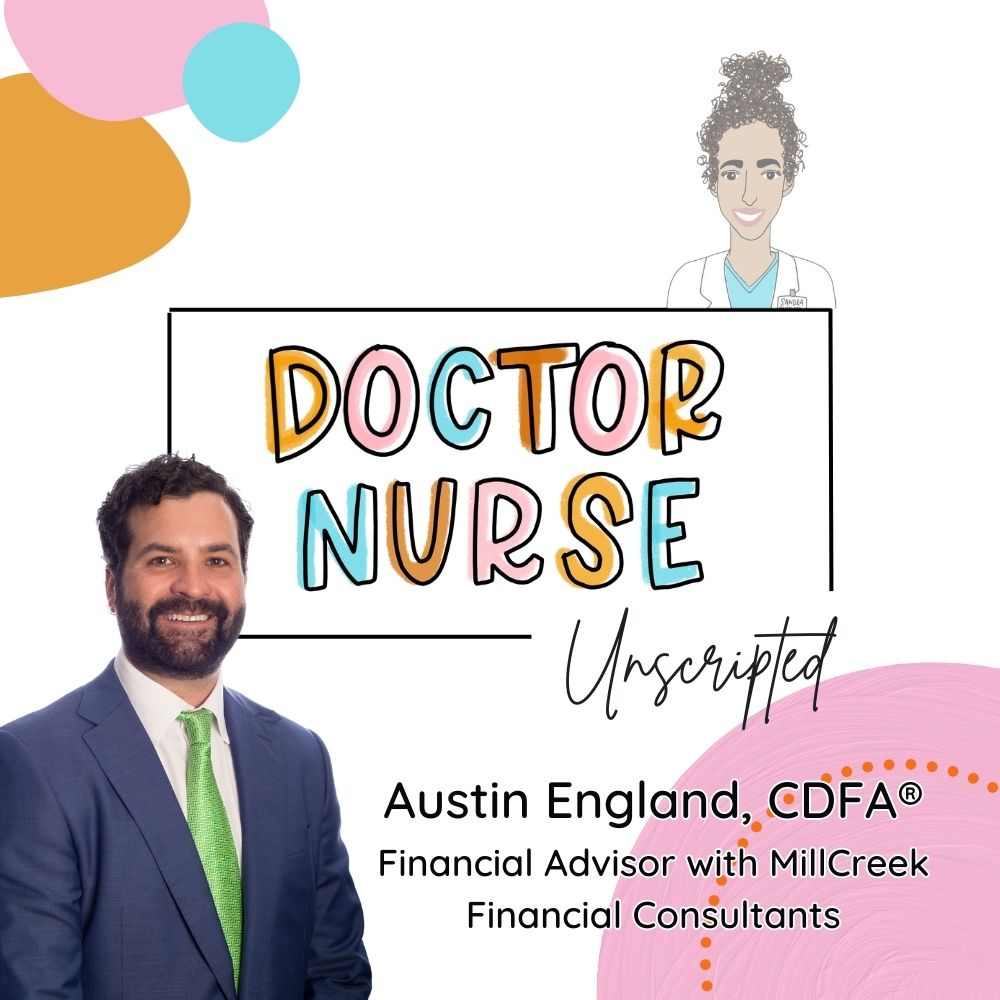
Dr. Sandra Pagenta: Dr. Nurse Podcast fam. Welcome to another episode of the Doctor Nurse Podcast. My name is Sandra Projeta and I am the host of the Doctor Nurse Podcast. Today we have on Austin, England. He is a financial consultant. He’s been a financial consultant for the company called Mill Creek. He’s been doing that with this company for about four years.
Is that correct?
Austin England: Yeah, I’ve been in the business for 17 years and partnered with Mill Creek about four or five years ago.
Dr. Sandra Pagenta: You’ve been doing this a long time. And what you really specialize in Austin and why I wanted to have you on the podcast today is you work with a lot of healthcare professionals, nurses, doctors, nurse practitioners, PAs and you help them make the right financial moves for their careers because you really feel like in order to make an impact in someone’s life, you really need good financial planning, and especially in the medical field, having an advisor to help you navigate the unique areas and then unique risk associated with our profession.
It’s good to have some of that really understands exactly what they’re doing. So thanks for coming on today to chat with my audience.
Austin England: Yeah, my pleasure. Absolutely.
Dr. Sandra Pagenta: Yeah. And whenever you’re not working, you enjoy spending time with your wife and your children, Raquel. And you’ve got Aiden, Audrey, and Anderson.
Did I, did I nail it? And you like to golf? Hunt fish, woodwork. Anything, being outside, that’s what you enjoy doing. So again, you’re a person above everything else, and that’s really, really cool. So let’s dive right in. So one of the, the themes for today’s podcast episode and some of the things I wanted to really tailor for my guests or my audience is common questions for financial experts from, you know, Common questions that you might have for a financial expert, as well as one of the things that I’ve been kind of recently focusing it on in my podcast side, hustles and creating side income streams.
And how does that really help you to create a business for yourself? So let’s start there. I mean, I started a, a side hustle and been making money from this kind of, this siding income stream. So what is the benefit of starting a side hustle outside of making extra money?
Austin England: Yeah, that normally that’s the Underlying theme as to why people do it is to make extra money.
But also it could be, you know, pursuing a, a passion, it sounds, you know, like you with your podcast. And also there can be tax, you know, tax benefits as well as you know, time freedom and scheduling and so forth. That, that we find that a lot of you know, medical professionals do in their side businesses, whether it’s You know, a dermatology pa doing the, the creams, Rodan Fields or, you know, whatever they, they may be doing on the side and making money doing that, and they can do it, you know, on the weekends or at night or whatever they would like to.
Also, you can, by having typically 10 99 and income, it allows you to deduct expenses. That are everyday things that you might be doing anyway that are not deductible as a W2 employee. So those are some of the reasons that we see people. Do, you know, side hustles or, or just contract work that’s outside of their w2?
It may be doing the same thing they, they do as an employee. But they may do it at a different, you know, hospital or, you know, what have you.
Dr. Sandra Pagenta: So, yeah. Yeah. That’s one of the things I found when I was doing my taxes this year, was that I was scraping for stuff to find. I was like, okay, I gotta, I gotta buy a computer before the end of the year.
I gotta start buying stuff. I gotta spend this money. Because I think a lot of nurse practitioners and PAs don’t quite realize the financial aspect behind things. We were just taught how to be nurses on how to care. For people, and then the side of how to care for ourselves. Making sure that we’re not broken and burned out by the end of our careers and we have nothing financially planned for ourselves.
Has been something that I’ve been a lot more interested in as time has gone on, and so I was kind of thinking as I was, I was here as I was exploring really what it is that the side hustle L L C, starting your own business does for you. I was very surprised to learn that no, you can actually take the things that you would normally.
Apply for yourself, scrubs, lab codes, you know, all these different things which you could do when you were, you know, when you were a W2 employee, but even more so when you own your own business. These are things like my computer, my, my, my microphone. These are all things that I was able to tax the deducts and it did take a little bit off my, you know, income.
And that’s one of the things that I’ve been finding as well. And maybe you can expand upon this, you know. Are, you hear about all the news, like people taking these tax write-offs and people aren’t paying their fair share of taxes mm-hmm. And all these different things. But is there a way, is there a way to legally shelter or I guess yeah.
Shelter your income from getting hit with so much income taxes.
Austin England: Yeah, absolutely. So a lot of times, you know, like just like you’re doing for your podcast, you can deduct the proportionate or proportional space that you’re using for home office. Now you can’t have the baby bed in there and you know, the ping pong table and all that stuff.
It has to be dedicated to space. But you can deduct that percentage of, you know, whether it’s homeowner’s insurance or. Utility bills, you know obviously your cell phone, you could deduct most of it. If you’re using it for business, which most people do you know, retirement plan, you could potentially set up a retirement plan specifically for the income that you make from your side muscle, where in addition to potentially a 401k.
Plan that you may have provided, you know, by your employer. So those are things, and those are ways to reduce your taxable income that you may not be able to do if you don’t have a, you know, a side hustle as you, you call it. Yeah. And, and you said something earlier, which is not really necessarily tax related, but something earlier that I learned working with physicians, and I know a lot of them, you know, they.
Get online and they say, well, I’ve read this, or I read that. And, you know, and we can confuse ourselves. And what I always tell the physicians or, you know medical professionals that I’ve worked with, I, I say, you know, one time I didn’t feel well and I didn’t want to go sit in the doctor’s office for two hours, so I got on WebMD.
Well, by the time I got off, I had every ailment done, pain, and I was gonna be dead like a week, so I didn’t need to go to the doctor. So I don’t, you know, I don’t diagnose my own medical conditions and most people should not diagnose their own financial, you know, things, you know, or opportunities, or issues or what have you.
Also is not, you know, there are some people that really enjoy, you know, Doing finances and things and, but I was going driving through at a coffee shop the other day, and it’s a pretty interesting concept. And they played really upbeat music, gets you awake in the morning and they’ve trained the pe these, you know, these young people that work there to, you know, try to relate to you, ask you what you’re doing, you know how your day is going, where are you going?
And normally I go through there after the gyms, I’m sweaty and, you know, wearing a hat or what have you. And they said, well, where, where are you doing today? And I said, well, I’m going to work and. They said, well, what do you do? And I said, well, I’m in finance. And they said, oh, that sounds interesting.
They’re, you know, they’re 17 years old. I said, no, it doesn’t. Not, not, it’s 17. Right. And it’s important, you know, and I, I love it, you know, but just like what you, you know what you’re doing as a nurse practitioner. It’s not, that’s, it’s not interesting to me, you know, so it’s important. Right. But you know what, you know, I’m going to give somebody a shot.
Oh, that sounds great. I, that’s not sounds,
Dr. Sandra Pagenta: that sounds kinda gross. Not into it. Not into it.
Austin England: That’s right. He’s their own and that’s what makes the country around, you know?
Dr. Sandra Pagenta: So what is some of the things that you find in your Your practice as a financial consultant that you really would like for a nurse practitioner or a pa?
And again, I didn’t, I didn’t send you this question, but I was just thinking as you were talking cuz you’ve got so much experience leading them in their careers. What’s one thing that you notice that all of them are kind of missing? Like, you know, as I’ve been doing this podcast, you find themes, themes in life show up.
And so I was thinking like, I wonder if any themes have shown up in the time that you’ve been a financial consultant for mostly nurses, doctors, and, PAs. Like what is it that you’ve been seeing is like they are really missing the boat on this. Yeah. I, what
Austin England: I find is that oftentimes, and a lot of it’s just what they hear, you know, get out of debt, pay off your student loans.
You know, lack of, lack of financial education really is what it is. Just like I have a lack of medical knowledge. Right. And that’s why I was thoroughly confused when I got on Web D. Right. So the, and, and what, what I feel like that we find is that people are doing things that are important, but they’re not prioritizing them correctly, if that makes sense.
So they’re, they’re not, they’re, they’re like, Doing things out of order. It’s kind of like we get dressed in a, a certain way, right? We don’t put on our pants and then we put on our underwear, hopefully.
Dr. Sandra Pagenta: Yeah. Unless you have toddlers, then you already know that that’s
Austin England: how you just have, they have clothes on at all.
So the but it, you know, what we find is that people don’t really, they’re unintended consequences. They have, you know, the best of intentions. But they’re just kind of not doing it in the right order. If, if that makes
Dr. Sandra Pagenta: sense. So what do you feel like is the right order if you had to like tell, you know, run-of-the-mill nurse practitioner that’s starting off like you need to.
Then when you do like debt snowball like Dave’s Dave Ramsey, you think like, I get outta debt, then I can start to save for the future. Then you know these different things that you might think. Yeah, and
Austin England: all those things are great, but, but even like with, you know, nothing against Dave Ramsey and I think a lot of the stuff that he says is great, you know, for his audience, but, but really, you know, it’s probably the opposite order that people should be doing that they should be, obviously you have to pay your bills, but you want to make sure.
That you’re saving for an emergency or an opportunity prior to, you know, put, put you and your family first, not Visa, American Express. Right? So, and, and oftentimes that’s kind of what that, it sounds logical, but in practice it’s really not ideal because typically bad things happen when you don’t have any money.
Right. So what, you know, what we recommend is, is one, you know, addressing or planning for, protecting against what may happen today. Right. And then plan for what might happen five years from now, 20 years from now, whatever. And I’ll give you an example. I could probably be retired right now if, if I had a hundred dollars for every client that had a baby that called us and said, Hey, we need to set up a.
College plan, a 5 29 plan or whatever it might be, college savings for, you know, th this new baby. And I say, you know, planning for college is great. And I’m sure that your baby’s probably the smartest six month old baby that’s ever, you know, ever been born. Right? They all, all of them but it’s the likelihood that that baby’s gonna go.
To college in the next five years zero, right? In both cases. But what’s the likelihood that either something bad may happen where you need money for emergency or, or something great may ha you know, an opportunity for a side hustle or a investing in a, you know, a business or, you know, whatever real estate or whatever it may be, where you may need that money.
That was then. That was tied up in the, the college plan that they can’t touch for 13 more years anyway. Right? Yeah. So, and, and one of the things that we want to, you know, we make sure with in our practice is that people are adequately protected. We spend a lot of time talking about protection. We live in a very litigious society.
Now. Every commercial on TV or every billboard that you pass is some kind of personal injury. You know, firm and they’re important and they play their role. But we wanna make sure, you know, that we’re, we have adequate, you know, liability limits on our car and our home and we have, you know, umbrella policies and, and obviously, you know, depending on what you’re doing and your side hustle liability insurance for that.
Right. Especially cause you’re malpractice most of the time. And I’m not an attorney, and this is not to be construed as. Legal advice or tax advice. But most of the time your malpractice insurance through your employer is not gonna cover 10 99 worth. So you wanna make sure that you, you know, that you have that, or, or at least consult with your hr wherever you are.
Find out what it does, it doesn’t cover. Or have your, you know, hire an attorney and pay them, you know, $300 or whatever they charge an hour. Cause it’ll be money well spent to make sure that you would be covered. Doing those things. Because we feel, speaking of malpractice, we feel it’d be malpractice on our part if we came here and said, well, let us help you with this, you know, x, y, Z investment or retirement plan or college fund or what have you, and something bad happened and you get sued and it’s all gone.
Right. Wow. So so we wanna make, that’s kind of what I was talking about, getting dressed financially. We wanna make sure that we. Protect against what could happen today and then plan for what, you know, we hope to happen in the future. So, so what
Dr. Sandra Pagenta: I, I’m hearing what from what you’re saying is you kind of help set up the menu and in what way to order the things that you need to order off the menu, right?
So like, yes, I hear that you want to order dessert, which is having a college fund for your kids, but you really need to make sure you start with the appetizer. Main course, get your sides, and then you can worry about these other things down the line because again, you’re right, you, you’re putting kind of the cart behar before the horse if you’re not eating, need some water in the right.
Yeah. Yeah. If you’re not eating those enough water, right? Yeah. Like, you’re not doing the right things that you need to do. What you’re gonna end up doing is you’re gonna be putting money in the wrong places and you’re not gonna be setting yourself up for success. Because if you’re in the right spots, it all makes sense whenever you go ahead and.
And move forward with that next thing you wanna invest in or whatever. It makes a lot of sense. We don’t know these things because we aren’t financial, we’re not trained financially, we’re not trained in our schooling at all. Like we just know how to give injections and, help patients out and take care of them.
And so you do need someone in your corner kind of helping you. Cherry pick what you need to be focusing in on at that current time. And I think that’s super wise. And one thing you had said when you were talking was about insurance and disability insurance is something that you and I wanted to chat briefly about too, because I know some of the things that you’ve heard, and I’ve thought about this too.
My job doesn’t offer short-term disability. I’m sorry, long-term disability. But it’s something that I think is important. Just because again, if you were to hurt your hands and you work with your hands, like I’ve heard that surgeons and, and healthcare providers, I mean, nurse practitioners get trained to, to bedside assist and do these different procedures in your hands like you need them.
And I remember I had surgery on my shoulder and they were like, oh, okay, so we’re gonna do a nerve block on your hands. You won’t be able to fill your arm and you know, there’s some risk of this and this and that. And I was like, Okay, so I need to work with my hands. There can be no risk to Yeah. The nerves in my hands, you know?
So I was like, I’m gonna go without the nerve block. I regretted it the moment I woke up from surgery, but in the moment I was like, no, no, no pats. So so yeah, tell me a little bit about disability insurance. I feel like that’s just like one of the things on the menu you can kind of choose and pick
Austin England: from.
Yeah. It’s not, and that’s part of that, that whole protection component and It’s one of those things that is not important until it’s supported. Right? But one of the things, and it is not a trick question, but I ask this in every like protection meeting that we’re having with a client, and most of them in including myself, this would.
Hold true for, but we, we use a web-based model that kind of, you see everything at one time, kind of like their whole financial situation’s on one screen. Oh, wow. And, and I, and I even tell ’em, I say, look, I’ve been doing this for 17 years. It’s not a trick question. But if we were to look at your model and choose your most, your single most valuable asset, what would that be?
And normally they’re gonna say, You know, my retirement account, my house, my car, you know, whatever a, you know, a resident that might be their iPad, you know, because they don’t have anything. Yeah. But But the reality is for most people, it’s their ability to work, right? Their income is their most valuable asset because E, everything that we’re ever gonna have in the future, barring, inheritance, or winning the lottery, you know, some sort of windfall is gonna be dependent on that consistent income coming in, right?
And if that income were to stop, it wouldn’t be long before most people would be in trouble. Right. And that’s one of the other reasons that we talk. We really harp on save first, then worry about paying off debt or doing oth, you know, other things to make sure that you have, you know, at minimum three months.
And, you know, ideally Six months to a year worth of expense is saved. Okay. For emergencies, opportunities. Not to mention that most disability plans, even if they’re through your employer, don’t kick in for three to six months. So you want to make sure that you have that covered. And then, you know, as far as disability insurance, there are many, you know, iterations of disability insurance.
But if you’re looking, if you’re in the marketplace for it, you don’t have it through your employer or a lot of employers that. It’s a percentage of your income to a certain cap. Well, a lot of nurse practitioners are making more above that cap, right? Yeah. So you still have a gap in pay and, and the more we make, the more we spend money, like air takes up as much space as you, you let it.
And so you want to look, you know, if you’re looking for in the marketplace for disability insurance, you wanna look for a policy. That is what’s called non-cancelable guaranteed renewable. And what that means is you could always cancel it, but the insurance company can never cancel it, nor could they change the premium or any of the provisions of the policy.
So they couldn’t say, Hey, we saw Austin, he wasn’t looking too good. We’re gonna raise his rent. Right. Where would your car insurance, you go get five speeding tickets, they can drop you, right? Yeah. You also want a policy that pays based on what’s called an own occupation definition of disability. So if you, versus an any occupation definition of disability.
And what I mean by that is an any occupation, disability definition of disability says you have to be unable to do anything for which you are suited based on education, training, and experience. Or we’re not gonna pay you. Okay. So if you could go do so, if you could. Teach, you know, at nurse practitioner school.
But you can’t, they’re going to potentially not consider you disabled, where with an own occupation definition of disability, if you’re unable to do your job, you are disabled, even if you can and choose to do something else and make money doing something else.
Dr. Sandra Pagenta: Yeah, no, that’s, that’s a really good thing to think about.
Austin England: Your example. You know, heaven forbid you had the nerve block, your arm never woke up, right? You could still do this podcast, right? You could still make money doing this podcast, but you can’t do your job, which is be a nurse practitioner. So those are things that we really, you know, wanna make sure people understand.
Cuz it is a, a legal contract and it’s protecting most people’s most valuable assets. Right? Yeah. And what we found was funny, and this is kind of being facetious, but. We buy the, you know, we buy the insurance on the toaster, but we don’t ensure, you know, our most valuable asset. Right? Or, or we buy the insurance on the, the $400 tv, but we’re not ensuring our.
You know, millions of dollars of earning potential in the future. Yeah.
Dr. Sandra Pagenta: So I hear you, and that’s kind of the recipe that you’re cooking up is all right, save for your family. Take care of yourself first. Get three to six months in a, you know, savings account so that you can float yourself. God forbid something happens, and then you recommend that your clients then pursue.
401ks, you know, Roth versus I r A. There’s all these different accounts. Yeah. That are, you know, they just overwhelm you whenever you start thinking about Roth
Austin England: Traditional Exactly. Comes, yeah. Numbers and, yeah. Yes.
Hey guys. Hate to interrupt the conversation, but I need to remind you guys to check out the Success NP Etsy Shop. It’s an Etsy shop that I created with my best friend, and we create a ton of digital products for nurse practitioners merch. All the different things to keep you going in your NP career.
We noticed that there was just a lack of content for nurse practitioners out there, so we decided to go create it. So check it out. I have it linked in the show notes. And be sure to support us cuz again, you’re supporting small nurse business owners. We would love to have you guys check out our merch or refer our shop to someone who you think would enjoy the content. If you guys are liking this podcast, please gimme five stars on Apple podcast. Any, love that you throw at me helps keep my audience engaged, keeps people coming to check out what we’re creating here. Thanks for being a part of our community and consuming the content on my podcast.
And let’s get back to the conversation.
Dr. Sandra Pagenta: And you know, some you can take now, some you can’t ever take. You get hit. Bad with taxes when you’re putting this stuff o you know, when you try to pull the money out if people do that.
And there’s just a lot of different things and so you kind of work with your clients to explain what all the different things are. But you had said something earlier about side hustle money, and when you’re a self-employed person, I know that there’s a separate account, which is different than the Roth and the traditional accounts for retirement.
What is that called? Yeah,
Austin England: it’s called a mo. There are a few different versions, but the one that’s most common that you see most often is called a SEP ira. And you’re able to basically defer, you know, a certain percentage of your income up to a, a limit of that side hustle money in addition to, you know, 401k.
So we, we have a lot of provi, you know, medical providers that may moonlight. And they’re able to take that moonlighting 10, as long as it’s 10 99, they’re able to take that moonlighting income that may be paid to their LLC and could put, you know, five, 10, $50,000 depending on how much money they make. I, I think the cap is around 60,000 or so.
But it’s a percentage of your income, so you couldn’t just, if you made 60, you couldn’t just go put 60. Okay. Got it. Got it, got it. Yeah. It’s a percentage to a cap. But I wouldn’t get real hung up on the caps. We could, you know, talk about those as pe people have questions, but but, but yeah, you can put a percentage of that side hustle, income per profit.
It’s really more kind of price. It has to be profitable to be able to do it, but of the profit you could put into that SEP IRA and kind of accelerate, you know, your retirement in addition to whatever you may have provided. Through your employer, that’s
Dr. Sandra Pagenta: fantastic to just, again, accelerate. And if for step IRAs, are they taxable?
Are they taxed whenever you take the money out or they get, you get hit with tax? It’s, it’s a
Austin England: pre-tax deduction. Pre-tax. It grows tax deferred and then it’s taxable whenever you take it out. Now you can convert SEP dollars to Roth dollars. So you could do a Roth conversion down the road. Where effectively you’re putting it in the SEP and then eventually you’re, you can convert it, pay the taxes on it, that at that time, yeah.
But then all of the growth is tax free. Yeah. So in a market like we’ve had recently where the market’s down it could be an opportunity, again, this is not tax advice, but it could be an opportunity for Roth conversions where you’re basically converting, you know, dollars that are. You know, down 20% where when it does rebound, you’re getting that growth tax free.
Ooh, that’s a good
Dr. Sandra Pagenta: idea. That is a good idea.
Austin England: Presently, no Roth, presently Roth IRAs, 401ks, et cetera. Do not have what’s called a required minimum distribution. Now, I would imagine most of your audience is probably younger, so they don’t think about that. And again, like I said, it’s not important until it’s important, but we do have retired providers that are, you know, 75 years old, and they’re like, you’re telling me I have to take this money outta my IRA whether I want to or not.
And if I don’t, I’m penalized 50% on what I was supposed to have taken. Where? With the Roth? With the Roth, there is no required minimum distribution. And it goes, you know, keep past tax free to family or, you know, what have you. So it is a, you know, it’s a, a good vehicle and they all have their, you know, they all have their place.
And, and what we, what we do in our, in our practice is, We tell clients, you know, there’s money and there’s math, and money’s not math. We make decisions with money that mathematically make zero sense, right? Knowingly, mo knowingly most of the time. But what we find is that most people make decisions without all the facts.
They do it cuz their uncle did it to work okay for them or their hr. Person at work told ’em to do it, or, or they rented on the internet. Right. Ev everything on the Internet’s true. So so our goal is to really give them the math and the facts and they put their own emotional thoughts and beliefs with it.
Whatever they decide is fine with us. But, but what, you know, what our goal is just to kind of explain, cause everyone’s situation is different and, and you hear in our practice, we, we say it depends a lot because everyone’s situation’s different. Yeah, I
Dr. Sandra Pagenta: had two. Okay, go ahead. I’m sorry. No, that that was, that was it.
I was gonna say, I had two questions based on what you had said. My first being, As you were talking, I was like, okay, so do you need to be in some financial position in order to reach out to a financial consultant? Like, do you have to have all your ducks in a row? Should I not even come talk to you until I have three to six months saved up?
Like, what is the point? When should I get in the door with a financial consultant? And then if and when I look for one, what am I looking for? So those are the kind of the two part questions.
Austin England: Good question. So, so the sooner the better. Right? It’s kinda like, when should I start exercising? Right? Yeah. You know?
Dr. Sandra Pagenta: When should I get a checkup? It’s like last year when,
Austin England: yeah. Yeah, that’s right. Yeah. When should I start eating healthy? When should I, you know, there, there are, you know, certain advisors that will only take, you know, certain levels of clientele. Our team is large enough that we’re equipped to really work with anyone wherever it kind of meet them where they are, for lack of a better term.
We also do a lot of Financial education and residency programs. We’re located, I live in southern Georgia, but we’re located, our, most of our advisors are in Florida and we work a lot with University of Florida, university of Central Florida Medical residents who, as I mentioned before, typically are not rolling in day.
Right? Yeah. So we kind of start with them, help them make, you know, those, some of those kind of basic decisions, get ’em on the right path and it, and it is actually easier. To, to do, you know, to do that. Then it just like, it’s easier to teach a. Five year old how to read, then it would be a 40 year old how to read that.
They not if they didn’t know how or swim or whatever. A lot of other things, you know, a lot of other things that we learned typically when we’re younger.
Dr. Sandra Pagenta: Yeah, like a foreign language. It’s easier to teach a, a kid a foreign language than it is an older person because they’re so in their ways. Yeah. It’s
Austin England: debatable if I could even speak English, but the so the but.
But it’s you know, it, it is one of those things that, you know, the sooner the better, find someone you trust that you, you know, like relate to. But I, I would say, you know, the biggest thing is it, to your point earlier, what, you know, what should you look for? You know, like I said, someone that, that you feel comfortable with, that you relate to because it is a, you know, it’s a long-term relationship if it’s the right one, right.
And I have clients that I. You know, I’ve had for 17 years, you know, so, and hopefully I’ll have another for another 17 years. And, you know, so that, that would be, obviously they, you know, they have to be competent in what they’re, you know, what they’re doing. But it’s just like, you know, if I’m gonna have open heart surgery, I don’t care if I like the surgery or not.
Right. Because I’m only gonna see him, you know, I’m not probably gonna be asleep, you know? But with some,
Dr. Sandra Pagenta: you just wanted to be able to do the procedure, right? You better be able to, you better be the best SAR surgeon I’ve ever
Austin England: seen care. Nice or not, or any, it doesn’t matter to me. But now some people, you know, they may be like, oh, well they, you know, they didn’t have good bedside manner.
What? I could care less. But, you know, with a financial advisor, you want them to have, you know, a good bedside manner. You wanna want to meet with them. You wanna feel comfortable calling them either with. Things, when things are going right or when things aren’t going right, you know, and, and you want to be comfortable having those uncomfortable conversations because it is, you know, you to, to get the best job, you know, or the best outcome for you as a client.
You do have to kind of get, you know, undress financially and talk about things that aren’t, aren’t comfortable.
Dr. Sandra Pagenta: Yeah, so one of the things I was always told was to make sure that somebody was a fiduciary. So whenever you’re looking for someone to give advice and to help you along your financial journey as someone that’s a fiduciary, meaning that they are obligated to be honest, and that they have taken some type, I don’t know if this is true, like, you know, we take the Hippocratic oath that we’re not gonna do any harm.
You know, these things are things that you’re looking at because people can be predatory. I mean, when you’ve got money and you’ve got. People that can benefit from your money, you kind of start to look at people with like, Hey, are you really looking out for me? Or are you looking out for you? So, I mean, I think that’s one of the things that I’ve always been told when looking out for someone to help me with my finances has been, make sure they’re a fiduciary, that they are obligated to look out for the client’s best interest.
Is that something that you guys are?
Austin England: Yes. Every, everyone in our office has the, the it’s called a series 66 license,
Dr. Sandra Pagenta: And I wanted to ask one more question selfishly. So I, I tell myself one day when my podcast is so big, I’m like, Joe Rogan, I’m making all this money for my podcast.
I wanna hire my son. I told him, cuz he said, mom, I wanna come on your podcast. He’s. Four. Yeah, almost four in July. And so I’m like, okay. And then I was like, Benji, one day when your mama is making Joe Rogan money from her podcast, I want you to come on and I wanna hire you as my, you know, my whatever.
Whatever it is. Yeah. So is that one thing I’ve heard, I’ve. Seen it in the news. People talk about hiring. I mean, I’ve seen it on like Instagram, like, this is a great way to like, take some of your money. You could hire your kid. Like, is that true? Is that like, is that just an Instagram like TikTok challenge?
Like what is it?
Austin England: It’s like everything else that you see on you, you probably have to, you know, take it in moderation. But it. Yes, you, you can, and it’s this legitimate thing. You can’t hire your children. They do have to have a legitimate, you know, job. And, and your son could be Was that, was that him that we heard, like reading to us on the Yes.
Okay. So he could be your, you know before we locked in, we heard, we said, that’s gotta be our child. So he, you know, he could be your. You know, pre podcast. Liaison or you know, whatever
Dr. Sandra Pagenta: No No He’s on the podcast. He says that on the end. He goes, this is Mama’s podcast. Thanks for listening. It’s so cute.
Austin England: Yeah. There, there’s a, there’s a local radio station here where one of the guys that holds the stations son does the Pledge of Allegiance at noon every day, you know, and he’s probably four or five years old, you know, it’s so cute. I dunno if they paid to do it or not, but, but basically you can’t, you can pay your children.
They have to be, you know, If you, if you owned a, you know, a plumbing company, you couldn’t substantiate hiring a four year old. Right. Go for a podcast maybe, or like say if you had your own practice. Like I’ve, I know some dentists personally that they pay their children because they’re on their, they’re on their advertising or they’re on their billboard, you know, for the dentistry and it’s their children and they’ve got their picture and all that.
So they’re like models and. Advertising. So Yeah, and then it has to be reasonable, you know? I mean, you can’t pay, you know, a million dollars, yeah, a hundred dollars an hour to, you know, or whatever. But yeah. But yeah, so you can, you can basically pay them and, and again, this is not tax advice. Please consult with your tax advisor.
But yeah, if you, if you have a side hustle, 10 99 income, you can pay your children and you can actually pay them up to the standard deduction, which is about $13,000 ish. The only thing they would have to pay is the payroll tax. They wouldn’t know any income tax cuz they, it’s all deductible. It’s under the standard deduction and, and they would be fully tax deductible to you.
So, so as the employer, so, so there can be some tax arbitrage there. And then a lot of times people will, you know, the kids have to have their own account and they could put money in a Roth IRA if they want to. They can pay for their own. You know, tennis lessons or ballet or whatever it might be. And there are things that you would pay for anyway, right?
Yeah. But it’s just a, it can be a more tax efficient way to do it. Yeah. Again, not for everyone. And make sure you, like I said, it’s reasonable and you consult with your accountant more. You do it. Yeah. That’s so cool. Legitimate thing. And people, and you can do it.
Dr. Sandra Pagenta: That is so neat. Again, like I said, I didn’t know about that and again, I, it’s just something that I’ve always been like, oh man, one day kid one day.
And I definitely wanted to ask your advice and, and again,
Austin England: he’s doing a good job. You should, you should pay him.
Dr. Sandra Pagenta: And give him a raise too. I mean, that poor kid. So one of the things we were, I was thinking as you were talking, was just creating general, you know, generational wealth and it is something that.
I think a lot of different ethnic groups, different people haven’t had the exposure to, and so I really think it even behooves them even more to find people to help them, you know, have a lot of African American women that listen to my podcast and it’s like, no, you need one of these. This isn’t just for white people.
This isn’t just for anyone. This is for everybody. Everybody needs financial advice. Everyone needs somebody in their corner helping them make the right decisions because you’re, like you said, there are some family members that did do it and they know what to do and they can give you advice. And then there’s some families that have never seen the kind of money that a nurse practitioner, a physician that have, they’ve never seen that kind of money in their family structure.
And so they don’t know what to do with it. And so again, I definitely think that financial advice is for everyone and. That is how you create generational wealth is by getting the education and having somebody that you can ask questions from that you can say, Hey, I don’t understand this. Explain it to me.
Because just like you said, that relationship you need with someone as a financial advisor, you’ve gotta be able to come up underneath them. And I, I hate when people give you the answer of, you don’t need to know this. Well, why don’t I need to know it? You need to explain it cuz you’re not explaining it.
And so that’s, that’s the stuff that I think. As a financial advisor is another thing that you wanna be looking for is the humbleness and the meekness to just go, Hey, let me explain this to you because I understand it really, really well, and I’m gonna explain it in a way that you can walk outta here and not be confused about what you’re putting your money into, what you’re putting your time into, what we are investing in, because this is your money and this is your future, and I’m just here to help you and I’m supposed to be your translator.
And that’s what we expect from our doctors and our nurses, that they’re supposed to be there to. To give us and explain to us what’s going on in, in the medical field and the medical world. So I just wanted to add that as you were talking, I was like, I think that’s another thing that’s really important is Yeah.
That they just can’t, I said it.
Austin England: Yeah. Yeah. Couldn’t have said it better myself. And, and it does boil down to education and it, it boils down to taking something that’s very complicated or can be very complicated or is not, you know, mainstream or you know, what have you. And being able to. Explain it to a four year old and them understand it at least at a high level, you know?
Yeah. And, and it did, you know, you do want to make work with someone that doesn’t try to talk over your head or let prove to, you know, how smart they are or what, whatever. And like you said, somebody that, that you feel, you know, is, is certainly competent and confident in what they do, but not arrogant.
Yeah.
Dr. Sandra Pagenta: Yeah, a hundred percent. I agree with you. So I think that’s a really good place to end it. I think we’re gonna do rapid fire if you’re all right. And I wanted to give you a chance to do a disclaimer. So I know that this is a lot of financial advice, a lot of tax stuff. So why don’t we throw in a disclaimer right here, just for anyone that’s like, all right, Austin, you know, just.
Let’s just put Yeah.
Austin England: Austin right now and it doesn’t work. Yeah, exactly. Yeah, so, so every, as I mentioned earlier, everyone’s situation is different. Some of the things that we’ve talked about in this podcast may be extremely appropriate for you. Some of these may be extremely inappropriate for you, so make sure that you’re getting, you know, personalized advice for your situation.
And please don’t construe any of this as legal or tax advice because I’m not a cpa, nor am I an attorney. So. You, you’ve been warned.
Dr. Sandra Pagenta: Do it at your own risk. I got it. And then for the last part is the rapid fire questions. So I know that you’re a hunter, so what’s your favorite game to hunt?
Austin England: I’m not, and hopefully this doesn’t offend anymore, but I like, I like to bird hunt, so I like to bird hunt.
Wing, wing shoot, I guess is a technical, so duck hunting pheasant. Pheasant hunting.
Dr. Sandra Pagenta: Okay, so like Duck Dynasty type stuff?
Austin England: Yeah. I need a longer beard, but,
Dr. Sandra Pagenta: so I was watching something on Netflix, I think, or maybe YouTube. These people that call like elk hunting, I think it was, think it’s elk hunting.
And they had these bugling. Yes, they had these things. It was the, I’m serious. I watched it for probably an hour and a half. It was so interesting. And I was like, There’s all these scopes and they have to spray all these like ENTs in the air. I was like, oh, these people are legit. Like, this is really cool.
Yeah. So I just wanted to ask you what you were into.
Austin England: I, I preferred bird hunting. Like last year we went to actually two of my business partners and I were, were friends outside of work. We actually went to north and South Dakota pheasant hunting in last fall. And it was fun. One day we walked 10 miles through hills and.
Wow. Go for holes and everything else, but it was fun. So that, that’s the kind of hunting I primarily like, primarily enjoy doing and I like to fish
Dr. Sandra Pagenta: interesting pheasants. Interesting. So the other question I wanted to ask you was, if you had to give a financial book to somebody, what would it be?
Would you say like, this is the best book you can read on finances?
Austin England: There, I, I would say there are two the, and one of them’s a pretty old book, but I think it’s a good one. And it’s called Unintended Consequences. There’s also a book called The Wealthy Physician that we feel like’s a good book.
Okay. And just pretty high level, not anything super. Complicated or in the weeds, but just, and but there, there are a lot of good ones out there. But I would say those are probably two of you know, two of my, my favorite. And then, you know, there’s some, you know, rich Dad, poor Dad, you know, those, those types of books are also good.
But I would say, you know, like the wealthy physician is more geared to your, your audience. And I, I think it’s a pretty easy read. They could read it. They probably all read faster than I do, but they could probably read it and. Three hours or so.
Dr. Sandra Pagenta: Got it. Got it. Well, I was actually gonna recommend the book.
I don’t know if you’ve read it. It’s called The Prosperity Bible. I’m reading it right now. Yeah, I’ve heard of it. I have not read. Oh, it’s so good. And it just, it’s really, it’s kind of an oldie, mm-hmm. Like an old time r it’s like written for like, In, in a time before a time that’s passed. Yeah. So it talks a lot about the Vanderbilts and the Carnegie and like all these guys that just had crazy money and how they managed it and what they did.
And a another one that I really love is The Millionaire Next Door. That’s another one. That’s really good.
Austin England: That’s a great, I should have mentioned that. That’s a good one.
Dr. Sandra Pagenta: No, that one’s another one that I love. I could literally, I should read it every year. I mean, it’s one of those things that I should just be, most,
Austin England: most of the people that have money, you would never know.
Dr. Sandra Pagenta: Exactly. No, exactly. My, my parents grew up that way and one of the things that I remember is that my dad, he bought one year all of his cars. You know, not nice cars. I mean, these are just like cars for all his kids. And he never bought himself a car. And he was driving, he was a director level at a Fortune 500 company, and this man was driving like this like old car, but he would never believe that he bought every member of his family a vehicle but himself.
And so he just showed me that growing up that. You know, honestly, it’s not about you. It’s not about looking flashy people that were underneath him, that he managed, had nicer cars than he did. And so yeah, it was a, a great way to, to look at life and to see that and just realize that yeah, just be quiet about what you got.
And that’ll, that that’ll be the biggest surprise is the people that die. They were janitors and they have a million dollars in the bank.
Austin England: Oh yeah. Or the, the CEO’s secretary that just. Watched the stocks that they bought and did the same thing, and they, they, she’s right. Yeah. Mul, yeah. Very wealthy people.
Yeah. So, so I would definitely, you know, that Millionaire Next Door is also a great book. Our actually one of our colleagues, seven Wilson wrote a book specific to disability insurance, which is take something that’s not fun or, you know, sexy, but it, it breaks it down and, and kind of talks in more depth, kind of the, what I talked about earlier, what to look for.
You know, all those types of things, so.
Dr. Sandra Pagenta: Excellent. Well, if you gimme the title of that book, I’ll link it in the show notes. Yeah. So people can get it and they can check it out. Yeah. That’s really cool. And then for the last question, what are you most grateful for in the whole world?
Austin England: My family and the relation.
Just really just the relationship. I mean, like my family first. And then just the relationships I have in my life. I, I feel very blessed to. Have the friends that I have and the work colleagues that I have. And it’s just, I, I just feel very fortunate cuz I know a lot of people don’t have that.
Dr. Sandra Pagenta: Yeah. It’s the stuff money can’t buy. Right.
Austin England: The relationships. Oh, yeah. And, and, and that’s what I tell people. And there it is, it is, seems very contrary, but I, I’ll be the first to tell you, there’s a lot more to life than money. Mm-hmm. And, and my kids, you know, we, they don’t remember, they don’t care about, you know, we don’t do it, but they don’t care about sitting around the fireplace.
I’m looking at my 401k statement that, you know, it’s just not, you know, that’s not what they, what, what excited, you know? So Yeah. They, with their dad. Yeah. Yeah. So I, I’ve got one graduating tomorrow from high school, so, oh my gosh. It goes fast, right? Got one finished third grade. We had his program yesterday.
My daughter finishes fifth grade and she’s going to middle school. So we’ve got that program in the morning, and then we’ve got a graduation from high school and. Off to college tomorrow night. So oh my goodness. You’ve been there before.
Dr. Sandra Pagenta: You know it. What a blessing. What a blessing. Well, again, thank you for your time, Austin.
Thanks for your expertise and your knowledge and sharing what we need to know.
Austin England: Yeah, yeah. Well, thank you, Sandra. Hope you have a good rest of the day, and we’ll be in touch.
Dr. Sandra Pagenta: All righty. Take care.
Podcast Description
Austin England is a CDFA, MillCreek Financial Consultant and partner for the last 4 yrs based in Thomasville, Georgia. He has over 15 years of experience with financial consulting. Austin helps doctors, nurses, ARNPs, and PAs apply the MillCreek approach to financial planning. He enjoys the interactions with clients which is what drew him to financial planning because he knew he could make an impact on someone’s life. Being in the medical field, it’s important to have an advisor who can help you navigate the unique risks associated with your profession, Austin is that advisor.
Outside of the office, he enjoys spending time with my wife, Raquel, and our three children Ayden, Audrey, and Anderson. He also enjoys playing golf, hunting, fishing, woodworking, and almost anything else that involves being outside.
This podcast is for informational purposes only and intended for general public use. Doctors Nurse Podcast is not affiliated with or endorsed by PAS, Guardian, or Millcreek Financial Consultants and the opinions stated are their own. By providing this content, Park Avenue Securities LLC and your financial representative are not undertaking to provide investment advice or make a recommendation for a specific individual or situation, or to otherwise act in a fiduciary capacity. Guardian, its subsidiaries, agents, and employees do not provide tax, legal, or accounting advice. Consult your tax, legal, or accounting professional regarding
your individual situation.
Austin is a Registered Representative and Financial Advisor of Park Avenue Securities LLC (PAS). OSJ: 3664 COOLIDGE CT., TALLAHASSEE FL, 32311, 850-562-9075. Securities products and advisory services offered through PAS, member FINRA, SIPC. Financial Representative of The Guardian Life Insurance
Company of America® (Guardian), New York, NY. PAS is a wholly-owned subsidiary of Guardian. Millcreek Financial Consultants is not an affiliate or subsidiary of PAS or Guardian. AR Insurance License Number -8934205. 2023-156695 Exp 6/25
If you would like to learn how I can help you optimize your financial life or chat about hunting or fishing, give me a call at (229) 469-8707.
Protecting Your Income With Disability Insurance book by Sevin Wilson
Doctor Nurse Podcast Links:
Check out the DNP blog for more information on side hustles: https://doctornursepodcast.com/blog/
Doctor Nurse Podcast YouTube: https://www.youtube.com/channel/UCYQYlS9d6m7HyMK7Z1BI5DA
Doctor Nurse Podcast IG: https://www.instagram.com/DoctorNursePodcast/
Doctor Nurse Podcast Website: https://www.doctornursepodcast.com
Doctor Nurse Podcast Email: doctornursepodcast@gmail.com
Success NP: Etsy Shop developed by my best friend and I, who are both Nurse Practitioners. We create digital notebooks to help you prepare for your clinical experience.
Latest Episodes
Doctor Nurse podcast brings you weekly shows to help INSPIRE, EDUCATE AND EMPOWER nurses with true stories of initiative and impact.
Doctor Nurse podcast brings you weekly shows to help INSPIRE, EDUCATE AND EMPOWER nurses with true stories of initiative and impact.
Latest Episodes
Doctor Nurse podcast brings you weekly shows to help INSPIRE, EDUCATE AND EMPOWER nurses with true stories of initiative and impact.