
Also Available On






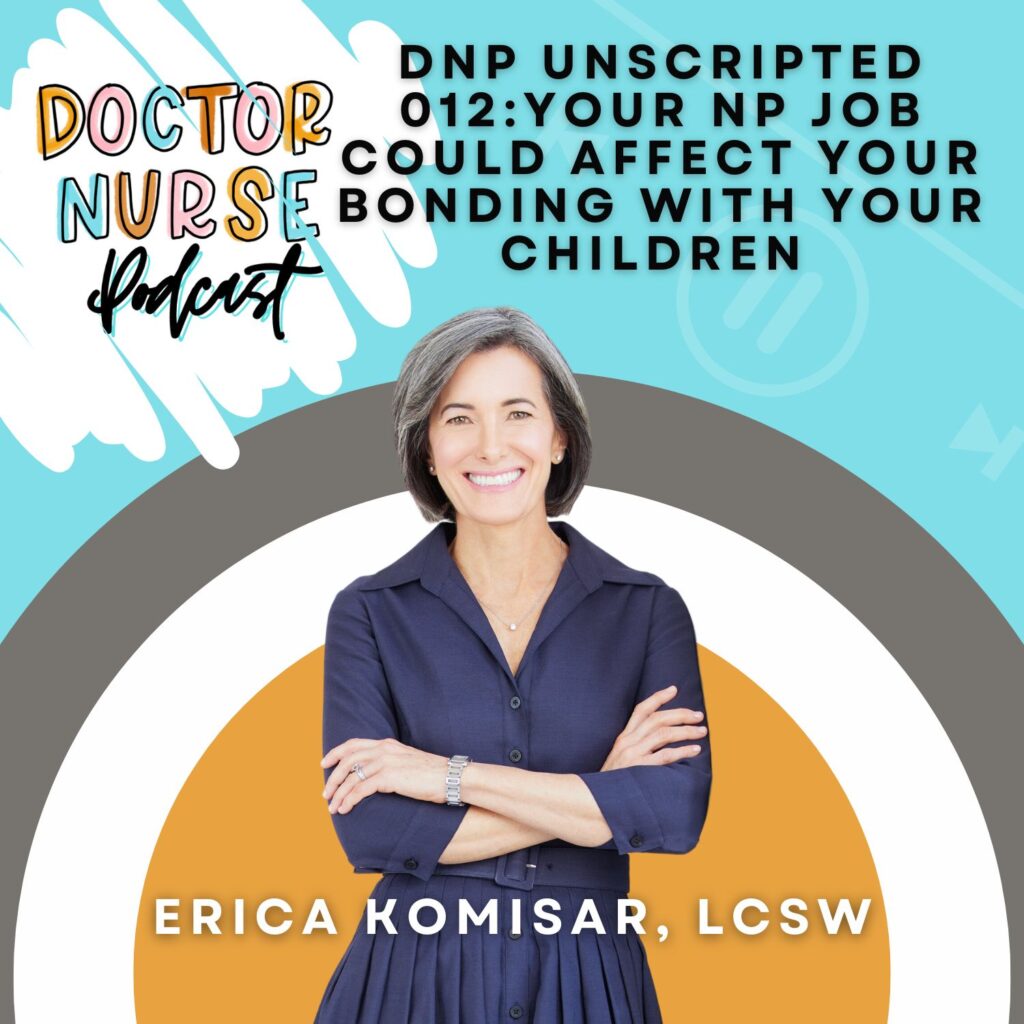
Dr. Nurse podcast fam. Thanks for joining me on another episode of the Dr. Nurse podcast. Today on the podcast, I have Erica Komisar. She is an author, a social worker, and a psychoanalyst with with over 30 years of experience in private practice working to help individuals with depression, anxiety, as well as she brings work life workshops to clinics, schools, corporations, and child care settings.
Sandra Pagenta: She’s the author of the book, Being There, and Why Prioritizing Motherhood in the First Three Years Matters, which I have read the book, it’s fabulous, and she’s a regular contributor on the Wall Street Journal, CBS, ABC, all these really big news Fronts, I guess, is the way to say it. She lives in New York with her husband she’s got three children.
Sandra Pagenta: And she decided to agree to come on the podcast today to talk about something that is really near and dear to my heart, which is moms and working and prioritizing motherhood first. So thanks for coming on Erica and agreeing to talk to me.
Sandra Pagenta: So let’s go ahead and set the stage for what it looks like for children today. What’s happening with children as the culture has really been prioritizing the accumulation of career stuff.
Sandra Pagenta: What’s been happening that you’ve seen on the scene with kids?
Erika: Well, so for children to be mentally healthy, they need, there are some irreducible needs that they have. And the most important of those needs is something called detachment security. And so what that means is that in the first three years.
Erika: 0 to 3. They are born incredibly neurologically fragile. They’re not born resilient. They’re not born capable of dealing with a great amount of stress. They are born incredibly fragile, vulnerable, and sensitive to stress. And some children are born even more sensitive to stress. We call them sensitive babies, but essentially children need.
Erika: To feel safe. They need to feel secure there. You know, we’re not like other animals, other mammals who are born ready to go. You know, we require the presence of our go to person, our, our mother, our primary attachment figure, who’s usually the mother and mothers serve this unique biological function, which is they make babies feel safe.
Erika: and secure through skin to skin contact, through breastfeeding, through being there physically and emotionally. They buffer children from stress. They regulate their emotions every time they soothe them. They’re regulating their emotions. And that from moment to moment, and I use the term moment to moment because it, it You can’t just leave babies and come back later, like they’re a vase or or a pretty sort of plate in your, in your house.
Erika: They’re, and they’re in exactly the same spot where you left them. They need you from moment to moment in the first three years to provide them with a sense of security and safety. And it’s the process. Of being there that allows them to go back and forth and emotionally refuel as they get a little bit more adventurous as they get to be toddlers when they’re really starting to crawl.
Erika: And if you were there, they take more risks and they become resilient because they’re able to explore and take risks. And if you’re not there, then they become more fearful, more anxious. They develop attachment disorders. So what we know is attachment disorders in the first three years correlate to mental illness later on.
Erika: And so we have a great number of children who have attachment disorders that correlate. So, you know, there’s different kinds of attachment disorders. And I guess you could say an attachment disorder is a strategy to cope with fear and loss. And babies develop different strategies. Some of those strategies are what we call avoidant strategies.
Erika: Some of them are anxious strategies. And some of them are you know, there’s an attachment disorder called disorganized attachment disorder, which is when babies don’t have a strategy and they do the least well. Because they cycle through all the strategies and they don’t have a strategy of their own, right?
Erika: So, and those babies develop things like borderline personality disorders. We’re seeing a lot of kids with borderline personality disorders. You know, the whole DBT sort of rave is all about treating a borderline personalities. We never had so many borderline personalities before. So yeah, so basically we’re not by abandoning our children in the early years to go back to work so early by having other people raise them by putting them into daycare.
Erika: What we’re doing is we’re basically creating generations of children with attachment disorders.
Sandra Pagenta: Wow. And so that is where we start. And what I started noticing when I also went back to work full time after having my son, I was in a similar situation, went back to work, didn’t realize I’d requested to go full time and I was denied by my job.
Sandra Pagenta: So I thought, well, my only option is to go full time. Back full time and I did and I began to start seeing all these issues with myself which you talk about a lot in your book that moms also start to kind of have these feelings of like what’s going on like why am I not attaching am I over all these different things and I just knew.
Sandra Pagenta: I was going to leave my job if it was not going to be a part time situation. So I went part time and that’s why I advocate for so many moms to go part time because it helped me with depression, anxiety, things that I was dealing with postpartum that I didn’t understand, why am I feeling this way? And I began to realize it was because something needed to change at work.
Sandra Pagenta: And one of the things that I think is important. We decided that going part time was the right move.
Sandra Pagenta: And I began to see for my career and for my wellbeing of my child, I didn’t know it at the time, but intrinsically, I knew something could not be right with a mom working full time. It just was. doesn’t work. And throughout my time working, I began to see no women need altered schedules to be present moms.
Sandra Pagenta: And I began to dive into what the literature said about that. And again, it’s one of those things that now I want more nurses to know, Hey, listen, Nurse practitioner roles in particular, they need to be done part time if you’re a mom, because you can’t do it, you can’t do both well. So for many NP moms, or for NPs, I think it’s important that they go part time.
Sandra Pagenta: And what are the benefits that you notice for the children whose moms work part time or work very, very little? And in terms of self care for themselves, but also behavioral issues for kids down the road.
Erika: Well, I mean, first a child whose mother has to work, but works or wants to work, but works less is going to be less stress.
Erika: So first you have a less stressed mom and a less, less exhausted mom and a more available mom physically and emotionally. But you also, yeah, you just have your mom there more to help you. Depending on the age of the baby and how sensitive the baby is, babies can tolerate short lapses of their mother.
Erika: They can, they can deal with short separations, but when their mothers are gone for long periods of time, they can’t handle it essentially. So if you have, as long as you’re not leaving your, your child in daycare, which I’m adamantly opposed to and you have what I call an alternative. attachment figure, a babysitter, a nanny, a family member, like a grandmother, an aunt, or you know, if we can’t afford it, then you, you share a caregiver with another family, but someone who’s a trusted, consistent, sensitive nurturer, an empathic nurturer, who’s there all the time, who’s going to be there all the time, who you’re going to have for years to come.
Erika: Someone who’s really consistent and constant, then, then I think leaving for shorter periods of time does not damage children. You know, I think the idea is depending on the age of the child, I mean, the younger the child, the more fragile the child. And so, you know, ideally, if you could take off as much time as possible and then go back to work part time, your child is getting the benefit of having you there more physically and emotionally, but also is getting a better mother.
Sandra Pagenta: I agree with that. I totally agree with that. And kind of more to your point, things that you talk about in the book about how children that are colicky have higher needs and higher thresholds. I remember you saying that in the book that they’re called sensitive children. And so you really want to be there more, especially if your child is showing signs of.
Sandra Pagenta: having issues regulating their emotions. And so I think that’s really good. And again, that’s what those benefits are for children are again, that ability to regulate and to, and to soothe themselves with your mother. And as you describe in the book about the oxytocin, the hormones that are released to help children regulate their nervous systems.
Sandra Pagenta: I just found it incredibly interesting to see that they need you there, that you leaving for extended periods of time. Again, they, they have this. Feeling that like you, you died and then. You know, they can’t understand what that means for you to come back because of the object permanence you talked about.
Sandra Pagenta: So I thought it was, I thought it was very interesting. And again, all into the science. I mean, everything that you’re talking about is right on track with science, which is what, you know, how nurses and nurse practitioners are. trained is with science, and yet we continue to deny the science in regards to advancing our careers as we treat and care for people.
Sandra Pagenta: So I just find it very interesting that we just kind of tend to get tunnel vision and don’t think that these things matter. So for an NP mom that’s exhausted and thinking about, you know, going part time, one of the things that you talk about as well is, Our workplace is very open and receptive to moms working part time.
Sandra Pagenta: And so I was thinking maybe you could touch on that. And what are some of the things that you noticed kind of in the career space that you’re seeing are options for, for part time working moms?. Well,
Erika: I mean, I think big institutions that are male run institutions, or I’m going to say even some female run institutions where women are really function more like men are really not friendly environments.
Erika: And I say this honestly, you know, not to discourage women from going into whatever floats their boat and you know, whatever they dream of and that there are certain fields that unless you can break off and be entrepreneurial, Or unless you can break off and be, so sometimes you can be in a big organization or institution like a hospital and they allow you to be more entrepreneurial within that institution.
Erika: But many times these big institutions have rules and they’re very strict about the rules. And the rules were made for men who could work full time and come home at the end of the day, knowing their wife was. Cooking dinner and taking care of the children and so, you know, they, they were created for men who worked when that split was a thing, you know, and so the, the, the rules that hospitals still live by.
Erika: And I, I’ve worked, I worked in Mount Sinai years ago in New York and the rules that they, they live by are men’s rules. And so you would say, well, if a woman ruled hospitals, there aren’t many presidents of hospital you know, conglomerates that are women, but I suppose if there were, maybe they would change the rules.
Erika: Maybe not. I don’t know. I mean, but maybe they would change the rules. So they were more in line for women to, to, to be able to work in those environments, you know, for women to be able to balance their lives better, but as it stands now, the best kind of work for women. is entrepreneurial work, meaning if you are a nurse practitioner, then you start your own practice with another nurse practitioner who also has children and you agree that you’re going to support one another, but you also have the same value system.
Erika: So, you know, the most important thing is that you not sacrifice your value system for your work. That’s what I’ll say. No work is worth sacrificing your children for, and it’s not worth sacrificing your value system for. Because at the end of your life, that’s what you’ll regret. And I can tell you as a therapist, I see a lot of women who made a lot of choices that they regret.
Erika: Because they didn’t pursue their value system. They didn’t do what their instincts told them to do. And either their children had issues or they’re estranged from their children now as their children are adults. So, you know, it’s just not worth it. That’s what I would say to women. It’s just not worth sacrificing your children for
Sandra Pagenta: your work.
Sandra Pagenta: Yeah, no, I agree with you. I get emotional talking about it because it is the biggest regret of my career is going back for those three months full time. You know, one of the things that you just talked about, you know, about ideal work situations, you say a couple hours out coming back, don’t spend long periods of time, especially in the first three years.
Sandra Pagenta: Right. And so those extended periods of time and you say, make sure that they’re short burst. I love that you give science behind the decisions that you can make so that you look back at your life and you don’t regret the decisions that you made. That’s just huge. Like that’s exactly what I want to do.
Erika: Yeah, I mean, the idea is to keep your toe, keep your big toe in your work when you’re raising young children.
Erika: So, and so what does that mean? That means that in those years you’re not going to be at the top of your game with your career. So there’s sacrifice involved, but it’s not forever sacrifice. So the idea that, you know, keeping your toe in your work may be just keeping your license alive. It may be working a few hours a day.
Erika: It may be You know, things that don’t involve spending great, a great deal of time away from your children and, or being preoccupied with your work rather than being preoccupied with your children, your maternal instincts dictate that you should be preoccupied with your children. And what women are doing is they’re forcing.
Erika: themselves to look away in a schizoid kind of way. They’re forcing themselves to turn away from their children and turn toward their work. And society’s telling them, that’s a great thing. And I’m telling you that that’s not a great thing. And it’s not a great thing for children, but it’s also not a great thing for women.
Erika: Yes, I agree. So keeping your toe in your work so you have it to go back to in whatever form you want to go back to it and then maybe amp it up later on when your kids are older. That’s the
Sandra Pagenta: idea. Yes. I agree with you. And I always hear, don’t worry about leaving babies. They’re resilient. And that’s something that they tout as a way to kind of allow women to disconnect.
Sandra Pagenta: And you talk about this in your book about the attachment and how women that detach from their children likely have an attachment disorder of themselves. And so, well, and
Erika: also the problem is either they have a Attachment disorders. From childhood. Or they’ve been forced to turn away so much. I mean, there’s only so much turning away.
Erika: We can do where we develop defenses as women. So most, I would say most women that turn away from their children do have some kind of attachment disorder. But I think there’s also the possibility that if you turn away enough. If you flip that switch and turn off your instincts enough, your instincts no longer work.
Erika: Yes, that’s so good. And then you don’t pass down those instincts to your children. So there’s a lot of research in the book. One piece of research that’s so interesting is Michael Meany did research with animal research, but basically that when mammals, Mother with what we call sensitive empathic mothering, licking and grooming in animals, but we call it sensitive empathic nurturing.
Erika: They pass that nurturing down generationally to their children. If they don’t lick and groom their children, then their children can’t lick and groom their children. And so. You know, what we know is that nurturing is passed down generationally, not genetically, but generationally. And so you can basically water down one’s instincts over many generations.
Erika: So we’re seeing three generations from the women’s rights movement the women’s liberation movement, which means that there’s three or even four generations of women who have. Watered down their instincts to the extent that their children and their children’s children can no longer even feel attached to their children.
Erika: There’s a huge uptick in postpartum depression, which has to do with the bonds that should be happening, not happening.
Sandra Pagenta: One of the things you talk about, and it made me think about this is epigenetic changes. And so as what you’re kind of describing in my mind is as these children are being raised in these societies where the mother is not there doing the mothering and the nurturing, that you begin to almost epigenetically change your kid as they get older, and then they become mothers, they end up.
Sandra Pagenta: mothering differently, they end up nurturing differently. That’s kind of what I’m thinking as you’re talking. And I just find that fascinating that we, we are, we have done such a disservice to women in this feminism movement, not completely because it is good. And you say this in the book, it is good that we can provide for ourselves.
Sandra Pagenta: You know, the, the, we have other means of creating income. But that their support is needed for moms during these times where they step back instead of, you know, companies kind of coming at mothers like you need to mother, like, you know, you need to work like you don’t mother and you need to mother like you don’t work instead of these unrealistic expectations, really adjusting how we look at things.
Sandra Pagenta: And again, Babies aren’t resilient. They’re not meant to be resilient. And as you describe in the book as well, as they, our children are born so much more dependent than normal animal parents or normal animal babies, because we are meant to do that nurturing for that extended period of time. So what do you say to the nurse who says, okay, okay, okay, wait, but I’m afraid of losing my identity through motherhood that I want to keep working because this is part of who I am.
Sandra Pagenta: I love your take on this. So if you could share it, I just think it’s wonderful.
Erika: Well, I mean, I think that, that, that fear often is based in the fact that, that one’s identity is not solid from, from the beginning, right? So if we have a solid sense of ourselves and what we love and what we love to do, that even when we take, take breaks from it, we, we can find ourselves again.
Erika: And we may find ourselves in a different kind of, in a different form, but we find ourselves again. So people are afraid of getting lost. And the idea is well, I talk about in the book, I think, I don’t know which story you’re talking about, but, you know, I talk about the fact that sometimes by getting lost, you find a different path to the same place which is satisfaction.
Erika: You find a completely different route that you may not have found if you were so scared. stuck to a linear route. And so, you know, for a nurse or a nurse practitioner, I suppose that would be, you work in a big institution that has rules that don’t allow you to have flexibility or control in your life.
Erika: And that’s good when you’re in your 20s and you don’t have children. And then you get married, you want to have children, and you take a break. And when you come back, you decide, Actually, I don’t want to work in a big institution anymore. I want to work in a small practice, or I want to start my own practice with another couple of nurse practitioners.
Erika: And, and you know, we, where we have the same values. Or maybe I’m going to use my nursing for something completely different that’s administrative or you know, so I think the point is that you never know. Where life will lead you if you’re so afraid of getting off the path, right? So life is not linear.
Erika: It never was. It never will be. And the fear that careers should be linear. It’s terrifying women talk about terror. It’s terrorizing women. So they’re not able to make the best choices. For their families.
Sandra Pagenta: Yeah. And I love that you say that motherhood doesn’t leave you as it found.
Erika: No, you may not go back to working in that
Sandra Pagenta: big institution.
Sandra Pagenta: You don’t have any control of that because the moment you have children, you’re frozen. The moment that you’re, that you have children. It completely shifts your identity to begin with and so you don’t get any control of that and I Completely agree with that and that’s one of the most my most favorite things that you talked about in the book was that okay?
Sandra Pagenta: Good luck. You’re gonna be changed. It’s just the way it is. You’re never gonna be the same And so I I totally agree that again if you’re you’ve you’re going to your identity is going to change the moment you have a child and Your identity can’t be wrapped up in your career or your child for any matter.
Sandra Pagenta: You’ve got to be able, but you’ve got to be able to understand that you are necessary and needed at this time for the nurturing, for the long, for the long haul with your, with your child. And that’s something that you need to be thinking about beginning with the Indian mind, even with. Raising your children.
Sandra Pagenta: And I just think that that’s something that I really want to touch on. One of the other things that I thought very interesting you talked about is being present and that quality versus quantity of time. Cause that’s something that a lot of people say, well, as long as I’m super present and I’m really good.
Sandra Pagenta: It doesn’t matter if I’m there for all of it. It just means I just need to be really present. And you kind of challenge that is that that divided attention is not enough, that you really need focused attention. So I thought maybe you could touch on that briefly, if that’s something that, you know, yes, it’s definitely true and why it is true.
Erika: Well, it’s the, it’s the, it’s the of quality time. Cause it’s It’s not a real thing. It’s anyone who has any kind of meaningful relationship, whether it’s with a lover or a boyfriend or a girlfriend or a husband or a spouse or a child or a parent or a sibling or a friend knows that it’s why we. Profligate, why we promote this, this myth that it works with children, I have no idea because it works for our narcissism, but it doesn’t work. It doesn’t work because all relationships that mean that, that, that have any weight to them at all require presence. You cannot be close to someone if you do not have proximity to them.
Erika: Yeah, with Children, it’s critical. So, and I’m going to say I challenge anyone with any other kinds of relationships to be really, truly close. I mean, you can have a friend. Look, I have friends in South Africa and Rome that I’ve old friends. I love them, but I don’t have proximity to them. I don’t know what’s going on in their lives.
Erika: It’s not the same level of closeness as my friends in New York, who I have dinner with once a week. So, you know, the idea that with children, they need you constantly there. And so when you’re not there, you, you’re not able to provide that moment to moment soothing them and regulating their emotions. It’s just not the same when you pop in on your schedule and try to be with your children because your children are already, you’d say your children are already feeling the loss of you.
Erika: So you’re not, you’re also not getting the best of your children, I’m going to say. When you pop in and pop out and you’re gone for long periods of time, when you’re with your children, they’re angry at you. And they’re often detached from you and they’re often anxious around you. So you’re also not getting the best out of your children.
Sandra Pagenta: Yeah, that is so good, Erica. So one of the things you talk about is the ideal work situation for moms and, and, and as well as maternity leave. And. One of the things you say is that nursing is one of the better fields because it is a woman dominated field and it tends to be more of a caring centered field.
Sandra Pagenta: I was wondering if you could expand on that a little bit and describe why you feel like this field is probably the best for flexibility.
Erika: Well, any helping profession, you know, so it’s interesting because women in trying to. Become more like men in the women’s rights movement. They, they really sacrificed or denigrated all of the professions that were called women’s professions.
Erika: And yet they were women’s professions because they allowed women to have control and flexibility, nursing, being a therapist. being a speech therapist being a teacher, you know, all of these professions allowed women more time with their children. And so they were great in that you could have flexibility, more flexibility, more control.
Erika: And you could, You could take breaks. Teachers can not teach and go back to teaching. You have a profession, you know, being a nurse. If you take time off when you have a child or you reduce your schedule, you can always pick it up later. You know, they weren’t these careers that really were based on a value system that was a male oriented value system.
Erika: I mean, so ironically, the old, the irony of all ironies, cause I’m almost 60. So this is my generation. You know, the irony. Is that my generation and the generation before in trying to be, be equal, quote unquote, equal, we sacrificed all the good about being women. I mean, so now it’s time to reclaim. Now it’s time to reclaim what’s really great about being.
Erika: We’re generative. We can create, we, we create life. Men can’t create life. We nurture life in a way that they can’t nurture life. We give our children things that fathers can’t give their children. So, and if we sacrifice that, we sacrifice the best part of being women. Yeah.
Sandra Pagenta: And it’s hurting our kids, which is.
Sandra Pagenta: The, the
Erika: further hurting our kids.
Sandra Pagenta: It’s the ripple effect of all of this. And so we have got to stop throwing the, the, the, the coins in the pond because it’s just absolutely rippling down and we’ve got to, we’ve got to, we’ve got to do something about it. And I love. Everything you just said, I brought tears to my eyes.
Sandra Pagenta: Another big trend in I’m seeing is fathers stepping in. And I know you talk about the best situation is for the mom, and that if it’s not the mom, then the dad is the next best thing. And that the, you even talk about the hormonal changes in dads, as they take care of children, they’ll grow a level of oxytocin, that nurturing hormone.
Sandra Pagenta: They typically have more vasopressin. Which, which is with testosterone, but then they can change, they’ll, you know, start to lose some of that with taking care of the children. I found it fascinating. And then you agree that grandparents are the next line. And so that’s who I leave my kids with because daycare was never an option.
Sandra Pagenta: So my little ones get left with their grandma when I’m gone. And then their dad will cover if I’m gone. So it’s dad or grandma, or it’s no one it’s bust. It’s me just calling out of work. It’s me doing the things that I have to do to take care of my children. So those are the options for me. But. Right.
Sandra Pagenta: For the person that’s like, well, aren’t we all interchangeable? Doesn’t it matter? Doesn’t matter if you leave it with the dad or the, you know, leave the baby with the dad or the grandma. It’s somebody, but what, what, what’s really the difference whenever you leave them with one of those versus daycare?
Erika: Well, I mean, for obvious reasons, children do best with their primary attachment figures because that is their, that, that is their go to person for a sense of safety and security in the world. So it’s always best with the primary attachment figure. That’s usually the mother. The next best thing is.
Erika: Kinship bonds. So kinship bonds means that the people that have the closest investment in that child emotionally to the mother are people who are family or extended family. That would be the father. That would be a grandmother. That would be an aunt. Right? And. You know, next, if you don’t have kinship bonds that you can leave your child with, the next best would be to have an alternative attachment figure like a surrogate, like a babysitter or a nanny.
Erika: And then if you can’t afford that, then you share a nanny. That would be probably about the same price as daycare, but daycare is the least good option. Daycare, the ratio of caregiver to child is much too high. Your child is overwhelmed, overstimulated and in an environment with transient care because, because the caregivers come and go and get sick and are overwhelmed.
Erika: And because for the most part, there isn’t a daycare center with a ratio of. Less than five to one and it’s never five to one because they’re always getting sick and they’re underpaid and they’re undertrained and they’re overwhelmed and so they’re always quitting and leaving. And so your child is in this kind of rotating, revolving door of caregivers who you know, again, A stranger in a strange world, and that’s not what babies are supposed to be feeling.
Erika: They’re supposed to be feeling safe in a familiar place with familiar faces who provide them with a sense of safety and security and are consistent throughout their childhood. That is not what you get in daycare. And I challenge mothers. Always to think this way if you if you read in my book It says that from moment to moment you are meant to soothe your baby when they’re in distress and regulate all of their emotions I want you to think about yourself as a daycare worker caring for what is more likely to be eight to one eight children under the age of Let’s say, let’s, let’s be generous and say your daycare center has a ratio of 5 to 1 under the age of 1 and then 8 to 1 under the age of 3.
Erika: Let’s be generous. Okay. 5 babies under the age of 1 and you are 1 person trying to soothe babies distress from moment to moment and soothe all of those babies at the same time. It’s impossible. This is why people lose their minds having quintuplets. Or sextuplets or octuplets. The reason is that you can’t handle it.
Erika: It’s why as human beings we’re not meant to have five babies at once. We’re not meant to have six or seven or eight babies at once. We’re meant to have one at most two babies. Right? And so outside of that, we are not prepared to be able to regulate those children’s emotions. And those children develop anxiety, they develop aggression, behavioral, but what it does is it triggers their stress responses.
Erika: So we know that children in daycare have much higher levels of cortisol. Yes, you talk about this. They do salivary cortisol tests. Yep, yep. And so that stress response too early turns on their stress. The threat regulating system too early, which makes it overly active again, too early and ultimately makes it dysfunction later on, ceases to function in the way it’s meant to function.
Sandra Pagenta: So for the nurse mom that goes, it’s too late. I have already done the, I’ve put my baby in daycare, she’s three, you know, I’m starting to notice things in her, anger, aggression, different things that you talk about in the book. As your kids get older, I want to give her hope. I want to make her, I want to help the new mom.
Sandra Pagenta: That’s like, what am I doing? Should I do this? I want to help her with everything we just told her. And then I wanted to give hope to the mom. That’s like, oh my gosh, what do I do? It’s too late. The ship has sailed. I should just keep going. Or I can’t, how do I fix it? What do you say to that mom, that nurse mom?
Erika: So I say that repair, repair, repair. When there’s a hole in a sock, you darn that sock and it makes that hole in the sock stronger. But you have to repair it. You can’t keep going on as you’re going on. You need to stop in your tracks, you need to pause, you need to feel the regret, not turn away from it, feel the guilt, not turn away from it, and then help that to be activating for you.
Erika: So you change your behavior. When we feel guilty, we’re meant to change our behavior. And so change your behavior. Change your schedule, find a way to be more present for your child, you know, repair what you can, maybe it’s not a hundred percent repairable, but there’s a lot about being away that can be repaired, but you need to change your behavior.
Sandra Pagenta: Yeah, and I love the different stories you tell in the book about how moms slow down their careers and they step away and they just get on the floor and they play with their children. They spend time talking with them, you know, and if you did notice, like, man, I’m noticing, like, You know, Sally’s having these problems or Kevin is acting this way.
Sandra Pagenta: You can work on your children. It’s not too late. You can still build bolster support, create that relationship because what they need is that connection with their primary caregiver, their mom. And you did again, if you do it now, children will notice it. And they’ll say like, mommy, you slowed down, mommy, you didn’t do these things.
Sandra Pagenta: And you can tell them. And I love how you say that you. Narrate for the children like mommy’s doing this because I want to be here. I don’t want to just miss out on these moments and you tell them to tell that to the children. They get it. They understand. Right. And so it becomes easier for them to forgive and to to not have anger with their primary caregiver, their mom, because they felt like you missed out on the times and it’s it’s not It’s it might be too, it might be late, but it’s better late than never and I think that’s the part that I
Erika: Exactly I don’t know when the narrative changed, but at some point in history, the narrative changed.
Erika: thAt somehow when children have issues, there’s something wrong with the children, as opposed to there being something wrong with the parents. And that narrative is a very important narrative that we shift back. When your children are struggling, It’s not a problem. Your children are the barometer of how you’re doing.
Erika: And when our children, when our children have difficulties, there’s nothing wrong with our children. It means that there’s something wrong with the way we’re raising our children. And that’s a harsh toke. And I know it’s hard for mothers to hear and fathers to hear, but it is factual and it is reality.
Sandra Pagenta: Yeah. I like that you say I may be child centric, but that doesn’t make me anti feminist. It doesn’t. I love that you always bring it back to the child and you always bring the focus back to the children. And again, instead of being like, Oh man, there’s something wrong with my kid. It’s like, no, you raised that kid.
Sandra Pagenta: Look at yourself, look in the mirror, see what’s going on. And it’s a regret of mine, but it’s also my biggest redemption. Shut To step away. And I, I’m so thankful that you came onto the podcast today because I’ve been building the podcast in the quiet moments. My little one is napping. And so I build my podcast.
Sandra Pagenta: I talk to my guests while my little ones nap. And I do that because this is my way of giving myself a chance to grow something for myself and that entrepreneurial space that you described. And I agree with you. I think that is the best space for women to grow something for themselves and to be able to create businesses because if we don’t do this and we just rely on these, these systems that were built for men, and we expect them to meet our needs one, as we pull away from these big institutions demanding for bet for change, they will begin to change.
Sandra Pagenta: But the longer we stay slave to them and we continue to just show back up and keep showing up for work and We just keep paying the penance. They are going to lose good talent. And even as you said in like Google and these big organizations, they give these great benefits and then women still don’t want to take them because they’re afraid they’re going to lose their jobs and different things.
Sandra Pagenta: I thought that was so interesting in your book, but I think we need to encourage moms. We need to start having more conversations and really talking about, no, this is longterm. This is not just, Hey, they’re resilient. They’ll be fine. It’s like, no, they won’t be. They’ll be more anxious. They’ll be more depressed.
Sandra Pagenta: And we’re seeing this pandemic of kids that are hurting themselves and all these different anxieties and medications. And I just think there needs to be a call to arms for mothers to step up and mother and not be afraid when your job says, hey. It’d be great if you were here more. Yeah, but I can’t be because I have got a higher calling that’s above anything that I do here.
Sandra Pagenta: So I won’t be here. I’m so sorry. And I’m not sorry. I’m sorry. I’m not sorry. I’m going to, I’m going to be doing my biggest calling. And the thing that at the end of my life, and you talk about this in your podcast, in your book, excuse me, in your book, at the end of your life, no one regrets. Having worked more, I’m sorry, having, no one regrets having spent time with their family.
Sandra Pagenta: They regret having worked more and not spent time in the relationships and the different, you know, you talk about even the cultural and society differences between other cultures that say relationships are the most important thing and America needs to wake up and get back there and especially allow their, allow mamas to, to do that part.
Sandra Pagenta: would be a better country. And I think that would be great. I think it’s big. So shameless pug for your book. I loved it. Shameless pug where people can find you. It’s been a joy to chat with you, Erica. It really has been such a wealth of knowledge.
Erika: Thank you for having me on.
Sandra Pagenta: Yeah. Yeah. And they can find you at ericacomasar.com
Erika: They can find me at www.ericakomisar.com
Sandra Pagenta: Okay. And then you’ve got two books. I know you have the one book that I described earlier and then something about an adolescent book.
Erika: Yes, so Chicken Little, The Sky Isn’t Falling, Raising Resilient Adolescents in the New Age of Anxiety, which is also about repair.
Erika: So if you miss that first window, all is not lost, you have another window of vulnerability where you can make a big difference in helping your children to learn to regulate their emotions and be healthy. Yep. Oh, I love that.
Sandra Pagenta: Thank you guys. Check that out. And again, thank you, Erica, for your time today. Yeah.
Sandra Pagenta: Thank you so much.
Erika: Thank you.
Podcast Description
This episode was going to be apart of my part-time NP series, but the episode was just too good to put behind a paywall. Subscribers stay tuned for specific content for you coming out next week!
This week I spoke with Erica Komisar who is a clinical social worker, psychoanalyst, parent coach, and author. With 30 years of experience in private practice, she works to alleviate pain in individuals who suffer from depression, anxiety, eating, and other compulsive disorders. By helping them live better lives and have richer, more satisfying relationships, she assists them in achieving their personal and professional goals and living up to their potential.
A graduate of Georgetown and Columbia Universities and The New York Freudian Society, Erica is a psychological consultant bringing parenting and work/life workshops to clinics, schools, corporations, and childcare settings including The Garden House School, Goldman Sachs, Shearman, and Sterling and SWFS Early Childhood Center.
Erica is also the author of the book Being There: Why Prioritizing Motherhood in the First Three Years Matters and has appeared on major media networks such as CBS, ABC, FOX, and NPR. She is a regular contributor to the Wall Street Journal, Washington Post, New York Daily News, and FOX 5 NY. She is a Contributing Editor to the Institute for Family Studies. Her upcoming book, Chicken Little The Sky Isn’t Falling: Raising Resilient Adolescents in the New Age of Anxiety will be released in Fall 2021.
She lives in New York City with her husband, optometrist, and social entrepreneur Dr. Jordan Kassalow with whom she has three teenage and young adult children.
https://www.ericakomisar.com/
Doctor Nurse Podcast Links:
Check out the DNP blog for more information on side hustles: https://doctornursepodcast.com/blog
Doctor Nurse Podcast YouTube: https://www.youtube.com/channel/UCYQYlS9d6m7HyMK7Z1BI5DA
Doctor Nurse Podcast IG: https://www.instagram.com/DoctorNursePodcast
Doctor Nurse Podcast Website: https://www.doctornursepodcast.com
Doctor Nurse Podcast Email: doctornursepodcast@gmail.com
SuccessNPs.com is our official and newly launched website for all things SucessNP! Get your clinical rotation booklets. Be sure to follow us on IG…I’m not going to lie- We are pretty funny 🙂 https://www.instagram.com/successnps/
Share this podcast with a nurse friend: Subscribe to exclusive Doctor Nurse Content for only $4.99 a month!! Support the podcast and hear content to help you grow in your career. https://podcasters.spotify.com/pod/show/thedoctornursepodcast/subscribe
Latest Episodes
Doctor Nurse podcast brings you weekly shows to help INSPIRE, EDUCATE AND EMPOWER nurses with true stories of initiative and impact.
Doctor Nurse podcast brings you weekly shows to help INSPIRE, EDUCATE AND EMPOWER nurses with true stories of initiative and impact.
Latest Episodes
Doctor Nurse podcast brings you weekly shows to help INSPIRE, EDUCATE AND EMPOWER nurses with true stories of initiative and impact.