Also Available On






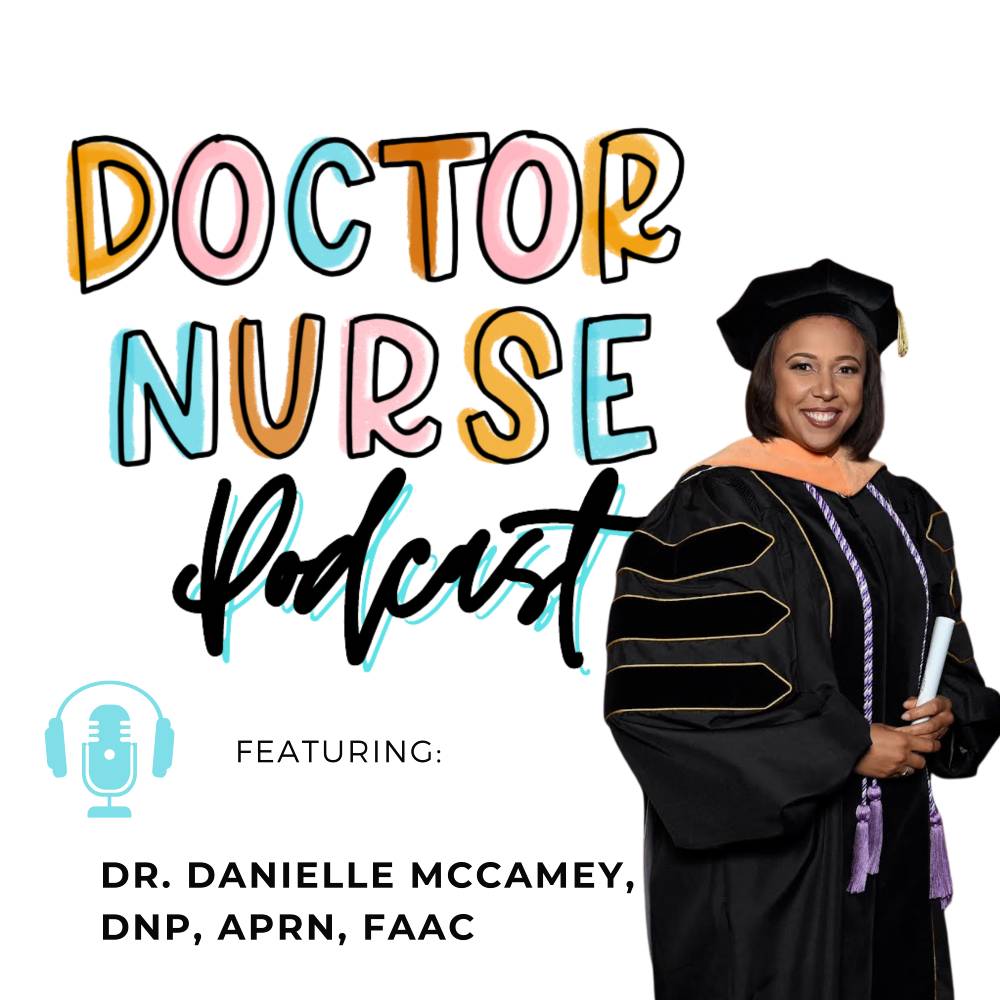
Sandra Pagenta: [00:00:00] Hi guys, welcome to the doctor nurse podcast today. I have Dr. Danielle McKamey she’s a DNP APRN board certified acute care nurse practitioner. She was inducted into a fellowship of the American college of chest physicians back in 2019. She is a mentor nurse motivator an expert clinical care. Practice clinician. She attained all her degrees from Georgetown university. She has a, bachelor’s a master’s and a doctoral degree. She also was recently elected as the vice chair of.
End of life care network, where she focuses on education, raising awareness in the palliative end of life care and chest and clinical practice. She’s nearly 20 years of nursing experience over a decade as an acute care nurse practitioner. And she’s currently working as the chief advanced nurse practitioner.
Pre-anesthesia testing department and she is a senior advanced practice provider in the surgical intensive care unit. [00:01:00] She also in addition is the co-creator and chair of the doctoral nurses collaborative, which is a group that joins DMPs and PhD prepared nurses throughout her current health care system.
One of the other things that are really liked is that she is the founder, CEO and president of the DMPs of color incorporated, which is a nonprofit nursing organization that is building community for nurses of color, through networking leadership, advocacy, to increase diversity in doctoral studies, clinical practice in leaders.
I’m just so excited to have you on your energy’s infectious. I know my guests are going to get a lot out of just what you have to say today, and describing your journey from where you were to where you are. Thank you for coming.
Danielle McCamey: Thank you for the invite. I’m so humbled and appreciative.
Sandra Pagenta: So let’s dive right in. Describe to me a little bit more about what you do at your current job and your job.
Danielle McCamey: My current job, I’m the chief nurse practitioner of the pre-anesthesia department.
And I lead a department [00:02:00] of about 12 individuals, six nurse practitioners, six support staff. And our goal for our department is to make sure patients are optimized and preparation for surgery, and that they’re safe to receive anesthesia. We basically collaborate. The anesthesiologists, the surgeons, the patients, of course, and their providers, whether it be their primary care cardiologists, pulmonologists, just to ensure that all of their chronic conditions are optimized.
So meaning if they need any recent labs or diagnostics to make sure that everything would be good to go for them to have the best possible outcomes for their surgical. And on the side and my side hustle, I still do PRN and the surgical ICU, which is my love. I’m a critical care nurse practitioner. Our particular service, we call ourselves Jack of all trades master of none.
And I think the phrase goes on to something else, but we have a unique specialty because we do cardiac surgery, vascular surgery. Trauma burn neurosurgery. We get to rotate through the different specialties. [00:03:00] It’s an awesome experience and I just can’t quite let it go.
Sandra Pagenta: also you’ve developed this, this nonprofit that you organize and describe to us a little bit about what you’re involved
Danielle McCamey: in.
My nonprofit is my passion. This is my mission and will be my legacy. It is DMPs of color. As you mentioned, we’re a nursing 5 0 1 C3 nonprofit that came from my experience of going to a PWI, which stands for a predominantly white institution being the only black woman in my cohort at the start.
I can. Being the product of a single parent family household, and all of the statistics that are placed on having that layer and then being a black woman in America, lay on that layer and then being a black woman from a single parent family household pursuing higher education, a doctorate, nevertheless.
So all of that, that came with that as well. And then that understanding of having to represent my family, my ancestors. And then having to prove not only to myself, but to my colleagues and my [00:04:00] professors that I earned this place in space. And then also, how do I occupy it so that I’m not boxed into one thing or another?
I just craved community because I couldn’t come to my cohort mates. Man. There’s a lot of things going on because they couldn’t really relate to my lived experience. And so I look to my current Nursing organizations and they didn’t quite have what I was specifically looking for. I wanted something that focused on nurses of color, getting their DNP.
And I was like, do you guys just have a space for just DMPs of color? I couldn’t find it. So I ended up launching a Facebook. Just organically. It grew beyond my wildest expectations. That was back in, I guess, 20 16, 20 17 ish fast-forward to today. We’re still our organically grown social media group, but we have private Facebook group and LinkedIn group and combined, we have nearly 1800.
So it has float up, but people find this space, a safe space and [00:05:00] a validating space because they see other folks that look like them. A lot of the stories that are told in our private groups is that they’re the only one. And. Creates a lot of challenges, a lot of pressure, but also it puts an onus for us to pave the way for others.
There’s a certain obligation and this certain kind of where you have to move to have your influence. Oh, I’ll make that path for others.
Sandra Pagenta: I just want to touch on, how important this is because you are right. There are not a lot of us for my listeners. I am half African-American.
My father is African-American. And I am used to a dad in a space where he is all alone. He is the only black guy. In whatever space it was that he would go into. And so he always encouraged me as a kid to be okay. Being alone, but it’s nice to know that we are creating community as we move forward. And we push the barriers.
We create little niches and little places where we can experience community and not [00:06:00] feel so alone. It’s not a divisive thing. It’s not, you guys stay over there. We’ll be over here. I don’t think that’s it at all. I just did it for everything in life. You, you gravitate towards people.
You have something in common with every friendship is based on that. I think it’s really neat to be able to create a space where African-Americans or people with the same lived experience can talk and share as we push boundaries and limits that. A lot of our family members have never achieved.
My grandmother, my African-American grandmother was an LPN. And so it means a lot to me to be a DNP because I came from a grandmother that, she was an LPN. That’s how she supported, , her family. And so I hear you on. Pushing past those barriers, but then community, once you get past those barriers and it sounds like there’s a big need.
Danielle McCamey: That message for the need. Wasn’t any louder. We had our virtual conference back in October. And so I was only expecting 60 people. I was like, we get 60 people that would be success. Awesome girl. We had over 200 [00:07:00] folks up in that piece.
Like Alva slide. Wait, what? 200 folks registered. On the day of the conference, we probably had like 130, 150 people show up and the energy was fire. People just felt so empowered, inspired, and that’s our tagline inspire, empower, and transform. People were just like, man, like I’m seeing people speak that have their DMP and they’re of color.
And they’re speaking to the issues that. Experiencing and they’re giving me tools to navigate and I’m expanding my network. And that’s a key thing in our community. I’ll speak to my experience that I just learned the value of networking. Like yesterday years old. you grow up.
Like I said, single parent moms uh, you go to school, you get good grades, you come home, you go to work, you do good work, you go home. And so you never really taught to expand beyond that because that’s just been like, you got to keep your job because you gotta pay these bills. As I, stand in my power and my authentic space as CEO, which took me a while to kind of be like, I’m a [00:08:00] CEO of a whole thing.
Yeah, as I’ve claimed that space, I’m recognizing the importance and the value of networking. And so we empowered that kind of essence in the conference and people were just like blown away. It was amazing. So people are like, can’t wait for next year’s conference.
Sandra Pagenta: So that’s really exciting. That’s incredible.
Again, one of the things that. Hearing reverberating through all these nurse practitioners stories is finding a gap and closing the gap. And so that’s what you did with DMPs of color. You found a gap and you closed it. I say that in regards to gaps in healthcare, but it can also be gaps in community.
It can also be gaps in education, those different. We are so good because we’re at the bedside. We see the forest through the patients. If we can take that same skill that we have at the bedside and just apply it to life, we would actually be able to create a lot of businesses. We are people that could be CEOs and stepping into those roles, because [00:09:00] those are great at that stuff.
That’s really cool. And thank you for sharing what you do right now. how did you get to this specific spot in your journey? Take us back to when you decided I’m going to be a nurse. How did you get from where you are right now? How did you get, what was that moment? You decided to be a nurse and walk me through that story.
Danielle McCamey: I was young, my mom would take me along to her home health client cases. And she would set me up in the corner of my car.
Where’s your mom. She’s LPN. Okay. I would have my little plastic medical bag that I would keep my crowns and my little plastics, but she’ll set me up in the corner. She’d be like, you’d be good. Like, I’m going to go take care of my patients and Bubba. When she thought I was coloring, I was actually watching her.
And I was just so fascinated how she could just go in and brighten each patient’s day with just whatever she would do. I’d at the time, I didn’t understand, , oh, she’s given them a shot or she’s given him medications and stuff like that. So by the end of the visit, like the patients would feel so restored and I could see the [00:10:00] significant impact she made with each.
And how she paid attention to the details to customize her care, to meet the needs for each of her patients. It’s I was just like, I want to be like you moms. So I would say that after every patient case, and I was like, oh, would it be like you mom? So she encouraged me, like, absolutely be like me, but go beyond just kind of like how your grandma’s story is.
And so when I got to the process of, okay, I’m going to go to college. And what does that look like? I was in high school and I, once I guidance counselor, cause I was the first in my family to even consider going to college. And my guidance counselor discouraged me. She was like because you are a product of a single parent family household, your family makes not even $40,000.
Like you wouldn’t even be able to make it because the statistics show because of your circumstances, you will not. The standardized tests and all that. I believe that because I had taken the sat scores and never got over a thousand, which was like the benchmark.
I believe that. She crushed my dreams of going to college. Thankfully I had a coach attracted[00:11:00]
Sandra Pagenta: girl. I
Danielle McCamey: had a track coach and I shared this story with him. Cause I was so overcome with emotion at track practice because of it. Cause she literally like just killed it. It was like, boom, you’re done.
And so my track coach was in tuned to all of his athletes. He saw that I was kind of. Present and I shared the story and he was like, if I could shake you, I could. So he began to tell me all the game secrets, he was like, you use you being a single parent of low socioeconomic status to your advantage because there’s lots of support and resources that will pay for your application fees and pay for your college.
So that lit the fire back up. And I was on a rampage. I applied to like 20. Nevertheless got in brought the 20 acceptance letters to the guidance counselor’s office, laid them on her desk was like, you can keep the pencil. So then , and ever since then have been on fire, , sometimes that little voice of that guidance.
Plays in my head as I continue to advance a different levels, but then my coaches, voices is a whole [00:12:00] lot louder and the other ear. I’m thankful for that experience because it showed how literally the course of my life change at the drop of the. Went to college and ended up getting scholarships for each level of expertise
Sandra Pagenta: because of my grades.
So
Danielle McCamey: it was just like, okay, we just going to rock this scholarship to the wheels fall off. So then ended up getting my doctorate, but reluctantly getting my doctorate because I was one of the ones that didn’t see the value. And at the time I was enjoying my clinical practice and the ICU.
Killing it slapping in lines, doing procedures, saving lives, taking names. So that was good. I was like, I don’t need to go back. But one of my mentors, he was in my ear. He was like, you have so much more to give in that doctor will open up a whole host of doors that you have no idea are before you. And I was like, you’ll be an extra, like whatever.
And he was. Yeah.
Sandra Pagenta: So here I am. You worked as an ICU nurse throughout all your degrees? Yeah.
Danielle McCamey: I pretty much stayed in critical care. I started [00:13:00] off in the recovery room, was there for a couple years and then transitioned to medical ICU and stayed there throughout my master’s acute care. Program, and then wanted to stay in MICU for advanced practice, but didn’t find any opportunities.
So we ended up, ended up going to CIC U, which was the best I was like, I will never go back to Michu sick. You is clean. It’s in out. There’s a couple of diagnosis we work with and if it goes beyond that, we’re consulting medicine. So,
Sandra Pagenta: so sick you is life. Yeah. So you found like what kind of feed your soul a little bit better?
Yeah. I feel the same way about surgery. When I got into surgery, I was like, I like this, you just do our little stuff. And they were like, no, no, no, we don’t do that. Yeah, absolutely. So that’s meaningful. I can connect to you with that. You went to Georgetown for all your degrees and you went on a scholarship, so you came out with no debt and college, a girl that’s amazing. And you worked as a nurse practitioner through your doctorate.
And did you go for a time or did you, I work full time
Danielle McCamey: work, full time. Wow. Full time. It [00:14:00] was, it was touch and go. I can’t even lie. It was touching certain parts because a lot of my cohort mates were able to go part-time because they already had the established, , wealth or they were married. So they had that, that flexibility.
Unfortunately, I did not.
Sandra Pagenta: I was in the exact same position as you. I was single working as a nurse practitioner. And I was working full time and I went part-time to school and I’ve actually never shared this, but when I was getting my degree, it was the second or third year of the nurse practitioner program at the university of Florida.
And they revamped the curriculum halfway. Oh, geez. Cut out. I think it was like 20 to 30 credits that they cut out. Wait, wait, wait that I had already done,
I was sick. Danielle don’t charge me for those credits. I was like, what? And she’s like, yeah. Just, just think like you had extra learning. I was like, She said that to me, she said that to me, no luck. I was like, well, you mean, I said you stole my youth
Danielle McCamey: and my [00:15:00] coins.
Sandra Pagenta: It was incredible. I was like, I mean, I have a PhD now.
I’m just kidding. No, I, I, it was like fine, I guess. You’re right. I’ll just look at it as learn time. Thank you. And I still had to finish out the rest of the courses. I was pretty upset about that, but anyway. So throughout your career, I know you have a lot of highs, a lot of lows.
Tell me about a challenge that you really had to overcome in your career. That felt like a failure, but in the end you realized was a springboard to.
Danielle McCamey: There’s one currently that I can’t really speak on, but I think, like I mentioned earlier, just owning the space of being a.
CEO. And what does that entail? Because in nursing school, they don’t teach you how to be a business person, a business woman. So there’s been a lot of ebbs and flows and highs in those and lots of lessons learned. And I’m thankful. A lot of the lessons learned haven’t been to the detriment of the organization, but it’s been like, okay, you going to have to garner up some business skills and education.
Sandra Pagenta: How does your.
Danielle McCamey: [00:16:00] Girl actually went and got a certificate in nonprofit management. Georgetown offered a certificate program and I just had to, because the energy required, the knowledge required to occupy the CEO role for DMPs of color is growing exponentially.
And I recognize that I didn’t have, some of the basics down to meet some of those needs to secure our foundation to keep it strong and solid. That’s how I’ve pushed through it and it’s still learning but grateful for the opportunity to, to learn.
Sandra Pagenta: We don’t learn any of this stuff. And that’s kind of why, again, when you listened to the intro to my podcast, I talk about a business mindset because we realize that we work in the health. Business. And yet we don’t understand, like, when people ask me, like, how much is this going to cost me?
I’m like, I don’t know. So you got insurance on that. I don’t know any of that stuff. And so that was, there’s an ignorance. There’s a lack of knowledge. And I think that that lack of knowledge keeps us less empowered. Oh, I going out and getting that knowledge just like you were like, I didn’t know how to do this, so [00:17:00] I’m going to go take your car.
And I’m going to go warrant and bridge that. And even then I still might not know everything, but at least I know a little bit more than I did. Knowledge brings a lot of power that you can go listen, you’re not going to jerk me around. I know what my worth is. As far as practitioner, I know, and I’m bringing to the table facts. Tell me about throughout your journey, what have been some of the highs of the highs
Danielle McCamey: when I reflect on my career, the highs of highs and it’s so funny. Cause when I was thinking about, , the podcasts, I was like, gosh, this is a high for me. The ability to be able to mentor others to be a nurse practitioner or throughout, their various studies, whether it be their master’s studies , or their DMP study. So I had one of my DNP mentees hit me up and said, In the implementation phase of her DNP project. So she calls me because she’s trying to do televideo visitations during rounds so that we restore family presence during rounds, because since the pandemic we’ve restricted hours and only, but so many rounds.
So she’s got the video screen [00:18:00] set up so that families that want to join rounds, they’re there on the video as we’re around. So she goes, yes, dove, right? Yeah. I’m so proud of her. she called me, she said, girl, this attending today is, is he tried to me because he wasn’t following the protocol that she had set forth with.
She says in the morning, They get a list of which families want to be called via telehealth. And so she had the list, she presented the list of the attending and was like, what, what order do you want to start? So he had an order, but he started going out of order. So she was trying to redirect him like, Hey, I have to call the family.
So let them know so that they’re ready, but you’re going out of order. So she was like, girl, tell me why, how we do. So she’s like on ABC wants you three. And I’m like, okay, let’s breed. Get all that energy out, cause I’m gonna need you to get back centered. So when you go back to him, you refocusing him to the, to the purpose of this project and the importance of family presence, because that’s part of the patient experience we’re trying to bring to the institution.[00:19:00]
I just love that, that she thought enough about me during that time. She’s like, I need to call my mentor because I’m all the way wound up. And I know that I can’t. With this physician right now, but I know that I can with my mentor. I love moments when, in my mentorship experiences that we have this bond and I love it when my mentees, when they get to that point and they get.
Everything clicks. They’re like, oh, so I’m doing this and that. And it creates this and oh, and I can do this. It’s like when they start seeing their potential and how to have it be manifest, it’s just, I’m addicted to that. I’m like, yes, yes, yes, that’s right. That’s what I see in you. So I love imparting that fire then having them spark their own fire to pass on the other.
So that’s my, the highlight of my career is being. That mentor, that light for
Sandra Pagenta: others. what you were just teaching her right then. And there was emotional intelligence. By controlling herself, She would have the ability to control the [00:20:00] attending, control the situation, get what she needs, which project done.
So she wouldn’t go off. Now. She can’t get her project on, which is going to keep her from where she needs to go. You allowing her to go, okay, now I need you to get your emotions under control and we need to work through emotional intelligence to get what we need out of this. Right. I guess my second thought is, and again, my father worked in a fortune 500 company and he had to work in the executive level of the business, a lot of heat.
Right. That’s a lot of heat. Right. And so he’s learned a lot about emotional intelligence and he’s a part of that wisdom on me in those moments, I do think about the things that my dad has told me about controlling myself. Therefore, I can control the situation and get what I need out of it.
That goes back to the networking that you were talking about, that training that I think, especially I can only speak for myself and my experience, African Americans, our networks aren’t built up because we are going out into those positions and taking those positions and being prepared for those positions.
So we need to be, and we need to, once we get there, look back and say, listen, this is [00:21:00] how I got here. How can I do. Because the more of us that are there, that’s how you get more
Danielle McCamey: representation. Absolutely. That’s the American way.
Sandra Pagenta: Right. So I agree. It’s who, you know. And what about you?
Did you have any mentors? I know that coach that’s always been that little, like versus I got to say his
Danielle McCamey: name, hats off to coach, bill, coach, Stearns. Like he is the man. Every time I tell him every time I’m like coach 30. Literally changed because of you. And he’s like, oh, I’m the KV. You’re just being extra.
He’s still humble. But yes, mentors, I mean I have had in the beginning, my thought process of mentors, like I have to have one and be loyal to. As I’ve grown and evolved in my personal professional life. I have like literally a whole entourage. I think I’m probably have like six mentors. So then there’s
Sandra Pagenta: scripture that says in the multitude of counselors, there’s wisdom, you’re supposed to have a multitude of them.
Danielle McCamey: Definitely. But yeah, there definitely like my wise counsel and they helped me see things from so many different [00:22:00] perspectives because they come from different walks of life, different paths within nursing and outside of nursing. So I definitely love the value they bring in them just to want to give important to me with.
Anything to be asked, like I can call one up and be like, , can I, I don’t know. I, can we go out to dinner? Sure. Let’s go. Well, , there’s literally nothing that I can’t ask for that they won’t do in their power to make sure that it’s possible for me. So, oh my gosh. I have a lot. I have a whole bunch.
Sandra Pagenta: Did any of them give you advice along the way.
Danielle McCamey: The biggest one is and I say this always. Whenever I close out conversations like this is don’t let your circumstances define you, but you refine and redefine them.
So that’s something to always hang on to love that. Yeah. I hang on to that. I have one of my mentors. He’s just, he’s like whatever he’s like, say yes, you’ll figure it out later. Not everyone at the [00:23:00] seats at the table knows what the heck’s going on. I’ve learned that as I’ve gone to the different tables, I’m like, you don’t even know what’s going on.
And another thing that’s speaks out to me, cause I used to always be like, gosh, why am I the only one? Why not me be the only one? Like, let me take hold of this and represent and blaze this trail for others. So why not? Yes, I will be the only one. That’s fine. So
Sandra Pagenta: that’s really cool
We have the final question of our interview here. What advice do you give to a new nurse starting off in her career that
Danielle McCamey: you wish you would’ve known?
Oh, man, I think early on, I wish I would have known the value of having more than one mentor in networking. I think since the pandemic, the way we network has changed because. Socially acceptable to just cold message someone on LinkedIn and say, Hey, I was looking at your profile.
I’m interested in the following. Can we have a conversation? So I would definitely encourage her to leverage the ability to [00:24:00] network in that way. One thing that like now that I’m 40 years old and I’m at like a, a crossroads with my life personally and professionally, I wish someone would have told me to always have a three to five-year plan.
And if that three years, you even haven’t, if you’re in a place where you not learn, if you haven’t, if you’re not constantly learning, teaching and growing, you gotta go, I would encourage her to get mentors network and make sure you evaluate where you are every three years.
And then come up with that three to five-year plan because the way culture of things have changed having that level of loyalty to institutions is not valued the same anymore. No. So,
Sandra Pagenta: what you’re saying is don’t say.
Danielle McCamey: Hey,
Sandra Pagenta: don’t sleep and that’s whenever I got let go from that job, we were talking before the podcast I’d been at that job.
It was going on five years, almost five years. And I was in that spot where you got comfortable. I didn’t [00:25:00] want to leave. When they told me my job was ending, I was like, wait, wait. And then when I started looking for jobs and I was like, oh, I can go anywhere.
Danielle McCamey: Hey, let’s talk about knowing your worth, baby.
Yes.
Sandra Pagenta: Yes, it did for me was fire me that allow me to go, oh, there’s not just doors open there’s windows open.
Danielle McCamey: Okay.
Sandra Pagenta: Don’t get stuck. Be looking out, leads, developing, and even if your job is on autopilot, that just means you like it. Well go do something for yourself on the outside. Yes. Go set up a DMPs of color, whatever it is. That’s your thing. Go find that thing and doing that on the side.
Yeah. Always be learning, always be growing. That’s absolutely beautiful advice. I love that. Yep. All right, Danielle. So the last part of our interview is the rapid fire questions. Are you ready? I’m ready. All right. So tell me it’s brunch.
Danielle McCamey: Oh, I usually will have some scrambled eggs with cheddar [00:26:00] cheese. So a ruggless salad with some balsamic vinegarette, and a little bit of olive oil and avocado with some cracked pepper.
And don’t forget the mimosa baby.
Sandra Pagenta: That’s a good one. So what is the best vacation you’ve ever
Danielle McCamey: taken? Oh, Best vacation I’ve ever taken. , Puerto Rico is, I feel like I was Puerto Rican in another life. So every time I go to Puerto Rico. Yay. I love the island feels, I love the people, the food it’s easy to get around and obviously the weather.
Sandra Pagenta: How do you start your.
Danielle McCamey: I start my day with meditation. I listen to I guess she’s a philosopher. Her name is Abraham Hicks and she does a lot around focusing on the things that you want, not the things you don’t want. So lots around energy work. And so she has like these sleeping meditations.
Play for like eight hours. So I usually wake up to those philosophy teachings [00:27:00] or binaural beats. So like the alpha theta waves, that kind of stuff hurts. Yeah. Four hundred, four hundred and thirty two Hertz.
Sandra Pagenta: Hey,
Danielle McCamey: yes. So I I’ll listen and find that spirit of gratitude because that’s the highest vibration.
Ever be in and start my day off that it could literally, , 15 minutes. Cause sometimes I just some like 10, 15 minutes, but it’s a game changer. And even if you start off with five minutes, I highly recommend the binaural beats 4 30, 2 Hertz, whatever. Just go to YouTube, binaural beats, and then just start thinking about the things you’re thankful for planning.
It’s healing.
Sandra Pagenta: Oh my gosh. It’s healing to the soul. The mind, the body, just put them in the right spot. I love your morning routine. Thank you for sharing that. Where can people find you?
Danielle McCamey: So they can find me on Instagram at Dr. McCamy I’m also on Twitter. Please be sure to check out DMPs of color. We’ll also on all the major social media platforms at DMPs of [00:28:00] color. Our website is www.dnp. Of color.org. Please follow us, hit us up. If you are a DMP of color, please hit us up. We’re going to be transitioning to a membership based organization, come this spring.
So we would love for you to join us and pushing our mission forward to diversify the nursing practice profession.
Sandra Pagenta: Thank you for your time guys checked around and thank you for listening today.
Podcast Description
Latest Episodes
Doctor Nurse podcast brings you weekly shows to help INSPIRE, EDUCATE AND EMPOWER nurses with true stories of initiative and impact.
Doctor Nurse podcast brings you weekly shows to help INSPIRE, EDUCATE AND EMPOWER nurses with true stories of initiative and impact.
Latest Episodes
Doctor Nurse podcast brings you weekly shows to help INSPIRE, EDUCATE AND EMPOWER nurses with true stories of initiative and impact.