Also Available On






Dr. Sandra Pagenta: Dr. Nurse Podcast fam, welcome to another episode of the Dr. Nurse Podcast. I’m your host Sandra Pagenta, and today we have on Lindsay on the podcast. I’m so excited to hear from her. Lindsay, welcome to the podcast. Thank you.
Lyndsey: Good to be here.
Dr. Sandra Pagenta: Lindsay is a 2012 graduate of the Oregon Health and Science University.
She’s an ER nurse most of her career, and is, I’m assuming for the last nine years, been a sexual assault nurse examiner and a death examiner as well, or a, a death invest. Yeah. Death investigator, correct? Yeah. And you’re doing all things forensic investigation, which is so cool. And you’re an f and p school, so you’re a hustler is what it sounds like.
You don’t have a lot of time in the day. No. What do you do? You do anything for fun? Lindsay?
Lyndsey: For fun. I consider eating uni uninterrupted fun and my outlet I would say is working out. So CrossFit’s my jam and that’s how I decompress.
Dr. Sandra Pagenta: Nice. And you are truly a nurse to answer. If I get to sit down and have a meal, that is a total blessing.
You’re a nurse. It’s a total nurse response. Yeah. So for my listeners that are just tuning in, you know, tell them exactly I’ve explained kind of your history, what you’re involved in, but really explain to them kinda how you see your role day-to-day and what you do for a living.
Lyndsey: Yeah, so I’m a forensic nurse investigator.
That’s my title in the county that I live in. I’m employed by the District Attorney’s office, and so I am lucky because I, I have such a varied day-to-day job. I work from home a lot. I’ll go into the office at the courthouse sometimes, and then I’ll be out on the road a lot as. And really my day is, is set by the schedule that I make, and it can be totally thrown into a loop when something comes in, like a unexpected death, like a homicide or a fatal car accident, a pediatric death, something that’s happened at the hospital.
Maybe somebody has. Died well in re in restraints or just something that seems suspicious to them in the ED or even the I C U. And so I get pulled in a million different directions, so I might have a plan for my day and then it could just totally change.
Dr. Sandra Pagenta: Interesting. So what is your role in all of these different things?
I mean, I’m sure the role changes depending on what’s going on, but in general, what would you say is kind of what you’re stepping into when you’re being called to these different events?
Lyndsey: Yeah, my pri my primary job is Medical Legal Death Investigator, and I am guided by the, the O R S, which dictates what death falls into medical examiner jurisdiction.
So there are parameters that indicate what. Any involvement will be. So if somebody just dies of a natural death, something that’s not unexpected because of their age or their comorbidities then and they’ve had a doctor who they’ve seen in the last year, well then that falls under a natural death and we don’t investigate that.
But everything else, it could be just something suspicious, something unexpected. It could be a healthy 30 year old woman. It could be It could be so many different things, but that triggers an investigation by me, and so then, If I’m able, I’ll go to the scene and do an assessment, speak with law enforcement, speak with family or friends, people that last saw that person alive.
I’ll ask a history. I can dive into their medical records. I have the legal ability to do that once someone is dead. So, It’s really just wearing a bunch of different hats and trying to figure out what happened and if they qualify for an autopsy. So I share all of that information with the medical examiner and then he’ll decide if he wants to autopsy or not.
If he doesn’t, then I’ll do my own external exam of the body and take forensic photos. I can do postmortem, toxicology, and so I’m really his eyes and ears for our county. And then that all gets uploaded onto a website for his review, and then he’ll be the one to sign the death certificate and he’ll put down the cause and manner of death.
Dr. Sandra Pagenta: I mean, I, I don’t like, I feel like I’m supposed to be like, Don’s, like I’m gonna be singing Law and Order here or something. That’s crazy. That is such a cool role. And what, how did you get involved in this? Like, what is, I mean, it might be a little morbid, but like, what was it that you were like, I wanna go do this.
Like, what drew you to this? And then tell me a little bit about your journey to that.
Lyndsey: Yeah, a couple of things. I’ve been in this role about a year and a half now, so it’s still relatively new. Our county never had anybody directly responsible for doing what I’m doing, and so a lot of things got missed unfortunately because no one really had that dedicated role and it felt a law enforcement a lot.
They also ha, some of them have the same training that I do, but they’re not from a medical background necessarily, and let’s be. I think probably no cop goes to become a law enforcement officer, but with the goal of working with dead people. So that’s not really their jam and usually they get voluntold to do that.
So they didn’t love it. They didn’t do a thorough job just by nature of not understanding the real reason behind doing a thorough death investigation. I mean, obviously a homicide is different, but it. It was like hot potato. It would get passed on to different people and that wasn’t great because you would miss a lot of important things like.
Like elderly neglect or death abuse cases, pediatric death. I mean, I can’t tell you how many times, even now, a child will die unexpectedly and nobody calls c p s and nobody calls me to say this seems strange. And so that. Is a big piece where I’m trying to educate everybody to understand what falls under Emmy jurisdiction and why we really do have to do thorough investigations.
So the position was posted a year and a half ago, and a friend of mine mentioned it to me. Just because she knew I had background working as a, a sane nurse for sexual assaults. And also she just thought I’d be good at it and that was nice of her. I kept pushing it off and thought, nah, I don’t wanna work with dead people.
That sounds really weird. That was also in the midst of Covid and so working in the hospital was getting really old and I was getting sick of it and burned out and I wanted a change. So, I
Dr. Sandra Pagenta: interviewed. That’s a big change. That’s a big change. Girl must have been bad if there to go.
Lyndsey: Yeah, it’s a big change for sure.
So I interviewed and asked questions and I got the job and I was a little like, oh God, I don’t know what I’m getting myself into, but. It’s just been a great fit. I really, really love it and I I can’t say enough good things about it. The nice thing is I’m a go-getter and so I made the program be what it, it should be.
So I think that nursing background I have just, just helped a lot because I speak the same language as our medical examiner. I use all the same abbreviations in medical terminology, so it really makes sense to have a nurse in this position.
Dr. Sandra Pagenta: Yeah. So you’ve been able to build the program since you were kind of the pioneer.
Yeah. You were able to really set up what it looks like. And again, I mean, I know you’re going to FMP school, so eventually you’re probably moving to like a nurse practitioner role if you want to at some point. Mm-hmm. And is, is there, are they gonna be modeling the, the, the next person or other people that need to work with you in kind of what you.
Lyndsey: Well, I hope to still do it in some capacity. The goal with being at F N P is I actually wanna be the medical provider at our local children’s advocacy center. So I would be doing the child abuse exams. So my background with the death investigation and SANE work is perfect for working with victims of child abuse.
So. I don’t know that I can do it all, but I would like to somehow stay involved in the death investigation side later. But also with that said, in a couple years I might be sick of it and want something new, so I’m not sure. But I know that through just the last few months, it really seems like word of mouth has gotten out that this job exists in my area.
So I’ve had so many nurses reach out and ask. If, if we’re hiring and if I do job shadowing or just, they just wanna know if they can get involved in forensics somehow. So I think that it’s a new area of nursing still. And at least in my area, it really didn’t exist beyond being a sexual assault nurse.
So I, I see a lot of potential for growth.
Dr. Sandra Pagenta: For sure. Yeah. So tell me a little bit about the sexual assault nurse. Cause I’m also very unfamiliar with that. I mean, I under, I’ve seen it like, again, like on tv, you know, the nurse comes in and she doesn’t exam and she says, these are the, you know, this is what we believe has happened based on.
Looking and doing an assessment. We believe that this has gone on, you know, these terrible, horrible things. So kind of explain to me your role in that. I mean, are you kind of in that, is that how it’s depicted on tv? Is that ac actually, you know, true Or is it something different?
Lyndsey: Well I don’t really have a frame of reference cuz I never watch shows like that cuz it’s like watching Grey’s Anatomy, you know, that’s not real and it’s a Exactly,
Dr. Sandra Pagenta: yeah, exactly.
Lyndsey: I can’t say that I watch shows like that. I like Binging Love is blind and crap like that because it’s lighthearted and it usually makes me feel better about myself. And that’s also my way to decompress is crap TV like that. So I don’t know. But I can tell you working as a sane is. Similar but different.
So you are looking at the patient like a crime has been committed. So you’re doing a an interview, you’re doing a head to toe exam, you’re doing evidence collection anywhere where there might be evidence based on their story or their memory of what happened. And even if they don’t remember what happened, maybe they were drugged or maybe they were strangled and they passed out, there’s still go-to areas where we’re always gonna do swabs to collect evidence.
And then we’ll make s t i medication recommendations to the provider. And then the ER nurse will dispense those. We’ll give discharge instructions, work with community advocates to make sure the patient has a safe place to discharge. And then usually that’s where it ends. Interesting. We’ll never usually see the patient again unless we’re subpoenaed to court a year or two later.
Dr. Sandra Pagenta: Wow. So I feel like when you were talking, I was like, she’s gotta have some really incredible stories and I don’t know if you can, like, you know, tell us something that kind of, you know, just for, for painting a picture of what this nurse or what a nurse can do in a scene that you’re like, this story was insane.
I mean, I feel like. I have stories from my urology practice that I’m like, yeah, they stuck that there for sure. And we had to go get it, you know, like that’s what we do in urology. And you know, if I had to give a story, I could but I was just wondering, is there something that you can share, kind of giving an example of what it is that you do at, at your job?
Lyndsey: Oh gosh. Okay, let me think. I do have a million stories and HIPAA applies in some ways to the dead, so I’m cautious of that. But I would say, Well, here’s just one random funny thing about my job that cracks me up. My work phone is the old animal control cell phone, so I always get calls from people that have somehow saved that number over the years, and they’ll call me frantic saying that.
There’s a stray animal or a animal that was hit by a car, and I’m a big animal lover, so I cut them off as soon as I can. I’m like, this isn’t animal control. Please don’t call this number again. I had a lady call me saying that her son was booked in jail and she was just going on and on and I said, how did you get this number?
And she said, dispatch sent me to you. And I said, well, they must, they messed up this. I can’t help you with your son who’s in jail and. So I get some odd calls on my work phone. If you were to scroll through the photos, there’d be over 3000 pictures of dead bodies. And so sometimes I’ll scroll through those just to like go down memory lane and be like, oh my gosh, remember when that happened?
Thanks for listening to the episode. I hope you’re enjoying the conversation. I wanted to take this time and remind you to check out the success. NP Etsy shop. It’s a shop that I design with my best girlfriend, cute nurse practitioner gear hats. Bags, anything you could think of as well as adorable digital products.
Mom life stuff. So resources for nurses to come. We’re just excited about our shop. It’s another way to support the podcast and to get really cool gear. Check it out and be sure to tell your friends about the podcast as well as the se shop if you’d like and what i’m building here, any promotion any sharing helps build my audience and i greatly appreciate it now let’s get back to the episode
Lyndsey: Like, that was so crazy. It’s nuts. So let’s see there. There was a, I guess a good example of job security for me was there is a sheriff’s office case where this woman who was older was found dead at home in her trailer. It was like a, like a RV kind of trailer. Yeah. And so she lived just an absolute filth.
She had a strong mental health history, maybe some dementia on top of that, but she needed a court appointed person to help take care of her finances and to bring her groceries and things like that. Well I get the report that she’s passed and I look at the scene photos from the officers and it’s trashed.
I mean, just, she literally was throwing every piece of trash out her front door, so it just, it was a huge white area garbage. And then inside it was the same. It was like, there wasn’t even walkable space cuz it was like quarter status. So you just knew she had mental problems, but then on top of that she didn’t, if you look closer at the scene photos, it’s like, oh, she.
Have electricity or running water, like where does she use the bathroom? Because it was all just piled up. And so she had a, a big cooler that the officer photographed as being filled with food, but obviously it was It was perishable because she didn’t have ice in the cooler. So it was just all these things that didn’t add up.
And I thought, it’s interesting to me that law enforcement didn’t raise an eyebrow with this scenario because obviously something’s wrong here. Yeah. So I called Adult Protective Services and made a report because in the re in the police report it said she had had a caregiver. And I was wondering, who is this?
Because they’re. A very bad job. And so anyway, long story short, that was a crazy case because that ended up being our medical examiner’s worst case of hypothermia that he had ever seen. So that woman died of exposure and. If I wasn’t there in the job that I had, it would’ve just been potentially signed off as a natural death by her pcp, if she even had one.
So that would be like the worst case. So something like that would’ve been missed. So that’s just a sad, like example. And something that always comes to mind as I’m glad that. I used my nursing brain to think this doesn’t make sense. Other examples would be elderly people that come in and you do a physical exam that come in.
Sorry. I mean, but
Dr. Sandra Pagenta: I’m talking I know what you mean. They’re not coming in on
Lyndsey: patients too, you know, it’s like they’re still patients in a way to me. Yeah,
Dr. Sandra Pagenta: yeah. Yeah. They weren’t driving themselves, is it? Yeah. Anyway, so
Lyndsey: I saw this person and did an assessment and just horrendous like ulcers and bed sores and just like pressure sores where you can see all their muscle, all their bone, their, oh my gosh.
Just another example of poor care by caregivers. So again, calling in aps and, and. The nice thing is with cases like this, we do every month M D T multidisciplinary team meeting. Yeah. So we get everybody together and we round table stuff like this. So hopefully we can learn from it or. Educate, you know, whoever needs the educating about looking out for signs in the future so we don’t miss something like this again.
Maybe, hopefully catching things before the person actually dies.
Dr. Sandra Pagenta: Lindsay, this is incredible work that you’re doing and the reason why it’s so incredible is because I don’t think the average nurse realizes that what we do at the bedside taking care of patients and tuning into like family dynamics mm-hmm.
And. Other little things that we just catch because we’re there and we’ve been there and we are starting to see a pattern and we start to kind of look at like, you know, social systems and we look at nutrition and we look at this and we look at access to care and we look at all these different things and we, because we work in this kind of like we’re like our cog or like, what’s the, what’s the saying?
You’re a spoke in the cogwheel or whatever it is. Like, because we are able to really see everything. You go into these, you know, death experiences, people dying and look at the body and you go like, does anybody else see that this is off here? And so I know that I’ve done that in the hospital with my other patients and like saying something like this doesn’t make sense.
Like, why are we doing this? Or, you know, again, that’s what I was always taught in nursing school is to question everything and to ask those questions and to look objectively at not just the body, but look at everything around, you know, Yeah, I think sometime, yeah, I think sometime in medicine. I think sometimes in medicine you can get so focused in on the body, you miss the surrounding, you know, and the nurse has been trained through what we went through in school to be holistic.
Right. To see not just the trees, but the forest through the trees. Right, right.
Lyndsey: Yeah. And I will say that because I, I look in Epic records every day for people that have been in the hospital recently, or maybe six months ago, or a year ago. All of that information is hugely valuable. So, When I’m looking in, in the chart and reading these nursing notes, that is like the biggest area to get information is because nurses will write something about like family dynamics that doesn’t really add up.
And so it’s so helpful to have. So I, I think it just goes to show nursing documentation is so important.
Dr. Sandra Pagenta: Yeah. Yeah. And again, those nursing skills that you formulate in the, at the bed, Can always translate to something else. If you find yourself like Lindsay just like burned out, exhausted, tired, you’re like, I gotta do something else.
So you’re really equipped to do stuff. You would never even think about that. I never thought, when I saw you on Instagram, I said there is no way. Like I’ve, I, I’ve seen it on tv. Is it as seen on tv or is it something different? And it sounds like it’s something totally different than just these one snapshot.
You take a picture and you walk out of the room and you say, this is what happened. Like, no, you’re looking at the total picture. And then to hear that there’s even a next level up with the nurse practitioner role that you could then step in and. Save and rescue children and assess them and make assessments and, you know, begin to really change people’s lives.
I think that’s just incredible.
Lyndsey: Yeah, I know it’s this weird niche of nursing that I didn’t know existed, but I think that for me, like somebody made this job description, but what, what they wrote didn’t make any sense. And so I’ve changed it to make sense for what our community needs and what I can offer.
So I think if people are interested in that, Have an opportunity to make it work for them and their community if it doesn’t already exist.
Dr. Sandra Pagenta: Yeah, yeah. And for a nurse that’s thinking, okay, so where do I go to even get started with forensic nursing? Did you have to take some type of course or certification in order to learn how to do these death exams and Yeah.
You know, being able to refer to all these different governmental programs, making sure people are safe, making sure you. Reporting. What did you do or was this on the Jobb training? You just were like, Hey, listen, I have an understand, a general understanding, I just need the specifics, or did you have to take a course?
Lyndsey: Yeah, I, I had to take a course. There’s a 40 hour medical legal, death investigator course put on by our state medical examiner’s office. I took that with. A ton of other people, and I’d say probably 90% of them were all law enforcement officers. So we all took the same class. We had an exam at the end of it, and then we were appointed by, you know, depending on the county you live in, it would be your county medical medical examiner and district attorney.
So from there, I think it just depends on where you’re working and what their expectations are. But for me, I didn’t have anybody to teach me. The job because there wasn’t anyone. So I went out of county and reached out and asked for help and guidance and job shadowing, and I ended up figuring out who I could trust to learn from and who did a better job than maybe somebody else.
And then I just tailored that to where I live. So and then on top of that, there’s just all kinds of education online and like any nursing thing, you’re always doing continuing education. For the sexual assault nursing, it was similar. So another 40 hour class and then on the job training and, and shadowing and.
Being watched by another nurse to make sure that you’re doing it okay, and then you can work independently. And so I think those areas are complimentary and it’s just, it’s different. So I actually just recently did a, a postmortem SANE exam on somebody, and that’s something new. I’ve never done that.
So I had a lot of questions and we just kind of talked out loud with the forensic staff and I, I, I remember saying, so this is what I do on a living person. Do I change this process on a decedent? This person’s been dead a week. Does that change the process at all? There’s, there’s no one to consent, obviously.
So what paperwork do I do? And so we kind of just had to walk that through step by step, because it was kind of new for everybody. You don’t do that often, but it’s gonna be really interesting to see what what they come up with evidence wise from that kit.
Dr. Sandra Pagenta: Yeah, and what I was, I was thinking too, when you were talking.
It sounds like you have to be very flexible at this job. This is not a job for someone that, you know, wants everything to be very rigid. It sounds again, because Yeah, you
Lyndsey: couldn’t do it if you want. Yeah, yeah, yeah. I have a work phone and my laptop and I carry two cell phones with me all the time, and I have the laptop with me frequently.
But I just. I really just, unfortunately I don’t like cell phones or to be glued to my phone. You know, I, it’s obnoxious. That’s how I need to, to decompress is to get off of social media, to get off a screen. Even, you know, I don’t want tv. Sometimes I just feel totally burned out cause I’m always on the computer and my phone.
But on the other hand, I have to carry it with me. So even at night, I’ve got my phone next to me, it’s on and I can expect to be woken up in the middle of the. Frequently because bad things happen at night more often than daytime. So I yeah, I’m always getting called at crazy times. I will have to, you know, it’s like any kind of nursing.
You’ve gotta shift your priorities and kind of move on the fly. I have my poor car is just full of work stuff. There’s hardly room for anything else, so I am on the road a lot. And I always just have to plan ahead and make sure I’ve got snacks, something to eat, water a change of clothes. Cuz I mean, where I live it’s all four seasons.
So I need to be prepared for any kind of weather. Interesting. But that’s part of the fun too, is I, yeah, I like that variability. Yeah. And I was getting sick of, you know, being on my feet for 12 hours a day at work. And this is a different kind of environment for sure. I mean, I’m definitely more sedentary than I’ve ever been.
I am at home working a lot. So it’s not like I’m walking six miles a day anymore. Yeah. So it’s just, it’s
Dr. Sandra Pagenta: different. So is the documentation with this job a lot more, or is it just kind of cut and dry? Is the document I, I guess, is the documentation. It’s gotta be different. It’s gotta be a lot better than the documentation that you’ve been doing in the hospital.
I hear you on, you’re on your, your computer a lot, but I’m sure it’s, it’s not as, as tedious as what you were doing when you were in the hospital.
Lyndsey: No, it’s, it’s not, it’s very synced. You use a lot of bullet points when you’re documenting. The medical examiner wants short and sweet. He doesn’t need all the details.
I mean, if it’s a homicide case, then I definitely do more documentation with that. Knowing that I’m probably gonna be subpoenaed at some point. It’s just facts. This is what happened. This is the time, this is what I was told. This is who is here step by step. This is the process that I got to. And it’s, it’s documenting just important things like the case number, the officer assigned.
When was that last person known alive? When were they found deceased? What are their medic, what’s the medical, oh, excuse me. What is their medical history? What kind of medications do they take? Do they drink? Do they use illicit drugs? I mean, again, very similar to nursing stuff. Yeah, so it’s, it’s.
It’s not nearly as much as you would have to do as a nurse, like a inpatient med surg nurse documenting their 12 hours. You’ve got that person. So I’m appreciative of that. But when you have a lot of people to document on, then you feel like you’re sitting there for a while. Got it.
Dr. Sandra Pagenta: And, and you can, I, I guess you were kind of saying you don’t have a set schedule.
There is no set patient load, so you could get more calls one day, less calls one night. I mean, it’s kind of like you said, you have to just be flexible and. Well, I mean, to stay motivated, we’d like to be paid. Is this pay comparable to what you were making in the hospital or is this something, is it more, I mean, I feel like it should be
Lyndsey: more No, it’s less, unfortunately.
Less. And you’re not getting swift differentials. I don’t get paid to be on call. I can make overtime, but really my only perk is mileage reimbursement. So working for the county is nothing lucrative but. You know, that’s not why I do it, but it, it is a pay cut from the hospital, which is Got it.
The one downside. Yeah.
Dr. Sandra Pagenta: Got it. And I’m sure based on how erratic the schedule it is, it’s harder to like pick up a side hustle or pick up some other type of side job. Because of, I mean, besides going to school that’s work in and of itself, but I was just thinking like it’d be pretty hard to side hustle as a nurse and then have this schedule that’s kind of erratic at this job.
Yeah. So this is definitely like a labor of love. You have to love what you’re doing. You have to, because again, when you love what you’re doing, yeah, you wanna be able to cover your bills and take care of the things we wanna take care of and live a certain quality of life. But outside of that, if you enjoy what you’re doing, then it sometimes doesn’t necessarily matter if you make more, if you.
What you do, you know? Absolutely. Cause it works harder. It works harder, you know? Cause I don’t enjoy this. So, and you said you do have some mentors, you have some people in different counties that you can jump, you know? Throw something by, you know, explain. You were talking a little bit about that. I like to, to say that sometimes because people think like, oh, there’s n like nursing, I feel like lacks a lot of mentorship from other nurses because women just trip on things and we should be way more giving with information, I feel.
So. Any men mentors along your way that still stay in touch and keep you encouraged because again, this is a really neat, a niche nursing area. So
Lyndsey: yeah, I have one SANE nurse in particular. She was an ER nurse friend of mine and she, I mean, I started out as a ER tech when I was in nursing school and then, My practicum was in the er, and then that’s the same ER I got hired in and also where I became a SANE nurse.
So one nurse in particular saw me through all of that. And then she was the original SANE nurse at our hospital. And it was a level four trauma center in a rural area. So it’s not like they were crazy busy and didn’t have a lot of sane cases, but she just, I’ve been a nurse 11 years now, she’s. Ben’s someone I can reach out to this whole time with sane in mind.
But also she’s super intrigued by the death investigation stuff that I’m now doing just because I think there’s a lot of crossover with interests. So if you’re into sane work, you would probably be interested in death work. The forensic piece is very similar, so there’s one nurse that stands out for sure, and then, yeah, there’s a couple of San.
And MDIs, so same as me in the state that I live. And so they’ve been great mentors as well because they understand both side of things that I’m doing. And both of them are near retirement. So it’s been fun to kind of pick their brains this last year and a half. And then they’ve been very encouraging of me pursuing my F N P.
So they’ve been great to work with as well. And then last is our medical examiner. He is so knowledgeable and so kind. He’s so good to work from and I, or work with, I should say, work with. Mm-hmm. But he. I mean, if anyone has the opportunity to see an autopsy, it is the best way to learn anatomy. It’s strengthened that so much for me.
I did advanced patho last term, and so seeing everything as I’m taking that course was really fun. Wow. And I got to ask questions every
Dr. Sandra Pagenta: day. Yeah, exactly. He was a good resource. He’s an md. Yeah, yeah, yeah. No, those guys are smart, man. You just, honestly, like, I, I, one of the, that’s one of the things I love most about working in the hospital is just having access to physicians so quickly just to like, pick their brains.
And so many of them are so well learned and well studied. It’s just incredible how much they know. And yeah, you, you start to just go like, I really respect, you know, what you, what you know and how you’re able to just make it simple. That’s the other part too, is how well they’re able to simplify things that you’re just like, and then you walk, you walk away and you step into it and you’re like, oh, I understand that so much better now.
Cause he simplified it, it wasn’t so difficult. I, I saw it a lot more difficult through my lens and now that I’m seeing it through his, it’s. Simpler. So yeah, that’s really cool.
Lyndsey: Yeah, you always can figure out really fast who likes to teach and who feels, who’s acting like they’re bothered by you asking them questions.
Dr. Sandra Pagenta: So Yep. A hundred
Lyndsey: percent never wanna be that person. Yes, but the nurse Instagram I’ve created recently has been really cool because that has just drawn a lot of nurses, pre nurses techs I mean, Even like law enforcement officers who are considering a career change, all kinds of different people have found me on there.
And so it’s been cool because I’ve connected with people that have questions and also a good way to find colleagues that are in the area, area of work that I am, but maybe live somewhere completely different in even a different country. So I. I think it’s been a really fun way to meet people and interact.
Dr. Sandra Pagenta: Yeah, I was just thinking as you were talking, I mean, potential side hustle business would be creating a, a community for saying nurses on Facebook or, I know you don’t wanna look at a screen anymore, but I was just thinking like, you know, it’s, that’s definitely some way that you can Yeah, like start to create and foster community between people that are interested or people that are doing it so that you guys can, you know, talk and chat and I don’t think there’s anything wrong with that.
And I, again, like so many nurses would love to hear and be able to reach out to people. So that would be, I mean, I know you don’t have time for side hustle, but if you’re thinking about something, you could snor something. Yeah, that’s a good. Yeah. So for the last question of the podcast, I’d just like to ask if you go back to yourself and ask yourself or tell yourself a piece of advice at the start of your career, you know, 11 years that you’ve been a nurse.
Is that what you, is that right? 11 years? Mm-hmm. Yeah. 11 years you’ve been a nurse that you would tell her, Lindsay, hold on to this piece of advice. Don’t you deviate from it cuz it is true regarding nursing or nursing in your career. What would you. Mm-hmm.
Lyndsey: I think for me, like it took a long time for me to get here.
I didn’t really know what it meant to be a nurse when I got into nursing school. No one in my family was in healthcare and I just thought it was a lucrative job with good job security and it would pay well and I could live anywhere. And so that’s really why I got into it. I just didn’t know any better.
And it turns out that Some nursing jobs are better than others, but I just think if you go with your gut and your interests and let that follow you through your career, I think that’s huge. Because for me, I worked in the er. That was my love, but I also worked in a jail. I worked mental health psych.
I was a health coach at a hospital system. I have done a lot of outpatient surgery, I mean, all kinds of things. Like in 11 years I’ve had a ton of different jobs, but I’ve also lived in a couple different states and had some really cool experiences. So I just think with all that said, I always have been curious and so don’t be afraid to network and ask questions.
I think a lot of people feel like at a certain point they don’t wanna come across as, you know, like, you should already know this, like, why are you asking that question? But, Stay curious. And the best thing about going back to school after all this time, even though I, I swore I never would, here I am you get to relearn a lot of that stuff again, but now you have context.
So for me, I, like I said, I wasn’t in healthcare before and I was like 20 years old when I got into nursing school. So there was no context then. But now there is. And so it’s just been so much more valuable.
Dr. Sandra Pagenta: Yeah, I was gonna say, as you were talking, curiosity, Might kill the cat. And then I was thinking, I don’t know if that that joke works at all, but it was just something about, you know, here you weren’t talking about curiosity and then you do death work.
So I was like, curiosity killed the cat. I don’t know. Anyway, it’s just funny that like, again, what you’re saying is stay curious, be looking for new things. When you get bored, when you start feeling that burn of like, duh, I’m ready to do something new. Explorer, check it out. What’s the worst that you could be?
You could end up going back to the thing that you already don’t like, cuz you don’t like this. Like either way. Now you’ve got experience. And so I just think it’s so cool that again, you’ve been working in these different areas, you’ve been trying different things. Mm-hmm. And you think you found something you really, really enjoy and now you’re gonna just continue to pile on the education and that and really create.
Something very great with your career. I think it’s very interesting. Very cool, Lindsay. I think you’re a total batty and totally what the Doctor Nurse Podcast is about, which is creating what you love in nursing, letting nursing work for you. Not just taking a job just to take a job. No. Let me find what I love and create something within that that’s special for me in nursing.
And it’s such a great career cause you can do that. And I think it’s awesome. So for the last part of the interview, it’s the rapid fire. Questions. Questions? Questions. Are you ready? Yes. Okay. So you don’t watch tv, so I gotta let all my tv What was your first job? My
Lyndsey: very first job. Ever. I, I was a trail guide.
I was a horse girl growing up. What?
Dr. Sandra Pagenta: That’s cool. That’s really cool. And do you play board games? What’s your favorite board game?
Lyndsey: Oh, board games. Gosh, you know, I’m an only, I’m an only child, so I didn’t really grow up playing games like that. I had horses. Those were my friends.
Dr. Sandra Pagenta: A lot of Barbies. Okay, got it.
Okay, that makes sense. That makes sense. And if you had to give a book to somebody to. Do you do a lot of audio books? Maybe you do audio books in the car? I, I
Lyndsey: read a ton, but my, my recall on names is horrible. Like I have a library library that I review and I’m like, oh yeah, that was a good one. But if you just asked me like, what book, what you recommended, I’d be like, let me look at my library behind me.
I can’t remember.
Dr. Sandra Pagenta: Okay. Okay. Lemme do another one. I can’t do that one. Okay. For you, what’s the best age to be
Lyndsey: boy? I’m turning 34 soon and I just can’t believe that that’s a trippy thing to say cause I don’t feel my age. Yeah. Hmm.
I’ll say 33 cuz right now it’s pretty badass. I love what I’m doing with things and I feel like once you’re in your thirties, you seriously do like, give up a lot of that crap that you worry about in your twenties and you do feel more like self-assured and confident and like just not willing to put up with.
People’s crap. So yeah. Thirties in
Dr. Sandra Pagenta: general. Yes. Good answer. Good answer. I feel like on Steve Harvey on the Family Feud. Yeah, I love that answer. That’s great. And again, thanks for coming onto the podcast. Thank you for your time today and sharing what you do with my
Lyndsey: guest. Yeah, it was a lot of fun.
Thank you. Yeah.
Dr. Sandra Pagenta: All right guys. Don’t forget to enjoy the journey of your career and thanks for hanging out
Podcast Description
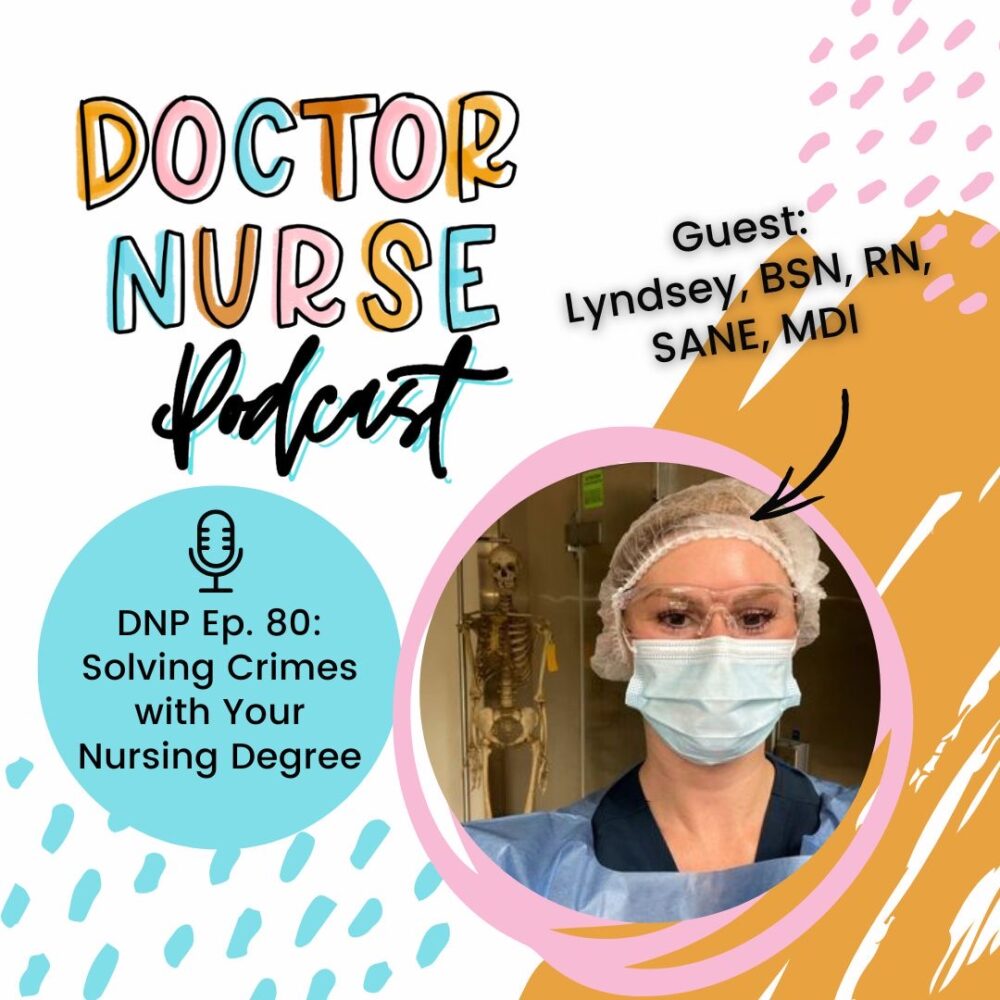
Lyndsey is a 2012 BSN graduate of Oregon Health & Science University. She has spent most of her nursing experience as an ER nurse. She also has experience as a SANE (sexual assault nurse examiner) for 9 years. Currently, SANE and MDI (Medical Death Investigator) doing all things forensic investigation. She is also enrolled in FNP school.
Lyndsey link: https://www.instagram.com/forensic.nurse/
Follow up with the Doctor Nurse Podcast here!
Success NP- Etsy Shop developed by my best friend and me who are both Nurse Practitioners and create beautiful designs for your life! Check us out.
Latest Episodes
Doctor Nurse podcast brings you weekly shows to help INSPIRE, EDUCATE AND EMPOWER nurses with true stories of initiative and impact.
Doctor Nurse podcast brings you weekly shows to help INSPIRE, EDUCATE AND EMPOWER nurses with true stories of initiative and impact.
Latest Episodes
Doctor Nurse podcast brings you weekly shows to help INSPIRE, EDUCATE AND EMPOWER nurses with true stories of initiative and impact.