Also Available On






Sandra Pagenta: [00:00:00] Hi, Eric. Welcome to the doctor nurse podcast. I’m so happy to have my first male guest on today.
Aric Mayer: Welcome. Thank you so much. So happy to be here.
Sandra Pagenta: Happy to have you. So let’s dive right in. Again, going back. You’re from the great state of California and you have this really interesting background in plant medicine.
Can you kind of describe to us what your current role or job title is right now?
Aric Mayer: So I am the nurse practitioner in a pain clinic. At the camp Pendleton Naval hospital, that is my day job. my passion, my thing that I am doing on the side is building a platform to educate nurses about psychedelics and plant medicine.
And it has been just a joy to research it and to plan it and to get the word out about these incredible compounds for healing.
Sandra Pagenta: So when you say plant medicine might be a lot of people out there that are hippie they’re like , peace, loving plants. But [00:01:00] really diamond to what it is that you are educating nurses on what are the modalities?
Aric Mayer: So the idea around the plant medicines is that, these. Wonderful substances have been relegated to research. And even that has been difficult since about 1970, when the government made the scheduled drug. Laws. Right. So all of these medicines that we have used as a, human species for millennia, we’re stuck into a category called schedule one drugs, which basically are considered to have a no.
Use at all. Right. They’re just tucked away, locked away. If you’re found with them, you’re imprisoned. So it created a situation where , the scientists and the doctors and the health practitioners and all of the people sort of wanted to. Looking into these substances again, for research, they had to petition the government in order to get access in order to get the IRB going for research.
They had to basically beg the [00:02:00] government. Now what you have as a, as a result of that is, , 50 years, of no usage of this medicine. As I’ve, I’ve just dork out on this stuff. Right. So I really enjoyed it, so you’d have to be sleeping under a rock, not to have heard a little bit about what’s happening.
I think it’s on front page of the New York times. We’re starting to see phase three trials now where it’s coming back. That yes. , medicines such as what would street drugs would be called ecstasy LSD. These, these medicines are having profound effects on. People who are really stuck. People who are treatment resistant, depression who suffered terrible PTSD who have, , eating disorders, any number of mental health maladies.
Are being cured by these, by these compounds. Or at least they’re making progress right here is a hard word in mental health, but the progress is occurring because these medicines are able to snap people out of their their, their stuck paradigm. Right. So my, my thing is let’s rehabilitate what everybody thinks of is the. Sixties, , gateway drugs that are horrible for you, [00:03:00] let’s rethink these as medicines that generate from. Well, initially from plants, even when you think about LSD, which is , a chemical the, the derivative is from ergot right from, from a fungus that grows on rye bread. That’s what was being toyed with when LSD was discovered.
Okay. So it all goes back to some form of plant that we have chosen to ingest. It has given us experiences that allow us an alternate state of conscious.
Sandra Pagenta: Interesting. So, , I just think this is so cool. Whenever you’re educating and you’re distributing this information, are you working as a guide, like helping patients use this stuff?
Or are you just saying we need to get the word out that all these drugs that we give patients are actually probably based on medicine that we no longer use. Kind of chemically altered and changed. And now we are giving this altered state of this plant. Why not go to the plant? How are you getting that information out?
Aric Mayer: So not guiding at [00:04:00] this time directly for patients outside of the fact that I do participate. I do write for ketamine, which is an S dissociative anesthetic. That is used traditionally in medicine, it’s for anesthesia, obviously putting, , doing surgery and putting someone under but what, what ketamine has is a psycho psychotropic properties.
And if you, if you don’t give the full dose, right? So putting them into a state where you can operate, but keep them in sort of a Twilight where the patient is pre they’re sedated. Completely out there’s this, there’s the psychedelic aspect to the medicine and that I do prescribe and I do talk with my patients about their experiences and try to help them.
Mostly that’s reserved in the pain practice. That’s reserved for people with pain that doesn’t respond to other modalities. So. Central pain, syndromes like complex regional pain syndrome, or sometimes it’s helpful for even, even for something simpler like a migraine or a [00:05:00] fibromyalgia patient where there’s no other good.
Medicine involved and they’re chronically in pain and they never see themselves below, , a seven on the zero to 10 pain scale. People who are really suffering from from a chronic condition can benefit from a little bit of ketamine. So that is the one thing that I am prescribing. Interacting with patients around the rest is sort of listen to nurses.
We need to prepare for this. It is coming. The, the FDA is pushing towards, , reviewing all this stuff for approval and we need to understand what it is. Our patients are asking for why they want, what they’ve heard you, you need to be a step ahead so that you can answer the questions and not be shocked.
That that’s my concern is that an ER nurse is gonna come across somebody who’s, , taken too much. X Y or Z substance. And they’re, they’re not going to recognize that this is what is occurring, right? So if we educate ourselves about the mechanism of action, the onset, the, the amount of time that it stays in the system, what a, what a, what a patient presents.
Like we can do some harm reduction. We can help that [00:06:00] patient stabilize. Alternatively, if they’re coming to us to say, look, I heard about this, I read this article. I really am stuck with my therapist or Mike. Dose of Prozac is not doing it anymore. I really having a hard time struggling. And I’ve heard about this thing I’ve heard about, , psychedelic assisted psychotherapy.
What can you tell me? I don’t want the nurse to have that look in their eyes like, oh, but I thought that was a Woodstock thing, right? ,
Sandra Pagenta: Woodstock is here is what it sounds like it’s upon us. And so I actually find this really interesting because I was recently reading a book by Ben Greenfield called boundless and he is a really big biohacker.
And it’s a 30 hour audio book, right. So it’s pretty heavy and I was reading it and he talks a lot about. Like micro dosing with psychedelics and how that helps him with the creative aspect. And of course, , there’s legality issues surrounding this, that we, , I’m not gonna do that on today’s podcast whatsoever, but I just find that, I think you’re right.
I think that people [00:07:00] are starting to introduce this into their mainstream lifestyles. I don’t think, I think that he’s got a really big following and I find it hard to believe that people aren’t listening to him. I think that this is where things are going, because I think there is this level of distrust with.
The way that medications are being doled out and the way that certain drugs and compounds make people feel, it’s kind of like, well, why not try this? If it’s, especially, if they can do it in a way that could be safe. I think we need to be ready for This coming down the pipeline from our
Aric Mayer: patients, truly it’s it’s, , people are, are getting the word from people that they that they may trust people who might be , conservative or otherwise unexposed to this, , suddenly it’s, being Featured on a episode of goop on Netflix, right.
And you’ve got Joe Rogan is expounding this, , there’s, there’s all sorts of ways in which it’s getting out there, the hesitation and the problem that we’re trying to avoid is we don’t want another Timothy Leary [00:08:00] explosion. People with access and experimentation and sort of letting the genie out of the bottle prematurely, we want to sort of control this and keep people, , make your patients aware, but, , have the hard pause button on until such time as they can be supervised by a clinician.
Wow.
Sandra Pagenta: That is so cool. What a neat niche you are in. So how did you get to this specific spot in your career? What was your journey that led you to this niche.
Aric Mayer: So just, , I’m a career changer. I went back to school. I started off in acting school back in, out of high school and works, not as an actor, but as a person who. Divides money that is paid to actors. So when you, , back in the day, when you rented your video from the local video store, I would take that money and separate it out to the writer, director, actor.
It was it’s called residuals calculations. And I did that for the better part of the nineties before I went back to school and decided to go ahead and pursue a bachelor’s and that was. Whole time when I was in Berkeley, I got involved in [00:09:00] hospice volunteering. When I did the training for hospice volunteer work, the facilitator said we don’t have to do a whole lot of screening people usually don’t turn up for this if they’re not.
So so I, and then met my wife to be who recommended nursing school. And I had been Arts guy I’ve always been, I had always been kind of frightened of science and math and kept it to a minimum but realized that this was going to be the best path towards that kind of work of end of life care was towards nursing.
So went back to night school after that experience at Berkeley and. Got myself the prerequisites for nursing school, which has, we all know is the anatomy, the physiology, the statistics things that I had avoided well into my thirties but managed to get through and get into a good school and went to nursing school.
And that landed me in oncology during my rotations and oncology was close enough, , to either with people who were doing well, but there are also a lot of end of lifers . And I learned a lot there. And then I was trying [00:10:00] to get to hospice, but they wouldn’t let you just directly go without experience.
So I thought, well, pain management would be a good route. So I took my first job in pain. How North Carolina at a private pain clinic working for one doc with one other PA. And that was an intense and interesting experience learning to get comfortable with, at that time, this was before the opiate crisis.
This was opiate crisis in the making. So.
Sandra Pagenta: Opioid crisis. What does that the
Aric Mayer: opioid crisis we find ourselves in now. Sadly. I’m a little guilty of of that kind of a practice that I was involved in, in the about 10, 12 years ago. Before we, before we knew, , We were not aware of what we were creating, I don’t think.
And so I was in a practice that did that for about a year before I went into primary care. It was a great experience. Of course, you learn and you’re as a, as a primary carrier, just the Jack of all trades master of none, as opposed to this pain specialist who, , which I’ve, I’ve now after six years in, in primary care, I’ve circled back to pain medicine and realize how, , talk about a niche.
I mean, that is just, you’re thinking about the same, four [00:11:00] or five medicines, the same four or five procedures. While every patient is different and every pain presentation is different. That particular way of looking at the patient and trying to get to the bottom of what is ailing them is a very specific thing.
And so I found myself looking for Alternatives and came across a group called nurse preneurs. And that gave me I took a course with them talking about how do you free your brain? How do you free your mind? How do you become a entrepreneur in nursing? And I went through the steps and the program was very good.
And I wound up with this idea that a passion of mine is psychedelic plant medicine and. Although I’m not a psychiatric mental health practitioner. That realm really has always interested me. And I found myself making
Packed with that group to sort of broaden my horizons and figure out a way to educate, , start off going into education about this. Roam of psychedelic medicine in preparing for the point when we might be able to open a practice, my wife is a psychiatric nurse [00:12:00] practitioner.
So we between the two of us prepared. Yeah. Compared to venture into that, in that realm, once the medicines are approved and we can get ourselves into sort of an integrative clinic we’ll be prepared to go.
Sandra Pagenta: And at your current job, are you doing procedures within the scope of your license or are you just prescribing medication?
Are you just seeing patients in, , chronic pain states? Because now here in Florida, we don’t prescribe pain medication for more than like three days. And if you’re dying and there’s something going on with pain, we’re just like, go see your chronic pain specialists. We don’t know how to help you.
And so that’s kind of where we’ve gone, which again feels kind of lacking, but it’s just the way that the system is now.
Aric Mayer: We are I, the, the position was created with the Naval hospital as part of.
Congressional funding source to keep people off of opiates and figure out alternatives. So if if a Marine or a Naval person is worldwide deployable, they [00:13:00] cannot be on a chronic. OPM. And so we have to find all the alternatives possible to help them. So in my practice, I’m doing a Botox protocol for migraines for trigger point injections.
I use Trigger point injections into the muscles that bother these Marines. We work in a multi-disciplinary group. So we’ve got a physical therapist on board and acupuncturist. We have the docs do the , stellate, ganglion blocks. They do the spinal injections. So epidural steroid injections.
Branch blocks that, , the usual things that you would find in a, in a pain clinic, out in town, but the, the number of patients I have on a chronic opioid, I can count on, , on my hands. They really aren’t meant to stay on those medicines, which is a great relief and a big difference from where I started in a pain clinic, out in the community.
Sandra Pagenta: Aric, I just think of Sony and you’re going to, you’re making such a big difference. And to hear that, you guys are working to get people off of opioids and it just shows like how much we were mistreating those patients.
[00:14:00] Before, if you can just count them on your hands now. And it’s true. I also worked as an oncology nurse and I remember, I thought it was so wrong when you’re doling out pain meds to someone who, , is depressed, right?
You see it and they’re sick and that’s not a fallacy. I remember just knowing it just intuitively as a nurse that I’m not treating physical pain, I’m treating. A mental pain, a depression and anxiety. There’s something else going on.
And I was treating it with morphine and oxycodone, , like, and I knew it because it was like all the lights were off and I can even see the patient’s face, like to this day. And that was almost 15 years ago. Like I just remember the lights were off in his room. He never spoke. And even though he was clinically fine and there was nothing going on with his disease process.
I was keeping him in like this drug to state. Cause he didn’t want to cope with what he had to deal with when his eyes opened up. And it was just really it felt wrong. It was just like, I don’t think this guy needs another [00:15:00] oxycodone. Like he needs it like a therapist or I don’t know, like whatever psychedelic or thing that could just keep him functioning and.
Not so just taken down by depression and absolutely.
Aric Mayer: Those are the primary patients that interest me. The, the end of life, anxiety, the anxiety around cancer , the issues and quality of life. Some of the studies from the sixties, I just love, , you’ll have to excuse me, Sandra and I dark out, but I mean, I pour through these old studies from the fifties and sixties that are, there’s tons of them.
There were thousands of studies done before the. A mandate to, to go schedule one with these medicines and they, they got locked away, but some of the really interesting. Data shows exactly what you’re saying that they would, they were trialing LSD for, pain. And, and what they found was that the patients were recording extraordinary remission of their pain.
It should have been very painful from the size of the tumors and the kind of cancers that they were battling. But at the time, it was much easier to say, to ask the [00:16:00] doctor for pain medicine for their back than it was to talk about their fear and their existential anxiety, because this is the fifties and the sixties.
This is, , buck up buttercup , you don’t talk about those things, right? We forget that we’ve come at least to the point now where we can talk about our feelings. That was not so much the case back in the at that timeframe. And so, the breakthrough of the psychedelic.
Really put the pain in perspective, put their lives in perspective, gave them a way to be hopeful. And it’s hard. It’s really hard to explain unless you’re there, but just to know that the right guide with the right medication for the right patient can make all the difference in the world that a patient like that who’s, , clearly depressed and yes, they’re in pain, but the pain isn’t really what’s driving it.
And it’s just a. Factor adding to their existential depression. .
Sandra Pagenta: I agree with you. I don’t know if you’ve read this book. I just think it’s, so it’s a really good book. It’s called molecules of emotion. Why you feel the way you feel and it’s by Candace PERT. And it was recommended to me by another guest. And in the [00:17:00] book she talks about the effect , of medications. I think it would have been ketamine that she had had during a time in the hospital and She describes how it passes the blood brain barrier and affect the consciousness and states of consciousness.
Remember reading the book and just being very mesmerized and that’s what led her into a level of research that she went into. And so I, I also find that these medications. Can bring about creativity and unlock parts of your brain that you might not even be aware.
Were there, is that something that you’ve experienced or you’re familiar with?
Aric Mayer: Yes, absolutely. The, the way in which the medicine works on the default mode network, which is the place where we. Operate in the world, from what we, what we recognize as predictable how we respond, where our baseline is for the healthy adult or the healthy individual is fine.
That’s our, that’s our protective area that we interact with everyone and everything with, but for the person who’s clinically and chronically [00:18:00] depressed, let’s say they’re coming from a place of. Being being stuck in the mud. They cannot, sometimes they can’t get out of bed because what’s the point, , all of those kinds of thoughts that keep people stuck in a state of inactivity.
And when these medicines break open that default mode network and create a new way of thinking, and it is, , we get down to the Pathophys or the science of this, there are molecules passing through the blood brain barrier, and you’re essentially creating new connections, new neural connections, where there were previously So it’s like, I use the analogy of shaking up the snow globe, ?
So you look at that snow globe and all the snow is in the bottom and that’s kind of the default mode network. And when you shake it up and all that snow falls all over the place, that is what the psychedelic medicine, whether it’s ketamine, LSD, MGMA, it’s going to shake it up and make all sorts of possibilities open up for that person.
Sandra Pagenta: So thank you for sharing that. I think it’s really good. Interesting. So give me an example of one of the biggest [00:19:00] successes or highs in your career as you’ve gone along this journey to plant medicine.
Aric Mayer: Having students enroll and give me a fee for service and performing those three workshops here recently was, was the highlight for sure.
Just, , launching something. Putting it out there having people say, yes, I’m interested, , sign on the sign on the dotted line, Venmo you some money and wait for you to give them information is that’s definitely the highlight of this so far. I, , there’s also these, you can pick out your patients that you’ve helped along the way, right.
Even with ketamine, having people have breakthrough, seeing the medicine work and not worrying. About them because you’re in a hospital setting. And if anything goes wrong with ketamine, , or you can call a code as opposed to the fear of having your own private clinic where you’re, , that sort of, one of the barriers for me is like, oh my gosh, what would I do if although.
If never seems to happen at least in the hospital, but so helping people break through in the actually showing, putting the proof’s in the pudding, right? Where you, where you see [00:20:00] the ketamine helps someone who has been like you’re describing lights off in the dark, in their chronic pain and have a breakthrough that is an amazing high.
But I think for me personally, the, the idea of not being a. Person who depends on the man for the paycheck, for the rest of my life. I had a glimpse of this possibility, right. That if, , if you build it, they will come. That is for sure a thing. Awesome.
Sandra Pagenta: I think I quoted that on my last podcast.
If you build it, they will come. It’s so true. And I think it is so interesting that moment that you realize, like, I don’t have to rely on. This person to pay me. I, can I go and find my, coin? Is this really new? Thing that I want more nurses to understand that wherever you are dive in deep, get as much knowledge as you can.
And then now that knowledge becomes your property, right? Like your intellectual property, and you can actually sell that. And I don’t think that we’re encouraged to do that. So it’s really cool to hear. That that was your aha [00:21:00] moment. And you really saw your eyes were opened. That was your ketamine experience.
Aric Mayer: Exactly. Cross my blood brain
Sandra Pagenta: barrier for sure. So corny anyway. Okay. So what was one of your challenges that you had to overcome in your years as a practicing nurse and nurse practitioner.
Aric Mayer: So there’s always the stories of you’re you’re as a fledgling nurse, where you’re trying to figure things out and, worried that you’ve harmed a patient or broken a protocol or had it out with another personality in the nursing, eating the young, all those kinds of stories I have.
But I think the challenge. The the most prescient challenge. And the one that, that I’m still sort of battling with is the, just that idea that you’re, that I am legitimate, that I have something to say, and that it’s worthwhile and trying to straddle. I mean talk about two worlds, , being in a military environment every day and then going home at night and studying up on psychedelic prep, plant medicine, presentations, and training, , talking to doing my my [00:22:00] coaching call with the nurse preneurs.
Basically from a broom closet at work, , try not to have anybody hear me talk about LSD and ecstasy when cannabis that has been a challenge. But I think, , my hands are sort of tied as far as what I can tell these guys who were, who were active duty as they’re getting ready to exit, we can sort of have the conversation that , cannabis is equivalent to an opiate or a benzo.
You can explore this now that you’re no longer going to be, , an active duty member. You can try a ketamine clinic. And just so , coming down the line, there will be more opportunities for you to utilize these medicines for your PTSD. , we’re working with guys that are suffering so much every day on all aspects of their being is just really hard on the soul.
And and that is a challenge that I enjoy and that I meet every day trying to, to treat each of these guys with respect and, and drill down a little bit in my, time that I have with them and not just make it about , offering. A muscle relaxant in a, an anti-inflammatory, , try to really talk with them about [00:23:00] where is your pain really your back, or do we have a situation where you’re not being straight about what’s bothering you?
What you’ve seen, we know what’s, what’s happening.
Sandra Pagenta: I think you have an interesting perspective as well, being a guy. I’ve worked alongside of a guy at my job and I work also with, in the military kind of like veterans. I notice that men are a lot more receptive to what he says. And I’m like, I just said that, I just said what he just said, like, , I live in the moment that a guy says it, they automatically receive it. And then he makes fun of them. And he’s their guy, listen, you have a, what is it? An X, Y chromosome. You’re not ever going to think.
Right. Or whatever. And like, I’m just like, how did you just get away with saying that, like, how did, and I think it’s because , He that perspective of where you’re coming from and you really do elicit a sense of like, , the people can talk to you that you can just open up and share.
You’re making a difference, not even prescribing something. Sometimes I’ve noticed they just need someone to talk to like and just having somebody there that can understand them and [00:24:00] , that they can open up to, I know.
Is making a big difference. So, but , it would be really great to be able to say, Hey, listen, these mushrooms, you can eat really vary
Aric Mayer: for you
Sandra Pagenta: yourself. Actually there was a study not too long ago in the advances in nutrition, they had done a systematic review looking at individuals that ate 18 grams of mushrooms daily had a 45% lower risk of cancer compared to those who didn’t eat mushrooms. They were talking Shataki king oyster, mush, or stirrer mushrooms, like different types of mushrooms. I love mushrooms, in normal regulated mushrooms from the grocery store, I eat them, , almost every day. And when I read the study, I was. I don’t think we know what mushrooms can do, like lowers your risk of cancer by almost 50% in the studies that they were looking at.
I was like, that’s kind of a big deal. Significant. . I’ll tag that article in my show notes so people can read it. It was definitely interesting. and again, just kind of going back to what you do. I really think that we don’t really understand how much plants can help us and really unlocking that is [00:25:00] going to be incredible, incredible to the world.
Did you have any mentors or anybody along the way that helped you with developing your career?
Aric Mayer: I was really lucky to have good. Doctors that I worked with. you hear a lot of anecdotes about the struggle of the nurse practitioner and the doctor. And I was really fortunate.
I was embraced and, and especially jumping into primary care. Like I said, you can, I learned a lot. In a short amount of time about pain. But when I jumped into the realm of here’s every patient with every malady, when, and every drugs on the table and anything can be used , fortunately I was in a community health center, so at least I didn’t have to worry about the latest and greatest drugs.
, you just kind of had to have your basic arsenal. But Dr. Mary Ray back was an incredible mentor to me during my first years as a, as a primary care nurse practitioner. And then here more recently with regards to what I’m doing now. There’s a guy named Andrew Penn, who is a nurse practitioner on the staff of [00:26:00] university of California, San Francisco, who is a huge proponent of psychedelic plant medicine.
And he is just a wonderful resource and guide and teacher and I wouldn’t say we have a mentorship, , formal mentoring relationship, but he offered me to use some of his slides for my first presentation and , gave me good feedback after my first webinar that I did.
So that he’s just been a a great person to bounce things off of. And he’s just a huge resource publishes like crazy, , teachers all the time. He’s just a really passionate about that.
Sandra Pagenta: And I guess the last question that we have for today’s podcast is what advice would you give to a new nurse?
Starting off in her career that doesn’t really know what to do, where to go. What would be the advice that you wish you would’ve known when you were getting started
Aric Mayer: saying good one. Again, I became a nurse as a, as a career changer. What I thought I wanted was not what I have so far achieved.
Right. So I think people [00:27:00] need to keep an open mind. You need to remember that your nursing degree opens any door that you want to walk through. And that is one of the reasons why when the young sailors at work some of the young Navy guys that are thinking about being Corman are going on with their careers in medicine always try to keep an eye towards the fact that you can do anything with that degree.
And you can go into any field, , that. Suits you when I was brought, , I felt like I was sort of rushed through my masters and you’d sort of do these six week rotations. Okay. This is what psych does. And this is what labor delivery is like, and this is what, , ortho floor and , all those things, you, you just get these little glimpses and then it’s like, okay, now choose now we got to get you through this program.
We’ve got to get you out of here. ? So I think if you haven’t gotten a taste of everything that you imagine you can do, it’s really important to keep your eyes open, look for the opportunities that are available in your area or outside your area. Look where they’re recruiting low, , try to be clear about what is it that you like about nursing.[00:28:00]
, is it the interaction with the people? Are would you rather be in the ICU and have that patient zonked out? And it just, , there’s people who, people who love to keep those pumps going and, , take down the, the measurements and the readings. You have to kind of be in tune with yourself and know what it is that you like to do, and then figure out how to make them.
Fit into the career rather than vice versa, ? Oh, there’s an opening in labor and delivery. So I should go do that even though I can’t stand crying babies. Well, what, what are you thinking? ? . , you got to stay open to your calling and that’s going to change. And the beautiful thing about nursing is as you grow and evolve and your interests change, you.
You can fit yourself into a niece like psychedelics. I mean, who would have thought, when I, , when I was a kid, , smoking grass, I never would’ve thought number one, I never would’ve thought that the cannabis would become a legal medicine that I could talk about. Let alone, , sit and write a script pad for ketamine infusions.
So you, you just, you never know. And I think it’s really important to keep an open mind.
Sandra Pagenta: I agree with all of that snaps to all that. Now we are moving into the final portion of the interview interview, [00:29:00] interview, interview. I’m trying to do like an echo.
. This is the rapid fire question portion where I’m going to give you questions that you weren’t able to prepare for. Are you ready, Eric? Let’s go. All right. Are you a morning person or a night person? Morning person. Okay. And what is the strangest thing you have ever eaten? I dunno if you should maybe say that on here and I’m just kidding.
Tell me what’s the largest thing you’ve ever
Aric Mayer: eaten. I would go with the lungs of a yak when I was in Tibet.
Sandra Pagenta: Oh my gosh. Okay. That is, I have questions, but we’ll keep moving on. If you’ve had a yacht, what would you call.
Aric Mayer: Oh, wow. Lucy in the sky with diamonds.
Sandra Pagenta: Thank you for coming on to the podcast today. I had an absolute blast with you, Eric. Thank you for all your knowledge and sharing. Your journey with the rest of the world so that nurses can hear how. Your career can develop and how to find the gaps in nursing and the gaps in healthcare. And I think nurses need to be the bridge in those gaps. And I think it’s really cool how you’re, you’re bridging those gaps in,
Aric Mayer: in your job. Absolutely. Sandra, I really appreciate what you’re doing. And this podcast is [00:30:00] amazing.
It’s we’re nurses and we make a difference and the sky’s the limit and just to have faith in yourself and again, , look for those opportunities.
Sandra Pagenta: Thanks so much. Thank you.
Podcast Description
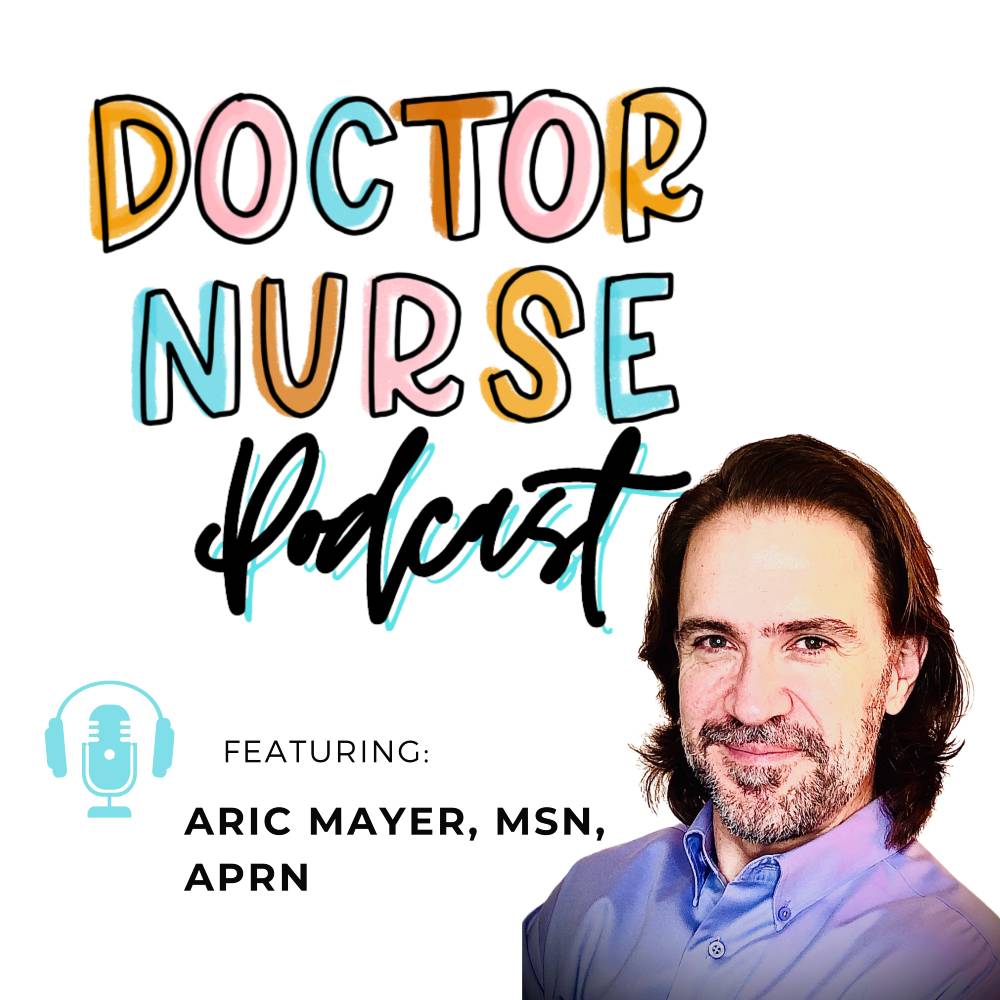
Aric’s passion for the circuitry of the mind has evolved into decades of research and study of altered states of consciousness and the healing powers that lie within. As an adult nurse practitioner, he prescribes ketamine infusions and offers alternative modalities for pain management for patients who have exhausted traditional therapies. Aric remains on the cutting edge of research into psychedelic plant medicines. He utilizes his expertise in psychedelic-assisted healing to educate nurses, health providers, and patients, preparing for the moment when these compounds become available for patients searching for a new way of healing. He graduated with the highest honors from the University of California at Berkeley and published his honors thesis in a scholastic journal. He completed his MSN through Columbia University and has worked in oncology, research, primary care, and pain medicine.
Where you can find him:
Email: aric@thepsychedelicnp.com
Website: thepsychedelicnp.com
Social Media Links
Twitter @psychedelic_np
Instagram instragram.com/thespsychedelic-np
Facebook www.facebook.com/thep-sychedelicnp
Medium aric-mayer.medium.com/
Article I reference in the podcast: www.sciencedaily.com/releases/2021/04/210421200133.htm
Latest Episodes
Doctor Nurse podcast brings you weekly shows to help INSPIRE, EDUCATE AND EMPOWER nurses with true stories of initiative and impact.
Doctor Nurse podcast brings you weekly shows to help INSPIRE, EDUCATE AND EMPOWER nurses with true stories of initiative and impact.
Latest Episodes
Doctor Nurse podcast brings you weekly shows to help INSPIRE, EDUCATE AND EMPOWER nurses with true stories of initiative and impact.