Also Available On






Sandra Pagenta: [00:00:00] hi, welcome and Lita to the doctor, nurse podcast. So happy to have you on today.
Thank you for having. All right. Let’s dive right in. So describe to our listeners what your current job role or roles
Elida: are. Sure. I currently wear a few different hats. I work full time for the department of surgery at U of health in Gainesville, Florida. And I’m. Special group of advanced practice providers, consisting of nurse practitioners and PAs.
I think we have close to 60 providers now. And in that position, I rotate between four different surgical ICU’s and I round as part of a multidisciplinary team on surgical patients in the trauma, cardiothoracic, vascular lung transplant, and general surgery unit.
Sandra Pagenta: And then one other side hustle.
Elida: I also work part-time at the university of Florida college of nursing, where I serve as coatrack coordinator and they are mostly responsible for the clinical placement and management of [00:01:00] the adult acute care nurse practitioner, students. and then on the side, I also dabble in some research work with the emergency department and we mostly help with sepsis research or recently we had the opportunity to work with the COVID research.
Sandra Pagenta: That is so neat. So you’ve got multiple things to dive down into more specifically. So tell us a little bit about what you do at your full-time critical care job, what are some of the things that you see on a day to day basis? Sure.
Elida: So pretty dynamic environment. We really get to practice at the top of our license as nurse practitioners in the acute care setting.
We kind of work under the the guidance leadership of an intensivist in the ICU, and we work intimately with those surgical teams as well. So we round on patients of course the census will vary from day to day, but we get to. Do procedures. We get to make clinical decisions, formulate plans for those patients and get to really be the [00:02:00] glue essentially of the ICU.
Because we’re the one constant factor there. At a teaching hospital, we always have rotating residents and various types of students in there, and even fellows that rotate every month. So the nurse practitioners and the PAs are that one constant factor in all of our surgical ICU.
Sandra Pagenta: So, what are some of the procedures that you do
Elida: we get to do?
Basically anything you can think of in the ICU. So anywhere from arterial lines, central lines, chest tubes, intubations, bronchoscopies we get to assist with various bedside. Procedures that come along the way. We’ve not just, you know, get into the nitty-gritty of it, but you know, many, a times we’ve had to open a chest at the bedside and we have to be prepared to think critically and be on our toes and be able to assist in those situations.
Sandra Pagenta: Incredible. And then for your research job, I think you touched on it a little bit, but take us through kind of what you’re [00:03:00] researching just recently with your COVID work. Certainly. So we
Elida: got to participate in the recent studies that came along with COVID. I. God to pick up just a couple of chefs with them, but we essentially got to screen patients.
We had the opportunity to go to the bedside to collect the blood samples and then follow up with patient data as well. We ha I have to give credit to the research team that works. And that department Matt and Rebecca really are. Wonderful human beings who come done great work there. Under the leadership of Dr.
Carmel, Ellie. So yeah, that is always busy. And then we also got to do research with sepsis. It’s called a Clover study. So we are still in the process of getting that data published. Very cool.
Sandra Pagenta: And then your job with that, we were speaking earlier before the podcast about kind of what your faculty position entails.
Can you dive into that a little bit? Yeah. [00:04:00] That
Elida: has morphed in the last year. I took the position right before COVID started, so we definitely had to get creative and think on our toes again, obviously no one has ever dealt with a pandemic of this magnitude. So we had to. Quickly restructure how we were going to handle student clinicals and, you know, switch some, a few courses around.
But that position essentially is a split between myself and another colleague of mine Dr. Thompson, and I teach the clinical portion of the program. So I’m responsible for placing students in various clinical. Positions around the state of Florida. And I really enjoy that. It’s gotten, it’s been very fulfilling and challenging all at the same time.
Sandra Pagenta: What a full plate time for all this, like, goodness, a lot of, a lot
Elida: of the time management and I asked for help, I’m learning more and more to ask for help. And you know, also there’s [00:05:00] that little thing about setting boundaries and learning when to say no to things, but I’m still in the process of learning with how the hand.
Well, it’s impressive
Sandra Pagenta: to say the least. So what was your specific journey to this spot in your career that you have all these hats that you’re wearing? Can you take us back to even when you were decided I want to be a nurse to kind of how you got to where you are today? Absolutely.
Elida: I have to say that it hasn’t been a clear-cut road or easy along the way.
I, if I have made it this far. Because of God’s grace and, you know, there’s some fantastic people that I’ve met along the way. If I really go back, I would say that my journey began probably around age 12 or 13 when my dad had a stroke when he was 37. And I remember feeling scared and helpless. Being at the bedside, looking up at the monitors and having no clue what all the numbers meant.
And I was asked multiple times to translate for my parents, but really had minimal knowledge of what [00:06:00] they, you know, everyone was talking about. So I was encouraged at an early age throughout my education to go into medicine, mostly because it would provide a secure job after college, but I really fell in love with providing care for others.
I shadowed a nurse in high school. But as an Mexican immigrant, I was the first in my family to go to college. So my parents and I had very little knowledge of what academia entailed at a higher level past high school. So it was originally pre-med and you know, being all, this was new to me. So I was overwhelmed though, the course load and I switched eventually and landed on nursing and.
I was thinking about how I was going to pay for college and whether I had the mental stamina to make it through it all. And I remember calculating how many 99 cents. Wendy’s chicken nuggets. I could afford my budget.
Sandra Pagenta: So, you
Elida: know, eventually I graduated nursing school in London, a job at Lakeland regional, and it was not my first choice. I thought I wanted to be a labor and delivery nurse, [00:07:00] but I could not find a job in that field. And so I had two interviews. And I remember calling a friend of mine from college and discussed it with him.
And I said, these are my two options. And one of them was going to be a little harder of a job than the other. And he said, well, you know, you gotta take the harder job can’t settle. And so I started my first job as a nurse on a med floor at Lakeland region. Medical center. And it really challenged me to hone in on my Tam time management.
And I quickly realized how much more I had to learn about medicine, but the nurses there were fantastic and had a lot of experience. And it was there that I met my first role model in nursing and she was a true blessing. Her name is Amy and she helped me. Kind of, you know, teach me the ropes and made sure I ate lunch and stood up for me when I was being treated poorly by someone.
And it was Amy who gently suggested that I make a trip to the ICU and I really was stubborn. I said, no, we mean that’s not for me. [00:08:00] But one day I took her advice. And I went to shadow and ICU and I fell in love with it. The the smaller patient ratio was really great. It matched my brain, how my brain worked and also in my body, it was a little bit easier than for nurses.
I was mentally stimulated and I found great leadership and the staff around me and everyone was really goal oriented. My manager Diana at the time had really high standards for the staff and supported higher education for everyone. And then let’s. Working in the ICU. You know, I had the honor to be with many patients in their last hours of life.
And that was also where I met another mentor of mine, Mimi, who was a palliative care nurse. And she’s also a fellow Gator grad. But she was fantastic and help guide me professionally. So then I applied to graduate school. I got denied from many local universities and eventually I did. Grad school at a private school there at Lakeland.
And I remember meeting me in the [00:09:00] parking lot one day and she said, what are you doing? And I said, well, I’m going to grad school. And she said, no, but really what are you doing? You need to spread your wings. And so little
Sandra Pagenta: angel. Yeah.
Elida: So then I applied to U S DNP program and I got in wait, so you unenrolled
Sandra Pagenta: from this other college and then enrolled at UL.
Yes, I lost
Elida: all my money, all the credits because they wouldn’t transfer. And I I got into grad school at USF and that of course was no easy ride. Towards the end, I was really discouraged due to some unfortunate experience and my clinicals, and it was really one of the lowest points in my academic career, because for the first time, I encounter people who underestimated me and did not take the time to invest in me as a student.
And I didn’t find it very kind. But again, I had a great program director at the time, Dr. who supported me and encouraged me and I made it through. And I remember it was two months before graduation, many [00:10:00] job applications, no job lined up, but somehow. Peace about everything that I couldn’t explain. And eventually I got the interview with the USF health critical care team, and I’ve been with them since then.
And I didn’t plan to be engaged all this long, but I’ve really come to love the town. And I really enjoy the work I do. I find it fulfilling, you know, and I appreciate the high acuity as well. Wow. Yeah, I definitely have not
Sandra Pagenta: anticipated being in Gainesville this long either, but somehow you get sucked in and you’re like, this place is great.
So what an incredible journey Alita it’s, it’s pretty neat to me because we’ve been friends for a long time and I didn’t know. Those other details about what you were experiencing in Lakeland? I had no idea. I knew some of your, your story from with the current hospital you’re working at, but I, I did not know the experience that you were having over in Lakeland. So that was definitely cool to hear and like provides a different [00:11:00] perspective on your journey. So thank you for sharing that. So I think you touched a little bit on your mentors.
Did you have any other mentors you’d like to give a shout out to that you were like throughout your process, you felt like they were really big in your career development? Absolutely. You
Elida: know, I think that most of the mentors I’ve had have really taken the time to get to know me as a person and have guided me not only professionally, but also spiritually.
In my walk as a Christian, obviously my parents, but I mean, Ray, I can think back to my high school band director, doctor Mr. Eckman and I middle school, social studies, theater teacher, Ms. Parrish. But my first nursing preceptor, Amy by far, I mean she saw my talents are what they were and she had the foresight to, to know where I would best flourish.
And then Mimi Jingo. For pushing me and being there all these years to give me professional and worldly advice. My graduate school program director, Dr. . She always encouraged me during [00:12:00] those really hard times at the end of my studies. And now my medical director, Dr. . He was very supportive of our professional growth as advanced practice providers.
He’s been treated. Yeah, I love that you’ve got
Sandra Pagenta: this hybrid role where you’ve got the clinical background, but you’ve also got your foot in research, which is something that, you know, as a DNP educated provider. Does kind of get injected into you a little bit of like the importance of research and then you kind of don’t see it.
When you go into your clinical setting, you just kind of work and you, do you see patients? So I think it’s really neat that you have your foot still in the research world, because when you get that DMP, you see how critical research is just even towards quality improvement, right. Not just into like, yeah.
Evidence-based care, that type stuff, but also just making life better. Right? Absolutely. Absolutely. All right. So the next question is, can you tell us, and maybe just more specifically, one of the biggest [00:13:00] successes in your career, something that you notice was a really big win for you? Sure. Let’s
Elida: see, you know, I think.
I think just being able to look back on hard times and struggles and say, wow, I got through that. I think that’s probably been my biggest success. The grit, the, the tears, the heart, you know, the heartache it’s, it’s not in vain. And it’s the little moments for me when a family member or a student say, thank you to be able to contribute to the next generation of nurse practitioners and to help families.
When they’re most in need, I really get a lot of fulfillment in those moments. And those are really the highlights of my career so far.
So
Sandra Pagenta: it reminds me of that quote where it’s like, you’re going to be happy, said life, but first I’ll make you strong. I just feel like that that quote is so. Pertinent to like what you’re doing, because you enjoy what you do, but it was just like, I had to get through some really tough spots and now I’m super strong.
And that, [00:14:00] that strength is what allows you to be really great at your job, because you’re just like this isn’t going to defeat me. Are you kidding?
Well, and it’s also
Elida: allowed me to you know, when I think the hardest, some of the lowest moments. God uses that to refine us. I do believe that. And it’s also given me a little bit of empathy for others who may be going through similar time in their life and be able to say, okay, I remember what it was like to be put down and to be you know, felt to be so small on the significant and I vowed to never treat a student like that or a new provider if I can help it.
Yeah. That’s.
Sandra Pagenta: It’s really beautiful. I like your heart on that. What was one of your biggest challenges so far in your career that you had to overcome? In a very
Elida: broad sense. I think my biggest challenge would have to be my own self doubt. And although I’ve been fortunate to have amazing friends and family who give me support and advice along the way, Sometimes, [00:15:00] I think you find yourself alone with these negative thoughts and being able to push through those tough days has been really hard.
And it’s not just the medicine, the long shifts, you know, the chronically ill patients that we deal with. It’s the interpersonal dynamics of the job that really wears on me. I’m not ashamed to say that I’ve had counseling during my time as a nurse practitioner. And I honestly wish I would’ve done it sooner.
I think that mental health. A stigma to it, and we really do ourselves a disservice by not tending to it. Wow. Thank you for
Sandra Pagenta: sharing that. That’s definitely much needed to shine light on that area because I think a lot of us are dealing with it in one way or another in different things. And so I appreciate your candor towards, Hey, like this was hard.
I had to overcome it. Just my own, issues, my own experiences that led to a certain way of thinking. You have to process [00:16:00] that stuff. Cause if you don’t, it’ll just keep coming back to bite you, you can’t ignore it. All right. So what advice do you have for a new nurse starting off in her career?
She just, she just got her bachelor’s or her associates. And she’s going to get started. What would be some advice that you wish you would’ve known when you first got going? My advice would
Elida: be to not settle for the easy road and to seek guidance from folks that they look up to. It’s okay to not know what you want to do with your career.
And it’s okay to stumble along the way. I wish someone had told me and taught me how to be more gentle with myself. I think we live in a world where we are very critical of each other and show a little grace for others and many times. We are our worst critics with ourselves. So that type of self criticism, I think it can be very detrimental.
And it does not really reflect who we truly are for me. Self-compassion has [00:17:00] helped me stay grounded on who God says I am and has really helped me maintain a sense of emotional balance. Now I’m not saying to not have high standards, but when we do fall or make a mistake, I’ve learned that. Important to show self compassion during those hard moments.
I do believe that it’s the self-compassion that better equips us to deal with our own anxiety, depression. And it also helps us, it gives us the tools to show compassion to others along the way. And I think that’s something that we need to see more. It’s really good.
Sandra Pagenta: I think sometimes when I’ve had students or I’ve been dealing with teaching, sometimes what I’ve done is I’ve maybe worked out of my own issues and put those issues off on my students. When I was working as a preceptor and I’ll just kind of do like a side story, but I was working as a preceptor.
And I remember I used to harp on medicine because I had made medical errors as a new nurse. And it was a really traumatic experience. And so when I had my students, I, when I was [00:18:00] precepting them, I would get very laser focused to probably a scary point with my students. What med they were giving, why they were giving it, where they were giving it, all the facts that you’ve got to know about it.
And if students were unprepared, I would come down really hard on them. And I remember like, I think it began to affect my students negatively because I was so critical. And. Again, that was coming out of my issues. Right. Having made a medical error being on the other side of that. I never wanted them to experience that.
And yet I wasn’t being compassionate with the fact that, like I was a new baby nurse. I made a mistake. We’re gonna make mistakes. It’s okay. You’re gonna be okay. So I kind of overcompensated instead of realizing, okay, Sandra, you need to be compassionate on yourself. And then through that compassion, you can be passionate with others instead of being so dogmatic and stressed and just like, you know, all the things [00:19:00] that I think we’re coming across.
Really poorly. It was actually out of my care, but it just wasn’t coming out healthy. And so I think that it was actually when I went and I reflected back, I thought, Sandra, that was your wounding. Those were your issues that you were kind of working out. And so I think if I had to do over, I would definitely not have, yeah.
Gone from that angle. I think the angle that you’re describing of self-compassion and understanding is a lot more therapeutic and I think brings a lot more change than. Kind of honing in on stuff that is super stressful for everyone. Yeah. It’s
Elida: I think medicine specifically, I can think Dino into the ICU study, it’s a very high stress.
We’re already stressed. The patients are already complex and to add that layer of frustration with your interpersonal communication, it can, it can sometimes be overwhelming. And like I said, I’m not saying that there should not be standards and that we. Some folks do need, you know, [00:20:00] from talking to, and that’s okay, but it’s, it’s in the delivery and how and how we approach the situation and the individual.
I agree. A hundred percent.
Sandra Pagenta: I’ve made plenty of mistakes, myself,
Elida: Sandra, with nurses, with students. And that’s, I really am trying to do better.
Yeah, no, I just,
Sandra Pagenta: I think your perspective on that is, is very key. Very keen. All right. So the next part of the interview is the rapid fire questions questions, questions, questions.
So tell our listeners, how many keys do you have on your keys? And how many keys. Okay.
Elida: I’ve really gotten better about this. I right now I have three. Oh my gosh. It’s
Sandra Pagenta: so good. I think I have like 15 keys. I don’t even know what they’re too, but I just have a bunch of key. That’s very impressive.
Okay. So what is your favorite summer active? My favorite summer activity.
Elida: Well, 4th of July is my favorite holiday. Yeah, I think just, yeah, you know, there’s no presence to buy and it’s the weather’s [00:21:00] good. And you just enjoy people’s company and there’s good food. So probably just, you know, being out in the sun and eating a nice sweet watermelon.
Ooh, that does
Sandra Pagenta: sound amazing. And then what are two things that you would put on your bucket list? Bucket list.
Elida: Let me think about that. I still want to visit Rome. Ooh. Okay. Man, I think just take my parents on a nice trip. I think I really like to do that sometime. That’s really sweet Elida,
Sandra Pagenta: man. I liked that.
That was very kind. I’ve always, I’ve always wondered about people that like when in life are you able to like buy your parents a trip? Like when does that happen? Like 40, 50. I don’t think it
Elida: matters. For me, you know, I think I can get so tied up with my work and, you know, all the, obviously all the things on my plate that I’m trying to be better about having perspective and spending time with the people who matter the most to me.
Sandra Pagenta: It’s been great chatting with you.
Elida: Thank you so much for having me.
Podcast Description
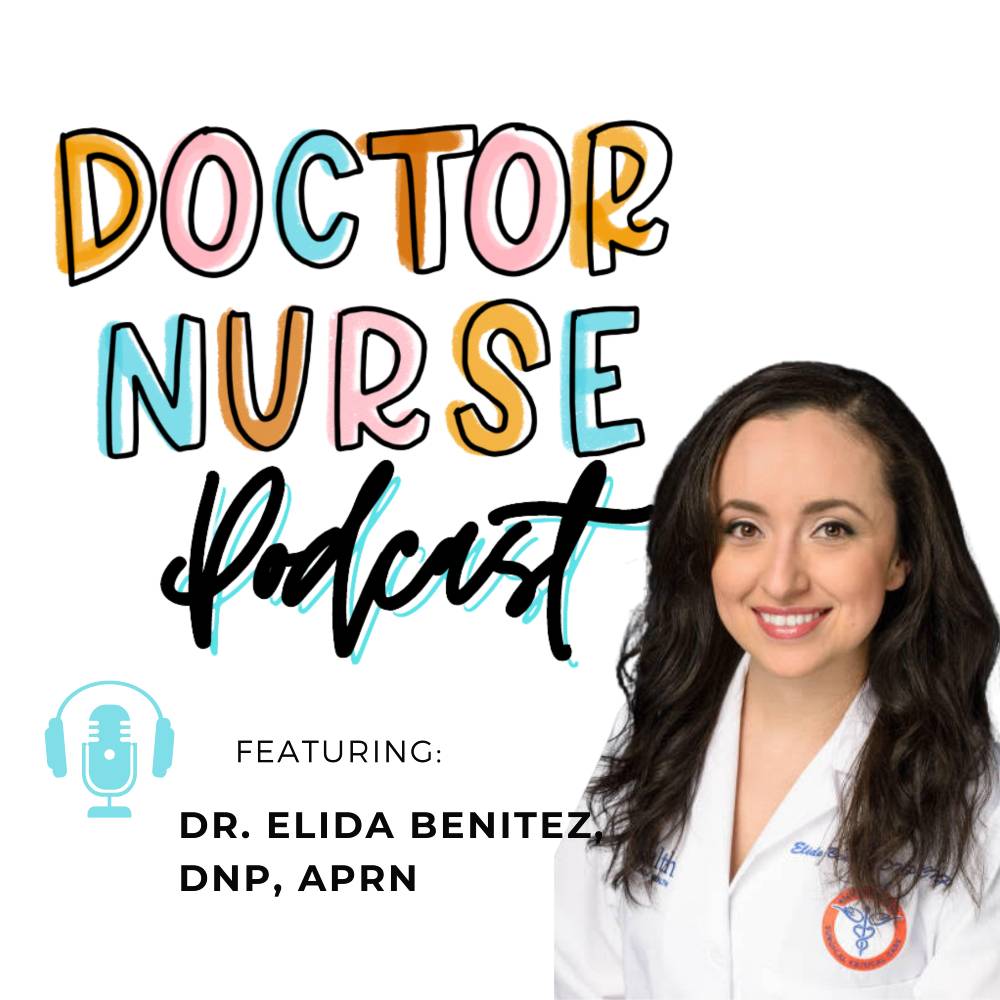
Dr. Elida Benitez is a Polk County native and current Gainesville resident. She earned her BSN (2008) and DNP (2015) degrees from the University of Florida College of Nursing.
Her nursing background is mainly in adult-gerontology critical care and she is a current member of the surgical critical care team at UF Health. She is a proud advocate for advanced practice providers sitting as active co-chair of the APP Council at UF Health. Most recently, she shares the role of track coordinator for the adult-gerontology acute care DNP program at the UF College of Nursing.
She is passionate about providing exceptional care for her critically ill patients and their families, teaching those around her, and living out her faith in her daily practices. Elida spends her spare time enjoying leisure time with close friends and family. She enjoys Latin dancing and being physically active, her cats, and recently started a new gardening hobby.
Latest Episodes
Doctor Nurse podcast brings you weekly shows to help INSPIRE, EDUCATE AND EMPOWER nurses with true stories of initiative and impact.
Doctor Nurse podcast brings you weekly shows to help INSPIRE, EDUCATE AND EMPOWER nurses with true stories of initiative and impact.
Latest Episodes
Doctor Nurse podcast brings you weekly shows to help INSPIRE, EDUCATE AND EMPOWER nurses with true stories of initiative and impact.