Also Available On






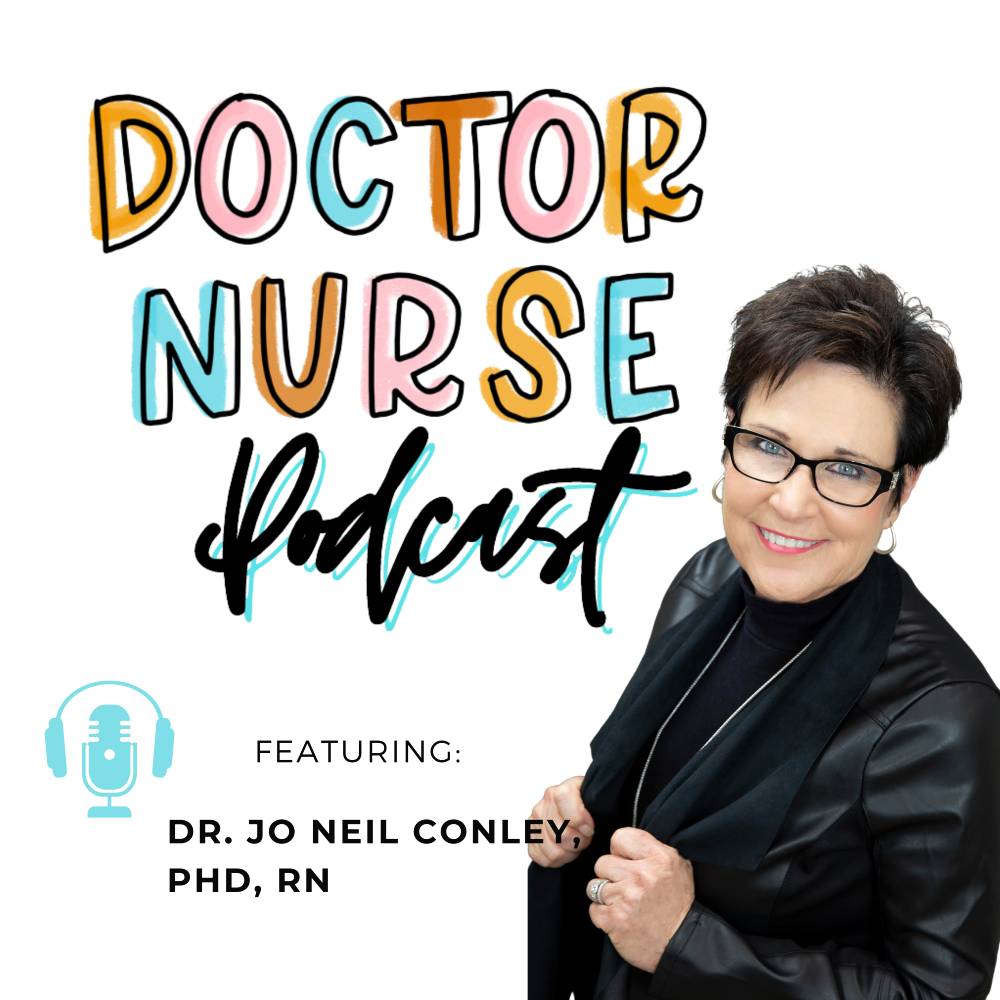
Sandra Pagenta: [00:00:00] Hi, Dr. Jo Neal. Thank you so much for coming on the doctor nurse podcast today. So happy to have you on from the great state of Michigan.
Dr. JoNeil Conley: I’m tickled to be here.
Sandra Pagenta: Let’s dive right in. Tell us about your current role slash job title. What are you doing for
Dr. JoNeil Conley: a living well for a living? I am currently. The headmistress of the school of bully allergy. And I actually have a company Dr. Joanie l.com, but I have transitioned into actually opening a school for nurses, for other people who have been impacted by the effects of bullying. I not only work with individuals, I also work with organizations.
So that’s what I’m up to. Right.
Sandra Pagenta: So, how did you get to this spot right here in your career? Take us through your process and your journey.
Dr. JoNeil Conley: Absolutely, absolutely. Well, I am actually a diploma of nursing graduate way back in the late seventies. When it was, we had three-year school two year schools, three year schools, four year schools.
I was a graduate of a diploma program. [00:01:00] I eventually went back and got my bachelor’s of science in nursing. I have an MBA and I have a doctoral degree in organizational leaders. But in terms of my clinical practice, I started my original practice in the, in the emergency room. I found out early on that I was not gifted for bedside nursing and luckily, and I think all of us need to recognize where we’re gifted for.
And yes. I went to the emergency and see room because it was high paced and I’m kind of an adrenaline junkie. I worked in the emergency. And I tell the story. It was before the days of H caps, when I told the patient to get his blankety blank, blank, and the blankety blank stretcher, and I went, oh, something’s wrong here.
I might need to change. So I love there. Let me just say, going back to the bullying topic, I was never bullied in the operating room. I was very confident. I had been a student nurse in that area and I was, , right out of school. People go, you don’t go to the emergency room, but I had my mojo in the emergency room. So I transferred to the operating room and all of a sudden I had no mojo. I was brand new. I was bottom of the food chain. And actually the operating room that I went to [00:02:00] work in, there was actually 12 different services and you had to rotate through every service. And I was learning as I went, but there’s a lot of stuff to learn machines and doctors and procedures and all of that.
I was toward the end of my orientation and I was. Orienting in the vascular service. And it got to the place where my preceptor was actually scrubbed in the case. And I was circulating, we were doing an aortic aneurysm, the kind before vascular, when you’re open from nipples to nuts, kind of a thing.
And the patient. Filleted wide open. The surgeon was the chief of vascular surgery. I’m trying to set up the dynamics here. , that’s good picture. . . Getting to a place in my preceptor looks to me and says, I need you to go get this retractor blade. It was a specific one and I knew what she was looking for, but I went all the places it should have been, and it was nowhere to be found.
And I’m calling central processing and I’m sweating and I’m painting and I’m like grabbing strangers in the hallway or the operating room.
Where is this red tractor? And I eventually went back into the room. Now, keep in mind, the longer the patient stays on the operating [00:03:00] room table, the increased morbidity and mortality. So I’m out of the room for about 12 to 13 minutes. I come back, I stand at the foot of the table. I’m a sweaty. I look up and I say to my preceptor, I I’m so sorry.
I couldn’t find it. She turns to the physician, pets him lovingly on the hand and says it’s okay. She doesn’t know anything. She’s brand new. And I stood there and like, not only was I thrown under the bus, I was run over by the bus. And so my credibility for that surgeon was diminished.
Now here’s the end of this. We finished the case, , it’s one of those ones that you tell yourself, don’t cry, don’t cry, don’t cry, don’t cry. We finished the case. I go out, I take the patient to the recovery room. The manager for central processing comes upstairs and goes to me.
She goes, Joanie hill, the person she knew that that retractor blade was out for repair. , you’re kidding me. I can’t make it up. I can’t make it up. No. So not only did she put me at risk, she put that patient at risk so that she could look special [00:04:00] in front of the chiefest of that service. And she was the queen of the service, , we all have those Queens.
What is
Sandra Pagenta: it like the mean girls? I would say. So everybody that wants to be their friend really
Dr. JoNeil Conley: likes them. Yes. That was the first time I can remember really. And truthfully having this nurse to nurse bullying, but I knew from that point on, that was going to be something that I was aware of.
Now, again there’s things in our profession and again, Graduated in the late seventies and even in the late seventies. Now keep up. Remember how long ago we’re talking about our teacher said, nurses eat their young. Now this is in the late seventies. We are in 2020 in God. Dang it. It’s still going on.
Why Paris fixed it? So I, I knew from that point, that was something that I was going to be over. Bullies seem to come up in my life in other areas professionally and I got stronger, but it seemed like every time I got stronger, for one level of bullying, I got bullied by somebody else in a higher position. It’s like what Joyce Meyer says, new level, new devil. And so I was constantly aware of it and constantly [00:05:00] growing. I will say that I was impacted by the consequences of bullying. And I think, let me just pause for a second and, and say, , bullying affects our mind, our body and our spirit.
Now it affects our mind where we start to lose confidence in ourselves. It’s like we start questioning our ability and. A lot of the folks that I’ve interviewed who have been bullied as nurses are really superstars. They’re very, very good, but they’ve got an Achilles heel and somehow that pulley just goes for the carotid kind of a thing I’m going to get you.
And so our self-esteem starts to, we start questioning. We know very well with the physical consequences of bullying. , we eat too much, we smoke too much. We get diarrhea. We have thought, I mean, our bodies are like, it takes an impact on that. But most of all, it takes our spirit. We start to lose hope.
Now that most extreme cases that I’ve talked with folks are people who actually committed suicide because of that bullying. So if we can
Sandra Pagenta: wait, wait. So there are nurses that you’ve heard of that have killed themselves because of the bullying that was going on.[00:06:00] Oh on their floors or in their
Dr. JoNeil Conley: communities?
Yes. I’m aware of, of six that I can name their names. And that’s the thing that should take that should take everyone’s breath.
Sandra Pagenta: That’s like a punch to the gut, Dr. Joni, one of the things that. I’ve as you’ve kind of described your story and you got to this point and you’re standing there in the operating room and you’re being embarrassed.
You’re being belittled. Like what is one of the things that through, your education, you were able to develop. To kind of help nurses through that
Dr. JoNeil Conley: process? Well, this has been a journey in, and every place I grabbed a little bit more knowledge. What I want everyone to understand is that the main goal is not to let those. Under your skin. And that is so hard to do. Let me just go on record. And if any of you are wind division fans, it’s like building your hex around you.
I did my doctoral dissertation on bullying in the operating room. And so this isn’t anything that I just left that day at the foot of the, or table I continued on with this. I do want to also say, not only are nurses impacted [00:07:00] by bullying, but there is a direct correlation to a nurse being bullied and a patient outcome, which we can touch base in a couple minutes.
But w one of the things. Kind of came to me, sort of like synthesis of all this information is I created a tool it’s called the meanness matrix and it’s a three by three grid. And along the bottom is a delineation of what kind of a person am I actually dealing with? Am I dealing with a person who’s rude?
And again, those people are unintentional. They don’t wake up in the morning and say, I’m going to aggravate so-and-so’s life and moving to the right there. There are people that are true bullies and a bully is someone who has real or perceived power over you and chooses to use that. And a narcissist or someone who has narcissistic personality tendencies is someone who really lacks the capacity to have empathy or care for anyone else.
And that’s a pathologic. Condition and we know some folks like that. Now, when, once we identify what kind of a person we’re looking at we go up the vertical axes and at the bottom are people [00:08:00] that don’t matter now, again, they don’t matter to me. They matter to Jesus. They just don’t matter to me.
And then you go up the chain and then you have people who, who matter a bit. And these are people that you have tangental relationships with. It could be your next door neighbor whose dog is barking. It could be, your kid’s teacher, it could be a distant relative. these are folks that kind of come in and out of your life, but they don’t necessarily impact.
Direct, , some directly, but not as much, but the key part are the people who really have influence on your life, your spouse, your parents. Now your manager or leader can either be matters a lot or matters a little bit, but then when you figure out what kind of a person am I dealing with? Where do they fall in this degree of influence, you can find yourself in a grid that has a strategy for each one of those techniques.
But the main part I want everyone to get their minds around is I want you to recognize you have to build your force field or your hex or whatever you want to call it, and don’t let them get through because once they get the. Past your [00:09:00] wall of protection or your boundary or whatever you want to call it, then those consequences of bullying start to impact.
Now I’m going to go on record as saying, it’s hard as heck to do this, but step one is having an awareness of what’s going on. And one of the things that’s on the Munis matrix, and again, I’ll make sure that I send you a copy and you can share it with your listeners. Step one or one of the key strategies, never believe what the bully says.
Never believe it because they’re trying to influence you in a way again, sucks. The life out of use makes you start questioning yourself, all of that. So then they somehow feel better because you feel worse. And so the less, and there are times that you have to directly interact with them. But the one thing I’m going to say about us for nursing, and I have another tool that I’m also going to share with you is we need to start taking some.
Emotion out of it. And we, as nurses, as women are pretty much, I lead with my emotion. You can tell where I’m at, but in this instance, I’ve had to get to where I can explain [00:10:00] this non emotionally. And this tool is how to chart bullying. So your voice will be heard and. Aspect of this is don’t go into your manager saying, oh my God, they were so mean to me and they made me cry and then your manners are going to go.
Oh, okay, because then it becomes your word against their word. And again, I’ve been a nurse manager, director of nursing, all of the above. Another thing, please do not slip a note under your manager’s door that says so-and-so was awful and don’t sign it because guess what? She throws that right into the waste basket.
I’m sure of it. So if you can say here’s the date, here’s the time here’s where this happened. Here’s what was said. Now this again is use the exact words you can add a little bit after you say she, or he said. This, this, this, this here’s who heard it. Here’s the staff. Here’s the patient. Here’s the impact on you?
Here’s the impact on our unit and here’s the impact on our organization. And I’ll give an example of that is that say you got so distraught that you [00:11:00] couldn’t get your work done. And so you ended up staying an hour and a half overtime, figure out the cost of an hour and a half overtime. And that was the impact on the organization.
They had to pay overtime because you got bullied and it’s hard to make that correlation, but if you can get to that point, that will get your manager’s attention. That will. And that’s what I want you to kind of get your minds around that we can’t just go, , I could have said, oh my God, my preceptor was so awful.
She made me look bad. Instead. I said, she sent me for a retractor that was out for repair. The patient stayed on the operating room, 15 minutes longer, therefore increasing their morbidity mortality by X percent and or time is $110 per. So, do you see how that kind of flows down to that? Does that make sense?
Sandra Pagenta: It takes the emotion out of what’s happening and actually relays it in a way that hospitals can measure and say, , this is affecting patient outcomes. It’s not just about my emotions. . That was hard for me to have to deal with, but I’m a big girl. I can do it. But you realize that you were hurting other people with whatever this little stunt was that you just pulled.
[00:12:00] So that is way more powerful. Appealing to what matters to the hospital is going to make them care about the bullying issue. That is a very, very good insight on the issue and through your journey, , you saying after. That moment in the, or you, then you said I didn’t let it go.
I kept pursuing that. And that’s what led you to get your master’s degree and then your
Dr. JoNeil Conley: doctoral degree, correct? Correct. And I knew that I was going to study bullying. I knew that I knew from day one, that that was going to be my focus. And it was interesting because when I, when you’re in a non quote, unquote nursing.
Program. I had people go, oh, Jamil. That’s not a problem. Bullying in nursing. Isn’t a problem. It’s like, oh dear God, please just go along with me on this one.
Yeah.. Just trust me. I have to just, . yeah. Singly enough is I went through three committee chairs in my doctoral program until I finally got a nurse as my committee chair and she and I was done in nine months. Her name is Darlene has just my seat. And I got done in no time because she, she [00:13:00] got it. She got it.
And she got me too. That is
Sandra Pagenta: really cool. And you said you had some experience in nurse leadership as well. Oh, you worked on the bedside and then at some point, I mean, you worked in the, or, but then at some point you became like the manager of the
Dr. JoNeil Conley: OA. I did, I did. I became a manager, ran the, or board, trust me, you can get bullied by surgeons.
Like give me a time. I need to go now all of those kinds of things. And that’s where you have to say follow the policy. The policy says, if you want a bump, so-and-so. You have to call them. And then all of the sudden their emergency wasn’t quite such an emergency. So that’s a part of it. And then I became director and all of that.
Then I actually spent 10 years with a company called the advisory board based out of Washington, DC, where we did healthcare research. And I was in four hospitals in five days, helping nurse leaders become better leaders, but one of the areas that I became sort of. Clinical expert is we did a program on disruptive behavior.
I think many of us know that in 2008, the joint commission issued a Sentinel. [00:14:00] Alert saying organizations that do not address disruptive behavior, which bullying is for sure a disruptive behavior will be cited and we’ll be in all of that. And that came out in 2008 and here we are in 2021 and it’s still happening.
Clearly something is amiss here. And again, it’s still happening
Sandra Pagenta: and it’s not getting talked about either. I think that the way that you word it in the documentation. . Shows like it doesn’t matter if this is just a cat fight girl games. Like we need to get in here and start talking about this because it’s directly affecting patients and other nurses well-beings.
Dr. JoNeil Conley: And of the people that I interviewed nine interviewed at the beginning of 20, 20, the year of the nurse, I was really going to go gung ho about this.
COVID happened. So that got kind of pushed, but I’d interviewed 20 nurses. And most of the nurses said that they experienced more bullying in their early years of practice. And so of late I have been very concerned about our new graduates who are graduating post COVID and that we, as a profession kind of need to wrap our arms around them and say, we’re going to [00:15:00] welcome you into our profession.
We’re gonna, we’re going to be preceptors. We’re going to help you. You didn’t get the clinical that you should have, but that doesn’t matter. We still want you. We want to help you. And I think that’s an area that our entire profession, along with all the things we’ve been through with COVID, we can look at this particular moment in time and say to those who we are welcoming into our practice.
We want you, we want to help you. We want to care for you. We want to make sure that your success.
Sandra Pagenta: What would you describe as the difference between a hard preceptor, meaning one that’s like making sure that you’re on your game versus one that’s bullying.
Because I feel like in my experience, I’ve had hard preceptors and. There’ve been moments where they’ve asked me hard questions in front of patients and I wasn’t prepared and I wasn’t ready. And then it makes me think, like, I never want to be in that position again. She was right. I didn’t know the answer to that question.
And so before I walk into the room, I want to know this, this and this and that versus one that you’re like, she’s just being mean to me. She doesn’t like me. Like, how do you differentiate between the
Dr. JoNeil Conley: [00:16:00] two? I think relationships understanding communication. I think the preceptee has to own a piece of their process and have those hard conversations with the preceptor.
Like I really want to be the best. Push me as hard as you want to push me versus somebody who wants to deliberately. And the keyword too, I think is deliberate. I think it’s, they deliberately want to make themselves look better. So you look worse and humiliation and all of that stuff. , I think they have a sense of let’s, , shoot, I got humiliated in my orientation.
I’m going to do the same to you. And I’ve heard that many a time, , if you can’t, if you can’t stand the heat, get out of the kitchen, that’s that’s not a healthy way to deal with this. It’s like hazing. , exactly, exactly. And I think one of the key elements to that you’re going to see on the meanness matrix is can we see each other as people.
You have to recognize you will never change the bullies behave. Only the bully can change if they so choose to change. Now, I’m going to have a [00:17:00] little sidebar here. Organizations must have a code of conduct that is enforceable in forced and have the courage to do it. I think organizations can address the bully’s behavior when it’s documented and all of that, but you yourself must protect your heart, your spirit, your mind, body, spirit.
If your preceptor can see you as a person and you have those conversations, you say, make me the best. And then that the preset I’ve had preceptors that did that. And then they give you the wink afterwards because they know that that it was good for you.
And maybe I’m not describing it well, but those are the. It’s that relationship piece. It’s that understanding piece. It’s that willingness to make that preceptee the best they can possibly be, even if they’re better than you. . . .
Sandra Pagenta: I had some students. And I was really hard on them and I got feedback that they felt like I was putting them down and I struggled with that.
Like I have not taught since then, because I felt like Sandra really need to look at yourself because you’ve [00:18:00] experienced bullying. You don’t want to be a bully. . And I remember thinking I was so worried about them making mistakes because I had made mistakes, but I was actually teaching out of my wounding and being so afraid that I was like, listen, you need to be perfect here because I made a mistake here.
And I don’t want you to ever make a mistake here. I want you to know what you’re doing, why you’re giving it, where you’re giving it. I had to spend some time with myself and realize like I, I was so. Hurt by that situation that then I was kind of like living out my trauma with my students and they were like, dude, what’s your problem.
If we can prevent the bullying from the front end, then we probably would not have so many other nurses that kind of go through that same process and think like, Oh, gosh, I don’t want you to deal with this. And so you might be reacting out of your own issues. It’s definitely a really sensitive topic and it’s it is an issue that a lot of new nurses are going to be dealing with. And I think it’s amazing that you’re tackling it and you’re bringing it to the forefront and you’re making people look at this [00:19:00] issue because it is sensitive.
And it’s one of those things that we just like to cover it up, but pretend like it’s not happening and just go like, oh, this isn’t a big deal. And then you start to see this ripple effect. I’m really glad that you’re, that you’re talking about this, that you’ve spent your whole career, your profession. So can you give me an example of maybe one of the biggest successes in your career up until this point
Dr. JoNeil Conley: well, one of the things we haven’t talked about is that I was married to a bully as well. And , so that’s a whole nother podcast episode, but I was a rock star at work. I mean, I was, , I was good. I was really good, but I was married to this person who literally suck the life out of me.
I think that some of the things, the tendencies that we get bullied at work are also in our personal life too. And. It’s a long, long story, I was in the last semester of my BSN and now ex-husband had come home from prison and I got breast cancer in the last semester of my BSN and God bless my BSN cohorts.
They took care of me. And that’s, like I said, that’s a whole nother thing. But when I decided to leave my ex-husband, I [00:20:00] left him with my nine-year-old daughter and one suitcase full of sequence formals. That’s a whole nother story. But the point being is that I was a single mom doing cabbages on-call working and trying and getting my master’s degree.
So. When I got my master’s degree and my ex-husband had a college degree, but not a master’s. And this is kind of like your own personal moment when they hood you, , you turn to the person and then you turn around to the state, to the people in the audience and in my mind, and this is all captured on video.
I’m smiling and in my head, I’m going blank. Ex husband name, you will never touch me again and so maybe that’s a different kind of success you’re looking at, but that’s a journey for me. That was my, Rocky moment, , can’t you see Rocky, stand it up there.
Sandra Pagenta: I feel that like, that’s such a beautiful picture of you just being hooded and like waking up was like a Jedi Knight, just like
Dr. JoNeil Conley: I’m this and that.
And that was sort of like that sort of healing moment kind of thing. It’s like all the things you said to me that I was fat and ugly and had only one boob and nobody would ever want me and all those kinds of. Doesn’t [00:21:00] matter, you can’t touch me. And that’s the message. I think if we, if people can take away from this conversation is that you have to do your own internal work to get to where you can’t touch me.
, you’re out there and you’re doing crappy things, but what? I’m strong. I’m good. I got up my thing. You could do all you want. I’m going to turn around and raise my fist and say, you can’t get me now. You can’t do it. That’s the takeaway.
Sandra Pagenta: Dr. Junel one of the things that I feel like, and again, this, hopefully this is something that you can understand, but whenever you’re a young nurse and you’re starting off in your career, How do you get that chutzpah?
How do you get that fire inside you? When you’re at least when I was a new nurse, I was 21 years old. I barely knew myself. , I’m a baby. I just got in, you know,, I don’t at school, ? And so how do you find that thing inside of you that voice. When you’re don’t have the life experience, like, do you have to go through the life experience?
Like how can you infuse it in [00:22:00] someone without having to experience
Dr. JoNeil Conley: something terrible? Well, , I actually work with teenage girls as well in a program, a club kind of a thing. And we talk a lot about that is who are you? And what were you brought here to do? , I have a strong belief in that and not everybody does.
I think everybody’s here for a reason. But I gained knowledge by just ask. And the one thing I would tell any new nurse recognize you don’t know what. Recognize that recognize you don’t know it all and find the person and it may not be your preceptor. You could say, okay, Mrs. So-and-so did this and this.
And here’s what I think it is. Am I right? Can I do this? And, and you’re going to gain some of that. Some of it really it is a passage of time and in the passage of experience, right. What I’m hoping is that our nursing profession can allow our new members, our apprentices, if you will, to spend.
Nurtured and grown and helped. And if if a seasoned nurse is doing something that doesn’t happen very often, grab that apprentice and say, [00:23:00] Hey, come with me for just a minute. So only going to take a second and then say, Hey, Suzy, watch so-and-so’s patient while I show her this, but we don’t do that. We don’t because we think power, , we think knowledge makes us powerful.
And if I know how to do this and she doesn’t, then I needed on this unit. Well, what happens when you go on vacation and nobody can do that thing that you can do.
Sandra Pagenta: Some of the books that I’ve been reading about leadership and development and intentional living, they talk about not feeling. This mindset of like scarcity, like there is this scarcity mindset where you just think there isn’t enough. And you’re like, I have to hoard what I have. And it’s like, actually, if you give away what you have. You will end up getting more. I feel like as women, we have this idea of like, there’s not enough husbands, there’s not enough.
There’s not enough. This there’s like, , we got to get like, we’re all fighting for spoons. And it’s, you’re that game where you put all the spoons in the middle and everyone’s like, oh , there’s one less spoon. And you’re just, you don’t want to be the one that doesn’t get a spoon. And like, I think that scarcity mindset.
Yup. Holds us back from advancing. And if we were like, you’re [00:24:00] describing like, absolutely go get that nurse. Let me go show her how to do this. Hey, listen. What I know I want to share with you, like here, have it like that. You will begin to live a life with an open Palm and you will realize your Palm will never be.
Dr. JoNeil Conley: Yes. Yes, yes, yes. For sure. For sure. , one of the concerns I have is my generation of nurses are pretty much for the most part retired. And I think about the intellectual capital that’s gone. Now. I feel strongly about that too. , that there’s a, there’s a chance that. , you think about the archetypal sitting at the foot of somebody knowledgeable kind of thing.
And I think we, as a profession, haven’t, we’ve shunned our elders. We’ve shunned all of those people and then we’re mean to our kids. So we need to have that identity of the kind loving people that we are because people who go into nursing, I believe. 99.9 9 9, 9, 9. And I are kind and loving. And, and what amazes me is I’ve seen nurses be so unbelievably kind in a room and they’ll come out in the hallway [00:25:00] and rip the face off as somebody who walks by.
And I think, is that all about?
Sandra Pagenta: that was a beautifully painted picture. And I feel like that is that part of your, your probably challenges that you’ve had to overcome is breast cancer and husband. That was just a total whack job.
Dr. JoNeil Conley: I told you I spent 10 years at the advisory board. It was like the best. Those were, those are some of the mentors that I had. Hundreds of hospitals that I went to, I, I was able to touch people’s lives and they touched mine as well. And to just hear the stories and to be with nurses every single day, it was wonderful.
But I actually left that job. I got remarried to a wonderful husband who I met in an airport. That’s another story. But I just, I took a job as a director of nursing in our local hospital and it was, it was sort of like, I know. It was an ER and, or, and I’d been there a week and we flunked the joint commission and we had to spend the next year being in survey hell.
But the piece of that one is the CEO of that organization was toxic and people say, oh, it’s just toxic leaders, blah, blah, blah, blah, blah. But let me tell. He said to me one time [00:26:00] until you’ve been here for six months, keep your damn mouth shut. It’s like, say what? And he put that in writing. So let me just tell you the end of the story is that I kept records.
I documented on emotionally, all the things that happened and why, when I woke up with seven ulcers and gained 30 pounds, I knew something had to change. And a long story short, there was a nexus event. I just got pushed to the point where I had to do something. And I made an appointment with the vice president of the corporate human resources.
And I took in my data and I have to say, this is an organization that I believe has extreme courage because he took me by the hand and said, Joanie, well, nobody needs to work under these conditions. I don’t know what’s going to happen. Here’s my card. Call me if you need me. And 10 days later that CEO was walked out of the room.
wow. So don’t say it can’t happen now because of your documentation, I was like the catalyst, they interviewed 40 other people in the midst of this time, but I was the one who presented it in such a way that they could see how this was impacting the organization.
And so people say, well, you can’t do anything about HR and you can’t do anything about your manager. organizations have to have courage to say, we don’t [00:27:00] want you here, , and they have to have the documentation to do that.
I’ve been at organizations where they were in, , The farthest nor this part. And they had one orthopedic surgeon who was a complete total turd and was sending people elsewhere. And the organization said we can’t, we can’t fire him. He’s our only orthopedic surgeon and 150 miles.
And I’ve been at other hospitals that had the same situation and said, we don’t need your kind of toxicity in our organization. We’ll find another orthopedic surgeon. So organizational courage is a piece of this as well.
Sandra Pagenta: At some point, , when you look back in history too, right?
Like Hitler was a bully, right. And the whole world took it until eventually we said, no more with the bully, you got to go, bro. Right. It just takes that courage and, and I think it was there’s like a really famous quote that. Like something flourishes when good men do nothing. .
Dr. JoNeil Conley: The only thing for evil to succeed is for good men to do nothing. That’s
Sandra Pagenta: it? That’s the saying? That’s what like keeps coming to my mind when you describe that whole process of you just [00:28:00] standing there. I’m not going to just let evil continue. Like, if we say nothing, if we do nothing, it will continue.
We’ve got to stand. You’ve got to make a stand. .
Dr. JoNeil Conley: And I think we have a voice. I think nursing, , has a voice. If we can just stop picking on each other. . .
Sandra Pagenta: And stand together. And that is what keeps you weak is that you don’t stand arm in arm.
We tend to just want to fight with the people next to us. It’s like if we actually stood arm in arm, we would be pretty much able to stop anything that was evil going on. I feel like Bernay brown talks about that.
Dr. JoNeil Conley: She does, , look what happened when that Senator said we had played cards on our breaks.
, look at those things. We have the power, we have, , the opportunity to do some of these things, but it’s always like, who’s going to be first. I don’t care. Who’s first, as long as we get there, , the back of the bus gets there too, just as well as the front of the bus. I
Sandra Pagenta: agree. .
Incredible. Those are such incredible examples. And did you, you were going to start to kind of allude to it, any mentors along the way, did anybody like come alongside you and kind of help you through this process? There’s
Dr. JoNeil Conley: been so many, , I can’t really pick out like my advisory [00:29:00] board colleagues where some of the most amazing people I worked with and they were from all over the country.
They were nurses from all over and they. Encouraged me. The one day that I was going to jump off the Washington monument because I couldn’t get my doctoral dissertation done. They were the group that held me and said, don’t jump, don’t jump. But I have always been an avid learner and I believe when the student is ready, the, the teacher will appear.
People have come into my life at the right exact moment for me to synthesize what happened last. And I think you have to be open to that. Like the meat I’ll tell you the story, but about the meanness matrix and you can believe it or not believe it. But my husband and I were driving in his little convertible in the upper peninsula of Michigan.
The top was down the sun was beating on my head and all of a sudden. The meanness matrix came to me and I’m like jotting it on the back of a McDonald’s wrapper kind of a thing. And I just believe that that was okay. Okay. Donelle, you’ve come to this place. Here you go. Here’s your next step. And if you’re open to that,
Sandra Pagenta: I like that.
If you build it, it will come. . I like it. And what advice would [00:30:00] you give to a new nurse starting off? I like you’ve given so much nuggets along this whole interview, but what would be kind of your whole like summarized, like wham bam statement of like, this is what I want you to take home for this whole chat.
Dr. JoNeil Conley: I would say take care of you because you’re no good to everybody else. If you’re not in a good place.
That’s what I would say.
Sandra Pagenta: I think that self care is not a matter of like getting a Manny.
Dr. JoNeil Conley: Can I say amen to that? Amen.
Sandra Pagenta: I feel that’s such a simple thing. I feel self-care is spend time with yourself, like, because nursing is so emotionally heavy, spending time in therapy or just spending time like meditating and reflecting on things. I just kept going. I was just like, just keep going to school, just keep working. And then I was like, whoa, I might be really messed up. And one of the first times that I noticed that was with my students , whoa, Sandra, like spend a second here because you are not caring for yourself and you haven’t for years, you’ve just been so busy.
But your issues are starting to come through.
Dr. JoNeil Conley: There is a [00:31:00] book and I’m looking for it on my bookshelf here about the wounded healer. Cause it’s a really poignant . And I think just growing into yourself, I think we want to be done before we’re done.
We’re not done, , you think, okay, I got the diploma I’m done. No, you’re not. I got that school. No, you’re not done. Be open and be willing, ? Therapy and coaching are the two things that have made a difference in my life in terms of processing this, because some of the stuff is so heavy.
You just don’t know how to do it on your own and you hold it in. And the minute you hold it inside, it starts to become an infection. And that’s when you get what I call it is bully itis. When you get bully itis, then it affects you. And you’ve got to like that. I need to have some antibiotics. Okay. Let me go see a therapist or let me get a coach. This isn’t something you should do on your own.
Sandra Pagenta: You’ve got to To breed the wound. You’ve got to open it up. See what’s in there.
Advice. And the last part of our interview is the rapid fire questions. So the first question is what is your favorite word?
Dr. JoNeil Conley: It’s probably a swear word and I can’t say it[00:32:00]
and some days it just feels so good to say. So what I can do that it’s probably jeepers.
Sandra Pagenta: What is one of your favorite books?
Dr. JoNeil Conley: Oh gosh. Man’s search for meaning by Viktor Frankl. I Read it pretty much every year, some point. And when I had gone through the thing with the CEO, I got that right off my right off my bookshelf. It’s worn, it’s torn, it’s written in, but it has so much to say. His messages is you can change. The circumstances can do all sorts of things. This is the gentleman that was in the concentration camp. He was a physician in a Nazi concentration camp and he said, you can take everything away from me but my attitude and that is, I think one of the best lessons we can.
Sandra Pagenta: Okay. And I feel like you’re this kind of girl, what is the first concert you ever attended?
Dr. JoNeil Conley: So old, you’re gonna, it’s like, it’s going to tell you how old I am. Okay. John Denver.
Sandra Pagenta: Who’s John
Dr. JoNeil Conley: Denver.
There you go. There you go. Was like this folk singer guy. I was probably like 12 sort of a thing in, in, in Flint, Michigan, there was the Ima sports arena and he came and he saw, like he was [00:33:00] saying Andy song, country roads, almost heaven, West Virginia. , John Denver.
Sandra Pagenta: I was like this lady goes to
Well, thank you so much for coming onto the podcast today and chatting. So happy to have you and your whole conversation is just littered with such sweet little pieces of knowledge. , there’s just awesome little morsels for our souls. So thank you.
Dr. JoNeil Conley: Thank you for asking me.
It’s like I said, it is my mission to get this message out to nurses and to other people. And I think at the time is right after what we’ve been through in the last couple of years and all of that. As a, as a nation, as a profession, as a world, we need to see some of this.
Sandra Pagenta: Love it. Thank you.
Dr. JoNeil Conley: You’re welcome.
Podcast Description
Latest Episodes
Doctor Nurse podcast brings you weekly shows to help INSPIRE, EDUCATE AND EMPOWER nurses with true stories of initiative and impact.
Doctor Nurse podcast brings you weekly shows to help INSPIRE, EDUCATE AND EMPOWER nurses with true stories of initiative and impact.
Latest Episodes
Doctor Nurse podcast brings you weekly shows to help INSPIRE, EDUCATE AND EMPOWER nurses with true stories of initiative and impact.