Also Available On






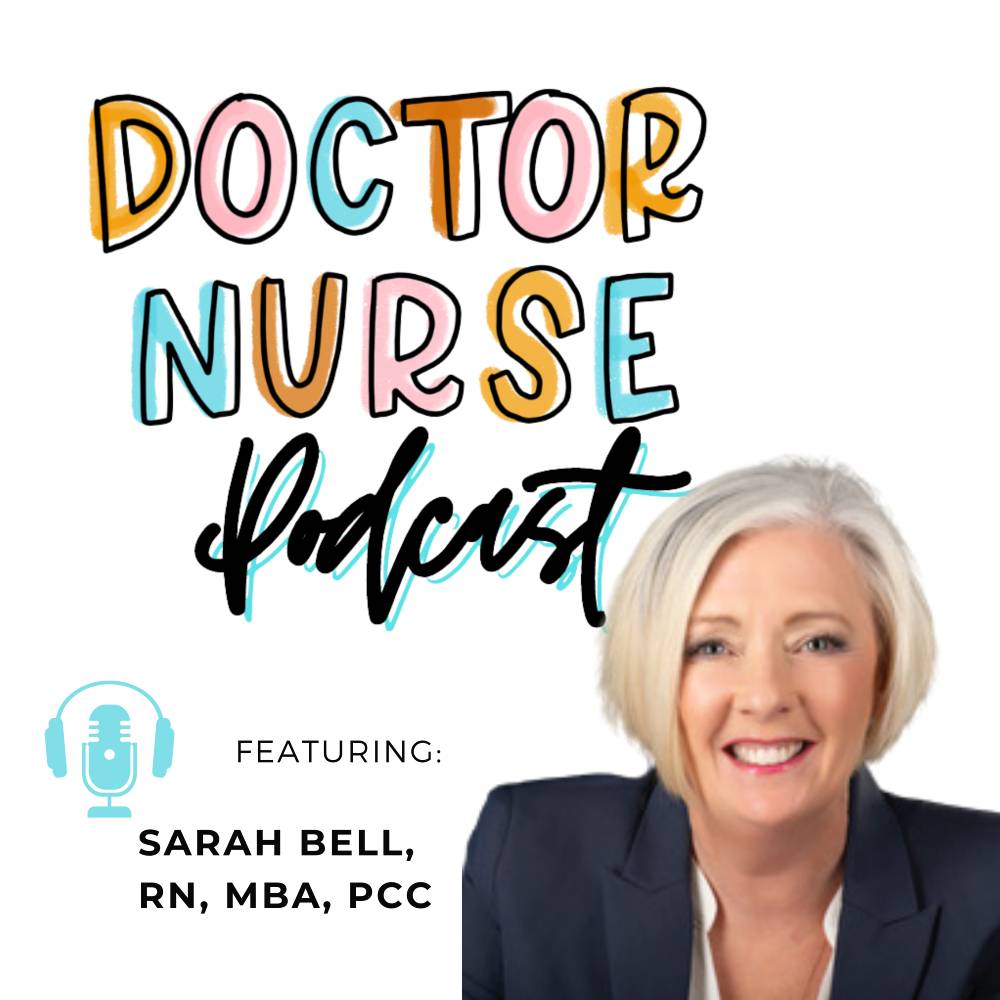
Sandra Pagenta: [00:00:00] Hi, Sarah, welcome to the doctor nurse podcast. So happy to have you on Sarah is a certified leadership coach originally from the UK currently residing in the great state of Texas. Who’s here to talk to us about what she does for a living. Welcome
Sarah Bell: Sarah. Well hi Sandra. Thank you for having me.
Sandra Pagenta: Yes. So let’s jump right in.
What is your current role?
Sarah Bell: My current role is I am owner and chief coach actually only coach for Sarah Belle’s leadership coaching. I’m a leadership coach for nurse managers.
Sandra Pagenta: Walk us through an average day on the job.
Sarah Bell: Ooh, an average day on the job. It’s a lot of communicating and connecting with people and a lot of creative work and creating group coaching programs and webinars and coaching tools. So I’m marketing a lot of marketing, so people actually know that I exist.
Sandra Pagenta: Whenever you’re doing your life coaching, [00:01:00] what does that entail? Is it directed towards a certain group of people?
Sarah Bell: My niche, as we say in the coaching world is newness managers. So a nurse who recently got promoted because she was an excellent nurse, took on her first management or his first management position. And then they find the.
They’re struggling and they’re not having the impact that they’d hoped for because a lot of the time in nursing, we never really get towards or learn what a leader really is. So I have them overcome that first six month hurdle where they’re learning to establish themselves in a leadership position.
Sandra Pagenta: Interesting what are some of the topics that you teach?
Sarah Bell: What leadership is, is the number one, because a lot of nurses are not aware that there are actually leadership models that they can follow. So the very first thing is to help them understand what, what the leadership models are, which ones lend themselves best for nursing.
And then we move in that I’ve been in with my clients on. So [00:02:00] what are the attributes that they either have, or would like to embrace? So that they can align themselves with the role of a leader, which is different to the role of a nurse.
Sandra Pagenta: Hmm. So when you go to nursing school and you’re saying you don’t get taught to be a leader, which I agree with, I think that understanding business and understanding leadership are concepts that aren’t explained, but are pivotal to what we do.
So how do you suggest that a nurse. Bridge those gaps while reaching out and getting help from someone like you, what can they do on their own?
Sarah Bell: So just on their own. I think one of the, one of the first things to be aware of as nurses were trained pretty much to be very reactionary where reacting in the moment we’re looking at were monitoring our patients were taking orders.
And so where we become very reactionary. And if there’s [00:03:00] one thing, I would encourage anybody to do the stepping into a leadership or a management position. Is to take a step back and get to know observe what’s going on in that area of responsibility and really get to know the people that they’re working with.
Get to know their team, get to know the team’s values, the contributions they want to make, and also get to know what is expected of them by the organization. What are the, we call them key performance indicators. They’re basically measurements of how well we’re doing to get to understand. What those are so that the nurse manager nursery, that can align themselves with the goals of the organization, and then start to understand the contributions the team can actually make to help them accomplish those outcomes.
So that would be a great place for any new nurse managers.
Sandra Pagenta: Yeah. And then to build on that you would help, you would kind of come alongside and help them as they build this [00:04:00] concept of who they would like to be as a leader and how they would like to shape their career, which is pretty cool.
Sarah Bell: It’s exciting because it is a, there’s a big difference between a nurse who’s taking care of the patients and then a nurse who now is responsible for leading a team to take care of the patients. We all need help and support when were making a huge transition like that, taking on that extra responsibility.
Sandra Pagenta: Yeah, that’s good. What was your journey to this career path for yourself? How did you decide this is what I want to do for a living?
Sarah Bell: Ooh, well, I’m going to kind of very long story short here, but I was getting to a point I’d been a vice president of education for several years and I was getting to a point where I didn’t feel I was having the impact I hoped for, and I needed to have a career change and there was stuff going on in my personal life as well.
And I was pretty burnt out. So I got a career coach because I didn’t know. What else I could do. And through working with a career coach and like, oh, I like [00:05:00] what you did. So I went to coaching school with the intention of nursing this saying, I’m becoming a life coach, long story short. It didn’t happen. I became a certified coach, the organization I worked for like what I was doing as a coach.
And so I just transitioned naturally into that role for a company I was
Sandra Pagenta: working for. And then from there you decided to go out on your own. I
Sarah Bell: did. Yes. It fills up the courage. But yes, I, I realized that I, if I, if I want to take a lead in my career and in my life, the best thing for me to do at that time was to step out and to start my own company and go out on my own.
Sandra Pagenta: How did you overcome that fear?
Sarah Bell: Oh, well, I was hanging on to that cliff for a long time, I had a good salary and I was afraid, but then I just woke up one morning, Sandra and I realized, what are you doing? What are you doing with your [00:06:00] life? And that, for me, that was just like, I just, it was like an aha moment.
It was first thing in the morning and I just took it from there. So there was no real, I’d been thinking about it a long time. I was afraid. And, and then all of a sudden I was like, well, am I going to stay where I am out of fear? Or am I gonna just take the leap and see what happens? So I just took the leap
Sandra Pagenta: and never looking back.
Sarah Bell: Never looking back. No,
Sandra Pagenta: that’s amazing. And so any other types of jobs in your career that you felt like led you to this point? Was there a gradual progression of your career, from bedside nurse to nurse manager, anything like that?
Sarah Bell: Oh, yeah, absolutely. And I think, I think my entire career has been a progression just to put, I did not necessarily look forward and go, this is the next step I’m going to take.
I think I got to certain situations in my career when I knew I needed to change some things, you know, right [00:07:00] off when. And early on as a nurse, some things happen and I made some mistakes and I saw the value in education. So I became a nurse educator and I was a nurse educator for the longest time. And then as I started getting into coaching, I started to see why people were not doing it.
What they’d been taught to do. And that was one of my biggest frustrations as an educator. And I used to think what’s wrong with people. Then I realized there’s nothing wrong with people. Nurses have competing objectives all of the time. And in any given moment, there are probably to make a decision on what is the best thing to do.
And sometimes. The need for efficiency and productivity in nursing puts pressure on the nurse, maybe to cut corners that, that they really shouldn’t be cutting, but they’re trying to meet another objective. When I realized that through my coaching school, that really hooked me into them wanting to help more nurse managers.
Become better [00:08:00] leaders be help them to navigate those difficult situations and to find their voice and speak up when, when the objectives that they’re dealing with don’t match up on the floor.
Sandra Pagenta: Yeah, I think leadership is like a trickle down effect. Once you have really good leadership at the top, everything else really functions well behind it.
Right. And so in one of the podcasts I talked with Jill Weber ding, we talked about a similar concept of when your leadership is really healthy. The rest of the organization tends to be healthy. I’m not saying they can’t be little spots along the way, but like, I just feel like leadership is so key Servant leadership is such an incredible thing to want to emulate that whenever you’re around people that are good leaders, you just want to be better yourself. You’re like, my boss is super great. I want to be great. Because you see how they act with their consistency.
And their awareness of what the goal is. When I’ve worked under good bosses, [00:09:00] it’s made the difference between me loving my job and hating my job, even if I loved what I did. And so a boss really does make or break your job.
Sarah Bell: Oh, absolutely. Absolutely 100%. And we can probably all look back over our careers and go, oh, this, this worked well under this boss and I didn’t work so well.
And under this boss and it’s actually one of the questions I asked my client. To consider who are the leaders that they have worked with, that they really thrived under. And what were the attributes that needed to demonstrate that that enabled that to happen? Because I think when we connect theory to real life practice, it becomes way more meaningful and it helps people to understand, oh, that’s what that person did that I really like.
I can do that.
Sandra Pagenta: That’s really good. I don’t think I’ve ever really thought about that and realize what was it that I liked about the boss that I really, really liked. It’s always been more comforting to have a boss that was like, you’re a professional. And I expect certain things because you’re a professional and it’s [00:10:00] like, oh, okay. I know what that means. I need to be on time. I need to be respectful. I need to be courteous. Like whatever those things are. What have you found has been a common theme that most people have in have liked about their previous boss?
Sarah Bell: People like transparency and they like clarity and they like to feel that that they’ve asked trusts them. Oh, that’s good. Trust is huge in both directions, trusting your team and building trust so that your team trusts you. That’s a huge one. When you have an environment where you feel that you’re, you can speak out. You’re going to be respected for your opinions, even if, even if you don’t get what you want, that you are still encouraged and your opinion is still valuable, is huge. And building that trust is so important.
Sandra Pagenta: Sarah, can you give us an example of one of the biggest successes of your career up until this [00:11:00] point?
That you’ve thought that was a really big high. That was a good one.
Sarah Bell: Oh it probably quitting my job and starting my business has been my biggest, biggest, high official definitely. It’s kind of like stepping out of my comfort zone. I’m really like, Really recognizing that what I do with my life is up to me and that I am a professional.
Th there are so many things that I can do when I actually took the bull by the horns and did that. That was probably the biggest success that I had in my life.
Sandra Pagenta: Yeah. Was that a Texas reference right there?
Sarah Bell: I’m slowly slipping into the lingo.
Sandra Pagenta: That was like the moment you decided to believe in yourself. Like, I can do that. Yes by
Sarah Bell: myself. Yeah.
Sandra Pagenta: Yeah. That’s huge. And so what are maybe, and I know maybe you’ve already answered this.
That was kind of overcoming, cause you did have to kind of overcome your fear or whatever was holding you back, [00:12:00] is there anything else in your career that you could think of was a really big challenge that you had to overcome?
Sarah Bell: Change it move in continents, moving from the UK and having to the U S that was a different healthcare systems. That was very, very challenging for me. It’s so interesting how we get into our comfort zone. We become unconsciously competent. We know what we’re doing. We don’t have to think about it. Life’s a breeze.
And then you move. And you come to a different country and you think you speak in the same language, but I’m in Texas. So it’s not quite the same language, but it’s close, but then you’re dealing with things like I wasn’t used to dealing with things like Medicare, the whole healthcare billing system. So many different things that really knocked my confidence for a good few years.
Really. And so, yeah, that was, that was a huge challenge.
Sandra Pagenta: Cause it’s a culture shock, right? Even though we’re speaking the same [00:13:00] language, we’re from a completely different culture and a completely different mindset, values and goals. You’re kind of like a fish out of water. One of my really good friends, even whenever we would go to The grocery store. She asked me to give her the trolley and I said the trolley and I’m like, you mean the shopping cart? It’s just different. And she’s like, oh yeah, it’s a trolley.
Sarah Bell: Yeah, medications was a huge one for me because they had different names over here than they did in the UK. And in the UK, we were never allowed to use brand names. We had to use the actual drug name and it, a lot of things like that. My confidence really was, but I don’t, I don’t know what I’m doing anymore.
I felt like I was starting again.
Sandra Pagenta: I could see that for sure. And how long did you practice as a nurse in the UK?
Sarah Bell: I started nursing school in 1989.
Sandra Pagenta: And so when did you come to the
Sarah Bell: states? I was supposed to be in a short relocation for a couple of years, but 20 years later, I’m still here.
We
Sandra Pagenta: sucked you in the American way. I love it.[00:14:00] Tell me a little bit about any mentors that you had along your career path. Was there anybody that came alongside of you that you felt like really helped shape who you are?
Sarah Bell: Oh, absolutely. And the first one was when I was applying for my first management position and I wasn’t going to apply for it.
And my mentor said, no, you absolutely. You’re ready for this. And she wasn’t a nurse. She was a bank inspector and she was in a very Masculine environment. And so she’d had to work her way up and overcome her career. Competing against men and all kinds of things like that. But she’s worked with me.
She talked to me about professionalism. You know, it wasn’t going to be wearing scrubs anymore, so I’m not kidding. She taught me how to dress. And I see this with a lot of Nurse managers. They’re used to wearing scrubs and they feel uncomfortable putting on business clothes to go to a meeting and things like that.
But she taught me how to dress. She taught me how to [00:15:00] present myself. She taught me how to do presentations. She was amazing. She, I don’t think I would have even applied for the position if I hadn’t had her as a mentor. That was huge.
Sandra Pagenta: Did you seek her out or did she identify you as someone that she wanted to mentor? Or did you have a conversation like, hi, I’d like to be your mentee and she’s like, okay, good. Like, how did that happen? Process go because I find in nursing, especially as a nurse practitioner, I feel very isolated and I don’t really feel like people share their journeys of their careers and positions that I would like to get to.
Right. So it’s like if I would like to be a nurse manager. I don’t necessarily feel like there are nurses that are like, Hey, are you interested in what I do? Like, let me tell you I got here. But did you have a conversation like that with someone? Or how did that just happen organically?
Sarah Bell: It happened organically because she was in my friend circle. And I think she, she took me under her wing and I [00:16:00] became her project. So it really did. It really did happen organically. Mental, having a mental is so powerful yet. I don’t think we figured it out.
In healthcare. We once we start formalizing it and making it a requirement for people to have mentors, I find that people get matched up maybe not with the right person for them. And so if you can go out and find a mentor for yourself, somebody that you can connect with and somebody who really wants to help you, that’s way more powerful than the bulk standard.
Okay. Everybody needs a mentor and here’s, we’re going to match you up. And that kind of.
Sandra Pagenta: it’s kind of like that quintessential thing. And when you’re in school, it’s like everybody find a partner. And then I’ve always, I’ve always was the last one around looking around. Like, does anybody want to be my partner?
Sarah Bell: Be my
Sandra Pagenta: friends. exactly. Which is why I think this, this podcast is so great too, because it just gives people the opportunity to ease, drop in on someone’s conversation that they might go, oh, [00:17:00] that’s kind of. Cool. Maybe I’ll go find somebody that’s doing that and ask them how they got there and have a mentor me.
You’ve got to have these conversations. I think you need that in nursing. And I don’t know if it’s just a culture thing, but I really do feel like we need to be more open to reaching back to the younger nurses and saying, Hey, this is how I got to where I am. Is this something that you’re interested in and it not being so every man for himself type.
Sarah Bell: Yeah. If we keep, if we can. Apply the same principles we do with our patients that saying nurturing and supporting and helping people without peers and then other younger nurses. I think that would make a huge difference, especially when it comes to the distress that we’re constantly hearing about this going on in nursing right now, everybody needs to be connected with somebody that they can run things by.
Without judgment.
Sandra Pagenta: Sarah, how is, and again, this is just for our listeners out [00:18:00] there thinking about maybe reaching out to a career coach. How similar is career coaching to mentors?
Sarah Bell: I think the main difference between mentorship and coaching would be as a mentor, you’re really going to share your experiences. You’re going to put some ideas and suggestions. The other person is always gonna make the decision, right? I’m if you’re my mentor in the end, I always have to make my own decisions, but a mentor is going to say, this is how I worked through that. This is how somebody else I know worked through it. When you move into coaching, you’re really creating space for the person you’re coaching to organize their own thoughts.
Their own experience says because we have more knowledge and understanding within us than we realize, but we’re just busy people and we’re not stopping to think. So a coach is going to create space for you for 30 to 45 minutes for you to really. Open up, get everything out in front of you and decide [00:19:00] on how you want to move forward.
So a mentor gets more information, whereas a coach elicits what you already know and helped you decide how you want to move forward.
Sandra Pagenta: That’s a good distinction. Thank you for sharing that. All right. So our last question is what advice would you have for a new nurse starting off that doesn’t know where she wants to start her career, or maybe she’s been identified by her nurse manager as someone that they would like to promote to charge nurse, or she’s starting to get on that path of leadership.
What are some, what are some advice that you would have for that nurse and something maybe that you wish you would’ve known when you started off your career?
Sarah Bell: the number one thing is to know yourself, because if I see something in you and I think you would make a great leader and a great manager, and I’m pushing you to do that.
If that isn’t in your heart, if it’s not where you want to go, what you want to do. [00:20:00] You’re going to run the risk of going down a career pathway. That’s not the pathway that you need to be on. So just really getting to know and understand the things that light you up. The things you’re passionate about because in nursing, Leadership and management is a career pathway, but there are many career pathways for nurses.
And so really understanding where your skills lie, where your passions lie, maybe do something like a strength finder assessment. Oh, there’s loads of assessments out there, but really getting to know yourself and aligning and exploring opportunities. Rather than just jumping on the next opportunity, that comes your way.
So you’re being very intentional and purposeful about where you want your careers.
Sandra Pagenta: I love that intention and purpose. So when you move with that, you’re moving towards a goal. I get this picture of like something being tossed by the ocean back and forth instead of kind of like a ship moving with a rudder and with a [00:21:00] motor and an intention.
Oh my God.
Sarah Bell: Yeah. I love that analogy. Yeah. Yeah, you don’t want to be tossed around on the ocean, but no. Cause you can be okay for
Sandra Pagenta: sure. That’s great. So the last part of our interview is the rapid fire questions. And so this is something I did not allow you to prepare for. It’s just fly by the seat of your pants.
Fun part of our conversation just to kind of keep it lively. Are you.
Sarah Bell: I have, do I get a buzzing so I can bus.
Sandra Pagenta: Okay. Got to work on that.
So if someone were to play you in a movie, who would it.
Sarah Bell: I can’t remember what her last name is. She was in Harry Potter and she was the Marcus Smith. Is it? She was the
Sandra Pagenta: one you’re talking about. She’s in bond too.
Sarah Bell: Yes, yes, yes. I can totally see that.
Sandra Pagenta: Yeah. And tell me someone you admire.
Sarah Bell: Oh, my gosh. So there’s somebody that I admire that is not famous. And that is a boss that [00:22:00] I had. My last boss, before I left my company, she started, she worked her way up as a nurse, right up to senior executive position. And she was so grounded the hallway. She was just a great mentor. She was a great boss and she’s just somebody that I look to as my guideposts, if you like, if I’m stuck in a situation, what would Donna do?
Wow.
Sandra Pagenta: Oh man. That’s goals right there to be the kind of person that somebody would go. What would so-and-so do? That’s that’s goals and when you’re not working, how do you, what do you do for fun?
Sarah Bell: I like cycling. I like swimming. I like skiing. I like going on vacations, especially to the beach. I’ve just gotten back from the beach one year old. So I’m a soccer slash football mum. Wow.
Sandra Pagenta: Sounds like you’ve got a full life when you’re not working. How wonderful. Thank you so much, Sarah, for coming on today, it’s been a [00:23:00] joy to chat with you. Do you want to do a shameless plug for your coaching business?
Sarah Bell: Shameless plug anybody go to my website, www dot Bell’s coaching.com. And on my website, you can see the programs I have to offer. You can sign up to join my email list and get my newsletter. And there’s some really cool tools and resources that you can do.
Sandra Pagenta: Great. Thanks for listening guys, and check out Sarah and her amazing business.
And if you’re looking for coaching for your career in regards to nurse leadership, check her out.
Podcast Description
Latest Episodes
Doctor Nurse podcast brings you weekly shows to help INSPIRE, EDUCATE AND EMPOWER nurses with true stories of initiative and impact.
Doctor Nurse podcast brings you weekly shows to help INSPIRE, EDUCATE AND EMPOWER nurses with true stories of initiative and impact.
Latest Episodes
Doctor Nurse podcast brings you weekly shows to help INSPIRE, EDUCATE AND EMPOWER nurses with true stories of initiative and impact.