Also Available On






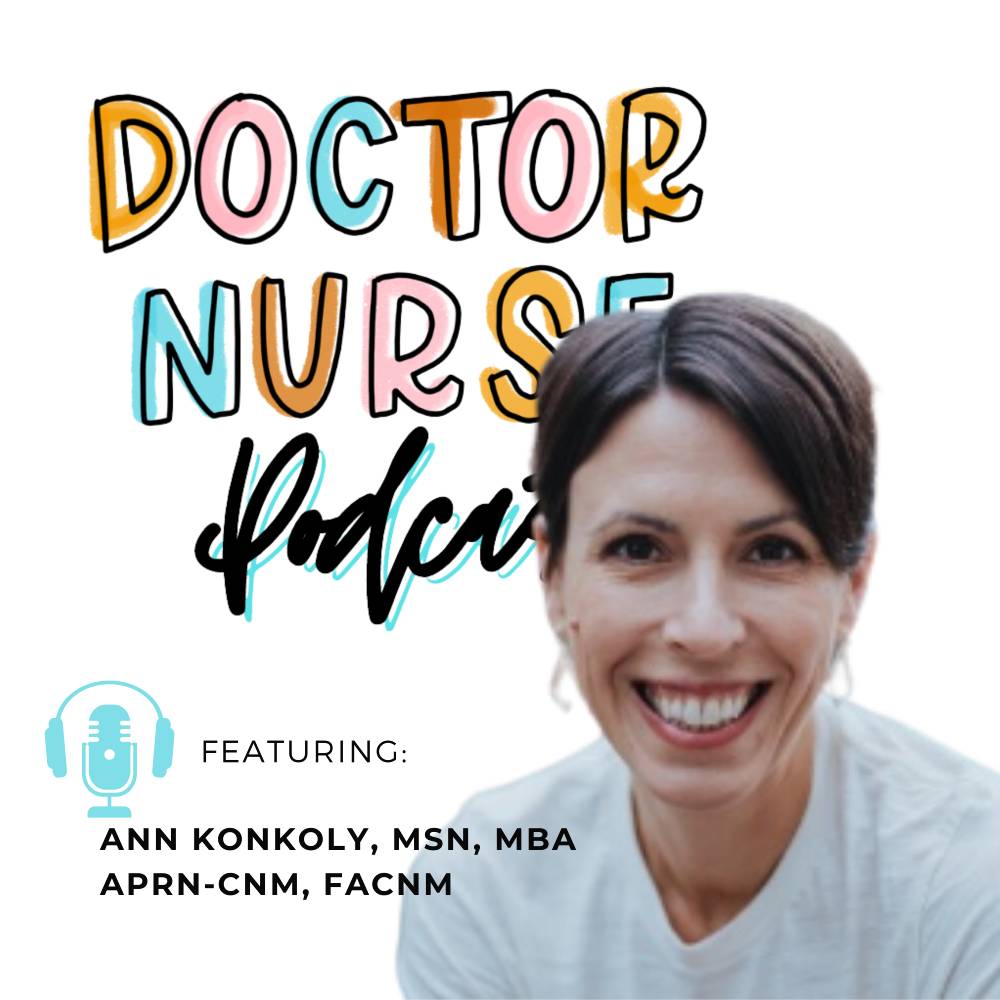
Sandra Pagenta: [00:00:00] Hey guys, on today’s episode, I have Anne Konkoly. She has an MBA. MSN. And she is an APRN in a clinical nurse midwife. She is a certified life coach for women and nurses who want to cultivate. Their next level of life and business. She’s the founder and owner of authentic coaching LLC. And she creates time and space and offers tools for her clients to cultivate change through coaching and mindset work.
Ann’s work to date honors, her purpose and her passion of supporting women. On their journey.
I am so excited to share this conversation with you guys today. And I hope that it inspires you to think about business differently and to think about your jobs as nurses and nurse practitioners, in a different light. So let’s hear from an.
Sandra Pagenta: Welcome. And to the doctor nurse podcast. So happy to have you.
Ann Konkoly: Hi, thanks for having me.
Sandra Pagenta: Let’s dive right in. What’s your job title?
Ann Konkoly: My name’s Ann Konkoly, I’m a certified nurse [00:01:00] midwife and a life coach, and I’m the founder of a business that’s called authentic coaching LLC. My role is that I provide group coaching and one-on-one coaching. To advanced practice nurses and to women entrepreneurs who are looking for some support to cultivate their next level.
My role is a life
Sandra Pagenta: coach. I am a listener.
Ann Konkoly: I am all the things. And a
Sandra Pagenta: master supporter guide. Got it. Do you currently work as a midwife or are you just doing the life coaching?,
Ann Konkoly: I left my clinical practice as a certified nurse midwife back in the middle of 2019.
I was serving as a medical director for a women’s health practice. And I left that role at being a Fullscope midwife and a medical director. And I co-director of our centering pregnancy program and left that role and my clinical practice in the middle of 2019 and opened my
Sandra Pagenta: business.
Incredibly brave. How did you get to this spot in your career? Kind of walk me through that process from when you [00:02:00] decided to be a nurse until right now, where you decided it’s time to bust out on my own.
Ann Konkoly: I knew really, I, it to be a midwife first. I saw when I was probably five or six a birth on 60 minutes or Dateline of some sort of a show. We were watching as a family. I’ll never forget it, but I saw this water birth and I was glued to the TV and I’ll never forget it. And I thought I want to do that, whatever that is. When it was in high school, I did a rotation with a midwife and then an OB GYN.
I caught a set of twins with the midwife in the outpatient setting. And it was phenomenal. I decided then. That I wanted to, again, confirmed my interest in birth. I went to my undergrad and Loyola university in Chicago. And was considering in medical school and considering midwifery school.
I chose midwifery school because it felt more authentic to what I wanted to do, which was to catch babies. I had very little interest in surgery. I went to the nursing program. I got an accelerated bachelor’s in nursing after finishing up[00:03:00] my first bachelor’s in psychology. And then I started to work in labor and delivery.
I was there for about a year, but the only reason, , I knew going to nursing school was a step to midwifery school. I literally despised every moment. That was not labor. The one day that I was. Labor delivery. I worked for a year because the requirement for when I was in Chicago, I went to university of Illinois in Chicago.
The requirement was that I needed to have a year’s worth of experience. So I worked a year in L and D. I applied very quickly thereafter and was accepted to UIC. I then went on and completed the dual certification on program for. Midwifery and to be a one south MP. I graduated, I did the part-time program worked the whole time, did some travel nursing through that.
And and then graduated in three years. That was in Chicago. My husband and I are both from Cleveland. We decided to move back home to be closer to family. We were ready to start a family of our own. We moved back to Cleveland in. 2008 and then I started working, I worked for Kaiser Permanente. Initially they were like, don’t [00:04:00] tell anybody you’re a midwife. We just want you to work as an NP in the office. And I was like, fine. The midwifery community in Cleveland is a little bit more tight knit. And I was really coming in as an outsider. There weren’t just as many opportunities and I didn’t have that network established to really, use it to my advantage.
Like I did in Chicago. When I left Chicago, I had three offers and, coming back here, it was like starting over a little bit just in terms of building on that work. My aunt was worked at Kaiser. She hooked me up with the chair of the department. He was great. I, I started there. I negotiated with them to to begin to take call and to begin to catch babies.
And so I was there for a couple years and then a Fullscope position opened up at a large academic medical center here in Cleveland called university hospitals. And I applied for that knowing full well that I love academic medicine and I just love the learning opportunities of grand rounds and , the guidelines and all that stuff.
I was there For about eight years total. And through that, , I grew and became an assistant medical director to the clinic. One of the clinics where our midwifery [00:05:00] division did about 60% of the visits and then 40% was the resident continuity clinic for our residency program.
I became the assistant medical director and then I moved into the medical director role and we built a large. Ambulatory medical center and along the way, Convince my chair to, I thought it would be cool to be a coach. And there was this program here at case where I’d done some executive education.
I just asked him like, Hey, would you pay for me to go and get a coaching certificate? And he said, yeah, no problem. And I was like, I’ll use it. ? And I, and I’ve always loved the mentorship I had always been. The go-to person in my department and, whether it was for friends or for colleagues or whatever, I’m like, Hey, , it’s like that.
Hey, what do you think of, Hey, can I talk to you about this? I just figured, what, let me just, let me get some. Skills more tools in my tool belt. So I did the coaching certification program. He paid for it and which was awesome. And then at the same time I was getting my MBA at case because I was also going through a very, it had a [00:06:00] pretty impressive shoulder to associate during one of my births and so I was catching this baby and had a this baby just had a tough birth and, and all worked out. We had, that a healthy mom, healthy baby. And I just really though, after that, it just shook me to my core in terms of just the, all the thoughts and all the feelings and just the Yeah.
Like I, , it was a moment of where I really just questioned, can I do this and am I okay if I can’t. I’ve caught, I don’t know, 7, 700, 750 babies, something like that at this point. And I’ve witnessed thousands of births at this point.
I’ve seen many shoulders associates. I was catching this baby during this one in particular with one of my physician colleagues, because we kind of had a sense that we were going to have a bigger baby and that we may have Some more challenges with the birth. So we were prepared.
I mean, we were like fully prepared as much as you can be. Cause we cannot prevent, we cannot predict and we cannot really prevent shoulders. [00:07:00] Sotia to be honest. I mean that’s what, at least what the research supports and I would agree anecdotally as a clinician. That’s true. , we got in there, we had an entire team, I had all, everything.
I had exerted as much control and I could in that situation and I still felt like control. Yeah. And so I thought, I don’t know if I’m okay with that. How many more experiences of this I can do, because what’s also interesting is that, from being I I know you said you’re coming up on 15 years in healthcare.
I had gotten to the point where, I worked nights for 15 years, whether it was on, on calls, a midwife where it was as an L and D nurse. And between that, and then some of the trauma and some of the, , the lack of sleep I had gone through, , a year or two worth of this finding a goiter, being diagnosed with Hashimoto’s thyroiditis, , multiple thyroid biopsies fearing that I had cancer.
And then I had two young kids and I was going to like diet lead them, motherless. I mean, these are all like, these are all the thoughts that were [00:08:00] brewing going on in my head. And then I was like,
Sandra Pagenta: what are they doing?
Ann Konkoly: Like, is the juice worth the squeeze? That was this thought, this question. Yeah, it just kept coming up again and again and again. And so I knew from. When I started working with a life coach through my coaching certification program, I started to just see like that there was, there could be some other options, but I had to do something and right.
And so, and then I was also in this MBA course called living the good life. And the only reason I took it, I was just talking with another advanced practice nurse yesterday, about how. We don’t. I think as a, as a profession have like entrepreneurship is not really a very common word in our
Sandra Pagenta: vocabulary.
Right.
Ann Konkoly: And so, so even had that course been titled entrepreneurship 1 0 1. I wouldn’t have taken it cause I would have been like, what, what is that like? Who I, I’m not, that’s not me. I don’t even know what that word is, but it was called living the good life. And I was like, I want that.
Sandra Pagenta: I just, I just know it’s under the [00:09:00] guise of living the good life, but it’s only entrepreneurship.
Yeah. And I was like,
Ann Konkoly: I want that. I want that. I want to have those like, sign me up. I’ll be there every night. I don’t care. What else is going on? Supersize me. Yes. Okay. What is this? So I got in there and my professor was. It was really good. He’s an entrepreneur. And he brought in many people who talked to us, one of them was hell L rod who wrote the miracle morning and, , brought in all these guest speakers to talk about how they have built their businesses.
I mean, it was like, guys, if you ever watch guy rise, how we built this on NPR, it was like, he put his own like how I built this together for our class. And that was our, entrepreneurship class. Fascinating, to just understand that there was, you could take something, an idea that you had and you could build it.
And I just, that wasn’t even in my awareness, it just, I just didn’t even know. Right. And in Ohio, I live in the state of Ohio. We do not yet have full practices already. And so in my [00:10:00] mind, a big barrier that I had put up, I was like, you can’t ever do a prep practice cause you, you don’t have full practice authority.
Well, , that’s total BS, I mean, in general, right? Like you can do anything right. And full practice authority and not like we can still make things happen. But to me that felt very real. That was a story that felt very real. Like I can’t, That’s not for me that life. I went through this class and one of the gals who he interviewed was Julia reseller, who is a life coach had along a corporate career career at Panera.
And she built this big business. And I was like taking notes furiously because I thought, what is this thing? Like life coaching and I was in this coaching certification program and I think. I had this thought,
Sandra Pagenta: which is like, check this alongside your MBA. Correct. You were in your MBA.
Ann Konkoly: I mean, I’m getting my coaching certification.
We’re building the clinic. I’m acting as a medical writer. Oh my
Sandra Pagenta: God. Got these two babies in a, , in a partner at home.
Ann Konkoly: All of this is going on and then it was just like [00:11:00] this perfect storm. And, , and I also dealing with some of these like health concerns. And so it was this perfect storm.
And I had this one thought of when Julie started talking about this business that she built and that book that she wrote and I was like, oh my God, I can do that. And I was like, oh, and I was like life coaching. I was like, I don’t even need, I don’t have to have a physician collaborator. I can open my own business.
I can charge whatever I want. I can provide whatever service I think is useful to the people who I want to serve. And I literally, it was at one thought. I can do this. I w I looked at the calendar. It’s so funny. I looked at the girl next to me, who she was so nice to me. And she and I had been like MBA buddies, , gone through many courses together.
And she, I was again, taking notes, furiously and choosing that. And she, and I experienced that class very differently. My experience was that I literally was like, I’m out, I’m out. I’m going, I’m going to quit my job. I’m going to open a business. I’m going to build it. I’m going to be a life coach. And I’m going to provide, I’m going to build [00:12:00] an empire that was like literally the birth of that.
And she was sitting there and she was like, wow, that was interesting. And I was like, interesting. I was like, wait a minute. Like. I’m going to do that. She was like, oh yeah, yeah. And everybody was like packing up their things and like getting ready to go. I was like, did you guys, did you guys hear that?
Sandra Pagenta: Did she did.
She
Ann Konkoly: was, I mean, it was so dumb and I was like, were you just like witness to that whole thing? Cause I was, and it like literally changed me. I ended up, I went home that night and I was like talking to my husband and I was like, I’m quitting my job. Like I’m quitting my job in six months. I’m going to be a life coach.
I’m going to build a business. I’m I’m good to go. And he was.
Sandra Pagenta: All right, let’s do it. So
Ann Konkoly: we have a good partnership and we kind of came up with just a scenario in terms of how to float, whether or not we could do it with one salary and, and how to, we were also at a point to my kids had just gotten out of daycare. We paid off our cars and I finished school and I was like, freedom
Sandra Pagenta: is calling.
Ann Konkoly: [00:13:00] Let’s go. Then I just started from there. I gave my we had to give 120 days notice at work. And so I did that. I planned to leave. We had just opened our ambulatory center.
We had been working on this project for three or four years of designing it, building it, going to do site visits of other places across the country. And so I wanted to get them through the first year. I did, I just, I got just shy of about that first year left in mid June, and then I was off to the races.
Sandra Pagenta: Wow. And the rest is history. So you have had your own business now for how many.
Ann Konkoly: Two years. Okay. Two years.
Sandra Pagenta: One of the things that as you were talking, I think it’s so true that you do get inspired when people tell you, this is what I did to go get free. There are moments in your
Ann Konkoly: career, especially as nurse practitioners,
Sandra Pagenta: where you start to realize like, okay, What is my business potential here? You don’t get that training in school where you start to learn like, okay, what’s the business side of things you just think like, okay, [00:14:00] I’m just going to go out. I’m just going to start curing patients. I’m just going to start seeing people. I’m just going to start making a difference. And then you start realizing in the rat race of work and also risk you’re taking while you’re doing whatever field you’re doing, you might want to consider it.
Taking the risk on yourself
Ann Konkoly: in our profession has always been where, the RVU system and productivity has been measured, right. We’re more in the past probably 10 years. Of this broader movement toward compensation based on productivity, but it w it wasn’t always that way, but we’ve always had this broad measure of productivity for our views, but I think as you’ve seen incident too, Billing, essentially under a physician or building under that NPI, many of organizations and rightfully so , have just discouraged any of that practice because it really doesn’t show all the value that we create.
And so when you begin to get a better sense, whether you’re looking at data from MGMA or you’re looking from Sullivan Cotter and you start to look at productivity and how much value [00:15:00] we create in terms of, gross billable revenue on a yearly basis, or or our use that we produce or procedures that are done, or the breakdown of you.
When you begin to see that you create five hundred thousand six hundred thousand eight hundred thousand dollars in revenue a year, that’s not from what your partners are doing. That’s not from what your colleagues, this is just what you produce. I think when you begin to see that and it’s measurable and you understand.
I’ve many clients who go through this right now who were having light bulb moments of like, wait a minute,
Sandra Pagenta: wait a minute, like, hold on.
Ann Konkoly: What is going on? Right? Because if I’m producing, , 700,000, the dollars worth of gross billable revenue for about a year, but I’m making less than a hundred grand.
Yeah, so it, this money going. And so sometimes I think it’s just the it’s it’s the necessary, like it’s almost the pain of being witnessed. Wait a minute. I’m making one seventh of what I’ve produced. And if I were in private practice, I [00:16:00] would be able to, to make roughly about a third, I mean, right.
Like owner’s pay can, can vary anywhere from 30 to 50% on a private practice, the more brick and mortar you have. And I think the more technical that we get, in terms of skills, procedures, and tools that we use, the higher our operating costs go. But the reality is there’s still a margin there and it’s a hell of a lot better than it is when you are sitting in.
Working 80 hours a week on and salary or covering somebody else’s vacation, and working an extra 10 hours a week in terms of finishing up notes, doing extra result management. And you’re like, what am I doing?
Sandra Pagenta: Yup. A hundred percent. Correct. I totally agree with you. And I think that that’s what I’ve so enjoyed.
Interviewing entrepreneurs, interviewing people that have taken their careers into their own hands is that other people can see like wake up sister, brother, whoever you are, wake up and see your value. Because if not just, if you really like your job, then go back and negotiate for more [00:17:00] like you don’t necessarily have to go bus out on your own.
That might not be what you want, but at least go back and go, listen, I know what I’m bringing in. Do the math and go back in with numbers. So go in with emotion. Going with numbers. They talk a lot louder than I don’t feel like I’m getting paid. Well, it’s like, okay, let me show you what I’m bringing in. Let me show you what I’m wearing.
And I think I can do better. I can have somebody else pay me more because what these numbers are showing. I think that’s, that’s great advice. That’s what I think as a realization that I came to in my career that, spurred me to want to talk to other people about this because I think nurses need to know.
And I was actually like go from a job because of numbers. And it was really painful that I was sleeping. I wasn’t awake. I wasn’t paying attention. And my boss pulled me in and he’s like, we don’t have the money for. And I’m watching new buildings go up all around me and I’m watching all this stuff and I’m just like, wait, wait, you don’t have money for me.
What does this mean? And he’s like, you’re not bringing in your salary. You’re not bringing in RBU’s and we’re almost like I will never be in this position again. Once you get caught sleeping like that, [00:18:00] you never want to be asleep again. I want to know what I’m doing, what I’m bringing here, what my value, what my productivity is. I need to know those numbers and those metrics. Tell me about one of your biggest successes are highs in your
Ann Konkoly: career
Sandra Pagenta: up until the.
Ann Konkoly: Oh, there are several, but my purpose really is to be like to support, women on their journey. Right. And so I’ve done that probably in two big ways. I’ve done that in my work as a midwife and I’ve contribute. Tremendously to this center, that 35,000 foot it’s square foot ambulatory center.
That’s like this buzzing beehive of activity with several support services to sign for our community and Cleveland, Ohio, where our infant mortality in particular for black women and for black infants is vastly higher than it is for white women, white moms and white infants. Part of the work that I’m so
Sandra Pagenta: proud of is being able to be a part of
Ann Konkoly: the us solution to provide care that is literally designed for to [00:19:00] help create more equity in, in birth and more equity and in decreasing infant mortality.
And so, and that’s, that’s a huge investment, I think of my time. So
Sandra Pagenta: I actually have a question about that because I am half
Ann Konkoly: African-American
Sandra Pagenta: and I do read those statistics and it is very disturbing to me that that is something that is going on and it’s truth, right? Like, regardless of your political views, don’t politicize this, just look at the numbers.
Right. I went back to those numbers, the numbers don’t don’t lie. What do you think are some of the reasons why that is the case? Why are black women die at higher rates than other racial? Groups.,
Ann Konkoly: it’s like you said, like you can’t like numbers don’t lie. You can’t look at two groups and say, the infant mortality rate for, black infants and the Huff neighborhood.
, is six to seven times higher than it is for white infants, right. Or in Cuyahoga county, which is our county, which is where Cleveland is here. Right? Like you can look at the preterm birth rates and say like, [00:20:00] merchandise gives us a grade of D right. For our preterm birth rates. And we know preterm birth is one of the biggest drivers of infant mortality. There are so many oppressive systems that exist that contribute to the poor health outcomes for certain individuals who those systems weren’t designed for. Whether it’s, you’re talking about,
Sandra Pagenta: lead
Ann Konkoly: in levels and Flint, Michigan.
And you’re talking about, infant mortality level rates here in Cleveland, namely that are higher for black infants in there for white infants and maternal mortality rates, which are higher. Right on average rate three to four times, it’s just depends on your, on where you are.
And because the, the data Cleveland, Ohio is not the same as it is in New York. It’s not the same as it is in LA or any other Chicago. But , here in Cleveland, , we’re looking at three to four times higher rate of. , more tap for moms, right? And maternal mortality rate for black versus white moms, because you, you have to, right.
You have systems of oppression. You have a medical hierarchy that was built on the backs of the patriarchy, right. [00:21:00] That really has always favor. Quite cis-gendered males. Every system is designed to produce the results that it
Sandra Pagenta: produces.
Ann Konkoly: Right. Like systems are they, they do right.
Whether, and you could talk about this, whether or not you’re talking about incentivizing, physicians with higher RV use on C-sections versus vaginal birth, like, which do you get more of? Right. Wow. Yeah. There’s all sorts of, but systems are designed to give the results that they give.
You just have to be, curious enough to look and say, wait a minute, what, what system have we actually designed?
Sandra Pagenta: This ambulatory care center that you set up, you were working to break down those barriers, working to
Ann Konkoly: create opportunities.. We had a lot of community involved, went from, the people of the hub. I mean, if you look at the state of Ohio, the data that comes out of Huff, the Huff neighborhood, which is in the city of Cleveland, which is in county.
If we can address that in our infant mortality rates for black babies and for the maternal mortality rates for black moms, we will improve the entire state. That’s ground zero [00:22:00] in terms of where the most attention needs to be right now today. And so we, so our center is built there and that was , that was not an accident.
I mean, that was on a very purposeful and intentional move to create a space that provides multiple services. Mental health and, psychiatrists and psychologists, and it provides WIC and then there’s free parking. And that we worked with the RTA to make sure that the bus line stopped in front of the building so that people, the majority of our patients, who may not have access to a car who who could have access to public transportation, that they could get there.
And then providing also people with, bus tickets and rides with Uber to improve their ability to get to us. Right. And then also offering a pharmacy in house, offering a lab. , bringing as many services into one building. So that is amazing. Right. And then also, , the other,
part of this too, is creating a safe space for , programs and for care that is provided to the community. So programs like centering pregnancy that [00:23:00] have, much better rates in terms of preterm birth than traditional, , antepartum care. So integrating more centering pregnancy.
It’s a multi-prong approach. It’s not perfect. , people will say, well, , you don’t have enough black midwives and yes, there, , we don’t have enough black midwives in the state of Ohio. We don’t have enough black midwives in the United States to address like all of the midwifery care that’s delivered.
It’s very, White midwifery population. And, and especially delivering care, in many places to a nonwhite population. Right. That’s a whole nother breeding brag of
Sandra Pagenta: worms. Yeah. I also feel like just to give a shout out, like, , some of the best.
Nurse midwives I’ve ever met. They just, they care about people. And I feel like regardless
Ann Konkoly: of your skin
Sandra Pagenta: color, if I had a nurse practitioner that walked in, that just cares, I don’t care what you look like. ? And so I kind of feel like. I agree with you. Like you connect more as an African-American to someone who’s African-American I get that.[00:24:00]
But also I’ve had nurses that are just white or Hispanic or whatever, and they walk into the room and you just go, like, this person just cares about me. That’s one of the things that made the difference in my
Ann Konkoly: journey. When I was having my son, I had a Hispanic.
Nurse
Sandra Pagenta: practitioner midwife. And she changed the whole thing. She just walked in and was like, you’re going to be okay. And just having that person there. Yeah. I think as an African-American, , I’m part African-American you feel like someone’s looking out for me and that immediately brings the energy down and I’ve spoken to many African-American women as well.
And they’ve had people in that same situation, like their midwives are there doulas that just care. I want to say that because I know that we are lacking black midwives and if you’re a black nurse and you like midwifery, go be a midwife, we need you like, but at the same time, I feel like the white people that are there are doing, I feel like so many of them are doing a really good [00:25:00] job.
Ann Konkoly: I just want to say that. I think the other piece, so here we have to acknowledge our maternal mortality rate is not on accident. We still have structures that favor. We have a lot of white privilege, especially in the medical hierarchy. And that also moves down into midwifery it’s in, it’s pervasive in nursing. I was just talking about this in one of the emails I sent out. Like we even have a pay gap, right for nurses who are dying versus nurses who identify as women and youth, that’s not even getting into that. The secondary kind of level of differentiation, right. By either by skin color or level of education. We have these systems in place. And so even though despite the fact that we have individuals who I think come into the profession just as I did, which is being a, being someone who wants to catch a baby and who wants to make a change and create impact. We have people who come in. Who are good inherently good individuals. And there w , draped in systems that are creative are big and they’re created to produce the outcomes and that the, [00:26:00] results they produce and the individuals, , within systems, especially the bigger that they get, , the last ability that the individuals have to have voices that are heard. you just get this perpetuation.
Sandra Pagenta: I agree. It does. It actually starts to take away from what the individual person is doing. If the system is working against the person. Yeah. A hundred percent agree.
Ann Konkoly: If we had regular in individuals who are, , who were saying, no, we will not agree to, , we will, we will look at every policy and make sure that it does not discriminate, people based on skin color. And we will make sure that we have equity in terms of our hiring practices.
We will make sure that we set up the system. Right. We don’t often do that. Right. This is a broader industry standard of starting to say, oh, we have to have a diversity equity and inclusion officer,
Sandra Pagenta: I don’t know what were we doing then for the
Ann Konkoly: past
Sandra Pagenta: 400 years, Yeah, no, I, I think you’re right.
I think that, , as you described this whole process, especially
Ann Konkoly: in the position that you were
Sandra Pagenta: in, you really did get a bird’s eye view of the business aspect of healthcare,
Ann Konkoly: right? Like you worked on [00:27:00] putting together a system and
Sandra Pagenta: you also have an MBA. You’ve got that mindset of like, how’s the system working either for the people or against the people.
And so I know that you’ve got a really good understanding of. Where the disparities are because you can see them and you can go listen like this. Isn’t going to set up for this to be successful. Like we’ve got to change
Ann Konkoly: or at least have somebody in there pointing out like, okay, wait a minute. I get that.
You want to move forward with there. But
Sandra Pagenta: do you realize that this is going to exclude these people?
Ann Konkoly: Yes, we’ve got to have somebody
pointed
Ann Konkoly: that out. Yes. You a hundred percent too. And then I think too, just to be mindful. The reality is that the endeavor, I think that I contributed to was, in terms of the center that we built and I think.
The broader kind of, , realm of, as these projects get bigger and bigger, like I, started to realize that my role was just in helping to facilitate the conversations and creating the space and then allow it the space then to flourish and allowing the people who needed it to be able to access it in a way that felt safe and trustworthy to [00:28:00] them and that, all that also brings in
all your community partners . It has to be like a big approach, like a big thinking
Sandra Pagenta: approach.
Ann Konkoly: This isn’t, that systems are big. And in order to kind
Sandra Pagenta: of dismantle some of the systems
Ann Konkoly: that exist, you have to kind of get real creative about, well, how is we were going to create, if we could create a system that served in the way that we need it to do so, how could we do that?
And that’s what.
Sandra Pagenta: That’s really cool. So give me one of the challenges
Ann Konkoly: that you had to overcome in your career,
Sandra Pagenta: something that you said, I mean, it could even be some of the health issues that you described, but just something that you say this was really hard. And I had to. I had to work to overcome it.
Oh, what did you want? Just a one. I mean, give me about 10.
Ann Konkoly: No, I think there’s a lot. I think one of the, the biggest ones for me is that that comes out more and more in terms of the coaching that I do is that I think we as clinicians, we and I only speak from my own experience of, of being a woman.
But I think there’s this tendency [00:29:00] for perfectionism. There’s a tendency for people pleasing. There’s a tendency for that I have had for sure. Achieving in order to, , prove my worth and to be right, to feel worthy. Only in the past couple of years, can I look back on that and say, Oh, that’s interesting.
That’s just , when I w there’s a, there’s a process for understanding how to create worth, and that doesn’t come from any certification and it doesn’t come from people pleasing and it doesn’t come from perfectionism. It comes from a really deeply rooted, intuitive sense
Sandra Pagenta: of I am enough. And that’s how
Ann Konkoly: I work with my life coach. That’s something that I I’ve struggled with. And , I wish I could say that. Well, I don’t even wish I could say it was different because this is what it is. And so to start my it’s a journey and my work now is to begin to say, okay, what stories am I willing to.
Put on having repeat and allow, , to be present in terms of the impact. I want to create the business that I want to build and, the lives that I want to support.
Sandra Pagenta: That’s really cool. And
Ann Konkoly: any
Sandra Pagenta: [00:30:00] mentors along the way here, you talk a little bit about, I love the life coach. So you are a life coach and you have a life
Ann Konkoly: coach, any other mentors that you felt like
Sandra Pagenta: along the way really helped you do, like get to the
Ann Konkoly: point where you are today.
Yeah, I there’ve been so many, in each season there’s always been one or two who have really stepped up and where I’ve, , I’m someone who I’m a relater. And so I like to have relationships. And this comes out of Clifton strengths, which is the backbone of some of the coaching that I do.
I’m a person who likes. Close relationships. I don’t need a high quantity, but I want high quality of relationships. And so I’ve had one or two people essentially, who are now on my, what I call my personal board of directors. They are the people to whom I go when I have, , I’m trying to figure something out.
I’m kind of trying to sort out and I know I can go to them and they will give me an essence, like a clean opinion, they’ll bring that to the surface where sometimes I walk, but there have been people all along the way.
And they’re, they announced that they have a seat at my board table as my personal board of directors team. , they’re the ones [00:31:00] that I go to , for. All sorts of questions and , when I need a little bit of extra, but it includes a life coach. It includes a business coach include some of the past physicians I’ve worked with, it includes some close friends who will tell it like it is and that, , a bunch of BS.
Yeah, so it’s a board structure. So.
Sandra Pagenta: It’s community. And what advice would you
Ann Konkoly: have for a new
Sandra Pagenta: nurse starting off in her career that is wondering where to get started or what is something that you wish you would’ve known at the start of your career?
Ann Konkoly: I think that you get to choose how you do
Sandra Pagenta: it.
There’s not a right way. There’s not a wrong way. Despite
Ann Konkoly: what you will be told. There is no right. , there’s, there’s really not a right way to do things. I mean, even we know what the art of medicine, like there’s a handful of antibiotics that can work in multiple situations. Right. Like, and so, so there’s, you get to choose whether or not you focus on getting it right.
Or you allow yourself the opportunity to create and know that, , there are many ways to do, to
Sandra Pagenta: do a thing that that’s [00:32:00] something I always
Ann Konkoly: share with clients and all of my mentees. Very good. The last part, before we get
Sandra Pagenta: into the rapid fire, where can people find you if they want bluff coaching, if they think, what
Ann Konkoly: I think that’d be really
Sandra Pagenta: cool to talk to it, ?
And what. Where can they find you give a shameless plug. You can find me on my website, which is www.concretelycnm.com.
Ann Konkoly: Or you can find me. My handle is an conclave CNM on Instagram, Facebook, Twitter, and LinkedIn, and please connect, feel free to reach out connect. I love to connect with people and I love what I do.
So if you have any questions and you’re like, it’s life coaching for me, I don’t know. What’s a business coach send me a DM or an email, happy to connect you with someone in my network, if it’s not me, but
Sandra Pagenta: happy to, to provide
Ann Konkoly: very cool.
Sandra Pagenta: And for the last part, the rapid fire questions, questions,
Ann Konkoly: questions, questions.
If you could spend a day in someone
Sandra Pagenta: else’s shoes, who would they be? Oh, bruh.
Ann Konkoly: I want to see that house. I want to have the chef. I I want to have Gail. I wanna [00:33:00] have Stedman. I think I love that. I want to be there whenever I see it. I’m like, I’m like, oh wow. Look it like, what’s that?
Like, what’s Oprah’s closet like that.
Sandra Pagenta: And if someone would have play you in a movie, who would you want it? Oh, God. Um, I couldn’t prepare for this. You could have prepared.
Ann Konkoly: I couldn’t. I always used to get like that it looks like Alyssa Milano, but I think that’s just from a look standpoint. Not necessarily I want to play me, but if I probably wanted somebody to play me,, I don’t have anybody.
Sandra Pagenta: That’s. All right. And is one thing that your mother and father taught you that completely changed your life? If you have anything to share?
Ann Konkoly: It’s probably
something
Sandra Pagenta: under the guise of , do the thing, do it with integrity. Yeah. Keep going. Rinse and repeat, rinse and repeat. And it has, and a joy to talk to you today. Thank you so much for coming on the podcast and
Ann Konkoly: chatting with me.. Thank you for having me. It was nice to speak with you as well.
Podcast Description
Latest Episodes
Doctor Nurse podcast brings you weekly shows to help INSPIRE, EDUCATE AND EMPOWER nurses with true stories of initiative and impact.
Doctor Nurse podcast brings you weekly shows to help INSPIRE, EDUCATE AND EMPOWER nurses with true stories of initiative and impact.
Latest Episodes
Doctor Nurse podcast brings you weekly shows to help INSPIRE, EDUCATE AND EMPOWER nurses with true stories of initiative and impact.