Also Available On






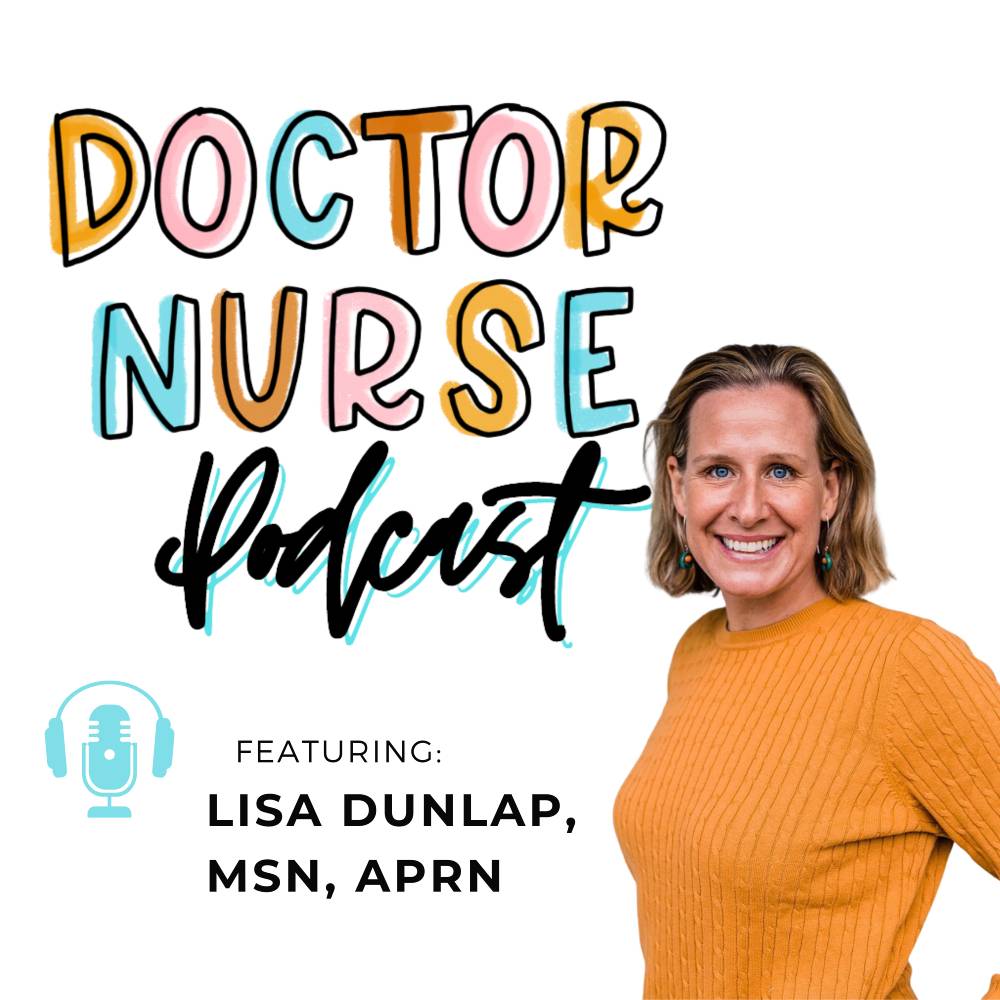
Sandra Pagenta: [00:00:00] Hi, Lisa, welcome to the doctor nurse podcast. So happy to have you on today.
Lisa Dunlap: Yeah. Thanks for having me.
Sandra Pagenta: Lisa Dunlap is a geriatric nurse practitioner, a transformational coach. She has her certification in reflexology, healing, touch clinical aroma therapy, healing energy and she’s working.
To her certification in mindful self-compassion training. And she is here to chat with us today about her journey as a transformation coach for other nurse practitioners that are experiencing being burned out, stressed out to feeling fulfilled, not just surviving, but thriving. She is currently in the great state of North Carolina from. Seattle with some roots in Hawaii.
She’s been just kind of all over. She’s just loving life has two children and she loves to surf and fish with her husband. She’s just really into being. Present. So I’m excited to hear your journey today, Lisa. Thanks for [00:01:00] joining me.
Lisa Dunlap: Great intro. I would add I also coach other women in healthcare, not just nurse practitioners, but nurses and other women just kind of feeling.
Sandra Pagenta: So any woman, regardless of their practice. Okay. So not just nurses, anybody. Okay. Okay, cool. So let’s start from the very top kind of describe, I guess, kind of piggybacking off of what you just said, really what your current role is, what are you doing for a living? What’s your job?
Lisa Dunlap: Thank you for asking.
I am currently working for myself and I call myself my is nurse your soul. And we’ll kind of get to the story behind that. And I would say I’m a transformation coach, so I’m really just helping to empower women to feel better and find their truth. They’re thriving in their current role. Or in their next role in healthcare, I also call myself a holistic healer.
So part of my coaching is mindset and part of it is holistic healing of mind, body, and spirit. And I do that about part-time and I’m a mom the rest of the time. I also work per diem as a nurse [00:02:00] practitioner, just because I love it, but I want more flexibility in my schedule. Part of my healing journey has really been about sticking to my values, which is time for me and my family.
And at this stage in life, a full-time nurse practitioner job just doesn’t allow that. So that’s where the coaching has been really beautiful to live that truth and kind of flex it around my family.
Sandra Pagenta: For your per diem nursing job, are you working in adult primary care, which
Lisa Dunlap: I used to write now I chose hospice and I love that as I mom, of littles minor four and seven, because you schedule your patients when you want.
I go to nursing homes, I go to homes. It’s really up to me when I see them and I can do the charting at home. And I also just love hospice work. It’s so spiritual and holistic in and of itself.
Sandra Pagenta: Very cool. Take me through the beginning of your journey. How did you get to this place now where you’re coaching, , women that are [00:03:00] dealing with burnout and then walk us through all the steps as you experienced things in your life that led you to this place right now that you are okay.
Lisa Dunlap: Wow. How much time do we have now? I loved the moment I wanted to be a nurse was very different than most. I was 25. And I’d already been through a degree. I already had been through this path of wanting to be a natural path. I grew up in Seattle, very holistic surroundings. I had already worked in like herbs shops, prescribing herbs, and supplements to people.
And the journey, the door for natural path was closed on me at the time for good reason. And I’m grateful now, but basically. Finances was the reason. It just looked like after I did some traveling in third world countries and went down the ethnobotany path, I realized the world needed more of integration.
Right. So if you’re in a tiny village in the Solomon Islands, like I was studying beetle nut and its uses for medicine. You realize that the merging of the two that like the [00:04:00] holistic medicine was already out there, especially in third world countries, which I thought I wanted to work in at that time. But if I could have the Western background and the herbal background to merge, the two would just be really powerful.
And so the light bulb went off and I was like, Nursing school. And I just got a second degree, an accelerated program. And I, once you case got on a plane to Hawaii, didn’t know anyone. And from there knew I’d become a nurse practitioner, but knew that I would integrate. I just had no idea how it would look.
Sandra Pagenta: Once you became a nurse practitioner and you were working, what was it that you experienced that led you to go. I’m tired. I’m burned out. And then to give that, to help other women kind of combat that burnout, what did you experience that led you to this, to this place?
Lisa Dunlap: Sure. So like most in just a little backstory in that most nurses we’re pushing, we’re going, we don’t see that we’re burnt out and I worked five years in the career and then.
, got my masters. I loved being a nurse practitioner and that was [00:05:00] about five years into so five years of nursing, five years as a nurse practitioner.
Sandra Pagenta: What was your job
Lisa Dunlap: as a nurse? I mostly did. I did the, not the same thing that everyone told me to do. I did outpatient psych mental health.
I did a holistic inpatient nursing job. I never went down the med surge route. I got to live that dream of providing energy work. Aroma therapy reflexology to patients in the inpatient setting. This was after teachers had told me I was wacko in nursing school and that I would never make a good nurse because I was like, we need to talk about energy medicine and holistic.
And I remember just wanting to send that teacher, that first paycheck from the hospital and be like, yeah, guess who’s laughing now. And so I, , for anyone who’s a new nurse out there watching this, I’m telling you if what you want and what your gifts are, follow that.
Do not, what else put you in a box because. I did not go the traditional route and I’ve had plenty of job options along the way. It’s [00:06:00] never been a problem.
Sandra Pagenta: This, that the only job you had as an RN was the holistic.
Lisa Dunlap: I did. I did a little bit of inpatient. I did some long-term care geriatrics.
I did a lot of psych mental health. Troops PTSD, military who are suicidal, taking them, surfing, taking them, hiking, running groups for them. Then I stepped into the nurse practitioner role and just kind of found my way and decided that. Geriatrics offered me after failing. Well, I won’t say failing after trying a couple primary care nurse practitioner roles where I got 15 minutes a patient and I was like, this is not me.
Like I cannot fix anyone. I cannot help anyone. I’m not thriving. I was feeling burnt out and I realized with geriatrics, I could spend 45 minutes a patient. We could take away meds. I could hold their hand and talk story. And so that became my niche. And for me, the empowerment of a flexible schedule has always been one of my high values.
So always love doing [00:07:00] house calls and, , case management type roles and charting from home. And that kind of.
Sandra Pagenta: You’ve walked us through kind of what turned you into a nurse, why you decided to be a nurse. You walked us through, , fighting hearing that naturopathic route was going to be a little bit more costly.
So you kind of switched, you changed. You’ve worked a mere ad of, of really cool nursing jobs. You become a nurse practitioner and you’ve gotten. Kind of spaced out really nice scheduled chunk of time with each one of your patients. Did anything else happen along the way that made you go now it’s time to change again and just kind of, kind of metamorphosis into this career coaching.
Lisa Dunlap: I think like most I was gifted some major illness and trauma that taught me a lot. So in order to sometimes blossom and bloom and grow and see what needs to happen for us and to follow our dreams, we need to hit rock bottom. So here I am. Rewind two years ago, beginning of the pandemic, Seattle Washington [00:08:00] king county, where it first began and I’m on the front lines as we used, , called it as a hospice nurse practitioner.
Going in and out of five nursing homes a day, we had no PPE, , everybody has like, has some story around COVID, but then childcare is falling through it. But two and a five-year-old at home. I was already about up to here at burnout. I didn’t know. Red flags at work, little things like, , boss saying, you’re just checking off the boxes.
Patients are complaining. And I remember just like, if I hear one more hospice, patient, tell me they’re in pain. I love people and I just didn’t see the writing on the wall, but the first sign was. I went from racing like an eight mile race, cause I’m very active to not to waking up and just not being able to walk.
I just, nothing happened in the race. I just severe debilitating, low back sciatica could not work. I could not watch my children. It literally happened like that. I tried to work for a couple of weeks and it just, and so I went on disability and that sent me down [00:09:00] this like six month journey of
Sandra Pagenta: your job.
Lisa Dunlap: This was disability. Luckily I was privileged enough to have a job that paid me to get well, not everybody has that. I got paid. And I was able to seek answers and being human we like to when we’re ill solve the problem and we want to call it something. So I went down the diagnostic path, all the imaging, tons of injections, tons of doctors, Western doctors, and a couple of alternative.
And I just couldn’t find answers. I was ping ponged around and I became over the course of three months of trying to find the cause of this pain. Chronic drug seeker. I was in that box where they would come in and they’re like, oh, you’re a chronic pain patient. You’re just seeking drugs.
And it was like, no, like I want a diagnosis so I could feel better. And I want to sleep at night. That was humbling because , we’re providers and we see it. And suddenly I was now a part of that kind of stigma. [00:10:00] That was a wake up call number one. Then as the journey progressed I started waking up to something’s going on deeper here, and I started getting answers about my back pain and I started going to holistic healers. Realizing there was more to it. There was some stress, there was some withheld emotions. Is
Sandra Pagenta: that, let me stop you really quickly.
Is that the PR, is that what holistic healers specialize in? Because I think for some of our listeners, they’d be like, what is a holistic healer? I think maybe to get down to the root of that and just kind of be like, what is their focus kind of like, are they just sitting there going like numb?
Lisa Dunlap: The healers I went to would be like an IRR ayervetic natural. And he would basically use his energy intuitiveness and like do energy work on my body and listen to my organs. And he would like talk about like, okay, this emotion is coming up. You’re withholding a ton of anger
Sandra Pagenta: with anger
Lisa Dunlap: and, we need to like figure out an outlet.
At the same [00:11:00] time he was giving me herbs for the pain and he was doing bodywork with oils. And like he was, , doing different Indian Ayurvedic things to help my low back, my sciatica heel. He was going deep into my old traumas. He was talking about the whole picture, not just the job, but what’s going on at home.
Sandra Pagenta: And you still don’t know what this is. You’re getting this treatment and you don’t know what this pain that’s so debilitating. That’s causing you to leave your work, go out on disability. He’s you still don’t have a diagnosis. He’s just working with what he has, right. With his hands, with his mind, this energy
Lisa Dunlap: that.
I did get an answer that it was S I joint dysfunction. That was part of it. So you, as a woman, I had two 11 pound babies and basically, , your
Sandra Pagenta: hips. That’s a really big baby. Hold on a second.
Lisa Dunlap: Yeah, that’s probably a whole nother story, but trying to do natural labor with two huge. , it messed up my hips and then being very active and [00:12:00] not understanding pelvic floor.
And we could go down this whole other road about. Yeah, we’re just not given the tools as women, after labor to heal our pelvic floor. So I didn’t know. And here I was trying to run this half marathon, but I didn’t have the strength down there. And so my hips started twisting and torquing and pulling, and that’s what caused, that was part of the picture of what caused the debilitating pain.
So I started to get answers and I thought I had answers and I was On the way to the mountain right before lockdown. And it was like a last trip before we were like, stay at home orders and how it goes. When you seek answers, you get all these scans and then other findings happen, , that you don’t expect.
Sandra Pagenta: I don’t even, I don’t even want to look. I don’t even want to look. Don’t tell me
Lisa Dunlap: here I am driving. Snowboarding with my family. And I’m starting to live that live the moment type of lifestyle, because I’ve been having all this pain and the call, the doctor says, you got a moment. I need you to sit down.
I’m like, okay, I’m driving, I’m sitting up. But [00:13:00] I knew, , I just knew it was bad. And it was my OB GYN. And she just said, we found the solid mass it’s in your ovary. We don’t know what it is. And we need you to race in. Because it’s serious. And you and I were talking about this moment. It’s very important.
It’s like this disc one relief.
Sandra Pagenta: Oh,
Lisa Dunlap: this is what’s been causing the pain. I’m not drug seeking. Everyone thinks I’m crazy, but I’m not. There’s an answer for my pain, SSI, joint problems, abdominal pain at this point. And two very quiet. Like I just felt like I was in the back of this tunnel seeing my entire life.
And I could just like pause and just say, holy crap, this is that moment. Like I could have ovarian cancer and I could be dying very quickly. And I’m not racing back to the hospital. I’m going on a snowboarding trip with my family, because that gives me joy. And if I’m dying, I want to have joy and I’m not bleeding and I’m [00:14:00] not in an emergency.
And I just, that was this first, like wake up. Aha of self-compassion. And what is it that gives me. And from then on the journey just became a whole beautiful unfolding of that, of like, how can I live in this moment? Amidst thinking I have cancer amidst pain in lockdown with two small children and find joy and find beauty and honestly love myself and accept myself without all those identities.
And the lessons just kept coming. They kept coming. And so.
Sandra Pagenta: What I like about what you’re describing, we talked about this earlier, you almost kind of get this disassociation when you have this diagnosis where you’re like is this what I’m dealing with?
At least for me, I felt that way. Cause I’ve got some similar story background. I did kind of feel like when you get that, you’re like, wait, they’re not talk about me. I’ve seen that a tick talk with her. Like, am I the drama? I can’t be the drama. When I heard your [00:15:00] story previously, I did kind of connect to that. I can’t believe this is happening. And then as you process through it, you just start to go, no, this is my life. It actually is like this wake up. It’s like this very, because you’re so much caught up in the hubbub of busy, busy vacations.
We’re going here. We’re going there. We’re doing there. Take the kid practice, take the kid to that class we got. And you’re so busy that you that’s the moment where it goes slow down. It’s almost like a clap. Yeah, everything else gets quiet and it’s just, it’s so beautiful. And you look at the moment and you’re like, this is really freaking me out, but it makes everything sharp and clear and you’re able to see exactly what is important at that time.
And we were saying earlier before the podcast that these moments in time are just these huge, almost like pillars, or I don’t know what the right word is, but it’s just really this. It’s the aha moment. It’s the awakening. It’s the crystal.
Lisa Dunlap: Portal portal.
Sandra Pagenta: Okay. [00:16:00] Yeah, I’ll take that portal a portal into truly living free because everything else you realize doesn’t matter.
As you’re going through this career path, and now you’re realizing I have ovarian cancer, possibly you’re in the middle of a pandemic. How do you now get care?
How did you navigate that? I’m
Lisa Dunlap: glad you mentioned that because it brings up the humanness, like. Any different than anyone else. I went down the rabbit holes of anxiety while I was like, okay, I’ll sit and wait for answers.
They’re like, you’re not getting into an oncologist for four weeks. And I just took that at first. And then even though I had those glimpses of I’m going to live in the moment on this mountain, , this is all I need is my family and me enjoy it. These are my last moments. Do I want to be depressed and anxious or do I.
Live my life. And at the same time I had moments of spiraling. Like I was metastasizing, my bones hurt. I couldn’t breathe. I had my, yeah, my first two ever panic attacks in my life where I was like calling like [00:17:00] EMT. I’m not kidding. Like when in an ambulance thinking I was having a heart attack because the mind was working against me.
And so when I saw that and I could step away. And I was in victim. I was like, I am screwed. And like, basically I’m going to sit here and die and wither and poor me. And then there was the shift of like, no, no.
Sandra Pagenta: How did you do that? How did you shift?
Lisa Dunlap: I mean, I think I looked at my kids and was like, how do they want to see me?
Like, how do they, if this is their final moments with mom, Do they want to remember mom like crying on the couch and just like waiting for answers or do they want to remember mom getting empowered and like making it happen and living the good life? And so that, that might’ve been, the shift was my kids.
And then, because I am. Knowledgeable and empowered, like most of us in healthcare, I just, I use two healthcare systems against each other. I’m not going to lie. I basically told my like four weeks [00:18:00] ain’t good enough. Heck no willing to the other health healthcare healthcare system down the road, , there’s like two big ones.
And it was like, I’m getting a second opinion and I’m going to be seen a lot faster. So I went to that one and they were like, we’re good. We’re going to get you in for testing tomorrow. We’re going to get you surgery. And then they called that, that second one called me 24 hours later on went, whoop sees.
No, we’re not we’re in lockdown. No. Surgeries are happening. We can’t get you tests. And I was like, Back to the first health care system. And I said, well, I, I went down this path. What can you guys do? They, they were trying to get in, I got a second opinion and they basically just said, this is ridiculous.
We talked about it and we said, we don’t need an oncologist. Let’s just get the, I can’t think of the name, but there’s a cancer marker. CA she’s like, let’s just order the blood test. I’m an OB GYN and you’re a nurse practitioner. We can figure this out. And so we got the blood test and this was after the four weeks of spiraling, it was negative.
And she’s like, okay, we can’t rule out uterine cancer, but we can rule [00:19:00] out ovarian and very unlikely to have uterine, no family history. And so that was like, Yeah.
Sandra Pagenta: Give you breathing room.
Lisa Dunlap: Yeah. Then it was, you need surgery, but it’s an elective surgery. Sit tight and wait in pain. Don’t come to our ER, if it bursts nothing.
Cause it’s scary. We don’t know what COVID is. Sit tight at home and just deal with it. So again, I was given that portal, that opportunity to say victim mode, what was me or. How do I want to live? Do I want to laugh while I’m in pain or do I want to sit around and just complain about being in pain? Do I want to go outside and touch the grass with my toes?
Do I want to. Ask myself, what I need in this moment to feel nurtured. And that was the question that changed my life and the path of my healing, because it was as a doer, an achiever whose identity and self-worth are wrapped in all that I can achieve. I had to find that worth doing nothing. But just being present to my children.
And to learn how [00:20:00] to nurture myself in these like mini moments.
Sandra Pagenta: So how do you think being a nurse and having a master’s degree in nursing and being a nurse practitioner and working in these different fields, how did your training in those moments. Help you, or did it not help you or did it hinder you?
Lisa Dunlap: I would say that that overachiever, ego driven I’m only worthy if I work, my arse off, came from nursing and a lot and some of it childhood stuff, but really that’s the culture.
We brag about overtime. We brag about like, not using our PTO. . For me, it was more of my holistic background growing up in Seattle, the herbalist, learning about mindfulness and that holistic nurse job and all those ,trainings that helped me shift into wow. I’ve been carrying all this stuff from nursing for 13 years.
I haven’t had a moment to cry in the bathroom. Wow. All this grief and anger and emotions bottled up. This is what it looked like. I would feel something and I’d be in pain and my kids would be screaming and it’s in a pandemic [00:21:00] and I can’t get surgery and I’d be like, what is it? I need, I touch my heart.
I’m angry. I need to go kick the crap out of something I’m going outside. I’m going to kick some balls. I’m going to take the baseball bat to the tree. And I did that crazy. But it was
Sandra Pagenta: healing. I’m sure your neighbors were like, well, they’re
out there kicking stuff.
Lisa Dunlap: Yeah, exactly. And my husband too, and every day at noon, I got a yoga mat on the floor and I did not force myself to do yoga. I sat on the mat every day at noon. What is it I need right now, sometimes it was laying flat and resting, which I had never given myself in my life with.
Earning it, and sometimes it was yoga. Sometimes it was crying with girlfriends over zoom. And so this eight weeks of waiting for surgery became this beautiful journey of how to manage stress. Here’s the cool thing. And then they went in for surgery. And there was no mass. The solid grapefruit mass ovary of 11 centimeters was completely gone.[00:22:00]
That’s
Sandra Pagenta: incredible. It’s incredible. So this confirmed mass on imaging after eight weeks of waiting, that just boggles my mind from so many angles is now. Not there can’t be found are how was your symptoms? This is one of the things I was wondering are your symptoms improved?
Lisa Dunlap: So they started dissertating.
Like the symptoms were almost down to nothing, the SSI joint, back pain. I had a team of people manifesting. I am good at delegating and asking, I said to family and friends and I learned, , like the Bernay brown and the Glennon Doyle message. Through vulnerability, we heal. So I told everyone my story and I said, manifest those cells turning good, manifest them going away.
And through all of this, the pain started going away and I wish I’d had the wisdom before surgery to say, , I’m feeling better, doc, let’s do one more ultrasound, but I just didn’t think of it. And they just don’t do it. It’s not protocol. They went in. And there was no imprint of like, it [00:23:00] had burst.
There was just nothing. And they were jaws dropped to the floor. They’d never seen anything. I went back and researched in the literature and I’d like at most in eight weeks you could shrink an 11 centimeter down. , 10 or nine with some birth control. So she said, but never wouldn’t just disappear.
Sandra Pagenta: I read a quote today that made me think immediately of what you’re describing, but your body is a manifestation of your thoughts, even if you don’t think that your thoughts and your feelings and your emotions are affecting your body.
Your body is being affected by your thoughts, feelings, and emotions, despite what you think you’re like, I’m not stressed. Am I stressed? I don’t feel stressed. I feel fine. But if you’re actually looking at yourself in every single moment, because you’re being present and you’re saying, Hey, at this very moment, I feel X.
Instead of being like, it’s fine, I’m busy. I have stuff to do. I don’t have time to feel that if you just stop and go, I feel angry right now. I need to get away or I need to go, and I have to let that emotion come out of.
Cause by burying it, it [00:24:00] takes roots in our bodies and I believe a hundred percent we, as nurses put ourselves aside, we absorb the energy from the dying and those people that are clinging to us as we’re taking care of them, to provide a level of support.
And then when things happen, We then are supposed to get up, go to the next room, take care of the next person. Like that. Didn’t affect us. This is insanity. This stuff we carry on us.
Lisa Dunlap: I would add also this like strong inner critic voice that humans have and women and mothers and nurses and this success driven and this inner critic, who’s also.
Not same kind of stuff. You check in, you’re like, I feel angry and we’re not allowing ourselves to say, what do I need? And it’s okay to feel angry. And you’re still a good human, even if you can’t go to work and take care of your kids and go run today. And so that self compassion piece of feeling was one piece.
And then this compassion that I knew [00:25:00] how to give up. I have no idea how to give that to myself of like, what is it that I need to feel nurtured? Sometimes guys, that’s a glass of water. Sometimes that’s like smelling one essential oil. Sometimes it doesn’t have to be big. I thought self care was like this big thing.
And it became this to-do list thing that then I beat myself up about when I didn’t do it. And so the nurture is this like many. Moment of it’s okay, I’m in pain. I have this cyst, I’m still beautiful human. And I can nurture myself and not feel guilty. I can give to me so that I can give to others.
Something about nursing and the culture, I feel like so much of us. We’re hard on ourselves and we feel bad if you give to.
Sandra Pagenta: It’s like, I shouldn’t be doing this. I’m not allowed. I don’t deserve it. It’s not even about deserving or allowed. It is necessary.
You have to do it. It is because it will manifest itself and life will require you to address it. You will not get away with it. It will come back and story. After story, I hear of [00:26:00] nurses, either dealing with depression, anxiety. Thyroid disorders, ovarian masses, these things are manifestations of the way that we treat ourselves for years, right on the job on all the jobs, the mom job, the nursing job, the, , household job, all these jobs. They wear on the body, on the soul. I think that the moment you described where you got that diagnosis on the phone, the mind and the soul. Almost separate. And you begin to hear your soul really, really loud at that very moment.
Whereas the mind is like, you gotta do this, you gotta do that. In that critiquing thing that you talk about and those moments where you get that phone call, all of a sudden that little voice gets really loud. And you’re like, oh my gosh, that little thing.
Is now, what do I want? I want joy. That’s
Lisa Dunlap: exactly it. That’s like the entitle of my business, nurse, your soul. And that’s exactly. I got chills when you said it, because that’s it. You get clear on your values and what is it that gives you [00:27:00] joy, excitement, passion.
And the idea of being a nurse practitioner was always like, that’s what I thought gave me joy, but it really was my ego that I need to do this. I need to prove something I need. I still love being a nurse practitioner, but more on my terms. And so every. After that surgery was like, what is it that my soul needs?
Exactly. And how will I give that? And how will I live so that I can feed that. And I’ll be a better mother, a better human, a better nurse practitioner. And that’s the coaching business just overnight was like, if I can make myself sick, my soul can be. From stress, others in my shoes are too, and we’re not talking about it.
I want to help other women in my shoes, feed their soul, find their joy, find their truth. I love still being a nurse practitioner. It’s not that you have to like jump ship. It’s just that my husband and I reshaped our whole life. I envisioned beach walks in the [00:28:00] morning, surf sessions at noon.
Creating a life that I could continue to heal, not continue to get sick. And believing it’s possible.
Sandra Pagenta: What do you offer your clients? So say someone does hear this message and there’s a nurse, that’s what I’m kind of preaching do or the nurses, but there’s any mom that stumbles upon my podcast and she’s like, so what do you do for me when I reach out to you?
What do you offer me?
Lisa Dunlap: What you can do is hop on a free self nurture session call. It’s a 30 minute call. And usually if I offer bonus 45 minutes for those watching this podcast, and I’m sure we’ll include the link below. What we do in that session is we look at some of your barriers right now to thriving feeling well of mind, body, and spirit.
And we kind of map out a plan of how we’re going to get you to where you want to be. And then I guide you through a holistic practice. Often it’s just like a self compassion or mindfulness practice. And to help integrate, right. We can have the mental, but how do we integrate it to use? And then you can find me on Instagram at nurse, your soul with Lisa [00:29:00] on Facebook, at nurse, your soul with Lisa.
And I have this beautiful group free Facebook group called burnout to bliss for females in healthcare. And there’s lots of free value content. I go live and interview folks experts and. If you chose to work with me, we would be working in like a three-month container is where I start you at. And it’s one-on-one intensives every other week.
And then there’s a group call with everyone that I work with. So you get to hear how other nurses and nurse practitioners are struggling. And that’s a once a month group call and the transformations they’re making that really inspire you. Very
Sandra Pagenta: cool. Along this whole path, we’ve gone through your ups and your dad’s.
And all the things that you’ve had to kind of overcome, has anybody mentored you have, you want to give a shout out to anyone or a nurse or a doc or anyone that you felt like has helped you through your journey to where you are today?
Lisa Dunlap: That’s a really good question that nobody has asked me it’s.
Almost hard to pinpoint it on one person. It would be a lie to say nobody has,[00:30:00] and I cannot pinpoint one person to me. It’s this like, interconnectedness that I’ve chosen, the open vulnerability that I share. And then I received from someone else like an old college girlfriend. My own spiritual. Who are very open-minded.
People like Renee brown and Glennon, Doyle, those inspiring women who are paving the way of vulnerability Jay Shetty, , like those type of mentors, those are the books I’m reading. But I’m always learning and growing. So for me, the journey has just been and I’m always getting, I have a couple.
I have a therapist. I’m not ashamed to say any of that. And I have a women’s group I attend and I highly recommend the accountability piece is huge, right? People to call you out and say, Hey, Lisa, last week you said you value family time. And yet now in your business, you’re working 60 hours a week. What are you doing? people to say, wait, what are your values again? And how are we going to get you there?
Sandra Pagenta: What I always like to ask all the interviewees. What would be something you wish you [00:31:00] would’ve known at the start of your career? That if you could look back at that person, you would say.
Do this, make sure to do that. I like to end on that note so that people can kind of hear what’s the thing that in your soul, you need to know from the beginning,
Lisa Dunlap: the believing in yourself. I didn’t listen to the naysayers.
I had my mission on the wall. Somebody told me. Keep that integrated mission that you want to put Eastern and Western together and don’t let anyone tell you different. I did not let the people tell me, oh, you’re not scoring well on your end collects, you’re going to make a bad nurse. Oh, you’re not going to go into med surge.
You’re going to make a bad nurse. I knew what my gifts were and I didn’t try to do what anyone else was doing. I didn’t look at it as a failure that I couldn’t, that hospital night shift was not for me. I saw it as my gifts are useful elsewhere and they will be used and I will thrive elsewhere.
And so I encourage you to just constantly do that. Check-in if you’re unhappy where you are or you’re a new nurse and you’re like which direction? No. [00:32:00] What your long-term vision is and work backwards. How am I going to get to that integrated nurse practitioner? Do I need med surge? Nope. Do I need people’s skills?
Yep. Do I need to heal from within? I can’t preach if I haven’t walked the walk, so, and if you’re looking to do holistic, which often people come to me for? You go pursue the things you use for yourself, because that’s the only way to share that. So when you talk about mindfulness, make sure that’s something you’re using and that’s the one to pursue, but , if you’re talking about herbs and you’re not using them, then it doesn’t quite line up.
Sandra Pagenta: Practice what you preach. I like that. The last part of the interview is the rapid fire questions and these questions will care. Prepare for, they’re just coming at you fast. Okay. All right. Tell me your favorite dessert.
Lisa Dunlap: Flowerless chocolate tour.
Sandra Pagenta: Interesting. Sounds good. Another one, tell me.
What book you’re reading right now?
Lisa Dunlap: I am so bad at finishing one book. I’m reading three, Marie Forleo’s. Everything is figure [00:33:00] out-able Pema Chodron when things fall apart and a hundred ways to get rich. Those are the a hundred
Sandra Pagenta: ways to get rich. And if somebody were to play you in a movie, who would you cast?
Lisa Dunlap: Oh, that’s funny. No, I, I really like Reese Witherspoon, Cameron Diaz
Sandra Pagenta: kind of see that.
Lisa Dunlap: Yeah, but they don’t look like me, but I’ve been told, I look like Daryl Hannah, but I’m dating myself. You might not even know who that is. Oh yeah. She was in splash. So old-school folks,
Sandra Pagenta: that’s the trick with the dolphin, right?
Lisa Dunlap: Yeah, I think she was like, she had kind of a big nose that similar features to me.
So anyway, I liked that question.
Sandra Pagenta: The last part is just a shameless plug. Do you have a website? Where can people find you?
Lisa Dunlap: So I do. And it’s nurse your soul with lisa.com.com. Or the best place would be Facebook and Instagram ad nurse, your soul with Lisa.
And those would be the best places me get in the Facebook group. And you’re good to go.
Sandra Pagenta: Perfect. I will link those in the [00:34:00] show notes so that people can find them. Thank you for your time today, Lisa, thank you for coming on to the doctor.
Lisa Dunlap: Yeah. Thank you for this amazing platform and giving us a voice and your listeners are super lucky to have you.
Podcast Description
Latest Episodes
Doctor Nurse podcast brings you weekly shows to help INSPIRE, EDUCATE AND EMPOWER nurses with true stories of initiative and impact.
Doctor Nurse podcast brings you weekly shows to help INSPIRE, EDUCATE AND EMPOWER nurses with true stories of initiative and impact.
Latest Episodes
Doctor Nurse podcast brings you weekly shows to help INSPIRE, EDUCATE AND EMPOWER nurses with true stories of initiative and impact.