Also Available On






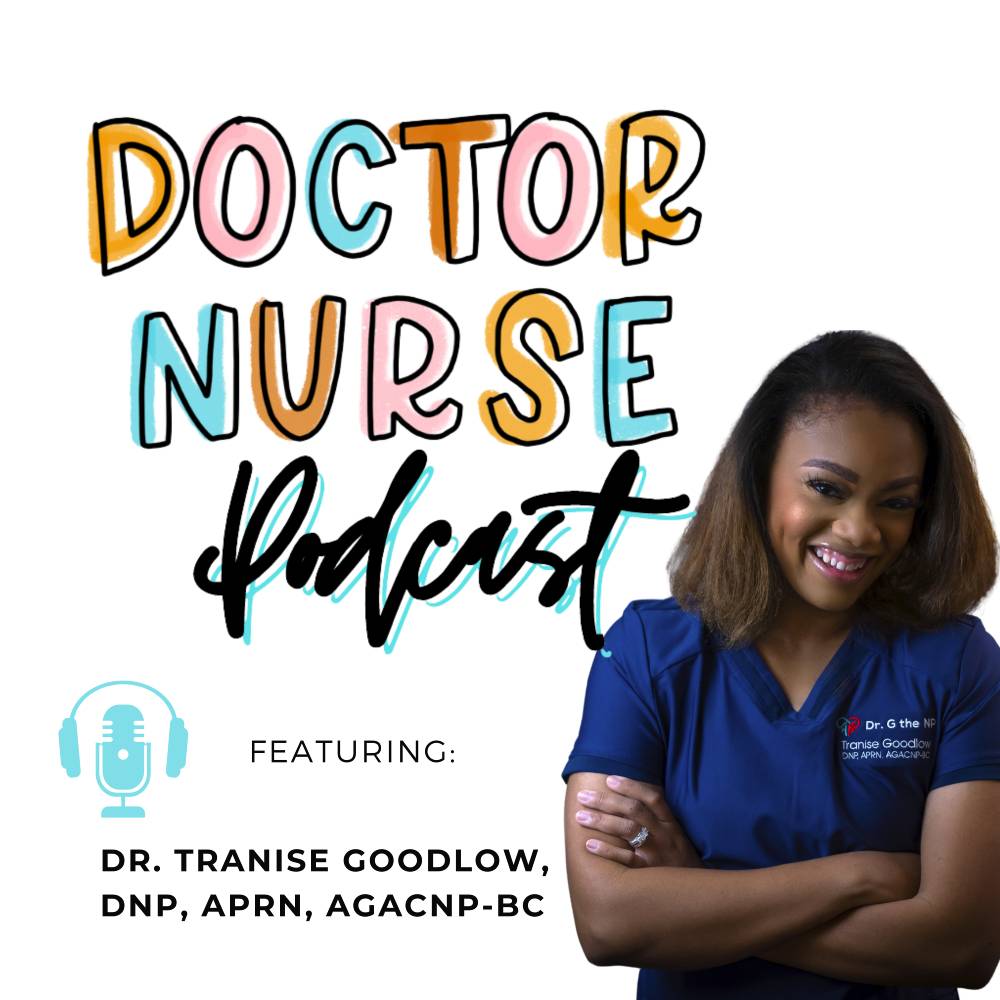
Sandra Pagenta: [00:00:00] welcome to the doctor nurse podcast today on the podcast I have Trinice Goodlow. She is a graduate of Southern university in 2010. She worked for years as a med surgery, telemetry nurse and then enrolled for her DNP at the university of Arizona. And it looks like you are an adult geriatric.
Yes you care. So you’re all of them. Graduated with that degree in 2017. What was your dissertation on? Just
Dr. G the NP: tell us hypertension within the African-American community, specifically JNC eight recommendations, seven.
For hypertension management.
Sandra Pagenta: Since 2018, she has worked as a cardiology nurse practitioner, and then in the summer of 2021, come on now COVID launching businesses. She began her business as a nurse and nurse practitioner, coach. Her business name is doctor. The N P and she hopes to help nurses and nurse practitioners, master certain [00:01:00] skills, such as EKG understanding and treating, diagnosing hypertension and then cholesterol management.
I am so happy to have her on to describe and to share with us, her journey, to where she got to today. Thank you for coming on. Dr. Goodlow, let’s take it from the top. What, and how would you describe your current role?
I’ve told them what you’re doing, but really give us an idea of what your day to day looks like. Are you in the hospital some days and working on your business? Break
Dr. G the NP: it out for us. I’m more than happy to break it down before I break it down. I want to thank you for having me on as a guest.
I love your energy. I love everything that you’re doing. So thank you first off. So my day to day is, is a little crazy. I do work full-time as a cardiology nurse practitioner have been doing that for three years. It’s been quite a journey and quite an evolution. I’m also a professor part-time as well. I started being a professor about two years ago, and then of course I launched Dr. G DMP, as you say that in summer of 2021. So it was quite hectic. I’m first thing in the morning I wake up, [00:02:00] first I get our youngest son ready and my husband gets the older two.
Ready. I get the baby ready. I go to the gym. Then I go to clinic all day. Depending on the day, then I’ll start grading papers or something like that. And then later on, I’ll either lecture to a client. And then I lecture on the treadmill. People know who’ve taken my session before I lecture on the treadmill.
I like to walk, I try to get 13,000 steps in because I’m a proponent of, you have to be what you say, right? So if I’m telling patients that you need to walk 10,000 steps a day per the American heart association, I need to at least meet that or exceed that. I don’t believe in telling folks to do things that you’re not practicing yourself.
So I’m known for lecturing on the treadmill. And I think I did a good job.
Sandra Pagenta: I saw that video of you lecturing on the treadmill. And I’m like, who is this? And she is working in working out at the same time. So I definitely wanted to hear your story and take me back. You’re working as a cardiology, NP. What do you [00:03:00] see in walking through the door? You’re taking care of complex, like heart failure type patients, or are you doing kind of like basic , hypertension management?
Dr. G the NP: I see a a wide variety. I do deal with a lot of heart failure patients and also see a lot of cardiomyopathy where there’d be a schemic non ischemic, dilated, hypertrophic, whatever of course hypertension, which is near and dear to my heart. My lipid management skills have taken off.
At this job and I really enjoy managing lipids. It’s very, very important to me to be proactive and preventative with patients. Other things that I manage palpitations, arrhythmias, those sorts of things. Everybody has swelling. Of course, we want to make sure they don’t have heart failure, which is why they’re swelling.
We’ll start working up pad minorly and then, maybe send it to vascular. Murmurs or carotid breweries had someone yesterday, he had a murmur and it was radiating up and said, well, we need an ultrasound and carotid ultrasound. I think it’s radiating, but we don’t know if there’s stenosis there too.
That’s kind of the meat and potatoes of what I do right there.
Sandra Pagenta: And then your adjuncts, who are you? [00:04:00] Full-time faculty at a university.
Dr. G the NP: Oh, no. Okay.
Sandra Pagenta: Goodness. Okay. I jumped faculty.
Dr. G the NP: Yes. I’m adjunct faculty. I’ve been doing that for two years. I’m actually. Small little hiatus right now because I’m trying to put more into my business.
And the eventual goal is for me to leave the university. I acknowledged that I have the ability to teach. It’s a gift that I have. And I want to really pursue that. The university was great because I get to connect with students, but I don’t get to teach. What I think is. So my business allows me to teach you what I know is not think I know the skills that you need to be successful.
And EKG is certainly a big piece of what I do. We all know an undergrad EKG is a footnote at best. And in grad school, I actually had a whole electrophysiology class, which I loved. But a lot of nurses don’t get it and I never got that. And I know I can convey things in a simple manner.
And I have people just taking off and being rock stars and it makes me feel well to see their light bulb come on and give back to our prac practice our profession. [00:05:00] Every Friday night, I do a free lecture. I break down one EKG every Friday via. So then do you do this? I do it at 8:00 PM central time.
Okay. And is this on
Sandra Pagenta: Instagram that you’re breaking this down? Where are you doing
Dr. G the NP: this? I do it on zoom and so I have a Facebook group but I post the links on Instagram, on Facebook, within my group. And you’re giving me some inspiration right now about, I should go do a live in addition to. Yeah, I need to put that into the works.
I’ve been doing it for since mid October, every Friday, unless it’s like a holiday or something. I do it this upcoming week. Since this Friday is a new year. Excuse me, Christmas Eve. I’m doing it on Thursday instead of. Okay.
Sandra Pagenta: Do you walk during these these lives?
Okay. For your teaching and your adjunct, it sounds like are you just working with nursing nurse practitioner, students or
Dr. G the NP: nursing students there’s practice and your students? So my course is the first clinical course [00:06:00] that they take. So I’m grading soap notes, communicating with preceptors that sort of
Sandra Pagenta: Then for your final, Dr. G the NP. Like you said you’re breaking down. You’re really explaining hypertension, cholesterol management, teaching people, how to do EKG. What do they get when they sign up with you? What is something that you share?
Dr. G the NP: Well, first and foremost, you get me. I do it live it’s interactive. And in the beginning of the session, I like to know what kind of nurse or nurse practitioner you are and your background experience, because I like to individually cater by interaction with you for, so it’s purposeful for you.
So that’s number one, number two, I believe. Going slow. And I don’t like big words. I like to break things down in a very simple manner because repetition builds confidence. Furthermore, I also teach things that you probably have never heard of, but the concepts are very important. For example, knowing how to name a QRS complex.
Knowing where the QA is an R wave [00:07:00] is. And an S wave is because if you can do that, you can identify right bundle branches, left bundle branches, left interior for secular box left posterior for secular blocks, incomplete right bundles. And of course old possible. It’s all contingent on that. So I walked you through the progression of that.
And again, I’m teaching you skills that you’re just going to run with it. I have two people right now, Caitlin and Kiana, and I know neither one of them would mind me sharing. They have absolutely taken off. They come every Friday, I’ve done multiple private sessions with them. And last night it was funny.
They were telling the people that were in the zone and they were like, before they met me, like they could not, they were intimidated with the EKG. They kind of shied away from it, but they knew they needed it. And now they’re up here asking me, they’ll text me, be like, Hey, is this a left interior for secular block?
And I’m like looking at you. I see you the way you explained it. It makes sense. It’s just. Yeah. And so I’m building in the foundation so that I can build people’s [00:08:00] confidence and knowledge. And like I said, I, I know I have the ability to teach. I think that’s a gift that I know that’s a gift that I have, and that is really the foundation of Dr.
GBMP me connecting with people and taking them on this journey.
Sandra Pagenta: Dr. Goodlow walk me through. How did you find that that was something that you had, that was a natural ability.
Dr. G the NP: How did you discover that? Well, I should preface it by saying one. I come from a family of. Actually I’m the only non non-teacher.
Well, I’m a professor, so technically I’m a teacher, but you know what I mean? I didn’t major in education. Everyone else in my family did principals, teachers, all of that. So it’s kind of, it’s in my genetic, it is in my blood. Furthermore, when I was younger, I used to coach basketball. I’m a huge basketball head.
I love ball. I’ve coached. It’s been awesome, but in regards to nursing, to be very specific it really started with patients and it was funny. My coworkers on the floor, they were jokingly messing with me. They’d say mantra, [00:09:00] nieces, and they’re giving lessons to, to patients. I used to get on the white board and if they had heart failure, I’d be like, okay, this is heart failure.
This is your heart. This is the chamber that is having the problem. This is why you’re on this medicine to make this be stronger. And so it started there and then. It evolved into me, precepting nurse managers, like, Hey, I want you to start precepting new grads. And it was, it was fine. And I had great success with new grads and I keep in contact with some of the people I precepted to this day.
It just kind of evolved. And then I ended up going back to school and then when I was a brand new nurse practitioner, by the way, I still consider myself. I had a mentor. Tell me if you have less than five years experience, you’re still new. So I do consider myself new, but I’m not brand new.
Right. I always equate nursing to life. Right. So I’ve been a cardiology nurse practitioner for three years. So a three-year-old compati be potty trained a three year old is talking a three-year-old is communicative. A newborn is a good way of putting it. I like that. Yeah, you can’t, you [00:10:00] can’t feed yourself.
Can’t change yourself. Can’t do anything. I still acknowledged that I’m still a child, but I’m certainly more advanced than a newborn. Yeah.
Sandra Pagenta: And I’d like to add, you’ve been a nurse since 2010, correct. So you’ve got experience with patient care patient education. Patient management, because as nurses, even though we’re not diagnosing per se, we still have to use our nursing diagnoses of, okay, I know this patient is needs food.
And like there’s things that we know intuitively that it’s like, he hasn’t eaten all day. We gotta make sure he’s electrolytes are stable and whatever, whenever we understand those concepts because of our nursing background, which means we don’t have as far to go, like you say, until. Walking a walking, talking toddler.
It, it doesn’t take us as long because of where we come from. Right. If you were a person that studied bugs before you became a nurse practitioner, then yeah. I mean, you really are going to struggle, but I think nurses do have a little. When they go back and get their doctorates and they come back and they [00:11:00] practice because we do, we have seen a lot through our experience as nurses.
So, yes, I agree
Dr. G the NP: with you continue. I will say my personal experience and a lot of people are surprised when I make this statement. I’m going to make a controversial statement. Do it
Sandra Pagenta: girl. Come on. Controversy.
Dr. G the NP: Stir the pot. Yeah. I’m going to make a controversial statement. I was unhappy being a nurse.
I almost left her. Me going back to get my doctorate. That was a real crossroads for me in life. I was a nurse for four years before I went to grad school and I was miserable the entire four years. I hated being a nurse. My husband’s an engineer. And when I was in high school you think about what you’re going to major in.
And engineer did cross my mind and I was very good at math and I actually have the ability to draw, so I’m like maybe I should be a civil engineer. And so I was unhappy. I see him happy he’s electrical engineer. I just was tired of being treated like trash as a floor nurse.
I was disrespected. Mind you, most people in this country don’t even have a [00:12:00] bachelor’s degree, let alone a doctorate. So the level of disrespect that was treated as if I was a maid and I was incompetent and I just had a very negative experience as a nurse. I thought to myself, what do I want to do?
Do I want to start over and get another bachelor’s degree and pursue something else? Or should I just see this thing through? So I’m not going to lie. What altered my decision? Initially I was going to get a master’s I found about programs that had BS in the DMP and I’m like, okay, for six more months, I can get a.
So that kinda did it for me. Furthermore, I felt like I had more options if I was the combination with the doctorate and being a nurse practitioner. And at that point I enjoyed cardiology. I knew that. So I said, okay, let me bite the bullet and let me do it. And I will admit it’s been the best decision that I ever made to be so unhappy as a floor nurse and a regular nurse.
I used to say, I have a dislike hate relationship with nursing. Now it’s more of a [00:13:00] like, dislike. Again, you’re still
Sandra Pagenta: on the spectrum though. That’s like, not all the way. You’re not like, love, like if we’re going to do like a liker at scale, like less likely more likely, you know what I’m saying? You’re still kind of in the middle.
Why
Dr. G the NP: do you think that is? Nursing itself? Let me tell you what I like about. Yeah, I like the options. I like the flexibility. I like that. I could pick up one day and say, oh, I don’t want to do cardiology anymore. I’m just going to go do this. I like having options for flexibility. That’s very attractive to me, despite me actually being a creature of habit, which is a little weird juxtaposition that I’m a creature of habit, but like for.
You know, you just
Sandra Pagenta: like to know that that option is there. If I ever need to, I can, if I need to get up out of here, right. I can get up outta here.
Dr. G the NP: Yeah. , like you want to make sure, you know where the exit is, right. Like you’re in the room, you know, where the exit is. That is attractive.
To me, that is one of the most attractive things about nursing to me. Plus again, I’m teaching there’s other things that I can do [00:14:00] what I don’t like about nursing and it’s inherently because of the society. Norms and patriarchy and whatever you want to call it. The negative side of nursing. For example, the view that nurses are subservient.
I don’t like that. The view that by the public that, oh, if you were a nurse, you tried to be a physician, but you failed. So that’s why you’re a nurse, which I never tried to be a physician. I’m quite clear on that. The thoughts that the physicians are, your boss. The ones that are working with their colleagues.
They’re not my boss. I know my boss’s name. And I can see you. You know what I mean? Yes. I don’t like that. I don’t like the whole doctor thing because doctors a level of education. It’s, it’s, it’s an adjective. It’s not a noun. I don’t like nurse bullying and perpetuating that. So that’s when I say I have a, like this.
It’s evolved to like dislike versus dislike, hate [00:15:00] relationship. I do like the, the practice I am, I’m blessed because I have a lot of autonomy, Texas I’m in Texas, Texas is not a full practice state, but within my clinic, like you wouldn’t know it. The physicians that I work with are supportive and they helped me grow and they’re not micromanaging me.
Like they’re there if I need them, but they’re also. Like you should have run it by me and you should, it’s not anything like that. So that’s why I have those feelings. And I honestly don’t think those feelings are going to go away, which is why I’m trying to carve my own. And Dr. G and P I like that.
Sandra Pagenta: I liked that. And I love everything. I love how you shared, so poignantly exactly what your issues are. I feel like I need to spend a little more time with myself so I can figure out what my issues are, because the way you just said it, I was like, that was well thought out. Like I liked the way you described it, because it’s so true.
Those are the issues. And those are things that I identify with every single one of them. It’s it is so well said, and they are [00:16:00] issues. But, you know what? The one thing that I think that keeps me coming back is like you said, that flexibility and the options, and that’s why I think the podcast and what I’m trying to build here.
I really want nurses to be able to see all the options, because if you are in that hate space, that you can get yourself, you can have separate yourself to push yourself out of that. You don’t got to stay there. You’re not a victim. Let me show you how to get to a spot where you can go. I’m in the hospital setting there, things I do and do not like about it, but I’m also in this world where I feel like I have a level of autonomy.
I feel like I have the power to create my own path. And that’s also why I started the podcast for myself, because I began to feel that limiting effect of wait, why is my boss a doctor? Just because he’s an MD. I don’t understand that. And you know, there’s different things where. Ask from a hospital to give you opportunities.
And it just doesn’t seem like it’s a conducive environment [00:17:00] to be able to grow in and of yourself. And so of your own will, if your own interest of your own push. And I think from a sports perspective as well, I mean, If I want to get out there and shoot free throws all day long. So that might feed throws are the best.
I should be able to do that without being told, well, we need you to go over here because we need you to fill this hole. It’s like, but this is what I love. This is what I’m good at. Let me get good at this. You know? So it’s just, it’s just really tough. And I, I love the way you said it. So thank you for sharing that.
Dr. G the NP: Let me add to that. Anybody who knows me knows I’m huge on clinical data and outcome data. The Institute of medicine wrote a position paper back in 2010, stating nurse practitioners give equal if not better care than physicians.
Furthermore, there are over 3 million nurses in this country, so we make the biggest population, so to speak of the healthcare world. So it’s always interesting to me. Some of it is a patriarchy because nursing is a female dominated, correct? [00:18:00] Yep. And then when you have nurse bullying the name escapes me of the nurse theorist who says this, but she basically, she described it in the eighties or nineties.
It’s basically when you’re in a pressed.. Everyone feels bad. So within the oppression, I’m going to try to get power within that. So that’s really like the child of nurse bullying because I’m oppressed, but I don’t like it. So I’m going to make you feel worse. So I feel some type of power, even though I can’t get up to the level that I want to get up to.
Sandra Pagenta: And I did so with Dr. Joe Neil and I talked about that, it’s almost like the cyclical behavior where like the abuse than abuse. because we don’t feel any power because of the system that we’re in. We try to exert that power on the younger generation the new nurses that are coming up, it’s awful.
Dr. G the NP: And then if you want to add another monkey, rich and another element to oppression and bullying, then. White women in this country make 78 cents per [00:19:00] dollar for white man women of color make about 63 cents per dollar of a white man. So you have socio-economical ramifications in the wealth gap, getting larger.
So you cannot even get ahead. So to be a double minority in the situation and in a sense, almost eight triple minority, because nursing is seen as subservient. I’m not trying to turn this into a bashing session by any means, but I also want to inspire people to know that despite all the obstacles you can still be successful.
And I have big plans for myself, my career, and I will be implementing them and I am implementing them. People don’t like that, right. That the inherent human nature is if I’m uncomfortable, I’m going to avoid being uncomfortable. But if you want to be great and you truly want to achieve something, walk into that discomfort, get comfortable with being uncomfortable, uncomfortable.
So I run to it. I lean into it before I started the six [00:20:00] months ago. I’m like, oh, you don’t know enough. You can’t can’t teach EKG. Cause there’s some stuff that you’re shaky on. But when you look at it from just pull back. On a scale. If I know more than most of my colleagues, even though I may not be where I want to be, I still have the tools to teach and connect with people
Sandra Pagenta: and that’s, and that is a really big, huge point that I want to sit on for.
It’s like, okay. Cause you’re an expert. And so you do see the nuances and what, you know, but compared to the rest of the world, you are an expert. And so that’s what I want nurses to see is that yes, you may not know everything about for my case urology, but compared to the rest of the world, I do know a lot about urology.
And so being confident and seeing that in yourself and that you do have something to give back, despite what you may think in that, I guess it’s my OPIC view. Is is critical and it’s absolutely, it’s how you can break out and [00:21:00] again, get releasing your lift focused on something focused, become an expert on something a hundred percent, but still don’t forget.
You can actually teach that whatever it is that, you know, you can actually disseminate that information. Show yourself as an expert because you are, I think I read somewhere that if you have read more than three books on a subject, you are more of an expert than anybody else in that field. And so, yeah.
And. And it’s interesting. I don’t know how many books you read in your DNP program, but I read more than three books. I think we had something to share something to talk about. Thank you for walking us through your journey and everything that you’ve gone through. Get to where you are today.
And as you’ve been going through this journey, can you share with us a specific challenge that you remember that you can say, you know what, this was really tough, but I overcame it.
Dr. G the NP: I’ll take you back to when I was in the latter part of my DNP years I needed a site.
I needed a clinical site to do my [00:22:00] research. And so yeah, I needed a site and that was hellacious to say the least also sidebar. I’m the only person that I personally know who had to get on a plane to get clinical. Because I was flying back and forth. I was in Arizona. I was in Albuquerque. I live in Dallas and then the latter part, I did Dallas and Houston, but the bulk of my hours was in Phoenix and Albuquerque.
I’ve never heard of anyone doing this that’s nuts. Right. So I had challenges to get my hours, but I made it happen. Now, the DNP situation I had to get. I was kind of in between jobs. And when I left the floor, I promised myself I would never go back. Cause I didn’t like the floor. I was miserable. I just, you know, I said, write a chapter is closed.
So that’s when I kind of started teaching really. I got an MBA school and eventually I started teaching at an ADM ADM. Okay. So that was at an ADM program for a very brief time. Tell me what an ADM program is. Associate’s [00:23:00] degree in nursing. Okay. Okay. Yeah. Two-year nursing program. Okay. So I was teaching there because I already had my BSN.
I was going to say, you’ve got your BSN in 2010, right? Yeah. Right. Yeah. So this was around 2016 ish. When I was, like I said, in the midst of the DNP, I was on the research side. I finished clinical. Yeah. So anyway, I was working at this school teaching in that program. And I was there briefly. I quit very quickly because I needed a DNP site and I was thinking, okay, they have clinical sites.
I can hook up at a clinical site with the students. Cause I was faculty and do my research there and it worked out. It didn’t work out that way. And so I ended up applying for another job as a nurse educator at a hospital. And when I was interviewing, I said, well, I’d be allowed to do my DNP project here.
And they told me. So I literally quit that job. So I would have a site because I had invested too much flying across the country and all of that. And to have my education halted because I didn’t have a. [00:24:00] So, like I
Sandra Pagenta: said, wow, I’m sure they loved you. I’m sure they love that you come in. Like, I want to do research here, you know, that’s cool.
Dr. G the NP: Yeah. So the stars aligned and God definitely has a plan. So I was at that job. I was a nurse educator. But I, I will admit my motivation for the job was to graduate because you spend so much time. Obviously I was a med surge educator, and that was fine. I stayed there a year and a half.
I really stayed there longer than I really should have. Because I had graduated and everything, but I wasn’t rushing to get a job. I was trying to get my shirt set. Plus we were in the middle of having our second kid at the time. So I wasn’t like you did all the babies girl. Well, so I told my friend, she laughs at me so real quick, I graduated in 2017.
What I’m gonna tell you is crazy. So hold on to your seats. I got pregnant in 2014. We have in 2015. So I timed it to where we had him. And then he was like six months old or whatever. And then I w I left cause I was traveling for clinical. I was flying [00:25:00] back and forth.
We had our second son in 2017, so I was working full-time as a nurse educator. I was in school, full-time working on my research. We actually had a small business called best drinks ever. We were doing alcoholic catering. We had a suite, we had a TABC license, liquor liability insurance. We had everything. I was pregnant.
Like I said, school full time nurse, educator, business. I was pre. Then I defended my dissertation that went fine. I had him a week after I defended, oh my dad, after I had him two weeks later, I got on a plane to fly across, to go back to Arizona to graduate. And when I graduated, they gave me the award for the most vulnerable population for my.
So I looked back at that chunk of my life. We had the business for two years from 2016 to 2018. So it was kind of a whirlwind and people always ask me, how do you be pregnant work, full time school, [00:26:00] full time, run a business. What happened to Kotler? What’d you take? Great. And I have two answers to that.
Well, one comment in two answers, one, I hope to serve as an inspiration because there are no limit. Too. I am very, very good at compartmentalizing. So if I’m at school, I’m at school, I’m literally not thinking about anything else. I’m filming this podcast with you right now. I’m completely focused a lot.
Then I have other things I have to do, but whatever I’m doing. I’m committing. So one be good at compartmentalizing two, the second key to being able to do everything that it did was I’m pretty stubborn. And I know that about my. So I, I understand that there’s a fine line between being stubborn and being crazy.
And I definitely Teeter that line. But I also, I also know what I want. I’m not a person who’s kind of scatterbrained like, oh, maybe I should do this. Maybe I’m very methodical. Like I [00:27:00] see something, I want it. And I’m willing to take the steps to get it. I will say that I’m on the side of stubborn and not crazy.
Because it was planned, everything was planned. So it wasn’t, we knew what we were. Shout out to all the spouses out there, that support. Cause I certainly couldn’t have done it without my husband. And I tell him, who’s crazier me for what the ideas are you for going along? There’s that, that was the craziest, most challenging time.
Those two years with the grad school, we had a contractor who stole money from us. Like it was. But the lessons, the business lessons I learned, I’m applying to Dr. G life is funny. When I started at one school for undergrad, I wasn’t happy there. And I went to another school when I started at the other school.
I was actually a double major for a hot second nursing. And. ’cause I always knew I wanted to do something with business, always smart. I didn’t survive. I couldn’t do double major in nursing, so I dropped the marketing. But [00:28:00] it’s funny how life comes back around and it was always in me to do business.
It was always in my heart, Dr. Jean was not a whim. It was. Thought out. It was meant to be just like my other business, which you can learn more on failure than you do success. And I’m taking those lessons, those expensive lessons in best drinks ever. And applying it here, shout out to the best drinks ever.
We actually left the corporation open because we may want to revisit it. We did rename it. Yeah. We renamed the corporation to BARR B a R is an acronym for best alcohol resurrected. If we want to come back. The door open or all options. Yeah. I tell you I’m all about options. So I’m in a season at life right now where I’m very excited, but I’m also grinding.
My goal, if I could have anything I wanted, Dr. G would be my full-time job and being a cardiology, MP would be my part-time job. I actually wouldn’t mind continuing being a professor, but my problem with being a professor is I’m told what I [00:29:00] need to teach. Yeah. There’s one time in the term where they allow me to do a case study and I can do it on whatever I want.
And I get so much feedback from the students. They’re like, can we do these all the time? It kinda, they inspired me to start Dr. G cause I’m like, I can do these case studies. I can like, I’m teaching you what you need to know. So that’s my version of perfect is Dr. G full-time cardiology and Pete part-time and really touring at different universities and giving my lectures, because like I said, I know.
Yeah,
Sandra Pagenta: that’s really cool. I love that. I love your vision. I love that. You’ve got, you’ve got a goal again, like you said, I like how you’re being intentional. You’re not wasting time. You’re not wasting your energy. You are moving with intention. And I think that that’s really big because I think there’s an element where.
With nursing. I’m really big about being present. I think you described that a little bit too, that when you’re in something be present, be there, but then there’s also outside of that, being intentional with the [00:30:00] things that you’re doing. See again, the forest through the trees analogy and see where you’re going and make sure that this is aligning with what you want in life. And I think that that is the biggest flux is that you live this life that aligns with the things that are important to you, which is I like being my own boss.
I like being able to push myself to be able to teach the things that I want to teach, to be able to put it in a way that I want to put it. Have nobody tell me, getting rid of a level of overhead with the way you want it to you. And then also keeping your foot in your, in the world of, of nurse practitioning, because I actually feel the same way.
I love what I do as a nurse practitioner and doing procedures I get to work out of overflow and not out of a sucking burned out position. And I get to do that. And then I get to do this other thing that I really enjoy. That’s for me. And I really love how you split that up. And I like where you’re going with your career. I think it’s really cool.
Dr. G the NP: I really want to get that. I always joke and tell people, they’re like, oh, you’re going to be a nurse practitioner forever. And I’m like, well, it is [00:31:00] called Dr. G the NP.
Sandra Pagenta: I think being a nurse practitioner is one of the greatest jobs hands down, and I really love what we’re able to do. And I think that more nurses again, seek it out.
Make sure it’s something that you’re passionate about because I just don’t think you should go just to go again with that intention. You can be a nurse and be able to have a beautiful career. So it does not have anything to do with it. If you’re seeking that next level, then it really does do a really good job of giving you the opportunity to
Dr. G the NP: build that.
I would, let people know is you have to be open. When I was an undergrad, if somebody would’ve told me I would have been a nurse practitioner, I would have laughed in there. I remember my mom telling me about being a nurse practitioner back in undergrad.
And I told her I do not want to be a nurse practitioner stop. Like I thought I was going to be a pediatric nurse. That’s what I thought I was going to be. But what changed my mind is I had a clinical rotation in paeds. We get to the floor, I see all these sick kids. One little girl had a shut in her head.
Some little boy liver failure. [00:32:00] His stomach is huge. Like it broke my. And I was like, I cannot do this. Like I was very clear after that day that I would never do pediatrics because I, my heart just couldn’t handle it. And the ironic part about cardiology. Hated cards. Oh my God, that test undergrad. We’re going to not talk about that experience.
Man, the curve, the grades so much because everybody did so bad. You shouldn’t
Sandra Pagenta: teach that class. I should, I should.
Dr. G the NP: I always tell younger nurses, even younger, high school students or whatever said, am I, and you have to be open because if you say, well, I want to do this. I’m not saying it’s not good to have a goal and you shouldn’t shoot for that goal, but you’re going to end up missing your blessing if you’re so laser focused on something, trying to put a square peg through a round hole, sometimes things you think will work.
It doesn’t work. And so, you know, in that regard, that’s being fooled. Rather than shifting, because remember you have to be adaptable if nursing isn’t [00:33:00] anything it’s adaptable, life, life is adaptable and being flexible. So you have to be able to apply those principles. And I’m happy that I was able to see that pediatrics was not for me.
I gave cardiology is second chance. It’s actually funny with, I assumed, and this is an undergrad. I assume that nurses knew how to read. Okay. It was news to me, the nurses didn’t know how to read EKG. I was a brand new nurse and the buyers of Louisiana first job night job. And I’m standing behind the TeleTech at 4:00 AM.
And I’m just looking at all the strips and she’s like, Hey, do you want to learn how to read EKG or read tele strips? And I was like, is that something a nurse needs to know how to do? And she looked at me, she’s like, nurses don’t know how to read strips. I said what? She’s like, yeah. They don’t know how to read them.
I was like, well, I’m going to be a nurse who can read. Fast forward to my last job on the floor. I was getting report from somebody long story short. She’s like, yeah, the patient’s been in sinus rhythm all night. While I looked up at the tele monitor. I [00:34:00] said, well, that looks like a first degree in a bundle branch block to me, just on the Italian monitor.
So I looked at her 12 lead and her 12, we looked like perfect sinus rhythm. And I’m like, well, this doesn’t look like. To me go check on the patient. She’s doing fine. Tell the tech to get some vitals. I call internal medicine. Tell him he’s like, I don’t know. You need to call cardiology. I call cardiology.
Yeah. He told me he didn’t know. He said, I don’t know, call cardiology. I said, fine. Call cardiology. He’s like, get another 12 lead. Cool. Get another 12 lead. The new 12 lead did not look like the original 12 lead. It looked like the tele monitor with the first degree in the bundle branch block. Now mind you in those days, I didn’t know what a left anterior fascicular block was.
I’m much more skills now than I was back then, but I, I, I had more knowledge than my peers. I’ll just say. So I said, okay he comes, he said, I’m gonna go see the patient. Okay, fine. He goes in the room. He physically wheels the patient away. I never saw the lady ever again in life. Like she could walk in front of me.
I couldn’t tell you what she looked like. [00:35:00] So a few weeks later I saw him in the elevator and I said, Hey, I said, what happened to that lady? He had to think for a second. And he was like, oh yeah, I remember who you talking about. She had a small heart attack. Good catch. He. So I was like, I was like, man, I was like, I felt pretty good that day.
Yeah. I told my nurse manager would happen and she hadn’t been on me. She was like, Tanisha, you’d go back to school. Tunis need to go back to, I wasn’t trying to hear that. I was a newlywed. I was on some other stuff I was trying to, I was, it was another life, you know, I’m worried about all that.
I was precepting somebody. We actually had caught a stroke too on the floor and she kept telling me, she’s like, Janiece, you need to go back, you keep getting stuff. And so it was the heart attack that did it for me. And again, to that point, I was always teaching other nurses like EKG. So I was precepting.
I was really into the heart so that the heart attack thing did it for me. And I haven’t looked back since, and I know [00:36:00] unequivocally, I’m where I need to be. I’m still growing and learning in my practice. A hundred. But I know, I know that I can do this. I know. Oh, you are
Sandra Pagenta: incredible. You’re incredible. Any mentors along your way, that helped you in your journey that you want to shout out
Dr. G the NP: to shout out my nurse manager at my last job. I was at that job the longest I was there almost two and a half years. She saw something in me that I didn’t see in myself. She always told me to go to back to school, like always unequivocally and to this day when I talked to her, I thank her because I really, I just didn’t see.
I just didn’t she saw something in me that I didn’t see, but then when things started happening, it kind of propelled me in that direction. I was the go-to preceptor on the floor, new grad. She was going to put them with me a hundred percent. I remember one time our charge nurse called off and she’s like, okay, you’re going to be charged her today.
And I was like, what? No, you’ll be fine. She’s like, I’ll be here if you need help, but you’ll be fine. Like. She made me uncomfortable and you [00:37:00] have to be uncomfortable to grow and really be your ultimate self
Sandra Pagenta: full circle.
Dr. G the NP: Yep, absolutely. And when I talk to my students, I try to push them. I know the concepts I talk about may make them uncomfortable and I ask questions, but I believe in talking with people, not at people when I lecture, that’s why I want to learn about you and actually your experiences and what you think.
Because you connect better in a conversation than you do being spoken at. But unequivocally my nurse manager, she was the one driving force that has gotten me here., she started it all. She really did her name, Cindy. Yeah. Dr.
Sandra Pagenta: Goodlow appreciates you and you made a difference. So keep, keep looking for good nurses and promoting them because
Dr. G the NP: you’re good at it now.
Sandra Pagenta: Oh, Cindy comes to work.
For [00:38:00] the final question, we’ve got a new nurse. She just got her degree and you know, she’s wondering, what am I going to do with my life? I don’t know where to start. I don’t know what to think about. What is something that you wish you would’ve known at the beginning of your career that you feel like she needs to know today?
Dr. G the NP: That’s a great question. In the very beginning. I would tell her don’t be, don’t be afraid to fail because as nurses and again, as educated people, right. I think sometimes there’s this disillusion and that’s what really irritates me about the subservient culture with nursing guys.
We at least have college degrees. You do realize the average person is not college educated and I don’t like the subservient nature that LPMs are addressed in because that’s ridiculous. Yeah. So the fact that you have a [00:39:00] degree, you are a head of the curve. Okay. That’s number one, number two, when I say don’t be afraid to fail, it’s more of, don’t be afraid to try things and they not working.
And then also the quote, the, the the late great Dr. Maya Angelou, when people show you who are, who they are the first time, believe them. Right. And so you can translate that into career. For example, with me in pediatrics, I had a bad experience. I couldn’t handle it. That didn’t mean that. Yeah, you felt bad and you didn’t like seeing those sick kids, but you gotta be that pediatric know if it doesn’t work, let it go.
Sandra Pagenta: I also had a very similar feeling about pediatrics. So that’s why I’m an adult nurse practitioner. I purposely chose. I did not want to be a family nurse practitioner. I did not want to ever cheat treat chips.
I knew that. And it sounds like you were in the same mindset. I was intentional in that. And so I, it sounds like what if, if [00:40:00] you had the same feeling that I did, it was like, my soul does not align with this. Like, do you know there’s certain things that lights you up, like you say, like I was born to teach, like I have that gifting.
I know that. And again, for me, I know that I’m gifted in procedures. I know that that’s my gifting. I feel good when I’m doing it. I feel like this is a flow state for me. It is out of just this energy that I feel very. Very much like I was designed for this. Absolutely. And that is something that I, I agree with you a hundred percent, that when you look at something and you’re like, this don’t sit right in here.
Like this is not just a mindset thing. This is not just like, oh, this is hard. And so I need to, it’s like, no, no, no, my soul does not align with this. That is when you need to shift. That is when you need to pivot. And so that is beautifully said. I think that is a great piece of advice for a nurse.
Alrighty. So the last part of the interview is the rapid fire questions. Questions, questions,
questions, [00:41:00] questions, questions, questions.
Dr. G the NP: Sorry. I’m silly.
Sandra Pagenta: So what is something that you will not be doing in 10 years? Come on with it.
Dr. G the NP: As bad as it sounds, teaching at the university. Okay. As, as an adjunct faculty, like I said, I personally would love to be a guest speaker. And I remember in undergrad they had guest speakers and stuff all the time, totally down for that. But I mean, be a part of a curriculum. That either one I didn’t help design or my input was put in so quickly.
I will likely not be an adjunct professor in 10 years. Okay.
Sandra Pagenta: And how do you like your eggs code? Scrambled eggs scrambled. Okay. And that was the thing I should probably ask people. Cause some people are like, well, I asked that to somebody she’s like, I don’t eat eggs. I was like, okay, terrible, not a
Dr. G the NP: great protein.
They taste great. I need the eggs. Matter of fact, I make protein pancakes with egg, with egg whites in [00:42:00] them, but that’s good.
Sandra Pagenta: That’s real good. Like. But like bodybuilding stuff. That’s good. Yeah. And what’s a book you’re currently reading. I mean, on top of getting up 13,000 steps, we’re going to, going to MP working as an adjunct taking care of your kids, being a mom, because I have a feeling you’re super intentional with your children.
I’ll talk about that. Are you reading any books?
Dr. G the NP: For pleasure or work. I’m going to answer a question with a question. Believe it or not. I don’t like reading. I know that sounds really bad. I don’t okay. People look at me strangely. If you have a doctorate degree, I’m like, I don’t like to read.
Sorry, disappoint you. I do not read for pleasure. Sorry. I’m not a book person. Okay. As far as in my professional career, my favorite book is my electrophysiology. Some of my clients told me there’s an updated version of the seventh edition. I might go and get it. It is a Goldberger’s electrophysiology.
I don’t know the exact title. I just spelled electrophysiology book. It’s great though. I have it on my Instagram. I posted a couple of times. It’s great because [00:43:00] you can hold the book in one hand and it bins. So it’s not a big thing. You know what I’m trying to say. It’s a digestible book. It’s my go-to and I got it in grad school and I absolutely love that book to pieces.
I do. There it is. That’s
Sandra Pagenta: that’s your book. That’s what you read. Beautiful. Well, Dr. Goodlow, thank you for your time today. Thank you for your candor and your vulnerability and your openness and sharing so much. Of what needed to be said with our listeners and where can people find you? Where can they check you out?
Yeah. I want to hear about what you’re doing. I want to know where we can find you so that we can take your course. Where does that all
Dr. G the NP: happen? Well, I am accessible in a multitude of ways. And I pride myself on being accessible and responding quickly. So I’m on Instagram, which is how you know you and I connected.
So Instagram is Dr. G the MP there’s no period. This Dr. T H E you know, Dr. G the MP. That’s one way. [00:44:00] Second way is on my Facebook group, it’s called Dr. G the NPS group guidance for nurses and nurse practitioners. I have about 2,800 people in the group. That’s where I post my EKG of the week. And then I put the interpretation that I post the EKG of the week on Wednesdays.
I put the interp on Friday. And that’s after the live session, so live sessions on Friday nights and then the post is like an hour or so later I put the tip of the week up there too, and other things I really am trying to grow the group. So please join the group. Okay. How has, can you reach me just Dr.
G DMP and that does have a period. So Dr. Dr. Period, the, you know, the rest on Facebook email contact at Dr. GDN p.com. No period that time. So it was just contacted Dr. GDN p.com. And my website is Dr. G the mp.com. Awesome. They’ve
Sandra Pagenta: got multiple sources to find you and sign up and you do classes and you do so if you sign up, do you sign up for like a lecture program where you kind of.
You know, have [00:45:00] 12 weeks of lectures or how does your how’s your business structured?
Dr. G the NP: So I book one lecture at a time. And it depends on the topic. My entry-level is anatomy of an EKG, so I teach them things to look for.
We go over QRS, morphology, that sort of thing. EKG 100 is building comfort and confidence, some similar strips, but again, showing you the process and how you build in that repetition EKG. 1 0 1 is focusing on incomplete, right bundles and right bundle branch. I throw a little bit of LVH in there too left ventricular hypertrophy.
The number one cause of LVH is hypertension and always told nurses or nurse practitioners specific. If you get a patient in clinic and you never saw him before and the blood pressure’s high, right? You think about white coat? They’re nervous. First time, check it again. Say it’s still high. Well, what’s the, what’s one of the determining factors.
If I get an EKG on you and you have LVH voltage, and you’re new, I’m probably going to put you on medicine because LVH voltage just occurs over time. This isn’t just a one off. [00:46:00] So that’s one thing I
use.
Sandra Pagenta: And that’s the detrimental effect of having a persistently high. High blood pressure is that this LVH shows up on an EKG.
Yes, that’s interesting.
Dr. G the NP: So I teach
Sandra Pagenta: That’s good to know because when I see patients in clinic and they’ll come in for a procedure, we take their blood pressure and I’ve seen their blood pressures that have been one 50 over 90, and they’re like, well, dark, I’m nervous to see you.
And I’m like, okay, well then let’s take it. Let’s let’s just, I’ll let you sit out in the waiting. I’ll check it again later and we’ll come back. It’ll still be high, 1 55 over a hundred or 95. And I’m like, this is a high blood pressure. So I’m really going to start pushing for those patients to go down to the ed and get an EKG.
Like, because they’re like, well, I didn’t take my meds darker, you know that, whatever they’ll,
Dr. G the NP: they’ll say. Yeah. That’s right. Interesting. by the way, LVH criteria, there’s over 50 criteria for LVH. I certainly don’t know all 50 actually. No three, [00:47:00] so it’s quite involved. But again, I do it in a phone.
So that’s EKG 1 0 1 EKG 1 0 2. I focus on the left side. So left anterior for secular box left post for secular blocks and left bundle branch blocks. So by the end of the course, you’re able to identify all of these blocks and whatnot. I’m looking at doing another course where I talk about old heart attacks.
I’ve done some old heart attacks in the lives zooms, but I don’t have like a second horse on it. And then I have another one I’m working on anything, but sinus rhythm. Whether it’s a paced rhythm, a junctional rhythm, AFib, you know, kind of making things up. So I’m, I’m trying to evolve with more courses, but right now I have those solid four courses in EKG is that people really, really like, of course I have my hypertension, which is awesome.
And I talk about LVH and hypertension and then cholesterol management. Because again, we don’t just have static. We have data. We have PCSK nine inhibitors and the latest and greatest has now been Potomac acid. So I like to talk about those options as well, the clinical outcome data, and why you do what you do.
Sandra Pagenta: [00:48:00] Amazing guys. Check her out on Instagram, Facebook, her website, email, or sign up for her classes. Stay educated, stay smart guys. Thanks for tuning in today. And thank you, Dr. Goodlow for your time.
Dr. G the NP: Take care guys. Thank you.
Podcast Description
Tranise Goodlow is the founder and co-owner of Dr. G the NP, LLC. Dr. Goodlow, also known as Dr. G, is currently employed as a cardiology nurse practitioner and a graduate-level adjunct professor. Her passion is teaching patients and nurses to build understanding and achieve the best outcomes, as well as nurse and nurse practitioner advocacy.
Dr. G obtained her Bachelor of Science in Nursing degree from Southern University and A&M College in 2010. She worked as a medical telemetry nurse for four years and also served as a charge nurse, preceptor, and mentor to her colleagues. During her time as a floor nurse, she discovered and developed an interest in cardiology. In 2014 Dr. G enrolled in the BSN-DNP, AGACNP program at the University of Arizona; she also worked as a nurse educator during her final year of graduate school.
In 2017 Dr. G graduated from the University of Arizona with her DNP, AGACNP degree. Her doctoral research entitled “Provider Adherence to JNC 8 Pharmacological Guideline Recommendations in African American Adults Diagnosed with Hypertension” was awarded the Mary Opal Wolanin Outstanding Dissertation Award for Excellence in Nursing with Vulnerable Populations.
Dr. G has the unique ability to simplify complex information which allows colleagues to build knowledge and confidence. Dr. G’s teaching style is engaging and allows reflection while creating a safe and welcoming atmosphere for learners. Her ability to marry evidence-based practice and practical real-world situations allows learners to evolve within their practice.
Dr. G the NP links: https://drgthenp.com/
Instagram: https://www.instagram.com/drgthenp
Facebook: https://www.facebook.com/drgthenp
Doctor Nurse Podcast Links: https://linktr.ee/DoctorNursePodcast
Subscribe to our YouTube Channel: https://www.youtube.com/channel/UCYQYlS9d6m7HyMK7Z1BI5DA
Latest Episodes
Doctor Nurse podcast brings you weekly shows to help INSPIRE, EDUCATE AND EMPOWER nurses with true stories of initiative and impact.
Doctor Nurse podcast brings you weekly shows to help INSPIRE, EDUCATE AND EMPOWER nurses with true stories of initiative and impact.
Latest Episodes
Doctor Nurse podcast brings you weekly shows to help INSPIRE, EDUCATE AND EMPOWER nurses with true stories of initiative and impact.