Also Available On






[00:00:00] Sandra Pagenta: Hi, Liam. Welcome to the doctor nurse podcast. I’m so happy to have you on today. Sorry.
[00:00:06] Liam Caswell: Thank you so much for having me. It’s a pleasure. It’s a joy to be.
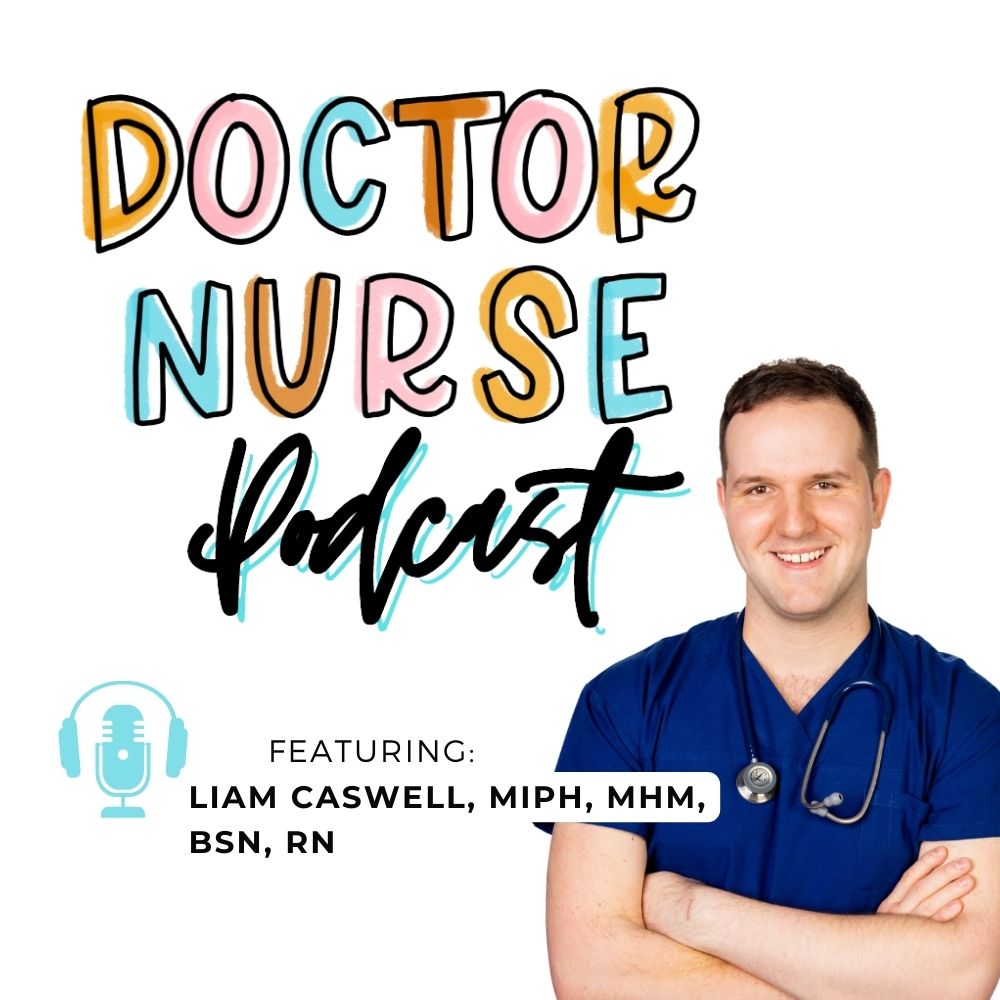
[00:00:10] Sandra Pagenta: Oh guys for you guys listening today, I have a real treat. Liam Caswell is an RN nurse coach and an NLP and LP practitioner.
[00:00:20] Liam Caswell: So it’s a neuro-linguistic programming practitioner, so I’m, it’s all about rewiring your patterns and your mindset.
[00:00:30] Sandra Pagenta: Neuro linguistic programming practitioner podcast host, and a nurse preneur. He graduated from Edinburgh Napier university Scotland in 2011. With 10 years of international nursing experience, spanning from the UK Australia.
Fiji Liam has a dual masters in international public health and health management. He’s a nurse career and leadership coach, and he is based in Sydney, Australia. He has [00:01:00] helped over 130 nurses achieve career alignment, success through one-on-one. He’s the proud host and creator of the high-performance nursing podcasts, which is on Spotify.
And I highly recommend you guys check it out where he has these conversations with global clinicians. And explores what is possible with the career of nursing. So welcome Liam. I am so happy to have you on today and guys let’s dive right in. So Liam explained to my listeners exactly what it is that you do for.
[00:01:36] Liam Caswell: Awesome. Well, thank you so much. I our nurse career and leadership coach, I am the founder and CEO, I guess, bad boss of high-performance Liam castle coaching. I set that up over a year and a half ago now, I think year and a half, two years ago, I, where I just saw this gap in the industry where nurses were just not getting access to mentorship and coaching [00:02:00] clinically in the workplace.
And I noticed that as a nursing leader. I want you to bring that to the masses and that’s kinda, my overarching vision is helping clinicians fulfill the full potential. And kind of rise through the career. And can, if like you, that the message that you deliver, allow nurses to see that their degree is a ticket to creating a life that they want to live an intentional life.
That’s my kind of current title at the moment. I also do still work in dabbling clinical land. And I work predominantly within the university sector. So I work as a sessional marker. So. All the students have bad grades if their grandma’s bad. And I also do some sessional academic teaching and work with students on placement here in Australia during the undergraduate studies.
[00:02:47] Sandra Pagenta: Oh my goodness. So. Lots of lots of hats, lots of pots on the stove that are cooking. And that’s what I’m all about. I think that one of the things that my podcast I hope to showcase [00:03:00] is nurses that don’t just have their foot in the hospital. And in one of your podcasts episodes, you were speaking with Lauren, you really do describe that.
That’s also your vision for nurses is for them to not just be stuck, especially. And when it comes to burnout in different things that you experienced throughout your career. And I know that you had said you’d moved up the ranks and you were in the managerial position. Is that on the clinical floor? Yeah, I guess walk me through your steps.
How did you get to this specific spot in your career? And kind of walk me through beginning with the moment you decided to become a nurse. And then walk me through just kind of that whole process to where you were like it’s time to bust out on my own.
[00:03:37] Liam Caswell: Yeah, I love that. So I started back in the UK.
I grew up in Scotland and I was kind of surrounded by clinicians. My mum was an assistant in nursing, like a healthcare support worker. And my Gran was a nurse and she worked actually in Spain. And at the time I thought, I love caring for people. Why not just dive into this? So I studied nursing Graduated from university when I was [00:04:00] 19 to study my degree when I was six super young, but I was kind of real dead set on achieving it.
Hence the high-performance thing. Yeah, there’s a theme there. From there I started walking medical admissions and planning. So it’s like a really busy acute medical kind of extension to emergency here in the UK work there. Loved it, thrived on the hustle culture. Patients and patient side, and then had a beautiful exchange with a nurse unit manager from the intensive care unit.
And I actually looked after one of her relatives, not knowing that that was the intensive care manager. And she came to me at the end of the shift. Have you ever thought about a career in intensive care? Let’s said, no, not really. Like I was only like one year out of my grads. Sure. I think you should apply.
And I was like, okay, cool. So if I try it and I did my intensive care nursing and I did that for about four or five years. And then I migrated to Australia. My partner is Australian. So moved out here to get some sunshine and some warm. Yeah. And did [00:05:00] a real variety of different things. This is what I kind of preach to the nursing population and workforce here in Australia is sample sample sample.
And I feel like through my career, that’s what I’ve done. I worked agency kind of like travel nursing. Locuming for a few years here in Sydney, what through the publics and the private sector I worked for the universities again, did a bit of university support, which is amazing. Support and nurture those students at that such an early stage in their career.
And then from there I actually moved down to Canberra Australia. So moved from Sydney to Canberra and Canberra is, this is the actual capital of Australia. Not that anybody knows that. No, everybody thinks it’s Sydney or Melbourne, but it’s Canberra.
I was the same coming from the UK. I’m like, what is this Canberra place? That’s so funny. And I moved there and then a lot of opportunities can have arose from that move actually, which was interesting. I [00:06:00] moved into. Advanced life support training. So it can have like your ALS training. I did that for a few years, which I loved.
And then I moved into, I loved, I loved helping people see that they can thrive in a high stress environment and kind of like really utilize that algorithm. And once you know, that that algorithm. Like genetic, there’s nothing stopping you. Yes. There’s lots of things that are variable, but once you get that down, pat you can achieve anything in those arrests really with the support of your team and really helping people see that they’re not alone because I think often as clinicians.
Holy moly I’m here. My patients just crashed who’s around. Does anybody here? So that was really rewarding. Yeah.
[00:06:44] Sandra Pagenta: I’m like self efficacy, right? You’re teaching them the ability to walk into a situation and. Like, you know, not always, but for the most part. Going back to your coaching, which is that same along that same line and that same vein of teaching people, [00:07:00] how to change the situation that they’re in, through what they know.
Yeah,
[00:07:05] Liam Caswell: I love that. I love that. And in terms of the ALS as well, what I loved about it was the critical thinking and seeing clinicians that maybe didn’t typically walk in an acute environment coming through the course and then equipping them with this like awesome skill set, like the fundamental thing, which is your patient assessment.
So I loved that. And moving from there, I went into clinical education. I did that in acute medicine for a few years, and then moved into that. And did nurse unit manager, and that’s where I saw. The system can have falling apart a little bit. The crash started noticing it.
[00:07:39] Sandra Pagenta: Have you seen the movie in Canto where on Disney it’s so cute, but basically the house starts having cracks in it and there’s somebody on the inside patching all the cracks.
So it’s all cracky, but there’s like somebody in there, like the nurse managers, like try to keep the cracks from showing. Anyway,
[00:07:57] Liam Caswell: it’s made me think more about the, a. [00:08:00] I need to watch that. Yeah, it was, it was very much like that. And that’s what I experienced. Despite having an investing in doing my masters of health care, leadership and management, I still was deeply, deeply frustrated with the system and the limitations and the staffing, and all of the problems that are global in health care around.
How do you deliver a high quality safe service? To patients and also create a psychologically safe environment for staff to work in, come on, come on. Like happy staff, happy patients. I, when will we learn that lesson? So from there, I kind of got a bit frustrated with healthcare, the leadership and management, and that was my opportunity.
Like that was my moment to change the world. I felt like I was pushing crap uphill. Like it was just not happening. And I realized that I could just, the one thing that I could do that I could do really well was support my staff [00:09:00] and really invest in the clinicians. So I guess that’s kind of where the coaching stuff for me was born.
I absolutely loved investing in people and seeing people thrive. For the first time in their career, just by taking a couple of minutes to chat. So yeah, nursing career coaching was born there. I was doing it kind of by default in the white place. I was helping people land promotions. I was looking at the resumes.
I was looking at their applications, getting them through their interview prep and they were all landing the jobs and I kind of thought, oh, this is cool. And to manage my own Barnett, I actually. Career and mentorship support external to the workforce. Now I hired a nonclinical career coach to see kind of what my options were at the time.
And I was a bit skeptical of it because I thought, well, how is this person going to help me? They’re not a clue. They don’t understand the clinical draft. And I was, boy, I couldn’t have been more wrong. They really helped me see what it was I had to offer and what I was already doing. And that’s why Liam [00:10:00] Casper coaching know general high-performance nursing, the spawn and kind of, I
[00:10:04] Sandra Pagenta: love that birth story of your business.
It’s beautiful. And a couple of things that I was thinking as you were talking, was this NLP practitioner. Now again, forgive my ignorance because I just assumed an LP just meant something along the lines of nursing. What two things, how did that training and then how did your nursing training help you as you’ve started to build this business?
[00:10:26] Liam Caswell: Yeah, NLP is really powerful. When utilized in a coaching setting, it really helps us kind of a look at our brains. I can have objectively and look at our past experiences and really try and work through some of those things that have caused us trauma or issues in the past. And it helps us kind of realign and rewire our kind of neural patterns and neuropathways, so that would opt for.
Better pathways and better choices and to ultimately adopt better thoughts so we can create better results in the future. I know, isn’t it fascinating. Yeah. It’s Tony [00:11:00] Robbins is the, is the go-to coach for this globally. I didn’t learn from him, but he is an NLP master. I think he like pretty much birthed it himself.
It’s phenomenal. And it’s just one of many tools that we can use in coaching to really help clinicians see, see their full potential.
[00:11:19] Sandra Pagenta: I remember when I did a level of therapy myself in the past, they talk about how your mind creates these almost like ruts. And so you automatically go from a to B and it’s really convenient because your brain can do things quickly, but it’s also super detrimental because instead of creating new pathways of thinking.
And new ways of looking at things. You always look at them at the same way. So is this kind of similar to that? Is this creating new pathways and creating new ways to think about things and kind of getting your mindset changed? Is that what the purpose of it?
[00:11:52] Liam Caswell: For sure. Yeah, absolutely. It’s, it’s one modality to basically help us look at circumstances as being a neutral thing.[00:12:00]
I’m, I’m creating space between what happens and then the thoughts that we then choose to think and the results that we create as we move down that path. So it’s pretty powerful stuff. Really helps people move from. I hate using the word, but move from that kind of victim mindset into more of a, like an empowered champion mindset, which we love coaching.
[00:12:22] Sandra Pagenta: . I just got finished listening to a podcast episode where Donald Miller. He is the author of Storybird. He comes on and talks about how there are four character types in every story. There’s the victim, there’s the hero. And there is the oh gosh, the other characters are escaping me right now.
But anyway, he says that at some point in our lives, we play one of these roles at different times and how the victim role never wins us anything. Ever in life and how we want to, oh, the guide. That’s the other one too. There’s the called the guide. So the Yoda, the person that comes into Luke Skywalker’s life and teaches him how to be the [00:13:00] hero.
And it’s very inspirational when you hear him describe these roles. I can’t remember the fourth one. Of course. It’s always one. You can’t remem. Yeah, that he describes these roles and you, you walk away and you just think like, oh my goodness, who am I choosing to be? Oh, the villain. There it is the villain.
There’s the villain. There’s the hero. There’s the guide. And there is the victim. And so they say that the. The hero saves the victim. But if you notice in, in the in the movie, they always scan away from the victim after he saves it and they focus in on the hero and that the hero always has a guy like Luke Skywalker needing Yoda.
And then at any point, the hero is always battling with the villain inside of himself. Right? So there’s this moment in star wars. I happen to be a really big star wars fan, but there’s this moment that Luke has to fight with the dark side of the force. Right. And he has to realize, is he dark? Is he light?
You know, whatever. This story timeline is in all of our lives and we get to choose which [00:14:00] character we want to play. And it’s just this really beautiful ensemble that he’s put together to really explain that same mindset that you’re talking about, about choosing to either be the victim, the hero.
And then in your role and something that I’m trying to cultivate is being the guide, right? Being the person that shows the hero, how to get what they want. And then the battle that the individual person has within themselves is choosing to be that hero choosing either to be that victim or choosing to be that villain.
And so it’s just really cool. But it made me think about that as you were describing it. And I went really convoluted in describing it, but that is essentially what I thought was so great. I
[00:14:40] Liam Caswell: love that so much. That is such an amazing way to look at it. Yeah. And know the crux of that is it’s a choice, but we forget that it is a choice.
Like there is no one bending, twisting it’s a
[00:14:53] Sandra Pagenta: choice. Yes. A hundred percent. And that’s the thing that I began to see in my career is that sometimes I felt [00:15:00] like the sessions were being made for me. And. To almost get into that victim mindset of like, oh, well, my boss doesn’t like me. Oh, well, you know, there’s all these different things.
And then you just started realizing like, no Cedar you’re in the driver’s seat. Like you have complete control over how this looks. And so please start driving your car. And I can’t be the only nurse that’s asleep. Like I can’t be the only one that’s not driving my life. And so I really wanted to just bring awareness and bring.
The the exposure to nurses that. Like walking into that hero mindset and let them be individual guides to people that might be struggling as well. So I think that’s a beautiful journey. I think what you’re doing is exactly what we all are aspiring to be is that Yoda esque that Yoda ask individual that we are showing others how to get the life that they want through the, the.
The moments in our career and the tough lessons and the things that we [00:16:00] learned as we were going through our careers. And you started even earlier than I did, I was 22. You were 19. So that’s pretty incredible. The next part of our interview, I like to ask tell me about a time that was a real struggle that you had to overcome something in your career.
And so people are like, what do you mean by this? I just mean a time where you were just like, I don’t know what I’m doing. Oh my gosh, this is a mess. And then how you work to over.
[00:16:26] Liam Caswell: Yeah, that’s a good one. Oh my God. There’s so many moments, but I’ll choose one. I think I had a real big bout of burnout in my transition from being a nurse educator into a nurse manager position.
And I think it’s because of took the weight of the world and the weight of the area, the clinical area and my staff and my patients kind of on my shoulders and had like three, four years worth of mess to tidy up that like no one had done. Three four years. So I think that for me was really challenging as somebody that naturally is someone that would, Jenna thinks they are a high performer.
I want to go out and [00:17:00] do the best that I can, which I think most clinicians do want to do. And that was really challenging for me in that process, allow me to start and kind of what was going on for me mentally, like the stories that I was telling myself and really detaching myself, like my true self from my ego in like that.
Angel and demon, I was sitting on my shoulder, so that was really challenging for me, I, to work through, but again, Jenna. I did that by just starting to prioritize my self-care going to therapy, walking through all of that. I don’t think maybe enough clinicians talk about going to therapy. I think that aids, it, a lot of people would benefit from going to therapy within the healthcare realm is it’s such a hard job.
The stuff we see is not normal day to day, so what’s normal. So yeah, that was, that was a really challenging time. But Janette, I guess it’s worth noting that when [00:18:00] you have those moments you always come through them, right? And in the moment you think, how am I going to get out of this? And at the time I really important reflection for me was I thought enough Singh was the problem.
When all along it was my thoughts about nursing. That was the problem I had this story. This internal story is such, I actually had a lot of hatred for healthcare. That was just driving me crazy. I just thought that what was the biggest problem in my life when it was my thoughts about work. So that was a huge moment for me when I went oh, right.
Okay. Yep. That’s me because the goal of the paid yes. What can be problematic, but I can choose what I want to think about that or what I want to believe about that versus feeling like the victim. So that was really.
[00:18:48] Sandra Pagenta: I think we all have those experiences and we all go through moments where we just think.
You know, I can’t be the villain kind of going back to what I was describing earlier. I can’t be the problem. And you [00:19:00] start to realize, no, you very much are the problem. And yes, the system has cracks because it’s an imperfect system and it will always be broken. However, you have got to create the life that you want aside from.
The system and you’re in complete control of that. I think for my listeners in the, and they know that, you know, I felt a similar sense when I had my son, I struggled going back to work. I worked full time for a period. And I was so burned out and stressed out, coming home and having a little one.
And I just decided like, this has got to stop. Like I cannot, I don’t hate my job. I don’t like that. I’m being pushed into so many things. Areas that I have to Excel in. Like I need to step back from things and prioritize myself. And so that was a real big turning point in my life as well. And it was one of those moments that I realized I’m like, I’m not a victim here.
Like I need to adjust my lifestyle. I need to. [00:20:00] You know, I need to get rid, I don’t need to have a super fancy car. And so one of the things I did, I got rid of a vehicle. I loved this car, but I was like, but it’s going to keep me from the life that I want, which is I don’t want to be here all the time. So is this car worth my happiness?
No. Like the car needs to go. We need to go get into 2010, you know, like we don’t need to be in a brand new car. And so these are the little things that I was doing. Even though in the moment you feel like, oh, this is so hard. I have to turn over my vehicle. It was like, no, but you’re, you’re being free. Give it go, let go be free.
And so those are the things that you create in your life. As a super small example, but it really is that overarching theme that I am prioritizing what I want in general and globally what I want in my life. And so you’ll make the sacrifices to make sure you can have those things and I think we’re all doing it in some sort of way.
It just looks different for all of us. That’s really cool. And tell me about a success. Tell me about a time that was just amazing that you were like, this [00:21:00] is, this is it. This is the moment. Did you have it, do you have I’ve made it or, or, you know, or is there no such number for you yet?
[00:21:07] Liam Caswell: I think I’ve had like a few since I’ve launched my business, my coaching business, I feel like I’ve had a few like really awesome moments that just kind of blow my own mind.
First of all, like working with amazing clinicians and helping them see how fab they are and helping them get those jobs that they want to achieve. I, that is my number one priority, and I love that. That lights me up big time, but also I might podcasts, like, you know what it’s like, what can I sing it?
Like, it’s a lot of fun, but it’s also a lot of time. Like there’s a lot of resources goes into it. So this week actually is a one-year anniversary since I launched my podcast. And yeah,
[00:21:44] Sandra Pagenta: I was just like,
[00:21:48] Liam Caswell: I’m celebrating that and celebrating it, being listened to across the world. And I all the amazing listeners and followers listening to little Liam from Juneau, from small town in Scotland, it just blows [00:22:00] my mind. That I’ve been able to achieve that. And it just goes to show right tonight, whatever you think you create, like, if you want to achieve something, you can, you just have to get to work and do it and make it happen for yourself.
And finally, last year I was invited onto national radio here in Australia. And I was on ABC radio, which is like a nasty. Radio station. It was at 11 o’clock at night, but but that’s that’s all right. There was still a million listeners. There was a million people listening to me talking live, and I was so scared, but, and I had so many internal stories.
I was like, oh my God, you can’t do this. Like, who are you? All of the things came up and it just. Hell to the note. Thank you very much. I’m going to go for this and give it to the 10%. And it was such fun. Like I just really enjoyed the experience, so, oh my God.
[00:22:53] Sandra Pagenta: Yeah. So I have a couple of things to say about what you just had first being shout out to my listeners in Australia, because you are [00:23:00] so right.
I actually see your, like where people are located. I actually pulled it up so I could Describe it. Let me see. I’ve got listeners in Victoria, south. South Australia and Queensland. There’s a like, things that come up and I shout out to y’all. I know you guys are listening. Thank you for listening, but it is incredible.
Like you said, to see that people all over the world are hearing what we are saying. And it’s just like, what? I would’ve never thought this, you know, seven months ago when I started my podcast, that I was going to have people from all over the world listening. So you are right. It blows my mind. Every single time I see it.
And I’m totally with you. And then you said having a million people, listening to you and fighting imposter syndrome and being like, I’m not worthy. Our Liam, like you’ve got years and years of experience, you are helping nurses. And so I’m just here to pump you up and say, you are absolutely every bit capable of [00:24:00] exactly what you were doing.
And so many more nurses, I think, need to see themselves as capable. Able to share whatever wisdom and knowledge that they have accrued. Everyone can be the guide. Everyone can guide someone else because there’s somebody behind you that could really benefit from whatever it is that you have inside of you.
So share it. Don’t be afraid. Don’t think that you don’t have. Anything to offer because just like Liam and I, we just decided one day we were going to sit down and have conversations with people and let them, and let us guide others. You can do the same. It doesn’t have to be a podcast. We don’t all have to be podcasters, but it can look like something for you that looks different.
And that will be beautiful as well. So, Yeah,
[00:24:47] Liam Caswell: so good. And I love that you keep coming back to be the guide because that speaks so loudly to me. And in particular, for people that are listening. A good lesson is that you only have to be one [00:25:00] step ahead of someone that you want to help. The biggest thing that people struggle with is they think they need to know everything.
They need to know all of the things and they need to know the how, but you don’t learn the how until you’ve achieved the goal. So it’s super important to just sit with that, go with that and just be that step ahead and start serving people. If that’s, when you want to do.
[00:25:21] Sandra Pagenta: Exactly. And I think it’s really interesting too.
I read this quote somewhere that said Oprah got very, very famous and very, very rich from asking questions. She didn’t come on to the Oprah Winfrey show and say, let me show you how I do this. No, what she did was she just asked questions. So you just set up a stage and a platform for people to ask questions and.
Explain themselves and this became her beautiful career. You don’t have to know at all. She didn’t know at all, but she just asked the perfect questions. And so I just thought that was like really like inspirational, like snaps. When I read [00:26:00] that, I was like, okay, I asked the right questions.
I wasn’t, you need to be doing you don’t have to know it. All right. So anyway, I thought that was. So um, our get curious folks beautifully said, so any mentors, Liam, did anybody come along the way and really help you in your career?
[00:26:17] Liam Caswell: That’s a great question. I think obviously there have been mentors along the way, but a big reason why I set up my performance nursing was because of the lack of mentors and coaches, unfortunately.
And once I discovered the power of coaching, I thought, wow, like this is the fix. This is the cure to all of healthcare’s problems. Like we start coaching each other. We start being nice to each other. We will see people rise and all of the rest of it. And. I did come across a leadership coach at work in my last nurse unit manager role.
And that was awesome. Having exposure to a leadership kind of executive coach. And that really opened my eyes. And I remember sitting in one of the sessions and I [00:27:00] just thought to myself, this is what I need to be. This is my path. It just spoke to me. And it’s so funny because I often feel guilt for not really wanting to be in the clinical arena anymore and wanting to be like, the coach for the clinicians.
But. Jenna. I just, I just felt so strongly pooled to that leadership coach in that moment. And when I left the room, a few of my colleagues were like, Liam, I can see you doing that in the future. Like that’s right up your street. And I thought, yep, this is my moment. This is what I need to do.
So that was super powerful for me. I don’t think I’ve necessarily had that many amazing kind of maintenance, unfortunately. But I hope to provide that for clinicians here in Australia and globally moving forward. Can I, we all need a coach. Bill gates has got a coach. Like, why wouldn’t you have a coat?
[00:27:47] Sandra Pagenta: Exactly. My last guest that I just published, she said, Tom tiger woods has a coach. Why would not? And so that same mentality that these people that are high-performing, they have coaches, they have people that are speaking into their lives and [00:28:00] helping them see things again. They are a couple of steps ahead of them.
I mean, these people are incredibly successful, like who is, have been more successful than bill gates, but yet they still need someone to help them, help guide them through their lives. So. Yeah, that’s really good. And the last question of our podcast is so you get, we’ve got a new nurse she’s starting off in her career and she doesn’t know where to get started, where, which she wants to do.
What is one piece of advice that you wish you would have heard when you were first starting off? And one, what is one piece of advice you would recommend her toss aside piece to hold onto something to touch this?
[00:28:39] Liam Caswell: Okay, PISA. Hold on. Two would be, get curious and sample. Just explore. Just, just try everything.
Don’t get yourself stuck somewhere. Just keep trying, keep moving, keep testing the waters and really find what it is. That works for you be that clinical nonclinical. The thing that you should toss [00:29:00] is definitely following a traditional nursing career path. I think that there are just so many amazing opportunities out there.
You do not need to follow that old. Can I sing, like you need to do your five years before you get X and you know, before you become a manager, you need to do 10 and slocky guts. And when you get to management, you’re gonna hate your life. Like no through that TSL, like don’t do it. It’s terrible. So yeah.
Toss that out the window and just, do you create your own path?
[00:29:32] Sandra Pagenta: Yes. I love that. I love that just again, because. One of the things that I discussed, I actually had on my podcast, she is a council woman for a city in California, and a nurse and I wanted to talk to her cause she got involved in politics. I reached out to her on LinkedIn and I was able to have this wonderful conversation with her. And basically she discovered. A similar thing that as she’s kind of paved her this way merging politics and nursing she’s realized [00:30:00] that she’s making it easier for the person behind her.
And so she’s describes climbing a mountain, like Mount Everest and that there were other people that have climbed these mountains and that they would leave things along the path to make it easier for the person who was coming behind him, who was climbing Mount Everest to get up to the summit.
I thought that was so inspirational because I was like, oh, I could just see her like climbing this mountain, like getting to, like, she was the mayor of the city for a period of time. She was working as a council woman and like, She was all by herself up there climbing this mountain. And now that she’s telling her story and she’s describing how she got there, nurses that are behind her can go like, oh, I can do that too.
And she left little morsels and little things along the way that help other nurses get there even easier. I just thought it was super beautiful and just this really unique thing that she gets to do. But if all of us do the same thing, if all of us choose the same path, [00:31:00] We don’t have people that are climbing Everest that are choosing hard paths by themselves, and then reaching back and helping others get to those same positions.
Because I think the more nurses that we have an incredible positions, the more doors that opens for all of us. If we all do the same thing, we open the same doors. Then we’re only going to have those options, like go off and do the thing that nobody else is doing and create something.
Maybe somebody else behind you could make even better or improve or yeah, it could be their escape. So
[00:31:35] Liam Caswell: be the example for sure. I love that.
[00:31:38] Sandra Pagenta: I thought that was really cool. All right. So Leon, the last part of the interview is the rapid fire questions. Questions, questions. I don’t know. I don’t know what I’m going to ever get sick of.
Say that. I don’t know. I don’t know what I’m going to get some dessert. I might not so much. Leanne. What is your favorite animal?
[00:31:57] Liam Caswell: I’m going to say Robert cause I’ve pet rapids.[00:32:00]
They’re totally not my favorite, but I like had my bike
[00:32:08] Sandra Pagenta: privates. I panicked. So the last thing you watched on Netflix
[00:32:12] Liam Caswell: the Witcher.
[00:32:14] Sandra Pagenta: The Witcher. Oh, it is. Oh, okay. I haven’t checked that. I think I’ve seen
[00:32:18] Liam Caswell: it. I haven’t checked it out.
[00:32:20] Sandra Pagenta: Yeah. I was just going to say, whenever you told me you were from Scotland.
I legitimately have I watched Outlander. And so I felt like I know Scotland and I don’t, I don’t, I don’t know anything, but I just feel like I do, because I love that show. Okay. And then what is one food that you would gladly get out of your.
[00:32:42] Liam Caswell: Oh I don’t want to go nuts. I’m very good at the summer. Well, the funny thing is I’ve literally just changed from being vegetarian to going back to eating meat.
So I would have said meat last week. What’s one thing I would get out of my life, maybe pastor, because I eat too much of it and it’s [00:33:00]
[00:33:00] Sandra Pagenta: okay. Okay. There you go. Pasta. All right, Leo can, where can my guests find you? Where can they say? They’re like, oh, I’m an Australia. And you know, I’ve been listening to Sandra and this is really cool.
I would like to reach out to Liam and he, and, and see if he can help me. Where can they find you? Share with me. Yeah, sure.
[00:33:20] Liam Caswell: Awesome. I’d love to chat. I am@liamcaswell.com and I’m also on every social media platform. Like we all are, but I’ll just give you an stuff on high-performance nursing. Yep. So just search that and you’ll find me down there on
[00:33:34] Sandra Pagenta: Insta.
Perfect. Perfect. Anything else you’d like to share with my listeners before I let you go? No, just thank you
[00:33:40] Liam Caswell: so much. Like I love you’re so inspiring and I’m just so glad that we connected. So I’m looking forward to having you on my podcast very shortly. I
[00:33:48] Sandra Pagenta: would be honored guys. Thank you for listening.
And don’t forget to enjoy the journey.
Podcast Description
Liam Caswell, MIPH, MHM, RN spent the last 10 years working as a registered nurse across Scotland, England, Fiji and Australia. Liam built his own nursing career from cleaner to senior healthcare educator/Manager. Liam knows the ins and outs of the healthcare industry and most importantly how to optimize your success as a healthcare professional. However, he also learned that focusing on my career solely led to multiple episodes of burnout. He gains so much personal satisfaction by leveraging my learnings, skills, and knowledge to help healthcare professionals throughout the lifespan of their careers go from a state of surviving to thriving.
From an early age, Liam knew he wanted to serve others, thinking that he fulfills that need from a career in nursing. As he gained his degrees, he climbed the nursing career ladder, investing in his professional growth gaining two post-graduate masters in health management & international public health, Cert IV TAE, NLP Practitioners course, and attending numerous coaching courses.
Liam’s career thus far has been an exciting mix of personal and professional development challenges which has led him to use my expertise to help others build their exciting and lucrative careers.
Education and Training:
Master of International Public Health (Excellence)
Master of Healthcare Management (Excellence) NLP Practitioner Dare to Lead Attendee (Brene Brown) ALS1 Course Director/Trainer Certificate 4 TAE Bachelors of Nursing (Distinction)
Liam Caswell Links:
https://www.liamcaswell.com/contact
https://cms.megaphone.fm/channel/high-performance-nursing?selected=DHT5680799158
Doctor Nurse Podcast Links:
https://linktr.ee/DoctorNursePodcast
Subscribe to our YouTube Channel:
Latest Episodes
Doctor Nurse podcast brings you weekly shows to help INSPIRE, EDUCATE AND EMPOWER nurses with true stories of initiative and impact.
Doctor Nurse podcast brings you weekly shows to help INSPIRE, EDUCATE AND EMPOWER nurses with true stories of initiative and impact.
Latest Episodes
Doctor Nurse podcast brings you weekly shows to help INSPIRE, EDUCATE AND EMPOWER nurses with true stories of initiative and impact.