Also Available On






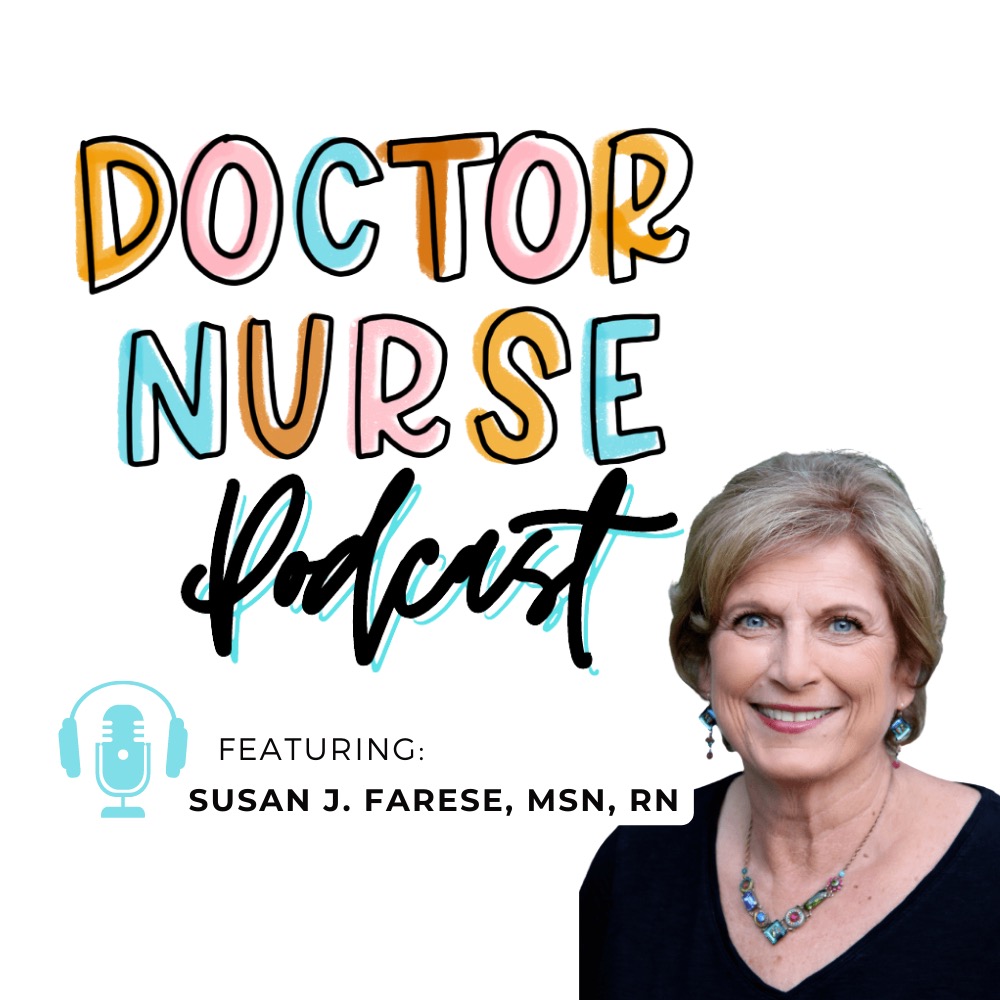
Sandra Pagenta: [00:00:00] Welcome to the Doctor Nurse podcast. I am so excited to present to you. Susan Farese is an MSN RN and CEO and president of S J F communications company. She was a licensed RN starting in 1978. She still holds an active RN license in the state of California. And she has her master’s degree that she obtained. In 1986 an adult master’s degree in nursing.
She had some time where she worked in the military. She’s done a mere rad of nursing jobs guys there. I don’t think there’s any job that she hasn’t done. I had to start with what she hasn’t done because she’s literally been everywhere. I believe she’s also a legal nurse consultant.
She’s a nurse auditor. She’s a continuing education provider in collects review instructor. She’s literally doing. Everything. Just an incredible career and amount of time in the nursing field that she’s been really pouring herself into it. As of late and her most recent role has been this owner and president of the [00:01:00] communications company where she works and does PR marketing, social media stuff, writing public speaking for clients that are needing someone to kind of go out and spread the word about whatever it is that they’re doing. And something really special that I really like. And that’s what made me wanted to reach out to her and really talk to her was that she wrote a book called the poetic expressions in nursing sharing the caring.
It is a book of poems that she has written about nursing. And what’s going to be really neat today on today’s episode, she’s going to write. One of these poems. Susan welcome. You’ve been an entrepreneur since the 1990s. Let’s dive right in Susan.
Sure. How would you describe your current role and your job title?
Susan Farese: Okay. That’s a great question. I am the owner and president of SJF communications. I’ve been doing this on and off since 2002, but since 2016, I’ve been freelance PR public relations. I do websites, marketing PR publicity. Social [00:02:00] media, I’m a writer, I’m a blogger. I kind of do it all and it’s just me. I don’t have a team or an intern or anything. And I keep saying every year I need somebody. I need somebody. So maybe this year, the year, but I’ve been doing this as a freelance Provider of communications since 2016 and love what I do love spreading the word always has been, interested in that.
But, I do keep my nursing in my heart and I use my nursing skills in a different way.
Sandra Pagenta: Yeah, that is really neat. What is your day-to-day look like? Are you involved in meeting out with your clients, connecting with them, figuring out what they’re needing, how
Susan Farese: do you find clients? Well, first of all, yes, I have a diverse type of client.
I’ve worked with. Mostly the entertainment industry. So theaters, filmmakers, musicians authors, many authors most recently artists and businesses as well. This has been, like I said, since 2016 as a freelance PR I do not look for clients. They [00:03:00] find me. So you know, that word of mouth thing, it’s taken a while to, to establish myself.
But the way I got started in PR was in 2011, I was asked to do PR for a theater of a professional regional theater here in San Diego. And so for five years I was there and I knew all the people in theater that way the press and media and all. And so I started with theater and then somehow. People started mentioning me and reaching out.
I’m also on a few databases. I mean, sorry, like websites where I’m listed as a virtual assistant, as well as PR for authors. My clients have been so interesting. They’re all different ages. Most of them though are over 50 and are really. I’m not comfortable with social media, getting the word out, especially authors, they’re really into their process of writing the book, so into it.
And then it’s time to promote. And you need to think about promotion before you get the book finished and planning., but as far as nursing, you know, using my nursing with PR. I’ve used the nursing [00:04:00] process with every client. I assess what we’re going to do. We make a plan, we implement it. We see what works and what doesn’t work.
And we evaluate sometimes the client is a great match. Sometimes it’s an okay match. And sometimes it’s not a good match. And so my assessment skills are that using my intuition also to say, this might not be a good match for me. I can’t wait to work with this person.
Sandra Pagenta: I love that. Take me through your journey from the time that you decided I’m going to be a nurse back in the 1970s to now where you’re doing something that seems unrelated, but is related. Take me through your process from that point.
Susan Farese: I went to a BSN program, originally graduated in 78 from Weidener university in Pennsylvania, and my home state is New Jersey.
So I was kind of close to clinic, close to home, a few hours away. After I received that, I went right into the army as an army, a Navy nurse for three years in general medicine and cardiothoracic surgery, step-down telemetry. And then I transferred to the army nurse Corps. So I was in the Navy nurse Corps and then army [00:05:00] north scarf for the next nine and a half.
The total of almost 13 years active. What is the difference between those? It’s just a different service and it’s just mostly a paperwork transfer because the rank transferred. When I left the military in 1990, I was a major. So as an officer major and, and had absolutely really great experiences in diverse nursing settings. When I transferred to the army. Oh, let’s see. I started in SIQ recovery room ER, after, ER, let’s see orthopedic surgery then graduate school and then outpatient clinic . And nursing education again and another ICU.
Sandra Pagenta: These are military hospitals or just so those
Susan Farese: were, yes, they were, those were all military hospitals.
And then I went for my master’s degree at Seton hall university, which was my home state while I was still in the military, they sent me for my masters. So it was just a really fulfilling career. Lots of reinvention and change because it [00:06:00] was it’s the way the system works, where every year to three years, we just were given another assignment either to move geographically or within the hospital.
That has really made an impact on my life because I embraced change and reinvention and I don’t stack. So if I know that something’s, it transitions.
Sandra Pagenta: I think you used to being uncomfortable, which is really cool. I mean, we’re creatures of habit.
We want to be where we’re like, oh, I know this magician precious, but this is Nope. Don’t ever get comfortable. It’s time to go. That’s kind of nice.
Susan Farese: And I’m a lifelong learner. So if I am transitioning, I learn as much as I can about what I’m going into, you know, and it’s a lifelong process.
I’m always.
Sandra Pagenta: When you came out of the military, did you go straight into
Susan Farese: entrepreneurship? I did. I did. I wanted to be an entrepreneur. I had done the Myers-Briggs and my type was an ENTP, which is the entrepreneurial intuitive. Logical thinker and perceptive and spontaneous as far as making decisions and living life.
I didn’t fit in the basket of a [00:07:00] typical nurse or a typical military person. And I came out of those two systems, but I also love systems. I had taken that assessment and went as a gift to myself. When I transitioned out of the military to become a consultant.
The Myers-Briggs and I did a lot of team building and conflict resolution with my consulting and my nurse entrepreneur business back then it, it taught me that it’s okay to have different styles so that we need all different people on the.
Sandra Pagenta: When you were consulting, what was your consulting business on?
Was it the legal nurse consulting? Because I not legal nurse
Susan Farese: consultant, not yet. So from 90 to 98 I had started prosper development systems, which stood for professional. Staff personal development, because I was teaching a lot of topics for a junior college as an adjunct instructor for their clinical.
And I also was asked to do, to develop continuing education programs on a variety of professional development topics. Once I did that, they were, they said there w once you develop a program to give for C. They are yours. So I [00:08:00] combined, you know, goal setting like you have your smart goals, they’re on your website, goals, conflict resolution management and leadership values, clarification, stress management.
Critical incident, stress debriefing. And what I did was I also kept every program that I did from the late eighties on, onto my a CV. So it immediately establishes your credibility. So this is for all your nurses out there that do in services or, you know, CE programs keep a keep tally on that for your CV.
It, it comes in very handy when you’re, Looked at on the
Sandra Pagenta: web. Yeah.
Susan Farese: So it’s good advice for, you know, for those first eight years or so. I did prosper developments. And then I became a mom a little bit older in life in 2002. 98 to 2002, I took a little bit of a mama break. And then in 2002 started SJF communications.
Yep. And that’s when the legal nurse consulting started research at duke. I was also working at duke university and [00:09:00] research clinical research and worked on four different studies.
Sandra Pagenta: Purchases like a, like a coordinator and
Susan Farese: research coordinator and the other research nurse. But I was also running SGF communications with legal nurse consulting as on and off at that time.
But I worked in cardiac anesthesia research, cardiology, research, headache, research. And stroke prevention in a fifth study. So that was really cool for about two years or so, at least. And still was running the business a little bit on the side. So you could do both,
Sandra Pagenta: you know, honestly, I’m going to take a break and say, I feel like I could just do a multiple podcasts, all the jobs you’ve done
Susan Farese: and I’m not even halfway done, but I have to hurry.
I know I’m trying to go fast here. I’m from New Jersey originally. I’m very fast.
Sandra Pagenta: You’re doing legal nurse consultant thing, growing your PR business on the side? No, not
Susan Farese: yet. With PR though. I was still nursing topics, teaching legal nurse consulting.
In Boston. I started acting and believe it or not, I put nursing on my acting [00:10:00] resume. Good point if you’re ever doing acting. And I was, I got my sag card with Ricky survey’s comedy, the invention of lying back in 2008. And then I started, I was nurse three, no lines, but with the principle actors edge of darkness, so I can play a nurse with my demeanor.
I don’t need any lines. I could just,
Sandra Pagenta: so I got into, I
Susan Farese: had the best time and I keep my sad cards still. The transition then when we moved here is when I got into in here, meaning San Diego in 2011, we moved here and I started with the PR. So I have evolved with mostly con you know, nursing and communications, because acting as communications teaching, continuing ed is communications.
So you can combine your love of nursing with other creative avenues. In many fields and I’m not done, I’m still, I’m still looking for opportunities to develop. The best that I can be. I love that
Sandra Pagenta: my heart just like [00:11:00] explodes hearing, and I’m not done. Like there’s just this continual pushing and persevering and moving forward that I can see in your life.
And I can see as I’m talking to you, that is so inspiring. For the nurses listening out there right now, You aren’t done just because you’ve become a mom and you’re taking a break just because you think you might enjoy some hobby and you’re not necessarily doing nursing. You’re going to find that these skills translate into something else.
If that’s what you want to do and you don’t have to be at the bedside.
Susan Farese: Exactly, exactly right. When I became a nurse entrepreneur, that was the other decision I had to make. And even in the military, after getting my master’s, I could have been a nurse practitioner and many different duty stations.
And I chose to do a nursing administration track and chief nurse track because I had a little bit of role conflict. So I wanted to tell your audience too, if you feel uncomfortable with, you know, I know Dr. Sandra, you had that little issue with med surge nursing in the beginning when you don’t feel [00:12:00] comfortable in a setting that you’re in for whoever places.
Really examine them and think about it very deeply in your heart and talk to whoever you need to talk to and see if it’s time for another transition and speak up. Because I did not feel like that, the nurse practitioner role was the perfect role for me. And I’m glad that I did that because I would have felt a little bit more insecure in that role.
Whereas I was much more secure as a nurse entrepreneur, creative. And now PR it’s just what you’re matched with and what your skills are and your sensitivity to, what your story is basically, and what you feel comfortable with
Sandra Pagenta: Susan. What about the nurse practitioner role? Didn’t you like despite getting a master’s degree and being able to do that?
What did you find when you got there? You thought this isn’t for me,
Susan Farese: I thought that if I missed something in diagnosis or assessment, it would be so tough to live with. That’s what I that’s really the, the truth of the matter. So I was honest with myself and I could have been a [00:13:00] clinical nurse specialist, which I felt much more comfortable with.
However, the opportunity came to me and the choice came to me. What do you want to do? You want to go? We have these positions here. This is getting out of the masters, still in the army. And I chose to be the chief of a large outpatient clinic, which was another phenomenal opportunity. Where I could teach, which is what I wanted to do and lead
so I learned other things and I think my master’s program really taught me about being a change agent and embracing change and not being afraid of it. Yeah. So,
Sandra Pagenta: and then all the training that you had before with switching jobs, you’re just really open to that, which is really cool.
Right. One of the things that you haven’t touched on is that you’re an author and you wrote a book about poems, about nursing, which when I saw your YouTube video on this, I was astounded because I was like, this is so deep and, so emotional that you would pour your heart into.
You know, the night shift and all the different things that you were doing it. I was wondering just for my [00:14:00] listeners today, if you would read an excerpt of one of the works of art that you did. Sure. This is such a creative, a beautiful creative outlet. I think Sharon, to hear,
Susan Farese: I would love to read it, but I, can I tell you the little story of how I got into poetry first, please?
Because that means that that changed my life actually. Okay. Growing up in New Jersey. From age eight to 14, my maternal grandmother had early Alzheimer’s. She was only 60. When she died. She was institutionalized before she died. Because at that time, nobody knew what Alzheimer’s really was. There were no daycare centers.
It was not safe to keep her home at the time because of danger possible danger to herself or to us. My mom and dad, you know, they made the decision. She had to be institutionalized. She was really a danger. And so I grew up visiting her at a young age, in this institution, in a psych hospital.
And that first of all, went into my heart and made me a caring, empathetic person. Well, flash forward, she had passed away [00:15:00] in 71 at age 60 in 1991. I went to see the movie awakenings. Robert DeNiro, Robin Williams were in there and it was directed by penny Marshall. And in that movie, there was a character that sat in her wheelchair.
Her name was Lucy the character had a red ball in her hand. She was in a wheelchair and she had a gaze about her face that reminded me of my grandmother on her death bed. What, the day before she died. I started crying in the movie theater. I was with my husband. We were newly married at the time about a year or so.
So he didn’t know who she was because she had passed away 20 years prior, went home. And the following week, my husband was on a business trip and his one night I couldn’t get to sleep. And I just kept thinking about the movie and my grandmother and I had a glass of wine. I couldn’t get to sleep. I took a bath, I couldn’t get to sleep.
So I grabbed this journal that he had given me the holiday before that was blank. And I sat on the couch all by myself. And this poem poured out of me. That was like three or four pages long. It rhymed. It was in sequence from childhood to 20 years after [00:16:00] her death as a nurse in 1991. I grew up in the early sixties, late, late fifties, early sixties.
This foam was so incredible. I was smiling, laughing, crying, while I’m writing this. It was like this thing that went over me called my mom the next day, read it to her. She started crying. She said, it’s the closest thing to what we went through back then. Cause we didn’t talk about it for 20 years. Nobody talked about it.
And so she said, I want you to share this poem with everybody. So at that time I was in Florida as a nurse entrepreneur. And in any group, like a chamber of commerce meeting or a nurse educators meeting that I would be involved with, I’d say, can I read this poem to you guys? And people would come up to me.
They be crying. They’d need tissues. They’d want to talk about their aunt, their grandmother, whatever it related to people. It touched people. And I’m like, what do I do with this? This is amazing. Got chills. So I started continuing to write poetry and in 93, my book originally came out. So this book now is a second edition and it was the same title with a nurse on [00:17:00] publishing company.
And she is since deceased. The company has no more. So I wrote the book in 93. As a a compilation of at least 40 poems from just different things in my nursing life, in my family life with illness, death in the family, things like that, just a variety of poems I’m struggling. When HIV aids was new coding, what’s what goes on in a code day shift night shift home healthcare.
A nurse practitioner things too. You name it? It was in the book that was 93 at first. And then I put the poetry down a little bit for quite a while. I got busy with motherhood and, and just everything. And then all of a sudden, about three years ago, a writing group that I was in because I did blogging and.
I was promoting authors. So I was involved in the writing community and they asked me to do a haiku work. For brain injury patients and their caregivers. So I started doing the haiku workshop and that led me to do them for the last [00:18:00] couple of years at the libraries in the San Diego county. And I was almost ready to get a big contract to do it for the next few years with the county, for the county to pay COVID and then COVID happened.
So during COVID I kept writing about COVID like, why are they having. Press conferences holding onto the podium and not, not math and putting the mass down here. And, you know, everybody was confused about it in the beginning. No, it was, it was, it was scary. I was angry. I was crying. I was going through all these emotions.
So I kept writing. And so I said to myself in 20, late 20, 20, I said, I’m going to redo the book and I’ll add some new high and some of my nature photography. Cause I’m a photographer, a birdwatcher. And so. The book is out there again as a second edition, poetic expressions and nursing sharing of caring.
And I love doing these podcasts and getting the word out to nurses because nurses, I know it’s been extremely tough the past couple of years. Depression PTSD, everything with COVID [00:19:00] and anxiety, even suicidal ideation and suicide. So I wanted to release this again as a way to give back to nursing and celebrate nursing and also encourage nurses to.
Right. Whether it’s a journal or do something creative, a podcast, a cooking show sports exercise, anything that’s creative theater film. You know, I thoroughly believe that the creative arts are extremely therapeutic and cathartic. So my choice happens to be poetry. I’m also, I took dance lessons when I was a kid.
So dance is fun. You know, humor is fun. Anything that can get you out of that space, where you’re stressed out as a nurse? I can’t, I can’t say enough about how strongly
Sandra Pagenta: about that. I.
Oh, God, what did I do? No, no, I believe what you just said is so poignant because it really is the cure. It may not cure it, but it sure [00:20:00] will alleviate the pain of burnout. As you’ve been going through your career and you’ve been sharing that, you’ve been moving into all these fields and doing different things and staying true to the things that bring you joy and connecting back to that and finding ways to get those emotions out of you.
You have been healing yourself from whatever from the, either the COVID pandemic that so many people yeah. Suffering people are being wounded and hurt by this whole pandemic and the way that we have handled it and the things that we have done watching what you just said, hearing what you just said was like listening to somebody who say, this is how you mend your soul.
Absolutely. And it was so beautiful. It was like, I, at first I was like, Take this moment. This is a big moment. Yeah. I was like, I need to just sit in this for a second because I so believe what you just said about journaling and sitting alone and being quiet and seeing what’s inside of you and writing that stuff down.
And another podcast [00:21:00] episode, we had talked about how nurses just stuffed stuff down and we just moving, but the poetry has been this beautiful just expression for you to just let your soul grieve, let your soul kind of push that stuff out in a way that can really affect people and touch them. And I just think that is.
Like literally.
Susan Farese: So we had a fall. I love that. And it validates the other person that reads it or listens to it too. I did a workshop a few months ago and I. I think it was night shift, actually that poem. And I saw the nurse in the audience going yup. As I was reading my post, she was validating.
Yes. I’ve been through that. Yes. So yes, I would love to read night shifts.
Sandra Pagenta: Did you, did you write that poem? Like right after a night shift, like give me the context of the poem.
Susan Farese: You know, it was so long ago. It’s just that I work many, many, many night shifts in the military and rotated.
Before the 12 hour shifts started, it was the eight hour shifts. So we would do, a whole week of nights or [00:22:00] whatever, and then have a couple of maybe two or three days off then do evenings. And then do days like we were rotating three. So talk about circadian rhythm being messed up. but I love there was something about night shift that just really touches me in the heart because it was the time that, well I’ll read it and then you’ll understand.
Would that go through it? Okay. Night shift night shift. So dear to me, despite its circadian disruption, the nocturnal rhythm sublime. So inviting, so relaxing making rounds with flashlight in hand and night, vision intuition, the serenity envelops me side rails up. Call bells within reach bedsides, tidy breathing in secret.
Snores and noises unspeakable during prime time status quo during night shift, gentle and peaceful, those who by day lurk and cry and pester. And now between midnight and seven are compliant and you’re in for peace as well. I last time to [00:23:00] review and verify and stuff and thin the charts time to read the progress notes.
Finally, a time to put it all together, like spies looking for the clues of their lives. One is truly lucky. There are some shows in patients who decide it is time during night shift to ventilate, truly share opening up the dam of their fears, thoughts, feelings, even sharing stories, enhancing our knowing, oh, please.
I yearned for these nights when the nature of nursing facilitates the connection of lives.
Sandra Pagenta: Yikes. This is very beautiful. I love that. You know, so true. I know too. I heard it when I heard it, on another YouTube video, I was watching a view. I said, I want her to, I want to hear it from her. , I just want to hear that.
The poem and it’s so beautiful because it does transport you to those little micro moments in nursing. You start to realize that those little micro moments are the big things. They are, the transformative things that’s [00:24:00] why a nurse can never be replaced at the bedside by a robot.
It’s just, we do incredible work for people. And as I, again, as I hear your, your poem, I get transported back to the floor and I see those little moments where you’re right. Like patients are coming to you and they’re just happy to have you in the room talking to them and sharing their life. Yeah. Oh
Susan Farese: emotional.
Well, I remember I was missing when I was a Navy nurse. So early in my career and I worked a lot of nights and all of a sudden there would be a couple of guys that were Vietnam, vets that were in the day room. We called it the lounge, the solarium, whatever, and they’d be smoking. And so I’d go up to them.
I was very bold at the time and I’d say, you know, put that away let’s chat. And you would not believe the stories that came out with these guys. They had PTSD. Nobody knew what PTSD was back then. Nobody’s said it, nobody had a diagnosis really, or treatment or support. Night shift is very special to me because that’s when I bonded with patients in a different [00:25:00] way.
It wasn’t the hustle bustle. Cause I’ve got poems about day shift to where everything is. Go, go, go, go, go. And yet some people thrive on that. But it’s also exhausting and you need to, you know, decompress a little bit. The other thing besides the poetry and creative arts is go outside and look in nature, get out.
And maybe bring your phone or a camera and take a look at, use your senses and find something that you see that just, oh, is amazing. And majestic like a hummingbird, which is my little mascot on the book. Cause I watched them from my, my balcony here up in my room. and take note because nature is so therapeutic as well and recognizing it and then, and poetry helps you, get out your feelings, but it also examines if you have a conflict in, in your mind or a values clarification, if you’re angry at someone, it’s amazing to get it out.
And I like poetry, especially haiku the short version of the Japanese poetry, because it’s more succinct and easy. You know, there is a formula and [00:26:00] everything, but it’s, it’s easy to do. And it’s based on the census and the seasons. It’s just very, it’s delightful. When you can write a haiku, either a positive or, or one about a bad day, just very, very reflective and it’s just impactful.
Sandra Pagenta: So, how did you learn how to write poems? Or is this something that just naturally was inside of you? It
Susan Farese: just was naturally inside, but I’ll tell you, I do have good rhythm from dance. My mom was a dance teacher and a singer way back when. And so I took the amps lessons for about eight years when I was a kid.
And I always, like, I took tap and jazz and ballet, and I think the. Did I took, gave me good rhythm. I also have a drum that I bought when I was on a trip in Spain, in high school, and I am so ready that that’s going to be my thing for 2022 is to do some videos, you know, and maybe I can drum while you do your, I love your videos by the way.
I absolutely love they’re so cute and funny. Sky’s the limit on what you can do. I love that.
Sandra Pagenta: Oh, that is, oh, that is just such, [00:27:00] such the line for 2022. Throughout your career, I know you’ve had highs and lows. Can you share with me a challenge that you had to overcome throughout your career that just sticks out to you in your mind and then maybe a really high, a real big success, a win a moment that you felt like this is the tip.
Over the peak. This is cool.
Susan Farese: Give me one. Well, I gave you the nurse practitioner when that role conflict that I had. So that was, that was one. I felt like I was bullied once. I’m not going to go into specifics. Yeah. In a time when I was vulnerable with something personally, like commuting with my new husband in different states because of the situation with being in the military.
And that affected me in my heart, in my soul everywhere. And, you know, what. I made a change and I got out of the bureaucracy and became a nurse entrepreneur. That’s what healed me. So I, you know, because I’m a systems person and it made me value that, Hey, I really get systems. And if I can change the [00:28:00] system, whether it be, design a certain clinic for women to come, and I got an award for, or whatever, if the system bugs me, no matter what, if I’m in the pharmacy picking up a medicine like last year, There was a bad system and it just irks me and I’m like, it could be much easier if you change the system.
So, so the bullying happened at a time when I was very vulnerable and I got through. And still to this day, I think of how I felt then and how I didn’t know how to really reach out for support. So I want nurses to know that, you know, we’re not super human. We have things that happen to us. We have families, we have this function possibly, we have the, we run the gamut of everything and we need support to, we need to reach out.
And I did not really reach out because of the system that I was in. At the time. So I got through that. Whenever I do get like uncomfortable in a situation or I, I use my intuition and that’s another nursing gem that we all have. We have good [00:29:00] intuition and I follow it. So sometimes I transitioned because of what my gut is telling me. It’s time to move on or, you know, this just isn’t working, or I always wanted to learn about this.
Maybe I should go into this. I just explore , different things. Right now, actually it’s, it’s, it’s a sad point, but my parents are on the east coast. I’m on the west coast, their elderly. They’re going through situations with COVID, you know, they all COVID and whatever, and it’s hard for me to be so far away.
And yet I have a family here, so I’m sandwiched as we all can be, so there’s difficult times, but I try to, I kind of immerse myself in work as much as I can and, and, you know, spending quality time with my family. And then visiting them as much as possible. We’re human, it’s okay to seek help.
It’s okay to talk to people and also to do something creative, to get the stress out.
Sandra Pagenta: As far as a high in, throughout all your careers, what would you say is a moment that’s just been [00:30:00] like, you look back in your life. That was, that was a good day. Okay.
Susan Farese: Well, I have so many highs, really the whole book thing, the whole thing, but when I was my, when my husband.
He got a job in Sweden, not got a job, but we transferred with his company to Sweden for about a year. And I thought, before I go there, I’m going to maybe connect with people and see if I could do something besides being like a wife there. Right. So I reached out to see what they TA I was a member at the time and I felt I got some connections with some of the universities and I ended up doing 17 continuing education programs in Sweden.
Throughout Sweden, or we take the train. I was all over and I spoke about nursing in the USA documentation do’s and don’ts the poetry and lecture that I would do and had such a fabulous time creating an opportunity for myself. I did go to the museums for a few weeks. I took a course, and that was fun, but it was like, I wanted to feel purposeful.
And I had the blast of my life. Like I said, the [00:31:00] poetry is another one. I’ve had so many cool clients too. Like I have a, I’m a concert pianist that I work with a Korean concert pianists. We’re working on her next concert, but we got her a book at Carnegie. From California, I’ve done things like, how do you do this?
I don’t know. I just try to do it. And some things work and some don’t I’ve had such incredible clients too. That’s the high of my career because each one, I mean, I’ve had psychiatrists, psychologists reach out to me, artists screenwriters. I will say that my work is fabulous every day, some days it’s routine and mundane, but most of the time it’s, I like getting up and I like making my own hours. Last night I was up until at least 10 or 11 doing work, you know, sometimes I’ll get up really early and work. So flexibility is something that I chair. And value. And when your
Sandra Pagenta: work is very purposeful, when you’re doing it, it doesn’t feel that way. It just feels like an extension of your purpose, an extension of your calling, an [00:32:00] extension of what you’re meant to do. And so you do find that the energy that it takes to do it is from a different vein. You’re not tapping into the same vein as. Monotonous work. Have I got to do this to get a paycheck, this exact same thing. Like you’re saying, it’s just this extension of what you just feel called to do. I just need to do it.
Right.
Susan Farese: Like somebody needed a website. So I learned how to do websites besides mine, going to a course in 2014 and building my WordPress website, I work with other ones like Wix GoDaddy. Whatever the client needs. If they have a deficit. Okay. Nursing deficit. Okay.
Deficit, critical thinking, we assess, how can I help you? Okay. I can help you with your social media. We could do your website. We can do an ad on Facebook. , we just run the gamut of what will make their presence visible and non-threatening and safe and all that stuff. So
Sandra Pagenta: That’s really cool.
That’s really neat. And Susan, have you had any mentors along the way, anybody that’s come along that you would like to [00:33:00] say is really helped you in your career?
Susan Farese: Well, I didn’t tell you the story of my first job. Did I? No, no. A mentor stepped in with my first job. I worked general medicine in the Navy, young 20 something.
Okay. Right out of school. And it was general medicine and we had a lot of different types of diagnoses, several deaths. I’m young. I don’t know how to say this is scary a little bit, and uncomfortable. So one day nursing supervisor from evening shift was making rounds and she came up to me and she must’ve seen something on my face and said, by the end of the day, I want you to tell me how much leave you’re taking vacation and where you want to work when you come back. And I said, what? I was burned out in my first. Okay. I didn’t realize it. And she saw it and I wasn’t even really close to her. She just happened to see something in me, maybe I just was going through motions and I just wasn’t happy.
I didn’t seem like my joyful usual self. So that was one mentor. And then I have many in the [00:34:00] military and in nursing throughout the years And I’m still friends with them. You know, I . They’re just so special and for different reasons, I’m just somebody that takes an interesting with you.
They’re not a parent, they’re not necessarily your boss. They could be your boss, but they’re probably not your boss. And they’re just your cheerleader. They’re looking out for you subsequently. I am a mentor. At San Diego state university, I’ve been doing this since 2016 or 17. When our daughter was a freshman, they have this phenomenal program, the Aztec mentor program.
Either alumni from there or parents of freshmen get invited to be mentors professionally. So I said, okay, I’ve done nursing. I’ve done PR why not? I’ve been doing it for five years now. And I’ve had at least 10 or 12 students altogether. now we’ve been meeting virtually, mostly with COVID, but I would go to campus every couple of weeks and we just gauge what’s happening.
We can look at career opportunities after graduation. Master’s programs, how’s your stress [00:35:00] level. Show me your resume. Let’s work on that. It’s that kind of a person give and take. We both get something out of it too. I grow from every student that I work with and then they do a nice testimonial for me.
I put it on my website or on my LinkedIn and I do one for them and it’s full circle. Seek out mentors that you look up to that you, you know, you watch and they just, there’s just something about them that really. Hits the spot professionally, that just, you just admire, and you want to learn from,
Sandra Pagenta: do you use as a metric when you were looking for mentors, what were things that you looked for in a
Susan Farese: mentor?
I don’t think I ever really looked for a mentor. I think they just happened. I think that circumstantially, they just happen. So I was in situations where I get to know someone. I mean, someone that I was in their podcast last week, Dr. Stout. Interviewed me. I was, I was her PR for a while, but I watch her and we’re each other’s mentors and she called me.
You know, like a mentor and a delight the other day in this [00:36:00] podcast, I’m like, I’m a delight nobody’s ever said I was a delight. That’s so cool. You know, very delighted. It’s a give and take, and she’s just so awesome. And I just admire her so much. You can be mentors to yourself too. It doesn’t have to be looking up high at somebody.
It could be a cool uncle relationship as well. What you get out of it. And professors, several professors of mine in my master’s program also. So, yeah, it’s a variety of people.
Sandra Pagenta: The last question I asked is to give a piece of advice to a nurse that you wish you would’ve known at the beginning of your career and a piece of advice that she can toss.
One to keep one to task.
Susan Farese: To keep is what we spoke about today is if you are unsettled, if you are, if your intuition is telling you something’s not right, speak up, get help. Don’t be an also, don’t be afraid of transition and change. That’s what I like. And I think that should start at the beginning of the nursing career and also to follow people like you and look up people on social media that you can follow as [00:37:00] mentors, or just to learn more information about different areas of nursing.
And then what was the other part that, to throw away a
Sandra Pagenta: piece of the toss? Like if she hears this, don’t listen to it. This is
Susan Farese: garbage. The whole nurses either. I can’t stand that you don’t have to eat you’re young. You can be kind. I think we need more kindness in nursing, but when you hear that, just throw that away and say, well, it can start with me and I will cultivate somebody and bring them up or, support them or whatever.
So I would go out nurses, eat their young. And I’ve seen it, but I think that it’s not worked and I’m a nurse with how many years now?
Sandra Pagenta: A lot of years. Yeah. So 40, almost 40 years. For my listeners out there, guys, if you feel like you’re not in the right spot, this is not good for you, whatever it is that you’re doing.
And it’s creating a lot of unhappiness and depression and anxiety, it’s time to make a move. It’s time to move towards the things that you remember that bring you joy, either writing [00:38:00] poems or, dancing as you described or whatever it is that lights up your soul. And. I feel alive, do that, and then find the points in whatever it is that you’re doing that intersect with nursing and try to find something that you can do.
That’s in that zone of strength and passion and nursing, and it’s crazy how much you find that it overlaps. Susan for the last part of our interview. It’s the rapid fire question. Ooh.
What is your favorite season of the year
Susan Farese: spring? Because my birthday’s in April and I just look like right now in San Diego, we’re in spring, like winter ended and I’m looking out the window and I see my hummingbirds on the feeder. They’re starting to come back. Birds are singing. The sun is shining, but I feel bad for people on the east coast.
That are still enduring, the winter, but spring is. Love flowers, flowers, blooming, and all that. Yeah. What’s your
Sandra Pagenta: favorite color?
Susan Farese: I have to I liked the combination of like purple orchid and a teal [00:39:00] Aqua kind of thing.
Sandra Pagenta: And then I guess I feel like I know this because I’ve been talking to you now and I feel like I know what your favorite animal is, but what’s your favorite animal?
I
Susan Farese: love to watch the gorillas at the zoo. I could spend hours hours at the San Diego zoo is like phenomenal, phenomenal. I do like, and of course hummingbirds are like my, my little mascot. Yeah. They remind me of day shift, you know, fluttering around and watching everybody. There’s actually a poem in the book called, the mirror image. That’s what it is.
Sandra Pagenta: It’s about birds.
Susan Farese: Yeah. Do you want to hear it? Yes, of course. The mirror image. Like the bird in brisk flight all over creation, dropping in and on creatures, nurturing and nesting from one Haven to another all times, day or night.
So is where maybe the nurse, like the bird who harvests and sharps and sometimes whales when someone or something invites, invades their turf. So is where maybe the nurse, like the bird that flocks with their own kind or others diverse for flight and frolic monitoring all with watchful, eye and Intuit.
So is where [00:40:00] maybe the nurse yet, unlike the bird, who’s comfortable in the sky and wary of land, the nurse uniquely knowing unafraid commands, the sparrows needing care, whether on land, sea, or air and embellishes, these adventures with flair. Unlike the bird, unlike the.
Sandra Pagenta: The way you paint the picture, with your words. It’s so true that the themes in nature, those rhythms are echoed in the different things that we do. You just capture that so beautifully. Thank you, Susan. You’re incredible. Where can people find you buy your book? I mean, give a shameless
Susan Farese: plug.
SJF communications.com and then I have different pages for the book and presentations. I’m doing interviews client’s testimony. So learn from me as the PR nurse for you guys. If you have a website, put the right menu pages on it, so people can find you and understand what you do and declare what you do and be proud of it.
And because nurses do it all, [00:41:00] and you need care for yourself. Remember that to support yourself, find support. And let’s all be kind. I never really learned that value. Like really, really learned it. And as an adult and a parent of a 20 something and looking at society, how it is, we need to be more kind to each other.
And if you look at social media, how rough it is sometimes. Yeah. Let’s all be kind to each other. I’m learning as we go along too, because I’ve just been kind of dogmatic and, you know, transitional and. Working hard and all that, but think about kindness. I think that’s the one lesson in the last couple of years with COVID too, is, nurses have it tough now with things I’m reading on social media, like violence against nurses and just the way family members might treat them and stuff.
It’s just so sad. So kindness find a mentor, be a mentor, have fun with whatever you’re doing with work. If you can. And if not, Listen to your gut transition. If you need to.
Sandra Pagenta: You’re the nurse [00:42:00] mama. We all need. You’re nursing all of our souls. So thank you Susan, for your time today and sharing your wisdom and your journey with my, with my audience.
That means a
Susan Farese: lot to me. Thank you. Thank you so much. And thank you, Sandra, for what you do. It is amazing. I cannot wait to keep watching all of your wonderful. Instagram videos. Are you on tech? Talk
Sandra Pagenta: to, I am. So the problem with tick-tock and I wonder if people, cause they probably think that I haven’t been doing it when I scroll through tick-tock I’m concerned because I think that they have different parameters and my kid will be there.
And so. Want to scroll through tick dog with my kid. Yeah, exactly. He’s so young and I don’t exactly see things. So I’ve kind of stepped away from that app. Cause I don’t really feel like it does a tighter job of saying like, Hey, this is sensitive information before you get going, don’t just click.
Susan Farese: As far as social media, I’m SJ, F Como, C O M M O S.
JFK. On Instagram, Twitter and tech talk. And Facebook is SGF communications. And LinkedIn is my name with the MSN RN after it. Okay.
Sandra Pagenta: They can [00:43:00] find you there. Thank you, Susan so much. Appreciate it. Take care.
Podcast Description
Susan J. (Felice) Farese, MSN, RN, a native of NJ, received her Bachelor of Science (BSN) degree from Widener University (’78) and Masters of Science (MSN) from Seton Hall University (’86) (Adult Primary Health- CNS/NP). Her diversified nursing career includes military (’78-90) and civilian nursing within inpatient outpatient and academic settings- including experience as a clinician, educator, administrator, consultant, and nurse entrepreneur.
Susan has been an entrepreneur on and off since 1990! She is the owner of SJF Communications PR in San Diego. https://sjfcommunications.com
Poetic Expressions in Nursing: Sharing the Caring: https://www.amazon.com/Poetic-Expressions-Nursing-Sharing-Caring/dp/173697761X
Doctor Nurse Links: https://linktr.ee/DoctorNursePodcast
Wanna start a side hustle? Subscribe to the Doctor Nurse Podcast and I will show you how to start: https://view.flodesk.com/pages/6253188857d9b15fd00f8329
Latest Episodes
Doctor Nurse podcast brings you weekly shows to help INSPIRE, EDUCATE AND EMPOWER nurses with true stories of initiative and impact.
Doctor Nurse podcast brings you weekly shows to help INSPIRE, EDUCATE AND EMPOWER nurses with true stories of initiative and impact.
Latest Episodes
Doctor Nurse podcast brings you weekly shows to help INSPIRE, EDUCATE AND EMPOWER nurses with true stories of initiative and impact.