Also Available On






Sandra Pagenta: Welcome to the podcast, David. I’m so happy to hear about your journey and kind of how you got to this spot that you are today in your career. I’m happy to have you on.
David Metzger: Yeah. Thanks for inviting me excited to talk.
Sandra Pagenta: Let’s take it from the top. How would you describe your current job title and your role? What do you do for a living?
David Metzger: I am a pediatric oncology nurse and take care of kids who have cancer hematology disorders. Many of them go to bone marrow transplant. So these days, primarily a bone marrow transplant nurse which shout know how much about pediatric cancer, but it’s kind of the last stop for many of these kids.
Have the really refractory cancers. They’re either going to get a bone marrow transplant or they’re going to die.
Sandra Pagenta: I actually wasn’t oncology nurse for adults have never had to actually treat children. And it was one of the things that I knew I could not physically emotionally handle. So but I did do a stint in the bone marrow transplant unit.
So I do remember taking care of adults that had [00:01:00] gotten. Bone marrow transplant. I cannot imagine what it would be like to take care of children that needed bone marrow transplants. So what led you to, I guess, becoming a nurse? Oh, well, that’s not all you do, correct. that’s an incredible part of your career, but that’s not the only part of what you do, correct?
David Metzger: Like I said, I’m a podcaster and I do lots of writing. I wrote a book before I was a nurse, I was a sculptor and a painter and I actually had a business making kind of large scale sculptures for hotels and restaurants and convention centers for about six years after.
And then I decided I wanted to do something a little bit more humanistic with my time. So I went to nursing school.
Sandra Pagenta: One of the questions I typically ask people to take me through the moment they decided to become a nurse and what led them to become a nurse. And then walk me through, tell, the spot that they, how they kind of made those micro-decisions and little turns and shifts in their career to where they are today.
And I [00:02:00] guess we can take it from that, from that point. But tell me a little bit about your podcast and kind of what it is that you talk about on your podcast and then a little bit more expendable expound upon what you
David Metzger: wrote about. Yeah, so the nurse pop-up podcasts it’s really about being a human parent in this world from the perspective of a nurse who takes care of kids.
So I tell these very. Typical yet, I’m using stories about parenthood, all my fumbles and mistakes. And I really try to normalize that there is no parent that is perfect. And it’s not perfect being a parent, it’s hard. So there’s that part of the podcast. I tell stories. And I have another segment where called dinner’s Papa, where a listener writes into me and I answered their parent question.
And then I have a third section where I tell stories about nursing. So I really try to kind of hone in on all the [00:03:00] very important parts of my life and, tell a funny, yet really important story about, where I am and how I got there. And the funnest part about my podcast is that my daughter and my son often take part.
Sandra Pagenta: Yes, that’s what I also liked about it when I listened. I thought it was a very interesting and creative way to describe different conversations that you were having with your children. And then also the processing that you do when you walk away. Because as an, as a parent, I really related to that because there are moments that my son will say or do something and then I’ll walk away and I’ll think.
That was a teaching moment for me. And so hearing your podcasts and listening to how you described different moments or different situations with your children and, and how insightful and deep you are
David Metzger: scary. And you listen to the.
[00:04:00] Yes.
Sandra Pagenta: And there’s talk about gaps for sure. And just again, just walking away, thinking, I’m glad I’m not the only parent that. I had to kind of check myself or I had to kind of shift my perspective on something because you’re right where there is no perfect parent, even though, , there’s no manual, you don’t get like a, you’ve read all these books about how to be a great parent, but each kid needs different things and it’s really hard to, to know what children need.
And then also I think that there. On earth to teach us a lot about ourselves. So I think that’s a really cool perspective that your podcast brings to the podcast. Airways, definitely that, that you share. Tell me a little bit about your book.
David Metzger: So the book is called nurse Papa 16 meditations on parenthood from pediatric oncology from a pediatric oncology nurse.
Yeah, the book is really about that crazy intersection of. , caring for sick and dying kids as a nurse and trying to raise my healthy ones. Yeah, at first I was really just trying to tell a [00:05:00] story because as a pediatric nurse and specifically a oncology nurse, there was just so much human drama.
It is just wild. What I encounter every day, it runs the gamut. From joy to terror, to pain, to abject sadness. And I just wanted people to see what people, what other people go through. And that was my first intention, just to start writing these stories down and it changed, like any like really valid form of art, it evolved.
And eventually I started to look at nursing. Through the eyes of the parents and what I could learn from these parents who are going through these horrible situations and from these kids. And, it just came down to these amazing lessons that I wanted to show to other people.
Sandra Pagenta: Yeah. I love that.
How do you pair it differently? Because you are a pediatric oncology nurse.
David Metzger: That’s [00:06:00] a really interesting question. I might have to really think about that in a way that is really thoughtful, but I am definitely for stuff on, I wouldn’t say I’m hands off, but I let my kids do stuff like, I’ve seen so many kids die and so many kids in so much pain.
And my daughter wants to do something that’s slightly questionable. I’m like, yeah, I did do it. Like live your life. I’m not gonna don’t let me try it on your, on your happy. That doesn’t mean I’m like lip and do something stupid, but sure. I want them to experience life. I want them to bump into things.
I want them to hurt. I want them to love, I want them to laugh. I want them to learn and, all the ELLs and learn, love, laugh. There’s Papa. , cause I’ve seen so many kids have such short lives. , I could have a short early life, , who knows what will happen after this interview, I might choke on a chicken bone.
And how do I know my daughter’s going to live? You’d be eight years old. I don’t think it’s morbid [00:07:00] to think about these things because I think that’s how life works. , I I’m a fatalist. Like I just, I want my kids to be happy. So I think having seen so many intense situations and seen so many short life.
I don’t want my kids to waste one second on their lives. And I want them to, to know how precious it is.
Sandra Pagenta: So that is. Weighty. And as a mom, there’s certain things that once you have a kid you’re just can’t handle. And before I was a mom, I knew I could not handle children and living in, in, in watching that stuff.
But I saw it as an adult. And it does change you even when you see adults dying of cancer and you’re, you’re seeing these things that you’re like I’m 22 years old. I had no idea people were dealing with these things. So that was a little bit sheltered from. And then again, when you realize that children don’t make it until eight years old, you could die at two, , and these different things that [00:08:00] you have to kind of.
Process, and then begin to just act normal, right? With your kid and not be this panicked parent of like, oh my gosh, what is that? , I could see it translating into very clearly, a very easily into anxiety. Very you have now turned it into a meditative practice. Bringing almost like almost kind of feel, and again, correct me if I’m wrong.
It almost feels like a therapeutic expression of what you’ve seen at your job and trying to share it with the world and probably process it and mull it over and, and deal with it yourself.
David Metzger: Lots of processing for sure, but it wasn’t, in some ways it wasn’t an active process. I didn’t make myself do anything.
I just, I am.
Sandra Pagenta so I, I guess I meant like as you write and as you create, does it help you kind of process and I guess kind of, I dunno, maybe meditatively or just kind of. [00:09:00] Spiritually deal with the heaviness of the things that you see or does it not? I mean, I feel like, no, it
David Metzger: absolutely does.
Yeah, it has to come on. So wait, so first and foremost, I am an artist. Like no matter what I’m doing, I’m going to be making a painting, sculpting, writing, playing music. I got to do it. It’s just like in my bones, it’s in my heart. I have no choice. So right now, I’m a nurse on the father and that’s how, that’s where it comes out.
I write about nursing. I write about being a father. It’s just like me just like interacting with the world. And for this book specifically, I had to go to some very dark places. I had to go through some dark tunnels to get out on the other side and to be able to write something that was coherently. True.
Yes. I was always talking, , because I, I, this book isn’t just about me, I interviewed, 30 or 40 people for it. Nurses, doctors, former patients, parents who lost their kids. It was intense process of. [00:10:00] Getting into people’s hearts, like in such a deep way. And that’s kind of why the book is so powerful because you don’t hear just my perspective.
You hear like so many perspectives. And I grew in that process, it was, it was just tremendous. But I would always, as I was having people read the book, when it was, in the process of being written, my question would always be. Now is it good? But is it true? Like, can you read this and is it true?
And that’s all that was important to me that I was making something true. And here’s the thing, Sandra, the truth hurts sometimes if you’re going to be true, you have to be okay with coming off like an
David Metzger: And sometimes I’m an. Yeah. Can we swear on this?
Sandra Pagenta: Typically we don’t
know, but I feel like what you’re saying is, is it’s really weighty. It’s a super weighty. And I feel like if people, especially nurses and in particular [00:11:00] parents, when they read your book and when they listen to your podcast, what are you hoping that they walk away? When they read your work.
David Metzger: So as an artist, I think the biggest mistake you can make is to have a heavy handed expectation for what you want.
Somebody to experience that being said, I want somebody to, , listen to nurse Papa or read nurse Papa and go, Hey, that’s me too. Because like, that’s the best kind of form of art is when somebody can just look at it and completely relate to. That’s when you laugh the hardest and that’s when you cry the most is when you feel like, oh, I was there or I’m going to be there.
And I feel like it’s such a human experience to relate to others and to make art that others can see themselves in.
Sandra Pagenta: Yeah. Cause that’s what I described. Right. Like when I was talking about your podcast, I walked away and was like, yeah, me too. , like, yeah. I can relate to what he’s writing here.
Okay. , one of the things that you described and I’ll just [00:12:00] share this David, because I think it’s something very important, but when I went part-time at my job, it was for the mindset that you just said, and it almost makes me feel crazy to say it because it’s one of those things that you don’t want to talk about.
But I did look at my life and think if I died tomorrow, And again, I think when you’ve been an oncology nurse, you see it a little more closely, right? Like you really do. It hits you in the face a little bit more than other areas of nursing care. But I just remember thinking, and because of had that background, I do tend to go back to that spot and just kind of assess my life.
You don’t know, you could choke on a chicken bone, like you said today, unless you’re a
David Metzger: vegetarian.
Sandra Pagenta: And then if you are vegetarian each other and shake belt and he’s going to know you’re not, so
David Metzger: you don’t want to get out and right when you die, he
Sandra Pagenta: pretty sure you saw that. But anyway, the point being that I [00:13:00] did assess my career decisions.
Based on what I had seen as a nurse and just said, what, if that is what I, you don’t know, you don’t know when you’re going to die. You don’t know how this all ends. What do you want the time that you’re living to look like? I knew I didn’t want it to, I knew it did not want my time to be according to my job.
And so I know that it’s kind of hard to do the job of an oncology nurse, but it does you a big favor and the fact that you have. Be faced with life or death so much that you begin to really look at it in yourself. It’s a gift that it gives yourself. Right. That’s
David Metzger: how I felt. Yeah. It’s total gift. I love taking care of people and , one of my favorite things to do, and this might sound weird is end of life care.
I think it’s a beautiful thing to do. I, I love being that nurse who can take care of a child. Is dying because you’re doing such a surface to [00:14:00] them. , if you can make a dying child as pain-free and happy as possible when they’re dying and to give their family as much. Like, I don’t know, like, man, I don’t, I’d rather do that than be bill gates or Elon Musk.
I don’t need any money. Like that’s just to be at service. It’s like the best payment that you can ever ask for anything. But I always think, and this is something that, it took me a long time to realize is that there is so much pain in the world. There are wars going on. There’s a famine. There is just.
It is endless, but just because you don’t know about it doesn’t mean it doesn’t exist. So I want to be there. I want to be at that, that side and I want to experience it because it is the mark of living a full life of just being available to what is there, because you can like live in a box, but like, man, you’re going to die in that box too.
It’s just not worth it.
Sorry, you’re [00:15:00] supposed to make me cry.
Sandra Pagenta: No, no,
it’s not supposed to be about that, but I think what you just shared is really beautiful. So let’s take it from the second question, which is take me through when you decided to become a nurse and kind of your program that you went through, that you told me. And then kind of how you started all these other side hustles and side things.
And I jumped to your current
David Metzger: nursing role. Yeah. Well, I’ll tell you how I became a nurse and it was like the least sexy story. It is so dumb. , so my mom was a nurse. My dad is a doctor, but I can’t say that they actually cut, Inspired me to go into medicine. I was a sculptor and a painter for a long time, and I think I was coming back from a job that was in Florida, in Hollywood, Florida.
I don’t know how close that is to Gainesville. Yeah, but, I was just like, oh man, I’m over this. I need to do something [00:16:00] else. And I sat down and turned on the TV. And ER, came on that like hospital show and I was like, oh, why don’t I be a nurse? It’s like so stupid. And, I looked into it and NCD seemed to be a job that made sense.
I applied to school , did this funny thing where it’s really hard to get into my program. So I actually printed out an acceptance letter and even Photoshop, like UCF insignia on it. And I sent it out to all my friends. Yeah. Put this out and send it to me. And like 30 of my friends sent me like acceptance letter.
And then like a week later I got accepted and it was like almost the exact same letter. Like it was so like weird. Anyway, so how I became a nurse, I don’t think it’s that interesting of a story, but how I became a pediatric nurse, I think is really interesting. So my program, unfortunately, they make you pick what kind of nurse you want to do.
Before you go to school, which is like telling a two year old child, like, tell me what you want to major [00:17:00] in, in college before you go to kindergarten. It’s just ridiculous. Like it’s it’s like to make their life easier and not make you the person you should be. So I picked adult acute care.
That may seem to make sense. I didn’t know anything about kids. So I started my program. We had to do all the different, demographics of nursing. So the first day. That I work in pediatrics. I’m like standing in the hall with my finger up my nose and this nurse taps me on the shoulder. She’s like, I need you to come help me.
She brings me into this room and there’s this little girl. She was like two years old and I’m all alone standing in her crib and like this in a diaper. And she’s covered with all these horrible sores. So she had Stephen Johnson’s disorder, which is a autoimmune disease. That’s fairly common. When I saw her, I almost fainted.
I was like, what is going on with this? With this. And then the nurse told me that, she was probably gonna be okay. And she’s like, can you stay with her and just calm her down because she was screaming and there’s no parent there. And I didn’t know what to do. Like [00:18:00] how do you do that? So I just picked her up and I started singing her a song that I’d been working on and she grabbed my thumb and she brought it to her face and she stopped crying.
And we just sat, we just stayed there, swaying back and forth. And when I stopped singing, she started crying again. So I just kept it up. And that night I was laying in my bed and I don’t know how many times this has happened to you, but I had such a clarifying experience. I was staring at the ceiling as I often do a nighttime.
And I was, I said to myself, I need to be a pediatric nurse. Like there’s no way I can not. With kids, it just felt so right. And there’s only God, that doesn’t happen very often. When the, when the universe tells you something, you kind of listen to it because if you don’t, you’re gonna be living a lie. So I literally, the next day I went to my advisor and told her I’m dropping out of the program.
Either you switch me to pediatrics or I’m dropping. And she said we can make it work. And of course, two weeks later they took [00:19:00] it back. So I dropped out, I got my nursing certificate, which I don’t actually know what that actually means, but I’ve been working as a pediatric nurse for 15 years.
No, I’m definitely licensed. I took, I took the NCLEX. I kicked ass on it. 75 questions.
No,
Sandra Pagenta: that is an incredible story. And so from there, and I know you’ve described this earlier. That you’re a creator and you’re a sculptor and you’re an artist at heart. And so as you were working in this field, when did you start to, when did you decide, like, okay, I’m going to start podcasting about what I’m doing and I’m going to write a book about what our scene, when did that come to
David Metzger: fruition for you and your child?
I didn’t [00:20:00] start writing the book until it made sense until I something to write about like. And what really happened was I was apparent, , I, I came into pediatric oncology, barely being able to spell oncology. I can spell it really well now. But I wasn’t a parent. I don’t think I understood what it meant to be a parent until I was one.
And when I became a dad and then the data too, like just the context of how I relate to these kids and these parents. It just turned it over on its head. Like I went from sympathy to empathy. I don’t know if that makes sense to you necessarily, but I went from being sorry for them, for understanding, to understanding how they must feel.
And that changed my world. And then when that happened, I was able to start writing about it. I was able to understand what am I feel like to hear that your kid’s going to die or that you’re going to have in college, you treatment for three years and you don’t know what’s going to happen because of.
Innately understand what it is to feel uncertain about what’s going on with your child, [00:21:00] because , kids throw you for a loop constantly. It’s just what they do is their job. And they do it so well. So like once I had something to write about, I started writing, I was just waiting patiently for it to happen.
Sandra Pagenta: It’s true. Kids take you for a loop and I’ll share. My kid has been on antibiotics. He had a little thing that’s going around. Everybody has it. And he started on antibiotics. He’s never been on antibiotics before. And he started on them for the very first time and I was nervous about it. Cause I was like, , some of his gut microbiome and all that jazz.
I started him on the antibiotics and last night on the date, that, that crazy story that morning, I said. I know they say you’re supposed to get it for 10 days, but I don’t know why I feel like we need to stop it today. I don’t know why I said this. My husband’s like, I mean, you’re a nurse practitioner.
Like if you think we should stop, we just have it. I’m like, well, no, technically you should finish it. You don’t stop antibiotics in the middle of the treatment, but civil, a weird feeling. And he’s like, what do you want to do? I’m like, well, I’m going to [00:22:00] just go with my science knowledge, which has just finished the.
That night I gave him another dose and his entire arm just broke out in this itchy, itchy, itchy, rash. And I know this is totally non podcast related. I might even take this out, but between you and me, it was just this moment of like what you’re describing, like yeah. Following my intuition for one, my husband was like, you said, it that’s so weird.
And then too, he was like, , the other part of like no, I know I was going to this, the, the out of control part, just realizing that like, I have no control over what happens to this human. My heart walks up the side of my body and that you don’t understand until you become a parent, right? Your heart will forever walk outside of my body.
And I am absolutely not in control of what’s going on here to
David Metzger: manage. It’s a rollercoaster. I know that’s kind of a trite expression, but , I have an episode of my vendors. Pop-up podcast coming. And then tomorrow actually, and in it, I [00:23:00] describe this kind of rollercoaster of being a parent. , it’s just like that stomach twisting, dropping feeling of being out of control and liking it because it’s just like, it’s such a, it’s such a game, , it’s like, it’s the most serious game you’ll ever play, but it’s so fun.
And I think I, I encounter, so I encounter parents all the time thousands of parents, and I see all these different ways that. And that’s why it’s been so amazing for me to not study it, but like be aware of it, be a keen observer of these different techniques of parenthood. And for me, the best way to parent is to just enjoy it and go for the ride and you’ll keep those kids safe, but you just gotta be uncomfortable.
You gotta be before. You gotta be sad. You gotta be mad, but you just gotta be happy at the same time. Like there’s like, even, even when I’m screaming at my kids, which I try not to do, I’m still happy. I’m like, , it’s so funny. I was trying to get the kids out of the house a couple of days ago and [00:24:00] they were just like, not, we were going to be late.
, we have to drive 10 minutes to school. It was just gonna be such a mess. Parking, everything. I just raised my voice. I said, no car. And immediately the guy in the car and my wife was like, why are you upset? So upset. I’m like, I’m not upset at all. I just know that they need to think I’m upset cause they need to get in the damn car.
Like. To be a little afraid in this moment. Yes,
Sandra Pagenta: no, I know exactly what you’re talking about. And one of the things that I always do to in parenting Benjamin is when I do, I say something very sternly. Like if you don’t get in there right now, and then he’s like, okay, mama, and then I’m like, I love you too.
And I’m like, cause I just want him to know, like, even though I’m being stern right now, and I’m trying to put a little, little fire under your pants, like, don’t forget that. Like I love you. Or the big one is when he puts his head up. What’d you put your head down. I immediately stopped whatever we’re doing.
I’m like, wait, wait, wait, did you, did you put your head down that. [00:25:00] Yeah was like, okay, mama. And I’m like, I’m not scolding you to put you down or to make you feel shame, or I don’t know what emotions is you want to capture. I want to capture that moment and make sure that that is not getting reinforced.
And so it’s just, you have to be super intentional, super awake, super present and
David Metzger: present. Yeah, no, absolutely. It’s funny. And I’ll send you a video of this video of. Playing a song on my ukulele and there’s actually a chicken on my, on the end of my ukulele, one of our little chickens, and one of the lines in the song is you don’t know how much I love you.
And my son was listening on the side. He was like, yes, we do. And that just killed me. Cause like, it’s so important. Like if your kids know that you love them, you’re like 99% there. Like you’ve done your job. You can, you can go bed at that point.
Sandra Pagenta: Yeah. Well said, oh my gosh, David, I’m [00:26:00] going to have to like, edit this out for my cry constantly throughout this podcast episode.
So that is your journey to where you are now. Can you tell me about maybe one of the times throughout your journey? Cause you didn’t wake up one day and. A podcast and a book and have a great career in pediatric oncology that you love. There’s been a journey to this spot, right. And going in and creating these little side streams and little things that you’ve been able to express yourself through.
Can you share with my listeners maybe a challenge that you had to overcome throughout your career and then maybe a real big success, a high, a moment that. Or maybe one that’s coming up that you’re like, this is, this is it. I’m super excited about this, this thing that we’ve got going on in regards to your
David Metzger: career.
I mean, I’ve had challenges like everybody else. I definitely experienced some nurse bullying when I was a new nurse. I like, it was crazy. I, I thought after six months [00:27:00] of nursing that I was actually going to fail at something for the first time. Which was terrifying to me because, I mean, it’s not like I’ve excelled at everything in my life, but I’ve never failed and I’ve never given up.
And I thought, oh, I’m gonna fail because I was getting my butt kicked by these just poison, poison people. And, what saved me was like other colleagues who became my mentor and who stood up for me and, , really kind of like raise me up instead of breaking me down. So, yeah, that was a huge, huge challenge.
I think actually our floor was pretty decent. It was just a couple of poisoned attitudes, but I think typically, like there’s some, that’s a real problem in the nursing world. I mean, I’ve only worked one place in my entire nursing career, so I don’t have that much perspective, but yeah. I’ve had some, it’s been
Sandra Pagenta: a challenge for you.
What about, so what about any sucks and any, any moments in your career that you’re like, these, this is a high, this is it. I’m excited about,[00:28:00]
David Metzger: every day, every day that I go to work and I make a kid smile, or I make a good intervention, between. , a child and a therapy that is dangerous, cause things sneak through.
I’m like, oh, let’s not do this because , you miss this. Like, what’s crazy is that I’ve been doing this for 15 years. I don’t know everything. There’s many things I don’t know, but I know a hell of a lot more than a first-year resident. So like, there’s just like, , the nurse being the last barrier to harm coming to their patient.
There’s so much opportunity. Politely educate somebody who makes a, a bad call. So, , there are many, many things I’m proud of. But just being a good person, having the opportunity to be a good person every day. First of all, it’s my pleasure. Like I’m like, oh dude, thanks for paying me to do this.
And also letting me, letting me feel these feelings like these deep, deep feelings of gratitude everyday I go to. [00:29:00] And, , just being with these kids and these parents, like, that’s just the joy of it. Like, I don’t need anything else. And , we’re talking about dying tomorrow. Like whatever happens, like if I die tomorrow, I’m good.
Like, I’ve been so blessed in my life. I’ve gotten everything I’ve wanted. I’ve worked hard and I’ve achieved a level of satisfaction. I could die tomorrow. I just want my kids to be okay. Like that’s, that’s all there is to it. And ultimately if I died, my kids wouldn’t be okay. So I might to stick around for awhile, which was our 18.
Sandra Pagenta: Yup. Yup. I hear you on that. And so you described mentors and that’s one of the things that I have found in nursing that is lacking and I, I have not had. Great opportunities for mentorship and, and even convincingly. So have I been the best mentor? I mean, that’s kind of one of the things I’ve been asking myself, so, but could you describe maybe people that have come alongside that you want to come alongside you, that you want to shout [00:30:00] out that you’re like this person had my back and it changed.
It changed the game for. Because they came alongside and they said, you’re not going to walk alone.
David Metzger: I’m going to walk with, I mean, that happens all the time. And I think it’s, it’s much more than that. Like yeah, of course I have people who are explicitly on my back who said, , he’s, he’s a good guy.
Like, let’s just give him some time, but I am a big fan of implicit education and mentoring, like seeing what people do and seeing what works and then doing it. So I’ll tell you two stories. Yeah. Okay. The first story is a nurse mentor, and I remember I was a young nurse. I didn’t know anything. And I was taking care of dying teenage boy.
And I was with another nurse at the boy’s bedside. And the, the boys, dad was standing over him and the boy was actively dying and the dad was just so there in that moment, he was one to take care of his son. And the nurse said this a most amazing thing to him. Have you taught them that it’s okay to [00:31:00] go.
And in that moment, I was like, what are you saying? This dad, you can’t tell him that it’s okay if his son dies, but it was the most beautiful thing you could ever say to somebody because kids need their, their parents permission. That’s all they want. They want me to share their parents are okay. And that they’ll be okay when they’re gone.
And it was like this nurse who, , if she was, she’d been in the trenches, she knew what she was doing. Expert at what you did. And not only as, , as her, her nursing side, but just her, her ability to be a human. And I was like seeing things like that and being able to like take them in and, , really know what a person needs.
That’s what mentorship is. Cause that’s one story you ready for? Number two,
you’re coming for number one. Number two is going to kill. So
it’s not just nurses who are mentors, it’s patients and [00:32:00] their parents. So I was taking care of this other boy. And this is when I’ve, I’ve been a nurse for 12 years. At the point, I knew what I was doing and he had a disease called DIPG. It’s a brain tumor that it’s one of those brain tumors where you will definitely get.
It’s just going to happen. Like we’re all going to die, but this kid’s going to die within two years and it’s going to be a steady neurological progression where, when I first knew him, he had trouble moving around, but he could talk, he could breathe on his own. And then I walked into his room one day and I hadn’t seen him for like six months.
And he was just, his disease had progressed so much. He was almost blind. He he could, he could barely hear the point where his parents were. I was screaming in his ear, which was like such a scene, parents screaming his ear just so he could hear them say, I love you. Or do you want me, do you want this?
He could, he was having lots of respiratory problems. Like he could barely breathe. His secretions were so crazy. You would just stand there looking at the sat net, [00:33:00] sat, monitor, waiting for it to go back up. Anyway. I’m standing there at this boy’s bedside and his mom’s holding this. And she’s telling me about all the things he did and was when he was healthy.
Like he was an Eagle scout. He was so good at mathematics. He was really into cars. He always like that. He’s like, I want a Tesla. That’s what I want when I grow up and just blowing his stuff up about what a great kid he was. And then I’ll never forget. She grabbed his hand and she looked me right in the eyes and she said, I’m so proud.
Of whom my son became.
And that just like in that moment, it just like, I almost fell to the floor because like, what is a better example of what it means to be a parent? You don’t get your kids, do what you want, you get to where you want, where your kids want to be. And you’d be that mentor. And you’d be [00:34:00] proud of them for what they are not for what they could be, not for what they.
And that just killed me. It just killed me. And, , that’s the most important thing I’ve ever learned nursing. And I wonder from a parent who wasn’t trying to teach me anything, she was just trying to be there for her son. And, , he died. He died a while back and his parents came back to the hospital and, they wanted to say.
To me and I wasn’t there, but somebody told me that they like bought a Tesla so they could just, so they could have a Tesla cause there’s someone wants so badly. They came to the hospital and his birthday for all days. Anyway, mentorship, you never know where those lessons are going to come from, but they’re going to come.
He’s gotta be open to it. And then you write a book about,
Sandra Pagenta: oh my gosh,[00:35:00]
David Metzger: Who’s stores are hard to hear and I’m seeing this, but like, yeah, they’re not bad to hear. Right? Like these are stories to hear. Yeah. You ever get that cry where you’re like naughty and it’s just like, Ooh.
I love that
David Metzger: I love, I love when I’m like crying, cause I’m like, oh, I’m fully alive in this moment because I am sad about something. Like it’s better than sitting there watching Netflix and just like, oh, I’m watching new girl for like the 10th time and seen this episode. Mine.
Sandra Pagenta: I mean, it’s true. What you’re describing is like my numbing Netflix, instead of being awakened alive and experiencing and feeling things like it’s a very different experience.
I think what. Just feeling and what I’m I’m I want to convey to my listeners [00:36:00] is why it’s so important to live every day when you’re at work. To enjoy the journey of our lives, because if you get so caught up in work and you have this life altering jolt, and it can be a child’s illness, it can be your own illness.
All so many stories in my in my podcasts are from people that have experienced something terrible happening to them that makes them wake up and say, What am I doing with my life? And as you described these stories of children that unfortunately are aren’t given the timeframe to even become a nurse, right.
To even become, they don’t, they don’t get the time right there. They didn’t get the shot to do these things. You owe it to yourself, then you owe it to everyone around you. To do exactly what brings you joy in [00:37:00] life and makes you feel alive. And if that is being a mom and staying home, do it, if that is working part-time and staying home, and maybe you get slack from people at work about how you’re not full-time anymore, do it, like do that thing, because what you’re describing in both of those stories is.
Feeling life and enjoying every moment and realizing that you don’t know how long. It’s about people. It’s all about the people around you and the connections and the relationships that you have. That’s the stuff that matters. Everything else doesn’t matter. The money doesn’t matter. The house doesn’t matter.
The clothes, all this stuff that we changed
David Metzger: there, it’s true. Like, it does matter in the sense that we all need to clothe and house ourselves and like, Sometimes you just got to feed the machine, right? You gotta, you gotta go work when you don’t want to, you got to do this. We don’t want to [00:38:00] do that when you don’t want to, but if you can do it with joy, that’s better, so much better because you’ll bring something to it that would otherwise not be there.
Like I would much rather be at work, laughing between different rooms, which I am like, I just like, I love just like that space between different rooms. Cause you don’t ever know what you’re going to get when you enter a new hospital. But if you do it with joy and you do it with purpose, you’re going to just enjoy it so much more.
Like sometimes you do have to fake it until you make it. Yeah. I don’t have to fake it to off it and to enjoy it.
Sandra Pagenta: David, could you give me a piece of advice for a new nurse that’s starting off in her career that you would want her to keep close to her heart and a piece of advice that you would tell her.
If you hear this, don’t listen to it because it’s garbage.
David Metzger: Okay. One thing I would tell any new nurse is that rarely only about 5% of the [00:39:00] time. Is it a true emergency? Like you, there will be times when you walk into a room and a child’s is blue and you’re like, oh, that’s anaphylaxis. And you need to take care of that.
Very now, epi everything code, but that’s like not a very common thing. That happens in the hospital. Like most things you can slow down, you can stop and you can think, and you can do something that is appropriate and rights. Don’t fly off the handle, don’t react. And that has to go that it’s more like anything in life.
I’m fine. I’m talking medical, psychosocial, everything, anything that throws you for a loop, it’s not emergency. You can figure it out. Don’t just, don’t react. I think, and then you can make it through it, get some help, , there’s so many things. And then you said something that people shouldn’t do.
Sandra Pagenta: Yeah. So the minute you hear, it’s just like, don’t listen to that. That’s
David Metzger: like, when anybody tells you, you can do something like, [00:40:00] oh, you want to go into this type of nursing. You can’t do that. I remember when I told my grandmother, I was going to be a nurse, the, the first thing she said to me, she.
A nurse that’s for women, you can’t do that. And like, she, she meant, well, she just was coming from a different generation and, , because her daughter was also was a nurse and I didn’t take that to heart. I still became a nurse. Yeah, exactly. Don’t yeah. Don’t let, don’t listen to the naysayers. That’s just going to build this drag you down, surround yourself by positive people.
Like. Is what you want to do is surround yourself by people whose eyes light up when you enter the room. That that’s what you gotta do.
Sandra Pagenta: Yeah, that’s good advice. So the last part of the interview is the rapid fire questions, questions, questions, questions. Okay. What’s your favorite holiday
David Metzger: Thanksgiving?
Because I love the food. I love the family. I love the [00:41:00] gathering. I don’t like the social cultural implications of people coming to the new world and killing any Americans. That’s okay. You can repurpose it to something different. I’m sorry. You’re Italian, right? What’s magenta. That’s my
Sandra Pagenta: husband’s last name.
What’s your,
David Metzger: what’s your
Sandra Pagenta: I’m Puerto Rican and African-American
David Metzger: okay, so you don’t mind.
Okay. So my wife is. My kids are biracial, like your kids. And like, I know the most beautiful kids in the world. Like those biracial kids, you’re just like, oh my God. I look at my son and daughter. I’m like,
David Metzger: you are so beautiful all the time. All right, this is not rapid. This is not rabbit.
Sandra Pagenta: What’s your favorite pizza topping.
David Metzger: Oh, jalapeno is corn on Nikita. So every Friday night we’d make people. And my favorite one is helping you corn [00:42:00] and pepper on top of this.
Sandra Pagenta: Okay. And if you had to pick a spirit animal, what animal do you feel like?
David Metzger: It is my aunt, my spirit animal is a Jack rabbit. Jack rabbit. Yeah. And I’ve actually encountered a Jack rabbit in the desert and we had a very spiritual experience.
Can’t talk about that. Kicking me too many details about that, but yeah, it’s a check grabbing.
Sandra Pagenta: Honestly, I get the most interesting answers through these things. I love it.
Sandra Pagenta: Great. Thanks for asking.
David Metzger: No problem. I’m interested in people. I’m asking questions now. I’m going to rapid,
Sandra Pagenta: okay. Let me let me like, what animal do I feel like I would
David Metzger: have you never thought about this? You
Sandra Pagenta: never thought about it.
I’ve never
David Metzger: thought about it. I feel like it,[00:43:00]
Sandra Pagenta: I feel like my spirit animal is an ostrich
David Metzger: ostrich. Yes. Okay. I like it.
Sandra Pagenta: I don’t really know why. I just feel like a giraffe or an Austrian. It’s like something long. Cause I’m like five, nine. But there’s also something about the way, like an ostrich. I think I’m more of an ostrich because it’s a little bird-like and like, I feel like I could be a little more like, like, and then get my wings going.
I don’t know. I just kinda just like the giraffes a little too slow, like an ostrich is a little more on my like frequency,
David Metzger: Well, I spent a lot of time with birds recently, as I’ve, as I mentioned to you before we started recording. Chickens. And it’s so funny. I look at them and I see them looking at me.
And I think to myself, if you were the size of the Austrians, you would definitely eat me.[00:44:00]
It’s so funny. I’m like, you just don’t, you just can’t do it. But if you could, you would,
Sandra Pagenta: I should just super powerful too, which is why it’s just like a form. Like
David Metzger: it’s not
But you also hear about not search, like they’re being cowardly. Is that true? Or is that just like a cartoon thing? They
Sandra Pagenta: say like they put their head in the sand. Oh, I didn’t even think about that,
David Metzger: but like, cause you don’t seem like that. That’s what you would.
Sandra Pagenta: Yeah. Yeah. I don’t, I didn’t know about that. I don’t, I have to study there.
Their behaviors in the wild a little bit more. Okay. I will, I will. I’ll get back to you on that. So David, where can people find you? Where can they hear your podcasts? Get your book, give a shameless plug for my listeners as we sign.
David Metzger: That’s nothing shameless about it. So you can find my book on Amazon.
It’s called nurse Papa 16 meditations on parenthood from a pediatric oncology nurse. It’s also in many local bookstores in the bay area. If you’re not in the [00:45:00] bay area, Amazon’s going to be your best bet. And if you want to support your local bookstore, enter the bookstore, go to the person in charge to say, I’d like to get this book.
And they’ll, they’ll say we don’t care. There’s Papa here. And you’ll say, well, can you order it from me? And they’ll say, sure, we can order it. So that’s the best way to get this book is to ask your local bookstore, support your brick and mortar and get that book to you. The podcast, you can hear it anywhere , on whatever podcast.
Platform you listened to is also known as Papa. It’s hilarious. Each episode is, 15 minutes. It’s very digestible. You can listen to it on the way to work or while you’re knowing your spouse. And it’s funny when I got AirPods. So those are like the noise canceling headphones. It like almost ended my marriage because my wife could literally be behind me screaming at.
But definitely AirPods for marriage. So, and yeah, the podcast is super fun and , one thing that my, my listeners do is they write me letters and [00:46:00] letters of parenthood questions. I get the most amazing letters. And I do lots of research and I answer their questions. So if you are interested in interacting with me and being on my podcast, meaning I will read your letter and answer.
Email meDavid@nursetopofthebook.com and, let’s, let’s solve these problems.
Sandra Pagenta: Oh, man, that is so deep. I feel like this, this podcast episode has been an emotional roller coaster. I mean, totally just hi. And then I, like, I, I think I do, I’m going to go out there and help my kid as soon as I’m done with this, my husband and I, because it was just.
I again, I don’t know if you always have this effect on potty as was just on mine. But it was, I think it was just really deep and I’m really thankful that you came on. Oh yeah.
David Metzger: A lot of fun, , something about me. And I don’t know if it’s particularly unique, but I just like have zero filter. I mean, I know how to act appropriately.
I put on my pants the right way. I will not do something grossly. But like, I’m [00:47:00] not going to have like a conversation with you at a party or on a podcast. If we’re going to talk about something we’re going to be fully real. And that means talking about things that are hard and talking about things are hilarious.
And having those things to happen in the same breath, because it’s just like, that’s what life is. It’s multifactorial. It has lots of emotions. It’s. And if you can’t deal with it and you might as well not appear on podcasts.
Sandra Pagenta: Yeah. And it’s life. I think this is, this is life so well, it was perfectly depicted.
So thank you for sharing and thank you for your time today. Thank you for coming on. And sharing everything that you did today, and I know people are going to get something out of it, so
David Metzger: yeah, no, I’m definitely happy to be here and , one more plug. I will. Tell your listeners that May 11th 9:00 PM.
Our MPC today’s show. We’ll be talking about my book with the anchor. So that’s something that’s coming up. [00:48:00]
Sandra Pagenta: I cannot wait to put that on here. I will definitely link that in the show notes out when that comes out.
David Metzger: Yeah. Or just if you link it then they’ll, I can give you the website before, like, after it comes out.
So you can do, after it comes out, you want to do it beforehand. Yeah. Okay. I stress you out. Sandra. You got too much going on already.
Podcast Description
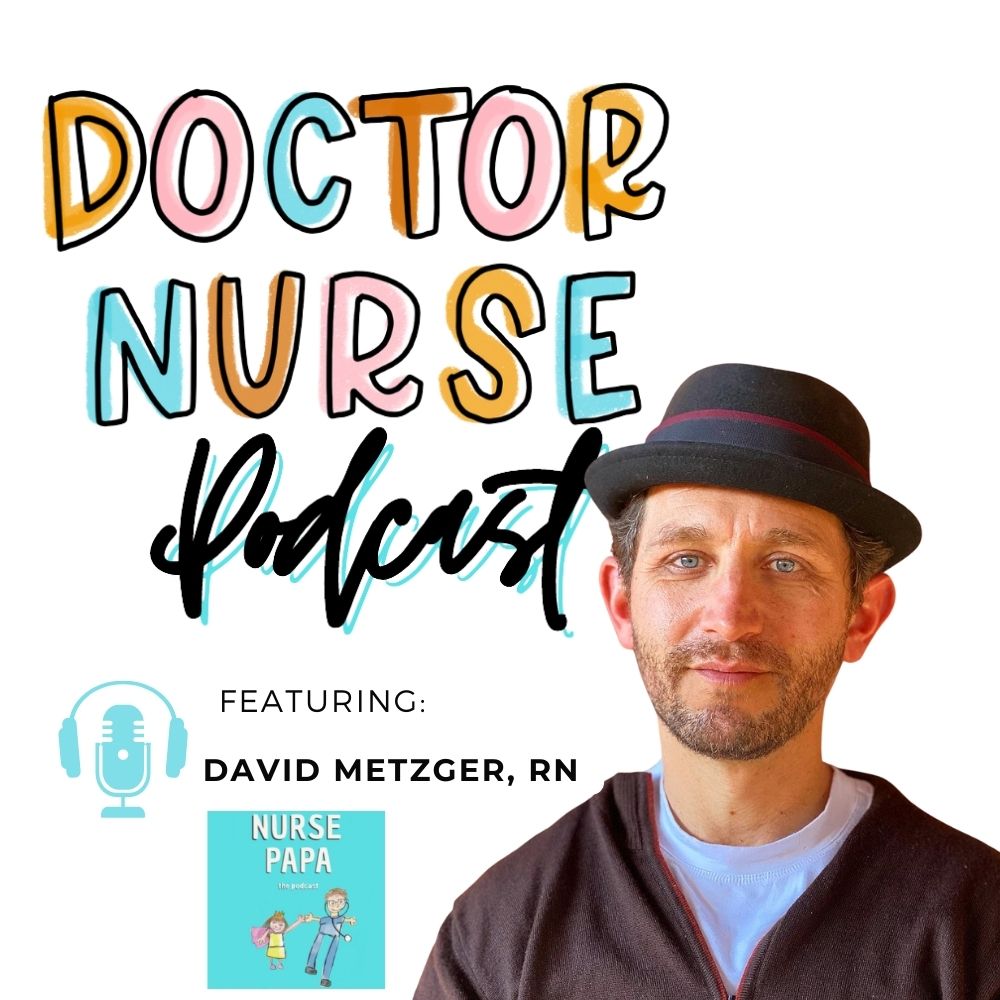
David Metzger is a pediatric oncology nurse, father, podcaster, and author. In his recent book, Nurse Papa, he encounters the crazy intersection of his life as a dad to healthy kids and his role as a nurse caring for sick kids. David is also the host and creator of the popular Nurse Papa podcast in which he shares and normalizes his wild stories of parenthood.
Nurse Papa Links:
www.nursepapathebook.com/
www.nursepapathebook.com/the-podcast
David on the Today Show: www.today.com/parents/dads/nurse-papa-switched-careers-realizing-taking-care-kids-fed-soul-rcna29535
Doctor Nurse Podcast Links:
Doctor Nurse Links: linktr.ee/DoctorNursePodcast
Wanna start a side hustle? Subscribe to the Doctor Nurse Podcast and I will show you how to start: view.flodesk.com/pages/6253188857d9b15fd00f8329
Latest Episodes
Doctor Nurse podcast brings you weekly shows to help INSPIRE, EDUCATE AND EMPOWER nurses with true stories of initiative and impact.
Doctor Nurse podcast brings you weekly shows to help INSPIRE, EDUCATE AND EMPOWER nurses with true stories of initiative and impact.
Latest Episodes
Doctor Nurse podcast brings you weekly shows to help INSPIRE, EDUCATE AND EMPOWER nurses with true stories of initiative and impact.