Also Available On






[00:00:00] Hi, Jasmine, welcome to the doctor nurse podcast. So happy to have you on today. Thank you, Sandra. I’m so excited to be here. Well, let’s jump right in. So can you describe to our listeners, what is your current role? What’s your job. My job title right now is manager of nursing operations. And so it encompasses a couple of different things.
I have five different departments that I oversee. And then along with any of the quality improvement projects, any half projects, anything that helps to improve patient care and patient safety at our hospital? I I have my hands in that pot are you working at one type of hospital setting? So I am working. In nursing administration for a pediatric hospital in a urban city. My role oversees a couple of different departments as a manager, but then I also help to oversee some of the quality projects and so hired by the hospital, working within the hospital.
Oh, okay. So. How did you get [00:01:00] here? What was your specific journey to this role? So kind of walk us through your bachelor’s your master’s. I know you have an MBA and then your doctoral degree. So I’ll even go as far back as after graduating high school, because that’s really where my healthcare journey started and why nursing was one of my selections and my top choice to, to pursue.
So after high school, I actually joined the army and I was a combat medic in the army. So that’s where. Medical journey began. I was a combat medic and an EMT in the army for three years. And in those three years I met many different professionals. We worked as combat medics directly under a physician assistant.
But one of the things that my PA kept telling me over and over is Jasmine. If you’re going to pursue healthcare, go the nursing route, go the nursing route. And I’m like, okay, you’re a PA you’re telling me to go the nursing route. You tell me why you think nursing’s better and why you made a mistake.
And so, and that’s what he did. He said, you know, if I had gone the nursing route, [00:02:00] my realm of reach would be so vast and so different. I would have so much more variety to choose from. Whereas with PA he felt like he had a tinier selection of areas that he can work in.
And so he had always said it and he had always given me great examples of his peers who were nurses, who became nurse practitioners, who progress upon beyond their, their bachelor’s degree. And just kind of gave me examples of what their career and what their pay turned out to be working in those different areas.
And so I knew after leaving the army that I wanted to do nursing. Well, after I left the army, I was a stay at home mom for a little bit. And then before I started going back to school and getting my education again, remember you’re right there because I think stay at home moms have the hardest job.
Yes. Yes. And, and, and stay at home moms. On top of that, being the wife of a soldier who was constantly deployed was even more of a, just, it was so much going on at that time [00:03:00] that, you know, I took my time and then eventually got back into the education side of things and I came back like pretty hardcore, took 21 credit hours my first semester. I was making up for lost time with my friends who have, are now graduating with their bachelor’s. Starting pursuing my college credits and so impressive. Impressive. The last time to make up for my husband was deployed. I needed a very good distraction and studying was it. So I ended up going back to school.
And at first I was just taking, you know, the core classes that you take when you first started in college. And somebody had her persuaded me, you know, maybe you should look at dental hygienist or dental assistant, and I’m thinking, okay, No weekends, maybe dental hygiene is the way I should go. And so I started looking more and more into that seriously.
And then realizing that the dental hygiene program at the college I was attending only accepted 35 students per year. And it was very competitive. So we were competing with like 200, 300 students trying to get into the program. And so. The [00:04:00] likelihood of me getting into dental hygiene was very, very slim.
My chances were maybe like 20% of getting into it and I knew the odds were against me. And so I was just like, you know what? Nursing has always been the way to go. And if I think realistically dental hygiene, the only thing I could do after that was to become the dentist. And so the education route was a huge leap from dental hygiene to the next step.
And I knew that that was not where I was. So nursing, it was cause I know nursing, I can get my bachelor’s. I can get my master’s. I can eventually get my doctorate. And at the time DNP wasn’t a thing, but PhDs were, so there were still doctor nurses. So eventually I ended up doing that route and I applied for nursing school, got selected into three different nursing schools and ended up choosing the university of Maryland.
We were stationed. My husband had been relocated at this point into Walter Reed hospital in DC. So we were up there in the DC area and that’s my hometown. And I knew the schools very well. And so I ended up choosing university of Maryland and received my bachelor’s education [00:05:00] there. And then of course now being a military wife, I’m moving around a lot.
So I started my education. Started working at the bedside as a neonatal nurse intensive care nurse at Johns Hopkins hospital and had just an amazing, amazing time and an amazing experience right out the gate with being a nurse. But then we had to relocate. So we relocated down to North Carolina.
Where I worked at another prestigious university hospital. I will not name it, but I just wasn’t as happy. You know, I didn’t realize that nursing changed from region to region and, and, and policies and procedures changed from region to region, even though there’s evidence-based practice, not everybody was most up to date.
So that really kind of caught me off guard. Yeah. Caught me off guard. And I was just like, you know what? I don’t think I want to work at the bedside here in the states. And so I stopped. Realizing that even the leadership was a little subpar. So I told myself, I think I would be an amazing leader. And so let’s start looking for leadership positions.
And so I [00:06:00] began looking and I just happened to meet a lady who worked in corporate health care. She worked in addiction medicine. She said to me, Jasmine, I think you would do really great in my position. And I am getting ready to move on and promote to a different position. She goes, why don’t you apply for my position?
And I said to her, I was like addiction medicine. I know nothing about that. I don’t have any experience. Like I have nothing to support this, this, this huge leap in, in change of career industry. And so she was just like, why don’t you just come observe for a day, do a shadowing event. And then just kind of see what it’s all about.
I went and I shadowed under the pretense of me coming in as a nurse, not as a leader. And so everybody was very real and very Frank with me who was on staff there and they basically. I, I were, I was able to meet some of the patients and learned about some of their stories and about how the addiction came about.
And you know, it’s not what we all think it is. It’s not patients who, who decided one day they were gonna take a hit of [00:07:00] heroin and then became addicted from that. You know, a lot of them were. Pain patients who took a Percocet, then took two, then took three and then they were buying it on the streets because they were running out too early, too soon.
So a lot of patients really had stories based off of a pain injury, like some sort of injury that they had. One fell off the roof when he was trying to put shingles up, you know? And when he fell off the roof, he hurt his back, he ended up having surgery and then it was just endless pain for him.
And from there, his addiction grew because. You know, we as clinicians, aren’t doing a great job of making sure that we’re treating acute pain, but we’re also treating chronic pain with the same acute medication that becomes addictive. Jasmine, that is, that is a hundred percent correct. And one of the things I’d like to add is just, I don’t think we do a good job.
Kind of differentiating different types of modalities for pain relief. It’s not just a pill. There’s so many other things like when you start studying like meditation guided imagery, acupuncture, you know, even massage is just like, there’s so many [00:08:00] other modalities that we should be introducing in the hospital to help people with their pain journeys that throwing pills at their problem creates more problems.
It’s almost like. Worse than the disease itself. Exactly, exactly. And it’s just, you know, and I, I want people to realize that and understand, because there’s such a stigma against the addiction population, but we’re not understanding why and how they even got to that point. So we started. Sharing these stories, these patients start sharing their stories more and more.
They’ll start understanding, oh my gosh, this could have been one of my patients easily. You know? And so we definitely need to hear more of that. But that’s for another podcast. But so while I worked the, so addiction medicine was under a corporate health entity and because it was corporate, everything was all about the money, all about, you know, all the numbers, everything was very number oriented and data oriented.
So I had my peers in my position. Me being a registered nurse was very odd. It was, [00:09:00] it did not require me having to be an RN to be a clinic director at an addiction treatment center. What it required me to do is have some sort of business knowledge and background. And so I just I, I guess during the interview process, I was very impressive.
And so therefore the regional director took a chance on me knowing that I had the healthcare background and I could probably merge some of those bridges between the addiction center and the local hospitals, and really helped with the community. Outreach of that. But what I didn’t know was the business aspect of it.
So my peers all had MBAs. They all came from tremendous business backgrounds and financial backgrounds. And when we sit in a group, they’re talking all these numbers and all these lingos, and I’m just like little nurse, are you guys talking about? So I took it upon myself. I’m like, you know what I need to learn and be just as, as, as great caliber as my peers here.
So I went back and got my MBA. My master’s in business administration. So that I can understand exactly what they’re talking about. And so that’s what I did. I ended up getting my MBA But [00:10:00] actually what I should add was prior to this, before leaving DC and being relocated, we I had actually started my master’s, my my nurse practitioner journey at Georgetown university, where I took two semesters of classes to pursue my women’s health nurse practitioner, dual degree with a nurse midwife, because I really, really wanted to be a nurse midwife.
But all that changed when I moved farther south and things were a little different and even nurse midwife. Practice very differently. And I definitely was like, not for me, you know, maybe I’ll revisit it at another time, but it wasn’t for me. So I went and got my MBA instead and and really just never looked back on the NP side of things.
So astounding, I think the MBA is such a nice addition to the RN degree. Yes. And it’s very helpful where I am now. So we ended up relocating again, my husband retired from the military and we decided that we were going to move to a large city with a great beach access. So here we are in south Florida and [00:11:00] we, I ended up pursuing I, what I did originally was started travel nursing down here because I wanted to kind of.
What the nurse, the hospital, what the hospitals were like down here because of my experience at the previous thing that we were residing in, I wanted to make sure that I kind of knew who the top players are in this area before I actually took a full-time position. So I became a travel nurse just so that I can get a feel for each of the hospitals before I decided this is where I really wanted.
Okay. That’s really smart. That’s like a try before you buy type thing. Exactly. And you really, you know, you don’t know until you walk through those doors and really know what the struggles are inside those that hospital. And, you know, and if you’re inside one hospital and they always say, oh, we’re getting ready to transfer this patient to X hospital.
Then, you know, X hospitals where you really want to be, if you want to have high acuity patients. So. I really learned very quickly who the in south Florida. So that’s what I did. And then I ended up taking on a position at the [00:12:00] hospital I’m at now, and eventually knew that I wanted to continue pursuing my education.
And, you know, I didn’t want to do just an MSN, but, and then the program at the university of Miami allowed for me to pursue my doctorate and get my DNP with a master’s in another area as well. I complete the required clinical hours. And so I applied with an MBA, whereas all of my peers who were, who became my classmates later had their MSNs and they were all nurse practitioners.
I applied with my MBA got selected, but then just had extra hours that I had to do to, to catch up to their clinical hours as an MSN. So it just required a little bit more work and effort on my end, but I was able to complete my DMP last year in 2020. And so here I am and still working at the same hospital that I basically scouted for.
What a hustler it’s really impressive work. So Jasmine, could you give me an [00:13:00] example of one of your biggest successes in your current career that you would just say was a real high for you? You know, I actually, I I’ll say it’s, what’s coming up soon later on this year is I for my doctoral project, what I ended up doing was a project based on doing standardized debriefing at our hospitals so that we have a standardized structure because we had debriefing.
Sometimes we didn’t have to be debriefing 100% of the time and then we didn’t have it standardized on top of that. Jasmine, tell me what debriefing . Sure. So debriefing and this sense, there’s a lot of different ways you can define debriefing depending on the type of area you work at. Cause our psychiatrists and psychologists will disagree with me, but debriefing.
And in my sense is the ability to sit down after a Sentinel event has occurred and really discuss the safety, the supply concerns and any other concerns and issues that we may have had. During the event so that we can better ourselves for the next upcoming event. So in this case, what I implemented was [00:14:00] a debriefing event for analysis and recovery.
And it allows for us to look at what went really well during the debriefing. Like for example, we had all of the staff members in place. We had all the supplies that we needed in place. Crash cart was fully loaded, or for us to discuss some of the areas for opportunity. So maybe we didn’t have the right size T2, maybe the EBI bag that hangs on the crash cart wasn’t available for the right patient size.
We’re a pediatric hospital, so we have to carry everything from neonates, pediatric to adult size. And so sometimes those things get borrowed and not returned, you know, or sometimes maybe there was another emergency in another area of the hospital. And so let’s just arrest. Let’s just say respiratory therapy was caught up over here in this other event and was not able to make it over here on time.
And so it really allows for us to speak to some of the staffing concerns and the safety concerns as well. So that’s what I define as debriefing. Now, my psychiatrist and psychologists. Which I’ve had like discussions consider they’re debriefing more of a [00:15:00] mental health debriefing. And so there is, will be defined a little bit differently.
But for us it was, this was implemented because really allowed us a chance to really everybody who occur, who attended this event, sit down in a room together and discuss some of the concerns that they had or some of the things that went well, so that we can just have a little bit of decompress moment so that we can before we move on to the next patient, All too often, we’re asked to hurry up and do post-mortem care.
And then go ahead and take this next submission. And so, and they’re not even able to take a bathroom break or just even a mental health break for 15 minutes, just to step away and really soak in what all just happened. It’s moving so fast in the hospital environment, in a critical care environment that we don’t have those opportunities.
And so this really was kind of like our version of a surgical timeout where we say, okay, everybody just pause for a second. Let’s just make sure we have a chance to discuss this. And this is a safe space for you to speak about whatever it is you need to speak about, man. That is so. Innovative. I [00:16:00] love that.
It’s almost like just taking out time to meditate from your day. When you have these brainstorming sessions, what’s neat about it too, is that everybody can kind of come together and build on ideas. Whereas if you never go back and reflect, you don’t have a chance to go like that didn’t work well.
Like I needed this and this person needed that and we kept missing each other. And so. It helps you build a stronger system when you’re able to look back and go and say, like what didn’t work when we played this out, yeah. And so, as a result, I submitted this project to different conferences for a podium presentation.
And so this is what I’m most proud of. So the big, the big story to get to the answer then. Yeah. Is I’ve been selected for Aon L, which is the American organization of nurse leader, I believe is what AOL stands for, for podium presentation in July. And then the other one, which is Sigma nursing, which was actually their international conference that was supposed to be held in Singapore.
But it’s now gone virtual [00:17:00] which I’m really sad that it’s no longer, or, but that was also selected for a podium presentation. So both very, very proud of those. And I can’t wait to do the presentation and hoping that, you know, in future conferences that the presentation was great enough that they will invite me back for the actual.
Stage live events, again, everything was turned virtual last minute, this year. Because I think AOL was supposed to be in DC and then Sigma was supposed to be in Singapore, which I’m really bummed about. Oh my gosh, what an incredible story and such a high. So tell me about something that you’ve had to overcome.
Something that you look back and you think that was hard. . Aye. Overcame. I think being a leader, being in a leadership position, especially for the first time, it’s always very difficult because you really don’t find yourself as a leader until you’ve been thrusted into that position in the army.
You know, I’ve had leadership positions in the army, but in the army. [00:18:00] Different, you know, we’re allowed to kind of cuss at each other. We’re allowed to tell each other to do pushups we’re allowed to in a way discipline one another. Right. You can’t do that in the civilian world. You can’t do that in a hospital setting.
So having to like kind of tone down the, the leadership mentality that I grew up in, in the army and being able to convert that to okay. What’s. Appropriate. And won’t get me written up in the civilian side. So becoming a leader and then working in addiction medicine, the staff that I had, I had nurses, I had social workers.
I had psychologists and I even had PA and a doctor working under me. And so those like so many different types of personalities of people really made it very difficult for me to a learn how to be a leader, to so many different. Types of thinking. And then B being a leader to a group of people who have been there in this organization for at least five years each, and they all look, they’re all looking at me like, who are you?
And why are you coming in here? Like ruffling feathers and, [00:19:00] and kind of changing things up, you know, when things were good to go before you ever came along. And so I really just had the battle of personalities and not being accepted as their leader. That was difficult. When I took on this position here at the hospital, because I had such an interesting and a dynamic group prior to becoming into the hospital and transitioning into a leader at the hospital setting was way easier having nurses and having ancillary staff who all think similar, and they all have the same objective with the patient’s outcome and patient experience really made it a little bit easier for me.
So it was much easier then, but I think. Biggest like difficult loop that I had to go through was learning how to be a leader initially and working in addiction, medicine and corporate healthcare. And just the dynamic of that was really hard. And I feel like you went through. Leadership bootcamp with your first job.
And then it was like, you know, easy sailing easy, easier sailing [00:20:00] when you stepped into the hospital. And that’s one of the things that I have also identified in nursing is really lacking. Is. Education on how to be a leader and how to step into that leadership role. When , to a certain extent when you’re working in the hospital, you’re taking orders.
And then now stepping in and you’re the one giving the orders and you’re the one that’s supposed to be that example. Did you have any mentors or anyone that kind of helped you along in that process? And did they say anything or do anything that really helped you move into that leadership role? You know, I will say that the person who he was my director currently definitely was I’d consider her a huge mentor in me growing to where I am now.
She’s been my leader for the past four years and we kind of grew together. I came in as a clinical coordinator. She was a manager and then we transitioned together. So now she’s at the director role and other manager role. And I’d say that like, she, she also comes from a very different perspective where she.
To south Florida from up north. And so [00:21:00] her personality is already a little bit different from what we see here in south Florida. And you know, same as myself. And so I think we were able to get along on that aspect of things, but at the end of the day, the take home and takeaway message is. This is going to help improve patient care and quality of care that this is what we need to advocate for.
And we’re going to continue to advocate and not back down until we see some changes are being made. And so that was her philosophy. And I think some people would even describe her as you know, like a dog with a bone. Like she just does not back down. And that’s, and that’s where I kind of take my leadership from is that if this is what’s best for the patients and for the quality of care that we’re providing, then this is what we need to do.
You know, whether it’s improving processes and protocols. For patient care or improving staffing on this end, whatever it is we need to do, we’re going to advocate and we’re going to advocate until some type of changes being made. And so and for that, you know, both, she and I are very heavily [00:22:00] involved in everybody else’s business in the hospital because we’d see.
Opportunities. And then we capitalize on it and you know, we try to push it as much as we can, and then we hand it off to the next person who can continue it. And so that’s definitely I’d say she’s my biggest mentor in being able to know that sometimes you’re gonna step on toes, but if you do it respectfully.
In the pretense that you’re doing it for patient care, then eventually they’re going to overcome whatever that ego is and, and that’s going to break down and we’re going to be able to work together collaboratively at the end. And so, you know, a lot of times we may come out the gate with very. Direct ideas.
But at the end of the day, when we all sit down and discuss it together, and if it makes sense, and this is what’s best for patients, then this is what we’re going to do. And so I think she has been one of my tremendous leaders and mentors that has helped kind of shaped and molded me to where I am today.
There’s a book that I read by John C. Maxwell called how successful people think. And in the book he talks about, [00:23:00] if you prioritize people. Then the profits always follow. So if you’re chasing a dollar amount, like, well, this is going to be too expensive to implement, or you can’t afford that.
If you’re chasing that mentality, then you will begin to lose the people because they will see that is what you’re after. And you’re not looking out for them. A person. And so it’s so smart. It’s how people that want to be successful. Think almost kind of like what you’re describing in your, in your mentor of just, we got to think about the patient.
Like that’s what we need to keep at the center of our focus. And then the rest of that stuff will follow because if people know that you’re caring for them, The best you can, who doesn’t want to go to that hospital, to be cared for because they know that you’re doing the best in the most that you can, for the people that go there because in life, people are what matters, I just think that. Super wise thinking. It’s great. The last question I have is [00:24:00] what advice would you have for a new nurse starting off in your career that you wish you knew when you started off in your, in your journey? I think one of the things that a lot of new nurses do not Capitalize on is the, the new nurse status.
Right? So what I like to tell, because what, what I used to do at the hospital that I’m currently working at is I helped to recruit and hire. New graduate nurses through our program residency program that we have. That’s the only way new graduate nurses can join our hospital. Otherwise we only hire experienced nurses.
So this event and this residency program only happens three times a year. So it’s super, super competitive. But what I tell them as a new nurse is to be a sponge, you know, and really be ready to absorb all and any information that you can ever. Think and, and let it be information overload, but eventually it’ll make sense.
So learn, learn, learn as much as you can and seek out opportunities. I think a lot of times new nurses feel like they need to stay in their lane. And you know, you’ve been given these [00:25:00] two assignments or these four assignments with your preceptor. This is what you have to do for the day, but what they don’t think outside the box to think is, oh, that patient over there is having an NG tube inserted.
Oh, that patient over there is getting voluntarily extubated or that patient over there is getting drips, hung. And so those are things where you have to keep your eyes and ears open. Be very aware of your surroundings. Inpatient hospital setting or long-term care facility or wherever it is you’re working, seek out those opportunities, know who your experts and your resources are and tell them, Hey, today, if you have an IV insertion that needs to be placed, can you call me?
And so that I can come help and watch, you know, because the more you watch and the more you help and the more you volunteer yourself, the more people are going to realize, oh, that girl over there, or that guy over there. Wants to learn, let me call them over because now we’re doing something pretty cool and unique over here that we don’t see, but once every two months, you know, and so that’s, that’s what I think new nurses need to do, do better with, if they’re not already is to just [00:26:00] ask for those different types of experiences, make yourself known because the more you make yourself known as being curious and wanting to learn.
The more people are going to want to bring you on board and say, Hey, come over here. I’m going to show you something real quick. Yeah. And that exposure being someone that’s really into like, Can I, can I watch, can I come help you is, is vital for you for your career. And I found in my current role working as a nurse practitioner in a surgery setting when I have presented that to the attendings and just like, Hey, do you need help with this?
Like, can I help you drain that? Or can I help you pull that? Or. Yeah, you want to come and I’m like, yeah, I’d love to. And so that’s something that I find that people are really receptive to because they, they, they love to teach most people in, in the, you know, healthcare setting are really great at teaching.
And so it’s just a moment to have a exposure to something that will maybe open up your world to something that you would think I would never have been here if I hadn’t seen that or done that. Right. So taking those opportunities. That’s really that’s [00:27:00] great advice, Jasmine. All right. So the last part of our interview is the rapid fire portion.
Again, this is just silly fun. So then it kind of lightened up the podcast and just kind of get the blood pumping. So, first question is what’s your favorite emotion? My favorite emoji is the forehead slap one.
Sometimes I just have no words to say, but slap my forehead. Like I just it’s, especially with COVID world right now. And then like, yeah. Yeah, crazy things that are coming out of people’s mouth, like totally against what CDC is saying. And I just like, you know what? Forehead slap. I have nowhere else. So good.
And are you currently reading anything interesting. I actually have a couple of books that’s on my shelf right now that I haven’t had a chance to completely finish, but one of them that I’m reading right now is actually the compound effect. I can’t remember who the author is.
It’s a really tiny square book that I have in my beach bag. Every time I go to the beach, I open it and start reading it. But it’s really just talking about those little tiny pebbles that you put in place. Will you eventually become a big mountains? Right? So the compound effect is just making sure you’re doing little things at a [00:28:00] time making those little daily habits.
Those little daily habits eventually turn into a routine for you. And so that’s why it’s important. So it can be implemented into your relationship, into your work, into your academics. Anything that you’re doing differently, whether it’s, you know, taking. Oh like a five minute meditation per day. One minute turns into two minutes, turns into 30 minutes.
And so it’s, it’s better for your wellbeing. So there’s so many ways you can implement it, but the compound effects and just taking it one day at a time, instead of trying to reach this big overarching goal, make it smaller, smaller little goals. Wow. I like that. . So based on your history and kind of hearing that you’re in the military, what’s your favorite city in the U S that you’ve lived.
That have lived in not including. Okay. Because we chose here for retirement, right. I would say the DC area. So, you know, and I say DC area because it’s not just Washington DC, but it’s like what we call the DC metropolitan or these days it’s called the DMV’s, which is DC, Maryland, Virginia. I would say that was my absolute favorite.
I [00:29:00] grew up there. But. Why I love it so much. And even having my kids at least start their school there when we were stationed there for five years was pretty amazing because of the opportunities, the diversity, the education system, and the field trips there, their field trips were to the white house.
They went to the Smithsonian, they went to some really cool places for their field trips as I did when I grew up. So I knew that. Perfect for them. I love it there because of diversity. I love that you have people from all walks of life. You have diplomats who live there. You have everybody, everybody lives there.
It’s very congested. Traffic is awful, but it’s not any worse than south Florida. So if you know back roads in DC back roads will get you places. Sooner. South Florida, there is no back roads. So it really I’d love to work living there the most. So I’d say that would be my number one. Pick. If we were to go back somewhere, I’d go there.
Now. Places I’ve visited, I would consider the west coast for sure. Yeah. Yeah. West coast is, I always say west coast best coast, so beautiful. All right, well, thank you so [00:30:00] much for coming on the podcast today and talking to all these nurses out there that just are looking for mentorship and thank you for, for sharing your journey with, with us and with them.
I really appreciate it. So do you want to do any shameless plugs for any of the stuff you got going on? Oh sure. Of course, of course always opportunity for shameless. Yeah. But so one of the podcasts channel that I have is comfort kills, and really it’s just a passion project that I’m working on with recruiting and finding different people with inspirational stories to share something else that I’m working on right now is more healthcare related, which is tales from the bedside.
So I have a Facebook group currently, and then I am hoping to launch my podcast, YouTube channel for that pretty soon. And it’s really just stories from the bedside. Any clinicians that have stories of grief, have stories of miracles, anything under the sun think chicken soup for the teenage soul, but from a nursing and healthcare perspective.
And then also what I’m doing is I’m recruiting stories for patients and [00:31:00] families as well, because they have stories to share as well. So that is coming soon along in the near future. But of course, if anybody ever has any questions, whether it’s academics. Route to pursue whether or not to pursue nursing at all.
I would love to have a chat because I’m a huge nursing advocate and I’m a huge education advocate as well. So would love to sit down and just have a chat with you. So feel free to. Perfect. Thank you so much for your time today. Great. Thank you so much.
Podcast Description
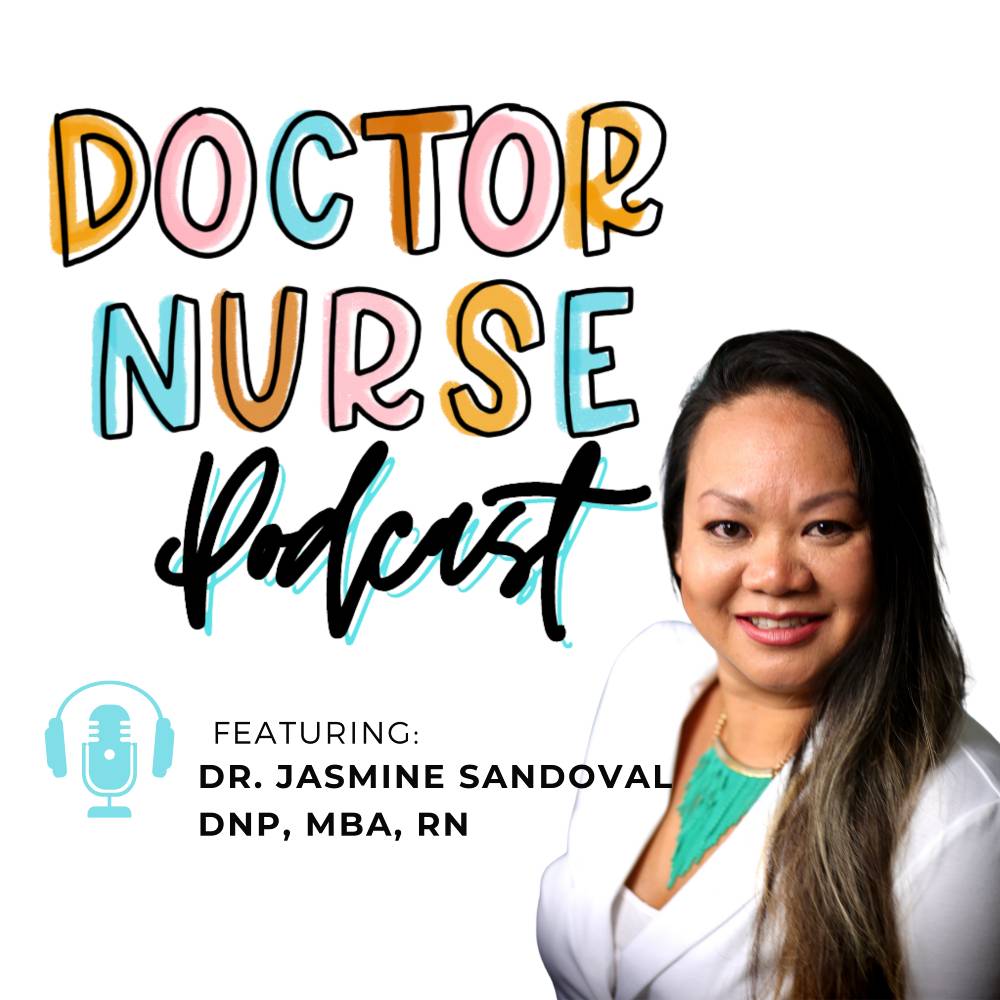
Dr. Jasmine Sandoval is a first-generation Asian American born to Vietnamese refugees parents. She is a veteran of the United States Army and enlisted right after high school. During her time in the military, she met and married her husband at 19 years of age. She had her first baby at 21, and second at 23, all while her husband was intermittently deployed. As she raised her children alone awaiting her husband’s return from war, she knew she wanted to make the most of her time. So, she enrolled in a local community college and graduated with a 3.89 GPA with two toddlers at home. She is a leader in the nursing industry and has really pursued the motto of “being the best.” She has experience as a pediatric registered nurse, NICU nurse, and working in the corporate world as a director of an opioid addiction treatment center. Meanwhile, she obtained her master’s in business. She is currently a Manager of Nursing Operations at a large hospital in Florida, and in case you still aren’t impressed so far she recently obtained her Doctorate in Nursing. In her spare time, she is a podcaster and has a youtube channel. They have titled Comfort Kills with Dr. Jazz and Tales from the Bedside. These are linked below, check her out!!
YouTube: www.youtube.com/channel/UCS_D_d8QGk5GzD7vjT4zWtA
Podcast: comfortkills.podbean.com/
Click here to follow us on:
Instagram: www.instagram.com/comfortkillsmedia/
Facebook: www.facebook.com/Comfort-Kills-Ambition-101560611574270
Twitter: twitter.com/JasBSandoval
LinkedIn: www.linkedin.com/in/jasminesandoval/
Latest Episodes
Doctor Nurse podcast brings you weekly shows to help INSPIRE, EDUCATE AND EMPOWER nurses with true stories of initiative and impact.
Doctor Nurse podcast brings you weekly shows to help INSPIRE, EDUCATE AND EMPOWER nurses with true stories of initiative and impact.
Latest Episodes
Doctor Nurse podcast brings you weekly shows to help INSPIRE, EDUCATE AND EMPOWER nurses with true stories of initiative and impact.