Also Available On






Functional Medicine Provider
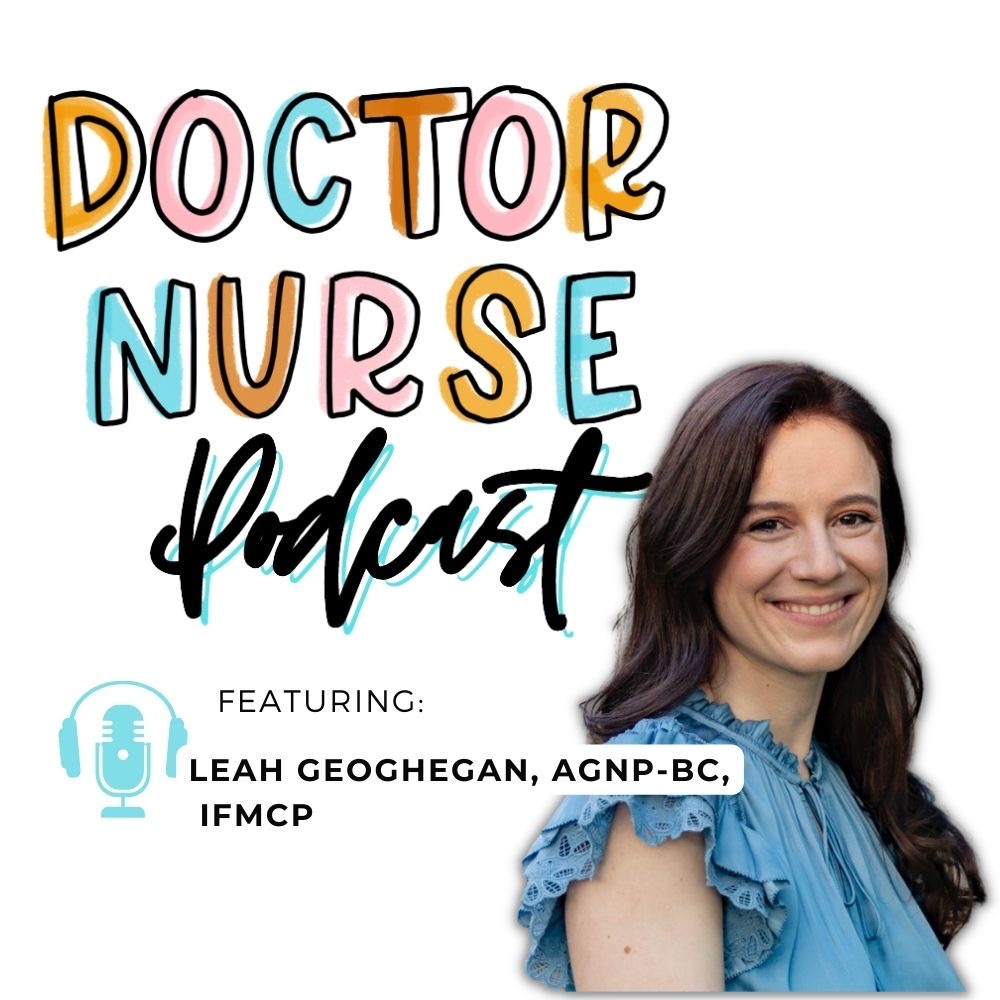
Sandra Pagenta: Hi, Dr. Nurse podcast. Welcome guys today, we have Leah Gagan and she is a board certified adult primary care and functional medicine nurse practitioner who owns her own business called emergence health. And so she’s gonna be talking guys about her journey, how she’s gotten, gotten to the spot that she is today.
And So excited to talk to her, because again I’ve had requests for functional medicine nurse practitioner to come on and share their journeys. And so I’m seeking ’em out guys, and I’m happy to have her on today. So Leah, welcome.
Leah Geoghegan: Thanks for having me, Sandra.
Sandra Pagenta: Yeah. Thanks for coming on. So let’s start off with kind of what your role is at your current job and what it is that you do on a day to day basis.
Leah Geoghegan: So I am a primary care and functional medicine, nurse practitioner, and most people would probably know what a primary care nurse practitioner is, who are listening to this podcast. But functional medicine is probably a bit of a new [00:01:00] term and just to get started, it is a root based approach to healthcare that looks at how the systems of your body work to identify the root cause of disease.
So I use a lot of lifestyle treatments in my practice in addition to some conventional therapies as well. I like to blend both the conventional and functional modalities in order to help people heal mostly from chronic illness. And I see people. Via tele-health really anywhere in the United States, but also I do home care.
So I’m licensed in Pennsylvania and New York and we’ll do physical exams and functional medicine appointments in people’s homes.
Sandra Pagenta: Wow. What kind of patients are you seeing on a day to day basis?
Leah Geoghegan: So functional medicine is like a specialty in and of itself, but it’s kind of being a master of all . So I do see a lot of people who have hormone imbalance issues.
Like we were talking about before P C O S infertility problems. I see a lot of [00:02:00] people with digestive issues. IBS Crohn’s disease. I see people who have a lot of heavy toxin overload that need help with detoxing. Okay. Specifically for mold. I see a lot of patients for mm-hmm and autoimmunity, because the, the way that conventional healthcare treats autoimmunity is through suppressing the immune system.
And it seems counterintuitive. Yeah. Yeah. Instead of really like addressing why somebody is having that autoimmune reaction and yeah, I kind of akin it to somebody having like a smoke alarm in their house and basically conventional medicine for a lot of things is just shutting off the smoke alarm.
It’s trying to mask the symptoms that people are experiencing instead of looking for the fire. So that’s like the very basic way of how I describe what I do is I don’t just shut off the alarm. I’m looking for that fire, that root cause of what is, what is leading to you? Not feeling well.
Sandra Pagenta: I love this approach in healthcare because it, I feel like Western medicine is very [00:03:00] good at being reactive. You have a disease and then they’re really good at just reacting to, well, here’s the fix? Or this is a bandaid to the problem. More so than what I love about functional medicine is I’ve been diving into this area of healthcare is that you guys are way more interested in, like you said, looking for the fire, what’s causing this instead of just looking to fix it.
And I love that you’re merging. I can help fix it, but I also really wanna dive into what’s going on. And so I was looking through your website. I saw that you do a ton of testing very specific testing. I I’m assuming like gut microbiome type stuff. You’re looking at people’s genetic makeup, getting that, like that, that bioindividuality that everyone has and really tailoring healthcare to the person.
Because again, I think. We all know this, there are genetic differences between people, every single person is different. Could you touch on a little bit about what it is that kind of sets functional medicine apart [00:04:00] in that bioindividuality, that you tailor your care to compared to conventional medicine, which is kind of a one shoe fits all, which no, sh like there’s no shoe that fits everybody.
Model of healthcare. Could you kind of differentiate that for my listeners?
Leah Geoghegan: Yeah, absolutely. We all went into healthcare because we wanted to help people at the root especially us nurses and. At least when I peaked under the hood of, of, of working in a hospital for a long time, I became frustrated because we worked mostly on protocols that were determined from the top down that every single person, if they were.
Septic got X, Y, Z, which of course, for certain things like emergencies, I still do believe very much in conventional medicine, but a hundred percent that same framework does not work for chronic disease, which is an epidemic here in the United States. And around 80%, they’ve done a study that 80% of chronic illness can be healed [00:05:00] through lifestyle, through diet, through exercise, through nutrition.
And yet those are the things that we were not trained in, in school. You know, maybe you had one nutrition class that was for one semester. That was very surface level, but nothing that was really applied to patient care. And the way that functional medicine looks at healthcare is we do still value evidence based practice which is very conventional, I guess, in, in perspective, but it’s not the only thing that we use to direct care.
We use both evidence based practice provider expertise and experience, and then also patient preference and how people want to Del their care delivered. What type of care do they want? What is their life like and what will fit best into their lifestyle versus the other way around. And that’s the aspect of the personalization that yes, we can do.
Also the advanced genetic testing, that’s a [00:06:00] whole new level of personalized care, but even just at the surface, just asking people what they want, having enough time to really. Understand those person’s needs understand their history. We go all the way back to when you were born, were you breast your bottom fed?
Were you a C-section baby or vaginal delivery? Because all of those things play a role into who you developed into today and what your individual risks are and what systems of your body could be out of balance. Where should we look first in terms of our investigation through that functional lens? Oh, and the average primary care visit here in the us is 15 minutes.
Like what can you get done in 15 minutes of time? I rely very heavily on the patient history. I, I really do believe that patients know what is wrong with them. They might just not know the medical terms or. Pathophysiology behind it. And my job is to be almost like a Rosetta stone for them, [00:07:00] like hearing what they’re saying about their health, translating it into a, a way that they can understand, but also playing on my medical expertise.
Sandra Pagenta: I love that approach that you’re describing it is so it’s, it is, I believe. For example, I’ll just start with an example. I had a patient just yesterday or two days ago in clinic when I was in clinic, I think it was Friday, Thursday. And he had described after getting Angar injection for prostate cancer, that something’s been off with his heart ever since.
And he’s like, no one believes me. And I just felt like. This man has been living in his body for 65 years. Who am I to tell him that this wasn’t something that he was experiencing? Because I feel like, and this was the thing that I was getting from him. And that, that you’re adequately describing that there’s this disconnect between providers, where we only look at this list of things and we say, well, if it’s on the list, then you can’t be true.
Or if it’s not common, then it can’t be true. It [00:08:00] really invalidates people. And I think it actually ends up sending them into kind of an anxiety spin where they’re just like, well then why is this happening? Cause I, I noticed that this happened and this happened. And so I just feel like over time, what we’ve done is we’ve created actually more anxiety by not listening to people by just kind of having that revolving door of like, okay, get in, get out, get in, get out.
Instead of spending that time, I spent, I spent so much time on the phone with him that day. And at the end of the conversation, he. Thank you so much for just believing. I said, I know I can’t fix it, but I believe you. And it was just that statement alone that I could tell curb the anxiety that he was just like, I know things happen.
Like I know you take things and so things can happen. And I said, that’s it like, unfortunately, That’s that’s healthcare is the there’s side effects, the stuff that we do. And so if you’re experiencing this and this is true for you, who am I to tell you that you’re wrong? And so that approach, I think, has been through my deep dive in functional medicine and just in my own experiences.
So just realizing like, [00:09:00] sometimes you just need to be believed and somebody just needs to go like, I see you, like, I know that this is something you’re experiencing. Cause I think there’s something very therapeutic just in that. Right? Like,
Leah Geoghegan: and Sandra, there have been studies on that too. That the patient provider relationship feeling heard actually will increase somebody’s immune defenses that their natural killer cells actually go up when they feel like they have a strong relationship with their provider.
So there’s healing. Listening and being heard even before you do any intervention so that no,
Sandra Pagenta: I could tell that that was, that was therapeutic for him. That alone had just calmed the situation down. And I was like, he’s like, if this is all we do today, I was like, I’ve done nothing. I’ve just been listening to him.
You know, like if that he’s like, if that’s all we do today, it’s been a great day. And I was like, okay. Again. You see it in practice and you start to kind of notice the themes and you’re like, I don’t think we’re doing a good job here as providers. And I know we don’t have the time. Right?
Cuz we’ve got [00:10:00] VUS that we need to be balancing out and we’ve got all these metrics that we need to hit. But I really wanna dive into how you got into functional medicine from your start. I know you went school, you’ve got experience working in New York city. And you’ve been. You were in a, you worked in a functional medicine practice and then decided to go off on your own.
And then kind of hit some snags along the way, powered through. I love these stories. So I’d love to kind of hear your journey to this specific spot that you are at today, if you wouldn’t mind sharing with my listeners.
Leah Geoghegan: Yeah, absolutely. So. Yeah, everybody has a story behind why they’re doing what they’re doing and for me. I guess I’ll get us started with when I was working in the emergency department in a really busy New York city, ER, and this is exactly what happened to me. Were you a nurse? I was a nurse at the, or a nurse. My sister. And I was getting my master’s in adult primary care and I went to NYU and they have a pretty unique program in the sense that they have a subspecialty for holistic medicine that you can actually certify in through their.
[00:11:00] Yeah through the university.. I started noticing this pattern that we’re talking about, you know, these frequent flyers coming in and us just patching up whatever was going on with them to send them home to see them come back again. And I realized that I went into medicine in order to help people heal.
And although I was trying not to do harm, I wasn’t actually fixing the problems that people were coming to see me for. And so. When I graduated, I had this job in both primary care and functional medicine in a private practice in Manhattan. And I was really able to hone a lot of those skills of both the standard primary care, and then also weaving in the functional medicine piece for people.
But the, the real transition point happened for me during the pandemic, because I, I feel like a lot of people, especially in healthcare have a pandemic story. It was a very trying time to be a provider and show up for your patients with so much uncertainty about what COVID was about how people heal from it.
[00:12:00] What exactly happens in the body. There’s so much that we’ve learned over the past two years about it since this moment, but whenever somebody is met with a, a difficult situation, I feel like that’s when people’s true character often comes out. It’s not when things are hunky Dory and you know, everything’s flowing well.
Yeah. That you really get to see how somebody. Shows up to difficult situations. And quite candidly, I just realized through the pandemic that the practice I was working at was not aligned with my healthcare goals, nor did it really give me integrity for what I was doing. If I decided to stay there, because some of the practices we were doing just.
Didn’t make me feel comfortable. And, and I think violated patient trust, which is first and foremost to any patient provider relationship and care that you’re delivering. So it was really scary. I I’m not going to lie. I didn’t have a plan when I quit my job. And this was in May, 2020 when many people were getting laid off [00:13:00] from their jobs. It was scary because I had always known what my next step was, or I was always taught, like have another job lined up before you leave. A, a current one. So this was definitely out of character for me, but I felt so strongly about it that I just trusted in myself that things would work out the way that they were meant to do.
And two years later, I feel really grateful that I had the strength and the support to make that decision, because that was really the foundation through which I built my practice and the way that I wanted to care for patients. Cuz too often, especially as NPS or DPS, you know, you’re working in a healthcare structure where you might not always be valued as a equal provider.
To physicians in the healthcare team. And one of my goals of practice is to work to the maximum capacity of my degree and to show people value, through the outcomes of the care in which I [00:14:00] deliver. Yeah. And that was part of, so I, the foundation of go ahead of what I built is of launching
Sandra Pagenta: out mm-hmm yeah.
So I heard, I know two things from your story. I have one, the first, first one was, I know that your fiance ended up losing his job during the pandemic, which is always so interesting that like, at this moment that you decide, I’m launching out like all just sudden now your, your, his husband to be is like struggling.
I’m fine work. And you’re just like, oh my gosh, I quit my job. Like, what am I doing? And there’s always these moments of like, Kind of testing you in the fire of like, how serious are you and you still stayed with your convictions and you were like, I can’t do this. And I’m just interested. I don’t know if you can share, but like what was going on at this practice that you were just like, I can’t do this.
Were they prescribing medication that you were just like, I know this isn’t correct. Or were they just not treating people appropriately? Or can you not say if you can’t say you can’t say, but if you can say like, this is what was going on, I’d be interested just to hear. What were they doing that made you go?
Like I can’t sleep at night [00:15:00] knowing that this stuff is going on.
Leah Geoghegan: Yeah, a really good question. I think it goes down to just broadly some of the perspectives that a lot of providers have about healthcare that we were just talking about. If you don’t know the answer to something. Do you say, like you don’t know or do you make up or project it back onto the patient?
Like, oh, there’s nothing wrong. It, it must be you and I feel like you were just talking about that, right? Yeah. And especially with something like COVID A lot of us were in the dark. At first. We didn’t know what the long term side effects of it were. We didn’t know how it fully worked in the body. And some people felt comfortable.
Like I’m always someone of the belief that if I don’t know something, I will admit that I don’t even to my patients and I will make it my goal to find. the answer to their question and to investigate and to bring in other providers and collaborate in order to answer that question fully to somebody. But other people don’t have that perspective or that philosophy.
And a lot of the [00:16:00] patients that come to see me fall into that category. Where they’ve seen many specialists who have followed their treatment protocol of assessing them. So like for example somebody who has irritable bowel symptoms like diarrhea, abdominal pain, they’ll get a colonoscopy. That’s normal.
They’ll have gluten antibodies tested for celiac and they’re negative. And when all of those tests come back negative, the practitioner just says, well, nothing’s wrong with you? Cause all of my testing was. Was normal instead of saying, or holding that space, that there’s something that I’m missing here, or I’m not looking at this in the right way.
And maybe I’m not the best fit to do that. Here’s another resource or here’s another connection.
Sandra Pagenta: Yeah, and I don’t really know what, instead of putting it on the patient, that the patient doesn’t, you know, there’s nothing wrong with you. But whatever you’re experiencing clearly is just not a big deal, even though they’re like, no, it’s affecting my, my quality of life.
Like, I don’t feel good. I’m [00:17:00] having bloating. I’m having all these other symptoms. It goes back to kind of that invalidating reaction where people just kind of sit there and they think like, Thomas must be losing my mind again, long COVID symptoms. And I have family that’s experienced long COVID I’ve had COVID and just been.
I couldn’t make my bed. Like I was struggling with like shortness of breath and I was like, why am I so short of breath? And like, I work out two to three times a week and like, I walk my kid and I was like, I can’t make my bed. Like, I’m like, what is this? What is this COVID thing? Like I’ve had colds and flus and been like, okay, I’m okay. Three or four days. This was at like the week mark and 10 days in. And so you’re right. We didn’t know. And again, I just trusted, I trusted like, okay, as long as I’m not, you know, having cleared respiratory distress I’m gonna keep, just kinda giving myself Bo my body time to heal, but you see the CDC say, you need 10 days to recover.
Now you need five days to recover. And it’s like, so what is it like, what, what about if somebody needs 10 days? And you’ve only said five, like [00:18:00] who everyone might need something different. I like what you said so perfectly that we just don’t know. And instead of pretending like, well then it must just be your problem.
You’re just kinda like we don’t know, and I’m willing to help journey with you. I’m willing to help find those answers. If they’re there I’ll help look for them for you. Even if you never find the answer, they at least know that someone’s trying and they’re not just writing them off.
Leah Geoghegan: That’s exactly it. Yep. And there’s somebody who genuinely cares. Who’s going to show up to bat for you. Who’s going to always be curious and leverage their network and, and learn. When you become a provider, although it feels so satisfying to like have that degree in your hand, like your work does not end there, if anything, it’s where it begins, because your patients will help inform you or tell you what you need to continue to dive into.
And. In both your practice and the way that you think. And it it’s so much a two way street, at least with the patients that I’ve partnered with, where I help them. And [00:19:00] then they also really help me to hone my skills and to, to learn always forever a student.
Sandra Pagenta: I guess what I would like to go next is kind of seeing how you set up your practice.
Cause I know that there might be nurse practitioners or nurses out there that are like, okay, well maybe I wanna do my own practice.. Briefly explain kind of how you set up your practice. And I know you said you left the, the private, you know the private group that you were with to go and make your own business.
But how did you navigate like all like starting your own practice? I just wanna hear about it. It just
Thanks for listening to the podcast. I hope you’re enjoying the conversation. I want to take a second and remind you guys to join the doctor nurse podcast, email list. I send out weekly emails about podcasts, episodes, blogs that I’m creating with information about motherhood, finances, health, and wellness, and how to build side hustles. Click my link in the show notes to subscribe to my email list.
And the doctor’s podcast is also sponsored by the net worth nurse. You guys know that I love Savanna Arroyo and her whole [00:20:00] team at the net worth nurse. I’ve actually had her on my podcast. So check out her episode. If you’re wanting to know more about what her and her team are doing to advance the wealth of nurses. Savannah and her team can also get you involved in real estate deals called syndications. And if you’re interested in this type of investing again, check out that podcast here about what she’s doing for healthcare professionals. Her network nurse team is on a mission to empower nurses, to take control of their finances and their net worth through their educational site, where you can learn about wealth building strategies. They also have video courses on real estate And financial investing that can help you learn how to get started. If you’re wanting to diversify your asset portfolio, the net worth nurse has everything you need to grow wealth and be sure to check them out on the links in my show notes.
And let’s get back to the conversation sounds incredible.
Leah Geoghegan: Yeah, absolutely. I’m happy to share you know, nurses, we, we learn a lot in school, but we’re [00:21:00] never actually told or trained about. Business, even as an NP in a state that’s green, like a full practice authority state, we were never told any of these steps that you need to take in order to set up your own practice.
So a lot of it was reaching out to networks and leveraging the people that I know and I trust to help me. And I’m fortunate that I have three immediate family members who are entrepreneurs. Not in the healthcare space, but including my husband. So I really heavily relied on them and their experience and their support to help me build this and build it very smartly and intentionally around my life and not the other way around.
So thinking about my goals, something that was really important to me was flexibility. And being able to travel, being able to continue to learn and having continuing communication and education. Building a network of supportive staff, like collaborating with an [00:22:00] acupuncturist com collaborating with naturopaths and chiropractors, people who have received training in alternative medicine, but through a different lens than what I was looking at with healthcare, so that I could provide my patients with that truly holistic care.
and leverage that network. When I needed to phone a friend when I needed a, a question answered. So that took a lot of time and, and thoughtfulness, but I like to think that because I invested that time at the start, it helped me be able to scale and grow very thoughtfully into a practice that. Even as we’ve grown in numbers, I have over a hundred patients now enrolled in the practice after a year and a half in business.
That I’m still very true to those core beliefs of how I wanted to build it. And that I feel good about that. Both myself and then the patients know what they’re expecting.
Sandra Pagenta: Wow. That is so cool. So you have a hundred patients and then you have a practice. [00:23:00] Clearly you have a site that you work out of, or is it on your like personal property or do you O like you own a building that you see patients.
Or do you mostly just do tele-health?
Leah Geoghegan: So I mostly see patients tele-health. I would say about 80% of my patients see me strictly, virtually, and then the remaining percentage I see via home care. So,
Sandra Pagenta: oh, that’s right. You go to their homes.
Leah Geoghegan: The majority of my care. Really rooted in the history, especially the functional medicine piece, but you know, physical exams virtually don’t really hold the same weight as doing them in person. So I like providing that option to patients too. But especially because of the environment. Post COVID or, or during the pandemic more and more people were really open to both alternative medicine care because they saw how our conventional system was not able to accommodate COVID and how a lot of these old systems kind of fell apart through the pandemic.
And they felt more comfortable being seen in, in a private space like their. Or virtually [00:24:00] because of that, that fear, at least in the beginning of going into a practice and possibly getting infected. So I really tried to listen to what people’s needs were and built my practice around them versus. What I thought that they wanted.
And that’s one piece of advice for anybody who wants to start a business is know that there is demand, listen to the people that you wanna help, and then build based on that. It’ll save you just a lot of time and effort and make sure that. What you’re doing is something that people will actually use and find value in versus building something that’s so good.
You know, if you build it, they will come. It, it is definitely not something that really works in practice, although it sounds very nice.
Sandra Pagenta: I heard there was a college that instead of putting in sidewalks, cuz you know, you put in sidewalks and you assume that people walk.
These paths. They actually did not put in sidewalks and they let people. Make the path and run the path down with how often that they would just, okay, we’re [00:25:00] just, this is the easiest way. Cuz people tend to kind of make their own paths and then they put sidewalks in wherever they started noticing the, the dirt was starting to get worn down because they were like, let’s just let.
Them show us where we need to put the S . You know, I love that. It’s kinda that same perspective of like, okay, let me figure out what you need. And then let me tailor my care to what people want. It’s that same philosophy. And I think that’s really wise. And so you said your big, big focus was flexibility.
Being able to travel. You’ve still been able to scale and grow your practice as you’ve kept the main. The main things. Do you work Monday through Friday or you just have certain appointments, slot times people slip into and you just kind of structure your day around the patients getting scheduled on your, you know, getting, or are being put on the schedule that you pre-approve.
Leah Geoghegan: Yeah. Good question. So I mostly work Monday through Friday, but that’s by choice. Yeah. And then if I do want to take a day off here or there, or. If something personal comes up, I do have the flexibility to adjust my schedule, [00:26:00] which is really nice. But I see patients mostly in two main ways.
I see people fee for service where they just, if they want an appointment with me, they sign up and they get charged for the amount of time that we’re together. and I see the majority of my patients under membership models which are slightly different than what we’re used to with the insurance model of care.
It’s basically when people will pay for they, they pay a monthly fee. That includes a fixed number of services that they have control over when they use them. So these plans are annual plans where patients will get for example, my basic plan complete care has three and a half hours of visit time. So patients can use that throughout the year in whatever cadence that they see fit versus me telling them how
often to see me. And it includes discounts and support for all of these other pieces of healing that I found to be valuable. So it includes discounts on things like acupuncture. It includes discounts on supplements and. Most of [00:27:00] my plans include some element of unlimited messaging with me as well because that was something that I realized was so important to helping support people through chronic disease is knowing that they have a point person that they know who knows their story that will be there on the other line to help them. not somebody else that they need to get up to speed every time they come in, they see somebody different.
That that relationship was really important for me to curate. And I try and continue that, that support with the same people throughout that full year plan.
Sandra Pagenta: In the beginning, when we talked about having that relationship with someone and somebody knowing them, and again, being able to piece like, okay, so you might be more at risk for this because you really weren’t breastfed very long as an fit.
And so I know that this could be something that you’re gonna struggle with or you were C-section born. And so these are things that kids. Are born via C-sections struggle with more because, that gut not being colonized as well when you’re first born. And so you’re more [00:28:00] prone to celiac disease.
You’re more prone to type one diabetes. We count on our environment to keep us healthy that we just think, okay, we can sterilize everything and we’ll be fine. And you find that is not the case. You just, you, that it’s not the same, that these things are designed and made with a purposeful intention.
And that when we disrupt that, then we encounter that imbalance that. Occurs when you, when you disrupt the natural order of things. If there’s emergencies or things that aren’t happening, I’m a mom of a C-section baby. I had no idea that C-section impacted the rest of your like, life like this. But I’m thankful for C-sections and so you have to balance it all out, but just realizing are we overusing these therapies thinking that they’re convenient and unfortunately this is the way nature designed it. .
Leah Geoghegan: Yes. Knowledge is power right? Knowing what happens in the body based on those choices. And sometimes they’re not choices like for you, you didn’t go into, into precipitous labor, like you had to have a C-section and that’s not something that you [00:29:00] should be made to feel bad about because a lot of things that happen to us in childhood are out of our control.
You know, it’s, they’re things that have happened to us due to our environment or due to our upbringing with our, our parents and. Part of, I guess, helping people heal is showing them that they do have control over what happens from this point forward. And that even though there are risk factors associated with parts of their history, knowing about it, Testing for it.
And then doing targeted treatment can make a world of difference throughout the lifespan. You know, it’s never like, oh, darn you’re past this point. There’s a point of no return. There’s always something that you can do to move the needle.
Sandra Pagenta: I think functional medicine gives so much hope and I want all my listeners, black, brown, white, Asian, everyone to hear that this is for you.
It is not just some tiny sector of the population that has access to this. That like, again, reach out to functional medicine [00:30:00] providers, look for nurse practitioners that are doing this stuff, because I think more of us are starting to look at this model and question our role. In healthcare, when we’re just prolonging disease, we’re watching people just get amputations we’re diabetes.
We’re not really moving the needle and changing people’s outcomes. And we’re just kind of believing that your genes load the gun and fire the gun and you can’t stop it. Whereas when you really see that, you know, My gun might be loaded, but the things and the choices that I make fire the gun, then maybe I can start to change things.
And you know, this is so funny, but it’s for my kid because he’s missing certain bacteria. I kind of, I do a probiotic. I, I do kimchi. I do sour crowd. I’m giving fermented things. It’s not because. I know definitively this is gonna change anything, but because I understand that there is bacteria that if he’s got a couple strands, I’m trying to grow him, you know?
So there’s little, you know, [00:31:00] things that you can do that when, again, when you have that knowledge, like you said, you have the power and you can do little things that I know my toddler is so funny. Everyone laughs like your toddler eats Kimm G I’m like yeah, they eat little spicy kimchi. You just sits there with this breakfast eating kimchi.
So yeah. I would’ve never done that. Had I not dove into functional medicine to figure out. Oh, like there’s little things I can do. And, and yeah, maybe it doesn’t change anything, but at least I feel like I have hope. And that’s what I love about functional medicine. And I want more people to hear and know about what it is that you’re doing, that you’re giving people hope that it’s not game over.
It’s no, like you’ve got you’ve, we’ve got some tools that can maybe help. Have you had any, like you said, mentors, anybody along the path that’s really helped you as you have been coming into this new role as, as nurse practitioner functional medicine.
And then also as an entrepreneur that you’d like to shout out and just say like, this person helped me and they were vital in, in me starting this whole thing.
Leah Geoghegan: Definitely my three family members who are entrepreneurs have been [00:32:00] instrumental to helping me. My husband is my business partner now.
So is he all those things at the time of starting it were stressful. Like, oh no, he got furloughed from his job. What are we going to do? It just made things even more clear that. You wanna partner with the right people. And it’s really important who you place your trust in to make sure that they also understand the value of what you’re building and what your intention behind it is.
And I attribute a lot of my success and just my ability to set this up to people that I’ve had in my family who really know me and believe in me and are willing to invest their time and their, their experience to share. So he’s really been instrumental. Yeah. And. It really is a two person partnership in so many ways, although he’s not client facing I wouldn’t have known how to build the back end of the business, operationally, how to [00:33:00] market, how to collect data, you know, on different outcomes or on different demographics of people that I’m seeing how to figure out pricing models for services so that they’re profitable.
I mean, it’s really, really been instrumental in, in helping me build. So that, that is one thing I would recommend people just be very wary of and, and take their time of if they do want to start their own practice of finding those people that believe in you and believe in your vision, who are willing to work with you to manifest that.
Sandra Pagenta: I just think that’s really neat that you guys are partnering with one another and that’s power, couple stuff, right? Like. For the last question that I ask is, what is a piece of advice that you would give a new nurse or nurse practitioner starting off that you wish you would’ve known at the start of your career? Because none of us, really, again, like you said, we don’t learn about business.
We don’t know about these things. We come outta school and we’re pretty green. And you look back at that person and who you are today, and you’re so different. You’re so [00:34:00] you’ve got different insecurities, but also D. Confidences that you didn’t have back then. So what’s something that you would say to a new nurse that you’d you, you wanted to know starting off yeah.
Leah Geoghegan: I would recommend or something that I wish that I knew was just to take every experience that you have and just be observant of it. Try and go in without any preconceived notions, try and give yourself as much exposure as possible to different areas in the healthcare field. It’s okay.
If you don’t know what you wanna do. I didn’t know that this was going to be my path when I graduated from school, but I, I tried to just enter every single opportunity or job that I had with just an open mind and observing. How I felt how patients responded to certain care. And it’s just as important to recognize the things that you like about a job as it is to recognize the things that you don’t like.
[00:35:00] And that’s part of why I decided to build my own business at a very rudimentary level. Is that when I quit my job, I knew the things that I wanted out of my career. And I looked for. I looked for jobs, but nothing actually fit what I was looking for. And so instead of just fitting myself into a box or, or taking something that wouldn’t have made me fully happy, I took the harder road of building it myself.
Which might not be the journey for everybody. Sure. But those are also the people that I, I wanna bring into my circle too. The people who are genuinely curious, who want to make positive impact, who maybe don’t wanna start things, but wanna work for a company where they’re not just seen as a number or a replaceable person, but somebody who really has value and is cared for.
And That’s kind of, I guess what I’m trying to call in with my practice and the people that I partner with. And that’s also something that you shouldn’t compromise as a nurse, that there are jobs out there that will [00:36:00] value you, and that will invest in you and your growth. Just being open and looking for them.
Sandra Pagenta: I like that. You’re wanting to call that to yourself in people that partner with you as well, because eventually as you grow, you will need to hire other nurse practitioners. You will need to bring people on to your business. And I say this all the time, like.
You know, when you feel like your employer values you and that you’re part of a team and all the different things that you’re, that you’re talking about, you do work differently, you move differently, you treat your patients differently. And yeah, I, I think one of the things I’d like to ask you too, and this question came up as you were talking, so you, you built this from the ground up all by yourself, or did you take a crash course that. Helped you build
Leah Geoghegan: the business. No course. No. And of course you distill yourself. Yeah. A lot of it was just a ton of time it and research and some pickups along the way of, oh, no, like this is actually how you set up a LLC in New York.
Not this way. Oops.
Sandra Pagenta: [00:37:00] Yeah. Yeah. I did wanna know that. Cause I was thinking about that as you were talking, I was like, did she really do this all by herself? No, she really did. That is
Leah Geoghegan: not all by myself. Very vulnerable. At least at least the medical parts of setting up the practice I did by myself, but I really couldn’t have done it without the support of, of my team and of my family.
Truly. Yeah. Yeah. But yes,
Sandra Pagenta: I like that you say that cuz no one is ever self made. Right.
Leah Geoghegan: And I think it’s so important, like too much with social media and with the ways certain people pitch their story, they dont. Give any credit to the people that have helped them get there. And I don’t want people to think that I just emerged to this level all by myself, just out of sheer luck.
A lot of it came from just grit and asking the right questions to the right people and building slowly but intentionally.
Sandra Pagenta: I agree with you. I was actually thinking about that for my podcast. I was like, I can take no credit for this because literally my whole podcast is talking to other people like, so like I could never take any credit for anything that the [00:38:00] doctor does podcast does ever . The last part of the interview, it’s the rapid fire question question. These you cannot prepare for, you cannot study. These are just fly by see your pants. Are you ready? Bring it on favorite holiday, favorite holiday Christmas. Oh Christmas you know what I’ve recently found that I think I’ve gotten it to be like a July 4th person, like, oh really?
July 4th and Christmas are starting to compete a little bit. Like July 4th is so much fun. I don’t know. I like that one a lot. Okay. So tell me a little bit about a chore. Oh, what’s one chore that you hate doing that. If you could be like, I will pay for this forever. What chore would it be?
Leah Geoghegan: Laundry? I’m I’m lucky that my husband. Does the laundry, most of the time I will empty the dishwasher day after day, but the laundry. Yeah. Mm .
Sandra Pagenta: Hmm. Scored. And I like to ask this one, cause it’s very interesting to me what people say. So what is something that you do to de-stress as a functional medicine provider? What is something that, again, we know stress is huge on the body.
Oh yes. What do you. To like,
Leah Geoghegan: so I, I have a unique [00:39:00] living situation during the pandemic. I moved into a home inside of a state park in Pennsylvania. So it’s a historic home that used to be a farmstead that is owned by the government that now my husband and I are stewards of the land here, we live on two to three acres of property and we’re in the middle of a state park.
So we’ve got a Creek, we’ve got hiking trails, we’ve got nature right outside our door. And that has just been fundamental to keeping me sane while building this practice, being able to go outside my door and. Here in nature and go on my walks and just really take it all in and unplug.
Sandra Pagenta: Do you do grounding walking outside barefoot connecting to earth? All that stuff? Absolutely. Oh my
Leah Geoghegan: God, that sounds great. And we’ve got just all kinds of nature and I mean, we were transplants from New York city, so you can imagine there could be like a whole, probably hilarious documentary about our experience here.
Sandra Pagenta: Cause like the hustle and bust of to New York to [00:40:00] like not living in a state park. You know, nobody around you for three miles is like a pretty big pendulum swing, totally swing, you know, from one to
Leah Geoghegan: the other. So, but it’s about practicing what you preach, right? If I’m telling people to de-stress and to be in nature and to focus on the more important things in life, it’s important for me to also value those things and to be a good example.
And it’s a gift that keeps on giving towards me and my relationship too. And just the way that I’m able to show up for other people, if I’m really taking good care of myself.
Sandra Pagenta: And we will end on that note guys, check out Leah’s page. I’ll tag it in the show notes below check out what she’s doing and her social media stuff.
I’ll tag as well. So you can see her. And again, We as nurses have so many options and I love that you’re focusing in on doing the things that are good for your health. Teaching others that as well, and then also prioritizing your work to fit into [00:41:00] your life, not your life to fit into your work and that you are just creating really good balance and creating an example for us to go, like, be true to like what’s inside of you and move in that space and things will work out like it’s gonna be okay.
I just feel like there’s a lot of peace in what you’ve done and it’s really, really cool. So thank you for sharing. Thank you. thanks for coming on. And guys don’t forget to enjoy the journey.
Podcast Description
Latest Episodes
Doctor Nurse podcast brings you weekly shows to help INSPIRE, EDUCATE AND EMPOWER nurses with true stories of initiative and impact.
Doctor Nurse podcast brings you weekly shows to help INSPIRE, EDUCATE AND EMPOWER nurses with true stories of initiative and impact.
Latest Episodes
Doctor Nurse podcast brings you weekly shows to help INSPIRE, EDUCATE AND EMPOWER nurses with true stories of initiative and impact.