Also Available On





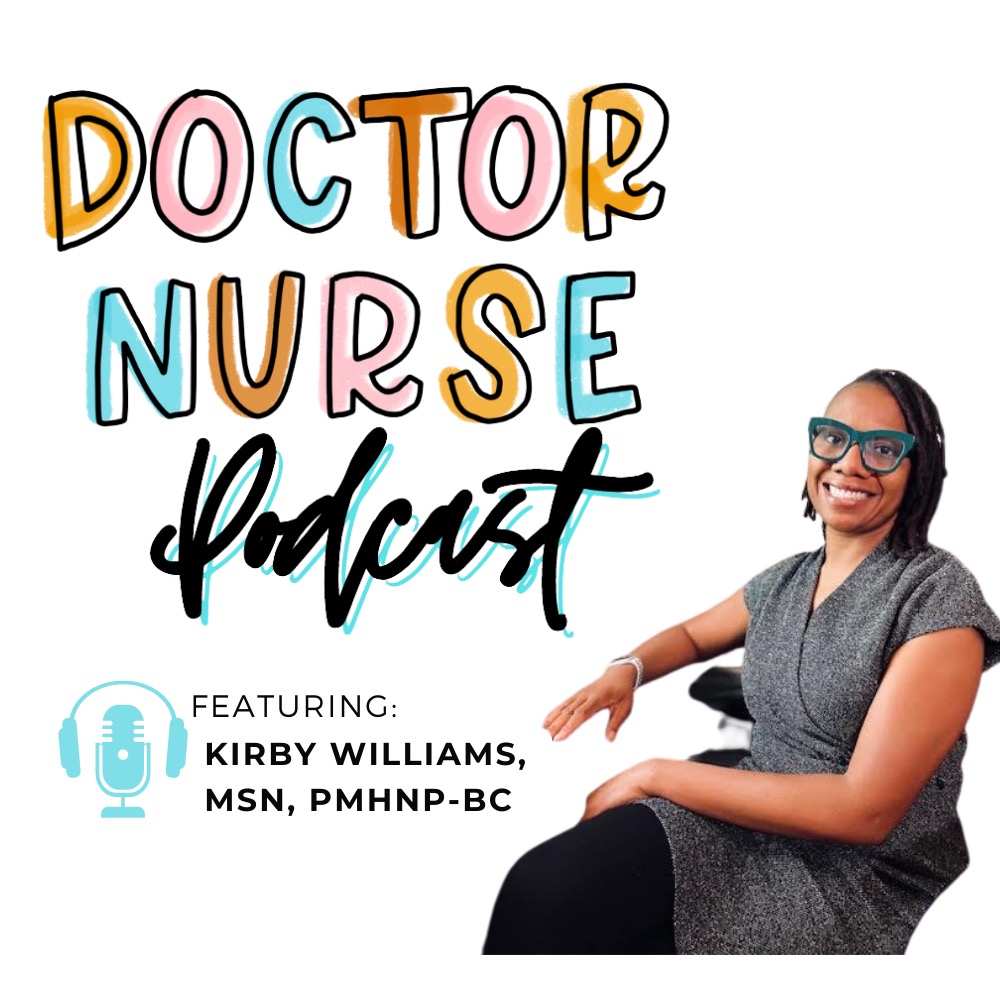
Dr. Sandra Pagenta: Hi, welcome to the Doctor Nurse Podcast. Guys, I am so excited to introduce our guest today, Kirby Williams. She is a nurse practitioner, psych mental health. Who has been running her own private mentorship and career consulting services for psych nps. And her business is called Beacon Behavioral Health and Consulting.
And she’s gonna come on and talk about her career and then also about her current is so welcome Mrs. Williams.
Kirby Williams: Thank you. Thank you, Sandra. So happy to be here. Thank you for having.
Dr. Sandra Pagenta: Yeah, All right so let’s dive right into what you do. So are you just, I guess my listeners kind of heard a little bit about what you’re doing, but e explain all the hats you might be wearing.
Kirby Williams: Several hats. I am a mom. I am working full time as a psychiatric nurse practitioner in community mental health. That’s my W2 position. And then I have branched out this year started doing. Career consulting and [00:01:00] private mentorship services for psychiatric nurse practitioners. I found from a lot of my previous students that I precepted that it was something that was really needed.
It’s something I kind of have been doing throughout my almost 11 years as a psych nurse practitioner. But I wanted to make something more formal. Where I could really devote the time to being with a person who is trying to start their career as a psych nurse practitioner, figure out like what the options are as a psych nurse practitioner, and really get into some of those intricacies and difficulties with some of the jobs, and just having a good support system like a mentor like myself.
Dr. Sandra Pagenta: Yeah. That’s really good. I love that you put Mom as your first job because that is our first job. Mm-hmm. , and I love that you did that. And then secondly tell me a little bit more about your, your, your W two job, which is funny how you position I love that. Yeah. So tell me a little bit more about what you’re doing kind of in your clinical practice and then we’ll dive into your, into your coaching, mentorship, business.
Kirby Williams: Okay, awesome. So I see [00:02:00] adult clients as a psych mental health nurse practitioner, and community mental health. What it can look like is that it’s an outpatient practice and it takes patients who sometimes are underinsured or uninsured, Medicaid, Medicare. And then we also have clients who come from the jail system.
So they don’t have insurance at the time, so they. Assistance getting connected to services. We also have primary care services there too, so that helps out a lot as well. And then we have patients who have what we call severe persistent mental mental illness, so schizophrenia that. Of a high severity.
So they have been hospitalized sometimes for several years and they’ve finally been stabilized after those years and then they’re coming out and need continued outpatient care. So majority of my patients currently have a high level of severity. For the most part. Many of them do. Not all but many. And so, but it’s the kind of work that I like to do.
It’s the kind of work I enjoy. I feel fulfilled by that. [00:03:00] And so I do. Position it’s still fulltime but not full time. 40 hours. I do 32 hours a week. Full time with us.
Dr. Sandra Pagenta: Yeah. And so balancing mom and work and now adding on this side hustle business. Yes you said you precepted for 11 years and then you decided, let me create a formal program to help psych mental health nurse practitioners kind of get their career started and how to navigate in their careers.
What were you finding when you were precepting students that you noticed something’s missing here and I can fill that?
Kirby Williams: Yeah. So what I found was truly missing is they really didn’t understand the business side of healthcare. They didn’t understand what were the best ways to be successful in their careers.
They knew like, okay, if I do. Good work. If the patient gets better, yeah, I’ll be good. But there’s more than that. As you probably know as well, there’s more than that just about the patient. Doing well. It’s also about continuing your education, continuing to network so you can [00:04:00] find better opportunities, more opportunities find mentorship, find support from other colleagues.
So they really lacked in understanding those types of processes. And then a big thing for psych mental health nurse practitioners that probably other nurse practitioners. Fine with jobs is that a lot of, well, I don’t wanna say a lot, some mental health practices that have, like all therapists, they look to hire a psych NP because they’re like, Okay, we have a lot of therapy clients.
Let’s add, you know, a psych NP to one who can do medications. That’ll be a great idea. And it is, but they don’t fully understand the capacity and the scope and all the supports that a. Provider would need for, you know, for care. So they’re just like kind of throw the person in the mix thinking, well, we got this thing going, so it’s gonna work.
And it actually doesn’t, if you don’t really truly know what a psych mental health nurse practitioner needs, if you don’t truly know what their billing is, like, what their day is kind like, and what kind of support they need. Like, for example, an admin assistant medical assistant, something like that.[00:05:00]
So I found that new nurse practitioners were getting into those positions and. Drowning might be a strong word, but we’re having some struggles that they just didn’t realize that would even come up. Gotcha.
Dr. Sandra Pagenta: Gotcha. So interesting. And as you have been helping these current psych nurse practitioners, you know, that are new in their career, what have you been able to provide for them?
Kirby Williams: So some of the things I can provide is really provide for them a outlook. Saying, Okay, what kind of jobs are you looking at? Or do you want, And they can talk to me about like what they’re, what they enjoy, those types of things, and talk about what they. Are looking into. So let’s say they’re looking into going to a private practice that has all therapists.
I say, Okay, well let’s talk about have you talked to them about what kind of systems they have in place already? Have you talked to ’em about what kind of like policies they have? Cause they might have therapy policies, but not medication management policies, which are, which can be different.
Sometimes they look similar, but a lot of times they look different. You know, are they willing to have you? Some medication management [00:06:00] policies, you know, different things like that. So helping with guiding them to think about these processes. I’ll help them even draft some of the policies if they’re like, Oh, I’m not sure where to start.
Which is, okay, that’s, you know, it’s not a, that’s not a crime. I’ll say, Okay, let, let’s help you draft them. Let’s think about like things that come up with medication management. Let’s think about things we need to have in place so that patients already know kind of what to do. So some of that are things that I do.
I also help them with kind of figuring out what may be a best fit for. Some nurse practitioners, like nurse practitioners are like, Well, I’m not ready to be like completely on my own. I don’t really wanna do like a private practice cause I would feel too alone, which is okay. Mm-hmm. . So I talked to ’em about like, okay, some options could be like community mental health, whether’s.
A lot of us altogether. It could be an inpatient hospitalization, it could be a crisis stabilization unit. So I talked to them about the options because it’s also possible during their training, they may have only seen two, maybe three kind of settings for psych nurse practitioners. So they might not be aware of like all the possibilities and what that could look like for them.
Dr. Sandra Pagenta: Yeah. [00:07:00] Yeah. I feel like I constantly see on job postings. Nurse practitioner, psych, mental health nurse practitioner, remote jobs, like it is like an absolute gold mine for psych nurse practitioners to be able to walk in and start, you know, with a remote position. And so I was thinking if you were a nurse practitioner and you had your psych degree and you were like, I think I wanna do remote care, what is something that you would help her?
You know figure out, like, think through. Yeah. What are some of the concepts that you think that, you know, if somebody came to you and was like, Hey, listen, I, I wanna be a remote nurse practitioner, and it’s like, you know, help me out. What’s something that you would suggest to her?
Kirby Williams: Yeah, that’s, that’s a, that’s a, Yeah, that’s true.
That’s a really good question. Cause I actually did a post about this about telepsychiatry, cuz I have gotten that question a lot. And so what I tell people too, I, I, first of all, I tell ’em I’m not gonna tell you what to do, , but let me give you some things to consider. So I talked to them about like, okay, have you ever done any kind of telehealth before?
First ? Have, do you feel like you can do. And [00:08:00] comprehensive assessment over telehealth. Some people might say not really, or, I’m not sure if I can only see this much of the person. I mean, that’s ok. Then I asked them about, Okay, well what are your thoughts about when you need to assess.
Something more physical because all medications, no matter what you give someone can have physical side effects. And mental health. There are a lot of medications that have a possibility of causing movement disorders or movement issues.
Dr. Sandra Pagenta: Sure is it dyskinesia?
Kirby Williams: Yep. That’s one of them. Mm-hmm. that started dyskinesia.
Yeah. So, you know, I say to them, Okay, how would you assess for that? In a setting like this, do you feel comfortable assessing for that in that setting? What kind of questions would you ask? And so kinda just getting them to think through some of those things. Talking to them about like, you know, do you feel like you have good enough boundaries that if a person answers your telehealth appointment and they’re driving, what are you gonna do?
Oh. Cause those type of things can happen. Yeah. You know? So what are you gonna do and do you feel, you know, you have to, the person has to ask themself do, do I feel comfortable setting boundaries or am I not? [00:09:00] Or am I just like, Ah, okay, we can do it really quick. You know? You know, you gotta be honest with yourself.
I talk to about those kind things. Cause those things do come up. They have come up. People have to understand, you might have to have like policies in place that patients sign about those kinds of things. Like no driving, you know, while you’re , you know, things like that. You know, just the things you don’t always think about Cause you’re like, Oh yeah, I feel really comfortable, I wanna work remote, which is great, but you have to think about all these other things as well to make sure that you can do it comfortably, you can do it safely and you can do it effect.
Dr. Sandra Pagenta: Interesting. Yeah, I didn’t even think about that with the, with the driving on the telephone. You’re right. I mean, how can people be present when they’re, you know, in afternoon traffic . Right, right. doesn’t, doesn’t work. It doesn’t work. Yeah, that’s a really good thought. So I like that. I like that you’re able to kind of walk through all the scenarios and bring up things that they may or may not be able to think about and kind of help them navigate you know, their comfort level with these things.
And I think it’s good because it allows for. You know, new nurse [00:10:00] practitioners or even seasoned nurse practitioners that are wanting a change to kind of get an inside look before they step into some of these places and some of these roles that they might not be familiar with, even though they are psych nurse practitioners.
Right. That’s really cool. So how did you get here? You know, like, like, like you didn’t just wake up and just started, you know, just worked all these years as a psych mental health nurse and, and, and start a business. Like how did you get to this specific spot? So I’d really like to kind of hear your journey from trajectory
Yeah. Your trajectory from, you know, nursing school until this spot in your career.
Kirby Williams: All right. Awesome. So one thing is that I always wanted to be a nurse. I knew that from the age of five. I know I’m a nerd, but that’s what I knew. . Yeah. So, you know, I got, went to school, got my bsn, and I will say one thing that, a mistake that I made going through school, cause I was young, I Was accepted in the college at 16.
I started at 17, and so I You were a nerd.
Dr. Sandra Pagenta: I was a nerd.
Kirby Williams: I was a nerd and [00:11:00] I started, and you know when you, Well not, you know, but sometimes what I’ve seen happen, and it still happens now, I hear from other students, is that when you’re in your undergraduate, everybody says like, start mid third, start mid third, start mid third.
I did express an interest in. As an undergrad, but it was just. What, Ah, and you know, I that, like I said, that time I was 19. Ooh. You know, but I was still like, Oh, okay, I guess I’ll start med-surg. Yes. That’s, you know, that’s the way I’m supposed to go. And not that I hated med-surg or anything like that, but I said, Okay, fine, I’ll start me search.
So I did that for two years in Phoenix, Arizona. I loved it. I loved my job. It was really exciting. It was fun. I did actually, interestingly enough, we did have a good amount of patients who had. Concerns. So sometimes people would come there after overdoses, after very major. We had a lot of car accidents in Phoenix after, after major car accidents, and there were very, very young people.
Who actually lost limbs. And so there was a lot of management of, you know, really learning how to [00:12:00] really talk with people who were going through more than just like, Oh, I just had a surgery, or, Oh my, I don’t know, hypertension flared up. Something like that. You know, you really having to really build rapport cuz someone’s life has dramatically, dramatically changed.
And that happened a lot on our unit. So after that, I said, all. I’m gonna travel a little bit. I’m gonna get myself back to, I’m originally from Chicago, but get myself back east somehow. . I did travel nursing in order to do that. One assignment was still on med-surg and another assignment I floated.
So I did some sites there. Not a whole whole lot, but some sites, some med-surg. And then I said, You know what? Stop this. Let’s just get back. Let’s just get back on track. Let’s get back, let’s get back on track. Let’s go get your, you know, go get your degree in psych mental health. It’s what you wanna do, it’s what you’re interested in.
You know, let’s just get back to it. So I did that and started working. I say an inpatient, which for me, inpatient, I was there three and a half years as a psych np. And that was really like my fellowship. I wish that everybody could get that experience, but it was really like my fellowship. I grew.
In those [00:13:00] three and a half years and really learned a lot. And that was like my foundation for all the knowledge I have now, and I just built up on that. Then I precepted a lot and had enjoyment for precepting. Continued to work as a si and p and like private practice. I worked at. Primary care offices.
Did community mental health in DC for a while. Did kind of a little bit of everything as a psych np. And then got myself back where I am now in Virginia. And I was continuing to kind of work in academia a bit. And I said, You know what? Full time academia is not for me, but I still have this joy for helping others grow and nurture new, aspiring, you know, novice and even nurse practitioners, like you said earlier, who might be looking for a change.
I hope you guys are enjoying the episode. I want to take a break and remind you guys to check out the resources on the Doctor Nurse Podcast website. I have blogs, Etsy, shop free resources for nurses who wanna start a side hustle or hear things that I wish I knew before I became a nurse. Listen to all the other podcast episodes I [00:14:00] put on my website.
Check it out. Now let’s get back to the combo.
Kirby Williams: They may not be new, they might be experience. And so I really said, this is what I wanna do. I really wanna continue to do that, but do it my way, Not do it in the academia way, which is still great for some, but it just wasn’t great. Yeah.
Dr. Sandra Pagenta: Yeah, Yeah, yeah. Cuz you have to kind of obey whatever the, the university is wanting you to push and curriculum and all that.
Yeah, exactly. So you gotta kind of decide like if I, if you’re not lining up to certain things because again, like entrepreneurship is something that’s not in the curriculum and like, I think it’s such a disservice to nurses to not allow them to see nurse entrepreneurs in their schooling. Mm-hmm.
which I know is. Probably the issue that you were having, but it is an issue that I have with academia. It’s just why do you give us such a myopic view of what nurses can do? It is so geared to get out and become a slave immediately in a hospital system. Right. And they [00:15:00] don’t show you all the other things.
And I’m like, even if I did, You know, one one day with a nurse practitioner entrepreneur, you didn’t have to put me the whole semester. Right? But even just one day, one week where I would’ve gone mm-hmm. and seen a nurse practitioner that was running a business or doing something like that, it would’ve opened my eyes to, whoa, I didn’t even know this was available.
So I agree. I think there are some things with the academic system that make it hard to swallow sometimes, and it’s like, okay, I’d rather just go do my own thing and really be able. Can I have autonomy over what I’m, what I feel is important, and I can kinda share those, those things. So I think that’s really cool and I think your journey is neat and I like how you used travel nursing to get where you wanted to go.
That’s a really smart thing. Yeah. Super smart And Another thing that I like to ask my, my podcast guests and people that are on is just, you know, it’s not always easy whenever you’re doing all these things, being a mom, working, you know, now trying to start something on the side and building [00:16:00] marketing and learning how to do, you know, reels and Instagram and.
Then learning how, like what am I, what am I about? What’s my niche and like all this different stuff and so, mm-hmm. There have been challenges along the way, I’m sure. And times that you thought, I am not gonna make it. Like this is just not. That’s it. Kirby, I’m throw in the towel . But you, but you still kept going.
So tell me about one of those times and how you over overcame.
Kirby Williams: Yeah, but I did, I have, I don’t wanna say I have them often, but they do come up because I am humans. And so I would say one of the times came up when I was trying to figure out, oh my goodness, trying to figure out a website. And I was like, Well, I’m smart.
I can do this website. I’m a nerd. Yeah. Yeah. I’m a nerd. I can do this, so let me just, you know, look at, look at this and put this together. And I was like, I’m gonna throw this laptop. I’m gonna throw it , I’m just gonna throw it. And my husband is more technologically advanced, we’ll say than myself.
And he tried and I was like, Oh, we got like through one [00:17:00] paragraph of. Putting something like on something. I was like, This took three hours. I can’t live like this, ,
Dr. Sandra Pagenta: I can’t do it. We’re paying for this.
Kirby Williams: Exactly. Exactly. Exactly. So really, I think that was one thing too, and I, I heard about it in a previous podcast as well, and it really resonated with me, which was like really investing stuff.
One of the thing, and that’s time and money investing time and. But yes, could I have figured out the issue? Yes, with websites, but I wanted to, I still wanna give time as a mom, I still wanna give time to my husband as a wife. I still wanna be a best friend to my husband and my friends and things like that.
So I said, No, we’re gonna. Invest in this other person who can do it in like two seconds. And she did and she did a great job. . Yes. And then, you know, that was, that was me like saying, Yeah. And so I do have done that with some other things for my business too. But that was probably like the biggest one or the first came up for me. Like hurdle.
Dr. Sandra Pagenta: Yeah, Yeah. No, it’s true. Cause it sounds like you’re a little bit like me and the fact that you’re like, I can do it. Give it, I got it, I got it, I give it, I got [00:18:00] it. And then you start doing it. Oh, this is a lot harder than I thought it was. Like that . I thought this was gonna be really easy. It looks really easy.
And then you start and you realize like this is not easy at all. And not only that, but going back to what you said, cause I agree with you, you’ve gotta invest money. in giving yourself more time. Like it’s just true. Mm-hmm. , like it was gonna take you so long to build that website that if you could just delegate that work, the time and the money, start to look a little like, My time is more valuable than this money to go and get this done.
Mm-hmm. You know? Mm-hmm. . And so I think it’s really smart, especially cuz there. There’s this thing where like I, I was working really hard to get people scheduled for podcasts, and I’ll just kind of share this little caveat, but I was working super hard. I would get on, I’d have to me email them, I’d have to do this, I’d have to do that, I’d have to remember all these things, and I said, mm-hmm.
you know what? When my podcast starts making a little bit of income, I’m going. To invest [00:19:00] in workflows with my calendar system that I use. And as soon as I was able to afford it, I purchased the calendar system. It has saved me so much time. I mean, the workflow sends out an email, reminds the person about the podcast, reminds me, don’t forget to send this.
And so it’s making my life easier. And so I’m looking at the time and the money and I’m like, Oh, this is so worth the money. because of the time that it’s giving me the freedom, the flexibility, and so, Yeah, I was just talking about this with another podcast guest. It’s okay to spend that money to give yourself a level of freedom sometimes and mm-hmm.
then it’s done and that box is checked and you can move on instead of spending Right. and waiting for that thing to materialize. So good. Mm-hmm. example. Perfect example. And yes, so true. And I completely agree with how you process. That was well done. And I know you talk a lot about [00:20:00] mentorship and what the mentorship that you provide, but is someone mentoring you, have you been mentored along your career that’s been able, that you’ve been able to look back and go, like, This person really changed my trajectory?
Because I think these stories are important, that people can believe that there are people in nursing that do wanna see you be successful, mm-hmm. , any stories like that or anyone that you currently in a relationship with to help you kind of navigate these whats,
Kirby Williams: yeah, what these, whats right? Yes. So I had one very, very, very good mentor.
Like, probably a weird, but she was a student of mine like one of my first students, my second student, and now she’s my mentor and I’m still her mentor, but we help each other with different things. She was in pharmaceutical and so.
Dr. Sandra Pagenta: What did you say? She was a pharmaceutical What? Before she became a nurse.
Kirby Williams: She, the mentor that I have, she was previously, before she was in nursing, she was in the pharmaceutical industry. And so she just has a different business mindset than myself. And that’s been really helpful [00:21:00] to just kind of bounce ideas off of her because she’s like, Well, Kirby kinda all you know is nursing because that’s your only like career has been my only career focus.
So she can talk to me about those things. She’s also had different experiences. She’s a psych NP as well now, but she has different experiences from working in the ed from working in substance abuse. And so sometimes if I need assistance in. More of those kind of topics or subjects. She’s able to provide some benefit.
And though I’ve worked longer than her, you know, there’s some ways that, you know, I can benefit her as well. So it’s like a mentee, mentor relationship back and forth between the both of us. That I found to be really helpful. And she’s just, another one is that she’s just really a good support overall because those days, like I gave you the day about wanting to throw the computer, Oh you know, off the desk because of that, you know, website, she was like, It’s gonna take time.
Dr. Sandra Pagenta: It’s gonna be a minute, you know, just take a pause, take a breath, and hire somebody and delegate this.
Kirby Williams: Yeah. Yes. Yes. So she’s just that helpful reminder in those times when [00:22:00] I also do get overwhelmed. She’s, she’s been a really, really good support. My husband is a good support as well throughout this whole process.
Because knowing I’m trying to start something else while still working full time while being a mom, you know, he’s supportive in all the things that I try to do to. Push the business forward giving me the time and the space to do that. So he’s not a mentor, but ah, he’s helpful. .
Dr. Sandra Pagenta: I’ll keep him. He’s a good guy.
Guy. He’s a good guy. .
So for the last question of the podcast, I like to ask if you could go back to Kirby at the very beginning when she just finished her bachelor’s and you could tell her something that you wish you would’ve known at the beginning of your career, what would it be? So a piece of advice that you would tell her, Hold on to this with all your might and then a piece of advice that you would tell her.
Toss it, it’s garbage. What would you, which what you got one of. That’s a good one.
Kirby Williams: So I would say a piece of advice that I would say to hold onto is to not listen to what your nursing instructors are saying about psych, mental health, nursing. They’re all wrong. And then a piece, a piece of [00:23:00] advice I would say, just to kind of trash and things like that.
I don’t know if it’s a piece of advice, but it’s just like, don’t just focus on the hospital. And I think that’s something you echoed as well, Like don’t just focus on the hospital. You know, because same thing, they were just getting you ready for the hospital as a nurse and then a hospital as a nurse practitioner if you chose at that time to continue on.
That’s what that was like. All, or like hospital system in the outpatient. Something like that. So I said, just, just toss that there are options, many options, many more options than just hospital. Cause it was like, Oh yeah, there are options. You could work, you know, Med surg, Med surg, tele, . I, but.
Dr. Sandra Pagenta: Yeah. I love how the tax deed wolf, like, he totally blew my mind on his episode where he talks about like when he started getting into real estate and investing and he realized he could make more money in a deal than he could while like going for a certification where they’ll give you an extra dollar mm-hmm.
excuse me, an extra dollar like an hour. And he was like, Right. But I just made 5,000 with [00:24:00] like working in tax, like working with tax de investing. Yeah. And. Again, like it doesn’t necessarily have to be nursing. Mm-hmm. that you find your side hustle in, or you find something that you enjoy mm-hmm. . But what you can do is you can use your nursing career and your nursing job to help finance other things for you to do just in case, just in the mis you know, the, the happenstance that you begin to get burned out with hospital work.
Mm-hmm. Newsflash, it’s happening to physicians and nurses. It’s happening to nurse practitioners. Mm-hmm. I mean, I talk to them on the regular, and we just heard today about a, a female, Asian female physician or resident who killed herself because she couldn’t deal with the anxiety and the stress and the depression of the, of the job that she’s doing.
And I’m like, we shouldn’t be having jobs that make us wanna, like, hurt ourselves. Right? Like, this is not, this is not li a lifestyle that. Is okay, it’s not acceptable. Mm-hmm. . Mm-hmm. . And so [00:25:00] if you’re able to get through the schooling and get through the, the rigorous training that we have to do, then you really need to move to keeping your eyes open to, Okay, so what if I don’t wanna do this anymore?
Mm-hmm. , I need to come up with a plan. Mm-hmm. . And again, it’s not always. You know, gonna be a million dollar idea right from the jump. It can just start really slow. You can slowly start to build something that might end up being the thing that you can go, I don’t have to do this as much. Because I’ve got this other thing, and so I’m gonna go part-time, or I’m gonna work two days a week, or I’m gonna, you know, take a job someplace else part-time or whatever.
You can, Yeah, you can flex it and you can really allow yourself a longevity and a career that tends to burn people out where they just, either they just keep doing it because their bills make them have to do it, and they just have things they have to pay for and people they have to pay for. Mm-hmm. or, you know, you’ve got the other option.
can do that half time [00:26:00] and I get to go do this over here at taxi investing or real estate investing or make a t-shirt company, or I can teach nurse practitioners how to get where they wanna be in their careers quicker. Mm-hmm. . Cause I was doing it for free for 11 years and so , I wanna challenge my life.
Yeah. Like, I just wanna challenge the whole mentality of doing things for free because nurses are such givers. That’s just all we do. Give, give. How can I give more? Mm-hmm. . And we need to start finding ways to monetize for ourselves so that we have options. Yeah. And so I think it’s fabulous what you’re doing.
I think it’s wonderful that you’ve decided to operate in this way and to really start to open up your eyes to what else you can do. And for one thing, , it’s not gonna return in vain. All work, all toil is profit, but mere talk leads to poverty. Mm-hmm. . And so I love that scripture so much because it just reminds me constantly that there is profit in work.
But if I sit here just, you know, I mean, funny, I’m a pod podcast host [00:27:00] and I’ll those talk, but, you know, over there. Yeah. But in this, in this, and by doing this and creating these relationships and creating, you know, The conversations around things I have been able to see and, and to notice, wow, there is so much more than I had any idea that was going on with nurses.
And it’s just really inspiring, so. Mm-hmm. , all good advice. Thank you for sharing that. And for the last part of the interview, it’s the rapid fire questions, questions, questions, questions. All right. Doo, do, do boo pew, are you ready?
Kirby Williams: I’m ready.
Dr. Sandra Pagenta: What do you say when you answer the phone? How do you answer the phone?
Kirby Williams: This is Kirby. Even from my regular regular
Dr. Sandra Pagenta: phone, , even
Kirby Williams: from my regular cell. This is, That’s so funny. Most people, most people text me anyway. So if you’re calling me, I Wait a minute. Yeah.
Dr. Sandra Pagenta: What do you,
And so what was your first job ever?
Kirby Williams: Oh my first job ever. I think I was like [00:28:00] doing, it’s probably something under the table. And sounds bad, but I was just young. That’s why I was under the table. Yeah, but nobody,
Dr. Sandra Pagenta: I was just working at a library,
Kirby Williams: a nerd. I told
Dr. Sandra Pagenta: nerd, I known you were in a library, . Free books.
Kirby Williams: Not free books, they’re already free. But just be, I get to be around more books all the time, .
Dr. Sandra Pagenta: Very cool. And so what subject nerd alert would you find the most fascinating in school? Oh,
Kirby Williams: Nerd Alert. I think the subject I found was Creative Writing. That was one of our courses in junior high. Ah,
Dr. Sandra Pagenta: yes. I really enjoyed that.
I remember that. Yes. Yeah. Oh, they probably
Kirby Williams: don’t even have it anymore, but I do.
Dr. Sandra Pagenta: I did enjoy that a lot. Yeah, they’ve changed the curriculum a lot for kids, which I don’t know if that’s a really good thing or a bad thing, but yeah, Creative writing is totally a fun, you know, subject. I remember that too. And getting to learn about different writing techniques and how to like, share and you know, write in such a way.
That was interesting. Isn’t that kind what it was? I feel like I might not have done well in that class. I don’t know. No, no. that that was it. That was it. That was it. [00:29:00] Making sure. I don’t wanna like be talking to people are like we have, that is not what that class was. . That’s all to do up. Kby, thank you for your time today.
Thanks for coming on the podcast and sharing your journey and sharing what you’re doing. I’ll put all your links in the show notes so people can check you out and see what you’re doing and reach out to you. If there, there’s psych mental health nurse that could totally use some. Coaching and just mentorship and community, cuz that’s what we all, we all need.
We need community . Yeah. And just getting to talk to someone that kind of gets, you know, has had enough experience in the area that can really help, I think is mm-hmm. fabulous. Mm-hmm. .
Kirby Williams: Great. Thank you so much for having me. I appreciate this.
Dr. Sandra Pagenta: Yeah, you’re so welcome.
Podcast Description
Kirby was born and raised in Chicago, and a proud deep dish pizza enthusiast. She is a lover of travel, food and lifelong learning. Her journey in nursing started in 2006 as a registered nurse in Phoenix, Arizona working on a trauma unit, where she witnessed numerous times the intersection of trauma and mental health symptoms. These initial years in the nursing field sparked her interest in mental health conditions and treatment. She returned to school in 2009 to complete her Masters of Science in Nursing with a psychiatric mental health nursing concentration and successfully completed this degree from University of Virginia in 2011. For a little more over a decade she has been providing psych mental health care to adult populations in various treatment settings. In 2022, she started providing private mentorship and career consulting services to PMHNPs through her business Beacon Behavioral Health and Consulting. This career path has led to the realization that her greatest passions include community mental health care and supporting new PMHNPs to become more confident and capable mental health providers.
Follow up with the Doctor Nurse Podcast here!
Success NP- Etsy Shop developed by my best friend and I who are both Nurse Practitioners and create beautiful designs for your life! Check us out.
Picmonic covers thousands of hard-to-learn facts and topics, to help you master the material that healthcare students often struggle to learn. This study system helps boosts nursing and nurse practitioner student’s confidence and grades. Picmonic learning system students increase retention and test scores. Why does Picmonic work? Years ago, psychologists and education researchers found mnemonics to be an effective tool in increasing retention and memory recall. Today, lots of different strategies for learning and memorization using mnemonics exist including keyword, phrase, music and image mnemonics. Using the idea of image mnemonics and applying clever pictures and humorous characters tied together with story and audio — and put it online to create the ultimate studying system for retention and memory recall. Use code DOCTORNURSE for 20% off your subscription.
Become a NP Preceptor and make up to 8,000 bucks a year!
CODES FOR MY LISTENERS: Sandrapagenta15- 15% off FlohWear by Undies Loft until November 19th!!!
Latest Episodes
Doctor Nurse podcast brings you weekly shows to help INSPIRE, EDUCATE AND EMPOWER nurses with true stories of initiative and impact.
Doctor Nurse podcast brings you weekly shows to help INSPIRE, EDUCATE AND EMPOWER nurses with true stories of initiative and impact.
Latest Episodes
Doctor Nurse podcast brings you weekly shows to help INSPIRE, EDUCATE AND EMPOWER nurses with true stories of initiative and impact.