Also Available On






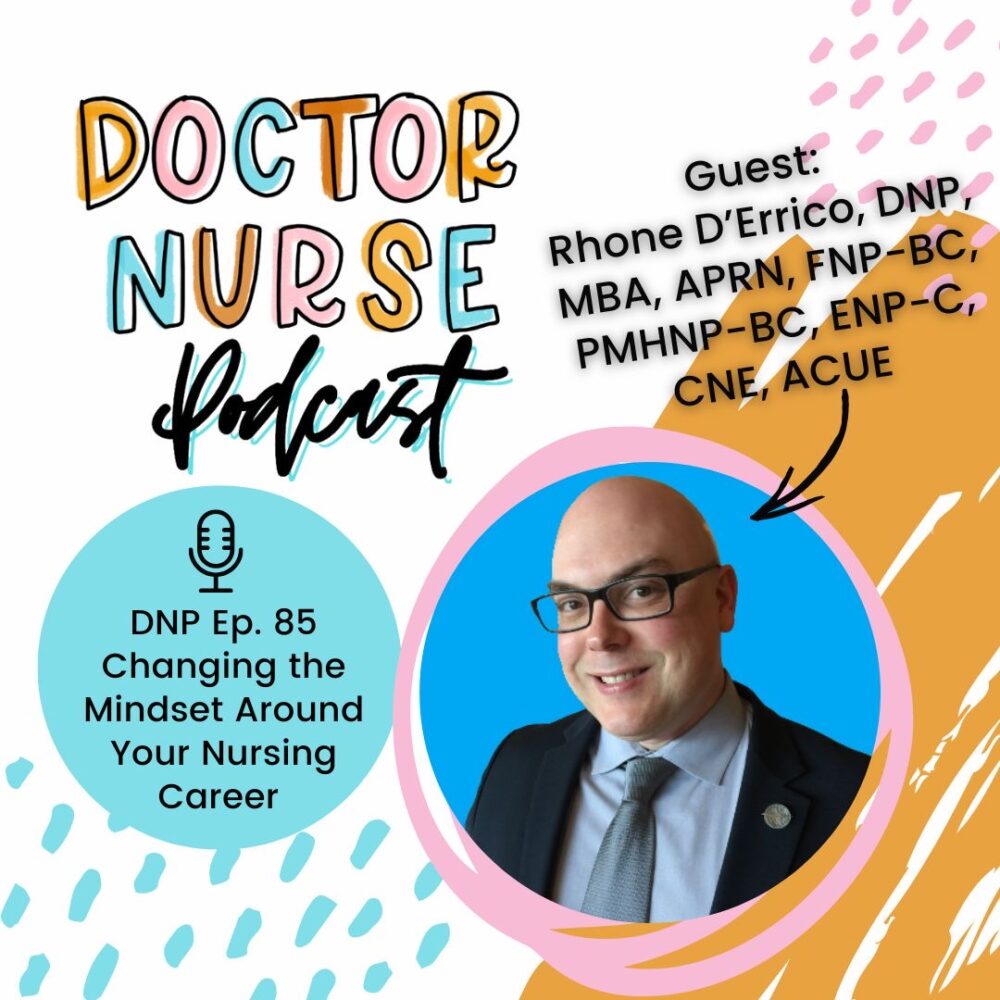
Sandra Pagenta: Doctor Nurse, podcast fam, welcome to another episode of The Doctor Nurse Podcast. I am so happy to have on our next guest today. I just, I cannot wait to share your, this content with you. R Doco, did I say it right? Yes. Doco, I nailed it. Yes. All right. Rone Doco is a certified family psych mental health nurse practitioner, as well as an ER nurse practitioner with an experience as an educator. Clinic leader, speaker and healthcare executive, he works to implement new technologies to combine with his mental health treatments in your own private practice.
Correct. You have your own private practice.
Rhone D’Errico: I contract out, do work with psych mental health. I do. I, I primarily clinically work in psychiatric mental health and I contract out to a couple of different couple of different nonprofits, not-for-profit clinics.
Sandra Pagenta: Okay, gotcha. And you have a passion for inspiring nurses and RNs to create the career of their dreams by leveraging their existing talents.
And rapidly acquiring skills that they need for success. His mission is to inspire nurses and nurse practitioners and high performing professionals to unlock their full potential and create the careers they desire to make a profound impact in their perspective. Fields, welcome to the podcast. I don’t know how you find time to do all the things that you’re involved in.
I’m so glad to have you on today.
Rhone D’Errico: Well, thank you so much, and I will say it is a true and sincere honor to be here because I was telling you before the show, and this is a fact, I’m a huge fan. I’m a huge fan of the podcast. I, I cheer along with every episode, so I’m just super happy to be here.
Sandra Pagenta: Well, thank you so much for the support.
It helps keep me going. And I just wanna dive right into your nursing career. I mean, I know that you started working in the restaurant very young. Yeah. And then you’ve just kind of maneuvered all through, so I won’t spoiler alert it, but I kinda love your like journey from where you started and how you got to where you are.
So could you walk me through kind of. Your nursing career and how you got to build your career like you have.
Rhone D’Errico: Sure. Absolutely. Thank you. And yeah, like you said, I actually started working full-time at a relatively young age. I was 15 years old and due to some family circumstances, I kind of had to start working full-time.
So I started as a busboy in a local restaurant and.
I was actually the youngest waiter there because at 16 I went to my boss. I said, listen, you gotta make me a waiter. Like I have, I have things going on. I need to work, you know how I work. So he’s like, I don’t know, you’re pretty young, but we’ll trial it.
So I did. I got, I became a waiter, and then I kind of stayed in the service business for pretty much the next decade. I worked as a waiter, worked in insurance offices, et cetera. During this whole time, I always lived to learn. And it took me a while to start college. So I was about 19 or 20 when I started college, and that is one of those really true 10 year bachelor’s degrees.
So it took me about 10 years to get that first bachelor’s degree. It was a BA in psychology and you know, towards the end I was just like, I need to get some credits and wrap this thing up. So finally got it done and I that. Day that I got that degree, I went from being a waiter to a waiter with a psychology degree.
And I said, Hmm, you know, I kind of wanted to get into a little different business than what I’m doing, and this doesn’t seem to do it. And the funny thing now is when I think back, I remember I was doing some experimental work. I was doing some experimental psychology. I was helping out in a laboratory at the university, and I was like, but boy, it’s another like six years.
You know, this is. Gosh, 20 years ago it’s, it’s, it’s gonna be another six years to become a clinical psychologist. I don’t wanna spend that much time. I wanna get right to it. And that’s how I came to nursing. No healthcare experience whatsoever. I was just, I used to flip through. We used to have the paper college catalogs and I used to flip through that catalog.
Like a toys r s catalog. I would literally go through and be like, Ooh, discrete mathematics, that sounds cool. I’ll take, this is why it took me 10 years. You know, oh, look at this molecular biology. I’ll take that course. You know? So that’s how I would do things. I was flipping through the catalog and I hit nursing and I’m like, Hmm.
And started to look through it and look really interesting and I’m like, started finding out more about it. We didn’t have social media as much then, but we did have a lot of internet forums, so all nurses, SDN network, all those old school forums. I started reading around. Finding out more and more about the nursing profession, and it just really captivated me.
And it’s one of those, at first I was kinda like, Hmm, that’s interesting, but it’s one of those that became like a brain worm, right? Like it just kept coming back to it like, eh, nursing, nursing, this sounds interesting. And so I went for it. I, you know, I had done, I’d done the usual thing of taking every prepharmacy pre-med, pre-whatever, pre-req already, so I had most of those.
So I just did a couple of pre-reqs, got accepted into a B S N program. Finish that out. I was just thinking today that this month will be six years since I started my final semester in nursing school. I graduated in 2007 September, so graduated from nursing and throughout nursing school I got really interested in neonatal I C u.
I studied it even before going into it. Yeah, this is kind of a lesson I draw that I can talk about later where I knew what I wanted to do. And so I went for it and I just geared my whole career in nursing school towards wanting to enter the nicu, got into a preceptorship, got accepted, and that preceptorship was basically my job interview.
Got hired and went into the nicu. And you know, I obviously, I, my mind kind of goes all over the place and so after a couple years I started looking at other things and that’s really what got me looking into the family nurse practitioner program. So, you know, I’ll, I’ll spare all the bazillion, intermediate steps, but I got into and graduated my F N P program.
Worked as an F N P in college health, actually, which I loved. Ended up in an emergency nurse practitioner position. It was an F n P position in the emergency department. Had no emergency experience, so went into the NICU with no nicu, went an emergency with no emergency. That was a huge learning curve.
Huge learning curve. I’ll, I, one day I’ll, I’ll dig out. I actually, cuz she’s a really good friend, my boss then who is huge in my career and I have such gratitude towards her. But my very first eval was kind of along the lines of if you don’t kind of get it together in the next six weeks, I don’t know if you’re gonna continue in the emergency department.
And it spoke to me and I ended up, you know, long story short, I ended up being a site manager and one of our ERs got promoted to director over all of our ERs. And from that got directed into an executive position with the staffing company that ended up purchasing our group. I became a vice president of operations.
I did for a couple years. I then went into teaching. I had somebody approach me as actually, and this is, you know, I talk on and on about networking, right? And these connections we made and these friendships we made. One of the people from my F N P program way back when was now the program director of a local F N P program.
And she knew in this, in this long litany of things, I got my psych mp, I’d got my postmaster certificate as a psych mp, and before I could actually even work and I got promoted to my executive position, she reached out. She needed someone that could teach. FNPs psych. So it was a psych course for FNPs, which I think is awesome.
I think it’s a great idea. I loved teaching that course. And that’s how I got into teaching. And you know, super long story short, I ended up, which is not true because I just keep going on and on, but I ended up leaving my executive position, became a full-time professor. I. And that’s what I’ve been doing ever since.
So now we get to this point where I’m a professor and I’ve started to do more and more entrepreneurial things of speaking and content creation. But that’s kind of where I’m at in my career right now. And it’s been quite a ride.
Sandra Pagenta: Yeah, because when I was, again, learning about everything that you’re involved in, you know, you’ve got this telehealth vein that you’re doing as well.
Yeah. You, you know, consulting work that you’re saying you were involved in. You’ve also got the, the coaching that you’re doing, so you’re helping. Other nurses kind of accelerate their career, change their mindset around what it is they can do in your career. And I think that’s where we’ve really connected is just, yeah, over that same idea of, wait a minute, there’s so much we can do, we shouldn’t be burned out because.
If we’re burned out, we’re not doing enough of the stuff that lights us up. So how do I get you from burned out to, to like excited and inspired about what you’re doing? Because again, that drudge work that we can do as nurses and nurse practitioners sometimes the, the salary is the price you pay to let your dreams go, you know?
Mm-hmm. And so one of the things that I
Rhone D’Errico: like that write down, you’ve been talking about,
Sandra Pagenta: That’s a good one. One of the things that I like that you keep talking about is just like that inspiration of like, don’t just settle for that, that salary. Like what is it that you were designed to do? And when I heard you talk on another podcast about how you began to teach and just something small, you said, I started kind of on a, as a side hustle.
Mm-hmm. And then that became, This now passion. It was like, oh, that’s exactly what I talk about all the time of my podcast, is just trying something, giving it a little shot doesn’t have to take all your time. It’s something very small. Yeah. But then you began to realize like, no, I love teaching. Like this is what lights me up.
And so you go from this executive position to teaching and now you don’t feel burnt out. Now you’re able to go and create even more, and that’s what it ends up doing is lining you up to go and, and go forth and do more creating. And I just, I think it’s so neat to hear. How you started kind of that side hustle.
So kind of take me through that process of like as you’re working as an executive, how you decided like, all right, I’m gonna go try this, this new thing. I’m gonna go just give this a shot and see what happens.
Rhone D’Errico: I. Yeah, and I can even take it back a little bit before that. So summer, who was my boss that I’m talking about that did so much for my career, she had actually kind of done the same track.
She was my boss. She got, and then when we got acquired by this big company, she became a vice president of operations. And even at that point, I was like, I, I just, I never thought of that. She’s an np, she has an NP with a master’s degree and she’s in this business. Executive role that are usually MBAs, and I was like, wow, that’s really interesting.
I never thought about that. And I had gotten promoted into her old position, which was the clinical, the N, the apc, we called it director. I was over all the NPS and PAs across eight emergency departments. But I said, wow, this is really, I never even thought of it. And she said, yeah, I didn’t either. If you want to kind of follow along and I’ll mentor you as I learn.
And that turned into my opportunity to get promoted into that position. Now, when I got promoted that position, she said, I’m gonna tell you something. She was giving me the inside track. She goes, when you negotiate for this new position, make them let you keep a clinical contract. Without minimum hours so that you can keep practicing clinically if you want to, you’re gonna be glad you did cuz this is gonna be a whole new world, but you’re gonna be glad you kept that.
And I did. And they did and they let me, and I remember I was thinking, you know, I’ll work like once, once or twice a month as I get into this new position. I didn’t work clinically for a year. That V VPO position was like, oh, this is a new world. But I kept that clinical contract and so I kept that little bit.
And then when I had the bandwidth, I started, I. Back in the ER once or twice a month and it kept my clinical hand and it was actually great. So I was doing executive stuff Monday through Saturday. I was traveling and stuff. And then one or two Sundays a month I would work in the ER and I’d get to actually talk to my people.
And you know, it was so funny cuz the, the ER directors would be like, Hey, you’re the vp, why are you. Why are you working here? And I’m like, well, when I’m here, I’m coming to you for, for direction. But that was that first little side hustle piece, right? That was kind of an int entrepreneurship, and I talk about this as well where I love entrepreneurship.
I can talk about that going 10 99 all day long, and I love it. But there’s those chances for entrepreneurship too. I was still an employee. I was still w2, but I just carved out my own little piece and I said, this will benefit the company. It will be good for you to have a V P O that actually gets in that floor.
A couple of times a month and is on the floor with the physicians, the PAs, the nps, knowing what’s going on. So I sold it. Now the next side hustle was the education part where I was a p o. Got, I’m gonna stop you right there. Yeah, go ahead.
Sandra Pagenta: I wanna stop you right there because one of the things that you just described, I think more nurses need to hear about, it’s called servant leadership.
Yeah. And that is kind of how I saw you in that exact moment as you get on the floor and you. Serve in the trenches with your nps. You don’t distinguish, I’m in the C you know, I’m in the executive suite. Yeah. You can’t touch me. I don’t know what it’s like to get down there. As you get down there and you show like, I can get in the trenches with you and serve and still work in leadership and know how to advocate for your nps that are on the floor, that just makes you that much better of a leader.
Yeah. And I think there is such a, a, a disconnect between. Leadership and realizing, no, you’re just one of us. Like, don’t forget. And by getting back in there, it just shows me, at least to me, the character that you have inside to just be like, no, man, I can get back in the trenches with you. My goal and, and my job as your leader is to figure out how to help you do your jobs better.
Like, that’s it. And I, I don’t know why. I just saw that really quick and I just wanted to say that. So that was your first side hustle, but. Seeing you back in there just reminds other nurses, like you want leaders and you wanna be the type of leader that gets back in the trenches and serves with the people.
Because that’s, that’s really what it’s about. It’s about the people that you’re, that you’re representing in those positions. Anyway, keep going. Second side
Rhone D’Errico: hustle. No. Well, and that was a cool gig because I’d be working with staff nurses also that, you know, our group was a separate entity and then the hospital employed staff nurses, and they’d get word and they’d like, are you like an executive?
Like what? And like, yeah, yeah, I do that. And then I could talk to them and they’d say the same thing I had said in the past. Like, I didn’t even know that was an option. I’m like, oh yeah, because our, our, our company actually had many, many nurses in in these executive positions cuz they found a lot of em were nps.
A lot of em were like former ER directors. People like that. But my company was awesome about hiring these nurses and putting them into executive positions cuz when we went to talk to the other C-Suites, we’d go the CEO of the contracts, we would work and we could speak that language, that clinical language.
So yeah, it was kind of that opportunity and that really is the most important thing to me, and that’s, that’s what I do today. It’s all about kind of telling nurses what you can do. With that opportunity. Yeah. And I talk about teaching too. I mean, that’s, that’s my segue there is I got reached out to teach an adjunct just one course.
It’s a fully online didactic course, so I didn’t have to physically go anywhere. I would just kind of, I, they wanted me to help design the course that had some updating the previous person that had been teaching the site course had left. So because I had both psych and family np, I could bridge that gap.
And I could say, here, I know what it’s like to practice as a family, np. Here’s what you need to know about psychiatric mental health to be a better family, np. And I just loved it. I loved it. I loved it. And when a full-time professor position came on, this was one of those struggles in my life. Cause it was hard cause I loved my VP position.
Hey guys. Hate to interrupt the conversation, but I need to remind you guys to check out the Success NP Etsy Shop. It’s an Etsy shop that I created with my best friend, and we create a ton of digital products for nurse practitioners merch. All the different things to keep you going in your NP career.
We noticed that there was just a lack of content for nurse practitioners out there, so we decided to go create it. So check it out. I have it linked in the show notes. And be sure to support us cuz again, you’re supporting small nurse business owners. We would love to have you guys check out our merch or refer our shop to someone who you think would enjoy the content. If you guys are liking this podcast, please gimme five stars on Apple podcast. Any, love that you throw at me helps keep my audience engaged, keeps people coming to check out what we’re creating here. Thanks for being a part of our community and consuming the content on my podcast.
And let’s get back to the conversation.
Rhone D’Errico: I loved the work, I loved the clients. I loved my, my coworkers were amazing. My boss, my senior vice president was an rn. He always liked to say, oh, I’m just an rn, but he had been in the business for decades. He’s a brilliant man. Excellent. You talk about servant leadership, Steven Miles, if you’re out there listening, I send him every podcast cuz I mention his name every time.
Steven Miles, RN from England living in la. Best boss. I’m telling you, he’s amazing. I’ve had some ama, I’ve had some amazing bosses. I’ll tell you right now, I could do a whole podcast on my, on the amazing bosses I’ve had. But I love that job. But it was, but I just, I loved teaching so much, and when a full-time professor position came on, yeah, it, you know, I even took that little bit of a pay cut.
I’m like, you know what? I’m. Me and my wife sat down, had the discussion, I said, I’ll let my clinical a bit, I’ll do some more clinical shifts and I’ll make up the difference. And this is another theme I love is those I envision dials, I envision in my mind I have dials and I have clinical professor, entrepreneur, and I just turn those dials.
Up and down. Yep, yep. So if I need a little more from one I up, one I down the other. So I did and I went into teaching and haven’t looked back since. You know, I’ve worked at a few different universities. I created and launched a psychiatric mental health nurse practitioner program at my alma mater, which was super cool.
I got recruited for that. Worked there for a year, got the program going, got it set for accreditation, got my first cohort, graduated, and then I was like, ah, admin. I’ve done it. I’ve done educational admin. I’m glad to say I’ve done it. I just, when I’m in that role, I just wanna teach. I love teaching all nursing students, but NPS and dps, I just that, I mean, you talk about finding something that your dream is sitting down and talking to those dps and nps and I love it.
And yeah. And then again, now I’m at this point where I started, I was saying all these things to my students. I’m telling all my students, I’m trying to grab my students. Like, yeah, we’re learning clinical stuff, you know, I’m teaching you DSM five, I’m teaching you when we’re in fnp. I’m teaching how to suture and doing all that, but I gotta get that mindset.
And that’s what you mentioned before. I gotta get you that mindset. Don’t just have been, and you’ve, you’ve, you know, this, that so many NP students. We’re burnout nurses and they’re just desperately looking for some escape. Like, get me outta here. And it’s like, I’ll go to NP school. Yes. I love being an np.
I love NP school. You and I both know there’s people out there that that might not have been their best choice, but they were doing it as an escape. And so I was telling all these yeah things to my students and then I’m like, oh gosh. And I’m fairly active on LinkedIn. I’m like, I gotta start getting this message out.
Maybe even before you go to NP school, you, there’s so many options. And that’s what I love about your podcast. There’s so many things nurses can do. You just gotta, you gotta give yourself credit for the skills, abilities and expertise you already have. So I guess I’m a teacher wherever I go. That’s the role I love because I’m a learner.
I’m always learning, so I’m just passing it along.
Sandra Pagenta: Oh my gosh, so much you just said I could like spend all day on and I love the dial word picture because it’s so true. And again, whenever you find that perfect combination, I mean it’s sometimes that’s what it ends up taking, right? Is you stepping away from like, that’s starting to burn me out.
Aspects of that are burning me out. I don’t need to do those, those other aspects, how can I do less of that? More of what lights me up. I like this teaching and you can get this perfect dial with your career where you’re in a lot of different things as a nurse practitioner or a nurse, and still be working clinically, still be in different things, but not to the degree where you experience that burnout.
That’s really the, that’s really the goal that I want more nurses to hear, more nurses to start tapping into and to start negotiating when you’re in certain roles and go. All right. I don’t mind doing that, but you’re gonna need to gimme a little bit of this. I need to be able to still kind of keep my hand in the clinical side here.
So I’ll, I’ll do this, but I wanna have this as well in the background. And whenever you can start maneuvering that and then things start happening, you’re like, why haven’t I been asking for this stuff? More like, exactly. You just start to realize, right? Yeah. Like, oh my goodness, I have so much leverage and I don’t even realize what I’m able to do.
Yes. And so one of the things that I wanted to ask you when you said this, you said, I went into teaching and I was doing it as a side hustle and I just realized like, this is what I love to do. Yeah. What was it that you began to realize for you to walk away from the money? Cuz this is big, right? You walk away from the money.
Going back to the salary is the, is the price you pay for your dreams to die? Yeah. Like what was it that you decided you were like, I’m gonna let the money go because my dreams lie here. What, what was that wrestling that you did that I think more nurses are probably going, I don’t know how to have that conversation with myself to figure out what it is that lights me up.
Like how did you know that this was the thing to walk away from? The other thing for?
Rhone D’Errico: Well, and it really was a running towards and not a running away. And I remember telling my boss that like, I wanna make this really clear, like, I love this job. But I’m, and I’m not running away from it. I’m not trying to escape.
It’s that I’ve just found something that really speaks to, you know, what’s, what really lights me up and what I feel is my best service. You know, my, my goal is always to be of service and I’m, you know, I’m always a rational individualist. I don’t think those are divorced and nurses have been taught that service entails sacrifice.
I don’t, I, I, I found the thing that I could, I loved and it made me happy and it also brought benefit to others. So that’s what I wanted to move towards. And that was the whole discussion and the thing, I realized, the thing that was holding me back, you know, partially money, money wasn’t so, so big a deal.
Again, going back to, because I had clinical work. So I created options. So that was less of a thing cuz we gotta keep it real. It’s not all about hopes and dreams. You, you gotta have the cheddar coming in, right? So, yes, I, I, I had options. You know, I knew I could always up my clinical work if I needed to.
So I had that option just for the, you know, you gotta pay the bills. It’s Maslow ma bottom Maslow is always first you gotta feed yourself and pay the bills. Yeah. But once that’s taken care of, then you can take those, those chances. And that’s, that’s exactly what it was. This is the things that were holding me back, was loyalty to my team, you know?
And that, that holds you back, that hurts loyalty to your boss, to your coworkers. But, and this is something I’ve counseled a lot of people on, it’s so easy for us to kind of overemphasize that you can be loved at your job and we all hope we’re loved at your job, and you can be vital, but there’s just about no job in existence that after you leave, They’re gonna crumble or six months later they’re still crying that you left.
Like Ron, just let it go dude. You know, you’re a great guy, but that business is gonna keep on keeping on. And the cool thing was I actually negotiated a consultant contract with them. So I stayed on another six months to wrap up. Cause I had a lot of contracts going and I wanted it to be a clean transition.
Yeah. So I was like, let’s sit down, let’s negotiate a, an. You know, contract and I’ll stay on as long as you need me to stay on and make sure these things are handed off appropriately while I transition into this new role. But that’s the answer. It was running too. And, you know, kind of letting go of your ego a bit.
Like, you know, everybody’s gonna be sad. You left. But they’re going, they’re gonna be fine. You gotta just move on with your life. And that, that’s really what I try to tell nurses too. Mm-hmm. Nurses and nurse practitioners, like, it’s good to be loyal to where you know you work, but you know, it’s, it’s all business.
Sandra Pagenta: Yeah. One of the things you just said, and I have to comment on is running away from something, changing that mindset, again, just all goes centers around mindset, but changing your mindset away from I’m running away from something instead of I’m running to something. And I think when you switch that out, you stop.
You’ll stop seeing nurses running to the NP degree. Mm-hmm. To prevent burnout. Because what you’re gonna find is you can easily burn out as an np. Easier. I think even maybe easier than even an RN because was an rn. You leave that work like your shift is over, somebody else takes it over. You walk away, and whenever you’re a nurse practitioner, the work follows you home.
You got labs to follow up on, orders to put in. There’s a lot more follow up you have to do as an np, you can easily become burnout. So if you are a nurse that’s thinking that the NP degree is gonna prevent or stop your burnout, and so I’m running away from the nurse to become the NP so that I can get away from this, you’re doing the wrong thing.
And that’s the great mindset shift that you just talked about. Like instead of thinking I’m running away from nurse burnout, we need to be figuring out what it is you’re running to. What is it that you would be, I want time, you know, I want time freedom. I want. To be, I want my dials to be better. I still like taking care of people, but I like teaching.
Like we need to do all that work. And I know that’s what you do. So one of the things I wanna ask you is when you talked a little bit about mindset, and I love your stuff on LinkedIn, you put on a ton of great content. But why do you think the Battle for Nurses is in the mind? Why have you decided to kind of hang your hat up on I want to change mindset shifts.
I want mindset shifts for nurses. Like why, what? Where is that coming from? Where’s that stemming from for you?
Rhone D’Errico: You know, I think for me it’s really stemming from kind of my individualist perspective. So I give, I give burnout talks, you know, now and again, and I’m always really careful about this conversation.
You know, especially online, how things can blow up. But really I want to be very respectful of when I start talking about means of, of battling burnout. I don’t go to the big system issues right away and I always have to say, listen, I acknowledge and honor that there are major systems issues in our healthcare system, and I know you love this cuz I listened to you and I I know you’re on the same, you’re on the same trip where yeah, there’s, there’s system issues.
I acknowledge that and yeah, me sitting here telling you to change your mindset and you know, meditate and eat your veggies and do your exercise, we all get a little. You know, a little jaded about that. Cause we’re like, yeah, you tell me this, but then I go to work and I’m getting crushed down by documentation requirements and maybe there’s bullying on the unit, there’s, you know, I’m understaffed, whatever it is.
So I always have to say, listen, I honor that and I acknowledge that and I really honor those that fight at the systems level. We have some amazing people in our profession that go to Washington DC that fight on a policy level. They benefit all of us and I really, really appreciate what they’re doing. Me personally.
My approach is always the individual per the individual, because if I can change my mindset and I can change my life, that system has less control over me. So that’s the lesson that I say is that if you start with your vision, It always starts with vision of your ideal life, where you really have to imagine, what do I wanna do?
Do I wanna work from home? Do I wanna work in a clinical environment? Do I wanna work in tech? Do I want to, where do I wanna live? How do I wanna spend my days? Do I want to be writing, speaking, healing? What do I want to be doing? And you start with that vision. You create your ideal life, and then you create, you run to right, those avenues that will bring you there.
So, That’s my starting point with mindset is if you fix your mindset, and it’s not a one-time fix, it’s something I do every day. You work on it every single day to make sure you’re in line with your vision and that you know what your vision is. Then, you know, the system just gonna have to kind of work itself out.
Now we’re all part of the system. If I get ill or a loved one does, we have to go to the hospital. So I’m not dismissive of needing to make sure things are good for nurses and healthcare professionals in the healthcare system. But when I’m talking to an individual nurse at, in front of me, just bottom line is, you gotta get yours like that.
That’s what it’s all about. You get yours and you just let the rest because you know the system’s not feeding your family. The systems not taking care of your loved ones. It’s, that’s us. And so we gotta just focus on ourselves. And then when we have that energy and that bandwidth and that ability, and this is what happens, you build yourself up, it’s putting the mask on yourself before the person next to you, you build yourself up, then we can go back and maybe we can go take a run at that system from a position of strength.
And that’s where I really want to come from with the individual nurse and nurse practitioner.
Sandra Pagenta: Yes. No, you are a hundred percent correct. We completely align on that because you can get so focused in on the system and you can actually kind of, I think, depress yourself from fighting. Mm-hmm. By being so bogged down by, oh my gosh, this system is so messed up.
We’re never gonna be like, Why don’t we just start in the, at the micro level with just your life and figuring out what it is that you can do, run towards, make those, again, make that special formula for what it would look like for your career. And then again, we could tackle those big things. And I, I totally agree with everything that you just said.
I mean, it was, I wish I could say it is eloquently, you just said it perfectly. I mean, this is the heart of the podcast and the thing that I’ve been describing. Yeah. And again, You talked about, you said, and this is just one of the things that popped in my mind. You said, you know, I have to do this every day.
You bathe every day, right? Mm-hmm. They say that you take a bath every day. Yeah. It’s not good for, like, you don’t take a bath one, you know, once a week and think it’s good for the week. You take a bath every day, right? So you’ve gotta constantly be bathing yourself. And what am I chasing? Yeah. What am I going, is this getting me?
Is this decision, is this job, is this career? Is this degree, is this edu? Like is this getting me to that end goal of whatever that looks like for you? And, and again, having a coach, having someone like you to kind of sit down who has seen at. I think to a, a really great degree, the forest through the trees with nursing, that someone that can go, Hey, listen, I know what this degree can do.
Let me show you, let, let me coach you through it and get you to where you want to be for your career. Yeah. I think we would prevent burnout for so many nurses, and like you said, putting the oxygen max on yourself and then going and taking care of patients. You, you move differently when you’re not burned out as a nurse practitioner.
Mm-hmm. You, you, you care differently because it’s like, I’m here for this amount of time. I can stay focused and do what I need to do and, and impact patients. It changes how, it just changes everything, how you see everything. So Well said. Beautifully said. And yeah, I think I. One of the other things I wanted to talk chat with you about was, you know, how’d you know it was when it was time to shift?
And how did you know how to pivot? And so again, like kind of going back to, we were talking about in this new spot where you’re at you know, you talk a lot about burnout, career options for nurses and, and you coach a lot of nps. And so if an NP were to come to you and say, alright, I feel like it’s time to shift, how do I pivot?
What advice do you give to that nurse?
Rhone D’Errico: Well, it always starts with vision and it can be tough when you get, I like, where, where do you want to go? I can’t tell you how to get where you’re going. If you don’t tell me where you want to go. Like, it’s like, how do I, how do I hit the road? Well get in the, get in your car and start driving, but.
I don’t know where you’re gonna end up. You gotta know where you gotta go. And it doesn’t have to be an exact, it doesn’t have to be intimidating. I mean, these are classic journaling examples of I like, and this is one I borrowed from others, it’s, it’s Tuesday morning on a regular week. It’s not a weekend, it’s not a holiday.
It’s literally just an average Tuesday. You open your eyes, it’s the morning. What time is it? Did you wake up with an alarm or did you wake up on your own? Where are you? When you look around, where do you look? Where do you live? Who are you with? And what is your day gonna be? And assuming you wake up on a day that you just are really excited about your day, this is your ideal day.
It’s that moment when you wake up in the morning and you open your eyes a day like today where I get to open my eyes and say, I get to talk to Sandra today. So I’m so excited. So it’s my ideal day. So you open your eyes. It’s my ideal day. What’s that day like? Where are you? What are you gonna do? Are you gonna go somewhere?
Are you gonna work from your home? How are you going to benefit the world? And that generally means work. And you know, I mean, like I said, I started working at an early age and I’m a just a devotee of the value of meaningful work. You know, I, I express myself through my work. I, I earn income by providing value to the world.
So how are you gonna provide value to the world? And that’s not something that can just be on a quick thing. You gotta give that some thought. And that’s not, it’s not meant to be like, You have to come up with it. But that’s how you know where you’re going. That’s how you know where you’re going. And the side that I do with that is sometimes when you talk to nurses and nurse practitioners, they’ll say, well, the scary thing is when I do that, it has nothing to do with nursing.
This is where I say, oh, okay. Maybe, maybe, but maybe not because you’re thinking it’s nothing to do with nursing. Cuz it means me going to my unit and having to beg to be allowed to go to the bathroom and have too many patients and be scared about my license for 12 hours. But just don’t. Before you say it has nothing to do with nursing, does it have something to do with persuasion, negotiation, writing, speaking, coaching, teaching, leading.
Business technology, does it have anything to do with any of those things? Cuz if it does, it has something to do with nursing. And then we can talk about how to take your nursing skills and abilities into those new realms. And that’s the big mindset sh mi mind set shift that I am working so hard to get across to nurses.
That’s the whole goal of all my social media postings, is just to give yourself credit for what we’ve achieved as nurses, what we’ve learned. Leverage that. You know, I think back to my first, my first staff nursing positions, I think we’re both alike. We weren’t staff nurses for an entirely long time.
And the only staff nursing I ever did was in the nicu. I stayed in the NICU that I went to be an np. I was in the NICU a total like seven years to include per diem. I’ll tell you my love of nursing, my, the first hint I had of this as an aside was I was a full-time nurse getting kind of burned out.
Entered NP school, but had to keep working. So I switched to a per diem and all of a sudden I went to one day a week from three. And boy does that change your mindset? Cause it used to be, I just dreaded the whole thing. I think I was dreading that third day, honestly, or fourth when I worked over. Because it’s like, oh, that’s gonna be miserable.
But when you work one day a week or one day every two weeks that I was like, Hey, you need me to stay over a couple of hours, hours was night shift. I was like, I’ll stay over a couple hours and hang fluids and, and get your, get your babe set up for their first round. I don’t care. I’m not here for two weeks and I’m gonna get paid two hours overtime, so I’m good for it.
So it’s that mindset shift. My mindset. But I think to those nurses I worked with, I worked with some genius, brilliant, excellent nurses. And it wasn’t just that they were the best at getting IVs. They had that. Nursing sixth sense. We learned about in nursing school that nursing intuition where they knew when a baby was gonna get sick.
They knew when to go toe to toe with the surgeon. They were just brilliant, but they were burnt out and they were sad and they were miserable and it was depressing. And then I didn’t quite have the knowledge I do now. And if I could go back in time and talk to them, I would say, what I say now is like, you have all these abilities.
And we live in the best era possible to do this. Look at this, me and you are shooting a podcast on an internet app. That’s, that’s just, it’s easy. Yeah. You click one click and we’re here. Something that wasn’t even possible three years, five years at all. So any nurse now, and you don’t have to just be a social media creator, but we have all these tools where it makes it super easy to build.
It makes it super easy to manage your business. We have increasing numbers of tools. We won’t even get into the large language models and the generative IV. AI and the things that you can do nowadays to get your business running. So telling nurses you can take that knowledge. You’re an expert in dealing with mother baby issues.
In the example I’m thinking of, and I know this is a passion of yours, and I know you’ve talked to NICU nurses that have transitioned into lactation consultants, doulas, all of that. That you have this mind, you have all this knowledge, skills, and ability. You just need the mindset to get out of that industrial system and leverage it for yourself.
So that’s really, that’s the message cuz it’s the thing I tell myself every day. Don’t ever feel like you’re held back. So anything I ever say to anyone else, I’m telling myself and I’m the one that needs to hear it first. Mm-hmm.
Sandra Pagenta: Yes. Well said. I mean, preach, preach, preach, preach. And I just, again, a couple themes that I’m gonna pull out of that, that you said is begin with the end in mind.
I love that. Again, where are you, where do you wanna go? And then you can drive the car there. And I love that. Begin with the end in mind. And another thing that you say a lot, and I feel like I’ve, I’m hearing from you is, is. Kind of that leader without a title and not feeling like you’ve gotta go chase some title to go do the things that you wanna do.
And a lot of the, the concepts that you are talking about, I feel like I’ve read in that book. It’s a fabulous book. A leader with no title and, and kind of setting up yourself to push forward what it is that you want, how you want to live, and from those things will stem so many different things that you just.
Never even realized. And it was just from that simple belief of leading your life with you as the, as the focus of what you want to build for yourself. And by starting there I think that a lot more nurses would again, not be as burnt out and not be as tired and be doing stuff that lights them up.
And yeah, I think that would be just, yeah, I think that’s just great. Great advice. And guys, if you guys aren’t writing this stuff down, I don’t know what to tell you. I don’t know how to help you if you can’t, if you can’t just absorb this to your soul because it’s the truth. And starting in that, Intrapreneur spot.
Yeah. If you were like, okay, I don’t know where to start, you can start there and start advocating for your own career and saying, I’m gonna do two days a week. I’m gonna start again. Like you said, you sat down with your wife, you figured out the budget. I’m gonna go and then I’m gonna go dial this up and see if I can make something with that.
And you might move differently. So for the last question, and again you just kind of answered it, that advice you give for a new nurse starting off in her career that you wish you would’ve known if you could have gone back to, you know, that, that. You know, baby de Rico starting his nursing career. If you could give him something that you would say, Hey man, I want you to know this now.
Hold onto this because it’s gonna be a crazy ride. So take this and run with it. What would you, what would you say, what would you say to yourself?
Rhone D’Errico: I would say to myself, you and all your little cronies in this intro course that are just starting in nursing, one thing you’re always talking about is, wow, we’re going for nursing cuz you can do anything.
Right? We all talked about that. Nursing in the beginning of nursing school. Gosh, you can do everyth anything. It’s not just the hospital. You know, there’s all these other things. And somehow by the end of nursing school that was gone and like, where did that conversation go? And now I’m back to it. And I’m like, that’s what I would hold onto.
That would be the bit of advice. That thing you’re talking about. Don’t ever forget that mindset. And every time you’re doing something, I’m not saying you don’t have to pay your dues, and I don’t tell people how many months or years they have to start and I don’t tell ’em what unit they have to start.
That’s not my business. But I would say whatever you’re doing, every time you’re doing something, make that file in your brain that I’m filing around this for me. So if you’re making me take too heavy of a load on a night shift and I do it, And I just have to do it. Well, if I have to do it, I’m doing it for me cuz I’m learning lessons that I’m gonna save for later.
Save every single lesson you learn for later and know that this is not the end all and be all. And that there’s just unlimited choices. I’d tell him his hair’s not coming back, you know, so just embrace it. So I think those would be the two big, the two big lessons I’d give to Baby Rhone on that baby 30 plus year old Ronan in nursing school.
Those would be the lessons. You
Sandra Pagenta: rock a bald look, man. So just own it. I love it. I love it on you. I love it. So
Rhone D’Errico: I couldn’t, I couldn’t go back. I love it.
Sandra Pagenta: So for the last part of the podcast, I do rapid fire. So this is just fly by the seat of your pants. Okay. You know, you can’t prepare for these. Are you ready?
Are you
Rhone D’Errico: ready? I’m, I’m ready. I tried to prep, but I, I just, I’m ready. No.
Sandra Pagenta: So what’s one book you would give to someone if you’re like, this is my go-to book, I give it to everybody. What would it be?
Rhone D’Errico: I’m a biblio file. I don’t, you can’t see the stacks around here, so this is the hardest question you could ever ask me cuz I, I just read constantly.
I would kind of narrow it down to a few of, I mean, I could tell you there’s just so many, but just if you were talking actionable. So we’re sticking actionable, we’re keeping it real. Getting things done by David Allen changed my life and saved my life when I became an executive. It’s not just productivity, it’s mindset.
It’s psychology. It’s all about making your life better. It’s not about having a ca like a super fiddly productivity system. David Allen’s books are genius and they’re, they’re spiritual, and that’s not an overstatement without being spiritual. They’re a guy in a suit and tie on the cover, but they’re brilliant.
So I would say that Cal Newport’s so good, they can’t ignore you. So it’s all about the craftsman mindset, the craftsperson mindset in approaching your career approaching it as a craft, as something you’re developing and improving and getting better and better at for its own purpose. So I think those would be two.
And then I’ll also, I’ll read anything by Brian Tracy that he writes, cuz again, it’s all mindset. It’s all actionable approaches. So I cheated, I gave you three. If I had to be one, I’d be getting things done. Cause I think that can, that you read that book and you implement it and it can make some real ch real, real improvements in your life.
Sandra Pagenta: Brian Tracy, I’m gonna tell you a side story. My dad played that in the car while we were growing up, and it was one of those things that I was like, oh gosh, like it’s this like corny little me, me, yes. Like he had a cassette tape and he would play them the eighties and then I became an adult and I Yes.
The eighties, right? And so then I became an adult and I be, and again, through my career and just. Through the silence of becoming a new mom and trying to figure out like, how did I get here? Like what is it that I’ve decided for my life? I started going back to Brian Tracy, and I was like, are you kidding me?
Like I’ve got full circle back to the car with my dad. I love Brian Tracy. He’s a game changer. Thank God.
Rhone D’Errico: Yeah, great wreck. Change changer your life. Love it. Oh, such, yeah. You’re the third person I’ve talked to this week that I mentioned, Brian Tracy, and they just go nuts. So, oh. Yeah,
Sandra Pagenta: he’s incredible.
Incredible. Performing a, performing a club. And then, okay, so what? Yes. So what subjects do you find most fascinating throughout all your education? I know you have a D N P, you have an M B A, you’ve got the psychology, you know, all this different degree. What would you find is the most interesting subject?
Rhone D’Errico: Self-improvement. I mean, not, not to stick to too much of a theme here, but anything to do with self-improvement. I’m just, I’m a junkie. Anything, yeah. You, you put self improvement, that one, right? I will. Yeah, exactly. That’s exactly it. It’s that 1% every day. Yeah. You mentioned, you know, start with the end of the mind.
The Stephen Covey sharpen the saw. Just every single day do a little something to get a little bit better. So yeah, that’s, that’s the one subject I have returned to over and over again, probably since I was like 19 years old, if not younger. Yeah.
Sandra Pagenta: Yeah. Atomic Habits is another book that talks a lot about that, that little percentage every day.
Yeah, it’s another incredible book. And then I guess to kind of go on a different vein, what are you most grateful for in the entire world?
Rhone D’Errico: My wife, my wife. I, I can say that without hesitation. My wife is, I was giving you, I was giving
Sandra Pagenta: you a moment there. Okay. I threw you a softball. I threw you a softball there.
Okay. Yeah. So when she listens, she can, she can feel Go ahead. Yes. What you gonna say? Your wife? Go ahead.
Rhone D’Errico: Yes, absolutely. No, shes just such an inspiration to me. And she’s my biggest supporter and I think the one danger in doing kind of this, Conversation like you and I have and you’re excellent at this cuz you’re very vulnerable.
Is it when someone like me is talking like this, it it’s the illusion that I’ve got it all together or that I’ve never, you know, I was gonna quit my D M P program like literally every month. And my wife literally had to drag me and be like, no, you’re gonna finish it. And in, in a lot of things she’s like, you know, whatever is your best, I’m here to support you.
But with that, she’s like, no, you’re not, you’re not gonna quit just cuz you’re frustrated and because there’s things going on, you’re gonna finish it. And that’s just one of many examples of the way of the, just the incredible things she’s done for me. And I can never, I can never be grateful enough to her.
Sandra Pagenta: Ooh. Well, I want her to hear that and know that and what a, what a blessing she is to your life. And I know that you inspire her in so many ways as well, so, Watching you fight through to complete things and not give up. You both are inspiring One another, and honestly, it’s one of the best mixes that I’ve, I’ve heard in so many of my podcast episodes is the person you marry matters.
Oh, yes. And so I think, yeah, you’ve, youve demonstrated that she keeps you going and you think about her when you make decisions and she thinks about you. And she knows that you would regret it if you walked away from your D N P. So she’s not gonna let you do it. So that’s an incredible team you guys make.
And oh my gosh, Dr. Rica, thank you for coming on my podcast and sharing about everything that I’m passionate about. I feel like we’re just the same. I was just talking to myself for a little bit and it’s just really nice.
Rhone D’Errico: That’s right. That’s the best conversation telling you today. Yeah. It’s a mirror.
It’s a mirror. Exactly. And unless,
Unless you ever enroll in one of my universities, you back word here. I’m telling you. And I’m telling you right now, unless you actually sign up for one of my university courses, you are not allowed to call me Dr. Dori Rico. I’m always around to you. The only people I make say that are my students cuz that’s the university rules.
So first name basis, Dr. Pagenta. I’m telling you right now. Okay, that sounds good.
Sandra Pagenta: Okay. Sounds great. Well, thanks again for coming on guys, and I’ll put all his social media links in the podcast show notes so you can find him, follow his content. It’s really inspiring. So guys don’t forget to enjoy the journey of your careers and thanks for hanging out.
Thank you so much. .
Podcast Description
Dr. Rhone D’Errico is a professional speaker and educator dedicated to bringing immense value and transformation to organizations, companies, and professional associations. He has expertise as a Doctor of Nursing Practice, certified nurse educator, and certified family, psychiatric-mental health, and emergency nurse practitioner. His passion lies in inspiring nurses to create the career of their dreams by leveraging their existing talents and rapidly acquiring the skills they need for success.By sharing practical inspiration, he helps nurses enhance their mindset, overcome limitations, and unlock their greatness. His ultimate goal is to empower nurses to find fulfillment in their careers and excel in their roles. He firmly believes that when professionals are inspired and equipped with the right tools, they can achieve extraordinary results and create a vocation aligned with their passions and aspirations. His mission is to inspire nurses, nurse practitioners, and high-performing professionals to unlock their full potential, create the careers they desire, and make a profound impact in their respective fields.
𝙏𝙤𝙥 𝙉𝙪𝙧𝙨𝙚 𝙄𝙣𝙛𝙡𝙪𝙚𝙣𝙘𝙚𝙧 𝙩𝙤 𝙁𝙤𝙡𝙡𝙤𝙬 𝙤𝙣 𝙇𝙞𝙣𝙠𝙚𝙙𝙄𝙣 – 𝙉𝙪𝙧𝙨𝙚.𝙤𝙧𝙜
https://www.linkedin.com/in/rhonederrico/
Doctor Nurse Podcast Links:
Check out the DNP blog for more information on side hustles: https://doctornursepodcast.com/blog/
Doctor Nurse Podcast YouTube: https://www.youtube.com/channel/UCYQYlS9d6m7HyMK7Z1BI5DA
Doctor Nurse Podcast IG: https://www.instagram.com/DoctorNursePodcast/
Doctor Nurse Podcast Website: https://www.doctornursepodcast.com
Doctor Nurse Podcast Email: doctornursepodcast@gmail.com
Success NP: Etsy Shop developed by my best friend and I, who are both Nurse Practitioners. We create digital notebooks to help you prepare for your clinical experience.
Latest Episodes
Doctor Nurse podcast brings you weekly shows to help INSPIRE, EDUCATE AND EMPOWER nurses with true stories of initiative and impact.
Doctor Nurse podcast brings you weekly shows to help INSPIRE, EDUCATE AND EMPOWER nurses with true stories of initiative and impact.
Latest Episodes
Doctor Nurse podcast brings you weekly shows to help INSPIRE, EDUCATE AND EMPOWER nurses with true stories of initiative and impact.