
Also Available On






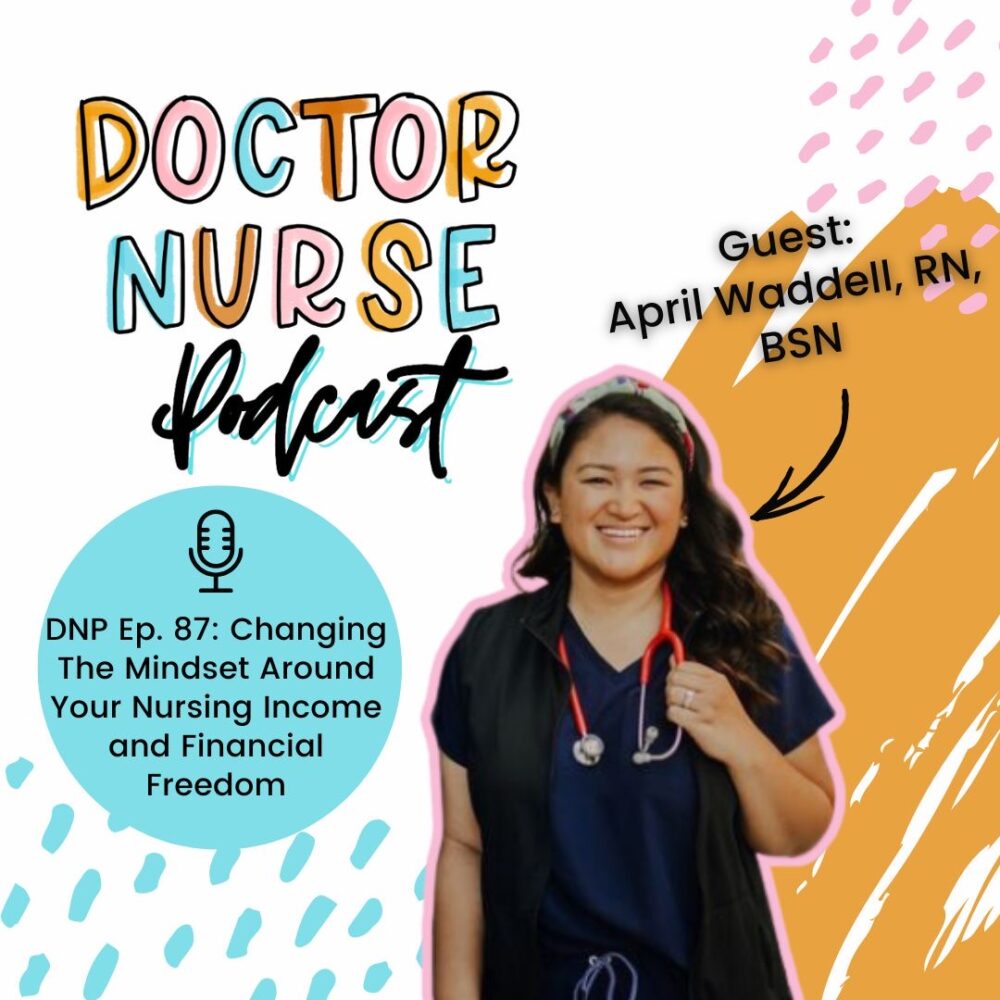
Dr. Sandra Pagenta: Doctor Nurse Podcast fam welcome to another episode of the Doctor Nurse Podcast. Today we have on April Woodell. She is an rn, B S N, C V I C U, peds nurse with experience in nursing adults, medical imaging, emergency room nursing. The P I C U, the nicu, she’s been kind of in all those realms.
As an rn, she is currently working as a financial coach for nurses. That is her full-time gig. And her hi. Her history is really, really interesting. She started immigrating from the Philippines to Chicago when she was five, from a family of nurses, dentists and caregivers. So taking care of people is something that she’s super passionate about, which is why nursing was such an easy transition for her.
And what she found was that having never been taught the power of investing and what to do with your money she started to find that there was a gap in her knowledge and that she was able to close the gap and go from being $30,000 in student loan debt within two years, being completely by implementing her money date system and being able to create.
Wealth for herself. Also moving from zero thousand dollars invested to $450,000 invested with no help from a financial advisor. So she’s super into teaching nurses specifically how to get debt-free like she did. How to get money smart money-wise, even if they don’t come from a family that. Talked about these things and did these things.
She wants to help bridge those gaps for nurses. She’s very, very passionate about that. So she’s coming on the podcast today to talk, and I’m so happy to have you on today, April.
April Waddell: That was such an amazing intro. It’s so different hearing somebody else say it. Thank you.
Dr. Sandra Pagenta: Well, welcome. So tell my listeners kind of how you see yourself.
What is it that you do? With your career from nurse to now this? Yeah.
April Waddell: So a lot of my job right now as a financial coach is really a hype woman. I help nurses believe in themselves that they actually can invest, pay off their debt, achieve all their financial goals. Nurses are so confident in what they do, but that definitely does not translate into confidence.
With their money and finances. So a lot of what I do is really lean on all the things they already do within nursing and lean on all those skills they already have and show them that, hey, you can do X, Y, and Z. You give lifesaving medications, you can look up your expense ratio, you can pay off your debt.
So a lot of my job really is just getting these nurses to believe that they’re able to do these things because unfortunately, the alternative is, Wait, not do anything. Or when they do do something oftentimes there are small mistakes that they make that have a really big impact.
Dr. Sandra Pagenta: Interesting. So one of the things I was thinking for this podcast episode and I wanted to start gearing some more of my podcast episodes towards mindset, and you and I were talking a little bit be before the podcast.
’cause I really feel like this is one of the biggest hurdles a lot of people need to get over. And kind of like what you’re saying when you’re making these decisions, you just do nothing. Yeah. And so that mindset of just in just in action, right? Like not making a decision is something that I think.
Sidetracks a lot of people. Yeah. So you and I were kind of talking about, well, what can we do to help nurses? What are the most common mindset hangups that you notice in nurses regarding their finances, regarding money? What are you seeing whenever you talk to them? And I, I thought we could touch on like maybe three of them.
Yeah. And then talk about how to kind of change those mindsets. And I was hoping you could speak to that a little bit. Right.
April Waddell: Sure, let’s start, let’s start with the big one. It’s a scarcity mindset, right? So scarcity versus abundance, scarcity mindset specifically with money sounds like this. There’s not enough money.
We can’t afford that. I can’t pursue the side hustle. I won’t make it right. It’s really coming from this area of not enough, not enough to go around. There’s not enough for everybody. Right. If I get something that means someone else doesn’t have it. Versus an abundance mindset with money is, money is always flowing.
Money is always attracted to me. If I buy something, it’ll come back to me. And I think especially too with my background, that was a really big personal hurdle that I had to overcome and still continue to overcome today. Especially being an immigrant and being raised by immigrants, you’re always grow up with this idea of we can’t afford that, right? We’re not doing that right now. So. I definitely, definitely see that with the nurses that I work with.
Dr. Sandra Pagenta: Hmm. So number one, you say is a scarcity mindset. Which to recap, it’s just the idea that there’s not enough going around. I like the word picture of the game of spoons, and so there’s only so many spoons and there’s always one missing.
Yeah. So you just don’t wanna be the one that gets left out. Like there’s just not enough. And so everyone’s got a race and everyone’s fighting each other and there’s the competition instead of the collaboration. Right. And so that’s what I love about that. Contrast between a scarcity mindset versus what the opposite side is.
And we’ll get into that later. The abundance mindset. ’cause that’s really how you defeat that, right? You just change your thinking around those things. What else do you notice? That’s number one. What would, what else would you say is another mindset that’s a bad one that we need to change?
April Waddell: Number two, the biggest one really is nurses thinking I can’t do it.
But then that translates to, I’ll just have somebody else do this for me. I will just have somebody else do this for me. And that’s huge because basically what you’re doing, it’s one thing to ask for help and get the education. It’s another thing to completely delegate investing to someone else. You’re basically giving your financial power away.
And that’s something that I don’t advocate for. Number one, it’s expensive. Number two, like I said earlier, nurses are smart enough to do this on their own. And again, it just ties back into the lack of education, the lack of confidence, the scarcity mindset. So all these three things really are connected and feed off one another.
But number two definitely is. Someone else can do it for me. I’ll make enough money at some point and someone else can just handle this for me and I’ll be fine. Yeah.
Dr. Sandra Pagenta: One of the things I also have heard is if, if there’s something that you feel like is, there’s a couple red flags, one of which, if you heard someone tell, tell you, you don’t need to know this.
It’s really complicated. You don’t need to know this. That’s a red flag for one, and I’ve heard that from other people about finances and about things in money. You just, yep. They say things like, oh, it’s really complicated. Don’t worry about it. It’s like, here it, it’s like, no, no, no, no, no. I do need to know what I’m invested in.
If it’s too complicated, then I probably shouldn’t be invested in it. You know? Like, yes. Right. Like that’s, that’s what I’ve been told. But then also, I like that you say that nurses are smart enough and capable enough to do it. It’s true. Like if you can calculate the drips for somebody’s vent, like yeah, you can definitely figure out the financial aspects of how to invest your finances.
Like we’re really smart. So like just again, believe in yourself, believe that you’re capable. And having somebody help educate you and to help you navigate that, I think is, is great. Instead of just blindly turning away and just being like, ah, I don’t want to know what’s going on. Just take care of it for me.
And so many celebrities I’ve heard have gotten caught in situations where they just left it to somebody else and then they find out they’re not paying their taxes and like things that aren’t like good. So I just, I think that anybody can get. You can get really burned with that with that system.
Okay. So that’s number two. What about
April Waddell: number three? Number three? This is the one I was like, there’s so many. Number three is nurses think that this takes a lot of time. They think it takes hours and hours and hours. And a big part of my education for nurses and coaching is, yes, of course this is gonna take some time, but once you have the basics and you have the foundation, you can really automate a lot of these things so that you can.
Become CRNA so that you can become an np, you can do all these other things, but you really do need that solid foundation, right? You need to learn how to take vitals before you can put an iv. So the foundation of all these things is putting your money to work. Specifically what I do is, and teach is putting your money to work in the stock market, which I think is the most passive thing that you can do.
I joke around that, you know, I make passive sales for my courses, but you know that it’s really not passive, right? Like you’re marketing it, you’re doing all these things. But going back to what I was saying investing in the stock market as soon as you can, getting that money to work in the background and then continuing to build your other streams of income through a side hustle or real estate or whatever you wanna do I think is a really great place to start.
But what prevents nurses from doing that to other things we already talked about, but number three. April, I don’t have time. I got too many things to do. I need to travel. I have kids, I have all these things. So number three is overcoming this mindset that you have to give up hours and hours of your life to be able to do this on your own.
Yeah,
Dr. Sandra Pagenta: I think too when you talk about that, I think about, I. You know that, that there’s a saying that’s like, imagine yourself two years from where you are if you never change anything. Whereas like if you just make a small incremental change, of course if you go to approach this huge elephant, like my whole financial picture, it’s so overwhelming and daunting.
It’s like you’re eating the whole elephant. It’s like, okay. So we’re just gonna start with this thing today. We’re gonna start small. And James Clear talks about this in his book Atomic Habits, where he talks a lot about making small, I don’t mind changes. It’s such a good book. But he talks about these small incremental changes that they don’t have to be overarching.
They just need to be small. You need to do one thing today, and that’s what you need to focus in on. And. I like what you’re saying, having someone in your corner to kind of help you say, all right, so I understand, yes, you have a mess, quote unquote, you’re in debt, you have all these other processes going on, but today we’re just gonna focus in on this one thing, and then you’ll start to turn the rudder on this really, really big ship.
And so I think that’s really helpful, especially from a mindset standpoint of, so just imagine if you just took one small step from where you were, even though you don’t have a lot of time. You haven’t, you have five minutes, gimme five minutes to do this thing and we’ll start a budget or we’ll do whatever.
So with all those different mindset issues and problems, how do we conquer them? How do we turn a scarcity mindset into abundance mindset? And yeah, let’s start there. I
April Waddell: think number one who you surround yourself with, and that really started to change for me once I left. My nursing role every single day every single day I would walk in and I would hear, we’re short staffed.
We’re not being paid enough, or Can you believe my raise was only a dollar or $2? Right? When you go to work three days a week, whatever your schedule is, and that’s constantly all you hear. And constantly seeing other people, not investing, spending their money luxuriously, all those things, it’s really hard for you to believe that.
There is enough and that there is more money out there. So what can that look like for nurses? We have the internet. We’re very lucky. There are online communities out there where you can learn about these things. But what’s really hard and the gap I’m hoping to fill is that, Being a nurse and doing this, I’m hoping that nurses can see it’s possible for them too.
Because again, where do you even start when you are a nurse and you don’t see other nurses doing these things like being investors, like starting a business. So I think the number one way is to improve your community, your network, the things that you’re listening to, the people you’re having conversation.
Conversations with is huge. So if you can’t leverage your physical community, leveraging all the things we have online, I think is number one.
Dr. Sandra Pagenta: Yeah, I like that. That is such a good tip because you don’t realize the input of things around you and how that completely. Completely affects your output.
Right? So like if you listen to even like the music that you listen to Yeah. Even the television that you’re watching again, the conversations that you’re having and you’re around, it almost goes back to the laws of attraction, right? Like, what are you bringing to you? And so when you’re talking about abundance mindset, you’ve gotta be.
Having those conversations with people that are elevated, they are not the same basic, oh, I never have enough. Ugh, that’s that inner, that energy affects you and. So that’s how you begin to see the world and it jades your, your ability to change. And that’s why I wanted a podcast where you could come on and as a nurse, not feel like a victim, not feel like you can’t change your job, your money situation, your health.
Like these are aspects of, I think nursing that sometimes we get really caught in a rutt of feeling like, We’re never gonna be heard or we’re, nothing’s ever gonna change or these, all these different things. And I’m like, no. Like I wanna inspire nurses to know that. Like absolutely not. You just need to change your environment.
And it’s almost like there was an experiment with plants and they talked to a plant and they said a positive things. Have you heard about this? Yep. Uhhuh. Yeah. And they spoke to the little tree or the little herb or whatever it was, and they said positive things to the plant versus tree and a little herb that they spoke negative to like negatively to.
And the growth between the two plants was obvious because again, that energy, the vibration, what you’re saying, these things, you are bringing things to you and you don’t even realize it. And it’s that important to make sure you are filtering what’s coming in and what you’re surrounding yourself in. So I.
A hundred percent agree with you. Change your environment. And if you can’t get outta your job, then the moment you leave work, you turn on something positive, a positive podcast you turn on, you call a friend that you’re just like, Hey girl, you’re my support buddy. Let’s talk about things that are good.
’cause I just got out of a really negative situation. You’ve gotta do that work.
April Waddell: Yeah. And again, it doesn’t have to be anything crazy, right? You can listen to a podcast, you can read a book. The impact doesn’t have to be, the impact can be huge with a small change in your day, like all the things you mentioned.
And to this day, I only have one friend from the last unit I was on that I still. Speak with, and she’s a nurse who’s into finance, into real estate, into all these things. And once you leave that situation, it’s really easy. It’s really easy to start seeing and believing, truly believing and embodying what your life can be.
And for me specifically, that meant going and really diving headfirst into all things fire community and retiring early and all those pieces.
Dr. Sandra Pagenta: Yeah, I love that. Again, fixate. That’s one of the things that I love about another book that I love. I think it’s called the Prosperity Bible. And it’s such a great book.
’cause it talks about picking a number and fixating on it and it feels crazy. Like when I do it and I do these mind work, right? So I just like pick this number that I’m like, I’m gonna grow this number. And then I have to like think about it and have, and like become so obsessed with it that like, oh yeah, you know, you write it on your bathroom mirror.
Yep. Putting it all over the place. Like by again, just. You just, you’re, you’re, it’s in, it’s incredible what your mind is able to do and what you’re able to attract to yourself by focusing in on your goals. But also shared a I think for, it’s actually really interesting. So when they’re directing pilots when they’re flying and what they tell them to focus on is what ends up like driving the plane in that direction.
So like if they’re trying to get a pilot to focus on, you know, not hitting something by saying, don’t hit that, you end up moving towards it. Right? But, but if they say, Focus in on this cloud up there that is gonna keep them from crashing or whatever it is that you end up. You know, not moving towards the thing you’re trying to avoid.
So the point is, instead of fixating on what you’re trying not to avoid, focus in on what you, what you want, focusing. That’s what’s gonna get you there, and you’re more likely to hit that. Right? Yeah,
April Waddell: for sure. And, and when you say like a specific number the number for my husband and I to, you know, retire early, do all those things as 3 million.
And so we fixated on that number for. Four or five years and you’re so right. Once you fixate on that number, your brain starts to think, there’s no reason why I can’t hit the number. I have to hit that number. What can I do to get there? Right? You turn into problem solving mode versus I’m a victim. I can’t do these things.
So I love that. I love. Being really clear on that one number and just figuring out, and your brain getting to work and saying, we’re gonna make this happen. How is this gonna happen?
Dr. Sandra Pagenta: Yes. So again, that goes back to abundance mindset where you’re not seeing problems, but you’re seeing solutions you’re seeing And opportunities.
Yeah. Opportunities, right? Oh, I love this mindset. It’s so good. And so, okay, so that’s how you conquer the first one of scarcity mindset is by surrounding yourself with. The conversations and the people fixating on the goals and the things that you want and creating. Again, every single time you have a negative thought or you have, you know I can’t do it, it’s not gonna happen.
There’s not enough. You immediately stop what you’re thinking and you go back and you’re like, no, I can do it. We can do this. You rewrite, re re rewrite the brain. You tell yourself what you believe is true, and then again, you focus and you fixate on your goals. That’s fabulous. So the second problem that we said was, I cannot remember now.
I’ve got it. What did we say
April Waddell: is, is delegating it saying whenever, oh,
Dr. Sandra Pagenta: somebody else can do it. Mm-hmm. So how do, how
April Waddell: do you conquer that? Yeah, so for that, you’re already in your network. You’re already reading books, reading podcasts. The thing that you’ll come up with, especially if you’re focused on money and finance, is how expensive these things are. The one thing with money and finances, especially with financial advisors, is more money does not mean more, better results. Mm-hmm. And that’s hard for nurses to understand. I love food, so I’ll give a, I’ll give a sushi example. If you spend $20 on sushi, probably pretty good, right?
Yeah. If you spend $200 on sushi, Probably, probably better, right? Yeah, yeah. If you spend $20,000 on sushi, it’s, it’s fresh from Japan or Korea, somewhere in Asia. Right. It’s really good quality sushi, right? Yeah. That’s easy to understand. Unfortunately, that’s not how. Financial advisors work, it doesn’t mean that you’re paying more money, that you’re getting better results and or better service.
So oftentimes nurses will say, I’ll just pay for the best. Right. And they can take care of it for me. That’s not the case. You make more money long term by doing things on your own with an index fund or an E T F. Mm-hmm. Short term financial advisors can potentially. Beat the market as in beat, like a standard s and p 500, but long-term they can’t do that.
Studies and studies over time have shown this and proven this to us, but the reason we, the common public individual investor don’t know this, is because they financial industry make more money. If we believe that we can’t do it right. So how do we fix this? Educating yourself on the fees. And once I break down with a nurse exactly for their specific situation, how much what they’re invested in, either through work or with a financial advisor is going to cost them over 10, 15, 20, 30 years immediate.
How do I do this on my own? April, right. So that’s a really quick way to Get out of that and it’s free. Look up right now. Mutual fund calculator. All you need to find is the fee usually for financial advisors. The, the standard is one to 2%.
Dr. Sandra Pagenta: But over time I read a book by Tony Robbins on Money Master the Game.
Yep. And he talks a lot about the fees and how they compound over time. Right? Yep. And so it might sound like, oh, it’s only 1% to this guy, but it’s like, no, no. No, no, it’s not just 1%. It’s 1% compounding over years on your cash and it grows and that number is really, really big. That’s coming outta your money for them to really do very minimal work.
I mean, the book is fabulous. I highly recommend you read it. For those that are wondering about financial literacy, he really does break it down. But that was something that was eyeopening to me and it actually led to me moving my money out of the account that I had as well, because I was like, Wait a minute, like the fees are really high here.
Yeah. So I moved it. What was it? I’m curious. What was that? What was the percentage? Oh gosh. I, to be honest, I don’t remember. I just know that Vanguard was much cheaper, so I was like, let me just move this money. Yeah. Og, I’m gonna go OG and move this money to Vanguard because it’s so much cheaper. And the fees were nominal compared to that.
And then there’s some of the, some of the accounts don’t have any fees except for like, They don’t, you’re not paying anyone. You’re managing it and you’re just paying like very small. Times. Yep. Peanuts with,
April Waddell: you know Exactly fees for nurses who may have a hard time who are listening, like comprehending the numbers basically 1% again, which is an industry standard for financial advisors over the course of 30 years.
That math, and again, it’s hard for us to understand compounding, but that comes out to almost a third of your returns. That’s right.
Connecting this back to nurses. Let’s talk about meds, right? You miss a decimal point, you add a zero. God forbid, that is a huge impact, right? A hundred on that person’s life. And I like to say this also is a huge impact on your financial life. So let’s take that just as seriously when we’re looking at these small numbers.
Dr. Sandra Pagenta: Yeah. That’s so good. So again, you help people learn how to do it themselves. Going back to how do you get your mindset around that, just that little bit of education right there. Once you realize like, whoa, like. Okay, so is that third of my, you know, my financial portfolio, is it worth it to have somebody manage, you better be doing a good job.
I need to talk to you every week to see what you’re doing. Exactly. Right. Exactly. And you don’t talk to these people barely at all for years at a time as you’re giving them a third of your wealth. Right.
April Waddell: I’m the catalyst to a lot of financial breakups, which I love, which I love because I ask like, Who is this person?
How often are they checking in with you? Do you understand exactly the protocol or the system they’re using to pick certain investments? What, what’s going on here? Crickets, right? Yeah. And so oftentimes too, it’s my parents work with them. They’re really nice. They’re so sweet over the phone.
I’m like, that’s all great. But that’s when we have to separate like our business mind and like our personal, this is, we’re doing business. You’re helping me with my finances, right? Yeah. So yes. That one piece of education of just understanding the fees goes a really long way. Yeah.
Dr. Sandra Pagenta: And makes you wanna change your delegation situ, like your delegation situation, right?
Yeah. Like, I don’t wanna delegate this task anymore. Yeah. Because it’s, it’s costing me too much and they’re really nice on the phone, but that’s not gonna feed me and pay my bills and pay for my meds when I’m 65. Like, that’s just not gonna do that. Exactly. So, yeah.
April Waddell: And a third, those fees translate.
Can translate into you retiring on time. You retiring earlier. That’s huge. This was from 2018 just for 4 0 1 k over 30 years. Investors inside their work sponsored 4 0 1 k. The average in fees after 30 years was about $200,000. It’s huge. Wow.
Dr. Sandra Pagenta: That’s huge. Again,
April Waddell: do you, can you, that’s a difference of working 10 more years maybe, or mm-hmm.
Can you retire next year or in two years? So yeah. The impact of those fees are huge.
Dr. Sandra Pagenta: Yeah. So that’s really interesting. And so for the third one, which we said was, I don’t have the time. How do we combat
April Waddell: that? Mm-hmm. Yes. There’s many, many ways to make money, right? Many ways to make money. You can do real estate, you can start a business, but specifically with the stock market, and the reason why I like to teach in this space is, again, upfront investment of your time, but long term, automate, automate, automate, automate.
Yeah. My, for me personally, again, we’re retiring in the next 15 years. The amount of time you spend a month. Of course varies throughout the year on average, five, 10 minutes because so much of that stuff is automated and, and when there is extra time, it’s, we have an influx of cash, influx of money. So it’s, it’s not automated, right?
And I teach nurses how to do that. I want you to know the foundation, I want you to know the basics. But hey, once you know these things, Let’s go into your Fidelity. Let’s go into your Vanguard. Let’s automate two, $300 every single month, so that can already come out and it’s already doing its thing.
Hmm.
Dr. Sandra Pagenta: Interesting. So the way to fight I don’t have time is automate. And again, we’ll teach you the principles, but then once you understand what you’re doing, put it on autopilot and just let it go. How often should you be checking back in though? Right? I mean, you can’t just let it go forever. We know this.
There’s nothing passive under the sun. Right? I like using that term because there’s nothing new under the sun and there’s nothing truly passive. You’re always doing some amount of work, like you said, advertising, marketing, you’re improving the program, you’re always doing. Something so. You automate, and then how often do you check in?
You check in every week, every month. I love the app in power or personal capital. That’s an app that I use to look and see what our net worth is every day. I look every day to see what my net worth is, because I wanna know like, am I moving the needle this way? Are we moving the needle that way? And then what is the average that I’m supposed to be looking at net worth wise for my age group?
So yeah, how often do people check in? And then what? What apps or tools can people get to kind of figure out what they need to be doing? I.
April Waddell: So I will piggyback off the personal capital ’cause I love personal Capital as well. I especially, especially really like I don’t know exactly what it’s called on the app, but it’s basically their retirement calculator.
And what I find really unique about that is that you can insert specific life events at certain points. So you can say, Hey, I want a kitchen renovation which is gonna take five years. Or I have kids and I’m gonna have to help. Fund them for 18 years, right? Yeah. So it’s putting your numbers in context with these life events.
So love that app. I think that’s really great. And number two, I think the biggest thing when we’re having this conversation about time and automation, Is Rec. Just going back to mindset really quickly.
Dr. Sandra Pagenta: Yeah, no. Take me there. I love it. Let’s go. You
April Waddell: have way more time in the day than you think.
If you think about how many times you’re watching Netflix, how many times you’re scrolling Threads or Instagram, I promise you, if you really are. Serious about investing. If you really are serious about leaving your bedtime job full-time, if you’re serious about any of those things, you are going to find a way and you are going to carve out that time.
If you don’t start with that mindset, no app, no book, none of that will help you, right? You have to be honest with yourself at the end of the day and just say, Hey. I spent three hours on my couch doing nothing. What really is the
Dr. Sandra Pagenta: problem here? Yeah. Okay. So I love that. And let me tell you why. ’cause I comfort people.
April, comfort them. Have a real talk with yourself, right? Like, am I really wasting time? Also have a kid and realize how much time you have been wasting. When you have a child, you start to realize like, I have an hour. I’ve gotta do eight things in one hour while he naps. Like I’m telling you, moms learn how to manage time so well after having a baby.
But I hear you like. I wasted so much time prior, and now I still find little moments where I’m like, you know, I’ve watched a couple shows and that screen pops up on Netflix. I’m like, are you still watching? And I’m like, yes. I’m, don’t ask me. I know. You know, like that’s a sign you might wanna get, you might wanna get up and start doing some of your finances.
Netflix is asking you, do you have anything better to do? They’re helping you. They’re helping you go get busy. No, I love that. April. Fabulous response. You probably do have the time, so yeah. Let’s check your commitment. And I, I love, there’s this one quote by Tony Robinson. He had said you know, somebody had, he was encouraging people to meditate.
And he’s like, I want you to take five minutes outta your life your day to meditate. And he’s like, people tell me they don’t have time. And he was like, what kind of life are you living if you don’t even have time to spend five minutes doing something on yourself? Yeah. On yourself, right? Yeah. Like, you’ve got a very bad situ.
You need to reassess your whole life, you know? And I think that that is true of the same thing with your finances. Like if you can’t take the time to do this one thing Yeah. That actually is gonna be the thing that either sets you free from the bedside Yeah. Or allows you to start that side hustle or Yeah, whichever.
If you don’t have that, like you’ve gotta look at your life and totality and figure out if you’re living what you want to begin with because you don’t even have the time to carve this out. And you need to have a real conversation with yourself. I think that’s huge
April Waddell: and all these different mindset things that we’ve talked about.
The reason why I have been so successful, and this is why I teach other nurses how to do this. I’ve talked about how I teach them how to invest and all those things, but how do I actually do that? Everything is focused on a money date, so, So really quickly, a money date is something that you experience every single week, right?
So it’s not this buildup of like, oh my goodness, I have to pay off my debt, or, oh my goodness, I have to do this. Nope. You’re spending five to 10 minutes every single week looking at your finances and you’re training your brain that I’m this person who looks at my finances every week. I’m this person who.
Checks my net worth every week. Answering your question from earlier, it depends. You look at your net worth every day. I’m gonna bet. And I know from what you do that you’re focused on this, right? Yeah. If you’re somebody who wants to retire, traditional age sixties, every quarter standard at least every quarter, you wanna check and make sure that everything is doing what it’s supposed to be doing.
But ultimately it depends on your goals. I wanna retire early. I’m checking this stuff every single week, right? So it just really depends on your specific goals. Yes. Yeah. Yeah. But I’m gonna, yeah,
Dr. Sandra Pagenta: no, that’s really good. I mean, again, What you fixate on, you, what you focus on, you fixate on what you fixate on.
Yeah. There’s like a whole thing. And then it just gets to, that just becomes you, right? Yeah. And so it becomes a habit and the habit becomes your behavior and that becomes your character. And like it’s this whole thing. And you, like you said, you define yourself and, and James clear, not to go back to him, but I’m obsessed with him in like mindset.
But he talks a lot about He talks a lot about being that person. It’s guy, that guy. He’s just game changer. If you listen to this podcast, get that guy change your mind, it’s so just an absolute game changing book. But he talks about seeing yourself as like a runner and identifying with that group of people, like I’m a part of this group, like.
Okay, so part of like a CrossFit group? Yeah. And like I’m clearly not a CrossFit, like you’ve seen them, they’re super cut, like they’re aren’t like they’re super buff, but just being in that community makes me feel like, I mean, I could, I mean, I could, mm-hmm. I, I do the workouts like, and yes, I may not be as buff or whatever, but I do CrossFit workouts and so I identify with that group of people.
And so by identifying with, I’m somebody that checks my net worth. I’m somebody that is into. Setting myself free financially sooner rather than later. I’m a part of that group of people. Yeah. By either having conversations with you, having conversations on Facebook groups, like whatever it looks like, listening to those podcasts, being about it, you start talking like them.
You start sounding like them, and like James Clear says you eventually begin to see yourself like one of them, and then now you’re that person. That’s who you are. It’s huge. And it’s huge.
April Waddell: If I can piggyback off the book, there’s one thing that I think is just so aligned with money and finance in the beginning of the book.
There’s a graph, I wanna say it’s like in the first chapter or two, but he basically says, You’re doing these things to become this person or to implement this habit, you think, Hey, I’m doing the work. I should be getting results, right? But he says, no, no, you have to keep going over time. And it’s a lot less sharp and it’s a lot more gradual than you think.
So how does this relate to finance? Especially in the stock market. Again, I said there’s many different ways to make money, real estate, business, all those things. Specifically with the stock market, it takes decades to see results. And this is why I say start with this first, start early and then do those other things.
Add those onto the top once you have that going in the background. because you invest and max out your Roth IRA for two years, you’re not a millionaire yet. I’m sorry to break into, you have to wait like 10, 20, 30 years to see this happen. Yeah. I just really wanted to talk about that piece in the book that I really appreciated.
Dr. Sandra Pagenta: Yeah, I agree. I love that. So one other thing, and I talk a lot about on my podcast, I have two more questions, is kind of how you decided to launch your side hustle business and be able to ditch the bedside and do something completely different with your career and kind of what that process was for you.
And I kind of hate to turn the podcast away, but we focused in on the mindset. Nurses kind of really know now like what they need to do in order to change their thoughts around it. But one thing that I love is a good. Nurse ditching the bedside doing something else. Story. I really do. I don’t even know. I gotta find the name for that.
Like hashtag, however you like. Metamorphosis. Nurse Metamorphosis. Okay. Yeah. So how did you, what was your like point, I know you had said on your website, That Covid 19 presented this opportunity for you and kind of what that experience was, and then how you launched it, and then how you set yourself free or kind of the two veins I wanna talk about really briefly.
I love, I
April Waddell: love talking about this story, so I’ll start off with the numbers first because I think that’s super important. So. One, the most important thing that allowed me to really leave was we hit a milestone. So for those listening who aren’t familiar fire is fin financial independence retire early.
There’s different forms of fire. Different variations. I guess one form of that is called Coast Fi, coast financial independence. So it’s basically a milestone where you have front loaded your investments, you invested so much. And it’s not uncommon that people in the fire community save and invest between 40 upwards of 70% of their income.
So they do that really early on. They can contribute nothing. Nothing left for the rest of their life. And it’ll grow because of time and because of compounding. So we hit that milestone. We had enough invested in the stock market that if we said, Hey, in investing stupid, we’re not doing this anymore.
If we did not contribute a single dollar into the stock market, our portfolio, if we wanted to do traditional retirement, would’ve been over. It was some crazy number just because of the, the amount of time Because we would’ve had 30 years for that to compound. Would’ve been, it was some crazy number. I haven’t done the number recently, but it was like seven, eight, like some millions of dollars.
Again, just because of the power of compounding and investing early, I wanna say it was like 13 million. Wow. Something absurd. Holy. So hitting that milestone, our conversations start to change. Right. We know how to save money. We know how to invest. We’re used to living off less than we earn, right? So our conversation started to become, what do I want my life to look like in five, 10 years?
And everybody that was in my immediate circle, I didn’t want that for myself. I loved them as nurses. I loved the care they gave how smart they were. But I saw nurses, being nurses for 20 years still stressing out about, am I gonna miss my kids’ soccer game? I have to work on Christmas. I did not wanna have those conversations.
I did not wanna have those problems in 10, 20 years when I eventually, you know, have a family. So I knew that wasn’t for me. And I knew I wanted something. That was entirely mine, something that I own, something where I controlled my time and basically saw a huge problem and saw that I had solutions and I had results to back that up.
And so I transitioned from part-time initially, so I did part-time and was. Doing my thing over here. Yep. Just getting my feet wet. And then an opportunity came up to move halfway around the world to Australia. My husband got a job offer. We already are in this like mindset of like retiring early.
And so once he said yes, I was like, all right, well I quit and I’m going in full-time. And the reason we were able to do that was because of our numbers. Right, because we were so used to investing and saving so much for four or five years, the difference of losing my income and building up my business wasn’t so dramatic because we were so used to having a weekly money date understanding what we spend in all those things.
So that is my story.
Dr. Sandra Pagenta: That is so cool and I love that. I love the story of the money date. ’cause I didn’t know what it meant when I read it. I was like, that’s an interesting like title for this whole thing that she’s doing. But it makes sense like it’s this again, that fixating on this date and fixating on this number and fixating on this lifestyle.
And attracting it to you, your mind. It’s incredible. What if you, I guess what they, your mom always told you if you put your mind to something, yeah. You can do it. Well, she didn’t quite follow it up with, and you gotta look at it every day and every single second. And you gotta be obsessed with it. And you gotta just keep that part.
She didn’t say, she just went, you can do whatever you put your mind to dear. Exactly. Clearly. And then she didn’t say you needed to become obsessed with it. Yeah. So we’re her to tell you that you can do whatever you put your mind to. You just gotta be super obsessed with it. You can’t just Exactly. You know, almost crazy.
Right? Almost kind of crazy. Yeah. Like you have to, I tell my husband, like, do I gotta check myself here? Like we had that conversation like, is it too crazy? Check. Okay. Same. You need that. You need that. So for the last question, question of the podcast, if you could go back. To April at the beginning of her career, and you can tell her something that you would say, April, don’t let go of this.
No matter what this is, this is key for your career. What would you tell her that you wish that you would’ve gone back and you could tell yourself?
April Waddell: I think, I think I would tell April that you make the rules. You make the rules. The very beginning, I was so fixated on being this perfect I C U nurse becoming IV certified and being a preceptor and being charge nurse and becoming a cr like doing these things.
But once I realized that those aren’t set and that is not the only way to become successful, to help people to make an impact, and once I realize that those rules are not rules I have to follow. I became what I always wanted to be, and I got to do it on my terms, which I think is the most important thing.
The hardest thing for me in the beginning during this transition was this feeling of like, I won’t be able to help people in the way that I’m used to physically taking care of them, right? Mm-hmm. There’s so many different ways to help people and make your impact, and you can only recognize that once you realize you don’t have to follow these rules that you’ve set for yourself or that society has conditioned you to follow.
Dr. Sandra Pagenta: Yeah. Yeah. You look like everybody else and you look like everybody else. Yep. Right? So just, yeah, like be who you want to be. There’s only one you, there’s nobody else. Nobody else can do you. And that’s the really special thing about the way that this world is, is that we’re all unique and we’re all different, and there’s something very specific set out for April, and there’s something very specific set out for me, and we’re not in competition with one another.
Again, going back to that scarcity mindset versus abundance mindset, that. There’s only one you and only you can live in the fullness of that nobody else can. And don’t let anybody take away that fullness that you’re supposed to have for your life by being fixated on what they have or what you don’t have.
Just be. Be fixated on who you’re supposed to be. Yeah. The best person that you can be. And again, that’s just that mindset. Mindset is everything. And I just feel like for this time period, and what I really want to talk to is just getting to starting at that incremental level and then watching the rest of your life change just from your thoughts and how you think you can change the whole game if you start with.
A single thought of what if I, what if I dreamed? Yeah. And as you chained situations, it opens up opportunities for you to dream bigger than you would’ve ever thought. You would’ve never thought that you could dream outside of the nursing field. What else could I do? And Yeah, that’s the point of the doctor’s podcast.
Like dream big. Yeah. What do you want? Yeah, nurse, if I could just
April Waddell: have one more last thing Go please. Just to close with this mindset thing, and this has helped me early on. Still helps me today. How dare you not share your gift with the world? How selfish of you to be able to have this gift, have this dream, and not share it?
This was especially important for me in the beginning of my business when I didn’t wanna sell. I was like asking people for money. Gross. But once I shifted and said, this can help nurses change their lives. How dare you not pursue this? How dare you not talk about it every day? You’re robbing the world of a gift and opportunity to change the world.
If you don’t do this, if you don’t pursue this dream, if you don’t pursue this side hustle, if you don’t pursue this podcast, imagine where their life is gonna be and how stuck they’ll be if you don’t do X, Y, and Z. So I just wanted to close and end with that because. It’s helped me when I was a bedside nurse.
It’s helped me when I first started my business, and it continues to help and drive me today as I’m actively building my business.
Dr. Sandra Pagenta: I love that. And we will end there. How dare you. Yeah. Don’t whatever. You won’t. Yeah, yeah, yeah. So I love that. So for the last part of the podcast and what I do with everyone is a rapid fire questions.
And again, you can’t plan for these easier fly by the seat of your pants. It might make you uncomfortable. They probably won’t. Don’t worry. I try not to make you Dr. Some people wanna come back on my podcast. I don’t wanna make it to a Are you ready? Are you ready? Yes, I am. Okay. What was your first job?
April Waddell: Tennis instructor. Oh,
Dr. Sandra Pagenta: stop. You play tennis? Yeah. Oh my gosh. You must be pretty good if you’re an instructor too.
April Waddell: I stopped after like college. I was really good at one point.
Dr. Sandra Pagenta: Wow. That is impressive. Okay. Nice to, nice to meet you April. Yeah. Okay, so what is one book that you would just recommend for everyone to read?
Financially, not.
April Waddell: Oh, it has to be financial Psychology of money. Psychology of money. Okay. This is an amazing, amazing book and I al I’m a history nerd. So I like how he also talks about specific historical events and people in history who have made really amazing financial results. But he ties that into psychology and mindset.
So I think you would love this book. I read it in like a weekend ’cause I was like, this is so amazing. And I continue to come back to it and I make all my clients read this book.
Dr. Sandra Pagenta: Wow. Okay. Done reading it. I’m gonna put it on my list. My, and again, I love, I love reading it. You can tell, obviously I’m me too.
I read constantly when I’m taking care of my babies. Like my little one, he actually had to tell me like, mommy, can we turn off the podcast? ’cause I want you to pay attention. I’m like, Okay. I just thought I could like watch you and like listen to a podcast. Is that not okay? He’s like, no, mommy. I’m like, okay, okay.
Turn that off. I’ll come back. So any little moment I’m doing something, I’m like, play, play, you know, just to listen and learn
April Waddell: you, your kids though, to keep learning. That’s amazing. I’m, I’m
Dr. Sandra Pagenta: trying girl. Yeah. Okay, so that’s number two. But number three. So you’re living in Australia. What’s your favorite, what’s your favorite dish?
Australian dish. What’s your favorite dish? Steak.
April Waddell: Steak. Steak, okay. Wait, steak meat. Like meat here. I’m from Chicago. I grew up in Chicago. Chicago has really good food. Yeah,
Dr. Sandra Pagenta: really good. Yeah. I mean that’s like one of the things you do is you eat in Chicago for sure.
April Waddell: The quality of food here, specifically the meat.
So good. It’s, so the standards, I’m sure, I’m sure I haven’t looked this up. I’m sure their standards are way higher and that’s why it tastes better. And it’s also a lot more affordable, which is also why we like it here. Like for a Wagyu cut of steak big foodie in in Chicago would easily. One that we had to share like
Dr. Sandra Pagenta: two, 300.
Yeah.
April Waddell: For a Wagyu steak here, 75, a hundred dollars. So it’s like half the price. Steak. Steak, definitely Favorite dish. Definitely not something we have every day or every week, like special occasion, but such good quality. Oh
Dr. Sandra Pagenta: my goodness, that’s so interesting. I feel like when, I think we had a ButcherBox subscription for a period of time, I think that get their.
From Australia. I, I don’t if it’s right. I wanna be
April Waddell: surprise and like, same thing with like their cheese here too, like all the dairy stuff. Again, I don’t have it all the time ’cause GI things, but Yeah, yeah, yeah. When I do,
Dr. Sandra Pagenta: but when you risk it, yeah. It’s always worth it. Yeah, exactly.
Oh, April. This has been so much fun. Thanks for coming on the podcast. Tell people where they can find you. Where they can see what you’re about. Yep. And check you out.
April Waddell: Yeah. Everything is Nurse Money Date. So Nurse money day.com. Nurse Money Day, Instagram, LinkedIn. I do have a free net worth quiz that I created specifically for nurses.
If you’re like, where do I start? What do I do? That’s something for free that I created where you can plug in all your numbers. I do all the math, and you can just get a really clear starting point. So that’s at@earthmandate.com.
Dr. Sandra Pagenta: Oh, fantastic. Again, thank you so much for your time, April, and sharing your wisdom and your expertise and your mindset.
Hacks with us today on the podcast.
April Waddell: It’s been so much fun. Thank you for having me.
Dr. Sandra Pagenta: Alrighty guys, and don’t forget to enjoy the journey of your career. Thanks for hanging out.
Podcast Description
April Waddell, RN, BSN who is a CVICU PEDS RN with nursing experience in adult, medical imaging, emergency, PICU and NICU is on the podcast this week. She immigrated from the Philippines to Chicago when she was five years old. Growing up, she was never taught the power of investing in the stock market or learned about compound interest. Building wealth was never discussed; She was taught to study hard so that she could get a stable and safe job. Building financial security was the main focus of her family. As immigrants, her parents were focused on surviving. They did their best and gave her every opportunity they could, and because of what they started and the foundation they gave her, she now focuses on thriving through investing and making passive income. She wants to take you with her and teach you how to do this too. She wants all nurses to reach that next level of freedom and success. She went from 30K in student loan debt to debt-free in 2 years by developing her unique weekly money date system.
Special facts about April:
▶︎ Went from 0K invested in the stock market to a 450k investment portfolio with no financial advisor
▶︎ Went from a scarcity mindset to an abundance mindset where money isn’t a source of stress or anxiety
▶︎ Went from a full-time *burnt out* nurse to a full-time business owner loving the work she does daily
Doctor Nurse Podcast Links:
Check out the DNP blog for more information on side hustles: https://doctornursepodcast.com/blog/
Doctor Nurse Podcast YouTube: https://www.youtube.com/channel/UCYQYlS9d6m7HyMK7Z1BI5DA
Doctor Nurse Podcast IG: https://www.instagram.com/DoctorNursePodcast/
Doctor Nurse Podcast Website: https://www.doctornursepodcast.com
Doctor Nurse Podcast Email: doctornursepodcast@gmail.com
Success NP: Etsy Shop developed by my best friend and I, who are both Nurse Practitioners. We create digital notebooks to help you prepare for your clinical experience.
Latest Episodes

Doctor Nurse podcast brings you weekly shows to help INSPIRE, EDUCATE AND EMPOWER nurses with true stories of initiative and impact.
Doctor Nurse podcast brings you weekly shows to help INSPIRE, EDUCATE AND EMPOWER nurses with true stories of initiative and impact.
Latest Episodes
Doctor Nurse podcast brings you weekly shows to help INSPIRE, EDUCATE AND EMPOWER nurses with true stories of initiative and impact.