Also Available On






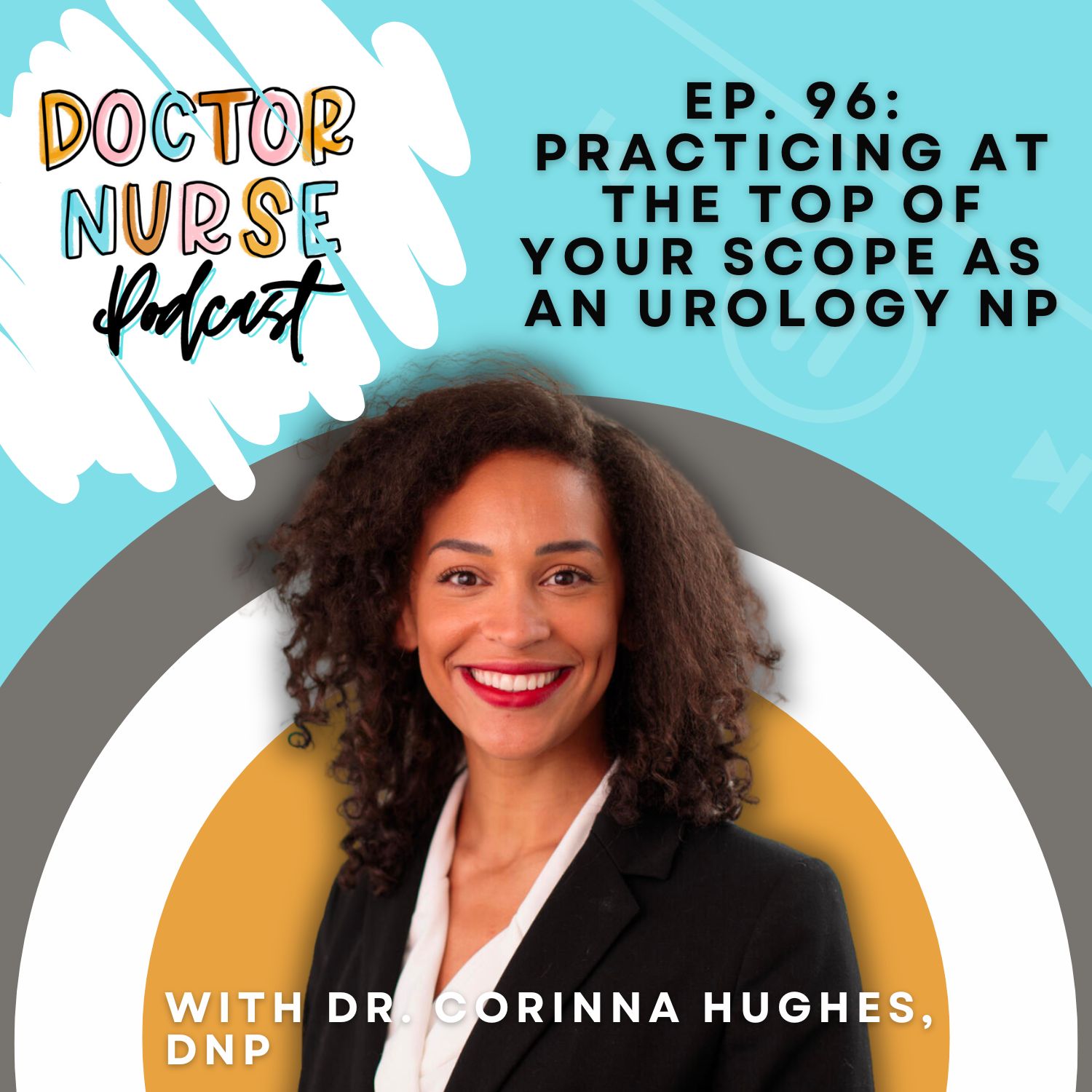
Dr. Nurse podcast, fam, welcome to another episode of the Dr. Nurse podcast today on the podcast. I have Karina Hughes, Dr. Karina Hughes on the podcast and I am so glad to talk to her. We have so much in common I feel like we’re kind of like copy paste sisters from another mister. I’m so happy to have you on I’m so excited to be here. Yeah. So let me talk a little bit about your history, kind of where you came from, what you’re about, and then we’ll dive into the questions. Karina Hughes got her BSN in 2015 and her DNP in 2020 from the University of Kentucky. Mm-Hmm. . While pursuing her degree for DNP, she worked as a full-time ICU nurse in a level three trauma center, really perfecting her nursing skills.
And after she finished her DNP, she then completed a fellowship. at Mayo Clinic for Advanced Practice Providers in Urology. So she is, has a specialized training to really understand male and female urologic conditions, and she performs in her role cystoscopies, MRI fusion biopsies, and percutaneous tibial.
nerve stimulation. I guess I didn’t know what the T standard for. So yeah, so she does a lot of really cool stuff in urology and she is so passionate about teaching others what she can do as a nurse practitioner in urology. She’s very involved in this specialty, this medical specialty for nurse practitioners.
And so crazy because we both work in urology. And so I’ve been dying to get her on the podcast so that we could just like geek out all things urology. So I’m so happy to have you on. I know this is fun. I love talking about urology with someone who also loves urology. It’s pretty nice. Yes.
And then I also think it’s so much fun that we’re both biracial and we were totally geeking out about that. Like we literally feel like we are like, you know, sisters, like both biracial, both in urology, both nurse practitioners, both DMPs. Like, come on, this is just so great.
Dr. Sandra Pagenta: So welcome to the podcast. Thank you
Dr. Corinna Hughes: Glad to be here. Yeah,
Dr. Sandra Pagenta: I’m so excited. So tell me a little bit about yourself and how you got started in urology and kind of how you’ve been able to kind of carve this niche for yourself for your career.
Dr. Corinna Hughes: So, thank you for the synopsis of the career. I’ll just add in some little things I did in between that kind of flourish my love for urology as I move forward throughout my transition. So, within my BSN at the University of Kentucky, I had the opportunity to be a sexual health educator. So within my nursing career, I was able to give, give like condom demonstrations, talk about safer sex, like on Valentine’s day, I remember rolling around on a golf cart, like passing out condoms to college students, you know, like so fun where college students are like.
Dr. Corinna Hughes: Oh my gosh. You know, cervical cancer awareness, all the things. And then throughout that I was able to like help teach at middle schools for high risk females and like about their bodies. And we would make like candy for bulbous for them to know their anatomy, you know, just like diving into things that I love.
Dr. Corinna Hughes: I grew to kind of love I always wanted to be a midwife. So I was always about like sex education, like women’s health, never really dive into men’s health as much as an interest. Moving forward, I had an opportunity to do like an externship at Mayo Clinic. So that was my intro into Mayo and to knowing like the Mayo way.
Dr. Corinna Hughes: So, like, key mark that and then pursued ICU, which was so different than my track that I never wanted to do. To do like, I see, but I was in the ICU for about 6 years and then throughout that I was a clinical educator. So that education portion, which I just have always loved and continue to have a passion for.
Dr. Corinna Hughes: And then during my DMP, which I was doing that full time while working full time. Wanted to shadow in urology. I was like, oh, urology, you know, learned a little bit about it in school and I’m like, what’s that about? Like sexual health. Say it again.
Dr. Sandra Pagenta: Yeah. Can I toss out some condoms? Say it again. Like ,
Dr. Corinna Hughes: I shadowed in shadowed some urology apps and even some like pediatric urology apps and found that, man, that can be really.
Dr. Corinna Hughes: Fulfilling like this sounds like something I want to do and I kind of lean on the type A slash B aspect of things. And I know I wanted to there were a lot of sub specialties in urology and I wanted to know a little bit of every one of those. So I looked up Google search. Fellowships question mark, and from that, that is where I found that there were at that time, maybe like 5 to 6 APP urology fellowships.
Dr. Corinna Hughes: And not only that, but I also applied to some community health, like community APP fellowships, because I wanted to be the best I can be and not that you have to be like, you have to pursue a P. P. fellowship to be the best you can be. But. Knowing how I am, I like to know a little bit of everything before I dive into it.
Dr. Corinna Hughes: And from that, I had a lot of interviews and Mayo Clinic was always at the top just because I had that introduction into Mayo and I knew it’s just a great place to be. And fortunately, I was accepted for that opportunity and it was a whirlwind. Talk about like another year of school after eight years of schooling, another year, you know and kind of that’s something that flourished.
Dr. Corinna Hughes: That helped me flourish and had like grounded roots from that. It was a great starting point for me moving forward to urology. APP. Mm-Hmm, . Wow. So
Dr. Sandra Pagenta: again, like that community health kind of working with
Dr. Corinna Hughes: sexual
Dr. Sandra Pagenta: health, kind of got your wheels turning, spending a little bit of time in the ICU doing that clinical education piece kind of helped put together these puzzle pieces and created this.
Dr. Sandra Pagenta: this foundation or groundwork for you to kind of figure out like what kind of pulls on all these little different heartstrings that I have that then I could put together and then work at the top of my scope of my license and I just think it’s really neat how the kind of the tapestries have woven together for you to create something that you can be Very passionate about naturally drawn to and then just be super good at and very impressive from a clinical standpoint.
Dr. Sandra Pagenta: I just think it’s fabulous. Absolutely fabulous. And so what exactly do you do in your urology job? Cause some you know, a nurse practitioner could be listening and she’s like, Okay, I’ve never like had any interest in urology. Every time I say urology, they always go neurology. I’m like, no, the other bone, the other bone men think with not the head bone, the other bone, they’re like, Oh, I see.
Dr. Sandra Pagenta: I see. And I’m like urology. And so they never quite understand me. So again, for one that’s listening. Tell me a little bit about what you do day in and day out at your job.
Dr. Corinna Hughes: Okay. So just a little background about my department because every department’s a little bit different, right? So I’m in an academic practice. Where we have residents, APP fellows a large APP group and within our urology department, there are various subspecialties.
Dr. Corinna Hughes: So we have like reconstructive urology. Oncology, right? So a little bit of everything in 1 department where I can just go knock on someone’s door and ask questions. But for what I am in right now is something more general urology. So, like, stones, lower and attract things also do some gynecology and I have a procedural calendar.
Dr. Corinna Hughes: So my, I currently work for tens. Love that. And my calendar, I’m either on a personal calendar. I work in a collaborative calendar with a surgeon or in the morning or in the afternoon. I can just have an all day procedural calendar and those procedures can range from the the fusion biopsy is in clinic with like a local anesthetic or doing systems all day.
Dr. Corinna Hughes: You know, so it definitely can range in that variance. Of everyday being a little bit different is something I love fueling. You know, I don’t feel burned out. I mean, I’m on year 3 just within the urology app career, and it’s definitely something I’m still learning every day. And I just really enjoy that calendar.
Dr. Corinna Hughes: I can never tell someone like, oh, tomorrow I’m doing this. You know, it’s definitely every day is a little bit different. And, I really appreciate that because I know not every practice has that capability or that APP support. Yeah,
Dr. Sandra Pagenta: and I like that as well because that was one of the things that I found was like burning me out, especially with certain jobs is just doing the same thing every day.
Dr. Sandra Pagenta: And what I love about my urology practice as well. Is that like, you’re right. You do see somebody for like a bladder cancer and then you might go and see something like I’m having trouble peeing and then you go and you’re like. Oh, we need a scopes. Can somebody get in there and do a cystoscopy? Or we need a prostate biopsy.
Dr. Sandra Pagenta: Can you get in there and do a prostate biopsy? And you just are trying on different hats. You’re trying on different things and it’s never mundane. It’s never the same thing. And it’s definitely something for someone that has that mindset and they like that kind of thing. I found that that just keeps me interested in what I’m doing.
Dr. Sandra Pagenta: And if I do the same thing, see the same thing every day, I just. So it is something very nice to think about if you’re wanting something that might be a little bit more dynamic, you don’t want the same humdrum every single day type of work. Urology is definitely something to check out and to consider because again, like you said, it’s so nice to just be able to go, all right, I don’t know what I’m doing today.
Dr. Sandra Pagenta: I just walk in and see whatever’s there and figure it out. And it’s just really kind of cool.
Dr. Corinna Hughes: And I think an important thing to be aware of is that you do not have to be a perfect you are. You will see a variety of cases, but don’t feel like you have to know everything. I think that’s something within urology.
Dr. Corinna Hughes: That can be a little bit daunting is feeling like you have to know everything about every subspecialty, you know, like, you don’t have to know the exact guideline for your ritual structure, you know, know where the guidelines are, know the resources. But I think that’s 1 thing in urology is to be aware of is that there’s a lot of different sub specialties.
Dr. Corinna Hughes: To be mindful that you may see, especially if you’re in private practice, and I think that, and that can be exciting, but at the same time being a new APP in their early career, that can be a lot, you know, and that’s definitely why I pursued the fellowship. But if not that, then have APP support and like, and know that that department has a lot of support around you to help and cultivate you and, and help you grow and flourish and be comfortable taking care of those patients.
Dr. Corinna Hughes: Yeah.
Dr. Sandra Pagenta: That’s super good. And I agree with you being able to then reach out to the attending that spent eight. You know, or this case, like four, five, six, seven years studying and his fellowship and his, his residency. That’s really, really good at his or her. Yes, exactly. Being able to, you know, talk about reconstructive, you know reconstructive surgeries or the guy that specialized in stones or the female that’s really good at, you know, Whichever, she might be really good at Euroguide and so knowing where to go for your your resources is something that I found also in urology.
Dr. Sandra Pagenta: You don’t have to know it all. Just know that you want to be someplace where they support you for sure, because it’s definitely very, very specialized. It’s, yeah, you would never think that there was so much to, to know about something. And again, I’m always learning every day. I learned something when I go to work and it’s never the same. It’s always something new and you always walk away and I’m like, I had no idea that about this simple little thing. And so it’s really, really neat. And so what else are you working on outside of, you know, being a urologic nurse practitioner?
Dr. Corinna Hughes: So, something I found a lot of fulfillment a few things, so I am very active within my department.
Dr. Corinna Hughes: I have like, a diversity leadership role. I’m a part of some commute some committees within my department. I really appreciate the opportunity to hold those roles within my department as an outside of that. I love being a part of the social media aspect, whether it’s Twitter, Instagram, it’s kind of like me being a clinical instructor, but kind of just.
Dr. Corinna Hughes: On my Instagram of sharing my knowledge within urology to those that are in like primary care or have an interest in urology. Outside of that, something I’m interested in is maybe cultivating or creating a resource for those that are earlier in their career for it. As an APP, there are a lot of resources.
Dr. Corinna Hughes: There are so many various different types of resources, whether it’s like videos, reading guidelines that are like, 10 pages long, you know that it it’s nice just to have a resource just for new. You know, and anyway, does have something to support that. But from a different standpoint, I’d be interested in creating something within that.
Dr. Corinna Hughes: Yeah, that’s where I am right
Dr. Sandra Pagenta: now. That’s really cool. And again, like our head and what we know up here, if we could translate it and put it in a way that can save people time and save people from having to go again, like you said, reading 10 pages of clinical guidelines, reading all this or just the experience part that you’ve just spent a lot of time and energy in already.
Dr. Sandra Pagenta: Mm, that you can save people time. That’s something you can profit off of and definitely make your own and be super helpful. And I just think that’s really, really good. And so being an APP in urology, I heard you say you work four tens, which immediately sparks in my mind work-life balance. Yeah. Because that’s something that’s so important and yeah.
Dr. Sandra Pagenta: So tell me a little bit about how you’re cultivating it, like work-life balance with this career.
Dr. Corinna Hughes: So over time, this is something that did not come easy at 1st, being a nursing student, grad student working full time in the ICU. Where was work life balance? I don’t know where it was. You know, I was just headstrong had this goal in mind and I didn’t stop right now where I’m at.
Dr. Corinna Hughes: I believe in you have 3 cups. You have your spiritual, your mental and your physical cups and like, those are not feel it’s hard to pour into other things, whether it’s people or different opportunities. And I’m definitely. Keeping my cups filled. Okay. So the 410 is an opportunity that was piloted recently within my department.
Dr. Corinna Hughes: And it’s something that after that pilot, it’s going to continue on because it has brought a lot of more fulfillment kind of in my career and just my own day to day, whether I want to go by the river, go fishing or like, go read a book, you know so that’s definitely something that has taken time. It’s not come easy at 1st, but it’s definitely Totally Here now, and I’m so thankful for that.
Dr. Corinna Hughes: Will that change in the future? It may, but hopefully I can always reflect back on keeping those three cups full because anytime I feel off balance, that’s what I reflect on.
Dr. Sandra Pagenta: Yeah, yeah. And again, it may change. I mean, those things, like you said, for right now, this is what you’re doing. And, you know, I look at the career is kind of like dials and you can just dial up and dial down different things and it might change for you.
Dr. Sandra Pagenta: Your life will change. Things will happen. That I liked in this one book that they, it’s called the psychology of money is that you think that, you know, yourself just don’t know what it’s going to look like, but it’s such a blessing that you have a career and you’ve got the knowledge base to be able to market yourself really well.
Dr. Sandra Pagenta: I just think that the fellowship is such a neat. Aspect to your career and something that I would have loved to have known about because I think it does make you very marketable. It does make you kind of give you a little bit in your, in your toolbox to go. Like, I know what I’m doing. I’m, I’m very accomplished and I’m also very well educated on what to do.
Dr. Sandra Pagenta: And so it should be able to afford you more opportunities to be able to say, and I’m a good worker. I have a good work ethic and I only want to do part time, or I only want to do these days, or I want to do these things with my career. And you can kind of tailor make it because once. Okay. You have the educational part and you’ve got the experience and you’ve got the proficiency, then I think that just like physicians have the opportunity to then say, like, listen, these are the things that I enjoy doing.
Dr. Sandra Pagenta: And so I just want to continue doing these things. I think it will afford you more opportunities and I just can’t wait to see what you’re going to do that. I think it’s going to be really, really neat. Me too. . Yeah. Yeah. Before me too. And as far as one, one of the things I talk about a lot of my podcast is mentorship, and I know, I think the fellowship aspect, did that provide you a lot of opportunities for mentorship and being able then to mentor?
Man, I hate to stop a great conversation, but I have to tell you guys about what’s going on at SuccessandPeace. com. It’s Jackie and I’s newly launched SuccessNP website that has access to all of our clinical booklets. We were able to create a fabulous resource for nurse practitioner and nurse practitioner students to use during their clinical rotations. What we noticed was that there was something missing that nurse practitioner students would go to clinicals and by the time that they would finally get up and running, The clinical rotation would be over. So what we thought was, could we create a shortcut? Could we create a hack that would help them? Get the most out of their clinical experience. My best friend Jackie and I created these booklets, and we have gotten five star rave reviews from so many nurse practitioner and nurse practitioner students that have been using our booklets and feel like it’s made a difference in their clinical journey.
So I invite you to click the link in the show notes, check it out, see what other things we have at our shop. We’ve got really cute nurse practitioner gear. We have some digital planners. We’ve got a lot of great resources to help you beautify your nursing journey. There’s just not a lot of stuff for nurse practitioners and we want to feel special too. So check out our shop. See if there’s anything there that you might like. Again, Any support that you throw towards the shop is support that you put towards the podcast.
So guys, thanks for listening. Thanks for hanging out with me. I hope you’re enjoying the conversation and, let’s get back to it.
Dr. Corinna Hughes: Mm, absolutely. I, throughout my nursing career, whether, you know, again, through undergrad and grad school, I have always. Lean towards those that I want it to be like, whether it’s like, I was a research intern and I lean towards someone that man, she is really thriving in her research and I’ve always gravitated towards those that I want it to be like, you know, I wanted to grasp the skill that they have and kind of move that forward with me.
Dr. Corinna Hughes: The fellowship definitely being surrounded by 14 plus now, 20 plus brought on a lot of opportunity for mentorship, not only through the learning learning aspect in the clinical world of learning the different sub specialties, but also just how to be the best you can. Within our department within our clinical role are the procedural role and even like a professional networking aspect. Definitely working around. App that have a fire underneath the element.
Dr. Corinna Hughes: It brings a fire with me where yes, now, like, I’m always looking for an opportunity, whether it’s presenting somewhere or being a part of a committee to learn and cultivate something. So, surrounding yourself with that network and again, the mentors who will help you get there has been great and absolutely the fellowship has granted that and moving forward the bills that come.
Dr. Corinna Hughes: That comes through our fellowship, I am I want them to know the same resources. I want them to be able to have those same opportunities. I’m like, whispering their ear beware of this conference, you know, so that’s something that was given to me throughout my fellowship. And for any fellow that comes throughout our department, that’s something that.
Dr. Corinna Hughes: Share the info. Yeah.
Dr. Sandra Pagenta: One of the things I was thinking, too, is that I remember reading somewhere. I don’t know if this is true or not. So you can double check me, but I think that there is a going to be a very big shortage of urologic surgeons. There’s just, they’re not making enough for how fast they’re retiring.
Dr. Sandra Pagenta: And so 1 of the things that again, this area of medicine. Nurse practitioners need to be checking out because we need to fill in the gaps. There’s only so many surgeons and if they can train us up and the other things that they, you know, are not necessarily their, their super specialized areas. I mean, we’re never going to be able to do nephrectomies, right?
Dr. Sandra Pagenta: Like, that’s just not something that we’re going to be able to do as first assist in the OR. Sure. We can help them. We’re never going to be the chief surgeon. And I don’t want to be like that responsibility. I’m glad you like doing that. I’m not into that, but I’m okay to help you bedside and I’m okay doing, you know, prostate biopsies and doing different procedures and fulgurations and clinic and all the different things that I do at my job that I love.
Dr. Sandra Pagenta: And, I think that that’s fine, but I definitely think that we need to be thinking about this specialty more because of the fact that there’s going to be a very big shortage of surgeons and they can only do so much. There’s only so much they can do and they really need the nurse practitioners and the ones that they are able to train up and get these procedures in and be proficient in.
Dr. Sandra Pagenta: They need us doing these things because there’s, there’s just not enough of them. And yeah, working in tandem with the urologic surgeon, I’m telling you, they’re just some of the most wonderful people. And they’re just again, for being surgeons, everyone has like, this line of like, it’s a surgeon and I’m like, I don’t know, you can come hang out with the urologic surgeons because they are so approachable.
Dr. Sandra Pagenta: They’re so kind, they’re just so great. And so
Dr. Corinna Hughes: mentors to, you know, what was that? There’s some of my mentors to and what you’re referencing is a put out a white paper about and kind of the transition with the shortage of physicians within urology. So that it is something true. And that’s something that can be looked up, you know, in reference and that is why some of these fellowships.
Dr. Corinna Hughes: You can reference their site that they’ll quote that that white paper. These fellowships are being developed also because of that. So more can be can be efficient within that field. So you’re exactly right. And I hope that every. Urology app, whether they’re about to start the career, or they’re within it knows that they can be utilized in such a way, not just like admin filling out prescriptions, but but.
Dr. Corinna Hughes: Be aware of how you can be utilized, and if you’re not being utilized in that way, be the 1 to step up and speak with leadership and, like, create that pathway. And if you need help, always welcome to reach out to me. I’m sure you, you have an open line we can be communicated with, but, but I think it takes first just being aware of the opportunity.
Dr. Corinna Hughes: Whenever I first started in urology, I did not think I was, I would be doing MRR fusion prostate biopsies. Yeah, or like, what, what is that? You know, I wasn’t aware of that, but it’s just nice to kind of explore different podcasts, different resources, being aware of that all you can do because you can do it.
Dr. Corinna Hughes: And if you’re scared of doing it, then that means there’s room for opportunity and growth because nothing is ever easy. Right? It’s always hard in the beginning.
Dr. Sandra Pagenta: Come on, girl. You’re talking, you’re talking, you’re saying my words, you’re using my speeches. Cause I agree with you a hundred percent that if you’re scared, check it out.
Dr. Sandra Pagenta: That’s probably a sign. Like you need to go check it out because again, like you’re saying, working at the top of our scope, the more of us that do that, the more of us that push that envelope, the more opportunities the other ones are going to have. And when you show yourself to be proficient and that you are working hard and you’re going to be dedicated and you’re going to be smart, you’re going to be careful.
Dr. Sandra Pagenta: Then again, they’re going to feel more yeah, they’re going to have that. I mean, at least my attendings where I work, they, they were just like, all right, Sandy, you’ve been doing this long enough, you know what to do, like, go ahead. Like I trust you. And so you’re just like, all right, well, I’m going to call you in here.
Dr. Sandra Pagenta: If things get a little hairy, they’re like, all right, no worries. And so you have that relationship and you create that understanding between you and the attendings and you make sure that you’re, you know, practicing safely, but also for the benefit of the patient. I mean. Patients can’t get in to get things treated in a timely manner.
Dr. Sandra Pagenta: So it just, it’s, and as much as people are like, Oh, you know, you’re just wanting to, you’re doing this scope reach so that there’s some ego involved. It’s like, actually, no, like this is for the patients to be able to get care that would take. A surgeon who’s all by himself and he’s got so much that he needs to do bigger cases, things that, you know, are very, you know, are things that are outside of our scope.
Dr. Sandra Pagenta: If you can get a nurse practitioner that can do these things proficiently, you can take care of people sooner and they’re not having to wait longer with a bladder cancer that’s just been sitting there for six months because they can’t get in to see a nurse practitioner or they can’t get in to see a physician to do their scope.
Dr. Sandra Pagenta: And you saw an NP who was able to find it, get you on the OR schedule. And do the things that you need to do to move this along. It’s, it’s not scope reach. It’s called using and taking the vital resources, which are the, the, the surgeons, urologic surgeons, and putting them where they’re most needed.
Dr. Sandra Pagenta: And then us taking that other burden and kind of help and helping carry the weight. And so, yeah, I, I think it’s again, guys, listen to what we’re saying. Like. If you are working urology, you are more than just paperwork. You are more than just seeing patients. Like you can do so many neat things safely and perfectly well and just as good.
Dr. Sandra Pagenta: And maybe not even, you know, I say that just as good because my attendings will tell me like, Sandra has done more than I’ve done of prostate biopsies in the last year. Like, cause I did do more than they were doing at the time. And it doesn’t make that I’m better. It just means that I’ve spent more time in it.
Dr. Sandra Pagenta: And so they would tell me like, Sandra, can you come down to the OR and do this because the resident doesn’t know and I don’t know how to and so I would go down there and help them and the residents leave after five years. They’re gone after five years.
Dr. Sandra Pagenta: And then the nurse practitioners and the PAs, they’re still there. And they’re the ones that are, you know, pulling in and teaching the residents and That’s just, it was just create such a great symbiotic relationship. Okay, I’m going to wrap this up girl, cause your computer is on the fritz. He’s ready to go home.
Dr. Sandra Pagenta: We take it out. Okay. To
Dr. Corinna Hughes: add one thing to that, what you were talking about, that’s what led to our 2020 APP led prostate biopsy clinic. Where that’s where we brought in, where we have three APPs now, now that are doing like the transproneal. Fusion prostate biopsies in our to reduce like, diagnostic delays, we were, we were able to improve access 100 percent when we’re like, reflecting back kind of on years prior and.
Dr. Corinna Hughes: We can get people in same day, you know, like, we can see someone, I mean, the MRI, have that. But if you are, if you have your MRI and your PSA and maybe not on an anticoagulant, you know, yes, people in the same day for prostate biopsy, because we have a calendar approach like that. And. And because they’ve granted the is within our than our facility and, within our state, like, we’re able to do that and they’re utilizing that, you know, and it helps helps the patients to access, you know, and just overall, because that’s what it’s about.
Dr. Corinna Hughes: It’s not about our ego or us. It’s about what we’re doing for these patients and moving things forward to make to make things easier for them.
Dr. Sandra Pagenta: I agree with you a hundred percent that like our abilities, again, I was nervous when I started doing them.
Dr. Sandra Pagenta: I was looking at ultrasounds, just going like. I cannot even, this looks like a blob. Like, are you kidding me? Like, I can’t read this at all to where now I look at them and I’m like, Oh yeah, look, there’s a classification there. All right. So that’s going to completely mess up the gain on the ultrasound tech.
Dr. Sandra Pagenta: It’s going to throw some like huge beam and now you’re going to be in like, I’ve done them where the prostate is so big. I’m like, I’m just taking a. Tiny, tiny super fraction. You need a saturation or like we do need an MRI and figure out what’s going on and all the different things. And again, just being in that world and being able to process and be a part of it, it’s just so neat.
Dr. Sandra Pagenta: And it’s so much of something that I did not ever think I could do with my nursing degree. And then there’s the whole next level of stepping into the O. R. and working first assist, which those nurse practitioners make. incredible salaries. They have such incredible working relationships with their surgeons.
Dr. Sandra Pagenta: One of the surgeons, one of the nurse practitioners, I’ve, I, she was a part of a huge academic center. And, and I, I’ve been, you know, informed by the other nurse practitioners that were working in her group that she left to go work in a very big, huge facility. And she was making almost 200, 000 a year.
Dr. Sandra Pagenta: And I was like, what? And that was what she was bringing in. Cause she was so specialized in being able to work bedside and do what she was able to do. And I was like, Oh my goodness. The career path that I’ve chosen has created, I think some hindrance in me being able to do those things because of just the time I just don’t have the time.
Dr. Sandra Pagenta: But if that’s a nurse practitioner, it’s like, wait, what? I didn’t even know that that’s something that I could do. It’s like, no, you could, you could seriously be like the right hand man to a surgeon and just be there at the bedside doing things that you’re like, I can’t believe I’m a part of this. I can’t believe I’m getting to do these really neat things.
Dr. Corinna Hughes: Absolutely. You just gotta have the want and the
Dr. Sandra Pagenta: passion for it. Yeah. And the drive to just go get it. I just think it’s so cool. So for a new nurse starting off in her career, what would you tell her if you could go back and talk to Karina you know, baby nurse Karina, and you could tell her like, hold on to this little piece of information, my sweet friend, what would you tell her?
Dr. Corinna Hughes: Don’t believe the lies. I feel like imposter syndrome is something very real throughout the journey at being new within every slow transition. So I would more so say, just don’t believe kind of what your mind is telling you that you’re not capable or you cannot do this. I feel like our minds are always when we’re in a new environment saying.
Dr. Corinna Hughes: Are you sure? You know, lots of questions on the shoulder and just dust that off. That’s kind of the advice I would say throughout the journey because it’s just very easy to let imposter syndrome get in the way.
Dr. Sandra Pagenta: Yeah, I like that. That’s really, really good. Again, like, especially in urology, when there’s so much, it’s particularly easy to feel a level of imposter syndrome.
Dr. Sandra Pagenta: And I also feel like the more I learn in urology, the less I know. There’s always more and more. Because there’s always stuff I don’t know. And then the fact that I don’t know stuff, I’m like, Okay. I know I don’t know this, but like, I do know all of this. So like, is this the part that I don’t know? Is this okay?
Dr. Sandra Pagenta: Is this relevant? And so those are the questions I take to my attendings now, because I’m like, is this too much? And my thing is like, yeah, you’re thinking too hard on it. It’s fine. It’s way simpler than that. I’m like, okay. Okay. Because that’s what you end up doing and you just have to just trust and believe in yourself.
Dr. Sandra Pagenta: And I agree with what you’re saying. And, and I also have the humility to ask the questions cause I’m never too proud to just pretend like I know everything. And I just ask it, I’m like, all right, it might sound stupid, but I’m going to ask you this question and just run it by you. And I always go like, I’m just going to curbside this with you real quick.
Dr. Sandra Pagenta: And he’s like, all right, tell me what you’re thinking. And he’s like, I agree with you. I think that’s a good thought process. You know, you’re right.
Dr. Corinna Hughes: Cool. You’re to send a page or knock on a door. Yeah,
Dr. Sandra Pagenta: absolutely. And so I, I think, yeah, I think it’s good too, because they know that you’re going to go. You’re going to ask before you just do something reckless and, you know, hurt a patient.
Dr. Sandra Pagenta: So I think that’s really great. Well, tell people where they can find you, where they can look you up, hear about all things Euroguyne and see kind of what you’re about.
Dr. Corinna Hughes: Yes. Well, you can find me on Twitter Karina Hughes, Karina S Hughes, but if you’re more interested in, is it called
Dr. Sandra Pagenta: X now or is it still Twitter?
Dr. Sandra Pagenta: I don’t know. I think the logo just changed. Okay. The logo just changed, but it’s still called Twitter. Okay. Got it. I don’t know. Question
Dr. Corinna Hughes: mark. I know. Right. Also can be found at, at your own nurse practitioner on Instagram. That is where you can find some of the education, my passions, what I’m doing on a day to day, whether it’s clinic, or I’m at a conference and you can always reach out to me through there.
Dr. Sandra Pagenta: Yes, and that’s where I found you and I love watching everything that you’re doing. You post like questions all the time and I’m like, I don’t know the answer to this. And then I click it and I’m like, oh man, I was wrong. And so I just love it. No, I love the content you put out. Rapid fire, okay? So we’re just going to go through some really fun questions and just finish up the episode because your computer is done.
Dr. Sandra Pagenta: What would you say is your favorite board game? Do you play board games?
Dr. Corinna Hughes: Favorite board game. I like… I like trouble.
Dr. Sandra Pagenta: Trouble. Yes, we love
Dr. Corinna Hughes: that game. I love life. I love life. How you can just move along life and put the little kids on there. Yes. Those are, those
Dr. Sandra Pagenta: are my favorite too. Love that. And then, if you could be a character on a TV show, what TV show would it be?
Dr. Sandra Pagenta: And what character? I was
Dr. Corinna Hughes: thinking of Ginger. My so called life. I don’t think I’ve
Dr. Sandra Pagenta: seen that. No, but Ginger’s your person.
Dr. Corinna Hughes: I really appreciate it. Just like the teenage spirit of everything. It was kind of fun.
Dr. Sandra Pagenta: That, that, that’s it. And then if you had to give somebody a book to read, what would it be?
Dr. Corinna Hughes: Hmm. I listen to a lot of audio. I drive 45 minutes to work. So I probably just give them a recommendation using like the free audible app from their library. Cause I’m very financially savvy. Yeah. But the most recent one I read would be American dirt.
Dr. Corinna Hughes: So again, I listened to a lot of books, so it’s hard for me to name the titles, but yeah, American dirt. Have you listened to that or read that? I’ll check it out though.
Dr. Sandra Pagenta: What is it like a novel or is it like nonfiction? Like. It
Dr. Corinna Hughes: is fiction. Okay. It is about the journey of a woman in South America where her has.
Dr. Corinna Hughes: I don’t want to give away too much, but she has a journey with her child across the border and it just talks about that transition into North America into the U. S. and this month is Hispanic heritage month. So a little shout out towards that. But that book, it was really good and it was very eye opening.
Dr. Corinna Hughes: So that’s the most recent thing that I have, again, listened to because on my way to work and listen to a lot of books and a lot of podcasts. Yeah.
Dr. Sandra Pagenta: So it’s so funny. I have this theory and you may have whatever beliefs about certain things or whatever, but. I think genuinely or genuinely, I think if we walked in other people’s shoes, we would have a lot less judgment for people just in general.
Dr. Sandra Pagenta: And so I love that perspective and always hearing about other people’s lives because I think sometimes it’s a lot easier to judge people when you don’t know their situations and you’re not a part of their lives and you can just look and say like, okay, this is how I feel about that. And so you’re in it and then you might have a different situation or you might have different feelings or you might expand as a person.
Dr. Sandra Pagenta: So I definitely think that sounds very interesting. And yeah, just thank you for coming on and sharing your journey and what it is that you’re doing and involved in at your career. Karina and again, it’s been a joy to chat with you.
Dr. Corinna Hughes: No, I love this. Thank you so much. I’m glad that me and you have finally met racial women that love urology.
Dr. Corinna Hughes: I mean, yeah, this was great.
Dr. Sandra Pagenta: All right, guys, thanks for listening and don’t forget to enjoy the journey of your career.
Podcast Description
VOTE FOR ME: https://nurse.org/articles/nurse-podcast/ Dr. Corinna Hughes, DNP, APRN obtained her Bachelor of Science in Nursing (BSN, 2015) and Doctor of Nursing Practice (DNP, 2020) degrees from the University of Kentucky. Throughout her DNP pursuit, she concurrently worked as a full-time ICU nurse at a level 3 trauma center, honing her clinical skills and experience. To further enhance her knowledge and expertise, she completed the Mayo Clinic Advanced Practice Provider Urology Fellowship. This specialized training has broadened her understanding of various male and female urological conditions. In her current role, she performs procedures such as cystoscopies, MRI-fusion transperineal prostate biopsies, and PTNS (Percutaneous Tibial Nerve Stimulation). She is passionate about urologic care and has had the privilege to share her insights and experiences at regional and national conferences, specifically focusing on the role of Advanced Practice Providers (APPs) in urology. Corinna’s Hughes: https://www.instagram.com/uronursepractitioner/ Doctor Nurse Podcast Links: Check out the DNP blog for more information on side hustles: https://doctornursepodcast.com/blog/ Doctor Nurse Podcast YouTube: https://www.youtube.com/channel/UCYQYlS9d6m7HyMK7Z1BI5DA Doctor Nurse Podcast IG: https://www.instagram.com/DoctorNursePodcast/ Doctor Nurse Podcast Website: https://www.doctornursepodcast.com Doctor Nurse Podcast Email: doctornursepodcast@gmail.com SuccessNPs.com is our official and newly launched website for all things SucessNP! Get your clinical rotation booklets. Be sure to follow us on IG…I’m not going to lie- We are pretty funny 🙂 https://www.instagram.com/successnps/ Share this podcast with a nurse friend: Subscribe to exclusive Doctor Nurse Content for only $4.99 a month!! Support the podcast and hear content to help you grow in your career. https://podcasters.spotify.com/pod/show/thedoctornursepodcast/subscribe
Latest Episodes
Doctor Nurse podcast brings you weekly shows to help INSPIRE, EDUCATE AND EMPOWER nurses with true stories of initiative and impact.
Doctor Nurse podcast brings you weekly shows to help INSPIRE, EDUCATE AND EMPOWER nurses with true stories of initiative and impact.
Latest Episodes
Doctor Nurse podcast brings you weekly shows to help INSPIRE, EDUCATE AND EMPOWER nurses with true stories of initiative and impact.