
Also Available On






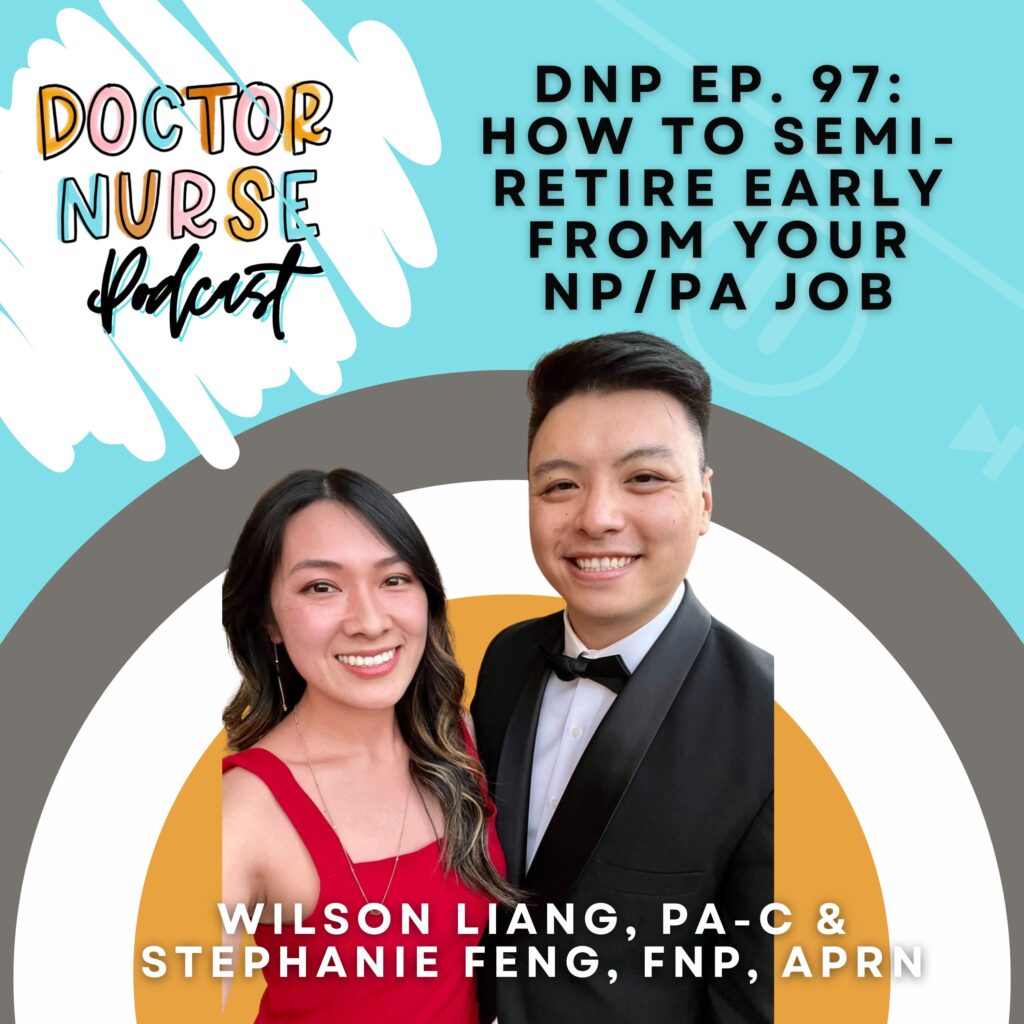
Dr. Sandra Pagenta: Doctor Nurse, podcast fam, welcome to another episode of The Doctor Nurse Podcast. Today on the podcast, I’m talking to Wilson and Stephanie, which I have been dying to talk to this Power couple. First PA ever on the podcast, by the way. So you are breaking barriers. Wilson first pa, and Stephanie is a nurse practitioner.
Dr. Sandra Pagenta: They became millionaires three years after they graduated by. Basically, financial hacks time hacks, all the things that they were doing are related to the careers. They were able to semi retire in their thirties and they are passionate about helping other NPs and PAs because we love our PA brothers and sisters to take control of their money, their careers, their time.
Dr. Sandra Pagenta: Man, it’s so cool what they’re involved in and what they’re doing, so I cannot wait to share. Stephanie, you’re an oncology nurse practitioner. Wilson is an informatics PA and , they’re going to just dive down the rabbit hole and tell us a little bit about themselves to start. And then , we’re going to hear about what they offer to our cohorts.
Dr. Sandra Pagenta: So let’s, let’s hear it. Thanks for coming on, by the way. But welcome to the podcast, guys. Thank
Wilson: you. Thanks for having us.
Stephanie: Yeah. Thanks so much. We’re so excited to be here. Wilson. Do you want to just start with that? Tell me a little bit more about yourself.
Wilson: Yeah. So hey, everyone. Thanks. So happy to be here. My name is Wilson. I like to think I am a finance nerd, but then recently also like student loan and career, everything like retirement nerd, which is great. I graduated PA school in 2019. Didn’t really know anything about.
Wilson: The profession, to be honest, and also money. And then, you know COVID happened, life circumstances happened, and you know, as PAs and MPs, we I, I like to say we’re all very good at learning really quickly and just applying a lot of things and you know, we’ve done a lot of big moves since, since we graduated and just happy to share kind of our journey.
Wilson: And I started as an oncology PA as well. Also really big on education. I taught as a professor and I think now I work as informatics and happy to hop on that and talk about that later because I know it’s not as popular or not as common.
Dr. Sandra Pagenta: Yeah, no, for sure. You what about you, Stephanie?
Stephanie: Yeah, I mean, you know, thanks so much for having us as well.
Stephanie: I’m super excited to be here. I think I took a little bit more of a traditional route in terms of like, you know, building up from being a nurse. Worked inpatient for a while as a oncology nurse, and then from there jumped into the nurse practitioner realm. And it was really from there, I, you know, optimize my W2 in many different ways, which we’ll talk about a little bit later, and then I started networking with a lot of different entrepreneurs and it was really like.
Stephanie: Building that network of entrepreneurs that we started, you know, jumping into real estate, all these other things as well. So,
Dr. Sandra Pagenta: yeah, that is so neat. And again, like what I said, I love that you guys are married. You just got married not too long ago. So they’re this power couple. And like I said, Wilson is our first PA and I’m so glad to have you on.
Dr. Sandra Pagenta: And again, at first I was like, Do I let PAs come on in my doctor nurse podcast? I’m mostly looking at nurses and I was like, wait, he married a nurse practitioner. He gets a pass.
Wilson: Yes. Thank you, Steph.
Dr. Sandra Pagenta: So tell us a little bit about your journey. I know you’re, when I was reading through your guys history, you guys don’t come from money.
Dr. Sandra Pagenta: So the fact that you’re millionaires, you have this time freedom, you have this financial freedom. This is not your upbringing. This is something you guys had to cultivate. Kind of take me through your journey. To kind of what you came out of your different schools with and then deciding. Oh my goodness.
Dr. Sandra Pagenta: How do we clean up this mess? You know?
Wilson: Yeah, I can, I can take this one and start off with, I think the biggest thing I always tell the story where you know, prior to even PA, I think it wasn’t until PA school. It was until I started like learning about finances. And the only reason was I think during the, the, my last year, my mom asked me like, Hey, like she’s never asked me about money ever in her entire life.
Wilson: And she was like, Hey, I want to retire. Like, how, how do I do that? And I was like, I don’t, I don’t even know how to answer that. Like, that was so frustrating. I don’t know. I actually have no idea how people even retire and. You know, I’m a, I’m a first generation, right? So you know, for me, it was, I was motivated to learn about retirement, how money works because to help my mom.
Wilson: And once I kind of learned that I was like, Oh, this is also applicable to PAs and MPs as well. You know, when we were on rotations, we noticed a lot of PAs and MPs. There’s a lot of burnout. There’s a lot of burnout happening. There’s a lot of student loan debt, and there’s a lot of people working beyond retirement age and kind of putting two and two together.
Wilson: I’m like, there has to be a different way. So, you know, we, we did the, we, we, we learned from so many people, right? We, I think it starts off with like you know, there’s white coat investor. There’s also what’s it called? There’s Reddit, right? There’s personal finance on Reddit. And then you know, we read rich dad, poor dad.
Wilson: So all these things that were like, Hey, there is a whole nother world out there. And that’s kind of where the journey started. Not cause like I wanted to learn about money, you know, everyone just kind of puts their head down and you’re just like, okay, I got loans. We’re going to make a six figures.
Wilson: It’s all going to work out. But then, when you actually look at the numbers, it’s like, Whoa, you have to be kind of intentional and you have to be strategic because you know, the decisions you make matter quite a bit.
Dr. Sandra Pagenta: Yeah. Yeah. It’s the little, the little tiny decisions that you make the compounding from those little tiny decisions that ends up kind of directing the whole ship.
Dr. Sandra Pagenta: Right. And so I love the content you guys put on social media, basically kind of pushing back on the norm. Of how nurse practitioners and PAs can work, and we’re always told your job’s in the hospital. That’s all you can work is bedside. You’re only in the clinic working 50, 60 hours for these big institutions.
Dr. Sandra Pagenta: And you guys kind of push back on that narrative of like, actually, you can work remotely. And actually, you don’t have to work full time to make a really good salary as a nurse practitioner or PA. And so what did you guys kind of find in your journeys as you went through to kind of go, Oh, okay. So once I’m able to attain X, Y, and Z, now I’m able to back away from my job.
Dr. Sandra Pagenta: Now I’m able to go into that entrepreneurial space.
Wilson: Yeah, Steph, you want to start this one? Well, I mean, I
Stephanie: think, you know, just to back up a little bit as well, kind of doping off of what Wilson was saying, we noticed that throughout PA school and NP school, like, no one ever learns about finances. I mean, no one even blinks when we start NP school, PA school, and they’re like, Hey, you have to take out 200K in loans.
Stephanie: So it’s really when, you know, afterwards, people realize, like, you have these six figure loans, and no one ever knows what to do with them. Yeah, so
Dr. Sandra Pagenta: the interest is compounding every day, month. It’s just getting bigger and bigger. Yeah. Yeah.
Stephanie: So, I mean, going off, you know, like Wilson was saying, everything’s calculated.
Stephanie: So did a lot of learning about finances on our own to a lot of exploring different networks as well. And we just kind of had to. Think of a goal, a goal that we wanted to achieve and then kind of backtrack from there.
Dr. Sandra Pagenta: So what was the first thing that you guys, I’m sorry, what was the first thing you guys put in place when you were like, all right, we got to come up with the plan.
Dr. Sandra Pagenta: Kind of what was that 1st step?
Wilson: Yeah, no, I was, I was literally the 1st thing we actually did is, you know, there’s a whole world of people like providers who are burnt out. And then we also know there’s also like. a world where people are not burnt out and like thriving and we’re like how do we how do we meet these people and like what are they doing so that’s actually probably the first thing we did is just network and learn the stories of people that came from similar backgrounds like us but then their trajectory looks completely different right do i want to be like my preceptors my my attendings who are like you know 70 and still like not happy with loans Not free or is there, is there another world out there?
Wilson: And, you know, we actually spent a lot of time just finding kind of other individuals who were, you know, some of that abundant mindset and just willing to share their journey. And like, since we were able to relate, right, we’re not that far different from them. They, we started from similar paths and then ended up here.
Wilson: So that’s, that’s actually the first thing we did, like find other people who did something where we want to go. So
Dr. Sandra Pagenta: what, so where were they? What, where, how did you find
Wilson: them? Yeah, no. So that, that’s a great question. They’re, they’re so hard to find. It’s for us, it was actually people who, it was combination of like, we went to a lot of like we, White Coat Investor was a good place.
Wilson: We went to a bunch of conferences. We also networked internally with real estate. Right. We did real estate, you know, the bigger pockets, there’s forums. So we, we met up with like local real estate communities. And I would say the other thing we did too, is we worked with CFPs. And accountants, right?
Wilson: Like, even though we may not know people, they work with people who know what they’re doing. So we just ask, like, what strategies do they use? So it was a combination of those three things. Yeah.
Dr. Sandra Pagenta: So what did you, okay, so where did you guys get started? So you start the conversations. You’re surrounding yourself kind of like a Petri dish.
Dr. Sandra Pagenta: You just, like, put yourself in with the people that are growing that organism of financial freedom, not being burned out. Where is that at? Kind of setting yourself in that Petri dish. And so how do you get that stuff to rub off on you? How do you, what did you guys do to kind of go, all right, now we need to do this first based on these conversations that we’re having.
Dr. Sandra Pagenta: How did you identify kind of that, those priority items to knock out, to get yourself where you are today? Well, I think
Stephanie: one of the things that we, or at least I realized is of course, like, you know, at the very beginning before you have kids, or even when you have like really young kids, You can also sacrifice something, especially if you are trying to attain a goal specifically for both of us.
Stephanie: We knew that, you know. Really optimizing your W2 and by optimizing your W2, meaning, like, trying to. Reach that higher income. And, you know, whether it takes, you know, skipping or not skipping, but like looking for new jobs every couple of years that was one tactic that we really, really utilize and also really, you know, tried to perform very well and for our jobs.
Stephanie: So, when I, when I started working as a nurse, that was actually during school. So I was working full time full time in school. And from there, you know, really like probably every like eight months to a year, so we have switched jobs, but didn’t like burn bridges along the way. Yeah.
Dr. Sandra Pagenta: Yeah. You’re a real diplomatic about it.
Dr. Sandra Pagenta: This is no longer serving me. Thank you for the opportunity. Bye bye. And then onto the next thing. Yeah. Yeah. Good for you. One of the things that you said, I was just thinking as you guys were talking. So who came in with more debt? Because I feel like if you were working as a nurse, you were able to kind of offset a level of your debt.
Dr. Sandra Pagenta: Did you have more debt Wilson than she did? I would imagine, right? With PA schools, if you can’t work, there’s a
Wilson: slight delay. It’s okay. Yeah, no. So for me, I actually had about 150 K in student loans while I was in PA school. And everyone told me you, like, you had to, you had, like, everyone graduates with debt.
Wilson: There’s really no way around it. And I was like, I don’t think that’s true. So essentially what I did, I just applied to like every scholarship known to man while I was in PA school. And then I also worked three jobs while I was in PA school. I worked in the, the study hall. I worked as a TA and I worked as a as a, as a professor actually immediately after graduation and through the combination of winning scholarships and also like working the three jobs and just like trying to be frugal during PA school and like taking free food.
Wilson: It was actually, I was actually able to pay off all my, all my loans before before graduating.
Dr. Sandra Pagenta: My goodness. So you did not have the student loan debt. Stephanie had the student loan debt. Neither one of you had student loan debt.
Stephanie: I’m very minimal, and I was able to pay it off a few months following
Wilson: graduation. Because the Bay Area nursing pay was worth it to work full time. It wasn’t easy. She did nights as an oncology nurse, and then during days she would do rotations in classes. So it’s the sacrificing sleep.
Dr. Sandra Pagenta: It was painful, but for a few years.
Dr. Sandra Pagenta: Yeah. Wow. So you guys are just hustlers. That’s what this looks like. ’cause again, one of the things that I’ve heard Dave Ramsey say repeatedly is that your income is your best wealth building tool, right? So whatever money you’re able to bring in, Mm-Hmm, , that’s really what you’re able to leverage in the direction of debt, towards putting away money and you can really build wealth.
Dr. Sandra Pagenta: And so what I’ve heard. From other people on my podcast, other influencers and people in that nursing sphere of finance, they talk a lot about front loading their, you know, retirement accounts. And if you’re able to do that, you’re able to just kind of leave it, set it in, forget it. And as it just compounds, it begins to.
Dr. Sandra Pagenta: Turn into millions, right? And it can do that relatively quickly if you just don’t touch it, leave it alone. And so was that part of your technique to get into that millionaire status that you both are in now?
Wilson: Yeah, I can, I can speak on this. You know you know one thing I wanted to add was when we were networking, talking to other communities and talking to our CFPs and CPAs, we asked them, what are things that people who achieved very early financial freedom or like semi retirement, what did they do?
Wilson: What are their characteristics? What are their demographics? And independently, they both came up with three very similar things. And it’s similar to what we, when we talk to people now, it just seems to be true. So first is, they all had really high incomes. Everyone wants to beat around it, but it’s like, no, no, no, you, in the beginning, it’s a lot of your active income.
Wilson: Right, so people who retire, you know, less than 15 years or semi retire in less than 10 years, right, their household income on average is around 400, 000, on average, right, so whether it’s a W 2, I mean, like, and this is household, so like, if it’s dual income, right, it’s either you know, you’re in a high paying, like, healthcare profession like we are you’re doing sales or you were in a business and then you IPO and then, you know, a lot of money overnight.
Wilson: The other thing they had is they all had high savings rates. You know, it’s interesting that the, the wealthier you get, the actual, the savings rates don’t change that much. Everyone who retires early or, you know, becomes millionaires early, their, their savings rates around 50%. I would say on average, like the minimum is around 50%.
Wilson: Wow. And it’s not because like they’re really frugal. It’s also because they just, they just made, they made a lot. So it’s like, they didn’t inflate their income too much. And then lastly, like you were mentioning, the third thing they did was everyone invested, whether it’s into the stock market, real estate or into their business.
Wilson: So that’s the combination of the three. So when we learned that we were like, we can do that. And the first part was like, how do we do the part one? It’s like, okay, how do we get our income as high as much as possible? Then we kind of figured out, okay, reverse engineer it. What are the numbers? Like you were talking about that we can invest and then kind of just leave it and let it cruise.
Wilson: And then what do we invested in stock markets, business, or real estate? So it’s exactly what you described. Like, that’s what we
Dr. Sandra Pagenta: did. And so you invested in real estate, you guys have a couple like duplexes or quadplexes or properties.
Wilson: Yeah, Steph, you want to take this one? Yeah,
Stephanie: I mean, I think one of the big things to, you know, to mention as well is that eventually didn’t look into investing into real estate until everything else was kind of like, we had a strong foundation.
Stephanie: So, we already were investing in the stock market. We already had optimized our W2 jobs. And then after that, we’re like, hey. Real estate is more lucrative, but also comes with a lot more risk as well. Yeah. So that was a very purposeful decision for us as well. But yeah, I mean, we started off in Texas, so out of state investing, and we have a couple of duplexes, we have a partnership for an apartment complex, and then a couple of short term rentals as well.
Dr. Sandra Pagenta: Amazing Airbnb in it. And you guys are totally crushing the game. It’s incredible. So one of the other things that we talked about, and I love you guys do these posts on maximizing your income, right? So if we’re saying your best wealth building tool, number one thing you got to do is make. A lot of money.
Dr. Sandra Pagenta: How does a nurse practitioner, some of the techniques that you described, Stephanie, like just being like every seven, eight months I was rolling. If you weren’t going to pay me, it’s time to go. And so you’ve got that option. You’ve kind of got this, you know, that is a technique. And then, Wilson, you’ve moved into the informatics world.
Dr. Sandra Pagenta: So maybe you were able to kind of join in some of your prior, skills and kind of marry them with your PA license and birth this new baby of skills that you’re able to kind of maximize what you’re pulling in. Is that something that you guys were finding? What were you guys doing career wise to kind of navigate into more and more income?
Dr. Sandra Pagenta: Because from what I’ve read, like, You guys are both pulling in at least 150 grand a piece and probably more. I mean, your guys are making that high net, you know, high income of 400. I mean, that’s what you guys are shooting for. So how’d you guys do it? What were some of the steps that you guys took to really maximize your income?
Wilson: Yeah, I can, I can take this one. I think the first thing we, we did was. First, like a lot is a lot of data points. So we actually looked like for the people who were financially free. First thing we did was like, what specialties are they working? And like, where were they working? Right. That’s the first thing we did.
Wilson: And you know, what’s interesting is the specialties that are actually the most popular are the ones that are paid the least, right? You get work the hardest. Cause there’s two ways to increase your income, right? It’s either increase your pay or decrease the amount of hours you actually have to work.
Wilson: Right. So we found that like the more specialized you get and the more niche the specialty is the ones that aren’t as popular actually have fantastic work life balance and you know, remote options and the pays higher. And I’ll talk about some of these specialties because it’s pretty universal for both PAs and NPs.
Wilson: Like for example, the popular, popular specialties, right. Are like cardiothoracic, neuro, right. Those are, you know, ortho, these are all specialties everyone wants to go into, but not necessarily the highest pay. Versus if you For the hours. Like the ones for the hours in the, for the hours. For the hours that you have.
Wilson: For the hours. Because you’re working like what? Mm-Hmm. . You’re getting crushed. Exactly. You’re getting
Dr. Sandra Pagenta: crushed with the work. So when you break down what your salary is versus what you’re making, you’re actually making less money than somebody in some primary care places that’s working at a chill job that’s like, I’m home, what I need to be, you know?
Dr. Sandra Pagenta: ’cause they’re per hour. Yep. Smart.
Wilson: Mm-Hmm. , go ahead. Exactly. And so like, great, great point, because like, when you they’re like, I make this much, but I’m like, but like, you’re working 80 hours, you’re like, it’s like a physician, you know, hour. So it’s like, you know, you’re not making that much. So like chiller specialties, for example, are like, before the ones that are still clinical, like, like psychiatry, actually pay really, really well.
Wilson: Psych correctional medicine also pays really well, home health pays really well. Right. Geriatrics pays really well. Sleep medicine pays really well. And the more specialized you get the reason the pay is higher is because there isn’t, like, there’s the demand for it, but not enough people want to go into these fields.
Wilson: So they actually do everything they can to retain you and to keep you there. So those are just some of the specialties, you know, the ones that are popular are like Derm, things like that, but those are sales based, right? Dermatology, aesthetics, plastics, those are becoming more up and coming, but those are actually, even though they’re high pay, you get worked pretty hard too, because you’re commissioned and like sales based.
Dr. Sandra Pagenta: Interesting. So you’re saying, as they always say, they are riches in the niches. So again, those places that there isn’t a lot of people, there’s actually little gold mines because there’s not a lot of people here. And I mean, it’s, it’s kind of classic, right? Go where the gold is and there’s gold everywhere cause there’s nobody picking it.
Dr. Sandra Pagenta: So maybe go there and check it out. And then you’ve worked on remote options, which I was super interested in cause I find it super hard to crack into that. That area of medicine and nursing is to be able to have these remote positions, which I believe you’ve attained, right? Yeah, it’s
Wilson: interesting. Both of us actually work remote.
Wilson: This is a good example because Steph is like, clinical, but she’s like, nearly almost remote. And then I’m I’m, I’m informatics. I don’t know, Steph, you want to share about kind of your specialty and why you’re able to work remotely?
Stephanie: For me being like a nurse, like clinical nurse practitioner it’s very, very rare for, you know, a clinical nurse practitioner to be remote.
Stephanie: And I kind of see it like a stepwise thing. So of course the first step for me was to maximize my income and I actually had negotiated for a lot of things within my job. sO 1 is, of course, the specialty. So I’m in oncology. So the great thing about medical oncology is that a lot of things are based off of imaging and based on the labs specifically in the department.
Stephanie: The second thing is when I negotiated within my job, I actually had like a counter department offer me a job. And then my manager was just like, what do you need in order to stay? And really that was like pretty much like the best, like negotiation tactic that I could probably recommend to people is really just jaw pop, see what’s out there continuously.
Stephanie: But of course, like do your job well. And, you know, stay loyal when you can.
Dr. Sandra Pagenta: Yeah. So by telling them, listen, I’ve got this other option, I’m thinking about leaving. They were like, care what you want. And so because you were good at your job, because you cared because you, you know, showed a lot of effort. And that’s one of the things I talk about if part is your job full time or part time?
Dr. Sandra Pagenta: I’ve worked 32 hours now. Okay. So 32. So like whenever you. Kind of whenever they see your work ethic and they know, like, no, she’s a hard worker. Like, when she’s here, she does what she has to do. She, takes care of the patient. She does a good job. She’s got good bedside manner, all the different things that you do as a nurse.
Dr. Sandra Pagenta: And now you’re doing on that next level as the NP, you can. Negotiate because they want to keep you like the retention rate on keeping nurse practitioners and then having to train another provider and get them through and the credentialing process and then get them to where they’re up and running very expensive.
Dr. Sandra Pagenta: So, it would be way better just to keep you and keep you happy. When we talk about part time roles I really think it’s important to hear what the options are for nurses and PAs, because I just think that the options are so slim and.
Dr. Sandra Pagenta: Again, it comes with that other caveat of you don’t make enough. There’s the, the stress of being in that part time status. So how do you guys kind of balance that? I think Stephanie says she works 32 hours. Wilson, do you work full time or are you part time?
Wilson: I work full time, but then I do a lot of project based work.
Wilson: So with that, I actually, like, I’m, I’m salaried for 40 hours, but I don’t really spend all that time working because it’s, it’s a lot of project based. So I have a lot of time freedom in my job. Like, I have full control over my schedule.
Dr. Sandra Pagenta: That’s incredible. So you do 40 hours and then you do other side hustle work with other companies or.
Dr. Sandra Pagenta: Informatics.
Wilson: Yeah. So for my job, I it’s a lot of project management. So it’s, you know, there are weeks that are busier, but, you know that’s introduced because like when you work clinically, it’s, it’s a hamster wheel that never stops versus project management.
Wilson: You’re allowed to delegate and you know, use other skills and, and you have a team. So for me, a lot of it is because I have a team, uh what I do essentially is I do Epic optimization. That’s what I do. So within my organization, I go around training oncology providers and customizing their builds to make them more efficient.
Wilson: And because of that it’s essentially like I’m a consultant, right? So I meet with people one on one, I set my own schedule, I coordinate with them. And then afterwards we kind of have like strategy calls and things like that. That is so cool. That’s kind of what I do.
Dr. Sandra Pagenta: Yeah. So again, like what you’re, what you’re describing, which is different than what Stephanie does.
Dr. Sandra Pagenta: She works on that clinical side, seeing patients going over, she said, imaging labs kind of saying, all right, this is the plan. We’re going to see you in six months or no, we need to do something sooner. We have to adjust medication, those types of work. You’re on that other side of systems, getting the systems working optimally so that people can do their jobs.
Dr. Sandra Pagenta: And so, again, you finish the project, something comes across your desk, you work on that project, it’s kind of this, as it’s being thrown at you, you’re kind of troubleshooting, fixing, making it better, and then you also do other side stuff, right? You guys have your own business, you guys are doing consulting, coaching on the side.
Dr. Sandra Pagenta: Anything else? Am I missing or is that everything?
Man, I hate to stop a great conversation, but I have to tell you guys about what’s going on at SuccessandPeace. com. It’s Jackie and I’s newly launched SuccessNP website that has access to all of our clinical booklets. We were able to create a fabulous resource for nurse practitioner and nurse practitioner students to use during their clinical rotations. What we noticed was that there was something missing that nurse practitioner students would go to clinicals and by the time that they would finally get up and running, The clinical rotation would be over. So what we thought was, could we create a shortcut? Could we create a hack that would help them? Get the most out of their clinical experience. My best friend Jackie and I created these booklets, and we have gotten five star rave reviews from so many nurse practitioner and nurse practitioner students that have been using our booklets and feel like it’s made a difference in their clinical journey.
So I invite you to click the link in the show notes, check it out, see what other things we have at our shop. We’ve got really cute nurse practitioner gear. We have some digital planners. We’ve got a lot of great resources to help you beautify your nursing journey. There’s just not a lot of stuff for nurse practitioners and we want to feel special too. So check out our shop. See if there’s anything there that you might like. Again, Any support that you throw towards the shop is support that you put towards the podcast.
So guys, thanks for listening. Thanks for hanging out with me. I hope you’re enjoying the conversation and, let’s get back to it.
Dr. Sandra Pagenta: One thing
Wilson: to add to that. Yeah. Oh, no, no. I think you nailed it. You know, one thing I wanted to add too, because you were mentioning especially like transitioning to part time work. You’re right. It’s especially if you start with part time, it’s hard. It’s really hard.
Wilson: Cause you don’t get to build culture. And, you know, when I, when I coach clients, I talk about you know, in addition to building your wealth, you need to build career capital as well. So career capital is essentially it’s like, you know, you can job hop, you can do these things, but then eventually you do want to stay put in a place that the manager is good and the organization respects you and you put in the work, right?
Wilson: You, you do things other people can’t. And then afterwards, then you can start asking for things, right? I think a lot of people make the mistake where you start demanding things upfront when you haven’t brought any value yet. Right? So it’s, it’s always, you know prove your value, make sure they know you’re competitive and that you’re a top talent, stay for a little bit.
Wilson: And then afterwards, you know, do things that other people can’t do. And so when you negotiate for things they are more receptive. And then they also know, like you were saying, like, you know, we are hard workers. We put in the work. Yeah. But that’s essentially what we do. Right. That’s why we’re able to ask for a lot of things because we’re, we’re very good at what we do.
Wilson: We also I don’t know if Stephanie shared this. We interview every year. And our managers know, like we get poached all the time. So they, they want to, they, the, our, our employers always know like, Hey, we are we’re, we’re hot in the market. And in order to retain us, like what else can they do for us?
Wilson: So wait a
Dr. Sandra Pagenta: minute. Let me, let me clarify. You are. Like, approached by people, Hey, we want to poach you, come over here. Or are you just staying in the interviewing game? Like, you’re actively seeking out jobs. What did you mean by that?
Wilson: Both. We do both. So we, we actively interview. People reach out to us to try to hire us.
Wilson: And we also look for top, like the top employers too. So actually Stephanie and I, we actually jumped between like top employers because every year they have to outdo each other. So that’s, that’s the other strategy to not just become the best, but find the people who treat the best, the well, and then just make them fight each other.
Wilson: That’s what we do pretty often. It was
Dr. Sandra Pagenta: so funny because we were just talking about that very briefly. One of the, one of the books I’ve been reading for my part time, my part time nursing series that I’ve been working on talks about these big companies like Goldman Sachs and Deloitte and the benefit packages they offer to new moms and it was blowing my mind, like what they offer and I was thinking Oh, we have no idea in healthcare what’s out there because we don’t use this to compete and we don’t go like, okay, what are you offering six months?
Dr. Sandra Pagenta: Okay. No, this guy’s offering nine. Okay. I’m going, you know, like that would make hospitals have to step up because they know that nurse practitioners and PAs are looking for the best. And so you want the best, be the best. And that would make them step up their game. And it’s not something that we’ve been very privy to because I was reading the book.
Dr. Sandra Pagenta: I was like, I didn’t even know these were, this is what options that people had. I mean, one person came back, they gave you like paid six months leave. I was like paid six months leave. That’s like standard package for some of these companies for maternity leave. And then when you come back, you get to do this quote unquote, build your own schedule.
Dr. Sandra Pagenta: So then you get to like slowly come back. You don’t have to just like come back. Act like you didn’t just have a baby come out of you and just like, get back in there. Like, no, they’re like, no, no, no. Take your time. Like, we’ll let you come back slowly and you can kind of slowly transition back into your role.
Dr. Sandra Pagenta: And like, we’re just so glad to have you. Like, if you’ll just give us eight hours a week, like we’ll keep you. I was like, these are options for these. And again, they’re lawyers, accountants are different in that consulting space that you’re kind of talking about. They’re just happy to have the help and the help that they have is good.
Dr. Sandra Pagenta: That talent, that part that they saw that woman work for five years before she had a baby and they were like she cranks when she’s here. So we’re going to keep her because to train somebody else to keep this talent, we’re going to make it competitive. And I think that’s exactly what you’re describing is that, Hey, listen, I’m working between Deloitte and Goldman Sachs and I’m figuring out who’s giving me the best stuff.
Dr. Sandra Pagenta: And then I’m going with them because I know my worth and I bring it. You know, so I just think it’s so cool when you’re describing and again, that mentality, because you’re hanging out with those people, because you’re hanging out with people that think and talk this way, it changes how you think and talk.
Dr. Sandra Pagenta: And I just think it’s so refreshing and so abundant mindset to hear you describe these things. It’s very inspiring. And again, just to know, you know, as Stephanie was describing that there are those remote options, but you got to put in the work before you can just come in and be like, I would like remote day one.
Dr. Sandra Pagenta: It’s like. No, I, I cranked and this was what I was doing. And so again, I just think that’s a really great lesson and probably one of the biggest things I want PAs and MPs to take from this lesson is you got to put in the work and then you can go around asking for things because they know your value and what you’re worth.
Dr. Sandra Pagenta: So for one of the things that I wanted to talk about, cause you write a lot about this on social media and I like that you talk a lot about this is part time work and Burnout. And you talk a lot about that mental, that mental space for providers. Kind of describe what you’re noticing, what you’ve noticed in your clients and some maybe tips and hacks for people that are like, okay, what you got for me?
Dr. Sandra Pagenta: What do you think I can do?
Wilson: Yeah, I can take this one. So I, you know, for me, I’m really big as you are too, right? I’m big on semi retirement. You’re really big on part time work. And it’s, I think that’s a, I think that’s where it is because we’re in a kind of a special field where. We’re, we’re in the profession where compared to like, you know, when people pursue financial freedom, it’s a lot of people who, you know, used to work in tech or they were in corporate.
Wilson: And then they really didn’t find meaning in their jobs. Versus when you look at healthcare providers A lot of us, like, it’s our calling and we don’t like, we don’t mind our jobs. It’s, it’s just sometimes it’s too many hours and, you know, we, we want healthier work life balance because like, you know, I always ask this question, if you had all the time and money in the world, right, would you still work as a PA or NP?
Wilson: And a lot of people, it’s like, we wouldn’t mind working a little bit. We wouldn’t mind. Yeah. So we try, we try to bridge that gap. And oftentimes it’s a combination of like finding really good work life balance and also doing smart things with your finances. So, you know, before you go like part time work, I always try to recommend people.
Wilson: It’s like, you want to build your assets. And usually where we start with people is in the stock market, right? Taking advantage of your 401s, your IRAs, HSAs, employer matches, pensions, doing these things and building your portfolio up to a certain point. Right. Everyone’s a little different, but it’s true.
Wilson: Once you build it up to a certain point, you can like no longer, you don’t have to touch it anymore. It will cruise. It will set you up for life. And most of our income, like a good chunk of our income when we earn money actually goes towards retirement. Right. So once you’ve hit that threshold where you no longer need to contribute to retirement, you can technically work less and like spend more because right in the beginning, a lot of us are saving 20, 30 percent of our income goes towards retirement.
Wilson: But once you’ve satisfied that need. You no longer need to put that money towards retirement. You have, you know, another job essentially passively working for you. So now you have an option to scale down your hours. And I find that like a lot of providers, Hey, you know, you’re burning out now, but what if you have the flexibility to now change to something that’s a little bit more low key, maybe reduce your hours.
Wilson: How’s your work life balance now? And you know, not everyone wants to like. Sip pina coladas and like go crazy. And then, you know, when they retired, a lot of us want to be somewhat active. And I, so I find like, that’s a good balance where, you know, you’re going to be full time for a little bit, build your assets and then let it go on autopilot.
Wilson: And then from that point, you’re in a position of power where you can reduce your hours or pick a specialty. That’s maybe lower paying, but chill. Yeah. Cause it’s all about sustainability.
Dr. Sandra Pagenta: Yeah no, that is so good. And it’s again, that marathon versus the sprinting, right? So like what we find and what I notice a lot of residents.
Dr. Sandra Pagenta: Nurse practitioners, PAs in these roles, we tend to get in sprint jobs and we think we can do this forever. And then what you find is like, you’re neglecting your mental health. You’re neglecting your family. You’re neglecting yourself physically. And you’re doing this all in the name of health and wellness for others.
Dr. Sandra Pagenta: And you’re just completely taking and deteriorating. And so again, I love that perspective of like, if you have to grind, do a short burst. Grind, hit some goals, be really targeted in your goals, and then move into that space where you go, all right, I got these things, I hit these targets. These are my little side hustles that are working either path.
Dr. Sandra Pagenta: Nothing is truly passive, right? Like you always have to manage your real estate. You have, you have to do something again, that sipping pina coladas, four hour work week. I never work. You know. It doesn’t exist, but you can get things working, small little fires and embers that will grow bigger and bigger over time, shoot for those goals, knock those things out.
Dr. Sandra Pagenta: And then like you said, you can decrease your time, you can decrease what you’re spending all weekend, especially if you have children that come up and other commitments that you find that your priorities shift. And again, the nurse practitioner world is female dominated. And I don’t think it’s wise that we pretend like these aren’t.
Dr. Sandra Pagenta: Future goals and aspirations that come out because as I’ve been, you know, again, working on this part time series and reading about the impact that mothers have those first first three years in particular in a child’s life, you don’t want to be grinding hard those first three years of having that baby that wants to be on mama and needs mama for everything.
Dr. Sandra Pagenta: And you want to be there. You don’t want to miss those moments. And so again, that’s why I also feel like the part time series is good for single women too, because I’m like, Hey, listen, like. Do this work before you get to this stage so that you can enjoy that time. You do have that freedom and you don’t have to look towards anyone to give it to you.
Dr. Sandra Pagenta: You’re not looking for your employment to cut you breaks. Gave yourself a break when you hustle five to six years ago and you didn’t have those commitments. And so I just love how you guys put it together and I just think that we’re so similar minded. It’s wonderful. So guys, thanks for coming on. Is there anything else that I feel like you guys want to touch on, talk about kind of about your coaching business?
Dr. Sandra Pagenta: Things that you guys have been kind of seeing as you guys have been working with people. Either way,
Wilson: Stephanie, you’ve been super, super happy to be here. You know, like you’re mentioning, I do you know, coaching, essentially consulting, coaching business for PAs and MPs. And I’m really big on like helping people get to part time or semi retirement or at least options in less than 10 years.
Wilson: Like, it’s true, like 5, truly 5 to 10 years of intentional planning, and like, it’s, it also has a philosophy, like, you know, we’ve spent at least 10 years going to school, like, it’s okay to work 10 years, there’s nothing wrong with that, right, I mean, 10 years if you’re miserable at your job is not okay, but guess what, you can change that.
Wilson: Right. You’re in control of where you work. You’re in control of your money. So, you know, 5 to 10 years of intentional decisions. A lot of, a lot of my clients, I would say 90 percent of them are set up. Doesn’t matter what age you are, right? You know, good 10 years of planning. You can completely change your life, right?
Wilson: Because there’s compounding, there’s things like that. And I find that even if you’re older, it’s not that you’re actually more mature. A lot of my clients, the older ones are like, they get it. They’re more mature. And they’re like, I know what I want. And then they’re super focused, right? If you’re younger, you can make more mistakes.
Wilson: You have a little bit more time, but also there’s less urgency. But that’s what I do. I talk to people about optimizing your career, doing good things, like smart things with your money, learning how to invest for the first time, right? We talk business, we talk stock market, we talk real estate and just figuring out, you know, you don’t have to do all three.
Wilson: You know, if you pick one of them, you’re going to be okay, right? Like everyone thinks you have to do real estate. Everyone thinks you have to start a business. Like you said earlier, Sandra, nothing is passive. So it’s like we, we kind of try to show people like, these are the things, this is what it looks like when you try to tackle these three, because we’ve tried it.
Wilson: And, you know, depending, I think, depending on where you are in life, right? You it’s always about like work life balance, making sure you’re being treated good at work and then picking investments that fit your personality. So yeah, that’s, that’s kind of what we do you know, outside of our, of our W 2s.
Dr. Sandra Pagenta: Yeah. Yeah. That’s the three pronged approach. And I feel like you’ve dropped so many good hints along the way today, both of you about kind of what it looks like for that negotiating part, Stephanie. I just love that story. That was so good. And then Wilson, just again, with the tips and the tricks and being able to kind of.
Dr. Sandra Pagenta: Again, target those goals quickly to be able to kind of set yourself up to go, all right, let that stuff simmer. Let me focus in on now and optimizing my career and really getting it in that work life space that I want based on whatever it is. Cause I think you’re right. I think it’s good for the soul to work.
Dr. Sandra Pagenta: The soul needs work and purpose. And that changes at different points of your career. And I think. When I’ve gotten pushback and people are like, well, you’re not crushing work anymore. And I’m like, yeah, because my priorities and my goals are different. It doesn’t necessarily mean that I’m not crushing something.
Dr. Sandra Pagenta: I work just as hard as the time with my children as I do. I used to do at my job. To the degree that I don’t, you know, do it anymore. And so it’s a shift and it’s a balance and you know, and again, women have a different balancing act. And I think that’s neat to kind of hear both of your perspectives and be happy to be able to have both of you guys kind of share what that looks like for you.
Dr. Sandra Pagenta: I think you guys bring an interesting dynamic to this space. So I think it’s, it’s again, really neat, really cool to connect with you guys and for you to share your journey. Where can people find you if they’re like, all right, I want to talk to them, kind of share where you guys are at and how people can find you.
Wilson: So we, so go ahead, Steph.
Stephanie: I was just going to say, pretty much we’re most active, or actually Wilson’s most active on Instagram. Yeah, yeah, yeah. So Instagram’s probably the best place.
Wilson: So you can find me at it’s it’s not hashtag, it’s at Wilson underscore invest. I also have a website called the finance hospital.
Wilson: Yes. So you can check out our stuff there.
Dr. Sandra Pagenta: Yeah. So I checked that out. It’s very nice.
Stephanie: Mine’s at stuff underscore
Dr. Sandra Pagenta: estate. Stuff underscore estate. Yes. No, I have to, I have to, I have to like, I have to like befriend you. I don’t think we’re friends. I think I’m friends with Wilson, but I definitely want to see what you’re putting out.
Dr. Sandra Pagenta: So okay. Sorry, Wilson. I’ve got to befriend your wife. I’ve got to be friends with both of you on Instagram. I like it. Yeah, for sure. I, I, I’m getting total good vibes from you. I feel like Stephanie and I could hang for sure. As buddies, and I’m just letting you know that the nurse practitioner and us were connected.
Dr. Sandra Pagenta: So it is what it is.
Wilson: It’s happening.
Stephanie: When I, when I pop on a baby, you know, I’ll be asking you all the details.
Dr. Sandra Pagenta: I hope it’s so soon for you guys. It just makes you a better person. I have a baby now. I’m so for it. So rapid fire questions. At the very end, I do this with everyone. I thought maybe I would have you guys compete, but because we’re having so many like problems on Riverside, like it won’t happen.
Dr. Sandra Pagenta: So we’re just, whoever wants to take it or you both can give an answer. I would love to hear both of your perspectives. What is a book that you guys give somebody, if you had to give somebody a book, what would it be? Okay, somebody’s speaking, like, both of you are like, I guess, it’s a first.
Wilson: There’s so many books.
Stephanie: yeah, there’s just so many amazing books out there. I would say that, like, one of the books that really resonates with me anyways is called Atomic Habits.
Dr. Sandra Pagenta: I’m a huge proponent of that. James Clear, yeah.
Stephanie: Yeah exactly. I’m a huge fan of like, just small incremental things. Like, you know, you’re not trying to do a heavy lift for everything or else you’re never gonna do it.
Stephanie: So just small things consistently over time, it makes the biggest difference.
Dr. Sandra Pagenta: Yes. So good. Yes. His book is life changing. What about you, Wilson?
Wilson: Yeah. I’ve recently, this book has been a really, really big hit for my clients. Psychology money is really good. It’s I think 90 percent of like financial freedom finances is actually behavioral. That’s why it’s so hard.
Wilson: I mean, like, like 10 percent of its math and the math part isn’t that difficult, but it’s like, it’s like diabetes, right? Like, it’s hard because it’s, it’s, it’s a lifestyle condition thing. So it’s like, you know, you understand not to eat it, but like the cake looks delicious. So, you know, psychology money just helps you understand, like, literally the psychology behind why people do certain things of money.
Wilson: No matter what background you come from, like, this is why we were wired that way. And it’s just wiring. You can always unwire it. So that’s been a really big fan favorite. Yeah,
Dr. Sandra Pagenta: and challenging those, those wirings in your brain. Like, why do you think that way? Like, why do you think that if you drive that car, you think you look cool?
Dr. Sandra Pagenta: You don’t. Most people aren’t seeing you. They’re actually seeing themselves in that car. And so it’s like, whoa, like. I’m trying to perpetrate this idea of something and one, if, and again, just, oh, that book is so deep. I can’t, I can’t even, we don’t have enough time to go down the rabbit hole in that book because it does, it makes you just start like looking at yourself in the mirror and any time that you are staring at yourself, you just see how flawed you are and you’re like, oh my gosh, my rationale on that is so.
Dr. Sandra Pagenta: off and with just a change in my thought. And again, applying that thought through consistency over time of replacing that lie with the truth. I can set myself free from stuff. Wow. And not be in chained and in burden. Like I got to have the latest outfit. Like I can go to Ross and I get more compliments on the Ross dress than on the anthropology dress.
Dr. Sandra Pagenta: Can I Save me some 70, you know, like it’s just it’s incredible. Okay. So what do you guys like to go out to eat? What is like your favorite food? You guys are in San Fran, California all the best eats. What’s your what’s your go to?
Stephanie: Our favorite day
Wilson: is Costco.
Wilson: Yeah Costco dates and we used to like soup plantation, but they close the plantation. Yeah I
Stephanie: don’t know if
Dr. Sandra Pagenta: you guys A Kirkland signature!
Stephanie: Exactly. What were you gonna say? You gotta hit two birds with one stone, you know?
Dr. Sandra Pagenta: Yeah, that is so funny. Wolfram was
Stephanie: saying, he was saying that we used to really love going to, I don’t know if you, I don’t know if you recall it, Sweet tomatoes or like soup plantation.
Stephanie: We like loved it at place. It was like basically like a salad and pasta.
Dr. Sandra Pagenta: Okay. Okay. That was your go to. That’s so funny. All right. And then I guess I’m going to do one more. Okay. What is, because we talked a little bit about habits. What would be something that you would say a habit that holds you back? You’re like this habit holds me back and it was hardest to kick or is still hard to kick with something that you both would describe in regards to your money or finances or job.
Stephanie: I personally, I’m like someone who really likes trying new things, so I think it’s, it’s almost like the opposite of the atomic habits where it’s like, I’m trying a lot of new things all the time.
Stephanie: It’s like, okay, I’m not really building that capital for
Dr. Sandra Pagenta: certain things. Yeah, yeah, yeah. But that’s your thing. You’re always trying something. Yeah. And so you have to, like, find the consistency. Yeah.
Stephanie: Yeah. Which is, I mean, it’s great because, like, we get to explore different things, but just sometimes it’s kind of like, all right, it’s got to, like, buckle down and, like, focus on that.
Wilson: you’re the focus and on yourself. And so if you can’t, you can’t like save everybody, like the best thing you can do is like set a good example.
Dr. Sandra Pagenta: Dang, that’s good, man, world needed to hear that the world needed to hear that. Guys, thank you so much for your time and chatting with me. Your energy from both of you is so wonderful.
Podcast Description
Wilson is a physician assistant and assistant professor. He completed a dual Master’s in Physician Assistant Studies and Public Health at Touro University California. After PA school, he completed a PA Educator Fellowship and Cancer Care Fellowship before working as an inpatient hematology/oncology APP. In addition to his clinical and teaching roles, he also worked as an oncology informatics specialist and educator in health tech and IT. He is currently working on various passion projects including financial coaching and running The Finance Hospital.
Wilson focuses on financial education and 1:1 coaching. He enjoys teaching student loans, personal finance, and investing topics!
Stephanie is a practicing nurse practitioner. She completed her Masters in Nursing and Family Nurse Practitioner program at Samuel Merritt University. While she was in school, she continued working full-time as a blood and marrow transplant and oncology nurse. After finishing her NP training, she began working as an inpatient oncology APP. She recently completed her Master’s in Business Administration and is working as an outpatient oncology nurse practitioner. She currently splits her time between clinical work, real estate investing, and traveling. Stephanie helps with the operational and business side of things. She is also our real estate investing enthusiast!
Thefinancehospital.com
IG: @wilson_invests
@steph_estate
Doctor Nurse Podcast Links: Check out the DNP blog for more information on side hustles: https://doctornursepodcast.com/blog/ Doctor Nurse Podcast YouTube: https://www.youtube.com/channel/UCYQYlS9d6m7HyMK7Z1BI5DA Doctor Nurse Podcast IG: https://www.instagram.com/DoctorNursePodcast/ Doctor Nurse Podcast Website: https://www.doctornursepodcast.com Doctor Nurse Podcast Email: doctornursepodcast@gmail.com SuccessNPs.com is our official and newly launched website for all things SucessNP! Get your clinical rotation booklets. Be sure to follow us on IG…I’m not going to lie- We are pretty funny 🙂 https://www.instagram.com/successnps/ Share this podcast with a nurse friend: Subscribe to exclusive Doctor Nurse Content for only $4.99 a month!! Support the podcast and hear content to help you grow in your career. https://podcasters.spotify.com/pod/show/thedoctornursepodcast/subscribe
Latest Episodes

Doctor Nurse podcast brings you weekly shows to help INSPIRE, EDUCATE AND EMPOWER nurses with true stories of initiative and impact.
Doctor Nurse podcast brings you weekly shows to help INSPIRE, EDUCATE AND EMPOWER nurses with true stories of initiative and impact.
Latest Episodes
Doctor Nurse podcast brings you weekly shows to help INSPIRE, EDUCATE AND EMPOWER nurses with true stories of initiative and impact.